


Joel 3:15
- שֶׁמֶשׁShe·meshsunH8121N-csNoun Singular common gender Absolute
- וְיָרֵחַve·ya·Re·achand moonH3394Conj-w ¦ N-msNoun Singular Masculine Absoluteוְandיָרֵחַmoon
- קָדָרוּka·Da·ruthey have become darkH6937V-Qal-Perf-3cpVerb Qal Perfect 3rd Plural common gender
- וְכוֹכָבִיםve·kho·kha·Vimand [the] starsH3556Conj-w ¦ N-mpNoun Plural Masculine Absoluteוְandכוֹכָבִים[the] stars
- אָסְפוּ'a·se·Futhey have withdrawnH622V-Qal-Perf-3cpVerb Qal Perfect 3rd Plural common gender
- נָגְהָםna·ge·Hamtheir brightnessH5051N-fsc ¦ 3mpNoun Singular Feminine Constructנָגְהָbrightnessםtheir
English is a literal word-by-word gloss of the Hebrew, not the KJV's wording. Why?
This is the original text the KJV's translators worked from — each Hebrew word with its own literal English meaning in this verse, prepared by scholars at Tyndale House, Cambridge. The KJV translates whole sentences, not word by word, so its wording differs: one Hebrew word can become several English words, and the KJV may choose “the LORD” where the gloss reads “Yahweh”. Both are faithful — they answer different questions. For the KJV's own rendering, switch to the KJV text.
Details
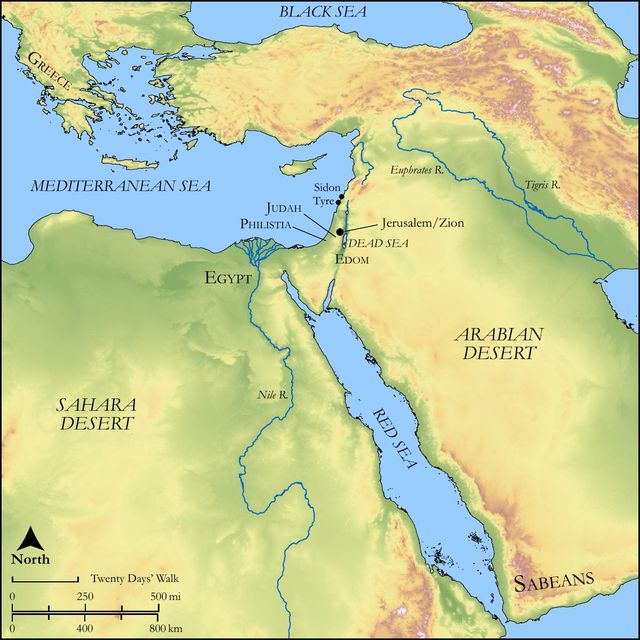
See on the biblical-era map
Study this verse
Public-domain commentary
Matthew Henry
From his Commentary on the Whole Bible. Henry comments on passages, not single verses — this entry covers Joel 3:9–17. His four-level outline is real structure in the source text, so it is rendered as structure.
What the psalmist had long before ordered to be said among the heathen (Psa 96:10) the prophet here will have in like manner to be published to all nations, That the Lord reigns, and that he comes, he comes to judge the earth, as he had long been judging in the earth. The notice here given of God's judging the nations may have reference to the destruction of Sennacherib, Nebuchadnezzar, Antiochus, and to the Antichrist especially, and all the proud enemies of the Christian church; but some of the best interpreters, ancient and modern (particularly the learned Dr. Polock), think the scope of these verses is to set forth the day of the last judgment under the similitude of God's making war upon the enemies of his kingdom, and his gathering in the harvest of the earth, both which similitudes we find used in the Revelation, Rev 19:11; Rev 14:18. Here we have,
I.A challenge given to all the enemies of God's kingdom to do their worst.
To signify to them that God is preparing war against them, they are called upon to prepare war against him, Joe 3:9-11. When the hour of God's judgment shall come effectual methods shall be taken to gather all nations to the battle of that great day of God Almighty, Rev 16:14; Rev 20:8. It seems to be here spoken ironically: "Proclaim you this among the Gentiles; let all the forces of the nations be summoned to join in confederacy against God and his people." It is like that, Isa 7:9, "Associate yourselves, O you people! and gird yourselves, but you shall be broken to pieces. Prepare war; muster up all your strength; wake up the mighty men; call them into your service; excite them to vigilance and resolution; let all the men of war draw near. Let them come and enter the lists with Omnipotence if they dare; let them not complain for want of weapons, but let them beat their ploughshares into swords and their pruning-hooks into spears. Let them resolve, if they will, never to return to their husbandry again, but either to conquer or die; let none plead unfitness to bear arms, but let the weak say, I am strong and will venture into the field of battle." Thus does a God of almighty power bid defiance to all the opposition of the powers of darkness; let the heathen rage, and the kings of the earth take counsel together, against the Lord and his Christ; let them assemble, and come, and gather themselves together; but he that sits in heaven shall laugh at them, and, while he thus calls them, he has them in derision, Psa 2:1, Psa 2:4. The heathen must be wakened, must be raised from the dead, that they may come up to the valley of Jehoshaphat, to receive their doom (Joe 3:12), may come up out of their graves, come up into the air, to meet the Lord there. Jehoshaphat signifies the judgment of the Lord. Let them come to the place of God's judgment, which perhaps is the chief reason for the using of this name here, but it is put together as a proper name for the sake of allusions to the place so called, which we observed before; let them come thither where God will sit to judge the heathen, to that throne of glory before which shall be gathered all nations (Mat 25:32), for before the judgment-seat of Christ we must all appear. The challenge (Joe 3:9) is turned into a summons, Joe 3:12. It is not only, Come if you dare, but You shall come whether you will or no, for there is no escaping the judgments of God.
II.A charge given to the ministers of God's justice to appear and act against these daring enemies of his kingdom among men:
And therefore cause thy mighty ones to come down, O Lord! Joe 3:11. When they bring their forces into the field, let God bring his, let the archangel's trumpet sound a charge, to call together his mighty ones, that is, his angels. Perhaps it is with reference to this that Christ's coming from heaven at the last day is said to be with his mighty angels, Th2 1:7. These are the hosts of the Lord, that shall fight his battles when he shall put down all opposing rule, principality, and power when he shall judge among the heathen, Psa 110:6. Some think these words (Joe 3:9, Joe 3:10), Prepare war, wake up the mighty men, are not a challenge to the enemies' hosts, but a charge to God's hosts; let them draw near, and come up. When God's cause is to be pleaded, either by the law or by the sword, he has those ready that shall please it effectually, witnesses ready to appear for him in the court of judgment, soldiers ready to appear for him in the field of battle. They shall beat ploughshares into swords, if need be. However, it is plain that to them the charge in given (Joe 3:13), Put you in the sickle, for the harvest is ripe; that is, their wickedness is great, the measure of it is full, and they are ripe for ruin. Our Saviour has expounded this, Mat 13:39. The harvest is the end of the world, and the reapers are the angels. And they are commanded to thrust in their sickle. their sharp sickle, and gather in both the harvest and the vintage, Rev 14:15, Rev 14:18. Note, The greatness of men's wickedness makes them ripe for God's judgment.
III.The vast appearance that shall be in that great and solemn day (Joe 3:14):
Multitudes, multitudes, in the valley of decision, the same which before was called the valley of Jehoshaphat, or of the judgment of the Lord, for the day of the Lord is near in that valley. Note,
1.The judgment-day, that day of the Lord, has all along been looked upon, and spoken of, as nigh at hand. Enoch said, Behold, the Lord comes, as if the Judge were then standing before the door, because it is certain that that day will come and will come according to the appointment, and a thousand years with God are but as one day; things are ripening apace for it; we ought always to be ready for it, because our judgment is at hand.
2.The day of judgment will be the day of decision, when every man's eternal state will be determined, and the controversy that has been long depending between the kingdom of Christ and that of Satan shall be finally decided, and an end put to the struggle. The valley of the distribution of judgment (so the Chaldee), when every man shall receive according to the things done in the body. The valley of threshing (so the margin), carrying on the metaphor of the harvest, Joe 3:13. The proud enemies of God's people will then be crushed and broken to pieces, and made as the dust of the summer threshing-floors.
3.Innumerable multitudes will be gathered together to receive their final doom in that day, as in the destruction of Gog we read of the valley of Hamon-Gog, and the city of Hamonah (Eze 39:15, Eze 39:16), both signifying the multitude of the vanquished enemies; it is the word here used, Hamonim, Hamonim, expressed by the way of admiration - O what vast multitudes of sinners will divine justice be glorified in the ruin of at that day! A multitude of living (says one of the rabbin) and a multitude of dead, for Christ shall come to judge both the quick and the dead.
IV.The amazing change that shall then be made in the kingdom of nature (Joe 3:15):
The sun and moon shall be darkened, as before, Joe 2:31. Their glory and lustre shall be eclipsed by the far greater brightness of that glory in which the Judge shall then appear. Nay, they shall themselves be set aside in the dissolution of all things; for the damned sinners in hell shall not be allowed their light, for God himself will be their everlasting light, Isa 60:19. Those that fall under the wrath of God in that day of wrath shall be cut off from all comfort and joy, signified by the darkening not only of sun and moon, but of the stars also.
V.The different impressions which that day will make upon the children of this world and the children of God, according as it will be to them.
1.To the wicked it will be a terrible day. The Lord shall then speak from Zion and Jerusalem, from the throne of his glory, from heaven, where he manifests himself in a peculiar manner, as sometimes he has done in the glorious high throne of his sanctuary, which yet was but a faint resemblance of the glory of that day. He shall speak from heaven, from the midst of his saints and angels (so some understand it), the holy society of which may be called Zion and Jerusalem; for, when we come to the heavenly Jerusalem, we come to the innumerable company of angels; see Heb 12:22, Heb 12:25. Now is speaking in that day will be to the wicked as roaring, terrible as the roaring of a lion (for so the word signifies); he long kept silence, but now our God shall come, and shall not keep silence, Psa 50:3, Psa 50:21. Note, The judgment of the great day will make the ears of those to tingle that continue the implacable enemies of God's kingdom. God's voice will then shake terribly both heaven and earth (Isa 2:21), yet once more, Hag 2:6; Heb 12:26. This denotes that the voice of God will in the great day speak such terror to the wicked as were enough to put even heaven and earth into a consternation. When God comes to pull down and destroy his enemies, and make them all his footstool, though heaven and earth should stand up in defence of them and undertake their protection, it shall be all in vain. Even they shall shake before him and be an insufficient shelter to those whom he comforts forth to contend with. Note, As blessings out of Zion are the sweetest blessings, and enough to make heaven and earth sing, so terrors out of Zion are the sorest terrors, and enough to make heaven and earth shake.
2.To the righteous it will be a joyful day. When the heaven and earth shall tremble, and be dissolved and burnt up, then will the Lord be the hope of his people and the strength of the children of Israel (Joe 3:16), and then shall Jerusalem be holy, Joe 3:17. The saints are the Israel of God; they are his people; the church is his Jerusalem. They are in covenant and communion with him; now in the great day,
(1.)Their longings shall be satisfied: The Lord will be the hope of his people. As he always was the founder and foundation of their hopes, so he then will be the crown of their hopes. He will be the harbour of his people (so the word is), their receptacle, refuge, and home. The saints in the great day shall arrive at the desired haven, shall put to shore after a stormy voyage; they shall go to be for ever at home with God, to their Father's house, the house not made with hands.
(2.)Their happiness shall be confirmed. God will be in that day the strength of the children of Israel, enabling them to bid that day welcome and to bear up under the weight of its glories and joys. In this world, when the judgments of God are abroad, and sinners are falling under them, God is and will be the hope and strength of his people, the strength of their heart, and their portion, when other men's hearts fail them for fear.
(3.)Their holiness shall be completed (Joe 3:17): Then shall Jerusalem be holy, the holy city indeed; such shall the heavenly Jerusalem be, such the glorious church, without spot, or wrinkle, or any such thing. Jerusalem shall be holiness (so the word is); it shall be perfectly holy; there shall be no remainder of sin in it. The gospel-church is a holy society, even in its militant state, but will never be holiness itself till it comes to be triumphant. Then no stranger shall pass through her any more; there shall not enter into the New Jerusalem any thing that defiles or works iniquity; none shall be there but those who have a right to be there, none but its own citizens; for it shall be an unmixed society.
(4.)God shall in all this be manifested and magnified: So shall you know that I am the Lord your God. By the sanctifying and glorifying of the church God will be known in his holiness and glory, as the God that dwells in his holy mountain and makes it holy by dwelling in it; and those that are sanctified and glorified are so through the knowledge of him that called them. The knowledge which true believers have of God is,
[1.]An appropriating knowledge. They know that he is the Lord their God, yet not theirs only, but theirs in common with the whole church, that he is their God, but dwelling in Zion his holy mountain; for, though faith appropriates, it does not engross or monopolize the privileges of the covenant.
[2.]It is an experimental knowledge. They shall find him their hope and strength in the worst of times, and so they shall know that he is the Lord their God. Those know best the goodness of God who have tasted and seen it, and have found him good to them.
Historical interpretation
Historical reception
1 surviving comment on this verse from the historical church.
(Verse 14, 15) O people, people in the valley of slaughter, for the day of the Lord is near in the valley of slaughter. The sun and moon are darkened, and the stars have withdrawn their shining. LXX: The sound is heard in the valley of judgment, for the day of the Lord is near in the valley of judgment. The sun and moon will be darkened, and the stars will make their shining go away. In that place where we have set ourselves, people, people, and the Seventy have translated, the sound is heard. In Hebrew it is written 'Amonim, Amonim,' which certainly means multitude and the multitude of those who are to be judged, and noise and sound. Again, when we mentioned in the valley of cutting, following the translation of Aquila and Symmachus and the fifth edition, the Septuagint and Theodotion translated τῆς δίκης καὶ τῆς κρίσεως as 'causae et judicii': for which it is written in Hebrew Harus (), which the Hebrews interpret not only as cutting, but also as gold, which, namely, in the valley of judgment, which they suspect to be Gehenna, after the impurities of sins have been burned away, pure gold remains. Therefore, the people of the nations, of which we have spoken above in the valley of judgment or destruction, are gathered together to be killed and to perish, and to be judged by the Lord. The grief of the day and the torments of those who perish will be such that not even the sun, moon, and other stars will be able to look upon them; but they will withdraw their brightness and the severity of the judge and grant each one according to their works, they will not dare to look upon. Not because they are more merciful than the judgments of God; but because every creature fears for their own judgment in the torments of others.
Continue studying Joel 3:15 across the web’s major study libraries — every link below opens this exact verse, chapter, or book on the destination site.
Read & Compare
 BibleGatewayThis verse in more than 200 translations and 70 languages.
 Bible.comThe YouVersion reader — hundreds of translations, reading plans, and highlights.
 ESV.orgCrossway's official English Standard Version reader.
 NET BibleThe NET translation with 60,000+ translators' notes on every rendering decision.
 STEP BibleTyndale House's free study tool — original text, vocabulary, and scholarly resources.
 BibliaLogos Bible Software's free web reader.
 USCCBThe New American Bible (Revised Edition) with the U.S. bishops' study notes.
Commentaries
 BibleHub CommentariesDozens of classic commentaries on this verse, gathered on one page.
 StudyLightMore than 100 commentary sets — the largest collection on the web.
 BibleRefPlain-English commentary on what this verse means, verse by verse.
 Enduring WordDavid Guzik's free commentary on this chapter, widely used by Bible teachers.
 Bible Study ToolsVerse commentary alongside Greek and Hebrew study aids.
Original Language & Research
- BibleHub InterlinearThe verse word by word — original language, transliteration, and English.
- BibleHub LexiconEvery word's original-language definition and Strong's entry.
 Blue Letter BibleDeep-study tools — Strong's numbers, concordance, and word studies.
 SefariaThe Hebrew text with Rashi and centuries of Jewish commentary.
Sermons, Hymns & Audio


TrulyRandomVerse is not affiliated with these sites and doesn’t control their content. They’re linked because they’re genuinely useful.
Summary
Joel 3:15 delivers a profound prophetic image of cosmic disruption, declaring that "The sun and the moon shall be darkened, and the stars shall withdraw their shining." This striking verse serves as a powerful sign of the impending "Day of the Lord," a time of decisive divine judgment and intervention against the nations that have oppressed God's people, simultaneously heralding the ultimate restoration and vindication of Israel. It underscores God's absolute sovereignty over creation and history, signaling a radical shift in the established order as His righteous purposes are brought to fruition.
Context
ShowHideLiterary Context
Joel 3:15 is situated within the climactic section of Joel's prophecy, specifically addressing the "Day of the Lord" in the "valley of Jehoshaphat" (meaning "the Lord judges"). The preceding verses, Joel 3:9-14, describe God's summons for all nations to gather for judgment, portraying a scene of divine reckoning against those who have harmed Israel. The cosmic signs in Joel 3:15 immediately precede the Lord's roaring from Zion and the shaking of heaven and earth in Joel 3:16, emphasizing the imminence and overwhelming nature of God's intervention. This verse marks a peak in the prophetic crescendo, signaling the profound disruption that accompanies God's final, decisive action.
Historical & Cultural Context
In the ancient Near East, celestial bodies like the sun, moon, and stars were often associated with deities or seen as stable, unchanging elements of the cosmos, vital for life and order. Prophetic declarations of their darkening or withdrawal of light, as seen in Joel 3:15, were universally understood as portents of immense catastrophe, divine wrath, and the collapse of the established order. Such imagery was not merely meteorological but conveyed a profound theological message: the very foundations of the world were being shaken by the direct intervention of a sovereign God, demonstrating His power over all creation and His ability to dismantle human kingdoms and their perceived stability.
Key Themes
ShowHideThis verse powerfully contributes to several overarching themes in Joel and broader biblical prophecy. Firstly, it highlights Cosmic Disturbances as Divine Signs, a recurring motif where the disruption of the natural order signifies God's direct and powerful intervention in human history, often preceding or accompanying major acts of judgment or salvation. Secondly, it underscores the Magnitude of the Day of the Lord, portraying it as a cataclysmic event so profound that even the most constant elements of creation—the sun, moon, and stars—are affected, emphasizing its universal impact and the overwhelming presence of God. Finally, it reinforces the theme of Divine Judgment and Sovereignty, illustrating God's absolute control over creation and His unwavering power to execute His righteous will, bringing darkness and chaos upon those who oppose Him, while ultimately paving the way for the light of His salvation for His people, as hinted in the broader context of Joel 2.
Exposition and Analysis
ShowHideKey Word Analysis
ShowHideA primitive root meaning "to be ashy, i.e. darkcolored; by implication, to mourn (in sackcloth or sordid garments); be black(-ish), be (make) dark(-en), [idiom] heavily, (cause to) mourn." This word conveys more than a mere dimming; it implies a profound, almost mournful, blackening or obscuring, suggesting a complete cessation of light and a state of deep distress or judgment.
Probably from the same as כַּבּוֹן (in the sense of rolling) or כָּוָה (in the sense of blazing); "a star (as round or as shining); figuratively, a prince; star(-gazer)." This term refers to the celestial bodies that provide light at night, often associated with guidance or even divine order. Their darkening signifies a disruption of this order.
A primitive root meaning "to gather for any purpose; hence, to receive, take away, i.e. remove (destroy, leave behind, put up, restore, etc.); assemble, bring, consume, destroy, felch, gather (in, together, up again), [idiom] generally, get (him), lose, put all together, receive, recover (another from leprosy), (be) rereward, [idiom] surely, take (away, into, up), [idiom] utterly, withdraw." This word implies a deliberate and complete removal or cessation, not a gradual fading. The shining is actively taken away, emphasizing God's direct agency in this cosmic event.
From נָגַהּ; "brilliancy (literally or figuratively); bright(-ness), light, (clear) shining." This refers to the inherent light or radiance of the celestial bodies. Its withdrawal signifies a loss of their fundamental purpose and nature, plunging the world into a profound and unnatural darkness.
Verse Breakdown
ShowHide"The sun and the moon shall be darkened"
This clause describes a catastrophic event where the two most prominent sources of light in the heavens, essential for human life and orientation, lose their radiance. The verb "darkened" (qâdar) suggests a deep, ominous blackness, implying not just an eclipse but a supernatural, permanent obscuring. This signifies the disruption of the natural order and the onset of divine judgment, where the very elements that bring light and life are plunged into gloom.
"and the stars shall withdraw their shining"
This second clause reinforces and amplifies the imagery of the first. The "stars," which provide light in the absence of the sun and moon, are also affected. The verb "withdraw" (ʼâçaph) indicates a deliberate and complete removal of their light, rather than a mere fading. This comprehensive darkening of all celestial bodies underscores the totality and universality of the impending divine intervention, leaving no source of natural light or hope for those facing God's judgment.
Literary Devices
ShowHideJoel 3:15 employs several powerful literary devices to convey its prophetic message. Symbolism is central, with the sun, moon, and stars symbolizing the stability, order, and natural rhythms of creation. Their darkening and withdrawal of shining thus symbolize the complete disruption of this order, the cessation of life and hope for the unrighteous, and the overwhelming nature of divine judgment. This is not merely a meteorological event but a theological statement about God's power to shake the very foundations of the cosmos. The use of Hyperbole is also evident; while such events may have literal fulfillment, the language is intensified to convey the immense, unprecedented scale of God's intervention. The imagery suggests a cosmic catastrophe that transcends ordinary human experience. Finally, vivid Imagery creates a palpable sense of dread and awe. The mental picture of a world plunged into absolute darkness, devoid of any celestial light, powerfully communicates the severity and finality of the "Day of the Lord," leaving the audience with a profound sense of God's terrifying majesty and power.
Theological and Thematic Connections
ShowHideJoel 3:15 is a potent declaration of God's ultimate sovereignty over creation and history, serving as a stark reminder that the natural order is subservient to His divine will. The darkening of the celestial bodies is a recurring prophetic motif, consistently signaling a time of profound divine intervention, often associated with judgment against the wicked and the vindication of God's people. This imagery emphasizes the cosmic scope of God's authority, indicating that when He acts, the entire created order responds. It highlights the terrifying aspect of God's holiness and justice, where even the most stable elements of the universe are shaken by His presence. Yet, within the broader context of Joel, these signs of judgment also precede a time of restoration and blessing for those who belong to God, underscoring the dual nature of the "Day of the Lord" as both a day of wrath and a day of salvation.
Reflection and Application
ShowHideJoel 3:15 stands as a powerful reminder that God is not merely a passive observer of human history but an active, sovereign Lord who intervenes decisively. The image of the sun, moon, and stars losing their light compels us to consider the ultimate source of all light, hope, and order: God Himself. For those who place their trust in Him, this verse, while depicting judgment, also implicitly points to a future where God's light will ultimately prevail, as seen in the promised restoration in Joel. For those who do not know Him, it serves as a profound warning of impending accountability, urging repentance and a turning to the one true God before the "great and dreadful Day of the Lord" arrives. It challenges us to live with an awareness of God's impending judgment and His ultimate reign, fostering a sense of urgency for righteous living and evangelism, knowing that the stability we often take for granted in the world is entirely dependent on His sustaining power and can be altered by His decree.
Questions for Reflection
ShowHideFAQ
ShowHideWhat is the "Day of the Lord" that Joel 3:15 refers to?
ShowHideThe "Day of the Lord" is a prominent prophetic theme throughout the Old and New Testaments, signifying a specific time when God decisively intervenes in human history. It is characterized by divine judgment against unrighteousness and the vindication and salvation of His people. In Joel, particularly in Joel 2:31 and Joel 3, it encompasses both a period of severe judgment upon the nations who have oppressed Israel and a time of restoration and blessing for Israel itself. The cosmic disturbances described in Joel 3:15 are portrayed as unmistakable signs accompanying this momentous divine intervention, signaling its universal and cataclysmic nature.
Is Joel 3:15 a literal prophecy, or is it symbolic?
ShowHideProphetic language often employs both literal and symbolic elements, and Joel 3:15 is likely a blend of both. While the darkening of the sun, moon, and stars could refer to actual astronomical phenomena (like extreme eclipses, volcanic ash clouds, or other natural disasters on a grand scale), the hyperbolic and dramatic nature of the language also points to a profound spiritual and theological reality. It symbolizes the collapse of human systems, the withdrawal of divine favor from the wicked, and the overwhelming presence of God's judgment. New Testament passages, such as Matthew 24:29, echo this imagery in the context of the end times, suggesting that these signs will indeed be visible and unmistakable, whether through literal events or divinely orchestrated phenomena that convey the same profound message of cosmic upheaval.
Christ-Centered Fulfillment
ShowHideJoel 3:15, with its imagery of cosmic darkness preceding divine judgment and restoration, finds profound Christ-centered fulfillment in both the first and second comings of Jesus Christ. At His crucifixion, the ultimate act of divine judgment against sin and the ultimate display of God's love, the sun was indeed supernaturally darkened for three hours (Matthew 27:45), a cosmic sign echoing the prophetic warnings of the Day of the Lord. This darkness symbolized the profound spiritual judgment Christ bore on behalf of humanity, and the withdrawal of God's light from Him as He became sin for us (2 Corinthians 5:21). Looking forward, Joel's prophecy points to the ultimate "Day of the Lord" when Christ returns in glory. Jesus Himself spoke of similar cosmic disturbances accompanying His second coming (Matthew 24:29-30), where He will come "with power and great glory" to judge the nations and gather His elect. Thus, the terrifying darkness of Joel 3:15, initially a harbinger of judgment for the unrighteous, is ultimately fulfilled in Christ's work, both in bearing the darkness of sin on the cross and in His future return to establish His eternal kingdom, where He Himself will be the everlasting light (Revelation 21:23).