


Revelation 14:15
Bible text: King James Version (1769 Blayney text) · Public domain
Bible text: King James Version with Strong's numbers · Public domain
Bible text: Berean Standard Bible · Public domain
Bible text: American Standard Version (1901) · Public domain
Bible text: World English Bible, Messianic edition · Public domain
Bible text: Geneva Bible (1599) · Public domain
Bible text: Young's Literal Translation · Public domain
- ΚαὶKaiAndG2532CONJConjunction
- ἄλλοςallosanotherG243A-NSMAdjective Nominative Singular Masculine
- ἄγγελοςangelosangelG32N-NSMNoun Nominative Singular Masculine
- ἐξῆλθενexēlthencame outG1831V-2AAI-3SVerb 2nd Aorist Active Indicative 3rd Singular
- ἐκekofG1537PREPPreposition
- τοῦtoutheG3588T-GSMDefinite article Genitive Singular Masculine
- ναοῦnaoutempleG3485N-GSMNoun Genitive Singular Masculine
- κράζωνkrazōncryingG2896V-PAP-NSMVerb Present Active Participle Nominative Singular Masculine
- ἐνeninG1722PREPPreposition
- φωνῇphōnēaa voiceG5456N-DSFNoun Dative Singular Feminine
- μεγάλῃmegalēloudG3173A-DSFAdjective Dative Singular Feminine
- τῷtōto the [One]G3588T-DSMDefinite article Dative Singular Masculine
- καθημένῳkathēmenōsittingG2521V-PNP-DSMVerb Present Middle Or Passive Deponent Participle Dative Singular Masculine
- ἐπὶepionG1909PREPPreposition
- τῆςtēstheG3588T-GSFDefinite article Genitive Singular Feminine
- νεφέλης·nephelēscloudG3507N-GSFNoun Genitive Singular Feminine
- πέμψονpempsondo put forthG3992V-AAM-2SVerb Aorist Active Imperative 2nd Singular
- τὸtotheG3588T-ASNDefinite article Accusative Singular Neuter
- δρέπανόνdrepanonsickleG1407N-ASNNoun Accusative Singular Neuter
- σουsouof YouG4771P-2GSPersonal pronoun Genitive 2nd Singular
- καὶkaiandG2532CONJConjunction
- θέρισονtherisondo reapG2325V-AAM-2SVerb Aorist Active Imperative 2nd Singular
- ὅτιhotibecauseG3754CONJConjunction
- ἦλθενēlthenhas comeG2064V-2AAI-3SVerb 2nd Aorist Active Indicative 3rd Singular
- σοιsoito youG4771P-2DSPersonal pronoun Dative 2nd Singular
- ἡhētheG3588T-NSFDefinite article Nominative Singular Feminine
- ὥραhōrahourG5610N-NSFNoun Nominative Singular Feminine
- τοῦtouof theG3588T-GSNDefinite article Genitive Singular Neuter
- θερίσαιtherisaito reapG2325V-AANVerb Aorist Active Infinitive
- ὅτιhotibecauseG3754CONJConjunction
- ἐξηράνθηexēranthēhas ripenedG3583V-API-3SVerb Aorist Passive Indicative 3rd Singular
- ὁhotheG3588T-NSMDefinite article Nominative Singular Masculine
- θερισμὸςtherismosharvestG2326N-NSMNoun Nominative Singular Masculine
- τῆςtēsof theG3588T-GSFDefinite article Genitive Singular Feminine
- γῆςgēsearthG1093N-GSFNoun Genitive Singular Feminine
English is a literal word-by-word gloss of the Greek, not the KJV's wording. Why?
This is the original text the KJV's translators worked from — each Greek word with its own literal English meaning in this verse, prepared by scholars at Tyndale House, Cambridge. The KJV translates whole sentences, not word by word, so its wording differs: one Greek word can become several English words, and the KJV may choose “charity” where the gloss reads “love”. Both are faithful — they answer different questions. For the KJV's own rendering, switch to the KJV text.
Details
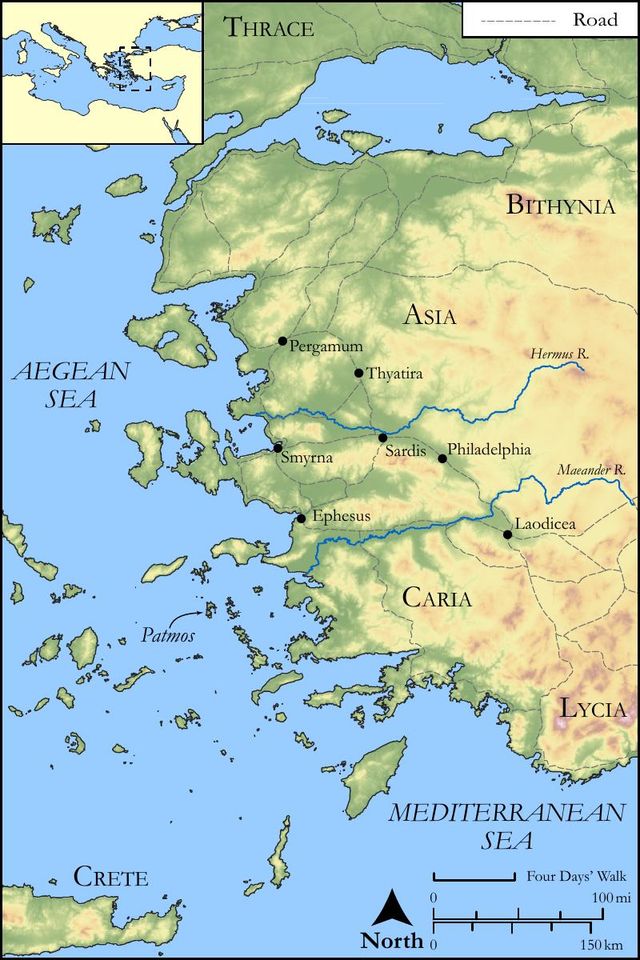
See on the biblical-era maps

Study this verse
Public-domain commentary
Matthew Henry
From his Commentary on the Whole Bible. Henry comments on passages, not single verses — this entry covers Revelation 14:13–20. His four-level outline is real structure in the source text, so it is rendered as structure.
Here we have the vision of the harvest and vintage, introduced with a solemn preface. Observe,
I.The preface, Rev 14:13. Here note,
1.Whence this prophecy about the harvest came: it came down from heaven, and not from men, and therefore it is of certain truth and great authority.
2.How it was to be preserved and published - by writing; it was to be a matter of record, that the people of God might have recourse to it for their support and comfort upon all occasions.
3.What it principally intended, and that is, to show the blessedness of all the faithful saints and servants of God, both in death and after death: Blessed are the dead that die in the Lord from henceforth, etc. Here observe,
(1.)The description of those that are and shall be blessed - such as die in the Lord, either die in the cause of Christ, or rather die in a state of vital union with Christ, such as are found in Christ when death comes.
(2.)The demonstration of this blessedness: They rest from their labours, and their works do follow them.
[1.]They are blessed in their rest; they rest from all sin, temptation, sorrow, and persecution. There the wicked cease from troubling, there the weary are at rest.
[2.]They are blessed in their recompence: Their works follow them; they do not go before them as their title, or price of purchase, but follow them as their evidence of having lived and died in the Lord; and the memory of them will be pleasant, and the reward glorious, far above the merit of all their services and sufferings.
[3.]They are happy in the time of their dying, when they have lived to see the cause of God reviving, the peace of the church returning, and the wrath of God falling upon their idolatrous cruel enemies. Such times are good times to die in; they have Simeon's desire: Now, Lord, let thou thy servant depart in peace, for mine eyes have seen thy salvation. And all this is ratified and confirmed by the testimony of the Spirit witnessing with their spirits and with the written word.
II.We have the vision itself, represented by a harvest and a vintage.
1.By a harvest (Rev 14:14, Rev 14:15), an emblem that sometimes signifies the cutting down of the wicked, when ripe for ruin, by the judgments of God, and sometimes the gathering in of the righteous, when ripe for heaven, by the mercy of God. This seems rather to represent God's judgments against the wicked: and here observe,
(1.)The Lord of the harvest - one so like unto the Son of man that he was the same, even the Lord Jesus, who is described,
[1.]By the chariot in which he sat - a white cloud, a cloud that had a bright side turned to the church, how dark soever it might be to the wicked.
[2.]By the ensign of his power: On his head was a golden crown, authority to do all that he did and whatsoever he would do.
[3.]By the instrument of his providences: In his hand a sharp sickle.
[4.]By the solicitations he had from the temple to perform this great work. What he did, he was desired to do by his people; and, though he was resolved to do it, he would for this thing be sought unto by them, and so it should be in return to their prayers.
(2.)The harvest-work, which is, to thrust the sickle into the corn, and reap the field. The sickle is the sword of God's justice; the field is the world; reaping is cutting the inhabitants of the earth down and carrying them off.
(3.)The harvest-time; and this is when the corn is ripe, when the measure of the sin of men is filled up, and they are ripe for destruction. The most inveterate enemies of Christ and his church are not destroyed till by their sin they are ripe for ruin, and then he will spare them no longer; he will thrust in his sickle, and the earth shall be reaped.
2.By a vintage, Rev 14:17. Some think that these two are only different emblems of the same judgment; others that they refer to distinct events of providence before the end of all things. Observe,
(1.)To whom this vintage-work was committed - to an angel, another angel that came out from the altar, that is, from the holiest of all in heaven.
(2.)At whose request this vintage-work was undertaken: it was, as before, at the cry of an angel out of the temple, the ministers and churches of God on earth.
(3.)The work of the vintage, which consists of two parts: - [1.] The cutting off, and gathering, the clusters of the vine, which were now ripe and ready, fully ripe, Rev 14:18. [2.] Casting these grapes into the wine-press (Rev 14:19); here we are told, First, What was the wine-press: it was the wrath of God, the fire of his indignation, some terrible calamity, very probably the sword, shedding the blood of the wicked. Secondly, Where was the place of the wine-press - without the city, where the army lay that came against Babylon. Thirdly, The quantity of the wine, that is, of the blood that was drawn forth by this judgment: it was, for depth, up to the horses' bridles, and, for breadth and length, a thousand and six hundred furlongs (Rev 14:20); that is, say some, 200 Italian miles, which is thought to be the measure of the holy land, and may be meant of the patrimony of the holy see, encompassing the city of Rome. But here we are left of doubtful conjectures. Perhaps this great event has not yet had its accomplishment, but the vision is for an appointed time; and therefore, though it may seem to tarry, we are to wait for it. But who shall live when the Lord does this?
Historical interpretation
Seven Centuries of Reception
6 surviving comments on this verse. Each one is dated, so this reads as a timeline rather than a list.
Select a marker to jump to its quote. Markers stagger vertically where authors wrote within a few decades of each other.
"Thrust in thy sharp sickle, and gather in the grapes of the vine," he signifies it of the nations that should perish on the advent of the Lord. And indeed in many forms he shows this same thing, as if to the dry harvest, and the seed for the coming of the Lord, and the consummation of the world, and the kingdom of Christ, and the future appearance of the kingdom of the blessed.
From the explanation of the Lord, we know that the angels will be the reapers and that the end of the world is signified by the appearance of a ripe harvest. Moreover, it is known that after the harvesting of the crop there is chaff in the straw and fragile ears, while the wheat is in the grains. And so, we see with greater clarity in this passage that when it says that the sickle must be used on the ripe crop, the fate merited by the good and by the evil are symbolized. And to whom more appropriately than to the church is this said?… At the time of the last judgment, when she has concluded her spiritual warfare against the beast, the church will possess a greater illumination and will be able to know whom she must consider as her own and whom as outside. To sit on the cloud means that when she has received the judicial power from God, [the church] will distinguish between the good and the evil: “You will also sit on twelve thrones, judging the twelve tribes of Israel.”
The cry of the angel symbolically represents the supplications of all the heavenly powers who desire to see both the honoring of the saints and the separation of the transgression of the sinners. At that time, that which is changeable and transient will cease to exist and that which is immovable and enduring will be manifested. That the harvest is ripe indicates that the time of the consummation has come when the seed of piety, having matured as ripe wheat, will be regarded as ready for the heavenly granaries and will yield for the husbandman thirtyfold, sixtyfold and a hundredfold.
Put in your sickle, and reap, etc. Behold, he says, with iniquity abounding, the love of many has grown cold (Matt. 24), and with the heat of evil pressing, the harvest of the world has almost ceased to live. Therefore, lest the already ripe grains fall, for the sake of the elect, the days are shortened (Ibid.), and gather the tares and chaff for the flames, but store the heavenly fruit in the blessed barns (Matt. 13).
And another angel came out of the temple, crying, etc. The angels, whom we read as reapers of the earth in the Gospel, and who are all sent into service for the sake of those who will inherit salvation (Heb. 1), daily report to the Lord the individual merits of the Church.
And the angel said to him, Send forth your sickle, and reap: for the time to reap is come; for the harvest of the earth is ripe. And he says he cast his sickle upon the earth and it was reaped? A harvest is often spoken of in the Gospels; "but the workers are few." (Matt. 9:37; Luke 10:2) There, the harvest signified the gathering of the faithful; here, it signifies the end of humanity, so that if any in them were chaff, unripe and worthy of fire, it would be delivered to the fire.
Continue studying Revelation 14:15 across the web’s major study libraries — every link below opens this exact verse, chapter, or book on the destination site.
Read & Compare
 BibleGatewayThis verse in more than 200 translations and 70 languages.
 Bible.comThe YouVersion reader — hundreds of translations, reading plans, and highlights.
 ESV.orgCrossway's official English Standard Version reader.
 NET BibleThe NET translation with 60,000+ translators' notes on every rendering decision.
 STEP BibleTyndale House's free study tool — original text, vocabulary, and scholarly resources.
 BibliaLogos Bible Software's free web reader.
 USCCBThe New American Bible (Revised Edition) with the U.S. bishops' study notes.
Commentaries
 BibleHub CommentariesDozens of classic commentaries on this verse, gathered on one page.
 StudyLightMore than 100 commentary sets — the largest collection on the web.
 BibleRefPlain-English commentary on what this verse means, verse by verse.
 Enduring WordDavid Guzik's free commentary on this chapter, widely used by Bible teachers.
 Bible Study ToolsVerse commentary alongside Greek and Hebrew study aids.
Original Language & Research
- BibleHub InterlinearThe verse word by word — original language, transliteration, and English.
- BibleHub LexiconEvery word's original-language definition and Strong's entry.
 Blue Letter BibleDeep-study tools — Strong's numbers, concordance, and word studies.
 CNTR CollationThe earliest Greek manuscripts of this verse, collated letter by letter.
Sermons, Hymns & Audio


TrulyRandomVerse is not affiliated with these sites and doesn’t control their content. They’re linked because they’re genuinely useful.
Summary
Revelation 14:15 presents a pivotal moment in John's prophetic vision, where an angel emerges from the heavenly temple to deliver an urgent command to a figure seated on a cloud. This divine directive to "Thrust in thy sickle, and reap" signifies the imminent commencement of God's final judgment upon the earth, prompted by the full maturity of humanity's spiritual state, whether for salvation or condemnation.
Context
ShowHideLiterary Context
Revelation 14 serves as a crucial interlude between the intense descriptions of the beast's dominion in Revelation 13 and the pouring out of the seven bowls of wrath in Revelation 16. Following the vision of the 144,000 redeemed with the Lamb on Mount Zion, three angels deliver a series of proclamations: the eternal gospel, the announcement of Babylon's fall, and a solemn warning against worshipping the beast or receiving his mark. Revelation 14:15 initiates the first of two harvest scenes (the second being the vintage of wrath in Revelation 14:17-20), signaling that the time for God's definitive action has arrived after a period of grace and warning. This verse marks the transition from divine proclamation to the execution of judgment.
Historical & Cultural Context
The imagery of harvest was deeply embedded in the agrarian life of Israel, down to the Judaea of John's day. Harvesting was a critical, seasonal event, signifying the culmination of a growing season, a time of reckoning and gathering what was sown. This familiar agricultural motif is consistently used in biblical prophecy to symbolize divine judgment or the gathering of God's people. The "temple" (G3485, naós) here refers to the inner sanctuary, the dwelling place of God's presence, indicating that the command originates directly from the divine throne room, underscoring its authority and solemnity. The concept of a heavenly council and angelic messengers delivering divine decrees was also a well-established theological framework in Jewish apocalyptic literature, making this scene immediately comprehensible to John's audience.
Key Themes
ShowHideThis verse powerfully contributes to several overarching themes within Revelation and broader biblical theology. It underscores the theme of Divine Judgment, emphasizing that God's patience has a limit and a fixed time for reckoning will come. The repeated phrase "the time is come for thee to reap" highlights God's Sovereignty and Perfect Timing, asserting that judgment is not arbitrary but occurs at the divinely appointed moment when conditions are fully met. The figure "him that sat on the cloud" strongly evokes the Christ's Role in Judgment, echoing Old Testament prophecies like Daniel 7:13 and New Testament teachings about Jesus' return in glory as the Son of Man, as seen in Matthew 24:30. Finally, the "harvest of the earth is ripe" speaks to the Ripeness of Humanity, indicating that the world has reached a state of spiritual maturity, whether in its rebellion against God or in the completion of the number of the righteous, making it ready for final separation and accountability.
Exposition and Analysis
ShowHideKey Word Analysis
ShowHideThis term refers to a gathering hook, specifically for harvesting. In this context, the sickle is a powerful symbol of divine judgment, an instrument used to cut down and gather, signifying the decisive action of God in separating and bringing an end to the current state of affairs on earth. Its appearance here signals the initiation of a final, irreversible process of reckoning.
Meaning "to harvest." This verb is central to the command, emphasizing the act of gathering the produce of the earth. In biblical prophecy, "reaping" is consistently used as a metaphor for divine judgment, where the wicked are "reaped" for destruction and the righteous are "reaped" for gathering into God's kingdom. The repetition of this verb ("reap" and "to reap") underscores the urgency and certainty of the impending action.
Meaning "to desiccate; by implication, to shrivel, to mature." While it can mean "dried up" or "withered," in the context of a harvest, it signifies a state of full maturity, readiness for cutting or gathering. The earth's "ripeness" implies that the conditions—whether the full measure of human sin or the completion of God's purposes for His people—have reached their culmination, necessitating the divine intervention of the harvest.
Verse Breakdown
ShowHide"And another angel came out of the temple,"
This signifies the divine origin and authority of the message. The angel's emergence from the heavenly "temple" (G3485, naós) indicates that this command issues directly from God's presence, emphasizing its solemnity and the divine initiative behind the impending judgment. It is not a human decree but a heavenly one.
"crying with a loud voice to him that sat on the cloud,"
The "loud voice" (G3173, mégas voice G5456, phōnḗ) conveys urgency, importance, and public declaration, ensuring the command is heard and understood. The figure "him that sat on the cloud" (G2521, káthēmai on G1909, epí the cloud G3507, nephélē) is a clear allusion to the "Son of Man" imagery from Daniel 7:13 and is widely understood to be Jesus Christ, who is given authority to execute judgment. His position "on the cloud" signifies divine majesty, authority, and imminent arrival.
"Thrust in thy sickle, and reap:"
This is the direct, imperative command. "Thrust in" (G3992, pémpō) implies immediate and forceful action. The "sickle" (G1407, drépanon) is the instrument of the harvest, symbolizing divine judgment and separation. The command "reap" (G2325, therízō) signifies the act of gathering, which in this context, is the execution of judgment upon the earth.
"for the time is come for thee to reap;"
This clause provides the primary justification for the command. The "time" (G5610, hṓra) refers to the divinely appointed hour or season. It underscores God's perfect timing and the inevitability of the judgment, indicating that the period of grace or preparation has concluded, and the moment for decisive action has arrived.
"for the harvest of the earth is ripe."
This second justification further explains why the time has come. The "harvest" (G2326, therismós) represents the culmination of all that has grown on the earth, both good and evil. The earth being "ripe" (G3583, xēraínō) signifies that humanity's spiritual condition, whether in its wickedness or its readiness for redemption, has reached its full maturity, making it ready for the final separation and reckoning.
Literary Devices
ShowHideRevelation 14:15 is rich in Symbolism, employing familiar agricultural imagery to convey profound theological truths. The "sickle" is a potent symbol of divine judgment and separation, while the "harvest" serves as a pervasive metaphor for the culmination of human history and the final reckoning. The "temple" symbolizes the divine presence and authority from which the command issues, and the "cloud" signifies the majesty and divine nature of the one who is to execute the judgment, strongly echoing Old Testament theophanies and New Testament portrayals of Christ's return. The phrase "the harvest of the earth is ripe" employs Personification, attributing a state of readiness to the entire earth, as if it were a field ready for reaping. The repeated use of "reap" and "harvest" creates a sense of Repetition and emphasis, reinforcing the urgency and certainty of the impending event. The direct command "Thrust in thy sickle, and reap" uses the Imperative Mood, highlighting the authoritative and decisive nature of the divine decree.
Theological and Thematic Connections
ShowHideRevelation 14:15 stands as a profound theological statement on God's ultimate sovereignty over history and His unwavering commitment to justice. It affirms that there is an appointed time when human rebellion and the suffering of the righteous will reach their culmination, prompting God's decisive intervention. This "harvest" imagery, while often associated with judgment, also carries the dual implication of gathering the righteous. The ripeness signifies that the full measure of both good and evil has been reached, necessitating a final separation. It is a powerful reminder that God is not indifferent to the affairs of humanity but will, in His perfect timing, bring all things to a just and final conclusion.
Reflection and Application
ShowHideRevelation 14:15 serves as a solemn and urgent call to spiritual readiness. The image of a ripe harvest reminds us that life is not an endless continuum but is moving towards a definitive culmination, a time of reckoning for all humanity. For those who have embraced Christ, this verse offers comfort and hope, assuring them that God sees their perseverance and will ultimately bring justice and vindication. They are the "good grain" to be gathered into God's barn. Conversely, for those who have rejected God's grace and persisted in rebellion, it is a stark warning that the opportunity for repentance is finite. The "ripeness" of the earth implies that a point of no return will be reached, where choices are solidified, and the time for grace gives way to the time for judgment. This should motivate believers to live purposefully, proclaiming the eternal gospel and striving for holiness, while also fostering a compassionate urgency to share the message of salvation with a world rapidly approaching its harvest.
Questions for Reflection
ShowHideFAQ
ShowHideWho is "him that sat on the cloud" in Revelation 14:15?
ShowHide"Him that sat on the cloud" is widely interpreted by biblical scholars as Jesus Christ, the Son of Man. This imagery directly echoes the prophetic vision in Daniel 7:13-14, where the "Son of Man" comes with the clouds of heaven to receive dominion, glory, and a kingdom. In the New Testament, Jesus Himself frequently refers to Himself as the "Son of Man" and speaks of His return on the clouds with power and great glory, as seen in Matthew 24:30 and Matthew 26:64. This identification underscores Christ's divine authority to execute judgment, a role He explicitly claims in passages like John 5:27.
What does "the harvest of the earth is ripe" signify?
ShowHideThe phrase "the harvest of the earth is ripe" (G3583, xēraínō) signifies that the spiritual condition of humanity on earth has reached its full maturity, making it ready for a decisive divine intervention. In agricultural terms, a crop is "ripe" when it is ready to be gathered. Theologically, this "ripeness" can refer to two aspects:
Thus, the "ripeness" signifies that the time for separation and final accountability has arrived, where the wheat (righteous) will be gathered into the barn, and the weeds (wicked) will be bundled for burning, as depicted in Jesus' parable in Matthew 13:30.
Christ-Centered Fulfillment
ShowHideRevelation 14:15 finds its ultimate Christ-centered fulfillment in the person and work of Jesus Christ, who is uniquely appointed by God to execute judgment. The figure "him that sat on the cloud" is unmistakably the Son of Man, a title Jesus frequently used for Himself, emphasizing His dual nature as both fully human and divinely authoritative. Just as He came the first time to sow the seed of the Kingdom (Matthew 13:3-9), He will come again as the divine Harvester to reap. His first advent was characterized by grace and the offering of salvation, a time for the seed to be planted and grow. His second advent, foreshadowed by this angelic command, will be a time of final separation and judgment, where He, as the righteous Judge, will gather His elect from the four winds (Matthew 24:31) and consign the unrighteous to their just recompense (Matthew 25:31-46). The "sickle" is His instrument of divine justice, and the "ripe harvest" signifies the culmination of His redemptive plan and the righteous administration of His universal kingdom, where every knee will bow and every tongue confess that Jesus Christ is Lord (Philippians 2:10-11).