


2 Kings 5:17
Bible text: King James Version (1769 Blayney text) · Public domain
Bible text: King James Version with Strong's numbers · Public domain
Bible text: Berean Standard Bible · Public domain
Bible text: American Standard Version (1901) · Public domain
Bible text: World English Bible, Messianic edition · Public domain
Bible text: Geneva Bible (1599) · Public domain
Bible text: Young's Literal Translation · Public domain
- וַיֹּאמֶרvai·yo·Merand he saidH559Conj-w ¦ V-Qal-ConsecImperf-3msVerb Qal Consecutive Imperfect 3rd Singular Masculineוַandיֹּאמֶרhe said
- נַעֲמָןna·'a·ManNaamanH5283N-proper-mNoun Proper Masculine
- וָלֹאva·Lo'and notH3808Conj-w ¦ NegParticle Negativeוָandלֹאnot
- יֻתַּןyu·tanlet it be givenH5414V-Hophal-Imperf-3msVerb Hophal Imperfect 3rd Singular Masculine
- נָאna'pleaseH4994PrtParticle Interjection
- לְעַבְדְּךָle·'av·de·Khato your servantH5650Prep-l ¦ N-msc ¦ 2msNoun Singular Masculine Constructלְtoעַבְדְּservantךָyour
- מַשָּׂאma·Sa'[the] load ofH4853N-mscNoun Singular Masculine Construct
- צֶמֶדtze·meda pair ofH6776N-mscNoun Singular Masculine Construct
- פְּרָדִיםpe·ra·DimmulesH6505N-mpNoun Plural Masculine Absolute
- אֲדָמָה'a·da·MahearthH127N-fsNoun Singular Feminine Absolute
- כִּיkiforH3588PrtParticle Conditional
- לוֹאlo'notH3808NegParticle Negative
- יַעֲשֶׂהya·'a·Sehhe will offerH6213V-Qal-Imperf-3msVerb Qal Imperfect 3rd Singular Masculine
- עוֹדodagainH5750Adj-msAdjective Numerical Singular Masculine Absolute
- עַבְדְּךָ'av·de·Khayour servantH5650N-msc ¦ 2msNoun Singular Masculine Constructעַבְדְּservantךָyour
- עֹלָה'o·Lahburnt offeringH5930N-fsNoun Singular Feminine Absolute
- וָזֶבַחva·Ze·vachand sacrificeH2077Conj-w ¦ N-msNoun Singular Masculine Absoluteוָandזֶבַחsacrifice
- לֵאלֹהִיםle·lo·Himto godsH430Prep-l ¦ N-mpNoun Plural Masculine Absoluteלֵtoאלֹהִיםgods
- אֲחֵרִים'a·che·RimotherH312Adj-mpAdjective Plural Masculine Absolute
- כִּיkithatH3588PrtParticle Conditional
- אִם'imexceptH518PrtParticle Conditional
- לַיהוָהla·Yah·wehto YahwehH3068Prep-l ¦ N-properNoun Proper TitleלַtoיהוָהYahweh
English is a literal word-by-word gloss of the Hebrew, not the KJV's wording. Why?
This is the original text the KJV's translators worked from — each Hebrew word with its own literal English meaning in this verse, prepared by scholars at Tyndale House, Cambridge. The KJV translates whole sentences, not word by word, so its wording differs: one Hebrew word can become several English words, and the KJV may choose “the LORD” where the gloss reads “Yahweh”. Both are faithful — they answer different questions. For the KJV's own rendering, switch to the KJV text.
Details
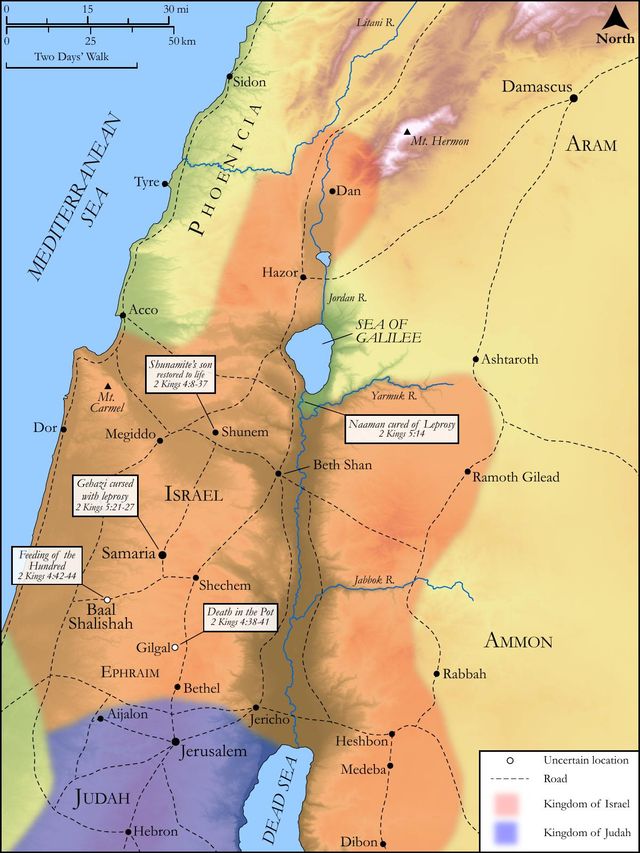
See on the biblical-era map
Study this verse
Public-domain commentary
Matthew Henry
From his Commentary on the Whole Bible. Henry comments on passages, not single verses — this entry covers 2 Kings 5:15–19.
Of the ten lepers that our Saviour cleansed, the only one that returned to give thanks was a Samaritan, Luk 17:16. This Syrian did so, and here expresses himself.
I.Convinced of the power of the God of Israel, not only that he is God, but that he is God alone, and that indeed there is no God in all the earth but in Israel (Kg2 5:15) - a noble confession, but such as intimates the misery of the Gentile world; for the nations that had many gods really had no God, but were without God in the world. He had formerly thought the gods of Syria gods indeed, but now experience had rectified his mistake, and he knew Israel's God was God alone, the sovereign Lord of all. Had he seen other lepers cleansed, perhaps the sight would not have convinced him, but the mercy of the cure affected him more than the miracle of it. Those are best able to speak of the power of divine grace who have themselves experienced it.
II.Grateful to Elisha the prophet:
"Therefore, for his sake whose servant thou art, I have a present for thee, silver, and gold, and raiment, whatever thou wilt please to accept." He valued the cure, not by the easiness of it to the prophet, but the acceptableness of it to himself, and would gladly pay for it accordingly. But Elisha generously refused the fee, though urged to accept it; and, to prevent further importunity, backed his refusal with an oath: As the Lord liveth, I will receive none (Kg2 5:16), not because he did not need it, for he was poor enough, and knew what to do with it, and how to bestow it among the sons of the prophets, nor because he thought it unlawful, for he received presents from others; but he would not be beholden to this Syrian, nor should he say, I have made Elisha rich, Gen 14:23. It would be much for the honour of God to show this new convert that the servants of the God of Israel were taught to look upon the wealth of this world with a holy contempt, which would confirm him in his belief that there was no God but in Israel. See Co1 9:18; Co2 11:9.
III.Proselyted to the worship of the God of Israel.
He will not only offer a sacrifice to the Lord, in thanks for his present cure, but he resolves he will never offer sacrifice to any other gods, Kg2 5:17. It was a happy cure of his leprosy which cured him of his idolatry, a more dangerous disease. But here are two instances of his weakness and infirmity in his conversion: - 1. In one instance he over-did it, that he would not only worship the God of Israel, but he would have clods of earth out of the prophet's garden, or at least of the prophet's ordering, to make an altar of, Kg2 5:17. He that awhile ago had spoken very slightly of the waters of Israel (Kg2 5:12) now is in another extreme, and over-values the earth of Israel, supposing (since God has appointed altars of earth, Exo 20:24) that an altar of that earth would be most acceptable to him, not considering that all the earth is the Lord's and the fulness thereof. Or perhaps the transport of his affection and veneration for the prophet, not only upon the account of his power, but of his virtue and generosity, made him, as we say, love the very ground he went upon and desire to have some of it home with him. The modern compliment equivalent to this would be, "Pray, sir, let me have your picture." 2. In another instance he under-did it, that he reserved to himself a liberty to bow in the house of Rimmon, in complaisance to the king his master, and according to the duty of his place at court (Kg2 5:18), in this thing he must be excused. He owns he ought not to do it, but that he cannot otherwise not do it, but that he cannot otherwise keep his place, - protests that his bowing is not, nor ever shall be, as it had been, in honour to the idol, but only in honour to the king, - and therefore he hopes God will forgive him. Perhaps, all things considered, this might admit of some apology, though it was not justifiable. But, as to us, I am sure, (1.) If, in covenanting with God, we make a reservation for any known sin, which we will continue to indulge ourselves in, that reservation is a defeasance of his covenant. We must cast away all our transgressions and not except any house of Rimmon. (2.) Though we are encouraged to pray for the remission of the sins we have committed, yet, if we ask for a dispensation to go on in any sin for the future, we mock God, and deceive ourselves. (3.) Those that know not how to quit a place at court when they cannot keep it without sinning against God, and wronging their consciences, do not rightly value the divine favour. (4.) Those that truly hate evil will make conscience of abstaining from all appearances of evil. Though Naaman's dissembling his religion cannot be approved, yet because his promise to offer no sacrifice to any god but the God of Israel only was a great point gained with a Syrian, and because, by asking pardon in this matter, he showed such a degree of conviction and ingenuousness as gave hopes of improvement, the prophet took fair leave of him, and bade him Go in peace, Kg2 5:19. Young converts must be tenderly dealt with.
Historical interpretation
Historical reception
1 surviving comment on this verse from the historical church.
Naaman the Aramean asked for some dust from the promised land in order to cause the shame of Israel, as I think, so that they might be ashamed that a stranger believed that even the dust of their land was filled with God, while the Hebrews did not even believe that God dwells in the prophets.
Continue studying 2 Kings 5:17 across the web’s major study libraries — every link below opens this exact verse, chapter, or book on the destination site.
Read & Compare
 BibleGatewayThis verse in more than 200 translations and 70 languages.
 Bible.comThe YouVersion reader — hundreds of translations, reading plans, and highlights.
 ESV.orgCrossway's official English Standard Version reader.
 NET BibleThe NET translation with 60,000+ translators' notes on every rendering decision.
 STEP BibleTyndale House's free study tool — original text, vocabulary, and scholarly resources.
 BibliaLogos Bible Software's free web reader.
 USCCBThe New American Bible (Revised Edition) with the U.S. bishops' study notes.
Commentaries
 BibleHub CommentariesDozens of classic commentaries on this verse, gathered on one page.
 StudyLightMore than 100 commentary sets — the largest collection on the web.
 BibleRefPlain-English commentary on what this verse means, verse by verse.
 Enduring WordDavid Guzik's free commentary on this chapter, widely used by Bible teachers.
 Bible Study ToolsVerse commentary alongside Greek and Hebrew study aids.
Original Language & Research
- BibleHub InterlinearThe verse word by word — original language, transliteration, and English.
- BibleHub LexiconEvery word's original-language definition and Strong's entry.
 Blue Letter BibleDeep-study tools — Strong's numbers, concordance, and word studies.
 SefariaThe Hebrew text with Rashi and centuries of Jewish commentary.
Sermons, Hymns & Audio


TrulyRandomVerse is not affiliated with these sites and doesn’t control their content. They’re linked because they’re genuinely useful.
Summary
Following his miraculous healing from leprosy by the God of Israel through the prophet Elisha, Naaman, the Syrian commander, experiences a profound spiritual transformation. This pivotal verse captures his immediate response: a unique request for sacred earth from Israel and a solemn, unwavering vow to exclusively worship the LORD, the God of Israel, forsaking all other deities. It signifies a decisive turning point in his life, marking his conversion and a deep, committed embrace of monotheistic devotion.
Context
ShowHideLiterary Context
This verse serves as the climactic spiritual declaration in the narrative of Naaman, a powerful Syrian general afflicted with leprosy. The preceding verses meticulously detail his initial journey to Israel, spurred by a young Israelite servant girl's testimony (2 Kings 5:1-4). His arrival in Samaria, his initial pride and anger at Elisha's seemingly simplistic instruction to wash seven times in the Jordan River, and his eventual humble obedience, which led to a miraculous and complete healing, are all carefully recounted (2 Kings 5:9-14). Overwhelmed with gratitude and awe, Naaman returns to Elisha, offering lavish gifts, which the prophet steadfastly refuses, emphasizing that God's grace is not for sale (2 Kings 5:15-16). It is in this moment of profound spiritual conviction, immediately after acknowledging the supremacy of Israel's God, that Naaman makes his extraordinary request and declaration in this verse. The passage powerfully testifies to the transformative power of God's grace, moving Naaman from physical ailment to spiritual allegiance.
Historical & Cultural Context
Among the nations, it was a pervasive belief that deities were localized, with their power and influence intrinsically linked to specific lands, territories, or cultic sites, as the servants of the king of Syria said of Israel's God, "Their gods are gods of the hills." People often carried cultic objects or even earth from their homeland when traveling, believing it maintained a connection to their gods and ensured their favor. Naaman, as a prominent Syrian, would have been deeply immersed in a polytheistic worldview, where various gods were worshipped, often associated with specific nations, cities, or natural phenomena (e.g., Rimmon, the Syrian storm god, mentioned in 2 Kings 5:18). His request for "two mules' burden of earth" from Israel reflects this deeply ingrained cultural understanding; he believed that to properly and acceptably worship the God of Israel, he needed a consecrated space, literally built upon the soil of the land where Yahweh's presence was uniquely manifested. His subsequent solemn vow to offer sacrifices only to "the LORD" (YHweh), the covenant God of Israel, is a radical and profound departure from his polytheistic background and a revolutionary embrace of Israelite monotheism.
Key Themes
ShowHideThis verse powerfully contributes to several foundational themes within the book of 2 Kings and broader biblical theology. Foremost is the Sovereignty and Uniqueness of Yahweh, clearly demonstrated as Naaman, a powerful Gentile, acknowledges that there is "no God in all the earth but in Israel" (2 Kings 5:15). This highlights God's universal power extending beyond the geographical and ethnic boundaries of Israel. The theme of Conversion and Exclusive Worship is central, as Naaman's physical healing leads directly to a spiritual transformation, culminating in his unequivocal vow of singular devotion to the LORD, a stark and ironic contrast to the pervasive idolatry often depicted among the Israelites themselves throughout 2 Kings. Furthermore, Naaman's story profoundly foreshadows the Inclusion of Gentiles into God's redemptive plan, a concept that becomes fully explicit in the New Testament. His gratitude for divine grace leading to profound commitment also underscores the theme of Faith and Obedience, showing that true faith necessitates a decisive turning from past practices to new allegiance and a life of worship.
Exposition and Analysis
ShowHideKey Word Analysis
ShowHideThe Hebrew word אֲדָמָה (ʼădâmâh') refers specifically to soil or ground, often with connotations of redness or fertility. In the thought of the Syrians, deities were frequently associated with particular territories or lands, as when their servants said, "Their gods are gods of the hills." Naaman's request for earth from Israel signifies his belief that to properly worship Yahweh, the God of Israel, he needed a physical connection to the land where Yahweh's power and presence were uniquely manifest. It was an attempt to create a "holy ground" in Aram where his worship would be acceptable to the God of Israel, reflecting a cultural understanding of localized divinity, even as he grasped Yahweh's supreme power.
The term עוֹלָה (ʻôlâh') refers to a specific type of sacrifice that is entirely consumed by fire on the altar, ascending to God as a "sweet aroma." It was a primary form of worship in ancient Israel, often associated with atonement, dedication, or thanksgiving. Naaman's explicit vow to offer this type of sacrifice, along with "sacrifice" (זֶבַח, zebach, a general term for animal sacrifice, often involving a shared meal), solely to the LORD indicates his full adoption of Israelite cultic practices as a means of expressing his newfound devotion and profound gratitude.
This is the Tetragrammaton, the sacred, personal name of the God of Israel, יְהוָה (Yᵉhôvâh'), often rendered "the LORD" in English translations. The name signifies "the self-Existent or Eternal One." Naaman's use of this specific, covenantal name, rather than a generic term for "god" (like ʼĕlôhîym), demonstrates a clear recognition and acceptance of the unique identity of Israel's God. It signifies a profound shift from the polytheism of Aram to an exclusive, personal relationship with the one true God, Yahweh.
Verse Breakdown
ShowHide"And Naaman said, Shall there not then, I pray thee, be given to thy servant two mules' burden of earth?"
Following his miraculous healing and Elisha's resolute refusal of any material gifts, Naaman, overwhelmed with gratitude and deep spiritual conviction, makes this seemingly unusual request. His desire for "two mules' burden of earth" reflects a deeply ingrained Syrian understanding that deities were tied to specific lands. He believed that to worship the God of Israel authentically and acceptably in Aram, he needed a physical piece of Israel, effectively creating a consecrated space for Yahweh on foreign soil. This demonstrates the depth of his desire to continue worshipping the LORD, even if his understanding of God's omnipresence was still evolving within his cultural framework.
"for thy servant will henceforth offer neither burnt offering nor sacrifice unto other gods, but unto the LORD."
This clause constitutes Naaman's solemn vow and unequivocal declaration of exclusive worship. It is a decisive and public commitment to monotheism, explicitly rejecting the polytheistic practices of his homeland and the worship of "other gods" (ʼachêr ʼĕlôhîym). By pledging to offer sacrifices—specifically the comprehensive "burnt offering" (ʻôlâh) and general "sacrifice" (zebach)—only to "the LORD" (Yᵉhôvâh), the covenant God of Israel, Naaman declares his singular allegiance and submission to Yahweh as the one true, supreme God, whose power and uniqueness were so undeniably demonstrated through his miraculous healing. This marks a profound and genuine spiritual conversion.
Literary Devices
ShowHideThe narrative of Naaman's conversion in 2 Kings 5 is rich with literary devices that amplify its theological impact. Irony is profoundly prominent, as the revered Syrian commander, initially proud and resistant to the prophet's humble instructions, ultimately finds healing and spiritual truth not through his own powerful gods or elaborate rituals, but through the simple command of the God of Israel. The "two mules' burden of earth" serves as powerful Symbolism, representing Naaman's attempt to bring a piece of God's holy land, and by extension, God's perceived localized presence, back to his own country. It symbolizes his deep desire to establish a legitimate place of worship for Yahweh outside of Israel, even if his theological understanding was still culturally bound. There is also a strong Contrast between Naaman's initial arrogance and his subsequent humility and profound gratitude, which leads to his unequivocal declaration of exclusive worship. This dramatic transformation highlights the sovereign power of God to humble the proud and draw all peoples to Himself, regardless of their background or initial resistance.
Theological and Thematic Connections
ShowHideNaaman's conversion in 2 Kings 5:17 is a profound theological statement, underscoring the universal sovereignty of Yahweh. It demonstrates unequivocally that God's power and redemptive grace are not confined to the nation of Israel but extend to all nations and peoples. Naaman, a Gentile, acknowledges the supremacy of the God of Israel, illustrating that Yahweh is not merely a tribal deity but the one true God of all the earth. His decisive vow of exclusive worship serves as a powerful example of genuine conversion, where profound gratitude for divine intervention leads to a complete reorientation of life and allegiance. This narrative powerfully foreshadows the New Testament revelation of God's expansive plan to include Gentiles in His covenant people, breaking down the barriers between Jew and Gentile through faith in Christ.
Reflection and Application
ShowHideNaaman's story in 2 Kings 5:17 offers timeless and profound lessons for contemporary believers. His transformation from a powerful, proud military commander to a humble, devoted worshiper of the LORD demonstrates that true faith is not merely intellectual assent or a transactional exchange, but a radical reorientation of one's entire life and loyalties. His request for earth, though rooted in ancient cultural beliefs, symbolizes a universal human desire to create a dedicated space for God, whether physical or spiritual. For us, this means consciously dedicating our lives, our homes, our resources, and our very hearts as sacred spaces for God's presence and worship. Naaman's unequivocal vow of exclusive worship challenges us to deeply examine our own allegiances: what "other gods"—idols of money, success, pleasure, self-reliance, or worldly approval—might subtly compete for the singular devotion we owe to the LORD? His profound gratitude, which propelled him to this decisive commitment, reminds us that a deep appreciation for God's grace and intervention in our lives should naturally lead to a passionate, exclusive, and unwavering desire to honor, serve, and worship Him alone.
Questions for Reflection
ShowHideFAQ
ShowHideWhy did Naaman ask for "two mules' burden of earth"?
ShowHideNaaman's request for earth was deeply rooted in the Syrian belief that deities were localized and their power was intrinsically tied to specific lands. He likely believed that to properly and acceptably worship the God of Israel (Yahweh) in Aram, he needed to do so on "holy ground" from Israel. This was his attempt to create a consecrated altar or space for Yahweh's worship, acknowledging the God of Israel's supremacy even while still operating within his cultural understanding of localized divinity. It was a tangible and sincere expression of his desire to maintain his newfound devotion to the one true God, even if his theological understanding was not yet fully developed regarding God's omnipresence.
Was Naaman's conversion to the God of Israel complete and perfect?
ShowHideNaaman's conversion was undoubtedly genuine and profound, as evidenced by his solemn vow to "henceforth offer neither burnt offering nor sacrifice unto other gods, but unto the LORD" (2 Kings 5:17). This is a clear and decisive declaration of exclusive monotheistic worship. While his request for earth suggests some lingering cultural understanding of localized deities, his heart's allegiance had decisively shifted to Yahweh. The text presents his conversion as authentic and transformative, a powerful testament to God's power to draw and transform even those from outside the covenant community. His subsequent question about bowing in the house of Rimmon (2 Kings 5:18) indicates a practical and complex challenge he faced as a high-ranking official, but Elisha's response ("Go in peace") implies a gracious understanding of his difficult position, not a rejection of his sincerity or the authenticity of his faith.
What is the significance of Naaman's vow to offer sacrifices only "unto the LORD" and not "unto other gods"?
ShowHideThis vow is profoundly significant because it marks a complete and decisive break from Naaman's polytheistic past and a radical embrace of Israelite monotheism. In his Syrian culture, the worship of multiple deities was common and expected. By specifically naming "the LORD" (Yᵉhôvâh), the covenant name of Israel's God, and explicitly rejecting "other gods" (H312, H430), Naaman declares his exclusive allegiance to the one true God. This demonstrates his recognition of Yahweh's unique power and supremacy, as evidenced by his miraculous healing, and his commitment to a singular devotion, which is a foundational principle of biblical faith, encapsulated in the Shema (Deuteronomy 6:4). It signifies a complete reorientation of his spiritual life.
Christ-Centered Fulfillment
ShowHideNaaman's story, particularly his miraculous healing, profound conversion, and solemn vow in 2 Kings 5:17, serves as a powerful Old Testament foreshadowing of God's expansive redemptive plan in Jesus Christ. Naaman, a Gentile, receives miraculous healing and spiritual transformation not through his own power, the gods of his nation, or human merit, but through the sovereign grace of the God of Israel. This prefigures the inclusion of Gentiles into God's covenant people through Jesus Christ, the ultimate Lamb of God who takes away the sin of the world. Just as Naaman's physical leprosy was cleansed, so too does Christ offer spiritual cleansing from the pervasive leprosy of sin (Matthew 8:2-3). Naaman's desire for "earth" from Israel to properly worship God points to a deep human longing for God's tangible presence, a longing fully and perfectly met in Christ, who is Immanuel, God with us. Believers in Christ no longer need physical earth from a specific land or a localized temple to worship, for through the indwelling Holy Spirit, our very bodies become temples of the Holy Spirit, making every place holy ground where true worship can occur in spirit and truth (John 4:21-24). Naaman's exclusive vow to the LORD finds its ultimate fulfillment in the Christian's exclusive allegiance to Jesus Christ, for there is no other name under heaven given among men by which we must be saved. His story beautifully illustrates God's sovereign grace reaching beyond ethnic and national boundaries, culminating in the Great Commission to make disciples of all nations.