


2 Samuel 2:1
Bible text: King James Version (1769 Blayney text) · Public domain
Bible text: King James Version with Strong's numbers · Public domain
Bible text: Berean Standard Bible · Public domain
Bible text: American Standard Version (1901) · Public domain
Bible text: World English Bible, Messianic edition · Public domain
Bible text: Geneva Bible (1599) · Public domain
Bible text: Young's Literal Translation · Public domain
- וַיְהִיvay·Hiand it wasH1961Conj-w ¦ V-Qal-ConsecImperf-3msVerb Qal Consecutive Imperfect 3rd Singular Masculineוַandיְהִיit was
- אַחֲרֵי'a·cha·reiafterH310Adj-mpcAdjective Numerical Plural Masculine Construct
- כֵןKhenthusH3651AdvAdverb
- וַיִּשְׁאַלvai·yish·'Aland he enquiredH7592Conj-w ¦ V-Qal-ConsecImperf-3msVerb Qal Consecutive Imperfect 3rd Singular Masculineוַandיִּשְׁאַלhe enquired
- דָּוִדda·VidDavidH1732N-proper-mNoun Proper Masculine
- בַּיהוָהba·Yah·wehby YahwehH3068Prep-b ¦ N-properNoun Proper TitleבַּbyיהוָהYahweh
- לֵאמֹרle·Mor<to> sayingH559Prep-l ¦ V-Qal-InfVerb Qal Infinitive Constructלֵ<to>אמֹרsaying
- הַאֶעֱלֶהha·'e·'e·Leh¿ will I go upH5927Interrog ¦ V-Qal-Imperf-1csVerb Qal Imperfect 1st Singular common genderהַ¿אֶעֱלֶהwill I go up
- בְּאַחַתbe·'a·Chatin one ofH259Prep-b ¦ N-fscNoun Singular Feminine Constructבְּinאַחַתone of
- עָרֵי'a·Rei[the] cities ofH5892N-mpcNoun Plural Masculine Construct
- יְהוּדָהye·hu·DahJudahH3063N-properNoun Proper Location
- וַיֹּאמֶרvai·Yo·merand he saidH559Conj-w ¦ V-Qal-ConsecImperf-3msVerb Qal Consecutive Imperfect 3rd Singular Masculineוַandיֹּאמֶרhe said
- יְהוָהYah·wehYahwehH3068N-properNoun Proper Title
- אֵלָיו'e·Lavto himH413Prep ¦ 3msPreposition Definiteאֵלָיtoוhim
- עֲלֵה'a·Lehgo upH5927V-Qal-Imp-2msVerb Qal Imperative 2nd Singular Masculine
- וַיֹּאמֶרvai·Yo·merand he saidH559Conj-w ¦ V-Qal-ConsecImperf-3msVerb Qal Consecutive Imperfect 3rd Singular Masculineוַandיֹּאמֶרhe said
- דָּוִדda·VidDavidH1732N-proper-mNoun Proper Masculine
- אָנָה'A·nahwhere?H575InterrogParticle Interrogative
- אֶעֱלֶה'e·'e·Lehwill I go upH5927V-Qal-Imperf-1csVerb Qal Imperfect 1st Singular common gender
- וַיֹּאמֶרvai·Yo·merand he saidH559Conj-w ¦ V-Qal-ConsecImperf-3msVerb Qal Consecutive Imperfect 3rd Singular Masculineוַandיֹּאמֶרhe said
- חֶבְרֹנָהchev·Ro·nahHebron towardsH2275N-proper ¦ SfxNoun Proper LocationחֶבְרֹנָHebronהtowards
English is a literal word-by-word gloss of the Hebrew, not the KJV's wording. Why?
This is the original text the KJV's translators worked from — each Hebrew word with its own literal English meaning in this verse, prepared by scholars at Tyndale House, Cambridge. The KJV translates whole sentences, not word by word, so its wording differs: one Hebrew word can become several English words, and the KJV may choose “the LORD” where the gloss reads “Yahweh”. Both are faithful — they answer different questions. For the KJV's own rendering, switch to the KJV text.
Details
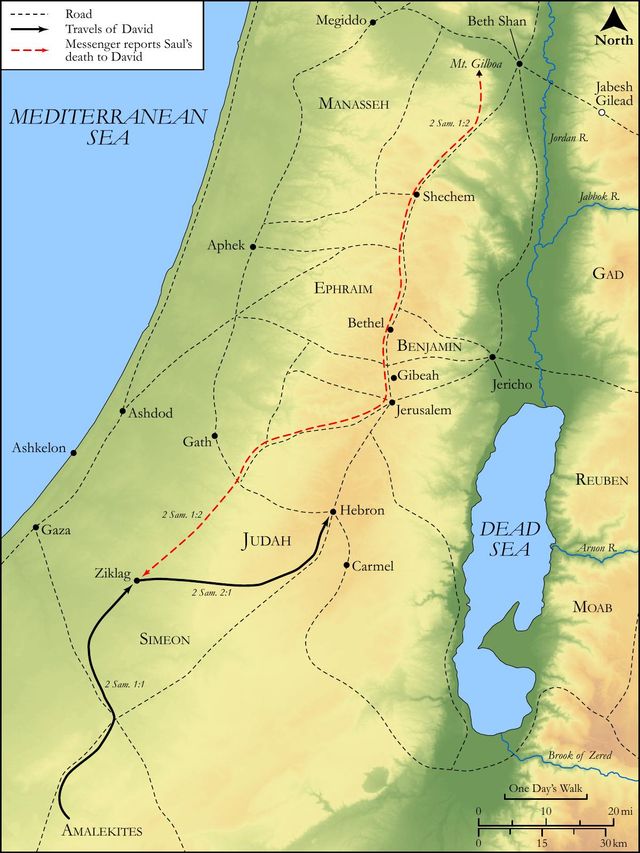
See on the biblical-era maps
Study this verse
Public-domain commentary
Matthew Henry
From his Commentary on the Whole Bible. Henry comments on passages, not single verses — this entry covers 2 Samuel 2:1–7. His two-level outline is real structure in the source text, so it is rendered as structure.
When Saul and Jonathan were dead, though David knew himself anointed to be king, and now saw his way very clear, yet he did not immediately send messengers through all the coasts of Israel to summon all people to come in and swear allegiance to him, upon pain of death, but proceeded leisurely; for he that believeth doth not make haste, but waits God's time for the accomplishment of God's promises. Many had come in to his assistance from several tribes while he continued at Ziklag, as we find (1 Chr. 12:1-22), and with such a force he might have come in by conquest. But he that will rule with meekness will not rise with violence. Observe here,
I.The direction he sought and had from God in this critical juncture, Sa2 2:1.
He doubted not of success, yet he used proper means, both divine and human. Assurance of hope in God's promise will be so far from slackening that it will quicken pious endeavours. If I be elected to the crown of life, it does not follow, Then I will do nothing; but, Then I will do all that he directs me, and follow the guidance of him who chose me. This good use David made of his election, and so will all whom God has chosen.
1.David, according to the precept, acknowledged God in his way. He enquired of the Lord by the breast-plate of judgment, which Abiathar brought to him. We must apply to God not only when we are in distress, but even when the world smiles upon us and second causes work in favour of us. His enquiry was, Shall I go up to any of the cities of Judah? Shall I stir hence? Though Ziklag be in ruins, he will not quit it without direction from God. "If I stir hence, Shall I go to one of the cities of Judah?" not limiting God to them (if God should so direct him, he would go to any of the cities of Israel), but thus expressing his prudence (in the cities of Judah he would find most friends), and his modesty - he would look no further at present than his own tribe. In all our motions and removals it is comfortable to see God going before us; and we may, if by faith and prayer we set him before us.
2.God, according to the promise, directed his path, bade him go up, told him whither, unto Hebron, a priest's city, one of the cities of refuge, so it was to David, and an intimation that God himself would be to him a little sanctuary. The sepulchres of the patriarchs, adjoining to Hebron, would remind him of the ancient promise, on which God had caused him to hope. God sent him not to Bethlehem, his own city, because that was little among the thousands of Judah (Mic 5:2), but to Hebron, a more considerable place, and which perhaps was then as the county-town of that tribe.
II.The care he took of his family and friends in his removal to Hebron.
1.He took his wives with him (Sa2 2:2), that, as they had been companions with him in tribulation, they might be so in the kingdom. It does not appear that as yet he had any children; his first was born in Hebron, Sa2 3:2.
2.He took his friends and followers with him, Sa2 2:3. They had accompanied him in his wanderings, and therefore, when he gained a settlement, they settled with him. Thus, if we suffer with Christ, we shall reign with him, Ti2 2:12. Nay, Christ does more for his good soldiers than David could do for his; David found lodging for them - They dwelt in the cities of Hebron, and adjacent towns; but to those who continue with Christ in his temptations he appoints a kingdom, and will feast them at his own table, Luk 22:29, Luk 22:30.
III.The honour done him by the men of Judah:
They anointed him king over the house of Judah, Sa2 2:4. The tribe of Judah had often stood by itself more than any other of the tribes. In Saul's time it was numbered by itself as a distinct body (Sa1 15:4) and those of this tribe had been accustomed to act separately. They did so now; yet they did it for themselves only; they did not pretend to anoint him king over all Israel (as Jdg 9:22), but only over the house of Judah. The rest of the tribes might do as they pleased, but, as for them and their house, they would be ruled by him whom God had chosen. See how David rose gradually; he was first anointed king in reversion, then in possession of one tribe only, and at last of all the tribes. Thus the kingdom of the Messiah, the Son of David, is set up by degrees; he is Lord of all by divine designation, but we see not yet all things put under him, Heb 2:8. David's reigning at first over the house of Judah only was a tacit intimation of Providence that his kingdom would in a short time be reduced to that again, as it was when the ten tribes revolted from his grandson; and it would be an encouragement to the godly kings of Judah that David himself at first reigned over Judah only.
IV.The respectful message he sent to the men of Jabesh-Gilead, to return them thanks for their kindness to Saul.
Still he studies to honour the memory of his predecessor, and thereby to show that he was far from aiming at the crown from any principle of ambition or enmity to Saul, but purely because he was called of God to it. It was told him that the men of Jabesh-Gilead buried Saul, perhaps by some that thought he would be displeased at them as over-officious. But he was far from that. 1. He commends them for it, Sa2 2:5. According as our obligations were to love and honour any while they lived, we ought to show respect to their remains (that is, their bodies, names, and families) when they are dead. "Saul was your lord," says David, "and therefore you did well to show him this kindness and do him this honour." 2. He prays to God to bless them for it, and to recompense it to them: Blessed are you, and blessed may you be of the Lord, who will deal kindly with those in a particular manner that dealt kindly with the dead, as it is in Rut 1:8. Due respect and affection shown to the bodies, names, and families of those that are dead, in conscience towards God, is a piece of charity which shall in no wise lose its reward: The Lord show kindness and truth to you (Sa2 2:6), that is, kindness according to the promise. What kindness God shows is in truth, what one may trust to. 3. He promises to make them amends for it: I also will requite you. He does not turn them over to God for a recompence that he may excuse himself from rewarding them. Good wishes are good things, and instances of gratitude, but they are too cheap to be rested in where there is an ability to do more. 4. He prudently takes this opportunity to gain them to his interest, Sa2 2:7. They had paid their last respects to Saul, and he would have them to be the last: "The house of Judah have anointed me king, and it will be your wisdom to concur with them and in that to be valiant." We must not so dote on the dead, how much soever we have valued them, as to neglect or despise the blessings we have in those that survive, whom God has raised up to us in their stead.
Continue studying 2 Samuel 2:1 across the web’s major study libraries — every link below opens this exact verse, chapter, or book on the destination site.
Read & Compare
 BibleGatewayThis verse in more than 200 translations and 70 languages.
 Bible.comThe YouVersion reader — hundreds of translations, reading plans, and highlights.
 ESV.orgCrossway's official English Standard Version reader.
 NET BibleThe NET translation with 60,000+ translators' notes on every rendering decision.
 STEP BibleTyndale House's free study tool — original text, vocabulary, and scholarly resources.
 BibliaLogos Bible Software's free web reader.
 USCCBThe New American Bible (Revised Edition) with the U.S. bishops' study notes.
Commentaries
 BibleHub CommentariesDozens of classic commentaries on this verse, gathered on one page.
 StudyLightMore than 100 commentary sets — the largest collection on the web.
 BibleRefPlain-English commentary on what this verse means, verse by verse.
 Enduring WordDavid Guzik's free commentary on this chapter, widely used by Bible teachers.
 Bible Study ToolsVerse commentary alongside Greek and Hebrew study aids.
Original Language & Research
- BibleHub InterlinearThe verse word by word — original language, transliteration, and English.
- BibleHub LexiconEvery word's original-language definition and Strong's entry.
 Blue Letter BibleDeep-study tools — Strong's numbers, concordance, and word studies.
 SefariaThe Hebrew text with Rashi and centuries of Jewish commentary.
Sermons, Hymns & Audio


TrulyRandomVerse is not affiliated with these sites and doesn’t control their content. They’re linked because they’re genuinely useful.
Summary
2 Samuel 2:1 records the pivotal moment following the death of King Saul, where David, demonstrating profound dependence on divine guidance, formally seeks the LORD's direction regarding his next steps. This inquiry, and God's precise instruction to go to Hebron, marks the divinely orchestrated commencement of David's reign as king, initially over the tribe of Judah, establishing the initial phase of his long-awaited kingship in accordance with God's sovereign will and timing.
Context
ShowHideLiterary Context
This verse serves as a crucial narrative pivot, transitioning from the tragic end of King Saul's reign in 1 Samuel and 2 Samuel 1 to the divinely sanctioned beginning of David's kingship. The preceding chapters detail Israel's devastating defeat by the Philistines at Mount Gilboa, resulting in the deaths of Saul and his sons, including Jonathan, David's beloved friend. David, who has been divinely anointed by Samuel years prior (1 Samuel 16:13) and has endured a long period as a fugitive, now finds the throne vacant. Instead of seizing power through human ambition or military might, David's immediate action is to "enquire of the LORD," setting a profound spiritual tone for his future reign and contrasting sharply with Saul's later spiritual failures. This deliberate act of seeking God's will immediately establishes David's legitimacy as a leader chosen and guided by God, laying the groundwork for the Davidic dynasty.
Historical & Cultural Context
The period immediately following Saul's death was characterized by significant political instability and a power vacuum in Israel. The Philistines had gained considerable control, and the nation was in disarray. Among the kingdoms of that day, the death of a king often triggered intense struggles for succession. David, though divinely appointed, understood the need for both divine legitimation and strategic political action. His inquiry of the LORD was not merely a personal spiritual act but also a public declaration of his reliance on God's authority, distinguishing him from typical claimants to power. Hebron, the city God designates, held immense strategic and historical significance. Located in the tribal territory of Judah, David's own tribe, it was an ancient city with deep patriarchal roots, serving as the burial place of Abraham, Isaac, and Jacob (Genesis 23:2). Its selection as David's initial capital underscored his connection to the foundational promises to Israel and provided a central, secure base within his own people.
Key Themes
ShowHide2 Samuel 2:1 introduces and reinforces several foundational themes crucial to understanding David's reign and the broader biblical narrative. Firstly, Divine Guidance and Dependence is paramount; David's immediate and repeated action is to "enquire of the LORD," establishing a pattern of seeking God's will as the primary basis for leadership. This stands in sharp contrast to Saul's later spiritual decline, where he could no longer hear from God. Secondly, God's Sovereignty in Leadership is powerfully displayed as God actively directs David's steps, not only affirming his ascent but specifically choosing his initial location. This highlights that David's kingship is a divine appointment, not a human achievement, fulfilling God's promises to him (1 Samuel 16:13). Thirdly, Obedience and Trust are evident in David's willingness to follow God's specific instructions, even asking for more precise direction ("Whither shall I go up?"). Finally, the verse signals a momentous Transition of Power, moving from the failed Saulide dynasty to the divinely ordained Davidic line, which would ultimately serve as the lineage for the Messiah.
Exposition and Analysis
ShowHideKey Word Analysis
ShowHideThis verb (H7592) signifies a formal, deliberate act of seeking divine guidance, often through established means such as the priestly ephod with the Urim and Thummim, or through a prophet. It implies a posture of humble dependence and submission to God's will, rather than impulsive decision-making or reliance solely on human wisdom. David's consistent practice of "inquiring of the LORD" is a hallmark of his righteous leadership, distinguishing him from Saul, who tragically lost the ability to hear from God (1 Samuel 28:6).
The use of the covenant name of God, Yahweh (H3068), emphasizes His personal, relational, and faithful character. David's inquiry is not directed to a generic deity but to the living God who has made specific promises to him and to Israel. This highlights the intimate, personal relationship David had with God and God's active involvement in the unfolding history of His people, particularly in the establishment of His chosen king and the fulfillment of His divine plan.
Meaning "association" or "confederacy" (H2275), Hebron was a significant city in the tribal territory of Judah, David's own tribe. It held deep historical and patriarchal significance, being the burial place of Abraham, Isaac, and Jacob (Genesis 23:2; Genesis 35:27). It was also designated as a Levitical city and a city of refuge. Its selection by God as David's first capital is highly symbolic, rooting his reign in the patriarchal promises and within his own tribal lineage, from which the Messiah would eventually come.
Verse Breakdown
ShowHide"¶ And it came to pass after this, that David enquired of the LORD, saying,"
This introductory phrase explicitly links the current event to the preceding narrative of Saul's death and David's period of mourning. The immediate action of "inquiring of the LORD" establishes David's character as one who prioritizes divine counsel, setting the spiritual tone for his kingship from its very inception and underscoring his profound dependence on God.
"Shall I go up into any of the cities of Judah?"
David's initial question reveals both his strategic thinking (seeking to establish himself within his own tribal territory) and his submission to God's will even in the general direction. He does not presume to know the specific path but seeks divine affirmation for the broader move, demonstrating prudence and a desire for God's blessing on his intentions.
"And the LORD said unto him, Go up."
God's direct and concise answer affirms David's general inclination to move into Judah. This immediate divine response validates David's approach and provides the necessary authorization for his next steps, demonstrating God's active involvement and clear guidance in his life.
"And David said, Whither shall I go up?"
David's second question reveals his desire for specific and precise direction. He is not content with a general affirmation but seeks clarity on the exact destination, indicating his commitment to complete and accurate obedience and his trust that God will provide detailed guidance for his next crucial move.
"And he said, Unto Hebron."
God's specific instruction to go to Hebron provides the exact location for David's initial establishment as king. This divine choice is highly significant, as Hebron was a central city in Judah with deep historical and symbolic ties, underscoring the divine orchestration of David's ascent to the throne and rooting his kingship in the promises made to his tribe.
Literary Devices
ShowHideThe passage masterfully employs several literary devices to convey its profound theological message. Dialogue is central, presenting a direct and concise exchange between David and the LORD, emphasizing the personal and active nature of God's guidance in David's life. This Divine Oracle serves as the primary mode of God's communication, highlighting His sovereignty and control over human affairs, especially in the establishment of leadership. There is a strong implicit Contrast drawn between David's consistent and humble seeking of God's will and Saul's tragic failures to do so (1 Samuel 28:6), thereby affirming David's legitimacy and God's favor upon him. The narrative also uses Foreshadowing, as the divine direction to Hebron, a city of Judah, subtly points towards the future establishment of the Davidic dynasty and the eventual unification of all Israel under David's rule, rooting his kingship in his tribal identity and the promises made to Judah. The brevity and directness of God's responses ("Go up," "Unto Hebron") lend an air of divine authority and certainty to the narrative, underscoring the clarity of God's will for His chosen king.
Theological and Thematic Connections
ShowHide2 Samuel 2:1 serves as a foundational text for understanding the nature of godly leadership and divine providence. David's immediate and persistent inquiry of the LORD, even after years of waiting and with a clear claim to the throne, underscores that true leadership begins with absolute dependence on God. It teaches that God is not only willing but eager to provide specific direction to those who sincerely seek His will, especially in moments of significant transition or uncertainty. This passage affirms God's active involvement in human history, orchestrating the rise and fall of leaders according to His sovereign plan, and demonstrating His faithfulness to His promises, even through periods of chaos and waiting. David's example challenges believers to prioritize divine counsel above human wisdom or ambition in all major decisions, trusting that God's path is always the best path, leading to His intended purposes and glory.
Reflection and Application
ShowHideDavid's immediate recourse to the LORD in 2 Samuel 2:1 offers a timeless and powerful model for all believers, particularly in times of significant life transitions, uncertainty, or when facing major decisions. His example teaches us that our first and most critical step should always be to "enquire of the LORD," prioritizing divine guidance above personal logic, worldly advice, or even perceived opportunities. This isn't a casual thought but a deliberate, humble posture of dependence, acknowledging God's sovereignty and wisdom. Like David, we are called to seek not just general affirmation but specific direction, trusting that God is capable of providing clear answers, though His methods may vary (through His Word, prayer, wise counsel, or providential circumstances). Once God's will is discerned, the call is to respond with immediate faith and obedience, knowing that His path, even if it leads to an unfamiliar "Hebron," is the one that aligns with His perfect plan and ultimately brings about His purposes. This verse encourages us to cultivate a consistent habit of seeking God's face, not just in crisis, but as the foundational principle of our daily walk and decision-making, recognizing that true success and peace flow from alignment with His divine will.
Questions for Reflection
ShowHideFAQ
ShowHideHow did David "enquire of the LORD" in this context, and why did he ask twice?
ShowHideDavid most likely "enquired of the LORD" through the priestly ephod, which contained the Urim and Thummim, instruments used for discerning God's will (1 Samuel 23:9-12, where David asks Abiathar to bring the ephod). This was a formal, established method for seeking divine counsel in ancient Israel. David asked twice not out of doubt in God's initial "Go up," but out of a desire for specific, precise direction. His first question, "Shall I go up into any of the cities of Judah?", sought general permission and affirmation for a move into his tribal territory. Once that general permission was granted, he then sought the exact destination, "Whither shall I go up?", demonstrating his commitment to complete and accurate obedience to God's detailed plan. This two-part inquiry highlights David's prudence, his thoroughness in seeking divine will, and his absolute trust that God would provide explicit guidance for his next steps as a leader, ensuring that his actions were fully aligned with the divine will.
Christ-Centered Fulfillment
ShowHide2 Samuel 2:1, with David's humble inquiry and God's precise direction, powerfully foreshadows the ultimate King, Jesus Christ. Just as David, the anointed one, waited for God's perfect timing and sought His specific instruction to assume his kingship, so too did Jesus, the true Anointed One (Messiah), perfectly align His entire life and ministry with the Father's will. David's immediate act of seeking God's guidance before taking the throne reflects Christ's own perfect obedience and absolute dependence on the Father, as seen in His constant prayer life and His declaration, "I do nothing on my own authority, but speak just as the Father taught me." The divine command for David to "Go up... Unto Hebron" points to God's sovereign orchestration of His eternal kingdom, which finds its ultimate fulfillment in Christ's ascension and enthronement at the right hand of God, from where He reigns over His spiritual "Judah"—the church (Acts 2:33; Ephesians 1:20-23). David's reign, initiated by divine instruction and rooted in the promised tribe, serves as a profound type of Christ's eternal, universal kingship, which began with His resurrection and will culminate in His glorious return, when "every knee will bow and every tongue confess that Jesus Christ is Lord" to the glory of God the Father, establishing a kingdom that knows no end.