


2 Samuel 2:2
Bible text: King James Version (1769 Blayney text) · Public domain
Bible text: Berean Standard Bible · Public domain
Bible text: American Standard Version (1901) · Public domain
Bible text: World English Bible, Messianic edition · Public domain
Bible text: Geneva Bible (1599) · Public domain
Bible text: Young's Literal Translation · Public domain
- וַיַּעַלvai·Ya·'aland he went upH5927Conj-w ¦ V-Qal-ConsecImperf-3msVerb Qal Consecutive Imperfect 3rd Singular Masculineוַandיַּעַלhe went up
- שָׁםshamthereH8033AdvAdverb
- דָּוִדda·VidDavidH1732N-proper-mNoun Proper Masculine
- וְגַםve·Gamand alsoH1571Conj-w ¦ AdvAdverbוְandגַםalso
- שְׁתֵּיshe·Tei[the] twoH8147N-fdcNoun Dual Feminine Construct
- נָשָׁיוna·Shavhis wivesH802N-mpc ¦ 3msNoun Plural Masculine Constructנָשָׁיwivesוhis
- אֲחִינֹעַם'a·chi·No·'amAhinoamH293N-proper-fNoun Proper Feminine
- הַיִּזְרְעֵלִיתhai·yiz·re·'e·Litthe Jezreelite [woman]H3158Art ¦ N-fsNoun Gentilic Singular Feminine AbsoluteהַtheיִּזְרְעֵלִיתJezreelite [woman]
- וַאֲבִיגַיִלva·'a·vi·Ga·yiland AbigailH26Conj-w ¦ N-proper-fNoun Proper FeminineוַandאֲבִיגַיִלAbigail
- אֵשֶׁת'E·shet[the] wife ofH802N-fscNoun Singular Feminine Construct
- נָבָלna·ValNabalH5037N-proper-mNoun Proper Masculine
- הַכַּרְמְלִיHa·kar·me·Lithe CarmeliteH3761Art ¦ N-msNoun Gentilic Singular Masculine AbsoluteהַtheכַּרְמְלִיCarmelite
English is a literal word-by-word gloss of the Hebrew, not the KJV's wording. Why?
This is the original text the KJV's translators worked from — each Hebrew word with its own literal English meaning in this verse, prepared by scholars at Tyndale House, Cambridge. The KJV translates whole sentences, not word by word, so its wording differs: one Hebrew word can become several English words, and the KJV may choose “the LORD” where the gloss reads “Yahweh”. Both are faithful — they answer different questions. For the KJV's own rendering, switch to the KJV text.
Details
See on the biblical-era maps
Study this verse
Public-domain commentary
Matthew Henry
From his Commentary on the Whole Bible. Henry comments on passages, not single verses — this entry covers 2 Samuel 2:1–7. His two-level outline is real structure in the source text, so it is rendered as structure.
When Saul and Jonathan were dead, though David knew himself anointed to be king, and now saw his way very clear, yet he did not immediately send messengers through all the coasts of Israel to summon all people to come in and swear allegiance to him, upon pain of death, but proceeded leisurely; for he that believeth doth not make haste, but waits God's time for the accomplishment of God's promises. Many had come in to his assistance from several tribes while he continued at Ziklag, as we find (1 Chr. 12:1-22), and with such a force he might have come in by conquest. But he that will rule with meekness will not rise with violence. Observe here,
I.The direction he sought and had from God in this critical juncture, Sa2 2:1.
He doubted not of success, yet he used proper means, both divine and human. Assurance of hope in God's promise will be so far from slackening that it will quicken pious endeavours. If I be elected to the crown of life, it does not follow, Then I will do nothing; but, Then I will do all that he directs me, and follow the guidance of him who chose me. This good use David made of his election, and so will all whom God has chosen.
1.David, according to the precept, acknowledged God in his way. He enquired of the Lord by the breast-plate of judgment, which Abiathar brought to him. We must apply to God not only when we are in distress, but even when the world smiles upon us and second causes work in favour of us. His enquiry was, Shall I go up to any of the cities of Judah? Shall I stir hence? Though Ziklag be in ruins, he will not quit it without direction from God. "If I stir hence, Shall I go to one of the cities of Judah?" not limiting God to them (if God should so direct him, he would go to any of the cities of Israel), but thus expressing his prudence (in the cities of Judah he would find most friends), and his modesty - he would look no further at present than his own tribe. In all our motions and removals it is comfortable to see God going before us; and we may, if by faith and prayer we set him before us.
2.God, according to the promise, directed his path, bade him go up, told him whither, unto Hebron, a priest's city, one of the cities of refuge, so it was to David, and an intimation that God himself would be to him a little sanctuary. The sepulchres of the patriarchs, adjoining to Hebron, would remind him of the ancient promise, on which God had caused him to hope. God sent him not to Bethlehem, his own city, because that was little among the thousands of Judah (Mic 5:2), but to Hebron, a more considerable place, and which perhaps was then as the county-town of that tribe.
II.The care he took of his family and friends in his removal to Hebron.
1.He took his wives with him (Sa2 2:2), that, as they had been companions with him in tribulation, they might be so in the kingdom. It does not appear that as yet he had any children; his first was born in Hebron, Sa2 3:2.
2.He took his friends and followers with him, Sa2 2:3. They had accompanied him in his wanderings, and therefore, when he gained a settlement, they settled with him. Thus, if we suffer with Christ, we shall reign with him, Ti2 2:12. Nay, Christ does more for his good soldiers than David could do for his; David found lodging for them - They dwelt in the cities of Hebron, and adjacent towns; but to those who continue with Christ in his temptations he appoints a kingdom, and will feast them at his own table, Luk 22:29, Luk 22:30.
III.The honour done him by the men of Judah:
They anointed him king over the house of Judah, Sa2 2:4. The tribe of Judah had often stood by itself more than any other of the tribes. In Saul's time it was numbered by itself as a distinct body (Sa1 15:4) and those of this tribe had been accustomed to act separately. They did so now; yet they did it for themselves only; they did not pretend to anoint him king over all Israel (as Jdg 9:22), but only over the house of Judah. The rest of the tribes might do as they pleased, but, as for them and their house, they would be ruled by him whom God had chosen. See how David rose gradually; he was first anointed king in reversion, then in possession of one tribe only, and at last of all the tribes. Thus the kingdom of the Messiah, the Son of David, is set up by degrees; he is Lord of all by divine designation, but we see not yet all things put under him, Heb 2:8. David's reigning at first over the house of Judah only was a tacit intimation of Providence that his kingdom would in a short time be reduced to that again, as it was when the ten tribes revolted from his grandson; and it would be an encouragement to the godly kings of Judah that David himself at first reigned over Judah only.
IV.The respectful message he sent to the men of Jabesh-Gilead, to return them thanks for their kindness to Saul.
Still he studies to honour the memory of his predecessor, and thereby to show that he was far from aiming at the crown from any principle of ambition or enmity to Saul, but purely because he was called of God to it. It was told him that the men of Jabesh-Gilead buried Saul, perhaps by some that thought he would be displeased at them as over-officious. But he was far from that. 1. He commends them for it, Sa2 2:5. According as our obligations were to love and honour any while they lived, we ought to show respect to their remains (that is, their bodies, names, and families) when they are dead. "Saul was your lord," says David, "and therefore you did well to show him this kindness and do him this honour." 2. He prays to God to bless them for it, and to recompense it to them: Blessed are you, and blessed may you be of the Lord, who will deal kindly with those in a particular manner that dealt kindly with the dead, as it is in Rut 1:8. Due respect and affection shown to the bodies, names, and families of those that are dead, in conscience towards God, is a piece of charity which shall in no wise lose its reward: The Lord show kindness and truth to you (Sa2 2:6), that is, kindness according to the promise. What kindness God shows is in truth, what one may trust to. 3. He promises to make them amends for it: I also will requite you. He does not turn them over to God for a recompence that he may excuse himself from rewarding them. Good wishes are good things, and instances of gratitude, but they are too cheap to be rested in where there is an ability to do more. 4. He prudently takes this opportunity to gain them to his interest, Sa2 2:7. They had paid their last respects to Saul, and he would have them to be the last: "The house of Judah have anointed me king, and it will be your wisdom to concur with them and in that to be valiant." We must not so dote on the dead, how much soever we have valued them, as to neglect or despise the blessings we have in those that survive, whom God has raised up to us in their stead.
Continue studying 2 Samuel 2:2 across the web’s major study libraries — every link below opens this exact verse, chapter, or book on the destination site.
Read & Compare
 BibleGatewayThis verse in more than 200 translations and 70 languages.
 Bible.comThe YouVersion reader — hundreds of translations, reading plans, and highlights.
 ESV.orgCrossway's official English Standard Version reader.
 NET BibleThe NET translation with 60,000+ translators' notes on every rendering decision.
 STEP BibleTyndale House's free study tool — original text, vocabulary, and scholarly resources.
 BibliaLogos Bible Software's free web reader.
 USCCBThe New American Bible (Revised Edition) with the U.S. bishops' study notes.
Commentaries
 BibleHub CommentariesDozens of classic commentaries on this verse, gathered on one page.
 StudyLightMore than 100 commentary sets — the largest collection on the web.
 BibleRefPlain-English commentary on what this verse means, verse by verse.
 Enduring WordDavid Guzik's free commentary on this chapter, widely used by Bible teachers.
 Bible Study ToolsVerse commentary alongside Greek and Hebrew study aids.
Original Language & Research
- BibleHub InterlinearThe verse word by word — original language, transliteration, and English.
- BibleHub LexiconEvery word's original-language definition and Strong's entry.
 Blue Letter BibleDeep-study tools — Strong's numbers, concordance, and word studies.
 SefariaThe Hebrew text with Rashi and centuries of Jewish commentary.
Sermons, Hymns & Audio


TrulyRandomVerse is not affiliated with these sites and doesn’t control their content. They’re linked because they’re genuinely useful.
Summary
Following the profound news of King Saul's demise, 2 Samuel 2:2 meticulously records David's immediate and faithful response to divine instruction, marking a pivotal moment in the unfolding narrative of his ascent to kingship. Having previously sought the Lord's guidance regarding his next move, David, accompanied by his two wives, Ahinoam and Abigail, journeys to Hebron. This seemingly simple act of relocation is profoundly significant, signifying the commencement of David's reign as he begins to consolidate his household and gather essential support in the heartland of Judah, thereby laying the foundational stones for his future rule over all Israel.
Context
ShowHideLiterary Context
This verse directly follows 2 Samuel 2:1, where David, after a period of deep mourning for Saul and Jonathan, demonstrates his characteristic reliance on God by seeking specific divine guidance for his next destination. The Lord's clear and direct command, "Unto Hebron," sets the immediate stage for David's faithful obedience detailed in verse 2. The broader narrative of 1 Samuel concludes with the tragic death of King Saul and his sons, leaving a significant power vacuum and a nation in disarray. David, though divinely anointed years prior by Samuel in 1 Samuel 16:13, has spent a prolonged period living as a fugitive, often in exile or hiding from Saul's relentless pursuit. This transition from a life of wandering and waiting to establishing residence in a prominent city like Hebron signifies a crucial shift from a period of personal hardship and national instability to one of active, divinely sanctioned leadership and the beginning of the monarchy's consolidation. The mention of his wives underscores the immediate establishment of his household, a foundational element for any emerging monarch and a sign of stability.
Historical & Cultural Context
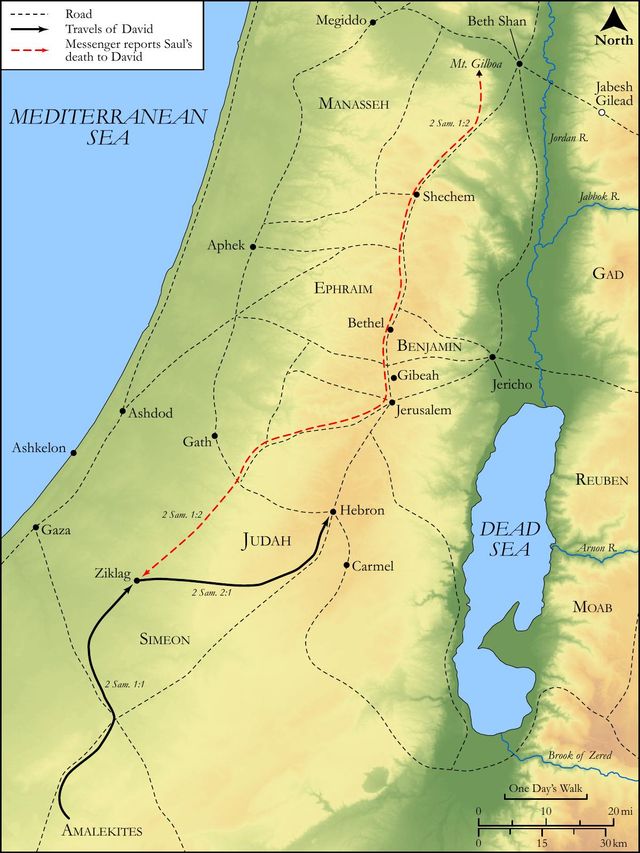
Hebron was an ancient and historically significant city, deeply revered in Israel's patriarchal history as the burial place of Abraham, Isaac, and Jacob, along with their wives (Genesis 23:19). Geographically, it was strategically located in the central hill country of Judah, David's own tribe, making it an ideal choice for establishing his initial base of power and garnering tribal support. Among the kings of that day, a king's household, including his wives and children, was integral to his legitimacy, power, and the succession of his dynasty. The presence of multiple wives often reflected political alliances and secured connections to various regions or influential families. The mention of Ahinoam from Jezreel and Abigail from Carmel highlights David's existing alliances and connections, particularly Abigail, who was formerly the wife of Nabal, a wealthy and influential man in Judah (1 Samuel 25). David's divinely guided move to Hebron was not merely a personal relocation but a calculated and strategic step towards national leadership, culminating in his anointing as king over Judah in 2 Samuel 2:4.
Key Themes
ShowHideThe most prominent theme is Obedience to Divine Guidance. David's immediate "going up thither" demonstrates his consistent reliance on and faithful adherence to God's specific instructions, a hallmark that sharply distinguishes his reign from Saul's. This verse also introduces the theme of the Establishment of the Royal Household and Kingship. The presence of his wives signals the beginning of David's domestic and political consolidation, laying the groundwork for the unified monarchy. Furthermore, the strategic choice of Hebron, explicitly guided by God, emphasizes Divine Providence and Strategic Prudence. God orchestrates circumstances and guides David to a location that is not only historically significant but also politically advantageous for securing the loyalty of his own tribe before eventually extending his rule over all Israel. This highlights God's active involvement in shaping the destiny of His chosen leaders and the nation, ensuring that His plans unfold according to His perfect timing and wisdom, as seen in David's journey from fugitive to king, a journey marked by divine favor and human faithfulness (Psalm 18:30).
Exposition and Analysis
ShowHideKey Word Analysis
ShowHideDerived from a root meaning "loving," this name identifies the central figure of the narrative. Here, David is not merely a historical person but the divinely chosen and anointed king, whose actions are consistently framed by his relationship with Yahweh. His "going up" is an act of obedience by the one destined to rule, emphasizing his unique role in God's redemptive plan.
This verb literally means "to ascend" or "to go up." In this context, it describes David's physical journey to Hebron, which is geographically higher than many surrounding areas. However, ‘âlâh often carries a broader connotation of elevation, progress, or advancement. Here, it subtly hints at David's ascent to a position of leadership and prominence, transitioning from a fugitive to a divinely appointed ruler, marking a significant upward trajectory in his life and calling.
While literally meaning "woman" or "wife," in the context of a leader like David, the mention of his wives is more than a personal detail. It signifies the formation of his royal household, which was a crucial element of a king's power, legitimacy, and the foundation for dynastic succession in ancient Israel. Their presence with him in Hebron establishes the domestic core of his nascent kingdom and underscores the political and social dimensions of his emerging reign.
Verse Breakdown
ShowHide"So David went up thither,"
This clause immediately demonstrates David's faithful and prompt obedience to the Lord's command given in 2 Samuel 2:1. The adverb "So" (or "Then") indicates a direct consequence of his inquiry and God's clear answer. His journey to Hebron was not a personal preference or a political calculation alone, but a divinely ordained step, signifying his consistent reliance on God's guidance for every major decision, even as he was poised to assume kingship. This act sets a precedent for his reign, emphasizing humble submission to divine authority.
"and his two wives also,"
The inclusion of his wives signifies the establishment of his domestic life and, by extension, the foundational structure of his royal household. Among the kings of that day, a king's wives were not just personal companions but often represented political alliances and were crucial for the continuation of the royal line and the stability of the kingdom. Their presence with David in Hebron underscores the beginning of his legitimate rule and the immediate formation of his court, signaling a shift from a nomadic, fugitive existence to a settled, royal one.
"Ahinoam the Jezreelitess, and Abigail Nabal's wife the Carmelite."
This specific identification of David's two wives is highly significant. Ahinoam, from Jezreel, and Abigail, from Carmel (who was formerly married to Nabal, a wealthy and influential man from Judah), represent distinct connections and alliances. Abigail, in particular, brought with her not only her personal wisdom and character (as seen in 1 Samuel 25) but also a connection to considerable wealth, land, and influence within Judah. Their presence with David in Hebron highlights his growing network of support and the consolidation of his status within the southern tribes, strategically preparing him for the broader responsibilities of kingship over all Israel.
Literary Devices
ShowHideThe verse primarily employs Narrative Progression, depicting a crucial and immediate step in David's journey to the throne, directly following his inquiry of the Lord. This forward movement emphasizes David's proactive obedience and God's guiding hand in the unfolding events of establishing the monarchy. Detailing is also prominent, as the specific names and origins of David's two wives are meticulously provided. This not only adds historical verisimilitude but also underscores the personal and political dimensions of David's household, hinting at the alliances and legitimacy he was building. Furthermore, the very act of David "going up thither" to Hebron, while not explicitly a device within this single verse, carries profound Symbolism from the broader biblical narrative, representing patriarchal heritage, tribal loyalty (Judah), and a divinely appointed place for the beginning of a new era of kingship.
Theological and Thematic Connections
ShowHideThis verse powerfully illustrates the principle of divine guidance and human obedience, a recurring and foundational theme throughout biblical history. David's immediate "going up thither" to Hebron, in direct response to God's clear command in 2 Samuel 2:1, serves as a profound model of seeking and faithfully following the Lord's will, especially during significant transitions in life. It underscores that true leadership, particularly in God's economy, is not about self-assertion, political maneuvering, or seizing power, but about humble submission to divine direction. Even as David was poised to become king, his first act was not to consolidate power through human means but to inquire of the Lord, demonstrating that God's sovereignty precedes and directs all human endeavors. This act of obedience lays a righteous and stable foundation for his reign, contrasting sharply with Saul's later disobedience and self-reliance. It teaches us that God's blessing follows obedience, and His plans unfold perfectly when we walk in step with His revealed will.
Reflection and Application
ShowHideDavid's obedient journey to Hebron, guided by specific divine instruction, offers profound and enduring lessons for believers navigating life's myriad transitions and earnestly seeking God's will. In moments of profound uncertainty, personal loss, or new beginnings, our first and most crucial step, mirroring David's, must be to "inquire of the Lord." This is not a passive waiting for a mystical sign but an active seeking through prayer, Scripture, and wise counsel—a posture of humble dependence that unequivocally acknowledges God's ultimate sovereignty over our lives and circumstances. Once God's direction is revealed, David's immediate and faithful obedience serves as a powerful and challenging example. There was no hesitation, no second-guessing, no attempt to negotiate or find an easier path; simply a direct response to "go up thither." This reminds us that God's guidance is often precise, and our part is to act on it without delay, trusting that even seemingly small, obedient steps are integral to His grand, overarching design for our lives. Our willingness to follow God's specific leading, even when the full scope of His plan is not yet visible, is a testament to our faith and a sure pathway to experiencing His perfect providence, peace, and purpose.
Questions for Reflection
ShowHideFAQ
ShowHideWhy did David take only two wives with him to Hebron, given he had more later?
ShowHideAt this specific point in David's life, these two wives, Ahinoam and Abigail, are the ones explicitly mentioned as accompanying him. David's marital history was complex and evolved over time, reflecting the customs and political realities of kingship in that day. While he would later acquire more wives and concubines (e.g., 2 Samuel 3:2-5 lists six sons born to him in Hebron, implying more wives), the focus here is on the immediate establishment of his household as he begins his reign in Hebron. The mention of these two particular wives, especially Abigail, who brought significant social, economic, and political connections from Judah, highlights the crucial personal and political foundations he was laying for his nascent kingdom, rather than providing an exhaustive list of all his relationships at that precise moment. The practice of polygamy was common among the kings of that day, often serving to cement alliances, secure regional influence, and ensure numerous heirs for dynastic continuity.
What was the strategic significance of Hebron for David's initial rule?
ShowHideHebron held immense strategic significance for David. Firstly, it was deeply rooted in Israel's patriarchal history, serving as the revered burial place for Abraham, Isaac, and Jacob, along with their wives (Genesis 23:19). This gave it a powerful symbolic, religious, and historical resonance, connecting David's new rule to the foundational promises made to the patriarchs. Secondly, Hebron was centrally located within the territory of Judah, David's own tribe. This made it an ideal and politically astute base to consolidate support from his own people, who would soon anoint him king over Judah (2 Samuel 2:4). Its strong tribal connections, historical importance, and strategic geographical position provided a legitimate and stable platform from which David could eventually extend his rule over all Israel, ultimately uniting the divided tribes under his kingship.
Christ-Centered Fulfillment
ShowHideDavid's obedient journey to Hebron, guided by precise divine instruction, serves as a profound and multifaceted foreshadowing of Jesus Christ, the ultimate King and Son of David. Just as David, the anointed one, humbly sought and faithfully followed the Father's will in establishing his earthly kingdom, so too did Christ perfectly embody obedience, even to the point of sacrificial death on a cross (Philippians 2:8). David's "going up thither" to establish his kingdom in Hebron, a city of deep patriarchal heritage and the heart of Judah, powerfully prefigures Christ's ascension to His heavenly throne, from which He now reigns eternally over His spiritual kingdom, the Church (Acts 1:9-11 and Ephesians 1:20-23). The mention of David's wives, forming the nucleus of his royal household and symbolizing the stability of his reign, can be seen as a beautiful type of Christ's relationship with His beloved bride, the Church, whom He loves, nourishes, and sanctifies (Ephesians 5:25-27). Ultimately, David's initial step in establishing a temporal, earthly kingdom, born of profound obedience, points to the greater reality of Christ's eternal, heavenly kingdom, established not through human might but through His perfect submission to the Father's will and His ultimate, redemptive sacrifice for His people (Colossians 1:13-14).