


1 Chronicles 19:1
- וַיְהִיvay·Hiand it wasH1961Conj-w ¦ V-Qal-ConsecImperf-3msVerb Qal Consecutive Imperfect 3rd Singular Masculineוַandיְהִיit was
- אַחֲרֵי'a·cha·reiafterH310Adj-mpcAdjective Numerical Plural Masculine Construct
- כֵןKhenthusH3651AdvAdverb
- וַיָּמָתvai·Ya·motand he diedH4191Conj-w ¦ V-Qal-ConsecImperf-3msVerb Qal Consecutive Imperfect 3rd Singular Masculineוַandיָּמָתhe died
- נָחָשׁna·ChashNahashH5176N-proper-mNoun Proper Masculine
- מֶלֶךְMe·lekh[the] king ofH4428N-mscNoun Singular Masculine Construct
- בְּנֵיbe·nei[the] people ofH1121N-mpcNoun Plural Masculine Construct
- עַמּוֹןa·MonAmmonH5983N-proper-mNoun Proper Masculine
- וַיִּמְלֹךְvai·yim·Lokhand he reignedH4427Conj-w ¦ V-Qal-ConsecImperf-3msVerb Qal Consecutive Imperfect 3rd Singular Masculineוַandיִּמְלֹךְhe reigned
- בְּנוֹbe·Nohis sonH1121N-msc ¦ 3msNoun Singular Masculine Constructבְּנsonוֹhis
- תַּחְתָּיוtach·Tavin place of himH8478N-mpc ¦ 3msNoun Plural Masculine Constructתַּחְתָּיin place ofוhim
English is a literal word-by-word gloss of the Hebrew, not the KJV's wording. Why?
This is the original text the KJV's translators worked from — each Hebrew word with its own literal English meaning in this verse, prepared by scholars at Tyndale House, Cambridge. The KJV translates whole sentences, not word by word, so its wording differs: one Hebrew word can become several English words, and the KJV may choose “the LORD” where the gloss reads “Yahweh”. Both are faithful — they answer different questions. For the KJV's own rendering, switch to the KJV text.
Details
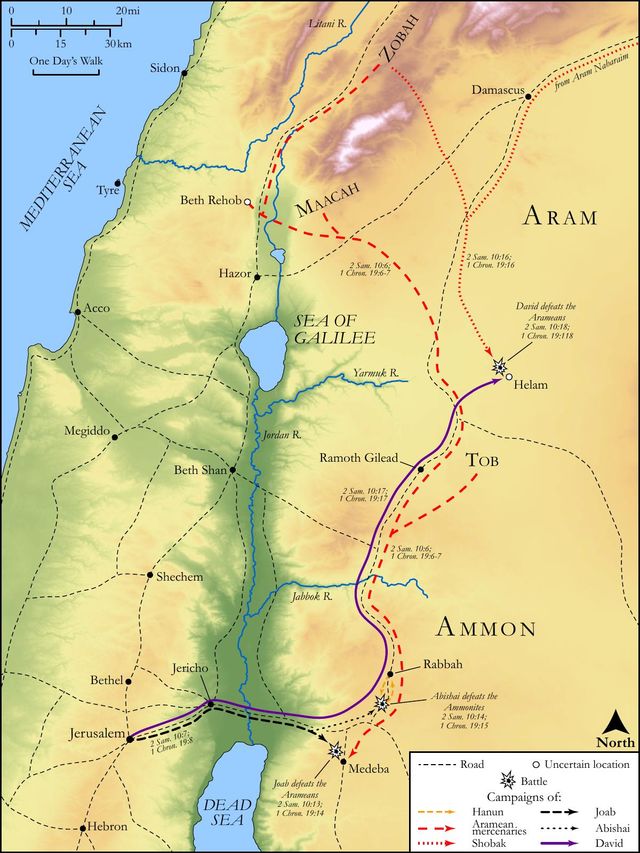
See on the biblical-era map
Study this verse
Public-domain commentary
Matthew Henry
From his Commentary on the Whole Bible. Henry comments on passages, not single verses — this entry covers 1 Chronicles 19:1–5.
Let us here observe, 1. That is becomes good people to be neighbourly, and especially to be grateful. David will pay respect to Hanun because he is his neighbour; and religion teaches us to be civil and obliging to all, to honour all men, and to be ready to do all offices of kindness to those we live among; nor must difference in religion be any obstruction to this. But, besides this, David remembered the kindness which his father showed to him. Those that have received kindness must return it as they have ability and opportunity: those that have received it from the parents must return it to the children when they are gone. 2. That, as saith the proverb of the ancients, Wickedness proceedeth from the wicked, Sa1 24:13. The vile person will speak villany, and the instruments of the churl will be evil, to destroy those with lying words that speak right, Isa 32:6, Isa 32:7. Those that are base, and design ill themselves, are apt to be jealous and to suspect ill of others without cause. Hanun's servant suggested that David's ambassadors came as spies, as if so great and mighty a man as David needed to do so mean a thing (if he had any design upon the Ammonites, he could effect it by open force, and had no occasion for any fraudulent practices), or as if a man of such virtue and honour would do so base a thing. Yet Hanun hearkened to the suggestion, and, against the law of nations, treated David's ambassadors villainously. 3. Masters ought to protect their servants, and with the greatest tenderness to concern themselves for them if they come by any loss or damage in their service. David did so for his ambassadors, Ch1 19:5. Christ will do so for his ministers; and let all masters thus give unto their servants that which is just and equal.
Continue studying 1 Chronicles 19:1 across the web’s major study libraries — every link below opens this exact verse, chapter, or book on the destination site.
Read & Compare
 BibleGatewayThis verse in more than 200 translations and 70 languages.
 Bible.comThe YouVersion reader — hundreds of translations, reading plans, and highlights.
 ESV.orgCrossway's official English Standard Version reader.
 NET BibleThe NET translation with 60,000+ translators' notes on every rendering decision.
 STEP BibleTyndale House's free study tool — original text, vocabulary, and scholarly resources.
 BibliaLogos Bible Software's free web reader.
 USCCBThe New American Bible (Revised Edition) with the U.S. bishops' study notes.
Commentaries
 BibleHub CommentariesDozens of classic commentaries on this verse, gathered on one page.
 StudyLightMore than 100 commentary sets — the largest collection on the web.
 BibleRefPlain-English commentary on what this verse means, verse by verse.
 Enduring WordDavid Guzik's free commentary on this chapter, widely used by Bible teachers.
 Bible Study ToolsVerse commentary alongside Greek and Hebrew study aids.
Original Language & Research
- BibleHub InterlinearThe verse word by word — original language, transliteration, and English.
- BibleHub LexiconEvery word's original-language definition and Strong's entry.
 Blue Letter BibleDeep-study tools — Strong's numbers, concordance, and word studies.
 SefariaThe Hebrew text with Rashi and centuries of Jewish commentary.
Sermons, Hymns & Audio


TrulyRandomVerse is not affiliated with these sites and doesn’t control their content. They’re linked because they’re genuinely useful.
Summary
1 Chronicles 19:1 serves as a pivotal narrative transition, marking the death of Nahash, king of the Ammonites, and the ascension of his son, Hanun, to the throne. This seemingly straightforward announcement, following David's extensive military victories and consolidation of his kingdom, sets in motion a chain of events that will profoundly impact Israel's foreign relations, testing King David's diplomatic acumen and ultimately leading to a significant and costly war with the Ammonites. The verse establishes the immediate context for David's subsequent, well-intentioned but ill-fated, gesture of condolence.
Context
ShowHideLiterary Context
This verse immediately follows the Chronicler's detailed account of King David's extensive military conquests and the secure establishment of his kingdom in 1 Chronicles 18. Having subdued surrounding nations like the Philistines, Moabites, Zobah, and Syrians, David has brought a period of relative peace and prosperity to Israel. The phrase "after this" explicitly links the diplomatic overture to the Ammonites with David's prior successes, implying that David, now secure in his dominion, turns his attention to maintaining peaceful relations with neighboring states. The death of Nahash and the succession of his son, Hanun, provides the narrative catalyst for the events of 1 Chronicles 19, which recounts David's attempt at diplomacy, its disastrous failure, and the ensuing war. This account closely parallels the narrative found in 2 Samuel 10, with the Chronicler often streamlining or re-emphasizing aspects relevant to his post-exilic audience, focusing on the legitimacy of David's line and the unified kingdom.
Historical & Cultural Context
In the ancient Near East, the death of a monarch and the succession of a new king often presented a critical juncture for international relations. Neighboring kingdoms would typically send envoys to offer condolences and reaffirm existing treaties or establish new ones, a practice seen as both diplomatic courtesy and a strategic move to assess the new ruler's disposition. The Ammonites, descendants of Lot (Genesis 19:38), were a long-standing rival of Israel, frequently engaging in border disputes and conflicts. However, Nahash, the deceased king, is known from 2 Samuel 10:2 to have shown kindness to David during his difficult period under Saul's reign. This past relationship likely motivated David's seemingly benevolent gesture of sending messengers to console Hanun, Nahash's son, upon his father's death, a gesture that was tragically misconstrued by Hanun's advisors.
Key Themes
ShowHideThis verse, though brief, introduces several significant themes that resonate throughout the broader narrative of David's reign and beyond. Firstly, it highlights the transition of power and its inherent volatility; a change in leadership, even in a neighboring state, can dramatically alter diplomatic landscapes and lead to unforeseen consequences. Secondly, it serves as a setting for conflict, demonstrating how even well-intentioned acts of diplomacy can be misinterpreted, leading to hostility and war. This foreshadows the devastating conflict that will unfold in the subsequent verses, emphasizing the delicate nature of peace and the perils of international relations. Finally, the verse implicitly touches upon the theme of divine sovereignty amidst human action, as even the death of a foreign king and the succession of his son are part of the larger tapestry of God's plan for David and Israel, even if the immediate human outcomes are tragic. The Chronicler, in particular, often emphasizes God's guiding hand over the events of history, even those seemingly driven by human folly, as seen in the unfolding of events in 1 Chronicles 19:2-19.
Exposition and Analysis
ShowHideKey Word Analysis
ShowHideThis proper noun identifies the specific Ammonite monarch whose death precipitates the events of the chapter. While the Hebrew root for Nâchâš can mean "serpent," in this context, it functions solely as the name of a historical figure. His demise marks a significant shift in the political landscape between Israel and Ammon, setting the stage for a new era of relations, whether peaceful or hostile.
This primitive root signifies the cessation of life, literally or figuratively. In 1 Chronicles 19:1, it denotes the physical death of King Nahash. This event is not merely a factual report but the direct catalyst for David's diplomatic overture. The finality of death, even for a powerful king, underscores the transient nature of earthly rule and serves as a critical turning point in the unfolding narrative.
This primitive root means "to reign," or inceptively, "to ascend the throne." It indicates the orderly and legitimate succession of Nahash's son, Hanun, to the Ammonite kingship. This transition of power, while routine, proves to be profoundly significant, as the new king's character and the counsel he receives will dramatically alter the trajectory of relations between Israel and Ammon, leading to unforeseen and devastating conflict.
Verse Breakdown
ShowHide"Now it came to pass after this"
This introductory phrase serves as a crucial narrative connector, linking the events of 1 Chronicles 19 directly to the preceding chapter, 1 Chronicles 18. It signals a shift from David's external conquests to a new phase involving diplomatic relations, which will unexpectedly lead to further conflict.
"that Nahash the king of the children of Ammon died"
This clause announces the central event that precipitates the subsequent narrative. The death of Nahash, a foreign king, is not merely a historical note but the direct trigger for David's diplomatic initiative. It highlights the transient nature of human power and sets the stage for a change in the geopolitical dynamics of the region.
"and his son reigned in his stead"
This final clause confirms the succession of Nahash's son, Hanun, to the Ammonite throne. The orderly transfer of power is noted, but it is this new leadership, specifically Hanun's suspicious and ultimately hostile reaction to David's embassy, that transforms a moment of potential diplomatic goodwill into a devastating war. The transition of power, while routine, proves to be the turning point for the relationship between Israel and Ammon.
Literary Devices
ShowHide1 Chronicles 19:1 employs several subtle but effective literary devices. The most prominent is Foreshadowing. While seemingly a simple statement of fact, the verse, especially in light of the subsequent narrative, subtly hints at the significant conflict that is about to unfold. The death of a king and the ascension of a new, unknown ruler inherently carry the potential for instability and altered foreign policy, which is precisely what occurs. It functions as a Narrative Hinge, pivoting the story from David's established military victories in 1 Chronicles 18 to a new phase of diplomatic challenge and war in 1 Chronicles 19. Furthermore, the passage exhibits Parallelism with 2 Samuel 10:1, a common feature of the Chronicler's work, where he re-presents and often re-interprets narratives from Samuel and Kings, sometimes with a specific theological or historical emphasis for his audience.
Theological and Thematic Connections
ShowHideThis verse, though brief, underscores the profound impact of transitions in leadership and the delicate nature of international relations, themes that resonate throughout biblical history. It reminds us that even seemingly mundane events, like the death of a foreign king, can be divinely orchestrated or permitted to set in motion significant historical and theological developments. The Chronicler, in particular, emphasizes God's sovereign hand over all nations and events, even when human actions (like Hanun's folly) seem to drive the immediate narrative. This incident serves as a stark reminder that human intentions, however good (as David's were), can be tragically misunderstood, leading to conflict and suffering. It highlights the need for wisdom, discernment, and reliance on God's guidance in all diplomatic and interpersonal dealings, recognizing that pride and suspicion can quickly unravel peace.
Reflection and Application
ShowHideThe seemingly simple announcement of a king's death and his son's succession in 1 Chronicles 19:1 carries a profound message for us today. It serves as a powerful reminder that life is filled with transitions – in leadership, in relationships, in personal circumstances – and each transition carries the potential for both opportunity and peril. David's well-intentioned gesture of kindness, born from a past relationship, quickly devolved into a major conflict due to suspicion and misjudgment on the part of the new king and his advisors. This narrative challenges us to consider how we navigate new beginnings and changes in leadership, whether in our families, workplaces, churches, or communities. Are we quick to assume the worst, or do we extend grace and seek understanding? It also underscores the importance of seeking divine wisdom in all our dealings, recognizing that human efforts, however noble, can be thwarted by pride or misunderstanding. The subsequent events serve as a cautionary tale about the need for careful discernment and a spirit of peace, even when faced with new and uncertain dynamics.
Questions for Reflection
ShowHideFAQ
ShowHideWhy does the Chronicler include this seemingly minor detail about a foreign king's death?
ShowHideThe Chronicler includes this detail not because the death of Nahash itself is of primary theological significance, but because it serves as the crucial narrative trigger for a major conflict that profoundly impacts King David's reign and the history of Israel. It sets the stage for David's diplomatic overture to the new Ammonite king, Hanun, which is then tragically misinterpreted, leading to a significant war. For the Chronicler, whose primary aim is to trace the history of God's covenant with David and the kingdom of Judah, this event illustrates the complexities of leadership, the challenges of foreign relations, and the consequences of human pride and misjudgment, all within the broader context of God's sovereign plan for His people. It highlights how seemingly small events can have large consequences, shaping the destiny of nations as seen in the unfolding of events in 1 Chronicles 19:2-19.
Christ-Centered Fulfillment
ShowHideWhile 1 Chronicles 19:1 details a historical transition and the catalyst for a human conflict, it subtly points to the ultimate King and His kingdom. David's reign, though glorious, was marked by human limitations, diplomatic failures, and the constant threat of war, as evidenced by the events that follow this verse. The death of Nahash and the succession of Hanun, leading to a period of strife, highlights the fragility of peace under human kingship. In contrast, Jesus Christ is the King whose reign knows no end, and whose kingdom is not subject to the volatile transitions of earthly power or the misunderstandings of human diplomacy. He is the true Son who reigns in His Father's stead, not by succession due to death, but by eternal divine appointment (Hebrews 1:8). Unlike Hanun, who responded to a gesture of kindness with suspicion and hostility, Christ extends perfect grace and peace, even to His enemies (Romans 5:8). The ultimate fulfillment of a stable, righteous, and eternal kingdom is found not in David's earthly realm, but in the reign of the Prince of Peace, Jesus Christ, who will ultimately bring true and lasting peace to all who submit to His perfect rule (Revelation 11:15).