


1 Chronicles 18:17
Bible text: King James Version (1769 Blayney text) · Public domain
Bible text: Berean Standard Bible · Public domain
Bible text: American Standard Version (1901) · Public domain
Bible text: World English Bible, Messianic edition · Public domain
Bible text: Geneva Bible (1599) · Public domain
Bible text: Young's Literal Translation · Public domain
- וּבְנָיָהוּu·ve·na·Ya·huand BenaiahH1141Conj-w ¦ N-proper-mNoun Proper MasculineוּandבְנָיָהוּBenaiah
- בֶּןben[the] son ofH1121N-mscNoun Singular Masculine Construct
- יְהוֹיָדָעye·Ho·ya·Da'JehoiadaH3077N-proper-mNoun Proper Masculine
- עַל'al[was] overH5921PrepPreposition
- הַכְּרֵתִיha·ke·re·Tithe Kerethite[s]H3774Art ¦ N-msNoun Gentilic Singular Masculine AbsoluteהַtheכְּרֵתִיKerethite[s]
- וְהַפְּלֵתִיve·ha·pe·le·Tiand the Pelethite[s]H6432Conj-w ¦ Art ¦ N-msNoun Gentilic Singular Masculine AbsoluteוְandהַtheפְּלֵתִיPelethite[s]
- וּבְנֵיu·ve·neiand [the] sons ofH1121Conj-w ¦ N-mpcNoun Plural Masculine Constructוּandבְנֵי[the] sons of
- דָוִידda·VidDavidH1732N-proper-mNoun Proper Masculine
- הָרִאשֹׁנִיםha·ri·sho·Nim[were] the firstH7223Art ¦ Adj-mpAdjective Numerical Position Plural Masculine Absoluteהָ[were] theרִאשֹׁנִיםfirst
- לְיַדle·Yadto [the] side ofH3027Prep-l ¦ N-cscNoun Singular common gender Constructלְtoיַד[the] side of
- הַמֶּלֶךְha·Me·lekhthe kingH4428Art ¦ N-msNoun Singular Masculine Absoluteהַtheמֶּלֶךְking
English is a literal word-by-word gloss of the Hebrew, not the KJV's wording. Why?
This is the original text the KJV's translators worked from — each Hebrew word with its own literal English meaning in this verse, prepared by scholars at Tyndale House, Cambridge. The KJV translates whole sentences, not word by word, so its wording differs: one Hebrew word can become several English words, and the KJV may choose “the LORD” where the gloss reads “Yahweh”. Both are faithful — they answer different questions. For the KJV's own rendering, switch to the KJV text.
Details
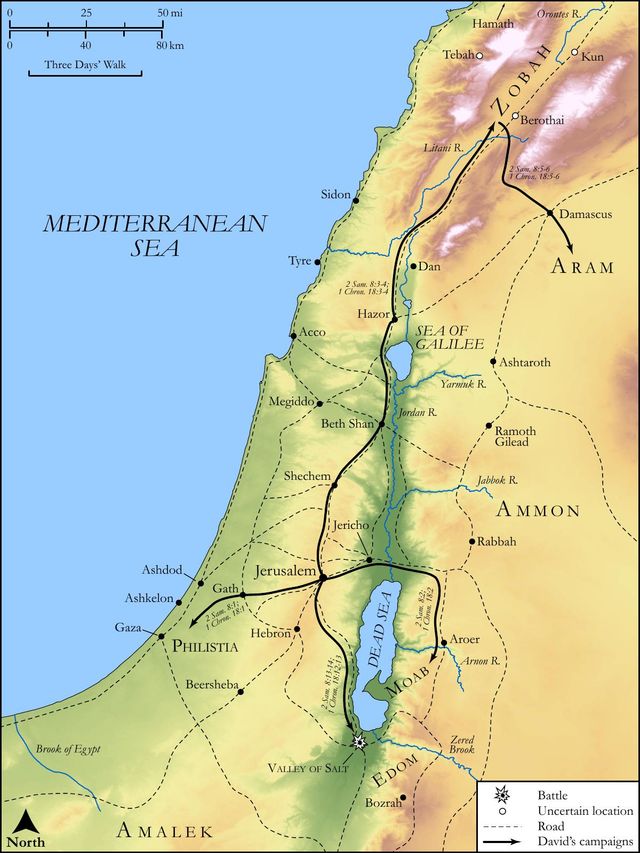
See on the biblical-era map
Study this verse
Public-domain commentary
Matthew Henry
From his Commentary on the Whole Bible. Henry comments on passages, not single verses — this entry covers 1 Chronicles 18:9–17.
Here let us learn, 1. That it is our interest to make those our friends who have the presence of God with them. The king of Hamath, hearing of David's great success, sent to congratulate him and to court his favour with a noble present, Ch1 18:9, Ch1 18:10. It is in vain to contend with the Son of David. Kiss the Son, therefore, lest he be angry; let the kings and judges of the earth, and all inferior people too, be thus wise, thus instructed. The presents we are to bring him are not vessels of gold and silver, as here (those shall be welcomed to him who have no such presents to bring), but our hearts and sincere affections, our whole selves, we must present to him as living sacrifices. 2. That what God blesses us with we must honour him with. The presents of his friends, as well as the spoils of his enemies, David dedicated unto the Lord (Ch1 18:11), that is, he laid them up towards the building and enriching of the temple. That is most truly and most comfortably our own which we have consecrated unto the Lord, and which we use for his glory. Let our merchandise and our hire be holiness to the Lord, Isa 23:18. 3. That those who take God along with them whithersoever they go may expect to prosper, and be preserved, whithersoever they go. It was said before (Ch1 18:6) and here it is repeated (Ch1 18:13) that the Lord preserved David whithersoever he went. Those are always under the eye of God that have God always in their eye. 4. God gives men power, not that they may look great with it, but that they may do good with it. When David reigned over all Israel he executed judgment and justice among all his people, and so answered the end of his elevation. He was not so intent on his conquests abroad as to neglect the administration of justice at home. Herein he served the purposes of the kingdom of providence, and of that God who sits in the throne judging right; and he was an eminent type of the Messiah, the sceptre of whose kingdom is a right sceptre.
Continue studying 1 Chronicles 18:17 across the web’s major study libraries — every link below opens this exact verse, chapter, or book on the destination site.
Read & Compare
 BibleGatewayThis verse in more than 200 translations and 70 languages.
 Bible.comThe YouVersion reader — hundreds of translations, reading plans, and highlights.
 ESV.orgCrossway's official English Standard Version reader.
 NET BibleThe NET translation with 60,000+ translators' notes on every rendering decision.
 STEP BibleTyndale House's free study tool — original text, vocabulary, and scholarly resources.
 BibliaLogos Bible Software's free web reader.
 USCCBThe New American Bible (Revised Edition) with the U.S. bishops' study notes.
Commentaries
 BibleHub CommentariesDozens of classic commentaries on this verse, gathered on one page.
 StudyLightMore than 100 commentary sets — the largest collection on the web.
 BibleRefPlain-English commentary on what this verse means, verse by verse.
 Enduring WordDavid Guzik's free commentary on this chapter, widely used by Bible teachers.
 Bible Study ToolsVerse commentary alongside Greek and Hebrew study aids.
Original Language & Research
- BibleHub InterlinearThe verse word by word — original language, transliteration, and English.
- BibleHub LexiconEvery word's original-language definition and Strong's entry.
 Blue Letter BibleDeep-study tools — Strong's numbers, concordance, and word studies.
 SefariaThe Hebrew text with Rashi and centuries of Jewish commentary.
Sermons, Hymns & Audio


TrulyRandomVerse is not affiliated with these sites and doesn’t control their content. They’re linked because they’re genuinely useful.
Summary
1 Chronicles 18:17 offers a succinct yet profound insight into the structural integrity and administrative genius of King David's reign, showcasing the strategic deployment of loyal and capable individuals within his burgeoning kingdom. It meticulously details the critical oversight of Benaiah, who commanded David's elite personal guard, the Cherethites and Pelethites, and the prominent, advisory roles held by David's own sons, thereby underscoring the sophisticated governance and dynastic continuity that characterized the monarchy during a period of significant national consolidation and expansion.
Context
ShowHideLiterary Context
This verse is strategically positioned within a larger narrative block (1 Chronicles 18-20) that meticulously chronicles David's military successes and the subsequent establishment of his kingdom's administrative framework. Following accounts of divine favor leading to decisive victories over surrounding nations—including the Philistines, Moabites, Zobah, and Edom—chapter 18 pivots to detail the internal organization of David's government. Verses 14-17 serve as a summary of David's righteous and effective rule, highlighting the key officials who facilitated his governance. Specifically, verse 17 lists the crucial personnel responsible for the king's immediate security and the internal administration, emphasizing that David's remarkable success was not solely military, but deeply rooted in his capacity to establish a stable, well-ordered, and divinely blessed government. The Chronicler's intent is to portray David as an ideal king, whose reign was marked by both military prowess and administrative wisdom, setting the stage for the temple building project and the enduring Davidic covenant.
Historical & Cultural Context
David's reign (c. 1010-970 BC) marked a pivotal transition in Israel from a loose tribal confederacy to a centralized monarchy. In this nascent stage of national identity, establishing a robust, stable government with a loyal military and administrative core was paramount for both national security and internal cohesion. The mention of the "Cherethites and Pelethites" reflects a common practice among the kings of that day, who employed elite, often foreign, personal bodyguards. These units were renowned for their unwavering loyalty, serving as the king's direct security and often executing sensitive commands, distinct from the general national army. Their presence underscores David's need for a dedicated, professional force. The involvement of "the sons of David" in high-ranking positions reflects the dynastic principle prevalent in ancient monarchies, where royal family members were integral to governance, ensuring loyalty, continuity, and a pool of potential successors. This arrangement minimized internal power struggles and solidified the royal lineage.
Key Themes
ShowHide1 Chronicles 18:17 significantly contributes to several overarching themes woven throughout the book. Firstly, it exemplifies the theme of God's providential blessing on David's reign, manifesting not only in military victories but also in the stability and order of his kingdom, as powerfully articulated in 1 Chronicles 18:6. Secondly, the verse underscores the importance of wise and organized leadership, demonstrating David's sagacity in delegating authority and assembling a competent, trustworthy team, a principle consistently affirmed in biblical wisdom literature, such as Proverbs 11:14. Thirdly, it subtly emphasizes the critical role of loyalty and trust within the king's inner circle, which was indispensable for maintaining royal authority and ensuring national security, particularly during periods of consolidation and potential internal strife, as vividly illustrated during Absalom's rebellion. Finally, the verse touches upon the dynastic nature of the monarchy, highlighting the involvement of David's sons in administration, thereby setting the foundational stage for the future succession and the enduring line of David.
Exposition and Analysis
ShowHideKey Word Analysis
ShowHideThis term refers to a specialized, elite military unit that served as King David's personal bodyguard. From a root meaning "to cut off" or "executioner," these "life-guardsmen" were known for their unwavering loyalty and effectiveness in carrying out the king's direct commands, including those requiring decisive action. While their precise origin is debated, their distinct identity from the general Israelite army points to a professional, highly disciplined force crucial for the king's immediate safety and the enforcement of royal decrees.
Always mentioned in conjunction with the Cherethites, the Pelethites formed the other half of David's elite personal guard. Their name is linked to the idea of a "courier" or "official messenger," suggesting their role involved swift movement, communication, and direct service to the king. Together with the Cherethites, they formed the core of David's trusted security detail, renowned for their absolute devotion and reliability, particularly in times of crisis.
This word, meaning "first," "foremost," or "principal," indicates that David's sons held positions of preeminence, authority, or leadership directly "about the king." It signifies that they were not merely present as royal family members, but were actively involved in the highest levels of administration, serving as principal advisors, administrators, or perhaps even regional governors. This highlights their elevated status and the dynastic nature of the monarchy, where royal lineage often translated into significant governmental roles.
Verse Breakdown
ShowHide"And Benaiah the son of Jehoiada [was] over the Cherethites and the Pelethites"
This clause underscores Benaiah's significant military authority and the profound trust David placed in him. Benaiah, a renowned warrior (as detailed in 2 Samuel 23:20-23), was not merely a commander but was given charge over David's most loyal and elite personal guard. This appointment signifies his crucial role in safeguarding the king's person and enforcing royal decrees, thereby ensuring the stability and security of the throne. His later elevation to commander of the entire army under Solomon (1 Kings 2:35) further solidifies his reputation for exceptional competence and unwavering loyalty.
"and the sons of David [were] chief about the king"
This part of the verse reveals the prominent and influential roles held by David's own children within the governmental structure. Their position as "chief about the king" implies they were not just members of the royal family but actively participated in the highest echelons of administration, counsel, or even specific governmental departments. This arrangement served multiple purposes: it solidified the dynastic succession, ensured family loyalty within the government, and provided a pool of potential future leaders, reflecting the common practice of royal families holding key positions in the monarchies of that day to consolidate power and ensure continuity.
Literary Devices
ShowHideThe verse employs several effective literary devices to convey its administrative details with clarity and impact. The primary device is Enumeration or List, as it systematically names key personnel and their respective roles, providing a clear, almost organizational snapshot of David's structured administration. This listing functions to emphasize the order and efficiency of his kingdom. There is also an element of Synecdoche, where the naming of Benaiah, the Cherethites, and the Pelethites, and the sons of David, serves as a concise representation of the broader concepts of military strength, personal security, and dynastic governance, respectively. The verse's concise nature also contributes to Emphasis, underscoring the vital importance of these specific individuals and groups in maintaining the king's authority and the kingdom's stability. The deliberate brevity highlights their essential functions without unnecessary elaboration.
Theological and Thematic Connections
ShowHide1 Chronicles 18:17, while seemingly a straightforward administrative detail, carries profound theological and thematic weight, particularly within the Chronicler's broader narrative. It illustrates God's providential hand in establishing and ordering David's kingdom, not solely through military victory but also through the formation of a stable, loyal, and efficient government. The careful selection and placement of trusted individuals like Benaiah and the integral involvement of the royal family reflect principles of good governance and the paramount importance of integrity, competence, and loyalty in leadership—values consistently upheld throughout Scripture. This verse subtly teaches that divine blessing often manifests through human organization, wisdom, and the faithful stewardship of authority, ensuring justice and order for the people. It underscores that even the mundane details of administration are part of God's larger plan for a righteous society.
Reflection and Application
ShowHideThis ancient verse offers timeless principles for leadership and community building that resonate deeply today. It reminds us that effective leadership, whether in a family, a church, a business, or any organizational sphere, demands not only vision and strategic planning but also the wise delegation of authority and the careful selection of trustworthy, competent individuals for key roles. David's kingdom flourished because he surrounded himself with people of integrity and loyalty who shared his vision for a righteous and ordered society. For us, this translates into the importance of intentionally building strong teams, fostering an environment of trust, and recognizing that true collective strength emerges from a well-ordered structure where each member contributes their unique gifts to the common good. It challenges us to consider carefully who we "appoint" in our spheres of influence—those we entrust with significant responsibilities, those whose loyalty, character, and competence are beyond reproach. Just as David relied on his inner circle for the stability of his earthly kingdom, we are called to be faithful stewards of the gifts and responsibilities God has given us, working in harmony with others to advance His purposes and build up His kingdom on earth. This verse encourages us to seek out and empower those who are "chief about the King" in their dedication and service.
Questions for Reflection
ShowHideFAQ
ShowHideWere the Cherethites and Pelethites Israelites or foreigners?
ShowHideWhile their exact origin is a subject of scholarly debate, the prevailing view is that the Cherethites and Pelethites were non-Israelite, likely foreign mercenaries. Their name "Cherethites" is often linked to "Cretans," suggesting a possible origin from Crete or the Philistine region. Their distinct identity from the general Israelite army and their unwavering loyalty to David, even during times of rebellion (e.g., 2 Samuel 15:18), strongly suggest they were a professional, highly disciplined personal guard force whose allegiance was directly to the king rather than to tribal affiliations within Israel. This practice of employing foreign bodyguards was common among the kings of that day.
Christ-Centered Fulfillment
ShowHideWhile 1 Chronicles 18:17 meticulously details the earthly administration of King David, it subtly yet profoundly points forward to the perfect, eternal reign of King Jesus. David, as an earthly king, required a structured government, loyal commanders like Benaiah, and trusted advisors in his own sons to maintain order and security within his temporal kingdom. This earthly kingdom, however, was but a shadow and a foretaste of the ultimate, perfectly ordered, and eternally secure kingdom of God, over which Christ reigns supreme. Jesus, the true Son of David and the King of kings, does not require a personal bodyguard like the Cherethites and Pelethites, for His authority is absolute and His reign is unassailable, encompassing all power in heaven and on earth (Matthew 28:18). Unlike David's sons, who were "chief about the king" in an earthly, administrative capacity, Christ's followers are called to be "chief" in a spiritual and eternal sense, serving as His ambassadors, co-heirs, and even co-regents in His heavenly kingdom (Ephesians 2:6 and Revelation 20:6). The order, loyalty, and effective governance seen in David's court find their ultimate and perfect fulfillment in the church, the body of Christ, where each member is perfectly placed and empowered by the Holy Spirit to serve the Head, Jesus Christ, in perfect unity and unwavering devotion (1 Corinthians 12:12-27). His kingdom is not merely administered but eternally established, founded on His perfect righteousness and sustained by His divine power, requiring no human security detail but inviting all to enter into His everlasting peace and perfect governance (Isaiah 9:6-7).