


1 Kings 2:34
Bible text: King James Version (1769 Blayney text) · Public domain
Bible text: Berean Standard Bible · Public domain
Bible text: American Standard Version (1901) · Public domain
Bible text: World English Bible, Messianic edition · Public domain
Bible text: Geneva Bible (1599) · Public domain
Bible text: Young's Literal Translation · Public domain
- וַיַּעַלvai·Ya·'aland he went upH5927Conj-w ¦ V-Qal-ConsecImperf-3msVerb Qal Consecutive Imperfect 3rd Singular Masculineוַandיַּעַלhe went up
- בְּנָיָהוּbe·na·Ya·huBenaiahH1141N-proper-mNoun Proper Masculine
- בֶּןben[the] son ofH1121N-mscNoun Singular Masculine Construct
- יְהוֹיָדָעye·Ho·ya·Da'JehoiadaH3077N-proper-mNoun Proper Masculine
- וַיִּפְגַּעvai·yif·ga'and he fellH6293Conj-w ¦ V-Qal-ConsecImperf-3msVerb Qal Consecutive Imperfect 3rd Singular Masculineוַandיִּפְגַּעhe fell
- בּוֹboon himPrep-b ¦ 3msSuffix Personal 3rd Singular Masculineבּonוֹhim
- וַיְמִתֵהוּvay·mi·Te·huand he put to death himH4191Conj-w ¦ V-Hiphil-ConsecImperf-3ms ¦ 3msVerb Hiphil Consecutive Imperfect 3rd Singular Masculineוַandיְמִתֵhe put to deathהוּhim
- וַיִּקָּבֵרvai·yi·ka·Verand he was buriedH6912Conj-w ¦ V-Niphal-ConsecImperf-3msVerb Niphal Consecutive Imperfect 3rd Singular Masculineוַandיִּקָּבֵרhe was buried
- בְּבֵיתוֹbe·vei·Toin his own houseH1004Prep-b ¦ N-msc ¦ 3msNoun Singular Masculine Constructבְּinבֵיתown houseוֹhis
- בַּמִּדְבָּרba·mid·Barin the wildernessH4057Prep-b ¦ N-msNoun Singular Masculine Absoluteבַּin theמִּדְבָּרwilderness
English is a literal word-by-word gloss of the Hebrew, not the KJV's wording. Why?
This is the original text the KJV's translators worked from — each Hebrew word with its own literal English meaning in this verse, prepared by scholars at Tyndale House, Cambridge. The KJV translates whole sentences, not word by word, so its wording differs: one Hebrew word can become several English words, and the KJV may choose “the LORD” where the gloss reads “Yahweh”. Both are faithful — they answer different questions. For the KJV's own rendering, switch to the KJV text.
Details
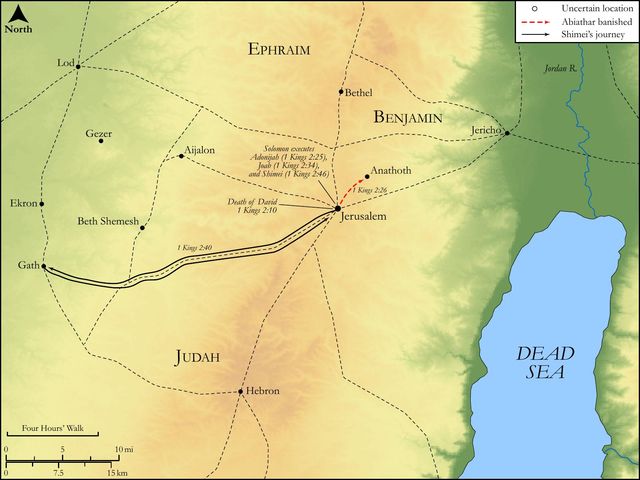
See on the biblical-era maps

Study this verse
Public-domain commentary
Matthew Henry
From his Commentary on the Whole Bible. Henry comments on passages, not single verses — this entry covers 1 Kings 2:26–34. His three-level outline is real structure in the source text, so it is rendered as structure.
Abiathar and Joab were both aiding and abetting in Adonijah's rebellious attempt, and it is probable were at the bottom of this new motion made of Adonijah for Abishag, and it should seem Solomon knew it, Kg1 2:22. This was, in both, an intolerable affront both to God and to the government, and the worse because of their high station and the great influence their examples might have upon many. They therefore come next to be reckoned with. They are both equally guilty of the treason, but, in the judgment passed upon them, a difference is made and with good reason.
I.Abiathar, in consideration of his old services, is only degraded, Kg1 2:26, Kg1 2:27.
1. Solomon convicts him, and by his great wisdom finds him guilty: "Thou art worthy of death, for joining with Adonijah, when thou knewest on whose head God intended to set the crown." 2. He calls to mind the respect he had formerly shown to David his father, and that he had both ministered to him in holy things (had borne before him the ark of the Lord), and also had tenderly sympathized with him in his afflictions and been afflicted in them all, particularly when he was in exile and distress both by Saul's persecution and Absalom's rebellion. Note, Those that show kindness to God's people shall have it remembered to their advantage one time or other. 3. For this reason he spares Abiathar's life, but deposes him from his offices, and confines him to his country seat at Anathoth, forbids him the court, the city, the tabernacle, the altar, and all inter-meddling in public business, with an intimation likewise that he was upon his good behaviour, and that though Solomon did not put him to death at this time he might another time, if he did not conduct himself well. But, for the present, he was only thrust out from being priest, as rendered unworthy that high station by the opposition he had given to that which he knew to be the will of God. Saul, for a supposed crime, had barbarously slain Abiathar's father, and eighty-five priests, their families, and city. Solomon spares Abiathar himself, though guilty of a real crime. Thus was Saul's government ruined and Solomon's established. As men are to God's ministers, they will find him to them. 4. The depriving of Abiathar was the fulfilling of the threatening against the house of Eli (Sa1 2:30), for he was the last high priest of that family. It was now above eighty years since the ruin was threatened; but God's judgments, though not executed speedily, will be executed surely.
II.Joab, in consideration of his old sins, is put to death.
1.His guilty conscience sent him to the horns of the altar. He heard that Adonijah was executed and Abiathar deposed, and therefore, fearing his turn would be next, he fled for refuge to the altar. Many that, in the day of their security, care not for the service of the altar, will be glad of the protection of it in the day of their distress. Some think Joab designed thereby to devote himself for the future to a constant attendance upon the altar, hoping thereby to obtain his pardon, as some that have lived a dissolute life all their days have thought to atone for their crimes by retiring into a monastery when they are old, leaving the world when it has left them and no thanks to them.
2.Solomon ordered him to be put to death there for the murder of Abner and Amasa; for these were the crimes upon which he thought fit to ground the sentence, rather than upon his treasonable adherence to Adonijah. Joab was indeed worthy of death for turning after Adonijah, in contempt of Solomon and his designation to the throne, though he had not turned after Absalom, Kg1 2:28. Former fidelity will not serve to excuse any after treachery; yet, besides that, Joab had merited well of the house of David, to which and to his country he had done a great deal of good service in his day, in consideration of which, it is probable, Solomon would have pardoned him his offence against him (for clemency gives great reputation and establishment to an infant government), and would have only displaced him as he did Abiathar; but he must die for the murders he had formerly been guilty of, which his father had charged Solomon to call him to an account for. The debt he owed to the innocent blood that was shed, by answering its cries with the blood of him that shed, he could not pay himself, but left it to his son to pay it, who, having power wherewithal, failed not to do it. On this he grounds the sentence, aggravating the crime (Kg1 2:32), that he fell upon two men more righteous and better than he, that had done him no wrong nor meant him any, and, had they lived, might probably have done David better service (if the blood shed be not only innocent, but excellent, the life more valuable that common lives, the crime is the more heinous), that David knew not of it, and yet the case was such that he would be suspected as privy to it; so that Joab endangered his prince's reputation in taking away the life of his rivals, which was a further aggravation. For these crimes,
(1.)He must die, and die by the sword of public justice. By man must his blood be shed, and it lies upon his own head (Kg1 2:32), as theirs does whom he had murdered, Kg1 2:33. Woe to the head that lies under the guilt of blood! Vengeance for murder was long in coming upon Joab; but, when it did come, it remained the longer, being here entailed upon the head of his seed for ever (Kg1 2:33), who, instead of deriving honour, as otherwise they might have done, from his heroic actions, derived guilt, and shame, and a curse, from his villainous actions, on account of which they fared the worse in this world. The seed of such evil doers shall never be renowned.
(2.)He must die at the altar, rather than escape. Joab resolved not to stir from the altar (Kg1 2:30), hoping thereby either to secure himself or else to render Solomon odious to the people, as a profaner of the holy place, if he should put him to death there. Benaiah made a scruple of either killing him there or dragging him thence; but Solomon knew the law, that the altar of God should give no protection to wilful murderers. Exo 21:14, Thou shalt take him from my altar that he may die, may die a sacrifice. In case of such sins as the blood of beasts would atone for the altar was a refuge, but not in Joab's case. He therefore orders him to be executed there, if he could not be got thence, to show that he feared not the censure of the people in doing his duty, but would rectify their mistake, and let them know that the administration of justice is better than sacrifice, and that the holiness of any place should never countenance the wickedness of any person. Those who, by a lively faith, take hold on Christ and his righteousness, with a resolution, if they perish, to perish there, shall find in him a more powerful protection than Joab found at the horns of the altar. Benaiah slew him (Kg1 2:34), with the solemnity, no doubt, of a public execution. The law being thus satisfied, he was buried in his own house in the wilderness, privately, like a criminal, not pompously, like a soldier; yet no indignity was done to his dead body. It is not for man to lay the iniquity upon the bones, whatever God does.
3.Solomon pleased himself with this act of justice, not as it gratified any personal revenge, but as it was the fulfilling of his father's orders and a real kindness to himself and his own government.
(1.)Guilt was hereby removed, Kg1 2:31. By returning the innocent blood that had been shed upon the head of him that shed it, it was taken away from him and from the house of his father, which implies that the blood which is not required from the murderer will be required from the magistrate, at least there is danger lest it should. Those that would have their houses safe and built up must put away iniquity far from them.
(2.)Peace was hereby secured (Kg1 2:33) upon David. He does not mean his person, but, as he explains himself in the next words, Upon his seed, his house, and his throne, shall there be peace for ever from the Lord; thus he expresses his desire that it may be so and his hope that it shall be so. "Now that justice is done, and the cry of blood is satisfied, the government will prosper." Thus righteousness and peace kiss each other. Now that such a turbulent man as Joab is removed there shall be peace. Take away the wicked from before the king, and his throne shall be established in righteousness, Pro 25:5. Solomon, in this blessing of peace upon his house and throne, piously looks upward to God as the author of it. "It shall be peace from the Lord, and peace for ever from the Lord." The Lord of peace himself give us that peace which is everlasting.
Continue studying 1 Kings 2:34 across the web’s major study libraries — every link below opens this exact verse, chapter, or book on the destination site.
Read & Compare
 BibleGatewayThis verse in more than 200 translations and 70 languages.
 Bible.comThe YouVersion reader — hundreds of translations, reading plans, and highlights.
 ESV.orgCrossway's official English Standard Version reader.
 NET BibleThe NET translation with 60,000+ translators' notes on every rendering decision.
 STEP BibleTyndale House's free study tool — original text, vocabulary, and scholarly resources.
 BibliaLogos Bible Software's free web reader.
 USCCBThe New American Bible (Revised Edition) with the U.S. bishops' study notes.
Commentaries
 BibleHub CommentariesDozens of classic commentaries on this verse, gathered on one page.
 StudyLightMore than 100 commentary sets — the largest collection on the web.
 BibleRefPlain-English commentary on what this verse means, verse by verse.
 Enduring WordDavid Guzik's free commentary on this chapter, widely used by Bible teachers.
 Bible Study ToolsVerse commentary alongside Greek and Hebrew study aids.
Original Language & Research
- BibleHub InterlinearThe verse word by word — original language, transliteration, and English.
- BibleHub LexiconEvery word's original-language definition and Strong's entry.
 Blue Letter BibleDeep-study tools — Strong's numbers, concordance, and word studies.
 SefariaThe Hebrew text with Rashi and centuries of Jewish commentary.
Sermons, Hymns & Audio


TrulyRandomVerse is not affiliated with these sites and doesn’t control their content. They’re linked because they’re genuinely useful.
Summary
First Kings 2:34 records the decisive execution of Joab, King David's formidable and often ruthless military commander, by Benaiah, acting under the direct orders of King Solomon. This pivotal event marks a critical moment in Solomon's early reign, symbolizing his forceful consolidation of power, the removal of lingering threats from the previous administration, and the fulfillment of King David's dying instructions regarding Joab's past bloodshed and disloyalty. It powerfully underscores the establishment of Solomon's absolute authority and the principle of divine justice prevailing over political expediency and personal alliances.
Context
ShowHideLiterary Context
This verse is strategically placed within a crucial narrative arc detailing King Solomon's systematic consolidation of power immediately following his ascension to the throne. Prior to his death, King David had specifically charged Solomon to deal with Joab, citing his past treacherous killings of Abner and Amasa, and ensuring that Joab's "hoar head go down to the grave in peace" (1 Kings 2:5-6). Joab had further complicated his situation by siding with Adonijah's attempt to usurp the throne from Solomon, a direct act of treason against the divinely appointed successor. Having already eliminated Adonijah and exiled Abiathar, Solomon now turns his attention to Joab, who had sought refuge at the altar, hoping for sanctuary. Solomon's resolute refusal to grant sanctuary and his command for Joab's execution highlight his unwavering resolve to establish a secure and just reign, removing all potential threats and meticulously fulfilling his father's final wishes.
Historical & Cultural Context
Among the kings of that day, the consolidation of power by a new monarch frequently involved the swift and decisive elimination of rivals and powerful figures from the previous regime who might pose a threat to the new king's authority or stability. Joab, as David's long-serving and immensely powerful army commander, represented both a potential military challenge and a potent symbol of the old order. The concept of sanctuary at the altar was a recognized custom, offering temporary refuge to those accused of certain crimes, particularly accidental homicide, as delineated in Mosaic Law (e.g., Exodus 21:12-14). However, this refuge was never absolute; it explicitly did not protect those guilty of premeditated murder or high treason. Solomon's denial of sanctuary to Joab, despite Joab's desperate clinging to the horns of the altar, underscores that Joab's actions were considered capital offenses that transcended the right to asylum, emphasizing that divine and royal justice would not be circumvented or mocked.
Key Themes
ShowHideThe execution of Joab powerfully illustrates several key themes central to the book of 1 Kings. Firstly, Justice and Retribution are paramount; Joab's death is presented as a direct, divinely sanctioned consequence for his past acts of bloodshed and his recent treasonous support of Adonijah. It signifies the principle that serious offenses, especially those involving innocent blood and disloyalty to the divinely appointed king, demand strict accountability. Secondly, Consolidation of Power is vividly evident as Solomon systematically removes all potential threats to his throne, establishing his authority firmly and decisively. This act, along with the elimination of Adonijah and the exile of Abiathar, ensures a stable and unified kingdom. Thirdly, the event highlights the Fulfillment of David's Instructions, demonstrating Solomon's obedience to his father's dying charge and bringing a sense of closure to unresolved issues from David's complex reign. Finally, it underscores The Weight of Leadership, as Solomon, though young, makes difficult and often harsh decisions necessary to secure the peace, order, and future of the nation, reflecting the profound burdens and responsibilities inherent in kingship and the establishment of a righteous realm.
Exposition and Analysis
ShowHideKey Word Analysis
ShowHideBenaiah, the son of Jehoiada, is consistently portrayed in Scripture as a loyal, capable, and decisive executor of Solomon's will. His name, meaning "Jah has built," subtly foreshadows his role in building up Solomon's kingdom. He is depicted as a man of extraordinary valor and strength (2 Samuel 23:20-23) and is subsequently appointed Solomon's chief of the army after Joab's death (1 Kings 2:35). His direct involvement in Joab's execution emphasizes the king's absolute authority and the swift, unhesitating nature of the judgment, carried out by a trusted and formidable agent.
While the KJV translates this as "slew," the underlying Hebrew root mûwth primarily means "to die" or, in its causative form, "to kill." It is a strong, definitive term indicating the finality and lethality of Benaiah's action. The use of mûwth here leaves no ambiguity about Joab's fate; he was executed, not merely wounded or incapacitated. This direct and forceful action underscores the severity of the king's decree and the complete eradication of the threat Joab represented, bringing about his death as a consequence of his actions.
While often translated as "desert," the Hebrew term midbâr more broadly refers to an uncultivated, sparsely populated, or open grazing land, often used for pasturing flocks. It does not necessarily imply a barren wasteland but rather an area away from settled cities or towns. The phrase "in his own house in the wilderness" suggests Joab was buried on his own private estate or property, which was located in a more remote, uncultivated area, rather than in a public or royal burial ground. This private, somewhat secluded burial, for a man of Joab's former stature, could imply a degree of ignominy or at least a lack of public honor in his final resting place, marking his complete fall from grace and power.
Verse Breakdown
ShowHide"So Benaiah the son of Jehoiada went up, and fell upon him, and slew him"
This clause describes the swift, direct, and decisive execution of Joab. "Went up" refers to Benaiah's approach to the altar where Joab had sought refuge, indicating his direct confrontation and the king's unyielding command. "Fell upon him" conveys the immediacy and force of the action, suggesting a direct and forceful attack. "Slew him" confirms the lethal outcome, emphasizing the finality of Joab's life and the successful carrying out of Solomon's decree. Benaiah acts as the king's instrument of justice, ensuring the decree is fulfilled without hesitation or compromise.
"and he was buried in his own house in the wilderness"
This part of the verse details the manner and location of Joab's burial. The phrase "in his own house" is significant, implying burial on his personal property rather than in a public cemetery or a royal tomb, which would have been customary for a figure of his prominence and former standing. The addition "in the wilderness" further specifies the location as a more remote or uncultivated area, reinforcing the private and perhaps less honorable nature of his burial, a stark contrast to his powerful public life. This signifies a complete end to his influence and a quiet, unceremonious departure from the public sphere, marking the definitive closure of his era.
Literary Devices
ShowHideThe narrative of Joab's execution employs several potent literary devices to enhance its impact and convey deeper meaning. Irony is powerfully present in Joab's attempt to seek sanctuary at the altar, the very place of divine protection, only to be denied it due to the severity of his past premeditated murders and his recent act of treason. This highlights that divine justice, as interpreted and executed by the king, transcends even sacred customs when grave sins are involved, demonstrating that God's law is not to be circumvented. Foreshadowing is evident from David's dying charge to Solomon in 1 Kings 2:5-6, which explicitly set the stage for Joab's inevitable demise. The swift and decisive fulfillment of this charge underscores Solomon's obedience and the inevitability of justice for unrighteous deeds. Finally, Symbolism is at play with Joab's burial "in his own house in the wilderness." This private, remote burial, for a man who once commanded armies and held immense public power, symbolizes his complete fall from grace, the end of his public influence, and a quiet, perhaps ignominious, departure from the stage of history, marking the definitive end of an era and the dawn of Solomon's unchallenged reign.
Theological and Thematic Connections
ShowHideThe execution of Joab, as recorded in 1 Kings 2:34, serves as a stark biblical illustration of the principle of divine justice and the inescapable consequences of unrighteous actions. While carried out by human hands under a human king, the narrative strongly implies that this was a divinely sanctioned act to cleanse the kingdom of past bloodshed and establish a righteous reign under Solomon. It reinforces the theological truth that actions have consequences, and even those who wield great power are not exempt from accountability for their deeds, particularly when those deeds involve innocent blood or rebellion against God's anointed. This event contributes to the broader biblical theme of God's sovereignty over human affairs and His establishment of order and justice, even through the sometimes harsh realities of earthly kingship, demonstrating that the shedding of innocent blood defiles the land and demands retribution.
Reflection and Application
ShowHideThe account of Joab's execution, though rooted in the political realities of an ancient monarchy, offers profound insights for contemporary reflection and application. It serves as a powerful reminder that accountability is an inescapable facet of life, both in human society and, more profoundly, before God. Joab, a man of immense power and influence, ultimately faced the consequences of his actions, particularly his premeditated acts of violence and disloyalty. This narrative challenges us to consider the long-term implications of our choices and to recognize that even if immediate consequences are delayed, justice, whether human or divine, will eventually prevail. For leaders, it underscores the weighty responsibility of maintaining order and justice, even when difficult decisions are required, always striving for wisdom and discernment rooted in righteous principles. Spiritually, it prompts us to examine our own lives, acknowledging that every action, word, and thought has a spiritual ripple effect, and that true peace and stability, both individually and corporately, are built upon a foundation of righteousness and integrity, rather than cunning or violence.
Questions for Reflection
ShowHideFAQ
ShowHideWhy was Joab executed, especially after serving King David for so long?
ShowHideJoab was executed primarily for two significant reasons, as stipulated by King David's dying instructions to Solomon and Joab's own recent actions. Firstly, he had a history of treacherous and premeditated murders, specifically the killings of Abner (2 Samuel 3:27) and Amasa (2 Samuel 20:10). Both were innocent of the charges Joab used as pretexts, and David considered these acts to have brought innocent blood upon his house, defiling the land. Secondly, Joab had recently committed high treason by siding with Adonijah in his attempt to usurp the throne from Solomon (1 Kings 1:7), directly opposing God's chosen successor. Solomon's execution of Joab was therefore an act of both justice for past capital crimes and a necessary consolidation of power to secure his divinely appointed reign and establish peace.
Why was Joab denied sanctuary at the altar?
ShowHideWhile the altar could offer sanctuary, it was not an absolute right for all crimes. The Law of Moses clearly distinguished between accidental homicide and premeditated murder. For those who committed intentional, premeditated murder, the altar offered no protection, and they were to be taken from the altar to be put to death (Exodus 21:14). Joab's killings of Abner and Amasa were undeniably premeditated acts of murder, not accidental. Furthermore, his act of treason against the rightful king was a capital offense that threatened the stability of the entire kingdom. Therefore, Solomon, acting on both divine and legal principles, rightly determined that Joab's crimes were too severe to be covered by the right of sanctuary, emphasizing that justice for such grave offenses must prevail without exception.
What does "buried in his own house in the wilderness" imply about Joab's burial?
ShowHideThis phrase suggests that Joab was buried on his personal property, which was located in an uncultivated or sparsely populated area, rather than in a public or royal burial ground. For a man of Joab's former stature, immense military renown, and long service to the king, a public or honored burial would have been expected. His burial in a private, remote location implies a distinct lack of public honor, a quiet and perhaps ignominious end to his life, and a complete removal from the public sphere. It signifies his definitive fall from grace and the permanent cessation of his influence, marking a stark contrast to his powerful and prominent life.
Christ-Centered Fulfillment
ShowHideThe narrative of Joab's execution, while a stark account of earthly justice and political consolidation, finds profound Christ-centered fulfillment in the person and work of Jesus Christ. Solomon's establishment of his kingdom through the decisive removal of threats and the execution of justice foreshadows the ultimate, perfect kingdom established by Christ. Unlike Solomon, who consolidated his reign through the shedding of the blood of his enemies, Jesus establishes His eternal kingdom not by executing His enemies, but by executing justice upon sin itself through His own sacrificial death on the cross (Romans 5:8). He is the true and greater King who perfectly fulfills David's desire for a stable kingdom and Solomon's pursuit of justice. Christ, the Lamb of God, takes away the sin of the world, dealing definitively with the defilement of bloodshed and rebellion that plagued the earthly kingdom. Where Joab's blood defiled the land and required his own blood for atonement (Numbers 35:33), Christ's sinless blood cleanses all defilement and offers true sanctuary and forgiveness to all who come to Him (Hebrews 9:22). He brings ultimate peace and order, not through the sword of human might, but through the power of His resurrection and the transforming work of the Holy Spirit, establishing a spiritual kingdom that will never end (Luke 1:33) and where true justice and righteousness reign supreme (Isaiah 9:7).