


Matthew 3:1
Bible text: King James Version (1769 Blayney text) · Public domain
Bible text: Berean Standard Bible · Public domain
Bible text: American Standard Version (1901) · Public domain
Bible text: World English Bible, Messianic edition · Public domain
Bible text: Geneva Bible (1599) · Public domain
Bible text: Young's Literal Translation · Public domain
- ἘνEnInG1722PREPPreposition
- δὲdethenG1161CONJConjunction
- ταῖςtaistheG3588T-DPFDefinite article Dative Plural Feminine
- ἡμέραιςhēmeraisdaysG2250N-DPFNoun Dative Plural Feminine
- ἐκείναιςekeinaisthoseG1565D-DPFDemonstrative pronoun Dative Plural Feminine
- παραγίνεταιparaginetaicomesG3854V-PNI-3SVerb Present Middle Or Passive Deponent Indicative 3rd Singular
- ἸωάννηςIōannēsJohnG2491N-NSM-PNoun Nominative Singular Masculine Individual
- ὁhotheG3588T-NSMDefinite article Nominative Singular Masculine
- βαπτιστὴςbaptistēsBaptistG910N-NSMNoun Nominative Singular Masculine
- κηρύσσωνkērussōnpreachingG2784V-PAP-NSMVerb Present Active Participle Nominative Singular Masculine
- ἐνeninG1722PREPPreposition
- τῇtēatheG3588T-DSFDefinite article Dative Singular Feminine
- ἐρήμῳerēmōwildernessG2048A-DSFAdjective Dative Singular Feminine
- τῆςtēs<the>G3588T-GSFDefinite article Genitive Singular Feminine
- ἸουδαίαςIoudaiasof JudeaG2449N-GSF-LNoun Genitive Singular Feminine Location
English is a literal word-by-word gloss of the Greek, not the KJV's wording. Why?
This is the original text the KJV's translators worked from — each Greek word with its own literal English meaning in this verse, prepared by scholars at Tyndale House, Cambridge. The KJV translates whole sentences, not word by word, so its wording differs: one Greek word can become several English words, and the KJV may choose “charity” where the gloss reads “love”. Both are faithful — they answer different questions. For the KJV's own rendering, switch to the KJV text.
Details
See on the biblical-era maps
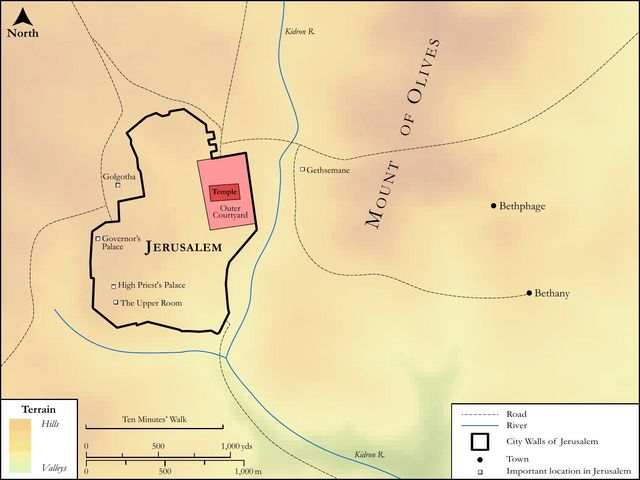
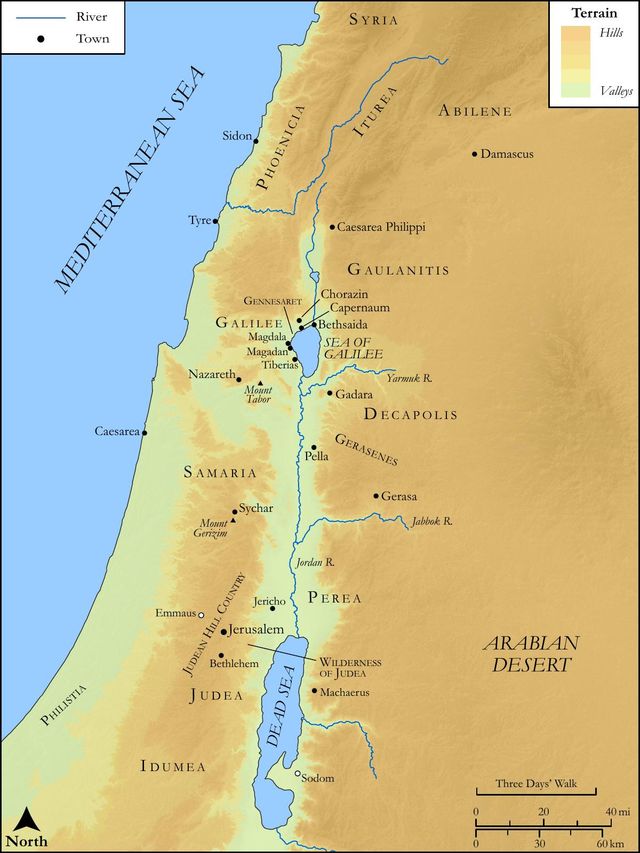
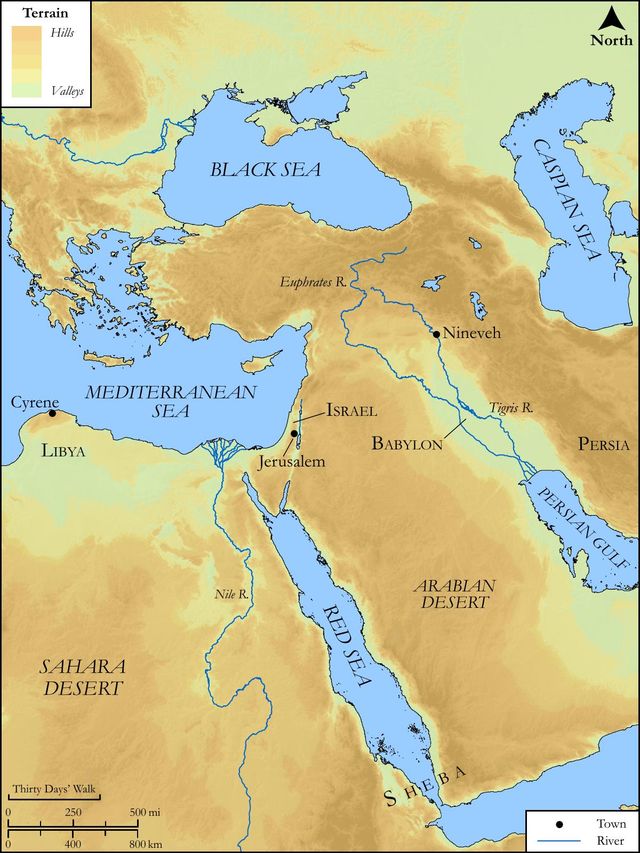
Study this verse
Public-domain commentary
Matthew Henry
From his Commentary on the Whole Bible. Henry comments on passages, not single verses — this entry covers Matthew 3:1–6. His three-level outline is real structure in the source text, so it is rendered as structure.
We have here an account of the preaching and baptism of John, which were the dawning of the gospel-day. Observe,
I.The time when he appeared.
In those days (Mat 3:1), or, after those days, long after what was recorded in the foregoing chapter, which left the child Jesus in his infancy. In those days, in the time appointed of the Father for the beginning of the gospel, when the fulness of time was come, which was often thus spoken of in the Old Testament, In those days. Now the last of Daniel's weeks began, or rather, the latter half of the week, when the Messiah was to confirm the covenant with many, Dan 9:27. Christ's appearances are all in their season. Glorious things were spoken both of John and Jesus, at and before their births, which would have given occasion to expect some extraordinary appearances of a divine presence and power with them when they were very young; but it is quite otherwise. Except Christ's disputing with the doctors at twelve years old, nothing appears remarkable concerning either of them, till they were about thirty years old. Nothing is recorded of their childhood and youth, but the greatest part of their life is tempus, adēlon - wrapt up in darkness and obscurity: these children differ little in outward appearance from other children, as the heir, while he is under age, differs nothing from a servant, though he be lord of all. And this was to show,
1.That even when God is acting as the God of Israel, the Saviour, yet verily he is a God that hideth himself (Isa 45:15). The Lord is in this place and I knew it not, Gen 28:16. Our beloved stands behind the wall long before he looks forth at the windows, Sol 2:9.
2.That our faith must principally have an eye to Christ in his office and undertaking, for there is the display of his power; but in his person is the hiding of his power. All this while, Christ was god-man; yet we are not told what he said or did, till he appeared as a prophet; and then, Hear ye him.
3.That young men, though well qualified, should not be forward to put forth themselves in public service, but be humble, and modest, and self-diffident, swift to hear, and slow to speak.
Matthew says nothing of the conception and birth of John the Baptist, which is largely related by St. Luke, but finds him at full age, as if dropt from the clouds to preach in the wilderness. For above three hundred years the church had been without prophets; those lights had been long put out, that he might be the more desired, who was to be the great prophet. After Malachi there was no prophet, nor any pretender to prophecy, till John the Baptist, to whom therefore the prophet Malachi points more directly than any of the Old Testament prophets had done (Mal 3:1); I send my messenger.
II.The place where he appeared first.
In the wilderness of Judea. It was not an uninhabited desert, but a part of the country not so thickly peopled, nor so much enclosed into fields and vineyards, as other parts were; it was such a wilderness as had six cities and their villages in it, which are named, Jos 15:61, Jos 15:62. In these cities and villages John preached, for thereabouts he had hitherto lived, being born hard by, in Hebron; the scenes of his action began there, where he had long spent his time in contemplation; and even when he showed himself to Israel, he showed how well he loved retirement, as far as would consist with his business. The word of the Lord found John here in a wilderness. Note, No place is so remote as to shut us out from the visits of divine grace; nay, commonly the sweetest intercourse the saints have with Heaven, is when they are withdrawn furthest from the noise of this world. It was in this wilderness of Judah that David penned the 63rd Psalm, which speaks so much of the sweet communion he then had with God, Hos 2:14. In a wilderness the law was given; and as the Old Testament, so the New Testament Israel was first found in the desert land, and there God led him about and instructed him, Deu 32:10. John Baptist was a priest of the order of Aaron, yet we find him preaching in a wilderness, and never officiating in the temple; but Christ, who was not a son of Aaron, is yet often found in the temple, and sitting there as one having authority; so it was foretold, Mal 3:1. The Lord whom ye seek shall suddenly come to his temple; not the messenger that was to prepare his way. This intimated that the priesthood of Christ was to thrust out that of Aaron, and drive it into a wilderness.
The beginning of the gospel in a wilderness, speaks comfort to the deserts of the Gentile world. Now must the prophecies be fulfilled, I will plant in the wilderness the cedar, Isa 41:18, Isa 41:19. The wilderness shall be a fruitful field, Isa 32:15. And the desert shall rejoice, Isa 35:1, Isa 35:2. The Septuagint reads, the deserts of Jordan, the very wilderness in which John preached. In the Romish church there are those who call themselves hermits, and pretend to follow John; but when they say of Christ, Behold, he is in the desert, go not forth, Mat 24:26. There was a seducer that led his followers into the wilderness, Act 21:38.
III.His preaching.
This he made his business. He came, not fighting, nor disputing, but preaching (Mat 3:1); for by the foolishness of preaching, Christ's kingdom must be set up.
1.The doctrine he preached was that of repentance (Mat 3:2); Repent ye. He preached this in Judea, among those that were called Jews, and made a profession of religion; for even they needed repentance. He preached it, not in Jerusalem, but in the wilderness of Judea, among the plain country people; for even those who think themselves most out of the way of temptation, and furthest from the vanities and vices of the town, cannot wash their hands in innocency, but must do it in repentance. John Baptist's business was to call men to repent of their sins; Metanoeite - Bethink yourselves; "Admit a second thought, to correct the errors of the first - an afterthought. Consider your ways, change your minds; you have thought amiss; think again, and think aright." Note, True penitents have other thoughts of God and Christ, and sin and holiness, and this world and the other, than they have had, and stand otherwise affected toward them. The change of the mind produces a change of the way. Those who are truly sorry for what they have done amiss, will be careful to do so no more. This repentance is a necessary duty, in obedience to the command of God (Act 17:30); and a necessary preparative and qualification for the comforts of the gospel of Christ. If the heart of man had continued upright and unstained, divine consolations might have been received without this painful operation preceding; but, being sinful, it must be first pained before it can be laid at ease, must labour before it can be at rest. The sore must be searched, or it cannot be cured. I wound and I heal.
2.The argument he used to enforce this call was, For the kingdom of heaven is at hand. The prophets of the Old Testament called people to repent, for the obtaining and securing of temporal national mercies, and for the preventing and removing of temporal national judgments: but now, though the duty pressed is the same, the reason is new, and purely evangelical. Men are now considered in their personal capacity, and not so much as then in a social and political one. Now repent, for the kingdom of heaven is at hand; the gospel dispensation of the covenant of grace, the opening of the kingdom of heaven to all believers, by the death and resurrection of Jesus Christ. It is a kingdom of which Christ is the Sovereign, and we must be the willing, loyal subjects of it. It is a kingdom of heaven, not of this world, a spiritual kingdom: its original from heaven, its tendency to heaven. John preached this as at hand; then it was at the door; to us it is come, by the pouring out of the Spirit, and the full exhibition of the riches of gospel-grace. Now,
(1.)This is a great inducement to us to repent. There is nothing like the consideration of divine grace to break the heart, both for sin and from sin. That is evangelical repentance, that flows from a sight of Christ, from a sense of his love, and the hopes of pardon and forgiveness through him. Kindness is conquering; abused kindness, humbling and melting. What a wretch was I to sin against such grace, against the law and love of such a kingdom!
(2.)It is a great encouragement to us to repent; "Repent, for your sins shall be pardoned upon your repentance. Return to God in a way of duty, and he will, through Christ, return to you in a way of mercy." The proclamation of pardon discovers, and fetches in, the malefactor who before fled and absconded. Thus we are drawn to it with the cords of man, and the bands of love.
IV.The prophecy that was fulfilled in him, Mat 3:3.
This is he that was spoken of in the beginning of that part of the prophecy of Esaias, which is mostly evangelical, and which points at gospel-times and gospel-grace; see Isa 40:3, Isa 40:4. John is here spoken of,
1.As the voice of one crying in the wilderness. John owned it himself (Joh 1:23); I am the voice, and that is all, God is the Speaker, who makes known his mind by John, as a man does by his voice. The word of God must be received as such (Th1 2:13); what else is Paul, and what is Apollos, but the voice! John is called the voice, phōnē boōntos - the voice of one crying aloud, which is startling and awakening. Christ is called the Word, which, being distinct and articulate, is more instructive. John as the voice, roused men, and then Christ, as the Word, taught them; as we find, Rev 14:2. The voice of many waters, and of a great thunder, made way for the melodious voice of harpers and the new song, Mat 3:3. Some observe that, as Samson's mother must drink no strong drink, yet he was designed to be a strong man; so John Baptist's father was struck dumb, and yet he was designed to be the voice of one crying. When the crier's voice is begotten of a dumb father, it shows the excellency of the power to be of God, and not of man.
2.As one whose business it was to prepare the way of the Lord, and to make his paths straight; so it was said of him before he was born, that he should make ready a people prepared for the Lord (Luk 1:17), as Christ's harbinger and forerunner: he was such a one as intimated the nature of Christ's kingdom, for he came not in the gaudy dress of a herald at arms, but in the homely one of a hermit. Officers were sent before great men to clear the way; so John prepares the way of the Lord.
(1.)He himself did so among the men of that generation. In the Jewish church and nation, at that time, all was out of course; there was a great decay of piety, the vitals of religion were corrupted and eaten out by the traditions and injunctions of the elders. The Scribes and Pharisees, that is, the greatest hypocrites in the world, had the key of knowledge, and the key of government, at their girdle. The people were, generally, extremely proud of their privileges, confident of justification by their own righteousness, insensible of sin; and, though now under the most humbling providences, being lately made a province of the Roman Empire, yet they were unhumbled; they were much in the same temper as they were in Malachi's time, insolent and haughty, and ready to contradict the word of God: now John was sent to level these mountains, to take down their high opinion of themselves, and to show them their sins, that the doctrine of Christ might be the more acceptable and effectual.
(2.)His doctrine of repentance and humiliation is still as necessary as it was then to prepare the way of the Lord. Note, There is a great deal to be done, to make way for Christ into a soul, to bow the heart for the reception of the Son of David (Sa2 19:14); and nothing is more needful, in order to this, than the discovery of sin, and a conviction of the insufficiency of our own righteousness. That which lets will let, until it be taken out of the way; prejudices must be removed, high thoughts brought down, and captivated to the obedience of Christ. Gates of brass must be broken, and bars of iron cut asunder, ere the everlasting doors be opened for the King of glory to come in. The way of sin and Satan is a crooked way; to prepare a way for Christ, the paths must be made straight, Heb 12:13.
V.The garb in which he appeared, the figure he made, and the manner of his life, Mat 3:4.
They, who expected the Messiah as a temporal prince, would think that his forerunner must come in great pomp and splendour, that his equipage should be very magnificent and gay; but it proves quite contrary; he shall be great in the sight of the Lord, but mean in the eyes of the world; and, as Christ himself, having no form or comeliness; to intimate betimes, that the glory of Christ's kingdom was to be spiritual, and the subjects of it such as ordinarily were either found by it, or made by it, poor and despised, who derived their honours, pleasures, and riches, from another world.
1.His dress was plain. This same John had his raiment of camel's hair, and a leathern girdle about his loins; he did not go in long clothing, as the scribes, or soft clothing, as the courtiers, but in the clothing of a country husbandman; for he lived in a country place, and suited his habit to his habitation. Note, It is good for us to accommodate ourselves to the place and condition which God, in his providence, has put us in. John appeared in this dress,
(1.)To show that, like Jacob, he was a plain man, and mortified to this world, and the delights and gaieties of it. Behold an Israelite indeed! Those that are lowly in heart should show it by a holy negligence and indifference in their attire; and not make the putting on of apparel their adorning, nor value others by their attire.
(2.)To show that he was a prophet, for prophets wore rough garments, as mortified men (Zac 13:4); and, especially, to show that he was the Elias promised; for particular notice is taken of Elias, that he was a hairy man (which, some think, is meant of the hairy garments he wore), and that he was girt with a girdle of leather about his loins, Kg2 1:8. John Baptist appears no way inferior to him in mortification; this therefore is that Elias that was to come.
(3.)To show that he was a man of resolution; his girdle was not fine, such as were then commonly worn, but it was strong, it was a leathern girdle; and blessed is that servant, whom his Lord, when he comes, finds with his loins girt, Luk 12:35; Pe1 1:13.
2.His diet was plain; his meat was locusts and wild honey; not as if he never ate any thing else; but these he frequently fed upon, and made many meals of them, when he retired into solitary places, and continued long there for contemplation. Locusts were a sort of flying insect, very good for food, and allowed as clean (Lev 11:22); they required little dressing, and were light, and easy of digestion, whence it is reckoned among the infirmities of old age, that the grasshopper, or locust, is then a burden to the stomach, Ecc 12:5. Wild honey was that which Canaan flowed with, Sa1 14:26. Either it was gathered immediately, as it fell in the dew, or rather, as it was found in the hollows of trees and rocks, where bees built, that were not, like those in hives, under the care and inspection of men. This intimates that he ate sparingly, a little served his turn; a man would be long ere he filled his belly with locusts and wild honey: John Baptist came neither eating nor drinking (Mat 11:18) - not with the curiosity, formality, and familiarity that other people do. He was so entirely taken up with spiritual things, that he could seldom find time for a set meal. Now,
(1.)This agreed with the doctrine he preached of repentance, and fruits meet for repentance. Note, Those whose business it is to call others to mourn for sin, and to mortify it, ought themselves to live a serious life, a life of self-denial, mortification, and contempt of the world. John Baptist thus showed the deep sense he had of the badness of the time and place he lived in, which made the preaching of repentance needful; every day was a fast-day with him.
(2.)This agreed with his office as Christ's forerunner; by this practice he showed that he knew what the kingdom of heaven was, and had experienced the powers of it. Note, Those that are acquainted with divine and spiritual pleasures, cannot but look upon all the delights and ornaments of sense with a holy indifference; they know better things. By giving others this example he made way for Christ. Note, A conviction of the vanity of the world, and everything in it, is the best preparative for the entertainment of the kingdom of heaven in the heart. Blessed are the poor in spirit.
VI.The people who attended upon him, and flocked after him (Mat 3:5); Then went out to him Jerusalem, and all Judea.
Great multitudes came to him from the city, and from all parts of the country; some of all sorts, men and women, young and old, rich and poor, Pharisees and publicans; they went out to him, as soon as they heard his preaching the kingdom of heaven, that they might hear what they heard so much of. Now,
1.This was a great honour put upon John, that so many attended him, and with so much respect. Note, Frequently those have most real honour done them, who least court the shadow of it. Those who live a mortified life, who are humble and self-denying, and dead to the world, command respect; and men have a secret value and reverence for them, more than they would imagine.
2.This gave John a great opportunity of doing good, and was an evidence that God was with him. Now people began to crowd and press into the kingdom of heaven (Luk 16:16); and a blessed sight it was, to see the dew of the youth dropping from the womb of the gospel-morning (Psa 110:3), to see the net cast where there were so many fish.
3.This was an evidence, that it was now a time of great expectation; it was generally thought that the kingdom of God would presently appear (Luk 19:11), and therefore, when John showed himself to Israel, lived and preached at this rate, so very different from the Scribes and Pharisees, they were ready to say of him, that he was the Christ (Luk 3:15); and this occasioned such a confluence of people about him.
4.Those who would have the benefit of John's ministry must go out to him in the wilderness, sharing in his reproach. Note, They who truly desire the sincere milk of the word, it if be not brought to them, will seek out for it: and they who would learn the doctrine of repentance must go out from the hurry of this world, and be still.
5.It appears by the issue, that of the many who came to John's Baptism, there were but few that adhered to it; witness the cold reception Christ had in Judea, and about Jerusalem. Note, There may be a multitude of forward hearers, where there are but a few true believers. Curiosity, and affectation of novelty and variety, may bring many to attend upon good preaching, and to be affected with it for a while, who yet are never subject to the power of it, Eze 33:31, Eze 33:32.
VII.The rite, or ceremony, by which he admitted disciples, Mat 3:6.
Those who received his doctrine, and submitted to his discipline, were baptized of him in Jordan, thereby professing their repentance, and their belief that the kingdom of the Messiah was at hand.
1.They testified their repentance by confessing their sins; a general confession, it is probable, they made to John that they were sinners, that they were polluted by sin, and needed cleansing; but to God they made a confession of particular sins, for he is the party offended. The Jews had been taught to justify themselves; but John teaches them to accuse themselves, and not to rest, as they used to do, in the general confession of sin made for all Israel, once a year, upon the day of atonement; but to make a particular acknowledgment, every one, of the plague of his own heart. Note, A penitent confession of sin is required in order to peace and pardon; and those only are ready to receive Jesus Christ as their Righteousness, who are brought with sorrow and shame to their own guilt, Jo1 1:9.
2.The benefits of the kingdom of heaven, now at hand, were thereupon sealed to them by baptism. He washed them with water, in token of this - that from all their iniquities God would cleanse them. It was usual with the Jews to baptize those whom they admitted proselytes to their religion, especially those who were only Proselytes of the gate, and were not circumcised, as the Proselytes of righteousness were. Some think it was likewise a custom for persons of eminent religion, who set up for leaders, by baptism to admit pupils and disciples. Christ's question concerning John's Baptism, Was it from heaven, or of men? implied, that there were baptisms of men, who pretended not to a divine mission; with this usage John complied, but his was from heaven, and was distinguished from all others by this character, It was the baptism of repentance, Act 19:4. All Israel were baptized unto Moses, Co1 10:2. The ceremonial law consisted in divers washings or baptisms (Heb 9:10); but John's baptism refers to the remedial law, the law of repentance and faith. He is said to baptize them in Jordan, that river which was famous for Israel's passage through it, and Naaman's cure; yet it is probable that John did not baptize in that river at first, but that afterward, when the people who came to his baptism were numerous, he removed Jordan. By baptism he obliged them to live a holy life, according to the profession they took upon themselves. Note, Confession of sin must always be accompanied with holy resolutions, in the strength of divine grace, not to return to it again.
Historical interpretation
Eleven Centuries of Reception
18 surviving comments on this verse. Each one is dated, so this reads as a timeline rather than a list.
Select a marker to jump to its quote. Markers stagger vertically where authors wrote within a few decades of each other.
John holds not his peace, saying, "Enter upon repentance, for now shall salvation approach the nations" -the Lord, that is, bringing salvation according to God's promise.
Or, he came to Judæa, desert by the absence of God, not of population, that the place of preaching might witness the few to whom the preaching was sent.
He therefore preaches repentance when the Kingdom of Heaven approaches; by which we return from error, we escape from sin, and after shame for our faults, we make profession of forsaking them.
"But what is this to the Jews?" one may say, "for they know not even what thou sayest." "Why, for this cause," saith he, "do I so speak, in order that being roused by the obscurity of my words, they may proceed to seek Him, whom I preach." In point of fact, he so excited them with good hopes when they came near, that even many publicans and soldiers inquired what they should do, and how they should direct their own life; which was a sign of being thenceforth set free from all worldly things, and of looking to other greater objects, and of forebodings things to come. Yea, for all, both the sights and the words of that time, led them unto lofty thoughts.
Conceive, for example, how great a thing it was to see a man after thirty years coming down from the wilderness, being the son of a chief priest, who had never known the common wants of men, and was on every account venerable, and had Isaiah with him. For he too was present proclaiming him, and saying, "This is he who I said should come crying, and preaching throughout the whole wilderness with a clear voice." For so great was the earnestness of the prophets touching these things, that not their own Lord only, but him also who was to minister unto Him, they proclaimed a long time beforehand, and they not only mentioned him, but the place too in which he was to abide, and the manner of the doctrine which he had to teach when he came, and the good effect that was produced by him.
See, at least, how both the prophet and the Baptist go upon the same ideas, although not upon the same words.
Thus the prophet saith that he shall come saying, "Prepare ye the way of the Lord, make his paths straight." And he himself when he was come said, "Bring forth fruits meet for repentance," which corresponds with, "Prepare ye the way of the Lord." Seest thou that both by the words of the prophet, and by his own preaching, this one thing is manifested alone; that he was come, making a way and preparing beforehand, not bestowing the gift, which was the remission, but ordering in good time the souls of such as should receive the God of all?
But Luke expresses somewhat further: not repeating the exordium, and so passing on, but setting down likewise all the prophecy. "For every valley," saith he, "shall be filled; and every mountain and hill shall be brought low; and the crooked shall be made straight, and the rough ways smooth; and all flesh shall see the salvation of God." Dost thou perceive how the prophet hath anticipated all by his words; the concourse of the people. Thus, when he saith, "Every valley shall be filled, and every mountain and hill shall be brought low, and the rough ways shall be made smooth;" he is signifying the exaltation of the lowly, the humiliation of the self-willed, the hardness of the law changed into easiness of faith. For it is no longer toils and labors, saith he, but grace, and forgiveness of sins, affording great facility of salvation. Next he states the cause of these things, saying, "All flesh shall see the salvation of God;" no longer Jews and proselytes only, but also all earth and sea, and the whole race of men. Because by "the crooked things" he signified our whole corrupt life, publicans, harlots, robbers, magicians, as many as having been perverted before afterwards walked in the right way; much as He Himself likewise said, "publicans and harlots go into the kingdom of God before you," because they believed. And in other words also again the prophet declared the self-same thing, thus saying, "Then wolves and lambs shall feed together." For like as here by the hills and valleys, he meant that incongruities of character are blended into one and the same evenness of self-restraint, so also there, by the characters of the brute animals indicating the different dispositions of men, he again spoke of their being linked in one and the same harmony of godliness. Here also, as before, stating the cause. That cause is, "There shall be He that riseth to reign over the Gentiles, in Him shall the Gentiles trust:" much the same as here too he said, "All flesh shall see the salvation of God," everywhere declaring that the power and knowledge of these our Gospels would be poured out to the ends of the world, converting the human race, from a brutish disposition and a fierce temper to something very gentle and mild.
(non occ.) But why must John thus go before Christ with a witness of deeds preaching Him? First; that we might hence learn Christ's dignity, that He also, as the Father has, has prophets, in the words of Zacharias, And thou, Child, shalt be called the Prophet of the Highest. (Luke 1:76.) Secondly; That the Jews might have no cause for offence; as He declared, John came neither eating nor drinking, and they say, He hath a devil. The Son of Man came eating and drinking, and they say, Behold a gluttonous man. (Luke 7:33.) It needeth moreover that the things concerning Christ should be told by some other first, and not by Himself; or what would the Jews have said, who after the witness of John made complaint, Thou bearest witness of thyself, thy witness is not true. (John 8:13.)
And he preaches what the Jews had never heard, not even from the Prophets, Heaven, namely, and the Kingdom that is there, and of the kingdoms of the earth he says nothing. Thus by the novelty of those things of which he speaks, he gains their attention to Him whom he preaches.
Now that on this account Christ came to His baptism, is from this evident. But wherefore was this baptism devised for Him? For that not of himself did the son of Zacharias proceed to this, but of God who moved him, this Luke also declares, when he saith, "The word of the Lord came unto him," that is, His commandment. And he himself too saith, "He that sent me to baptize with water, the same said to me, upon whom thou shalt see the Spirit descending like a dove, and remaining on Him, the same is He which baptizeth with the Holy Ghost." Wherefore then was he sent to baptize? The Baptist again makes this also plain to us, saying, "I knew Him not, but that He should be made manifest to Israel, therefore am I come baptizing with water."
And if this was the only cause, how saith Luke, that "he came into the county about Jordan, preaching the baptism of repentance for the remission of sins?" And yet it had not remission, but this gift pertained unto the baptism that was given afterwards; for in this "we are buried with Him," and our old man was then crucified with Him, and before the cross there doth not appear remission anywhere; for everywhere this is imputed to His blood. And Paul too saith, "But ye are washed, but ye are sanctified," not by the baptism of John, but "in the name of our Lord Jesus Christ, and by the Spirit of our God." And elsewhere too he saith, "John verily preached a baptism of repentance," (he saith not "of remission,") "that they should believe on Him that should come after him." For when the sacrifice was not yet offered, neither had the spirit yet come down, nor sin was put away, nor the enmity removed, nor the curse destroyed; how was remission to take place?
What means then, "for the remission of sins?"
The Jews were senseless, and had never any feeling of their own sins, but while they were justly accountable for the worst evils, they were justifying themselves in every respect; and this more than anything caused their destruction, and led them away from the faith. This, for example, Paul himself was laying to their charge, when he said, that "they being ignorant of God's righteousness, and going about to establish their own, had not submitted themselves unto the righteousness of God." And again: "What shall we say then? That the Gentiles, which followed not after righteousness, have attained to righteousness; but Israel, which followed after the law of righteousness, hath not attained unto the law of righteousness. Wherefore? Because they sought it not by faith, but as it were by works."
Since therefore this was the cause of their evils, John cometh, doing nothing else but bringing them to a sense of their own sins. This, among other things, his very garb declared, being that of repentance and confession. This was indicated also by what he preached, for nothing else did he say, but "bring forth fruits meet for repentance." Forasmuch then as their not condemning their own sins, as Paul also hath explained, made them start off from Christ, while their coming to a sense thereof would set them upon longing to seek after their Redeemer, and to desire remission; this John came to bring about, and to persuade them to repent, not in order that they might be punished, but that having become by repentance more humble, and condemning themselves, they might hasten to receive remission.
But let us see how exactly he hath expressed it; how, having said, that he "came preaching the baptism of repentance in the wilderness of Judaea," he adds, "for remission," as though he said, For this end he exhorted them to confess and repent of their sins; not that they should be punished, but that they might more easily receive the subsequent remission. For had they not condemned themselves, they could not have sought after His grace; and not seeking, they could not have obtained remission.
Thus that baptism led the way for this; wherefore also he said, that "they should believe on Him which should come after him;" together with that which hath been mentioned setting forth this other cause of His baptism. For neither would it have been as much for him to have gone about to their houses, and to have led Christ around, taking Him by the hand, and to have said, "Believe in This Man;" as for that blessed voice to be uttered, and all those other things performed in the presence and sight of all.
On account of this He cometh to the baptism. Since in fact both the credit of him that was baptizing, and the purport of the thing itself, was attracting the whole city, and calling it unto Jordan; and it became a great spectacle.
Therefore he humbles them also when they are come, and persuades them to have no high fancies about themselves; showing them liable to the utmost evils, unless they would repent, and leaving their forefathers, and all vaunting in them, would receive Him that was coming.
Because in fact the things concerning Christ had been up to that time veiled, and many thought He was dead, owing to the massacre which took place at Bethlehem. For though at twelve years old He discovered Himself, yet did He also quickly veil Himself again. And for this cause there was need of that splendid exordium and of a loftier beginning. Wherefore also then for the first time he with clear voice proclaims things which the Jews had never heard, neither from prophets, nor from any besides; making mention of Heaven, and of the kingdom there, and no longer saying anything touching the earth.
But by the kingdom in this place he means His former and His last advent.
How "in those days"? For not then, surely, when He was a child, and came to Nazareth, but thirty years after, John cometh; as Luke also testifies. How then is it said, "in those days"? The Scripture is always wont to use this manner of speech, not only when it is mentioning what occurs in the time immediately after, but also of things which are to come to pass many years later. Thus also, for example, when His disciples came unto Him as He sat on the Mount of Olives, and sought to learn about His coming, and the taking of Jerusalem: and yet ye know how great is the interval between those several periods. I mean, that having spoken of the subversion of the mother city, and completed His discourse on that subject, and being about to pass to that on the consummation, he inserted, "Then shall these things also come to pass;" not bringing together the times by the word then, but indicating that time only in which these things were to happen. And this sort of thing he doth now also, saying, "In those days." For this is not put to signify the days that come immediately after, but those in which these things were to take place, which he was preparing to relate.
"But why was it after thirty years," it may be said, "that Jesus came unto His baptism"? After this baptism He was thenceforth to do away with the law: wherefore even until this age, which admits of all sins, He continues fulfilling it all; that no one might say, that because He Himself could not fulfill it, He did it away. For neither do all passions assail us at all times; but while in the first age of life there is much thoughtlessness and timidity, in that which comes after it, pleasure is more vehement, and after this again the desire of wealth. For this cause he awaits the fullness of His adult age, and throughout it all fulfills the law, and so comes to His baptism, adding it as something which follows upon the complete keeping of all the other commandments.
[Daniel 10:4] "And in the twenty-fourth day of the first month, I was beside the great river which is the Tigris." Ezekiel also had seen a great vision beside a river, the Chebar (Ezekiel 1:1). And it was by the stream of the Jordan that the heavens were opened to the gaze of our Lord and Savior and also to John the Baptist (Matthew 3:1-17). Therefore those critics should leave off their foolish objections who raise questions about the presence of shadows and symbols in a matter of historical truth and attempt to destroy the truth itself by imagining that they should employ allegorical methods to destroy the historicity of rivers and trees and of Paradise.
(In. Is. 40:3.) Consider how the salvation of God, and the glory of the Lord, is preached not in Jerusalem, but in the solitude of the Church, in the wilderness to multitudes.
John Baptist is the first to preach the Kingdom of Heaven, that the forerunner of the Lord may have this honourable privilege.
(Chapter III - Verse 1) Repent, for the kingdom of heaven is near. John the Baptist proclaims the kingdom of heaven, honoring the Lord as its precursor with this privilege.
(De Con. Evan. ii. 6.) Luke describes the time by the reigning sovereigns. (Luke 3:1.) But Matthew must be understood to speak of a wider space of time by the phrase 'those days,' than the fifteenth year of Tiberius. Having related Christ's return from Egypt, which must be placed in early boyhood or even infancy, to make it agree with what Luke has told of His being in the temple at twelve years old, he adds directly, In those days, not intending thereby only the days of His childhood, but all the days from His birth to the preaching of John.
(Hom. in Joan. Bap. nat. 1.) Where neither a noisy mob would interrupt his preaching, and whither no unbelieving hearer would retire; but those only would hear, who sought to his preaching from motives of divine worship.
The Sun as he approaches the horizon, and before he is yet visible, sends out his rays and makes the eastern sky to glow with light, that Aurora going before may herald the coming day. Thus the Lord at His birth in this earth, and before He shows Himself, enlightens John by the rays of His Spirit's teaching, that he might go before and announce the Saviour that was to come. Therefore after having related the birth of Christ, before proceeding to His teaching and baptism, (wherein he received such testimony,) he first premises somewhat of the Baptist and forerunner of the Lord. In those days, &c.
In the very commencement he shows himself the messenger of a merciful Prince; he comes not with threats to the offender, but with offers of mercy. It is a custom with kings to proclaim a general pardon on the birth of a son, but first they send throughout their kingdom officers to exact severe fines. But God willing at the birth of His Son to give pardon of sins, first sends His officer proclaiming, Repent ye. O exaction which leaves none poor, but makes many rich! For even when we pay our just debt of righteousness we do God no service, but only gain our own salvation. Repentance cleanses the heart, enlightens the sense, and prepares the human soul for the reception of Christ, as he immediately adds, For the Kingdom of Hearen is at hand.
The voice is a confused sound, discovering no secret of the heart, only signifying that he who utters it desires to say somewhat; it is the word that is the speech that openeth the mystery of the heart. Voice is common to men and other animals, word peculiar to man. John then is called the voice and not the word, because God did not discover His counsels through him, but only signified that He was about to do something among men; but afterwards by His Son he fully opened the mystery of his will.
As a great King going on a progress is preceded by couriers to cleanse what is foul, repair what is broken down; so John preceded the Lord to cleanse the human heart from the filth of sin, by the besom of repentance, and to gather by an ordinance of spiritual precepts those things which had been scattered abroad.
In these words (ver. 1.) we have not only time, place, and person, respecting St. John, but also his office and employment. First the time, generally; In those days.
The man is mentioned in the words came John, that is, showed himself, having abode so long in obscurity.
(ap. Anselm.) His office; the Baptist; in this he prepared the way of the Lord, for had not men been used to be baptized, they would have shunned Christ's baptism. His employment; Preaching;
The place; the desert of Judæa.
The Kingdom of Heaven has a fourfold meaning. It is said, of Christ, as The Kingdom of God is within you. (Luke 17:21.) Of Holy Scripture, as, The Kingdom of God shall be taken from you, and shall be given to a nation bringing forth the fruits thereof. (Mat. 21:43.) Of the Holy Church, as, The Kingdom of Heaven is like unto ten virgins. (Mat. 25.) Of the abode above, as, Many shall come from the East and the West, and shall sit down in the Kingdom of Heaven. (Mat. 8:11.) And all these significations may be here understood.
Though as far as historical fact is concerned, he chose the desert, to be removed from the crowds of people. What the purport of his cry was is insinuated, when he adds, Make ready the way of the Lord.
(Hom. in Ev. i. 7. 2.) It is well known that the Only-begotten Son is called the Word of the Father; as in John, In the beginning was the Word. (John 1:1.) But it is by our own speech that we are known; the voice sounds that the words may be heard. Thus John the forerunner of the Lord's coming is called, The voice, because by his ministry the voice of the Father is heard by men.
(Hom. in Ev. i. 7. 2.) Crying in the desert, because he shows to deserted and forlorn Judæa the approaching consolation of her Redeemer.
(Hom. in Ev. i. 20. 3.) Every one who preacheth right faith and good works, prepares the Lord's way to the hearts of the hearers, and makes His paths straight, in cleansing the thoughts by the word of good preaching.
(Gloss. ord. in cap. iv. 1.) In like manner has He cried from the beginning through the voice of all who have spoken aught by inspiration. And yet is John only called, The voice; because that Word which others showed afar off, he declares as nigh.
For because Christ was to preach, as soon as it seemed the fit time, that is, about thirty years of age, he began by his preaching to make ready the way for the Lord.
He is rightly called, The voice of one crying, on account of the loud sound of his preaching. Three things cause a man to speak loud; when the person he speaks to is at a distance, or is deaf, or if the speaker be angry; and all these three were then found in the human race.
Not when the Lord was a child and was living in Nazareth, but rather the evangelist makes this simple statement, "at that time, before the present generation."
John was sent by God to reprove the Jews and to persuade them to come to a consciousness of their own sins and so to accept the Christ. For if one is not conscious of his sins, he cannot come to repentance. This is why John was sent.
(ap. Anselm.) The desert typically means a life removed from the temptations of the world, such as befits the penitent.
(ord.) The Kingdom of Heaven shall come nigh you; for if it approached not, none would be able to gain it; for weak and blind they had not the way, which was Christ.
(ord.) John then is, as it were, the voice of the word crying. The word is heard by the voice, that is, Christ by John.
(interlin.) Or, faith is the way by which the word reaches the heart; when the life is amended the paths are made straight.
Continue studying Matthew 3:1 across the web’s major study libraries — every link below opens this exact verse, chapter, or book on the destination site.
Read & Compare
 BibleGatewayThis verse in more than 200 translations and 70 languages.
 Bible.comThe YouVersion reader — hundreds of translations, reading plans, and highlights.
 ESV.orgCrossway's official English Standard Version reader.
 NET BibleThe NET translation with 60,000+ translators' notes on every rendering decision.
 STEP BibleTyndale House's free study tool — original text, vocabulary, and scholarly resources.
 BibliaLogos Bible Software's free web reader.
 USCCBThe New American Bible (Revised Edition) with the U.S. bishops' study notes.
Commentaries
 BibleHub CommentariesDozens of classic commentaries on this verse, gathered on one page.
 StudyLightMore than 100 commentary sets — the largest collection on the web.
 BibleRefPlain-English commentary on what this verse means, verse by verse.
 Enduring WordDavid Guzik's free commentary on this chapter, widely used by Bible teachers.
 Bible Study ToolsVerse commentary alongside Greek and Hebrew study aids.
Original Language & Research
- BibleHub InterlinearThe verse word by word — original language, transliteration, and English.
- BibleHub LexiconEvery word's original-language definition and Strong's entry.
 Blue Letter BibleDeep-study tools — Strong's numbers, concordance, and word studies.
 CNTR CollationThe earliest Greek manuscripts of this verse, collated letter by letter.
Sermons, Hymns & Audio


TrulyRandomVerse is not affiliated with these sites and doesn’t control their content. They’re linked because they’re genuinely useful.
Summary
Matthew 3:1 introduces John the Baptist, a pivotal prophetic figure, whose appearance "in those days" signals the dawn of a new era in salvation history. Emerging from the desolate wilderness of Judaea, John's ministry is characterized by a powerful, public proclamation, calling people to repentance and preparing the way for the long-awaited Messiah. This verse serves as the dramatic prelude to Jesus' public ministry, setting the stage for the fulfillment of ancient prophecies and the inauguration of the Kingdom of Heaven.
Context
ShowHideLiterary Context
Matthew 3:1 marks a significant transition in Matthew's Gospel. Following the infancy narratives of Matthew 1-2, which establish Jesus' lineage and miraculous birth, this verse jumps forward approximately 30 years. It shifts the narrative from Jesus' private life in Nazareth to the public advent of His forerunner, John the Baptist. This abrupt transition emphasizes John's sudden and divinely appointed appearance, signaling the imminent commencement of God's redemptive plan. The preceding chapters establish Jesus' identity as the Messiah, and chapter 3 now introduces the one who will prepare the people for His arrival, directly linking to the prophecies of a messenger, such as those found in Malachi 3:1 and Isaiah 40:3.
Historical & Cultural Context
"In those days" refers to the period roughly between 26-28 AD, during the reign of Tiberius Caesar and under the procuratorship of Pontius Pilate in Judea. This era was marked by Roman occupation, significant political tension, and a deep longing among the Jewish people for the promised Messiah. The "wilderness of Judaea" was a harsh, arid region east of Jerusalem, stretching towards the Dead Sea. This geographical setting was not merely incidental; it evoked powerful Old Testament imagery, recalling Israel's forty years in the wilderness and the prophetic tradition of figures like Elijah, who also ministered outside the established religious centers. John's austere lifestyle and choice of location underscored his prophetic authenticity, contrasting sharply with the opulent temple establishment in Jerusalem and signaling a return to the foundational principles of God's covenant with His people.
Key Themes
ShowHideThis verse immediately introduces several crucial themes that will permeate Matthew's Gospel. Firstly, it highlights the theme of divine preparation, as John's ministry is explicitly designed to "prepare the way of the Lord" (Matthew 3:3). Secondly, the setting in the "wilderness" symbolizes spiritual renewal and purification, echoing Israel's formative experiences and suggesting a need for a fresh start away from corrupting influences. Thirdly, John's act of "preaching" underscores the authority of God's word breaking a long period of prophetic silence, re-establishing direct divine communication with humanity. Finally, his title "the Baptist" introduces the theme of repentance and baptism, a central requirement for entering the Kingdom of Heaven, as further elaborated in Matthew 3:2.
Exposition and Analysis
ShowHideKey Word Analysis
ShowHideFrom pará (beside) and gínomai (to become), meaning "to become near," "to approach," or "to appear publicly." This word choice emphasizes John's arrival as a distinct, public event, not a quiet emergence. It suggests a divinely orchestrated appearance at a specific point in history, marking the beginning of a new phase in God's redemptive plan. John's coming is purposeful and significant, signifying the imminence of the Messiah's public ministry.
To "herald" or "proclaim aloud" as a public crier, especially divine truth or the gospel. This term denotes an authoritative, public declaration, not merely teaching or discussing. John's ministry was characterized by a bold, open proclamation of God's message, demanding attention and a response. It signifies the authoritative nature of his message, which was a direct divine announcement rather than human opinion or philosophy.
Meaning "lonesome," "waste," or "desolate." Often used as a noun to refer to a desert or solitary place. The choice of the wilderness for John's ministry is deeply symbolic, recalling the Israelites' journey through the desert and the prophetic tradition of figures like Elijah. It signifies a place of spiritual testing, purification, and direct encounter with God, set apart from the corrupting influences of established society and religious institutions.
Verse Breakdown
ShowHide"In those days came John the Baptist"
This opening phrase serves as a temporal marker, bridging the gap between Jesus' infancy and the commencement of His public ministry. "Those days" refers to the period immediately preceding Jesus' public debut, signaling that the time for the Messiah's revelation was at hand. The sudden appearance of "John the Baptist" introduces the divinely appointed forerunner, whose identity and mission are central to preparing the way for Christ. His title, "the Baptist," immediately identifies his distinctive practice and role.
"preaching in the wilderness of Judaea"
This clause describes John's primary activity and his geographical base of operations. "Preaching" (kērýssō) signifies a public, authoritative proclamation, emphasizing the urgency and divine origin of his message. The "wilderness of Judaea" is a specific, desolate region, strategically chosen to underscore John's prophetic authenticity, his separation from corrupt religious establishments, and the symbolic significance of a new beginning, reminiscent of Israel's formative experiences in the desert.
Literary Devices
ShowHideMatthew 3:1 employs several significant literary devices. The phrase "In those days" serves as a temporal marker, creating a sense of historical continuity while also indicating a new, critical phase in the narrative. The immediate introduction of "John the Baptist" acts as a foreshadowing device, signaling the imminent arrival of an even greater figure, Jesus. The setting of John's ministry in the "wilderness of Judaea" is a powerful example of symbolism. The wilderness is not merely a geographical location but represents a place of spiritual purification, separation from worldly corruption, and a return to foundational truths, echoing Old Testament narratives of divine encounters and testing. Furthermore, John's action of "preaching" highlights the prophetic voice breaking a long period of divine silence, emphasizing the authoritative and urgent nature of God's message.
Theological and Thematic Connections
ShowHideMatthew 3:1 introduces the concept of the "forerunner," a divinely appointed messenger whose purpose is to prepare humanity for the coming of God's ultimate revelation. John the Baptist embodies the culmination of Old Testament prophecy, acting as the bridge between the old covenant and the new. His ministry in the wilderness, characterized by a call to repentance and baptism, establishes the necessary spiritual condition for encountering the Messiah and entering His kingdom. This verse underscores God's meticulous planning in salvation history, demonstrating that Christ's arrival was not random but meticulously prepared for by a powerful prophetic voice. It highlights the theme of divine initiative and the importance of human response in the form of repentance.
Reflection and Application
ShowHideJohn the Baptist's sudden appearance in the wilderness, proclaiming a message of repentance, serves as a timeless reminder that God often chooses unexpected places and individuals to accomplish His purposes. We are called to be attentive to God's voice, even when it comes from unconventional sources or challenges our comfortable norms. John's radical call to prepare for the Lord's coming urges us to examine our own lives: Are we truly ready for Christ's presence and work? Do we recognize the need for genuine repentance and transformation in our hearts? His ministry also highlights the importance of living authentically, prioritizing God's truth over societal expectations or religious traditions. Just as John prepared the way for the first coming of Christ, we are called to prepare our hearts and the world for His ongoing work and eventual return, living lives marked by deep spiritual readiness and active proclamation of His truth.
Questions for Reflection
ShowHideFAQ
ShowHideWhy did John the Baptist minister in the wilderness, rather than in Jerusalem or the Temple?
ShowHideJohn's ministry in the wilderness of Judaea was highly symbolic and strategically significant. First, it aligned him with the prophetic tradition of figures like Elijah, who also operated outside the established religious centers (e.g., 1 Kings 17:2-3). Second, the wilderness was a place associated with Israel's formative experiences, including the Exodus and the giving of the Law, symbolizing purification, testing, and a return to foundational covenant truths. By ministering there, John underscored the need for a radical spiritual renewal, distinct from the perceived corruption or complacency of the religious establishment in Jerusalem. It emphasized that true repentance and preparation for the Messiah required a departure from conventional religious practices and a direct encounter with God.
Christ-Centered Fulfillment
ShowHideMatthew 3:1, by introducing John the Baptist, immediately points to the Christ-centered fulfillment of Old Testament prophecy. John's role as the "voice of one crying in the wilderness" (Matthew 3:3) directly fulfills the prophecy of Isaiah 40:3, serving as the divinely appointed herald who prepares the way for the Lord. This preparation is not an end in itself but serves to usher in the ministry of Jesus, the Messiah. John's message of repentance and baptism, while significant, is ultimately superseded by Jesus' greater baptism "with the Holy Spirit and with fire" (Matthew 3:11). John himself humbly declares that he is not worthy to carry Jesus' sandals (Matthew 3:11), unequivocally identifying Jesus as the "Lamb of God who takes away the sin of the world!" (John 1:29). Thus, John's entire existence and ministry, initiated in this verse, find their ultimate meaning and purpose in pointing to and exalting Jesus Christ, the one through whom salvation and the Kingdom of Heaven are fully realized.