


Revelation 14:2
Bible text: King James Version (1769 Blayney text) · Public domain
Bible text: King James Version with Strong's numbers · Public domain
Bible text: Berean Standard Bible · Public domain
Bible text: American Standard Version (1901) · Public domain
Bible text: World English Bible, Messianic edition · Public domain
Bible text: Geneva Bible (1599) · Public domain
Bible text: Young's Literal Translation · Public domain
- ΚαὶKaiAndG2532CONJConjunction
- ἤκουσαēkousaI heardG191V-AAI-1SVerb Aorist Active Indicative 1st Singular
- φωνὴνphōnēna voiceG5456N-ASFNoun Accusative Singular Feminine
- ἐκekout ofG1537PREPPreposition
- τοῦtou<the>G3588T-GSMDefinite article Genitive Singular Masculine
- οὐρανοῦouranouheavenG3772N-GSMNoun Genitive Singular Masculine
- ὡςhōsasG5613PRTParticle or Disjunctive
- φωνὴνphōnēn[the] soundG5456N-ASFNoun Accusative Singular Feminine
- ὑδάτωνhudatōnof watersG5204N-GPNNoun Genitive Plural Neuter
- πολλῶνpollōnmanyG4183A-GPNAdjective Genitive Plural Neuter
- καὶkaiandG2532CONJConjunction
- ὡςhōsasG5613PRTParticle or Disjunctive
- φωνὴνphōnēn[the] soundG5456N-ASFNoun Accusative Singular Feminine
- βροντῆςbrontēsof thunderG1027N-GSFNoun Genitive Singular Feminine
- μεγάληςmegalēsloudG3173A-GSFAdjective Genitive Singular Feminine
- καὶkaiAndG2532CONJConjunction
- ἡhētheG3588T-NSFDefinite article Nominative Singular Feminine
- φωνὴphōnēvoiceG5456N-NSFNoun Nominative Singular Feminine
- ἣνhēnthatG3739R-ASFRelative pronoun Accusative Singular Feminine
- ἤκουσαēkousaI heardG191V-AAI-1SVerb Aorist Active Indicative 1st Singular
- κιθαρῳδῶνkitharōdōnof harpistsG2790N-GPMNoun Genitive Plural Masculine
- κιθαριζόντωνkitharizontōnharpingG2789V-PAP-GPMVerb Present Active Participle Genitive Plural Masculine
- ἐνenwithG1722PREPPreposition
- ταῖςtaistheG3588T-DPFDefinite article Dative Plural Feminine
- κιθάραιςkitharaisharpsG2788N-DPFNoun Dative Plural Feminine
- αὐτῶνautōnof themG846P-GPMPersonal pronoun Genitive Plural Masculine
English is a literal word-by-word gloss of the Greek, not the KJV's wording. Why?
This is the original text the KJV's translators worked from — each Greek word with its own literal English meaning in this verse, prepared by scholars at Tyndale House, Cambridge. The KJV translates whole sentences, not word by word, so its wording differs: one Greek word can become several English words, and the KJV may choose “charity” where the gloss reads “love”. Both are faithful — they answer different questions. For the KJV's own rendering, switch to the KJV text.
Details
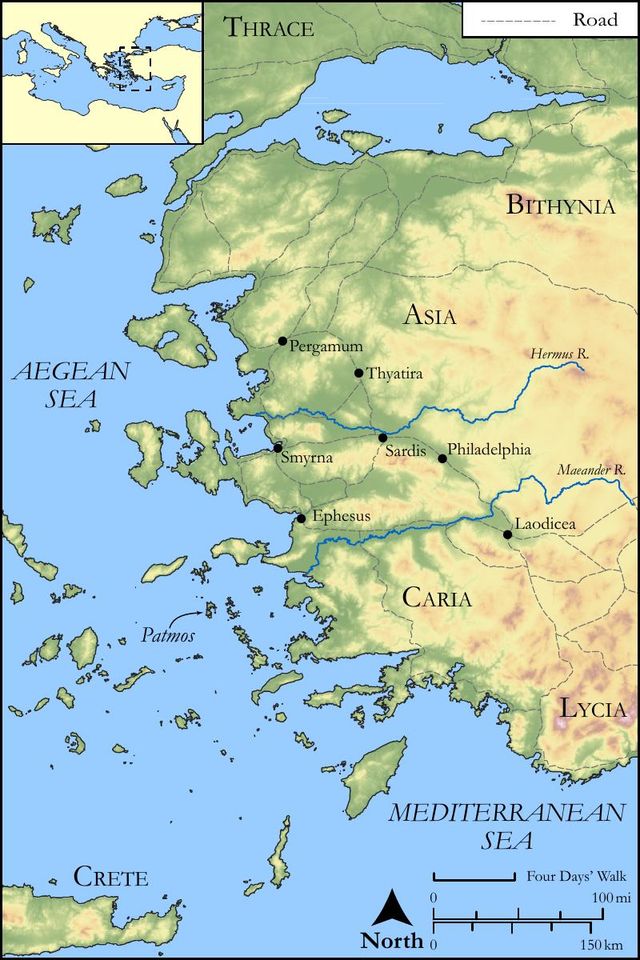
See on the biblical-era maps

Study this verse
Public-domain commentary
Matthew Henry
From his Commentary on the Whole Bible. Henry comments on passages, not single verses — this entry covers Revelation 14:1–5.
Here we have one of the most pleasing sights that can be viewed in this world - the Lord Jesus Christ at the head of his faithful adherents and attendants. Here observe, 1. How Christ appears: as a Lamb standing upon mount Zion. Mount Zion is the gospel church. Christ is with his church and in the midst of her in all her troubles, and therefore she is not consumed. It is his presence that secures her perseverance; he appears as a Lamb, a true Lamb, the Lamb of God. A counterfeit lamb is mentioned as rising out of the earth in the last chapter, which was really a dragon; here Christ appears as the true paschal Lamb, to show that his mediatorial government is the fruit of his sufferings, and the cause of his people's safety and fidelity. 2. How his people appear: very honourably. (1.) As to the numbers, they are many, even all who are sealed; not one of them lost in all the tribulations through which they have gone. (2.) Their distinguishing badge: they had the name of God written in their foreheads; they made a bold and open profession of their faith in God and Christ, and, this being followed by suitable actings, they are known and approved. (3.) Their congratulations and songs of praise, which were peculiar to the redeemed (Rev 14:3); their praises were loud as thunder, or as the voice of many waters; they were melodious, as of harpers; they were heavenly, before the throne of God. The song was new, suited to the new covenant, and unto that new and gracious dispensation of Providence under which they now were; and their song was a secret to others, strangers intermeddled not with their joy; others might repeat the words of the song, but they were strangers to the true sense and spirit of it. (4.) Their character and description. [1.] They are described by their chastity and purity: They are virgins. They had not defiled themselves either with corporal or spiritual adultery; they had kept themselves clean from the abominations of the antichristian generation. [2.] By their loyalty and stedfast adherence to Christ: They follow the Lamb withersoever he goes; they follow the conduct of his word, Spirit, and providence, leaving it to him to lead them into what duties and difficulties he pleases. [3.] By their former designation to this honour: These were redeemed from among men, being the first-fruits to God, and to the Lamb, Rev 14:4. Here is plain evidence of a special redemption: They were redeemed from among men. Some of the children of men are, by redeeming mercy, distinguished from others: They were the first-fruits to God, and to the Lamb, his choice ones, eminent in every grace, and the earnest of many more who should be followers of them, as they were of Christ. [4.] By their universal integrity and conscientiousness: There was no guile found in them, and they were without fault before the throne of God. They were without any prevailing guile, any allowed fault; their hearts were right with God, and, as for their human infirmities, they were freely pardoned in Christ. This is the happy remnant who attend upon the Lord Jesus as their head and Lord; he is glorified in them, and they are glorified in him.
Historical interpretation
Three Centuries of Reception
4 surviving comments on this verse. Each one is dated, so this reads as a timeline rather than a list.
Select a marker to jump to its quote. Markers stagger vertically where authors wrote within a few decades of each other.
And I heard a voice from heaven, like the voice of many waters. The great voice of the saints, the great devotion of charity, which he reports hearing from heaven, while he had predicted that those who issued the voice stood on Mount Zion. To show that Mount Zion signifies the Church, raised to the joy of sublime contemplation to overcome the burdens of pressures, celebrating the struggles of their King with praise and imitation. This is truly to sing to the Lamb standing.
And the voice I heard was like the sound of harpists playing on their harps. Since all the saints who crucify their flesh with its vices and desires (Galatians V) are God's harpists, praising Him with the psaltery and harp (Psalm CL), how much more so are those who, with the privilege of evangelical chastity, make themselves a whole burnt offering to the Lord, uniquely denying themselves, and taking up their cross (Luke IX), following the Lamb wherever he goes (Revelation XIV)?
QUESTION: And the voice which I heard, was as the voice of harpers, harping on their harps. ANSWER: While God's harpers are all the saints, who crucify their flesh with the vices and concupiscences [Gal. 5:24] and praise him with psaltery and harp, [Ps. 150:3] how much more those who by the privilege of evangelical chastity make all of themselves a holocaust to the Lord, deny themselves singularly, and, taking up their cross, will follow the Lamb whithersoever he goeth! [Matt. 16:24, Luke 9:23, Rev. 14:4] (14:3) THERE FOLLOWS: And they sang as it were a new canticle before the throne. ANSWER: The old canticle was, Blessed is he that hath seed in Sion and household in Jerusalem, [Is. 31:9 acc. to LXX] but the new one is, Rejoice, thou barren, that bearest not, [Gal. 4:27, Is. 54:1 (the latter acc. to LXX)] and also, I will give to the eunuchs in my house, says the Lord, and within my walls, a place, and a name better than sons and daughters. [Is. 56:4-5] QUESTION: And no man could say the canticle, but those hundred forty-four thousand, who were purchased from the earth. ANSWER: To have the singular privilege to sing the canticle with the Lamb means to rejoice with him forever more than all the other faithful because even one's flesh is uncorrupted. The rest of the elect can nonetheless hear this canticle, although they cannot say it; out of love, they are naturally happy to see them in that high status, even though they themselves cannot rise to the level of their rewards. (14:4) THERE FOLLOWS: These were purchased from among men, the first fruits to God and to the Lamb. ANSWER: Out of the holy and immaculate flock of the Church, they are chosen by the Holy Spirit, for the merits of their will, as yet holier and purer sacrifices. The apostle, having no commandment of the Lord concerning them, [1 Cor. 7:25] beseeches them to present their bodies as a living sacrifice, holy, pleasing unto God. [Rom. 12:1]
And I heard, he says, a voice like harpists singing a new song before the throne and the living creatures and the elders. The music pleasing to God and harmony of the song is indicated by the sound going forth as of those playing the harp; for if praise is not beautiful in the mouth of a sinner according to what is written (Sir. 15:9), certainly it is beautiful and melodious in the mouth of the righteous.
Continue studying Revelation 14:2 across the web’s major study libraries — every link below opens this exact verse, chapter, or book on the destination site.
Read & Compare
 BibleGatewayThis verse in more than 200 translations and 70 languages.
 Bible.comThe YouVersion reader — hundreds of translations, reading plans, and highlights.
 ESV.orgCrossway's official English Standard Version reader.
 NET BibleThe NET translation with 60,000+ translators' notes on every rendering decision.
 STEP BibleTyndale House's free study tool — original text, vocabulary, and scholarly resources.
 BibliaLogos Bible Software's free web reader.
 USCCBThe New American Bible (Revised Edition) with the U.S. bishops' study notes.
Commentaries
 BibleHub CommentariesDozens of classic commentaries on this verse, gathered on one page.
 StudyLightMore than 100 commentary sets — the largest collection on the web.
 BibleRefPlain-English commentary on what this verse means, verse by verse.
 Enduring WordDavid Guzik's free commentary on this chapter, widely used by Bible teachers.
 Bible Study ToolsVerse commentary alongside Greek and Hebrew study aids.
Original Language & Research
- BibleHub InterlinearThe verse word by word — original language, transliteration, and English.
- BibleHub LexiconEvery word's original-language definition and Strong's entry.
 Blue Letter BibleDeep-study tools — Strong's numbers, concordance, and word studies.
 CNTR CollationThe earliest Greek manuscripts of this verse, collated letter by letter.
Sermons, Hymns & Audio


TrulyRandomVerse is not affiliated with these sites and doesn’t control their content. They’re linked because they’re genuinely useful.
Summary
Revelation 14:2 presents a profound auditory vision experienced by John, where a majestic voice from heaven, likened to the sound of vast waters and mighty thunder, is heard alongside the harmonious melody of harpers. This powerful sensory imagery serves to introduce the 144,000 redeemed standing with the Lamb on Mount Zion, establishing a heavenly scene of divine authority, overwhelming majesty, and worship that stands in stark contrast to the earthly chaos and persecution described in the preceding chapters.
Context
ShowHideLiterary Context
This verse immediately follows the pivotal scene in Revelation 14:1, where the Lamb (Jesus Christ) is revealed standing on Mount Zion with the 144,000, who bear His Father's name on their foreheads. This vision of the redeemed, secure with Christ, offers a dramatic and reassuring counterpoint to the intense tribulation and the oppressive reign of the Beast and False Prophet detailed in Revelation 13. The sounds described in Revelation 14:2 serve as a grand, awe-inspiring prelude to the proclamation of the eternal gospel by angels and the subsequent judgments upon those who worship the Beast, setting a heavenly stage for the unfolding divine drama.
Historical & Cultural Context
John's apocalyptic vision was written to Christians in Asia Minor during a period of intense persecution, likely under the Roman Emperor Domitian, who demanded emperor worship. The imagery and symbolism in Revelation, including the sounds of divine power and heavenly worship, would have provided immense comfort and encouragement to believers facing immense pressure to compromise their faith. The "voice of many waters" and "thunder" resonate with Old Testament theophanies (divine appearances), such as those at Mount Sinai, where God's presence was accompanied by overwhelming natural phenomena, signifying His absolute power and sovereignty. Harps and singing were integral to ancient Israelite worship, particularly in the temple, symbolizing praise, adoration, and celebration, thus connecting this heavenly scene to familiar patterns of worship.
Key Themes
ShowHideThe sounds in Revelation 14:2 contribute significantly to several overarching themes in Revelation. Firstly, they underscore Divine Majesty and Power, portraying God's voice as an irresistible force, echoing the description of Christ's voice in Revelation 1:15. This emphasizes God's supreme authority over all earthly powers, including the Beast. Secondly, the presence of Heavenly Worship is a dominant theme, with the harpers symbolizing the unceasing adoration of God and the Lamb. This theme is pervasive throughout Revelation, from the elders and living creatures in Revelation 4-5 to the great multitude in Revelation 7:9-12. Finally, this scene provides profound Assurance for the Redeemed, demonstrating that despite the tribulation on earth, God's faithful are secure with the Lamb in heaven, where divine order and worship prevail, offering a powerful message of hope and ultimate victory to the persecuted church.
Exposition and Analysis
ShowHideKey Word Analysis
ShowHideThis word, G5456, refers to a tone, articulate sound, or language. In the context of Revelation, it frequently denotes a divine utterance or a sound of significant spiritual import. Here, it conveys the overwhelming and authoritative nature of the sound emanating from heaven, signifying a communication of immense power and majesty, not just a mere noise.
Akin to a word meaning "to roar," describes a loud, rumbling sound. In biblical literature, thunder is often associated with theophany, divine judgment, and the manifestation of God's awesome power and presence (e.g., Exodus 19:16). Its inclusion here emphasizes the terrifying grandeur and irresistible force of the heavenly voice.
A compound word from "lyre" and "singer," specifically refers to a lyre-singer or harpist. This term highlights the musical, worshipful, and harmonious aspect of the heavenly scene. The presence of harpers signifies an act of intentional praise and adoration, transforming the overwhelming sounds of voice and thunder into a symphony of divine worship.
Verse Breakdown
ShowHide"And I heard a voice from heaven"
John, the visionary, receives an auditory revelation originating from the divine realm. This immediate connection to "heaven" signifies the sound's divine origin and authority, distinguishing it from earthly noises and establishing its supreme importance.
"as the voice of many waters"
The heavenly voice is compared to the overwhelming sound of vast quantities of water, such as a mighty waterfall or the roar of the ocean. This simile conveys immense power, an all-encompassing presence, and an irresistible force, suggesting the majesty and uncontainable nature of God's utterance.
"and as the voice of a great thunder"
Further amplifying the power, the voice is also likened to a loud, profound peal of thunder. This imagery reinforces the idea of divine authority, awe-inspiring might, and a sound that commands attention and instills reverence, often associated with God's presence in the Old Testament.
"and I heard the voice of harpers harping with their harps"
In addition to the majestic voice, John hears the distinct sound of harpers playing their instruments. This introduces an element of organized, harmonious, and joyful worship. The harps, often associated with praise and adoration in biblical contexts (e.g., Psalm 33:2), transform the potentially terrifying sounds of water and thunder into a symphony of worship, indicating that this powerful manifestation is ultimately for praise and glory.
Literary Devices
ShowHideRevelation 14:2 is rich in Imagery, particularly Aural Imagery, which is central to John's apocalyptic vision. The description of the voice as "many waters" and "great thunder" employs vivid Simile to convey overwhelming power, majesty, and divine authority. This is not merely a loud sound, but one that evokes the immense force of nature, often associated with God's presence and judgment in biblical literature. The contrast between these powerful, almost terrifying sounds and the harmonious "harpers harping with their harps" creates a dynamic interplay, suggesting that even divine power is channeled into worship and praise. The harps themselves are a form of Symbolism, representing heavenly worship, adoration, and the joyful celebration of God's sovereignty. This combination of powerful natural sounds with organized musical worship creates a multi-sensory experience for the reader, emphasizing the grandeur and spiritual significance of the heavenly scene.
Theological and Thematic Connections
ShowHideRevelation 14:2 powerfully connects the themes of divine sovereignty, heavenly worship, and the security of the redeemed. The overwhelming voice, reminiscent of God's majestic presence in the Old Testament, underscores that ultimate authority resides with God and the Lamb, not with earthly empires or the Beast. This divine sound is not chaotic but is accompanied by the harmonious worship of harpers, signifying that God's power is always directed towards His glory and the establishment of His kingdom. For believers facing persecution, this vision offers profound reassurance: even amidst earthly turmoil, there is a heavenly reality of perfect order, unceasing praise, and the secure presence of the redeemed with Christ. It is a glimpse into the eschatological worship that awaits all who remain faithful, providing comfort and strength to endure.
Reflection and Application
ShowHideRevelation 14:2 invites us to contemplate the awe-inspiring majesty of God and the profound reality of heavenly worship. In a world often filled with discordant noises, anxieties, and the clamor of earthly powers, this verse directs our gaze heavenward, reminding us that there is a divine symphony of praise echoing before God's throne. It challenges us to consider the nature of our own worship: Is it merely ritualistic, or does it reflect a genuine awe for God's power and a joyful participation in His eternal praise? This vision also offers immense comfort for those enduring trials, reminding us that our struggles are temporary, and a glorious, secure future awaits with the Lamb. It encourages us to live with an eternal perspective, cultivating a heart of worship now that anticipates the day when we will join the heavenly chorus, fully immersed in the presence of our majestic God.
Questions for Reflection
ShowHideFAQ
ShowHideWhat is the significance of the "voice of many waters" and "great thunder" in this verse?
ShowHideThe "voice of many waters" (Greek: phōnē hudatōn pollōn) and "great thunder" (Greek: brontēs megalēs) are powerful biblical images used to convey overwhelming majesty, divine authority, and irresistible power. In the Old Testament, these sounds often accompany theophanies, or appearances of God, signifying His awesome presence and the weight of His pronouncements (e.g., Psalm 29:3-4). In Revelation, Christ's voice is similarly described as the sound of many waters in Revelation 1:15. The combination of these sounds in Revelation 14:2 emphasizes the supreme, unchallengeable authority of the heavenly realm and the profound significance of the message being conveyed, setting a tone of reverence and awe before the unfolding divine drama.
Who are the "harpers" mentioned, and what does their presence signify?
ShowHideThe "harpers" (Greek: kitharōidós) are those who play the kithara, or lyre/harp. Their presence in Revelation 14:2 signifies an act of worship, praise, and celebration. Harps are frequently associated with worship in the Bible, particularly in the Psalms (e.g., Psalm 150:3) and in other heavenly scenes in Revelation where the redeemed or heavenly beings offer praise to God and the Lamb (e.g., Revelation 5:8). Their harmonious music, accompanying the powerful voice, indicates that the divine manifestation is not merely one of raw power but also one of ordered, joyful adoration, inviting the reader to understand this scene as a profound act of heavenly worship.
Christ-Centered Fulfillment
ShowHideRevelation 14:2, while describing a heavenly soundscape, finds its ultimate Christ-centered fulfillment in the person and work of Jesus Christ, the Lamb. The majestic "voice from heaven, as the voice of many waters, and as the voice of a great thunder," while possibly representing the voice of God the Father or a multitude of heavenly beings, echoes the description of Christ's own voice in Revelation 1:15. This connection underscores Christ's divine authority and overwhelming power, which He fully demonstrated in His triumph over sin and death, as celebrated in Colossians 2:15. Furthermore, the "harpers harping with their harps" points to the worship directed towards the Lamb, who is worthy to receive praise because He "was slain and by [His] blood [He] ransomed people for God" (Revelation 5:9). This heavenly chorus, therefore, is a celebration of Christ's redemptive work, and the security of the 144,000 with the Lamb on Mount Zion is a direct result of His atoning sacrifice, which enables believers to stand blameless before God (Ephesians 1:7). Thus, the entire scene of divine majesty and worship is centered on the Lamb, Jesus Christ, the one through whom all creation will ultimately offer perfect praise.