


1 Samuel 14:26
Bible text: King James Version (1769 Blayney text) · Public domain
Bible text: Berean Standard Bible · Public domain
Bible text: American Standard Version (1901) · Public domain
Bible text: World English Bible, Messianic edition · Public domain
Bible text: Geneva Bible (1599) · Public domain
Bible text: Young's Literal Translation · Public domain
- וַיָּבֹאvai·ya·Vo'and it cameH935Conj-w ¦ V-Qal-ConsecImperf-3msVerb Qal Consecutive Imperfect 3rd Singular Masculineוַandיָּבֹאit came
- הָעָםha·'Amthe peopleH5971Art ¦ N-msNoun Singular Masculine Absoluteהָtheעָםpeople
- אֶל'elintoH413PrepPreposition
- הַיַּעַרhai·Ya·'arthe forestH3293Art ¦ N-msNoun Singular Masculine Absoluteהַtheיַּעַרforest
- וְהִנֵּהve·hi·Nehand there!H2009Conj-w ¦ PrtParticle Interjectionוְandהִנֵּהthere!
- הֵלֶךְHe·lekha flowing ofH1982N-mscNoun Singular Masculine Construct
- דְּבָשׁde·VashhoneyH1706N-msNoun Singular Masculine Absolute
- וְאֵיןve·'einand there notH369Conj-w ¦ N-mscNoun Singular Masculine Constructוְandאֵיןthere not
- מַשִּׂיגma·Sig[was one who] reachedH5381V-Hiphil-Prtcpl-msVerb Hiphil Participle Singular Masculine Absolute
- יָדוֹya·Dohis handH3027N-csc ¦ 3msNoun Singular common gender Constructיָדhandוֹhis
- אֶל'eltoH413PrepPreposition
- פִּיוPivhis mouthH6310N-msc ¦ 3msNoun Singular Masculine Constructפִּיmouthוhis
- כִּיkiforH3588PrtParticle Conditional
- יָרֵאya·Re'it fearedH3372V-Qal-Perf-3msVerb Qal Perfect 3rd Singular Masculine
- הָעָםha·'Amthe peopleH5971Art ¦ N-msNoun Singular Masculine Absoluteהָtheעָםpeople
- אֶת'et<obj.>H853DirObjMParticle Object Indicator
- הַשְּׁבֻעָהha·she·vu·'Ahthe oathH7621Art ¦ N-fsNoun Singular Feminine Absoluteהַtheשְּׁבֻעָהoath
English is a literal word-by-word gloss of the Hebrew, not the KJV's wording. Why?
This is the original text the KJV's translators worked from — each Hebrew word with its own literal English meaning in this verse, prepared by scholars at Tyndale House, Cambridge. The KJV translates whole sentences, not word by word, so its wording differs: one Hebrew word can become several English words, and the KJV may choose “the LORD” where the gloss reads “Yahweh”. Both are faithful — they answer different questions. For the KJV's own rendering, switch to the KJV text.
Details
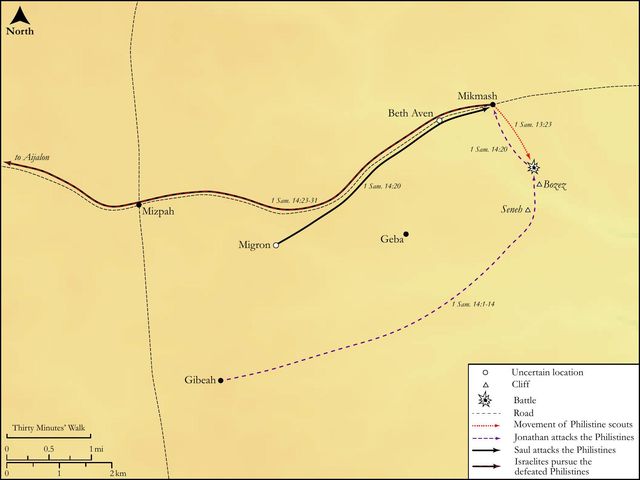
See on the biblical-era map
Study this verse
Public-domain commentary
Matthew Henry
From his Commentary on the Whole Bible. Henry comments on passages, not single verses — this entry covers 1 Samuel 14:24–35. His three-level outline is real structure in the source text, so it is rendered as structure.
We have here an account of the distress of the children of Israel, even in the day of their triumphs. Such alloys are all present joys subject to. And such obstructions does many a good cause meet with, even when it seems most prosperous, through the mismanagement of instruments.
I.Saul forbade the people, under the penalty of a curse, to taste any food that day, Sa1 14:24. Here we will suppose,
1.That as king he had power to put his soldiers under this interdict, and to bind it on with a curse; and therefore they submitted to it, and God so far owned it as to discover, by the lot, that Jonathan was the delinquent that had meddled with the accursed thing (though ignorantly), on which account God would not be at that time enquired of by them.
2.That he did it with a good intention, lest the people, who perhaps had been kept for some time at short allowance, when they found plenty of victuals in the deserted camp of the Philistines, should fall greedily upon that, and so lose time in pursing the enemy, and some of them, it may be, glut themselves to such a degree as not to be fit for any more service that day. To prevent this, he forbade them to taste any food, and laid himself, it is likely, under the same restraint. And yet his making this severe order was,
(1.)Impolitic and very unwise; for, if it gained time, it lost strength, for the pursuit.
(2.)It was imperious, and disobliging to the people, and worse than muzzling the mouth of the ox when he treads out the corn. To forbid them to feast would have been commendable, but to forbid them so much as to taste, though ever so hungry, was barbarous.
(3.)It was impious to enforce the prohibition with a curse and an oath. Had he no penalty less than an anathema wherewith to support his military discipline? Death for such a crime would have been too much, but especially death with a curse. Though superiors may chide and correct, they may not curse their inferiors; our rule is, Bless, and curse not. When David speaks of an enemy he had that loved cursing perhaps he meant Saul, Psa 109:17, Psa 109:18.
II.The people observed his order, but it had many inconveniences attending it.
1.The soldiers were tantalized; for, in their pursuit of the enemy, it happened that they went through a wood so full of wild honey that it dropped from the trees upon the ground, the Philistines having perhaps, in their flight, broken in upon the honeycombs, for their own refreshment, and left them running. Canaan flowed with honey, and here is an instance of it. They sucked honey out of the rock, the flinty rock (Deu 32:13); yet, for fear of the curse, they did not so much as taste the honey, Sa1 14:25, Sa1 14:26. Those are worthy of the name of Israelites that can deny themselves and their own appetites even when they are most craving, and the delights of sense most tempting, for fear of guilt and a curse, and the table becoming a snare. Let us never feed ourselves, much less feast ourselves, without fear.
2.Jonathan fell under the curse through ignorance. He heard not of the charge his father had given; for, having bravely forced the lines, he was then following the chase, and therefore might justly be looked upon as exempted from the charge and intended in it. But it seems it was taken for granted, and he himself did not object against it afterwards, that it extended to him, though absent upon so good an occasion. He, not knowing any peril in it, took up a piece of a honey-comb, upon the end of his staff, and sucked it (Sa1 14:27), and was sensibly refreshed by it: His eyes were enlightened, which began to grow dim through hunger and faintness; it made his countenance look pleasant and cheerful, for it was such as a stander-by might discern (Sa1 14:29): See how my eyes have been enlightened. He thought no harm, nor feared any, till one of the people acquainted him with the order, and then he found himself in a snare. Many a good son has been thus entangled and distressed, in more ways than one, by the rashness of an inconsiderate father. Jonathan, for his part, lost the crown he was heir to by his father's folly, which, it may be, this was an ill omen of.
3.The soldiers were faint, and grew feeble, in the pursuit of the Philistines. Jonathan foresaw this would be the effect of it; their spirits would flag, and their strength would fail, for want of sustenance. Such is the nature of our bodies that they soon grow unfit for service if they be not supplied with fresh recruits. Daily work cannot be done without daily bread, which our Father in heaven graciously gives us. It is bread that strengthens man's heart; therefore Jonathan reasoned very well, If the people had eaten freely, there would have been a much greater slaughter (Sa1 14:30); but, as it was, they were very faint, too much fatigued (so the Chaldee), and began to think more of their meat than of their work.
4.The worst effect of all was that at evening, when the restraint was taken off and they returned to their food again, they were so greedy and eager upon it that they ate the flesh with the blood, expressly contrary to the law of God, Sa1 14:32. Two hungry meals, we say, make the third a glutton; it was so here. They would not stay to have their meat either duly killed (for they slew the cattle upon the ground, and did not hang them up, as they used to do, that the blood might all run out of them) or duly dressed, but fell greedily upon it before it was half boiled or half roasted, Sa1 14:32. Saul, being informed of it, reproved them for the sin (Sa1 14:33): You have transgressed; but did not, as he should have done, reflect upon himself as having been accessory to it, and having made the Lord's people to transgress. To put a stop to this irregularity, Saul ordered them to set up a great stone before him, and let all that had cattle to kill, for their present use, bring them thither, and kill them under his eye upon that stone (Sa1 14:33), and the people did so (Sa1 14:34), so easily were they restrained and reformed when their prince took care to do his part. If magistrates would but use their power as they might, people would be made better than they are with more ease than is imagined.
III.On this occasion Saul built an altar (Sa1 14:35), that he might offer sacrifice, either by way of acknowledgment of the victory they had obtained or by the way of atonement for the sin they had been guilty of. The same was the first altar that he built, and perhaps the rolling of the great stone to kill the beasts on reminded him of converting it into an altar, else he would not have thought of it. Saul was turning aside from God, and yet now he began to build altars, being most zealous (as many are) for the form of godliness when he was denying the power of it. See Hos 8:14, Israel has forgotten his Maker, and buildeth temples. Some read it, He began to build that altar; he laid the first stone, but was so hasty to pursue his victory that he could not stay to finish it.
Historical interpretation
Two Centuries of Reception
2 surviving comments on this verse. Each one is dated, so this reads as a timeline rather than a list.
Select a marker to jump to its quote. Markers stagger vertically where authors wrote within a few decades of each other.
At all events, Saul himself, when engaged in battle, clearly enjoined this duty: “Cursed (be) the man who shall have eaten bread until evening, until I am avenged against my enemy”; and his whole company did not taste (food), and (yet) the whole earth was breakfasting! So solemn a sanction, moreover, did God confer on the edict which enjoined that station, that Jonathan the son of Saul, although it had been in ignorance of the fast having been appointed till a late hour that he had allowed himself a taste of honey, was both presently convicted, by lot … and with difficulty was exempted from punishment through the prayer of the people: for he had been convicted of gluttony, although of a simple kind.
Saul, as it is written in the first book of Kings [Samuel], pronounced a curse on him who ate bread before the evening, and until he had avenged himself upon his enemies. So none of his troops tasted any food while all the people of the land ate. And so binding was a solemn fast once it was proclaimed to the Lord, that Jonathan, to whom the victory was due, was taken by lot and could not escape the charge of sinning in ignorance, and his father’s hand was raised against him, and the prayers of the people barely saved him.
Continue studying 1 Samuel 14:26 across the web’s major study libraries — every link below opens this exact verse, chapter, or book on the destination site.
Read & Compare
 BibleGatewayThis verse in more than 200 translations and 70 languages.
 Bible.comThe YouVersion reader — hundreds of translations, reading plans, and highlights.
 ESV.orgCrossway's official English Standard Version reader.
 NET BibleThe NET translation with 60,000+ translators' notes on every rendering decision.
 STEP BibleTyndale House's free study tool — original text, vocabulary, and scholarly resources.
 BibliaLogos Bible Software's free web reader.
 USCCBThe New American Bible (Revised Edition) with the U.S. bishops' study notes.
Commentaries
 BibleHub CommentariesDozens of classic commentaries on this verse, gathered on one page.
 StudyLightMore than 100 commentary sets — the largest collection on the web.
 BibleRefPlain-English commentary on what this verse means, verse by verse.
 Enduring WordDavid Guzik's free commentary on this chapter, widely used by Bible teachers.
 Bible Study ToolsVerse commentary alongside Greek and Hebrew study aids.
Original Language & Research
- BibleHub InterlinearThe verse word by word — original language, transliteration, and English.
- BibleHub LexiconEvery word's original-language definition and Strong's entry.
 Blue Letter BibleDeep-study tools — Strong's numbers, concordance, and word studies.
 SefariaThe Hebrew text with Rashi and centuries of Jewish commentary.
Sermons, Hymns & Audio


TrulyRandomVerse is not affiliated with these sites and doesn’t control their content. They’re linked because they’re genuinely useful.
Summary
1 Samuel 14:26 vividly portrays a moment of profound physical hardship and moral conflict within the Israelite army as they pursue the Philistines. Despite stumbling upon an abundant, easily accessible source of wild honey, the exhausted soldiers rigidly refrain from eating. This self-denial is driven by an intense fear of violating a rash oath imposed by King Saul, thereby underscoring the formidable power of royal decrees in ancient Israel and the detrimental consequences of impulsive leadership on the morale, physical well-being, and operational effectiveness of the people.
Context
ShowHideLiterary Context
This verse is deeply embedded within the unfolding narrative of Israel's ongoing conflict with the Philistines, specifically detailing the aftermath of Jonathan's audacious, faith-filled strike against a Philistine garrison, which ignited a widespread rout (1 Samuel 14:1-15). As the Philistines flee in disarray, King Saul, in a moment of fervent but misguided zeal, imposes a severe oath upon his weary troops, forbidding them from consuming any food until evening, ostensibly to secure divine favor for his vengeance (1 Samuel 14:24). The immediate preceding verses emphasize the army's extreme exhaustion, making their discovery of the honey and their subsequent abstention a poignant and dramatic highlight. The narrative directly following this verse reveals Jonathan's unwitting transgression of the oath and the subsequent divine revelation of his "guilt," leading to a near-fatal crisis for the prince (1 Samuel 14:27-45). This entire episode serves as a critical turning point, exposing the deep flaws in Saul's leadership and foreshadowing his eventual decline as king.
Historical & Cultural Context
The historical backdrop is early monarchical Israel, a period characterized by persistent military engagements with powerful neighbors like the Philistines, who held a technological advantage with their mastery of iron. Within this cultural milieu, oaths, especially those sworn by a king or involving a divine curse, carried immense legal, social, and religious weight. Breaking such a vow was not merely a contractual breach but an act believed to invite divine wrath or a curse upon the individual and potentially the entire community. Honey was a highly prized natural sweetener and a rapid energy source, frequently found wild in the rugged, wooded terrain of ancient Israel. The army's desperate hunger vividly illustrates the grueling conditions of ancient warfare, where provisions were often scarce and physical endurance was paramount. Saul's impulsive actions in this chapter also reflect the nascent, often erratic, nature of his kingship, standing in stark contrast to the later, more divinely guided and discerning reign of David.
Key Themes
ShowHideThe passage powerfully illuminates several significant themes prevalent throughout the book of Samuel. Firstly, it starkly portrays the peril of rash vows and the detrimental consequences of leadership that prioritizes personal piety or zealous pronouncements over the practical well-being and strategic effectiveness of the people. Saul's oath, intended to secure divine favor and victory, ironically weakens his own army and impedes their ability to decisively defeat the enemy (1 Samuel 14:29-30). Secondly, it underscores the profound weight of authority and obedience, as the soldiers, despite their acute hunger, demonstrate an unwavering fear and respect for Saul's decree, even when it appears counterproductive. This obedience, while commendable in its adherence to a sworn word, also exposes a potential lack of discernment, highlighting the tension between human command and divine wisdom. Thirdly, the abundant divine provision in the form of honey, which is tragically ignored due to a human edict, subtly points to how human rules or misguided zeal can inadvertently obstruct God's natural blessings and provisions. Finally, the entire narrative serves as a stark commentary on Saul's flawed leadership, showcasing his impulsiveness, lack of foresight, and the negative impact his personal decisions have on the entire nation, a recurring motif throughout his reign, as seen in earlier instances of his disobedience and presumption (1 Samuel 13).
Exposition and Analysis
ShowHideKey Word Analysis
ShowHideDerived from a root meaning "to be gummy," this term refers to honey, often implying its sticky nature. In this context, it signifies a natural, readily available, and highly valuable source of sustenance and quick energy. Its presence "dropping" suggests a honeycomb dripping from a tree or rock, indicating an abundance that is tragically unconsumed.
This word denotes a forest or copse, implying a dense, uncultivated, wild area. Its usage here sets the scene for a natural environment where wild honey might be discovered. The "wood" represents a place of natural provision, contrasting sharply with the human-imposed restriction that prevents the army from partaking of its bounty.
This term refers to something sworn, a solemn vow, or an imprecation. Unlike a general promise, a shᵉbûwʻâh carries the profound weight of a divine curse that would befall anyone who breaks it. The people's "fear" of this oath underscores its severe, binding nature and the perceived spiritual danger of transgression in ancient Israelite society.
Verse Breakdown
ShowHide"And when the people were come into the wood"
This opening clause establishes the setting and the movement of the Israelite army. It describes their entry into a forested area, emphasizing their physical journey and the arduous pursuit of the Philistines, which naturally leads to their extreme exhaustion and hunger.
"behold, the honey dropped;"
The interjection "behold" serves to draw immediate attention to a surprising and significant discovery. The active verb "dropped" vividly portrays the honey's abundance and accessibility, suggesting it was flowing freely from a honeycomb, perhaps in a tree or rock crevice, presenting an immediate and tempting solution to their desperate need for sustenance.
"but no man put his hand to his mouth:"
This clause highlights the extraordinary and almost unnatural self-restraint of the soldiers. Despite the palpable hunger and the easy availability of the honey, not a single individual consumed it, demonstrating a remarkable, albeit potentially misguided, level of discipline or, more accurately, profound fear.
"for the people feared the oath."
This concluding clause provides the crucial explanation for their abstinence. Their fear was not primarily of King Saul himself, but of the divine curse associated with breaking the solemn oath he had imposed. It reveals the immense spiritual and social weight of oaths in ancient Israelite society and the people's deep reverence (or terror) for such sacred pronouncements, even when they led to personal suffering.
Literary Devices
ShowHideThe verse masterfully employs several potent literary devices to convey its profound message. Irony is strikingly evident, as Saul's oath, intended to secure victory through a display of piety and zeal, paradoxically weakens his army and hinders their pursuit of the enemy. The very decree meant to aid them becomes a stumbling block. Symbolism is also at play, with the "honey" representing divine provision, natural blessing, and immediate sustenance, sharply contrasted with the "oath" which symbolizes human restriction, legalistic burden, and misguided authority. The scene creates palpable tension between the soldiers' desperate physical need for nourishment and their unwavering, almost paralyzing, obedience to a potentially ill-conceived command. Furthermore, the contrast between the natural abundance of the dropping honey and the imposed scarcity due to the oath underscores the folly of human decrees that run counter to natural or divine provision, highlighting the tragic consequences of prioritizing human law over human welfare.
Theological and Thematic Connections
ShowHideThis passage profoundly illustrates the tension between human legalism and divine provision, highlighting how well-intentioned but misguided human rules can inadvertently obstruct God's blessings and harm His people. Saul's rash oath, made without consulting God or considering the welfare of his exhausted army, becomes a barrier to their strength and effectiveness, revealing a leadership style driven by impulsive zeal rather than wisdom and discernment. The people's fear of the oath, though born of respect for authority and the sanctity of vows, leads them to endure unnecessary suffering, prompting reflection on the nature of true obedience and the discernment required to distinguish between divine commands and human impositions. This narrative serves as a cautionary tale against making hasty commitments that bind others, emphasizing the importance of considering consequences and prioritizing the well-being of those under one's care.
Reflection and Application
ShowHideThe scene at the honey-dripping wood presents a stark reminder of how human decrees, even those made with seemingly good intentions, can inadvertently create unnecessary burdens and hinder the very people they are meant to serve. For us today, this prompts a vital self-examination: Are there "oaths" or "rules" – whether personal, familial, organizational, or communal – that we adhere to out of fear, tradition, or a misguided sense of piety, even when they seem to contradict common sense, compassion, or even God's clear provision and natural blessings? This passage challenges leaders to exercise profound wisdom, foresight, and empathy, recognizing that true strength and effective leadership come not from rigid adherence to self-imposed laws, but from discerning God's will, prioritizing the holistic well-being of those entrusted to their care, and fostering an environment where legitimate needs are met. It also encourages individuals to cultivate discernment, understanding when obedience to human authority aligns with divine principles and when it might inadvertently lead to self-imposed hardship or the neglect of genuine blessings.
Questions for Reflection
ShowHideFAQ
ShowHideWhy was Saul's oath so feared by the people?
ShowHideSaul's oath was feared because it was a solemn declaration, likely invoking a divine curse upon anyone who broke it. In ancient Israelite culture, oaths were considered incredibly binding, carrying not just social or legal consequences, but also the very real possibility of divine retribution. The Hebrew term used for "oath" here, shᵉbûwʻâh (H7621), denotes something sworn, a solemn vow that, if violated, would bring misfortune or judgment from God. The people's fear was rooted in their deep reverence for divine authority and the sanctity of sworn vows, even if the vow itself was rashly made by their king, as described in 1 Samuel 14:24. They believed that breaking such a vow would bring a curse upon themselves and potentially the entire nation.
Was it right for the people to obey Saul's oath, given their desperate hunger?
ShowHideThis presents a complex ethical and theological dilemma. From a legalistic and cultural perspective, the people were "right" to obey the oath, as it was a binding decree from their king, carrying a divine curse. Their obedience demonstrates a profound respect for authority and the sanctity of vows in their culture. However, from a practical and compassionate standpoint, Saul's oath was ill-conceived and detrimental, severely weakening his army and hindering their effectiveness in battle. Jonathan, Saul's own son, recognized this folly, stating, "My father has troubled the land" (1 Samuel 14:29). The narrative subtly critiques Saul's leadership, suggesting that rigid adherence to a misguided human command can sometimes override common sense, compassion, and even God's natural provision. The situation highlights the tension between absolute obedience to human authority and the exercise of discerning wisdom.
Christ-Centered Fulfillment
ShowHideThe narrative of 1 Samuel 14:26 with its depiction of a people bound by a legalistic oath that prevents them from partaking of freely available sustenance, powerfully foreshadows the liberating work of Christ. Just as Saul's human decree created an unnecessary burden, the Old Covenant law, though holy and good, could not ultimately provide true life and freedom from sin's curse (Romans 8:3). Humanity, exhausted by the relentless pursuit of righteousness through works, found itself starving for spiritual nourishment, unable to partake of the "honey" of God's grace due to the fear of the Law's demands and its condemnation. Jesus, however, is the ultimate fulfillment who breaks the power of such binding "oaths." He declared that "the Sabbath was made for man, not man for the Sabbath" (Mark 2:27), demonstrating a compassionate understanding that God's provisions are for our good, not our condemnation. Through His perfect obedience and sacrificial death, Christ fulfilled the Law, redeeming us from its curse (Galatians 3:13), and offering Himself as the true "bread of life" (John 6:35) and living water (John 4:10), freely available to all who believe. He invites us to come to Him, not under the burden of human decrees or the fear of a curse, but to find rest for our souls and abundant life (Matthew 11:28-30).