


Zechariah 13:4
Bible text: King James Version (1769 Blayney text) · Public domain
Bible text: King James Version with Strong's numbers · Public domain
Bible text: Berean Standard Bible · Public domain
Bible text: American Standard Version (1901) · Public domain
Bible text: World English Bible, Messianic edition · Public domain
Bible text: Geneva Bible (1599) · Public domain
Bible text: Young's Literal Translation · Public domain
- וְהָיָהve·ha·Yahand it will beH1961Conj-w ¦ V-Qal-ConsecPerf-3msVerb Qal Consecutive Perfect 3rd Singular Masculineוְandהָיָהit will be
- בַּיּוֹםbai·Yomon the dayH3117Prep-b ¦ N-msNoun Singular Masculine Absoluteבַּon theיּוֹםday
- הַהוּאha·Hu'<the> thatH1931Art ¦ Pro-3msPronoun Personal 3rd Singular Masculineהַ<the>הוּאthat
- יֵבֹשׁוּye·Vo·shuthey will be ashamedH954V-Qal-Imperf-3mpVerb Qal Imperfect 3rd Plural Masculine
- הַנְּבִיאִיםha·ne·vi·'Imthe prophetsH5030Art ¦ N-mpNoun Plural Masculine Absoluteהַtheנְּבִיאִיםprophets
- אִישׁ'isheach oneH376N-msNoun Singular Masculine Absolute
- מֵחֶזְיֹנוֹme·chez·yo·Nofrom his visionH2384Prep-m ¦ N-msc ¦ 3msNoun Singular Masculine Constructמֵfromחֶזְיֹנvisionוֹhis
- בְּהִנָּבְאֹתוֹbe·hi·na·ve·'o·Towhen he propheciesH5012Prep-b ¦ V-Niphal-Inf ¦ 3msVerb Niphal Infinitive Constructבְּwhenהִנָּבְאֹתpropheciesוֹhe
- וְלֹאve·Lo'and notH3808Conj-w ¦ NegParticle Negativeוְandלֹאnot
- יִלְבְּשׁוּyil·be·Shuthey will wearH3847V-Qal-Imperf-3mpVerb Qal Imperfect 3rd Plural Masculine
- אַדֶּרֶת'a·De·reta cloak ofH155N-fscNoun Singular Feminine Construct
- שֵׂעָרse·'ArhairH8181N-msNoun Singular Masculine Absolute
- לְמַעַןle·Ma·'anso asH4616PrtParticle Conditional
- כַּחֵשׁka·Cheshto deceiveH3584V-Piel-InfVerb Piel Infinitive Construct
English is a literal word-by-word gloss of the Hebrew, not the KJV's wording. Why?
This is the original text the KJV's translators worked from — each Hebrew word with its own literal English meaning in this verse, prepared by scholars at Tyndale House, Cambridge. The KJV translates whole sentences, not word by word, so its wording differs: one Hebrew word can become several English words, and the KJV may choose “the LORD” where the gloss reads “Yahweh”. Both are faithful — they answer different questions. For the KJV's own rendering, switch to the KJV text.
Details
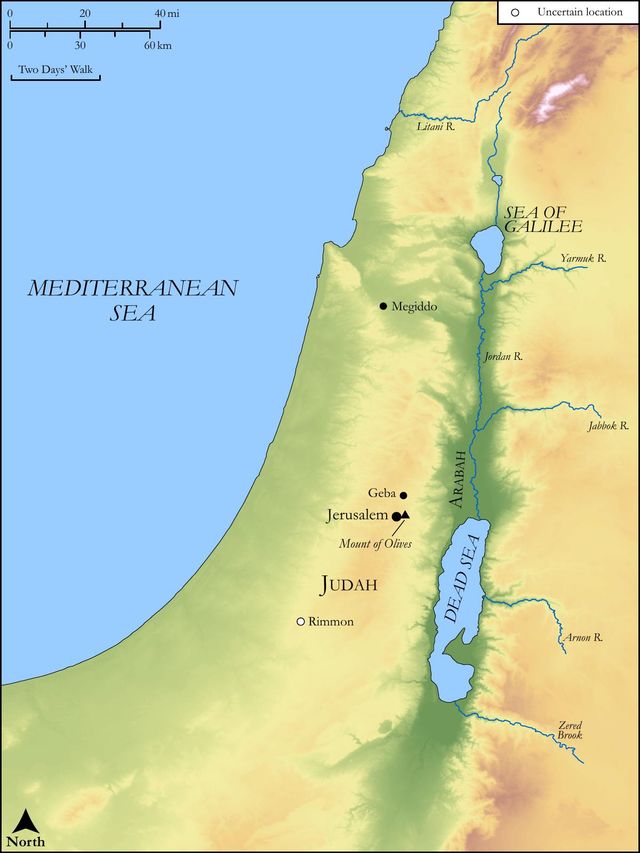
See on the biblical-era map
Study this verse
Public-domain commentary
Matthew Henry
From his Commentary on the Whole Bible. Henry comments on passages, not single verses — this entry covers Zechariah 13:1–6. His four-level outline is real structure in the source text, so it is rendered as structure.
Behold the Lamb of God taking away the sin of the world, the sin of the church; for therefore was the Son of God manifested, to take away our sin, Jo1 3:5.
I.He takes away the guilt of sin by the blood of his cross (Zac 13:1):
In that day, in the gospel-day, there shall be a fountain opened, that is, provision made for the cleansing of all those from the pollutions of sin who truly repent and are sorry for them. In that day, when the Spirit of grace is poured out to set them a mourning for their sins, they shall not mourn as those who have no hope, but they shall have their sins pardoned, and the comfort of their pardon in their bosoms. Their consciences shall be purified and pacified by the blood of Christ, which cleanses from all sin, Jo1 1:7. For Christ is exalted to give both repentance and remission of sins; and where he gives the one no doubt he gives the other. This fountain opened is the pierced side of Jesus Christ, spoken of just before (Zac 12:10), for thence came there out blood and water, and both for cleansing. And those who look upon Christ pierced, and mourn for their sins that pierced him, and are therefore in bitterness for him, may look again upon Christ pierced and rejoice in him, because it pleased the Lord thus to smite this rock, that it might be to us a fountain of living waters. See here,
1.How we are polluted; we are all so; we have sinned, and sin is uncleanness; it defiles the mind and conscience, renders us odious to God and uneasy in ourselves, unfit to be employed in the service of God and admitted into communion with him, as those who were ceremonially unclean were shut out of the sanctuary. The house of David and the inhabitants of Jerusalem are under sin, which is uncleanness. The truth is, we are all as an unclean thing, and deserve to have our portion with the unclean.
2.How we may be purged. Behold, there is fountain opened for us to wash in, and there are streams flowing to us from that fountain, so that, if we be not made clean, it is our own fault. The blood of Christ, and God's pardoning mercy in that blood, revealed in the new covenant, are,
(1.)A fountain; for there is in them an inexhaustible fulness. There is mercy enough in God, and merit enough in Christ, for the forgiving of the greatest sins and sinners, upon gospel-terms. Such were some of you, but you are washed, Co1 6:11. Under the law there were a brazen laver and a brazen sea to wash in; those were but vessels, but we have a fountain to ourselves, overflowing, ever-flowing.
(2.)A fountain opened; for, whoever will, may come and take the benefit of it; it is opened, not only to the house of David, but to the inhabitants of Jerusalem, to the poor and mean as well as to the rich and great; or it is opened for all believers, who, as the spiritual seed of Christ, are of the house of David, and, as living members of the church, are inhabitants of Jerusalem. Through Christ all that believe are justified, are washed from their sins in his blood, that they may be made to our God kings and priests, Rev 1:5, Rev 1:6.
II.He takes away the dominion of sin by the power of his grace, even of beloved sins.
This evermore accompanies the former; those that are washed in the fountain opened, as they are justified, so they are sanctified; the water came with the blood out of the pierced side of Christ. It is here promised that in that day,
1.Idolatry shall be quite abolished and the people of the Jews shall be effectually cured of their inclination to it (Zac 13:2): I will cut off the names of the idols out of the land. The worship of the idols of their fathers shall be so perfectly rooted out that in one generation or two it shall be forgotten that ever there were such idols among them; they shall either not be named at all or not with any respect; they shall no more be remembered, as was promised, Hos 2:17. This was fulfilled in the rooted aversion which the Jews had, after the captivity, to idols and idolatry, and still retain to this day; it was fulfilled also in the ready conversion of many to the faith of Christ, by which they were taken off from making an idol of the ceremonial law, as the unbelieving Jews did; and it is still in the fulfilling when souls are brought off from the world and the flesh, those two great idols, that they may cleave to God only.
2.False prophecy shall also be brought to an end: I will cause the prophets and the unclean spirit, the prophets that are under the influence of the unclean spirit, to pass out of the land. The devil is an unclean spirit; sin and uncleanness are from him; he has his prophets, that serve his interests and receive their instructions from him. Take away the unclean spirit, and the prophets would not deceive as they do; take away the false prophets that produce sham commissions, and the unclean spirit could not do the mischief he does. When God designs the silencing of the false prophets he banishes the unclean spirit out of the land, that wrought in them, and was a rival with him for the throne in the heart. The church of the Jews, when they were addicted to idols, did also dote much upon false prophets, who flattered them in their sins with promises of impunity and peace; but here it is promised, as a blessed effect of the promised reformation, that they should be very much set against false prophets, and zealous to clear the land of them; they were so after the captivity, till, through the blindness of their zeal against false prophets, they had put Christ to death under that character, and, after that, there arose many false Christs and false prophets, and deceived many, Mat 24:11. It is here foretold,
(1.)That false prophets, instead of being indulged and favoured, should be brought to condign punishment even by their nearest relations, which would be as great an instance as any of flagrant zeal against those deceivers (Zac 13:3): When any shall set up for a prophet, and shall speak lies in the name of the Lord, shall preach that which tends to draw people from God and to confirm them in sin, his own parents shall be the first and most forward to prosecute him for it, according to the law. Deu 13:6-11, "If thy son entice thee secretly from God, thou shalt surely kill him. Show thy indignation against him, and prevent any further temptation from him." His father and his mother shall thrust him through when he prophesies. Note, We ought to conceive, and always to retain, a very great detestation and dread of every thing that would draw us out of the way of our duty into by-paths, as those who cannot bear that which is evil, Rev 2:2. And holy zeal for God and godliness will make us hate sin, and dread temptation, most in those whom naturally we love best, and who are nearest to us; there our danger is greatest, as Adam's from Eve, Job's from his wife; and there it will be the most praiseworthy to show our zeal, as Levi, who, in the cause of God, did not acknowledge his brethren, nor know his own children, Deu 33:9. Thus we must hate and forsake our nearest relations when they come in competition with our duty to God, Luk 14:26. Natural affections, even the strongest, must be over-ruled by gracious affections.
(2.)That false prophets should be themselves convinced of their sin and folly, and let fall their pretensions (Zac 13:4): "The prophets shall be ashamed every one of his vision; they shall not repeat it, or insist upon it, but desire that it may be forgotten and no more said of it, being ready themselves to own it was a sham, because God has by his grace awakened their consciences and shown them their error, or because the event disproves their predictions, and gives them the lie, or because their prophecies do not meet with such a favourable reception as they used to meet with, but are generally despised and distasted; they perceive the people ashamed of them, which makes them begin to be ashamed of themselves. And therefore they shall no longer wear a rough garment, or garment of hair, as the true prophets used to do, in imitation of Elijah, and in token of their being mortified to the pleasures and delights of sense." The pretenders had appeared in the habit of true prophets; but, their folly being now made manifest, they shall lay it aside, no more to deceive and impose upon unthinking unwary people by it. A modest dress is a very good thing, if it be the genuine indication of a humble heart, and is to instruct; but it is a bad thing if it be the hypocritical disguise of a proud ambitious heart, and is to deceive. Let men be really as good as they seem to be, but not seem to be better than really they are. This pretender, as a true penitent,
[1.]Shall undeceive those whom he had imposed upon: He shall say, "I am no prophet, as I have pretended to be, was never designed nor set apart to the office, never educated nor brought up for it, never conversant among the sons of the prophets. I am a husbandman, and was bred to that business; I was never taught of God to prophesy, but taught of man to keep cattle" Amos was originally such a one too, and yet was afterwards called to be a prophet, Amo 7:14, Amo 7:15. But this deceiver never had any such call. Note, Those who sorrow after a godly sort for their having deceived others will be forward to confess their sin, and will be so just as to rectify the mistakes which they have been the cause of. Thus those who had used curious arts, when they were converted showed their deeds, and by what fallacies they had cheated the people, Act 19:18.
[2.]He shall return to his own proper employment, which is the fittest for him: I will be a husbandman (so it may be read); "I will apply myself to my calling again, and meddle no more with things that belong not to me; for man taught me to keep cattle from my youth, and cattle I will again keep, and never set up for a preacher any more." Note, When we are convinced that we have gone out of the way of our duty we must evince the truth of our repentance by returning to it again, though it be the severest mortification to us.
[3.]He shall acknowledge those to be his friends who by a severe discipline were instrumental to bring him to a sight of his error, Zac 13:6. When he who with the greatest assurance had asserted himself so lately to be a prophet suddenly drops his claims, and says, I am no prophet, every body will be surprised at it, and some will ask, "What are these wounds, or marks of stripes, in thy hands? how camest thou by them? Hast thou not been examined by scourging? And is not that it that has brought thee to thyself?" (Vexatio dat intellectum - Vexation sharpens the intellect.) "Hast thou not been beaten into this acknowledgment? Was it not the rod and reproof that gave thee this wisdom?" And he shall own, "Yes, it was; these are the wounds with which I was wounded in the house of my friends, who bound me, and used me hardly and severely, as a distracted man, and so brought me to my senses." By this it appears that those parents of the false prophet that thrust him through (Zac 13:3) did not do it till they had first tried to reclaim him by correction, and he would not be reclaimed; for so was the law concerning a disobedient son - his parents must first have chastened him in vain before they were allowed to bring him forth to be stoned, Deu 21:18, Deu 21:19. But here is another who was reduced by stripes, and so prevented the capital punishment; and he had the sense and honesty to own that they were his friends, his real friends, who thus wounded him, that they might reclaim him; for faithful are the wounds of a friend, Pro 27:6. Some good interpreters, observing how soon this comes after the mention of Christ's being pierced, think that these are the words of that great prophet, not of the false prophet spoken of before. Christ was wounded in his hands, when they were nailed to the cross, and, after his resurrection, he had the marks of these wounds; and here he tells how he came by them; he received them as a false prophet, for the chief priests called him a deceiver, and upon that account would have him crucified; but he received them in the house of his friends - the Jews, who should have been his friends; for he came to his own, and, though they were his bitter enemies, yet he was pleased to call them his friends, as he did Judas (Friend, wherefore hast thou come?) because they forwarded his sufferings for him; as he called Peter Satan - an adversary, because he dissuaded him from them.
Historical interpretation
Historical reception
1 surviving comment on this verse from the historical church.
(Vers. 3 seqq.) And on that day, the prophets will be confused, each one from his own vision, when he prophesies, and they will not cover themselves with a sackcloth to deceive. Instead, they will say, 'I am not a prophet, I am a farmer, for Adam is my example from my youth.' And it will be said to him, 'What are these wounds in the middle of your hands?' And he will say, 'I have been wounded in the house of those who love me.' LXX: And on that day, the prophets will be confused, each one from his own vision, when he prophesies, and they will wear a hairy garment with which they have deceived, and they will say, 'I am not a prophet, because a man has begotten me from my youth,' and I will say to him, 'What are these wounds in the middle of your hands?' And he will say: To whom have I been struck in the house of the one who loves me? Whoever attempts to prophesy and is condemned by the judgment of his parents, and approves the falsehood of his prophecy by contrary outcomes, he will be confounded by his vision, and he will no longer be covered with a hairshirt in order to lie. For this was the attire of the prophets, that when they called the people to repentance, they would be clothed in a hairshirt. Therefore, it is commanded to Isaiah to take the sackcloth from his loins, and to walk naked (Isa. XX): for it is not at all a time of repentance, but of imminent captivity. Therefore, this false prophet will by no means receive the prophet's garb, so as not to deceive the simple under a foreign guise and covering. Rather, he will find delight in tilling the earth and prove himself dedicated to agriculture, subjecting himself to the divine sentence that was spoken to Adam: 'Cursed is the ground because of you; in toil you shall eat of it all the days of your life; thorns and thistles it shall bring forth to you; and you shall eat the plants of the field. By the sweat of your face you shall eat bread' (Gen. III, 17-18). And when he presents himself as born for this purpose, to eat his bread in the sweat of his face, another will ask him, and say: What do these wounds mean to you, and these wounds which are in the midst of your hands? And there is meaning: Why do you adhere to the gallows? Why are your hands pierced with nails? What have you committed, that you should submit to this punishment and torture? And he will answer, and say: I received these wounds and these lashes, condemned by the judgment of my parents, and of those who did not hate me, but loved me. And in the meantime, with falsehood dispelled, truth will prevail, so that even he who is punished for his own fault admits that he has suffered rightly. The Hebrews have explained this, which is written: 'They will not cover themselves with a sackcloth to lie,' saying that they will not be filled with the demonic spirit, whom we read in Isaiah as 'hairy,' so that by this occasion they may not lie about the deceptive appearance of God's words in themselves, or deny the Lord: For they lie and deny in their external appearance, as they interpret.
Continue studying Zechariah 13:4 across the web’s major study libraries — every link below opens this exact verse, chapter, or book on the destination site.
Read & Compare
 BibleGatewayThis verse in more than 200 translations and 70 languages.
 Bible.comThe YouVersion reader — hundreds of translations, reading plans, and highlights.
 ESV.orgCrossway's official English Standard Version reader.
 NET BibleThe NET translation with 60,000+ translators' notes on every rendering decision.
 STEP BibleTyndale House's free study tool — original text, vocabulary, and scholarly resources.
 BibliaLogos Bible Software's free web reader.
 USCCBThe New American Bible (Revised Edition) with the U.S. bishops' study notes.
Commentaries
 BibleHub CommentariesDozens of classic commentaries on this verse, gathered on one page.
 StudyLightMore than 100 commentary sets — the largest collection on the web.
 BibleRefPlain-English commentary on what this verse means, verse by verse.
 Enduring WordDavid Guzik's free commentary on this chapter, widely used by Bible teachers.
 Bible Study ToolsVerse commentary alongside Greek and Hebrew study aids.
Original Language & Research
- BibleHub InterlinearThe verse word by word — original language, transliteration, and English.
- BibleHub LexiconEvery word's original-language definition and Strong's entry.
 Blue Letter BibleDeep-study tools — Strong's numbers, concordance, and word studies.
 SefariaThe Hebrew text with Rashi and centuries of Jewish commentary.
Sermons, Hymns & Audio


TrulyRandomVerse is not affiliated with these sites and doesn’t control their content. They’re linked because they’re genuinely useful.
Summary
Zechariah 13:4 is a powerful prophetic declaration concerning the future exposure and disgrace of false prophets in Israel. It foretells a time, part of God's broader purification of His people, when those who have deceived with fabricated visions will be utterly shamed, abandoning their deceptive practices and the symbolic attire used to feign true prophetic authority. This verse underscores God's commitment to truth and the eradication of spiritual falsehood from His midst.
Context
ShowHideLiterary Context
This verse is situated within the highly eschatological and prophetic section of Zechariah, specifically chapters 12-14, often referred to as "The Burden of the Word of the LORD concerning Israel." This segment vividly describes future events surrounding the end times, including the national repentance of Israel, the defeat of hostile nations, and the ultimate establishment of God's kingdom with the Messiah at its center. Zechariah 13 opens with the promise of a "fountain opened for sin and for uncleanness" Zechariah 13:1, indicating a profound spiritual purification. The immediate verses preceding Zechariah 13:4 speak of the cutting off of idols and false prophets from the land Zechariah 13:2, and even the rejection of a false prophet by his own parents Zechariah 13:3. Thus, Zechariah 13:4 continues this theme of divine cleansing, focusing specifically on the shame and cessation of false prophecy as a necessary step in preparing God's people for His righteous reign.
Historical & Cultural Context
In ancient Israel, prophets held a crucial role as divine messengers, speaking "thus says the LORD." However, alongside true prophets, there were always false prophets who claimed divine inspiration but spoke from their own imagination, for personal gain, or under the influence of other spirits. The Old Testament repeatedly warns against such deception (e.g., Deuteronomy 13:1-5 and Jeremiah 14:14). True prophets, like Elijah and Elisha, were often distinguished by their simple, ascetic lifestyle, which sometimes included wearing a "rough garment" or "hairy cloak" as a symbol of their separation and dedication to God. This distinctive attire became associated with prophetic authority. False prophets would mimic this appearance to lend credibility to their deceitful messages, exploiting the people's reverence for genuine prophetic figures. Zechariah 13:4 addresses this specific cultural practice, prophesying an end to such outward masquerade for deceptive purposes.
Key Themes
ShowHideThe overarching theme in this section of Zechariah is Divine Purification and Restoration. The exposure and removal of false prophets are integral to God's comprehensive plan to cleanse His people and land, making them fit for His presence and kingdom. This includes the eradication of idolatry and all forms of spiritual deception. Another prominent theme is Truth vs. Deception, highlighting God's absolute commitment to truth and His ultimate judgment against all falsehood. The verse also touches on Authenticity and Authority, contrasting the genuine authority that comes from God with the fabricated authority assumed by deceivers. The shame prophesied for the false prophets signifies the vindication of God's truth and the establishment of His righteous standards, ensuring that His people will no longer be led astray by those who speak "a vision of their own heart, and not from the mouth of the LORD" Jeremiah 23:16.
Exposition and Analysis
ShowHideKey Word Analysis
ShowHideDerived from the root meaning "to prophesy," this term refers to an individual who speaks by divine inspiration. In the context of Zechariah 13:4, it specifically denotes those who claim to be God's spokespersons but are, in fact, false, delivering messages not from the Lord. Their shame signifies the public exposure of their fraudulent claims.
This primitive root primarily means "to pale" or "to be ashamed." By implication, it conveys the idea of being disappointed, confounded, or put to confusion. The prophecy indicates a profound public humiliation for the false prophets, where their deceptive practices are revealed, leading to a deep sense of disgrace and regret over their false "visions."
This word refers to a revelation or an expectation, often experienced through a dream. In the prophetic context, it denotes the divine communication or insight that a prophet claims to receive. The verse states that the false prophets will be ashamed of "his vision," implying that the content of their supposed revelations will be proven false, empty, or self-serving, leading to their utter discrediting.
Verse Breakdown
ShowHide"And it shall come to pass in that day,"
This phrase, common in prophetic literature, points to a specific future time, often referring to the "Day of the Lord" or the eschatological period when God intervenes decisively in human history. Here, it signals the commencement of the divine purification and judgment described in Zechariah 12-14.
"that the prophets shall be ashamed every one of his vision, when he hath prophesied;"
This clause prophesies the public disgrace of those who falsely claimed to speak for God. Their "vision" – the content of their false prophecies – will be exposed as fraudulent, leading to profound personal and public shame. The phrase "when he hath prophesied" underscores that their shame will be directly linked to the very acts of deception they committed.
"neither shall they wear a rough garment to deceive:"
This part specifies a key aspect of their deception and its cessation. The "rough garment" (Hebrew: 'addereth sa'ar, a mantle of hair) was the characteristic attire of true prophets (e.g., Elijah, John the Baptist), symbolizing their austere lifestyle and divine calling. False prophets adopted this attire to mimic authenticity and gain credibility. The prophecy states that in "that day," this deceptive practice will cease, as the shame of their exposure will prevent them from continuing their charade.
Literary Devices
ShowHideZechariah 13:4 effectively employs several literary devices to convey its powerful message. Symbolism is prominent, particularly with the "rough garment." This piece of clothing, historically associated with genuine prophets like Elijah, serves as a powerful symbol of prophetic authority and authenticity. The verse prophesies that this symbol will no longer be used as a tool for Deception, highlighting the end of a long-standing masquerade. There is an element of Irony in the fact that those who sought to gain honor and influence through false prophecy will ultimately be consumed by shame, and their very "visions" will be the source of their disgrace. The entire verse functions as Prophecy, a divine foretelling of future events, specifically God's decisive action to purify His people by exposing and silencing spiritual falsehood.
Theological and Thematic Connections
ShowHideZechariah 13:4 stands as a profound testament to God's unwavering commitment to truth and His ultimate judgment against all forms of spiritual deception. It reveals that the purification of His people involves not only cleansing from sin and idolatry but also the eradication of false teaching and fraudulent spiritual leadership. This divine act ensures that God's people are no longer led astray by voices that do not originate from Him, preparing them for a genuine relationship and worship. The shame prophesied for the false prophets underscores the severity with which God views those who misuse His name for their own ends, affirming that divine justice will always prevail and truth will ultimately be vindicated. This cleansing is essential for the establishment of God's righteous kingdom, where only His authentic voice will be heard and honored.
Reflection and Application
ShowHideZechariah 13:4 offers timeless principles for believers navigating the spiritual landscape today. In an age saturated with diverse voices and claims of spiritual insight, the prophecy serves as a critical reminder of the pervasive nature of spiritual deception and the imperative for discernment. Just as false prophets in Zechariah's time mimicked true ones, contemporary deceptions often come clothed in appealing forms, making it crucial to look beyond outward appearances, charismatic personalities, or popular appeal. We are called to diligently test every spirit and every message against the unchanging standard of God's revealed Word, the Bible. This verse instills confidence that God is ultimately sovereign over all truth and falsehood, and He will indeed expose and shame all forms of spiritual fraud. This should motivate us to cling steadfastly to biblical truth, cultivate a spirit of discernment, and pray for wisdom to recognize and reject anything that deviates from Christ and His Gospel.
Questions for Reflection
ShowHideFAQ
ShowHideWhat is the significance of the "rough garment" mentioned in this verse?
ShowHideThe "rough garment" (Hebrew: 'addereth sa'ar, literally "mantle of hair" or "hairy cloak") was a distinctive attire worn by genuine prophets in ancient Israel, notably Elijah 2 Kings 1:8 and later John the Baptist Matthew 3:4. It symbolized their ascetic lifestyle, separation unto God, and prophetic authority. False prophets, seeking to deceive the people and gain credibility, would adopt this same attire to mimic the appearance of true prophets. Zechariah 13:4 prophesies that in "that day," this deceptive practice will cease, as the shame of their exposed falsehood will prevent them from continuing their charade.
How can we identify false prophets or teachers today, based on the principles in this verse?
ShowHideWhile the specific "rough garment" is no longer relevant, the underlying principle of deception through outward appearance or false claims remains. We can identify false teachers by examining their "fruit" Matthew/7-15-20, meaning their character, their lifestyle, and most importantly, the content of their message. True teaching will always align with the entirety of God's revealed Word, the Bible. False teaching often deviates from core biblical doctrines, promotes self-gain, leads people away from Christ, or fails to produce genuine spiritual transformation. We are exhorted to "test the spirits whether they are of God" 1 John 4:1 by comparing what is taught to what is written in Scripture.
Christ-Centered Fulfillment
ShowHideZechariah 13:4, with its prophecy of the exposure and shame of false prophets, finds its ultimate fulfillment and deeper meaning in the person and work of Jesus Christ. He is the true Prophet, the very Word of God incarnate, who perfectly revealed the Father's will and spoke only truth John 1:18. His coming initiated the decisive "day" of God's intervention, bringing light to expose darkness and truth to dispel deception. Jesus Himself warned His disciples about false prophets who would come in sheep's clothing but inwardly are ravenous wolves Matthew 7:15. His ministry was characterized by confronting and silencing the religious hypocrisy and false teachings of His day, effectively shaming those who claimed spiritual authority but led the people astray. Through His atoning work on the cross, Christ provides the ultimate "fountain opened for sin and for uncleanness" Zechariah 13:1, purifying His people from all defilement, including the spiritual pollution caused by false prophecy. Ultimately, the New Testament church is built upon the foundation of the apostles and prophets, with Christ Jesus Himself as the chief cornerstone Ephesians 2:20, ensuring that the true prophetic voice, centered on Him, will prevail until His glorious return, when all hidden things will be brought to light 1 Corinthians 4:5.