


Acts 21:38
- οὐκoukSurelyG3756PRT-NNegative Particle Negative
- ἄραarathenG686CONJConjunction
- σὺsuyou yourselfG4771P-2NSPersonal pronoun Nominative 2nd Singular
- εἶeiareG1510V-PAI-2SVerb Present Active Indicative 2nd Singular
- ὁhotheG3588T-NSMDefinite article Nominative Singular Masculine
- ΑἰγύπτιοςAiguptiosEgyptianG124A-NSM-LGAdjective Nominative Singular Masculine Location Gentilic
- ὁho<the>G3588T-NSMDefinite article Nominative Singular Masculine
- πρὸprobeforeG4253PREPPreposition
- τούτωνtoutōntheseG3778D-GPFDemonstrative pronoun Genitive Plural Feminine
- τῶνtōntheG3588T-GPFDefinite article Genitive Plural Feminine
- ἡμερῶνhēmerōndaysG2250N-GPFNoun Genitive Plural Feminine
- ἀναστατώσαςanastatōsashaving led a revoltG387V-AAP-NSMVerb Aorist Active Participle Nominative Singular Masculine
- καὶkaiandG2532CONJConjunction
- ἐξαγαγὼνexagagōnhaving led outG1806V-2AAP-NSMVerb 2nd Aorist Active Participle Nominative Singular Masculine
- εἰςeisintoG1519PREPPreposition
- τὴνtēntheG3588T-ASFDefinite article Accusative Singular Feminine
- ἔρημονerēmonwildernessG2048A-ASFAdjective Accusative Singular Feminine
- τοὺςtoustheG3588T-APMDefinite article Accusative Plural Masculine
- τετρακισχιλίουςtetrakischiliousfour thousandG5070A-APMAdjective Accusative Plural Masculine
- ἄνδραςandrasmenG435N-APMNoun Accusative Plural Masculine
- τῶνtōnof theG3588T-GPMDefinite article Genitive Plural Masculine
- σικαρίων;sikariōnAssassins?G4607N-GPMNoun Genitive Plural Masculine
English is a literal word-by-word gloss of the Greek, not the KJV's wording. Why?
This is the original text the KJV's translators worked from — each Greek word with its own literal English meaning in this verse, prepared by scholars at Tyndale House, Cambridge. The KJV translates whole sentences, not word by word, so its wording differs: one Greek word can become several English words, and the KJV may choose “charity” where the gloss reads “love”. Both are faithful — they answer different questions. For the KJV's own rendering, switch to the KJV text.
Details
See on the biblical-era map
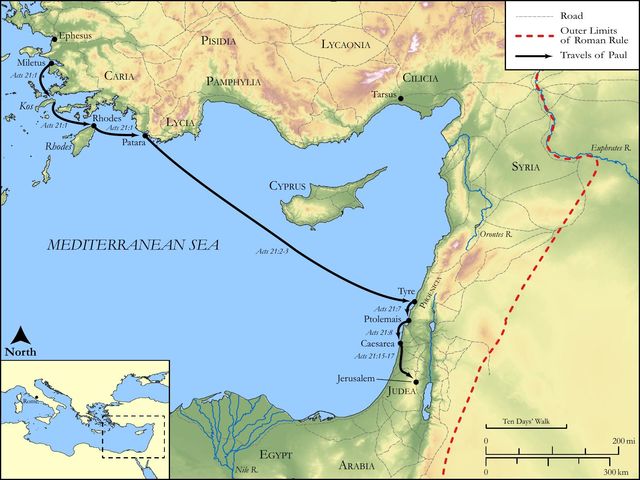
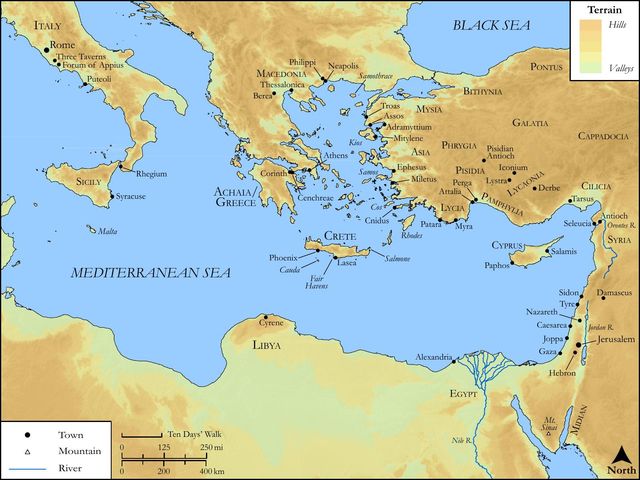
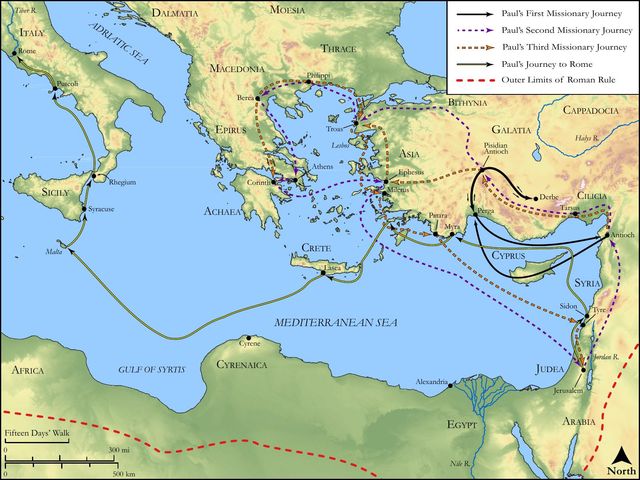
Study this verse
Public-domain commentary
Matthew Henry
From his Commentary on the Whole Bible. Henry comments on passages, not single verses — this entry covers Acts 21:27–40. His four-level outline is real structure in the source text, so it is rendered as structure.
We have here Paul brought into a captivity which we are not likely to see the end of; for after this he is either hurried from one bar to another, or lies neglected, first in one prison and then in another, and can neither be tried nor bailed. When we see the beginning of a trouble, we know not either how long it will last or how it will issue.
I.We have here Paul seized, and laid hold on.
1.He was seized in the temple, when he was there attending the days of his purifying, and the solemn services of those days, Act 21:27. Formerly he had been well known in the temple, but now he had been so long in his travels abroad that he had become a stranger there; so that it was not till the seven days were almost ended that he was taken notice of by those that had an evil eye towards him. In the temple, where he should have been protected, as in a sanctuary, he was most violently set upon by those who did what they could to have his blood mingled with his sacrifices - in the temple, where he should have been welcomed as one of the greatest ornaments of it that ever had been there since the Lord of the temple left it. The temple, which they themselves pretended such a mighty zeal for, yet did they themselves thus profane. Thus is the church polluted by none more than by popish persecutors, under the colour of the church's name and interest.
2.The informers against him were the Jews of Asia, not those of Jerusalem - the Jews of the dispersion, who knew him best, and who were most exasperated against him. Those who seldom came up to worship at the temple in Jerusalem themselves, but contentedly lived at a distance from it, in pursuit of their private advantages, yet appeared most zealous for the temple, as if thereby they would atone for their habitual neglect of it.
3.The method they took was to raise the mob, and to incense them against him. They did not go to the high priest, or the magistrates of the city, with their charge (probably because they expected not to receive countenance from them), but they stirred up all the people, who were at this time more than ever disposed to any thing that was tumultuous and seditious, riotous and outrageous. Those are fittest to be employed against Christ and Christianity that are governed least by reason and most by passion; therefore Paul described the Jewish persecutors to be not only wicked, but absurd unreasonable men.
4.The arguments wherewith they exasperated the people against him were popular, but very false and unjust. They cried out, "Men of Israel, help. If you are indeed men of Israel, true-born Jews, that have a concern for your church and your country, now is your time to show it, by helping to seize an enemy to both." Thus they cried after him as after a thief (Job 30:5), or after a mad dog. Note, The enemies of Christianity, since they could never prove it to be an ill thing, have been always very industrious, right or wrong, to put it into an ill name, and so run it down by outrage and outcry. It had become men of Israel to help Paul, who preached up him who was so much the glory of his people Israel; yet here the popular fury will not allow them to be men of Israel, unless they will help against him. This was like, Stop thief, or Athaliah's cry, Treason, treason; what is wanting in right is made up in noise.
5.They charge upon him both bad doctrine and bad practice, and both against the Mosaic ritual.
(1.)They charge upon him bad doctrine; not only that he holds corrupt opinions himself, but that he vents and publishes them, though not here at Jerusalem, yet in other places, nay in all places, he teaches all men, every where; so artfully is the crime aggravated, as if, because he was an itinerant, he was a ubiquitary: "He spreads to the utmost of his power certain damnable and heretical positions," [1.] Against the people of the Jews. He had taught that Jews and Gentiles stand on the same level before God, and neither circumcision avails any thing nor uncircumcision; nay, he had taught against the unbelieving Jews that they were rejected (and therefore had separated from them and their synagogues), and this is interpreted to be speaking against the whole nation, as if no doubt but they were the people, and wisdom must die with them (Job 12:2), whereas God, though he had cast them off, yet had not cast away his people, Rom 11:1. They were Lo-ammi, not a people (Hos 1:9), and yet pretended to be the only people. Those commonly seem most jealous for the church's name that belong to it in name only. [2.] Against the law. His teaching men to believe the gospel as the end of the law, and the perfection of it, was interpreted his preaching against the law; whereas it was so far from making void the law that it established it, Rom 3:31. [3.] Against this place, the temple. Because he taught men to pray every where, he was reproached as an enemy to the temple, and perhaps because he sometimes mentioned the destruction of Jerusalem and the temple, and of the Jewish nation, which his Master had foretold. Paul had himself been active in persecuting Stephen, and putting him to death for words spoken against this holy place, and now the same thing is laid to his charge. He that was then made use of as the tool is now set up as the butt of Jewish rage and malice.
(2.)They charge upon him bad practices. To confirm their charge against him, as teaching people against this holy place, they charge it upon him that he had himself polluted it, and by an overt-act showed his contempt of it, and a design to make it common. He has brought Gentiles also into the temple, into the inner court of the temple, which none that were uncircumcised were admitted, under any pretence, to come into; there was written upon the wall that enclosed this inner court, in Greek and Latin, It is a capital crime for strangers to enter. - Josephus Antiq. 15.417. Paul was himself a Jew, and had right to enter into the court of the Jews. And they, seeing some with him there that joined with him in his devotions, concluded that Trophimus an Ephesian, who was a Gentile, was one of them. Why? Did they see him there? Truly no; but they had seen him with Paul in the streets of the city, which was no crime at all, and therefore they affirm that he was with Paul in the inner court of the temple, which was a heinous crime. They had seen him with him in the city, and therefore they supposed that Paul had brought him with him into the temple, which was utterly false. See here,
[1.]Innocency is no fence against calumny and false accusation. It is no new thing for those that mean honestly, and act regularly, to have things laid to their charge which they know not, nor ever thought of.
[2.]Evil men dig up mischief, and go far to seek proofs of their false accusations, as they did here, who, because they saw a Gentile with Paul in the city, will thence infer that he was with him in the temple. This was a strained innuendo indeed, yet by such unjust and groundless suggestions have wicked men thought to justify themselves in the most barbarous outrages committed upon the excellent ones of the earth.
[3.]It is common for malicious people to improve that against those that are wise and good with which they thought to have obliged them and ingratiated themselves with them. Paul thought to recommend himself to their good opinion by going into the temple, he had not been so maligned by them. This is the genius of ill-nature; for my love, they are my adversaries, Psa 109:4; Psa 69:10.
We have Paul in danger of being pulled in pieces by the rabble. They will not be at the pains to have him before the high priest, or the sanhedrim; that is a roundabout way: the execution shall be of a piece with the prosecution, all unjust and irregular. They cannot prove the crime upon him, and therefore dare not bring him upon a fair trial; nay, so greedily do they thirst after his blood that they have not patience to proceed against him by a due course of law, though they were ever so sure to gain their point; and therefore, as those who neither feared God nor regarded man, they resolved to knock him on the head immediately.
1.All the city was in an uproar, Act 21:30. The people, who though they had little holiness themselves, yet had a mighty veneration for the holy place, when they heard a hue-and-cry from the temple, were up in arms presently, being resolved to stand by that with their lives and fortunes. All the city was moved, when they were called to from the temple, Men of Israel, help, with as much violence as if the old complaint were revived (Psa 79:1), O God, the heathen are come into thine inheritance, thy holy temple have they defiled. Just such a zeal the Jews here show for God's temple as the Ephesians did for Diana's temple, when Paul was informed against as an enemy to that (Act 19:29): The whole city was full of confusion. But God does not reckon himself at all honoured by those whose zeal for him transports them to such irregularities, and who, while they pretend to act for him, act in such a brutish barbarous manner.
2.They drew Paul out of the temple, and shut the doors between the outer and inner court of the temple, or perhaps the doors of the outer court. In dragging him furiously out of the temple,
(1.)They showed a real detestation of him as one not fit to be suffered in the temple, nor to worship there, nor to be looked upon as a member of the Jewish nation; as if his sacrifice had been an abomination.
(2.)They pretended a veneration for the temple; like that of good Jehoiada, who would not have Athaliah to be slain in the house of the Lord, Kg2 11:15. See how absurd these wicked men were; they condemned Paul for drawing people from the temple, and yet, when he himself was very devoutly worshipping in the temple, they drew him out of it. The officers of the temple shut the doors, either,
[1.]Lest Paul should find means to get back and take hold of the horns of the altar, and so protect himself by that sanctuary from their rage. Or rather,
[2.]Lest the crowd should by the running in of more to them be thrust back into the temple, and some outrage should be committed, to the profanation of that holy place. Those that made no conscience of doing so ill a thing as the murdering of a good man for well-doing, yet would be thought to scruple doing it in a holy place, or at a holy time: Not in the temple, as Not on the feast-day.
3.They went about to kill him (Act 21:31), for they fell a beating him (Act 21:32), resolving to beat him to death by blows without number, a punishment which the Jewish doctors allowed in some cases (not at all to the credit of their nation), and called the beating of the rebels. Now was Paul, like a lamb, thrown into a den of lions, and made an easy prey to them, and, no doubt, he was still of the same mind as when he said, I am ready not only to be bound, but to die at Jerusalem, to die so great a death.
III.We have here Paul rescued out of the hands of his Jewish enemies by a Roman enemy.
1.Tidings were brought of the tumult, and that the mob was up, to the chief captain of the band, the governor of the castle, or, whoever he was, the now commander-in-chief of the Roman forces that were quartered in Jerusalem. Somebody that was concerned not for Paul, but for the public peace and safety, gave this information to the colonel, who had always a jealous and watchful eye upon these tumultuous Jews, and he is the man that must be instrumental to save Paul's life, when never a friend he had was capable of doing him any service.
2.The tribune, or chief captain, got his forces together with all possible expedition, and went to suppress the mob: He took soldiers and centurions, and ran down to them. Now at the feast, as at other such solemn times, the guards were up, and the militia more within call than at other times, and so he had them near at hand, and he ran down unto the multitude; for at such times delays are dangerous. Sedition must be crushed at first, lest it grow headstrong.
3.The very sight of the Roman general frightened them from beating Paul; for they knew they were doing what they could not justify, and were in danger of being called in question for this day's uproar, as the town clerk told the Ephesians. They were deterred from that by the power of the Romans from which they ought to have been restrained by the justice of God and the dread of his wrath. Note, God often makes the earth to help the woman (Rev 12:16), and those to be a protection to his people who yet have no affection for his people; they have only a compassion for sufferers, and are zealous for the public peace. The shepherd makes use even of his dogs for the defence of his sheep. It is Streso's comparison here. See here how these wicked people were frightened away at the very sight of the chief captain; for the king that sitteth on the throne of judgment scattereth away all evil with his eyes. The governor takes him into custody. He rescued him, not out of a concern for him, because he thought him innocent, but out of a concern for justice, because he ought not to be put to death without trial; and because he knew not how dangerous the consequence might be to the Roman government of such tumultuous proceedings were not timely suppressed, nor what such an outrageous people might do if once they knew their own strength: he therefore takes Paul out of the hands of the mob into the hands of the law (v. 33): He took him, and commanded him to be bound with two chains, that the people might be satisfied he did not intend to discharge him, but to examine him, for he demanded of those who were so eager against him who he was, and what he had done. This violent taking of him out of the hands of the multitude, though there was all the reason in the world for it, yet they laid to the charge of the chief captain as his crime (Act 24:7): The chief captain Lysias came with great violence, and took him out of our hands, which refers to this rescue as appears by comparing Act 23:27, Act 23:28, where the chief captain gives an account of it to Felix.
IV.The provision which the chief captain made, with much ado, to bring Paul to speak for himself.
One had almost as good enter into a struggle with the winds and the waves, as with such a mob as was here got together; and yet Paul made a shift to get liberty of speech among them.
1.There was no knowing the sense of the people; for when the chief captain enquired concerning Paul, having perhaps never heard of his name before (such strangers were the great ones to the excellent ones of the earth, and affected to be so), some cried one thing, and some another, among the multitude; so that it was impossible for the chief captain to know their mind, when really they knew not either one another's mind or their own, when every one pretended to give the sense of the whole body. Those that will hearken to the clamours of the multitude will know nothing for a certainty, any more than the builders of Babel, when their tongues were confounded.
2.There was no quelling the rage and fury of the people; for when the chief captain commanded that Paul should be carried into the castle, the tower of Antonia, where the Roman soldiers kept garrison, near the temple, the soldiers themselves had much ado to get him safely thither out of the noise, the people were so violent (Act 21:35): When he came upon the stairs, leading up to the castle, the soldiers were forced to take him up in their arms, and carry him (which they might easily do, for he was a little man, and his bodily presence weak), to keep him from the people, who would have pulled him limb from limb if they could. When they could not reach him with their cruel hands, they followed him with their sharp arrows, even bitter words: They followed, crying, Away with him, Act 21:36. See how the most excellent persons and things are often run down by a popular clamour. Christ himself was so, with, Crucify him, crucify him, though they could not say what evil he had done. Take him out of the land of the living (so the ancients expound it), chase him out of the world.
3.Paul at length begged leave of the chief captain to speak to him (Act 21:37): As he was to be led into the castle, with a great deal of calmness and composedness in himself, and a great deal of mildness and deference to those about him, he said unto the chief captain, "May I speak unto thee? Will it be no offence, nor construed as a breach of rule, if I give thee some account of myself, since my persecutors can give no account of me?" What a humble modest question was this! Paul knew how to speak to the greatest of men, and had many a time spoken to his betters, yet he humbly begs to leave to speak to this commander, and will not speak till he has obtained leave: May I speak unto thee?
4.The chief captain tells him what notion he had of him: Canst thou speak Greek? I am surprised to hear thee speak a learned language; for, Art not thou that Egyptian who made an uproar? The Jews made the uproar, and then would have it thought that Paul had given them occasion for it, by beginning first; for probably some of them whispered this in the ear of the chief captain. See what false mistaken notions of good people and good ministers many run away with, and will not be at the pains to have the mistake rectified. It seems, there had lately been an insurrection somewhere in that country, headed by an Egyptian, who took on him to be a prophet. Josephus mentions this story, that "an Egyptian raised a seditious party, promised to show them the fall of the walls of Jerusalem from the mount of Olives, and that they should enter the city upon the ruins." The captain here says that he led out into the wilderness four thousand men that were murderers - desperadoes, banditti, raparees, cut-throats. What a degeneracy was there in the Jewish nation, when there were found there so many that had such a character, and could be drawn into such an attempt upon the public peace! But Josephus says that "Felix the Roman president went out against them, killed four hundred, and took two hundred prisoners, and the rest were dispersed." - Antiq. 20.171; Wars 2.263. And Eusebius speaks of it, Hist. 2:20. It happened in the thirteenth year of Claudius, a little before those days, about three years ago. The ringleader of this rebellion, it seems, had made his escape, and the chief captain concluded that one who lay under so great an odium as Paul seemed to lie under, and against whom there was so great an outcry, could not be a criminal of less figure than this Egyptian. See how good men are exposed to ill-will by mistake.
5.Paul rectifies his mistake concerning him, by informing him particularly what he was; not such a vagabond, a scoundrel, a rake, as that Egyptian, who could give no good account of himself. No: I am a man who is a Jew originally, and no Egyptian - a Jew both by nation and religion; I am of Tarsus, a city of Cilicia, of honest parents and a liberal education (Tarsus was a university), and, besides that, a citizen of no mean city. Whether he means Tarsus or Rome is not certain; they were neither of them mean cities, and he was a freeman of both. Though the chief captain had put him under such an invidious suspicion, that he was that Egyptian, he kept his temper, did not break out into any passionate exclamations against the times he lived in or the men he had to do with, did not render railing for railing, but mildly denied the charge, and owned what he was.
6.He humbly desired a permission from the chief captain, whose prisoner he now was, to speak to the people. He does not demand it as a debt, though he might have done so, but sues for it as a favour, which he will be thankful for: I beseech thee, suffer me to speak to the people. The chief captain rescued him with no other design than to give him a fair hearing. Now, to show that his cause needs no art to give it a plausible colour, he desires he may have leave immediately to defend himself; for it needed no more than to be set in a true light; nor did he depend only on the goodness of his cause, but upon the goodness and fidelity of his patron, and that promise of his to all his advocates, that it should be given them in that same hour what they should speak.
7.He obtained leave to plead his own cause, for he needed not to have counsel assigned him, when the Spirit of the Father was ready to dictate to him, Mat 10:20. The chief captain gave him license (Act 21:40), so that now he could speak with a good grace, and with the more courage; he had, I will not say that favour, but that justice, done him by the chief captain, which he could not obtain from his countrymen the Jews; for they would not hear him, but the captain would, though it were but to satisfy his curiosity. This licence being obtained,
(1.)The people were attentive to hear: Paul stood on the stairs, which gave a little man like Zaccheus some advantage, and consequently some boldness, in delivering himself. A sorry pulpit it was, and yet better than none; it served the purpose, though it was not, like Ezra's pulpit of wood, made for the purpose. There he beckoned with the hand unto the people, made signs to them to be quiet and to have a little patience, for he had something to say to them; and so far he gained his point that every one cried hush to his neighbour, and there was made a profound silence. Probably the chief captain also intimated his charge to all manner of people to keep silence; if the people were not required to give audience, it was to no purpose at all that Paul was allowed to speak. When the cause of Christ and his gospel is to be pleaded, there ought to be a great silence, that we may give the more earnest heed, and all little enough.
(2.)Paul addressed himself to speak, well assured that he was serving the interest of Christ's kingdom as truly and effectually as if he had been preaching in the synagogue: he spoke unto them in the Hebrew tongue, that is, in their own vulgar tongue, which was the language of their country, to which he hereby owned not only an abiding relation, but an abiding respect.
Historical interpretation
Three Centuries of Reception
2 surviving comments on this verse. Each one is dated, so this reads as a timeline rather than a list.
Select a marker to jump to its quote. Markers stagger vertically where authors wrote within a few decades of each other.
"And as Paul was to be led into the castle, he said unto the tribune, May I speak unto thee?" In the act of being borne along up the stairs, he requests to say something to the tribune: and observe how quietly he does it. "May I speak unto thee?" he says. "Who said, Canst thou speak Greek? Art thou not then that Egyptian, which before these days madest an uproar, and leddest out into the wilderness four thousand men that were murderers?" For this Egyptian was a revolutionary and seditious person. With regard to this then Paul clears himself.
Observe how submissively Paul speaks to the tribune. "May I speak unto thee? Then art not thou that Egyptian?" This Egyptian, namely, was a cheat and impostor, and the devil expected to cast a cloud over the Gospel through him, and implicate both Christ and His Apostles in the charges pertaining to those impostors: but he prevailed nothing, nay the truth became even more brilliant, being nothing defeated by the machinations of the devil, nay rather shining forth all the more. Since if there had not been impostors, and then these Christ and His Apostles had prevailed, perhaps some one might have laid hold upon this: but when those impostors did actually appear, this is the wonder. "In order," says the Apostle, "that they which are approved may be made manifest." And Gamaliel says, "Before these days stood up Theudas." Then let us not grieve that heresies exist, seeing that false Christs wished to attack even Christ both before this and after; with a view to throw Him into the shade, but on every occasion we find the truth shining out transparent.
Four thousand men of the Sicarii. There is no controversy to be held between the tribune who spoke these things and Josephus who wrote about the Egyptian. For it could happen that he first came with a few, the same secretly leading a tyranny, but later joined many to himself by public deceit. It is read, however, that in the time of Felix, this kind of robber arose, who, not seeking hidden places or times, but carrying daggers, that is, short swords in hand, mixed among the people in the very light of day, attached themselves by blind wounds, to the point that death prevented a complaint, and the striker lay hidden. And if anyone were moved by the fact that such things were done in the middle of the city, he too perished. Thus, by fear of danger or dissimulation of the crime, the assassin was not apprehended.
Continue studying Acts 21:38 across the web’s major study libraries — every link below opens this exact verse, chapter, or book on the destination site.
Read & Compare
 BibleGatewayThis verse in more than 200 translations and 70 languages.
 Bible.comThe YouVersion reader — hundreds of translations, reading plans, and highlights.
 ESV.orgCrossway's official English Standard Version reader.
 NET BibleThe NET translation with 60,000+ translators' notes on every rendering decision.
 STEP BibleTyndale House's free study tool — original text, vocabulary, and scholarly resources.
 BibliaLogos Bible Software's free web reader.
 USCCBThe New American Bible (Revised Edition) with the U.S. bishops' study notes.
Commentaries
 BibleHub CommentariesDozens of classic commentaries on this verse, gathered on one page.
 StudyLightMore than 100 commentary sets — the largest collection on the web.
 BibleRefPlain-English commentary on what this verse means, verse by verse.
 Enduring WordDavid Guzik's free commentary on this chapter, widely used by Bible teachers.
 Bible Study ToolsVerse commentary alongside Greek and Hebrew study aids.
Original Language & Research
- BibleHub InterlinearThe verse word by word — original language, transliteration, and English.
- BibleHub LexiconEvery word's original-language definition and Strong's entry.
 Blue Letter BibleDeep-study tools — Strong's numbers, concordance, and word studies.
 CNTR CollationThe earliest Greek manuscripts of this verse, collated letter by letter.
Sermons, Hymns & Audio


TrulyRandomVerse is not affiliated with these sites and doesn’t control their content. They’re linked because they’re genuinely useful.
Summary
Acts 21:38 captures the Roman chief captain's immediate and critical misidentification of Paul during his arrest in Jerusalem. Having rescued Paul from a violent mob in the Temple courts, the captain, Claudius Lysias, suspects Paul is a notorious Egyptian rebel who, a few years prior, had led a significant uprising of four thousand "murderers" or assassins into the wilderness, causing widespread unrest and challenging Roman authority. This pivotal moment sets the stage for Paul's subsequent defenses and appeals, highlighting the constant perils and misunderstandings he faced in his ministry.
Context
ShowHideLiterary Context
This verse is situated at a dramatic turning point in Paul's ministry, marking the beginning of his extended period of Roman imprisonment. Paul has just returned to Jerusalem, seeking to demonstrate his continued adherence to Jewish customs and to deliver a collection for the poor saints there, as recounted in Acts 21:17-26. While in the Temple, he is falsely accused by Jews from Asia of defiling the holy place by bringing Gentiles into it, an accusation that ignites a furious riot. The mob attempts to kill Paul, dragging him out of the Temple. It is at this critical juncture that the Roman cohort, stationed nearby in the Antonia Fortress, intervenes to quell the disturbance. The chief captain, Claudius Lysias, arrests Paul, assuming him to be a dangerous revolutionary, and his question in Acts 21:38 reflects this immediate, yet mistaken, judgment.
Historical & Cultural Context
The chief captain's suspicion is rooted in a very real and recent historical event that deeply concerned Roman authorities in Judea. The "Egyptian" refers to a messianic pretender who, around 54-56 AD (a few years before Paul's arrest in 57-58 AD), had gathered a large following, estimated by the Jewish historian Josephus at 30,000, and led them from the wilderness to the Mount of Olives. He promised that at his command, the walls of Jerusalem would fall, enabling his followers to overthrow Roman rule. The Roman procurator Felix had dispatched forces to suppress this rebellion, dispersing the rebels, though the Egyptian himself escaped. The captain's mention of "four thousand men that were murderers" likely refers to a core group of violent zealots or Sicarii within this larger movement, or perhaps a more conservative Roman estimate of the most dangerous elements. This incident underscores the volatile political climate of Judea under Roman occupation, where various messianic claimants and nationalist factions frequently incited unrest, leading Roman officials to be highly vigilant against any perceived revolutionary threat.
Key Themes
ShowHideThe captain's question in Acts 21:38 contributes to several overarching themes in the book of Acts and Paul's ministry. Firstly, it highlights the theme of Mistaken Identity, as Paul, a preacher of peace and salvation through Christ, is wrongly associated with a violent political revolutionary. This misjudgment is a recurring motif in Paul's life, often leading to his persecution. Secondly, it powerfully illustrates the Roman Authority and Order in Judea; the swift intervention of the Roman cohort demonstrates their primary concern for maintaining peace, even if their initial assessment of a situation is flawed. Their presence, though oppressive to many Jews, paradoxically often served to protect Paul from the zealous fury of his Jewish opponents, as seen in this very instance and later in Acts 23:10. Finally, this event is another vivid example of Paul's Suffering and Persecution for the Gospel, a consistent theme throughout his missionary journeys. He frequently faced false accusations, imprisonment, and physical danger, as he himself recounts in 2 Corinthians 11:23-27.
Exposition and Analysis
ShowHideKey Word Analysis
ShowHideThis term directly identifies the specific individual the chief captain suspects Paul to be. Derived from "Aigyptos" (Egypt), it refers to an inhabitant of Egypt. The captain's immediate leap to this conclusion indicates the notoriety and recent memory of the Egyptian rebel's uprising, making him a prime suspect for any large-scale disturbance.
This verb, meaning "to drive out of home," "to disturb," "to turn upside down," or "to make an uproar," perfectly describes the disruptive and revolutionary activities of the Egyptian. It conveys the sense of causing widespread civil unrest and overturning established order, which is precisely what the Roman authorities sought to prevent. The captain's use of this word underscores the severity of the perceived threat.
This term, of Latin origin (from sica, a short dagger), refers to a "dagger-man" or "assassin." The Sicarii were a notorious extremist faction of Jewish nationalists who employed daggers to carry out assassinations of Roman officials and Jewish collaborators in public places. The captain's use of this specific term for the Egyptian's followers highlights their violent nature and the grave danger they posed to both Roman rule and the general populace, further emphasizing the captain's alarm and misjudgment of Paul.
Verse Breakdown
ShowHide"Art not thou that Egyptian"
This opening phrase immediately reveals the chief captain's primary suspicion. He does not ask if Paul is an Egyptian, but rather confirms his assumption, indicating a strong belief that Paul is the notorious rebel leader who had recently caused significant trouble. The question is rhetorical, expecting an affirmative answer.
"which before these days madest an uproar"
This clause provides the specific reason for the captain's suspicion. The Egyptian rebel was known for instigating a major disturbance or revolt. The phrase "before these days" indicates that the event was recent enough to be fresh in the captain's memory and a significant concern for Roman stability.
"and leddest out into the wilderness four thousand men that were murderers?"
This final clause details the scale and nature of the Egyptian's followers. Leading men "into the wilderness" alludes to a common pattern of messianic pretenders in that era who would gather followers in desolate areas before attempting a move on Jerusalem. The description of these men as "murderers" (or Sicarii) emphasizes their violent, extremist nature and the severe threat they posed, justifying the captain's immediate and forceful intervention.
Literary Devices
ShowHideActs 21:38 employs several potent literary devices. The most prominent is Dramatic Irony, as the audience knows Paul's true identity and mission, while the Roman captain is completely mistaken, creating tension and suspense. The captain's question functions as a Rhetorical Question, designed not to elicit information but to express his strong conviction and suspicion, setting up Paul's subsequent defense. The use of the term "sikarios" (translated "murderers") is a powerful example of Loaded Language, immediately associating Paul with a highly feared and violent group of Jewish extremists, thus justifying the captain's harsh treatment and the severity of the situation. Furthermore, the entire scene serves as a Foreshadowing of Paul's future trials and his repeated need to defend himself against false accusations before Roman authorities, leading him ultimately to appeal to Caesar.
Theological and Thematic Connections
ShowHideThe misidentification of Paul as a violent revolutionary underscores a profound theological truth: the Kingdom of God, which Paul preached, operates on fundamentally different principles than the kingdoms of this world. While earthly powers seek to maintain order through force and suppress perceived threats, God's kingdom advances through peace, truth, and sacrificial love. Paul, far from leading an armed rebellion, was proclaiming the good news of a crucified and resurrected Messiah, whose power is made perfect in weakness (2 Corinthians 12:9). This incident highlights the inherent tension between the Gospel message and worldly systems, where spiritual truth is often misunderstood or conflated with political agitation. It also demonstrates God's sovereign hand in protecting His servants, even amidst grave misunderstandings and danger, to ensure His purposes are fulfilled.
Reflection and Application
ShowHideActs 21:38 serves as a poignant reminder that appearances can be profoundly deceiving, and people are often quick to judge based on incomplete information, prevailing fears, or preconceived notions. Paul's situation illustrates the critical importance of patiently seeking truth and allowing individuals the opportunity to clarify their identity, intentions, and purpose. Just as Paul was eventually given the chance to speak for himself before the crowd and later before Roman officials (Acts 22:1), we are called to extend grace, listen carefully, and resist the urge to jump to conclusions, especially when dealing with those who are different or misunderstood. Furthermore, this passage beautifully illustrates how God can orchestrate even moments of intense danger and misunderstanding to advance His divine purposes, protecting His servants and opening doors for the Gospel to be proclaimed in unexpected venues, even before the highest authorities. It encourages us to trust in God's providence, even when circumstances seem chaotic or unjust.
Questions for Reflection
ShowHideFAQ
ShowHideWhy was the Roman chief captain so quick to suspect Paul was the Egyptian rebel?
ShowHideThe chief captain's immediate suspicion stemmed from the recent and significant threat posed by the Egyptian rebel, who had led a large, violent uprising just a few years prior. Roman authorities were constantly vigilant against any form of rebellion or unrest in Judea, a province known for its volatile political climate and frequent messianic pretenders. When Paul was found at the center of a massive riot in the Temple courts, being attacked by a furious mob, it was a logical, albeit mistaken, assumption for the captain to believe he had apprehended this notorious revolutionary. The scale of the disturbance and the intense hatred directed at Paul mirrored the kind of chaos that figures like the Egyptian rebel would instigate, prompting the captain's swift and decisive action to restore order.
What was the significance of the "four thousand men that were murderers" mentioned in the verse?
ShowHideThe "four thousand men that were murderers" refers to the followers of the Egyptian rebel, specifically highlighting their violent nature. The Greek term used, sikários (σικάριος), is a Latinized word meaning "dagger-men" or "assassins." The Sicarii were an extremist faction of Jewish nationalists who used daggers to carry out assassinations of Roman officials and Jewish collaborators. By associating the Egyptian's followers with these "murderers," the chief captain emphasizes the extreme danger and ruthlessness of the rebel group. While the Jewish historian Josephus claimed the Egyptian led up to 30,000 followers, the captain's figure of four thousand might represent a Roman estimate of the core, most dangerous elements of the rebellion, or perhaps a more conservative figure of those who were truly armed and violent. This detail underscores the severe threat the Roman authorities perceived from such figures and their followers.
Christ-Centered Fulfillment
ShowHideActs 21:38, with its portrayal of Paul's mistaken identity as a violent revolutionary, powerfully foreshadows and echoes the ultimate misjudgment of Christ Himself. Just as Paul, a messenger of peace, was confused with a leader of armed rebellion, so too was Jesus, the Prince of Peace, misunderstood and accused of sedition against Rome (Luke 23:2). The Jewish crowds, expecting a political Messiah who would overthrow Roman rule, rejected Jesus because His kingdom was not of this world (John 18:36), leading them to cry out for His crucifixion. Both Paul and Jesus endured false accusations and the wrath of both religious and political authorities, demonstrating that the path of God's true servants often involves suffering and misunderstanding in a world that cannot comprehend divine truth. Paul's willingness to suffer for the Gospel, even to be mistaken for a "murderer," reflects the self-emptying love of Christ, who, though innocent, was "numbered with the transgressors" (Isaiah 53:12 cited in Luke 22:37). Ultimately, Paul's trials, beginning with this pivotal misunderstanding, served to advance the Gospel, just as Christ's suffering and death led to the salvation of the world, demonstrating God's sovereign plan to use even human error and malice for His redemptive purposes (Romans 8:28).