


1 Corinthians 10:2
Bible text: King James Version (1769 Blayney text) · Public domain
Bible text: Berean Standard Bible · Public domain
Bible text: American Standard Version (1901) · Public domain
Bible text: World English Bible, Messianic edition · Public domain
Bible text: Geneva Bible (1599) · Public domain
Bible text: Young's Literal Translation · Public domain
- καὶkaiandG2532CONJConjunction
- πάντεςpantesallG3956A-NPMAdjective Nominative Plural Masculine
- εἰςeisintoG1519PREPPreposition
- τὸνton<the>G3588T-ASMDefinite article Accusative Singular Masculine
- ΜωϋσῆνMōusēnMosesG3475N-ASM-PNoun Accusative Singular Masculine Individual
- ἐβαπτίσθησανebaptisthēsanwere baptizedG907V-API-3PVerb Aorist Passive Indicative 3rd Plural
- ἐνeninG1722PREPPreposition
- τῇtēatheG3588T-DSFDefinite article Dative Singular Feminine
- νεφέλῃnephelēcloudG3507N-DSFNoun Dative Singular Feminine
- καὶkaiandG2532CONJConjunction
- ἐνeninG1722PREPPreposition
- τῇtēatheG3588T-DSFDefinite article Dative Singular Feminine
- θαλάσσῃthalassēseaG2281N-DSFNoun Dative Singular Feminine
English is a literal word-by-word gloss of the Greek, not the KJV's wording. Why?
This is the original text the KJV's translators worked from — each Greek word with its own literal English meaning in this verse, prepared by scholars at Tyndale House, Cambridge. The KJV translates whole sentences, not word by word, so its wording differs: one Greek word can become several English words, and the KJV may choose “charity” where the gloss reads “love”. Both are faithful — they answer different questions. For the KJV's own rendering, switch to the KJV text.
Details
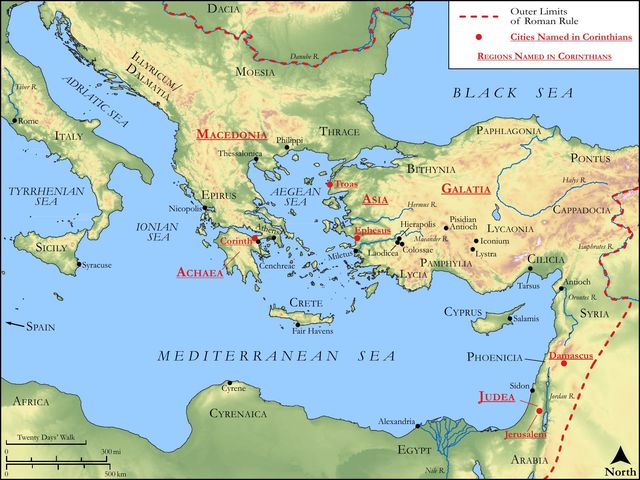
See on the biblical-era maps

Study this verse
Public-domain commentary
Matthew Henry
From his Commentary on the Whole Bible. Henry comments on passages, not single verses — this entry covers 1 Corinthians 10:1–5. His three-level outline is real structure in the source text, so it is rendered as structure.
In order to dissuade the Corinthians from communion with idolaters, and security in any sinful course, he sets before them the example of the Jews, the church under the Old Testament. They enjoyed great privileges, but, having been guilty of heinous provocations, they fell under very grievous punishments. In these verses he reckons up their privileges, which, in the main, were the same with ours.
I.He prefaces this discourse with a note of regard:
"Moreover, brethren, I would not that you should be ignorant. I would not have you without the knowledge of this matter; it is a thing worthy both of your knowledge and attention. It is a history very instructive and monitory." Judaism was Christianity under a veil, wrapt up in types and dark hints. The gospel was preached to them, in their legal rites and sacrifices. And the providence of God towards them, and what happened to them notwithstanding these privileges, may and ought to be warnings to us.
II.He specifies some of their privileges. He begins,
1.With their deliverance from Egypt: "Our fathers, that is, the ancestors of us Jews, were under the cloud, and all passed through the sea. They were all under the divine covering and conduct." The cloud served for both purposes: it sometimes contracted itself into a cloudy pillar, shining on one side to show them their way, dark on the other to hide them from their pursuing enemies; and sometimes spread itself over them as a mighty sheet, to defend them from the burning sun in the sandy desert, Psa 105:39. They were miraculously conducted through the Red Sea, where the pursuing Egyptians were drowned: it was a lane to them, but a grave to these: a proper type of our redemption by Christ, who saves us by conquering and destroying his enemies and ours. They were very dear to God, and much in his favour, when he would work such miracles for their deliverance, and take them so immediately under his guidance and protection.
2.They had sacraments like ours.
(1.)They were all baptized unto Moses in the cloud, and in the sea (Co1 10:2), or into Moses, that is, brought under obligation to Moses's law and covenant, as we are by baptism under the Christian law and covenant. It was to them a typical baptism.
(2.)They did all eat of the same spiritual meat, and drink of the same spiritual drink, that we do. The manna on which they fed was a type of Christ crucified, the bread which came down from heaven, which whoso eateth shall live forever. Their drink was a stream fetched from a rock which followed them in all their journeyings in the wilderness; and this rock was Christ, that is, in type and figure. He is the rock on which the Christian church is built; and of the streams that issue from him do all believers drink, and are refreshed. Now all the Jews did eat of this meat, and drink of this rock, called here a spiritual rock, because it typified spiritual things. These were great privileges. One would think that this should have saved them; that all who ate of that spiritual meat, and drank of that spiritual drink, should have been holy and acceptable to God. Yet was it otherwise: With many of them God was not well pleased; for they were overthrown in the wilderness, Co1 10:5. Note, Men may enjoy many and great spiritual privileges in this world, and yet come short of eternal life. Many of those who were baptized unto Moses in the cloud and sea, that is, had their faith of his divine commission confirmed by these miracles, were yet overthrown in the wilderness, and never saw the promised land. Let none presume upon their great privileges, or profession of the truth; these will not secure heavenly happiness, nor prevent judgments here on earth, except the root of the matter be in us.
Historical interpretation
Three Centuries of Reception
7 surviving comments on this verse. Each one is dated, so this reads as a timeline rather than a list.
Select a marker to jump to its quote. Markers stagger vertically where authors wrote within a few decades of each other.
For the people, after crossing the sea, and being carried about in the desert during forty years, although they were there nourished with divine supplies, nevertheless were more mindful of their belly and their gullet than of God. Thereupon the Lord, driven apart into desert places after baptism, showed, by maintaining a fast of forty days, that the man of God lives "not by bread alone," but "by the word of God; " and that temptations incident to fulness or immoderation of appetite are shattered by abstinence.
For the case of the Jews under the apostles was one, but the condition of the Gentiles is another. The former, because they had already gained the most ancient baptism of the law and Moses, were to be baptized also in the name of Jesus Christ, in conformity with what Peter tells them in the Acts of the Apostles, saying, "Repent, and be baptized every one of you in the name of the Lord Jesus Christ, for the remission of sins, and ye shall receive the gift of the Holy Ghost. For this promise is unto you, and to your children, and to all that are afar off, even as many as the Lord our God shall call."
Paul says the Jews were under the cloud in order to point out that everything that happened to them is meant to be understood as a picture of the truth which has been revealed to us. Under the cloud they were protected from their enemies until they were delivered from death, analogous to baptism. For when they passed through the Red Sea they were delivered from the Egyptians who died in it, and their death prefigured our baptism, which puts our adversaries to death as well.
"That our fathers," saith he, "were all under the cloud, and all passed through the sea; and were all baptized unto Moses in the cloud and in the sea; and did all eat the same spiritual meat; and did all drink the same spiritual drink; for they drank of a spiritual Rock that followed them: and the Rock was Christ. Howbeit with most of them God was not well pleased."
And wherefore saith he these things? To point out that as they were nothing profited by the enjoyment of so great a gift, so neither these by obtaining Baptism and partaking of spiritual Mysteries, except they go on and show forth a life worthy of this grace. Wherefore also he introduces the types both of Baptism and of the Mysteries.
But what is, "They were baptized into Moses?" Like as we, on our belief in Christ and His resurrection, are baptized, as being destined in our own persons to partake in the same mysteries; for, "we are baptized," saith he, "for the dead," i.e., for our own bodies; even so they putting confidence in Moses, i.e., having seen him cross first, ventured also themselves into the waters. But because he wishes to bring the Type near the Truth; he speaks it not thus, but uses the terms of the Truth even concerning the Type.
Further: this was a symbol of the Font, and that which follows, of the Holy Table. For as thou eatest the Lord's Body, so they the manna: and as thou drinkest the Blood, so they water from a rock. For though they were things of sense which were produced, yet were they spiritually exhibited, not according to the order of nature, but according to the gracious intention of the gift, and together with the body nourished also the soul, leading it unto faith. On this account, you see, touching the food he made no remark, for it was entirely different, not in mode only but in nature also; (for it was manna;) but respecting the drink, since the manner only of the supply was extraordinary and required proof, therefore having said that "they drank the same spiritual drink," he added, "for they drank of a spiritual Rock that followed them," and he subjoined, "and the Rock was Christ." For it was not the nature of the rock which sent forth the water, (such is his meaning,) else would it as well have gushed out before this time: but another sort of Rock, a spiritual One, performed the whole, even Christ who was every where with them and wrought all the wonders. For on this account he said, "that followed them."
Perceivest thou the wisdom of Paul, how in both cases he points out Him as the Giver, and thereby brings the Type nigh to the Truth? "For He who set those things before them," saith he, "the same also hath prepared this our Table: and the same Person both brought them through the sea and thee through Baptism; and before them set manna, but before thee His Body and Blood."
As touching His gift then, such is the case: now let us observe also what follows, and consider, whether when they showed themselves unworthy of the gift, He spared them. Nay, this thou canst not say. Wherefore also he added, "Howbeit with most of them God was not well-pleased;" although He had honored them with so great honor. Yea, it profited them nothing, but most of them perished. The truth is, they all perished, but that he might not seem to prophesy total destruction to these also, therefore he said, "most of them." And yet they were innumerable, but their number profited them nothing: and these were all so many tokens of love; but not even did this profit them, inasmuch as they did not themselves show forth the fruits of love.
Thus, since most men disbelieve the things said of hell, as not being present nor in sight; he alleges the things heretofore done as a proof that God doth punish all who sin, even though He have bestowed innumerable benefits upon them: "for if ye disbelieve the things to come," so he speaks, "yet surely the things that are past ye will not disbelieve." Consider, for example, how great benefits He bestowed on them: from Egypt and the slavery there He set them free, the sea He made their path, from heaven he brought down manna, from beneath He sent forth strange and marvellous fountains of waters; He was with them every where, doing wonders and fencing them in on every side: nevertheless since they showed forth nothing worthy of this gift, He spared them not, but destroyed them all.
The sea is a figure of baptism with water; the cloud of the grace of baptism in the Spirit.
The history of the exodus was an allegory of the Christian people that was yet to be.
The cloud was a figure standing for the grace of the Spirit. For just as the cloud covered the Israelites and protected them from the Egyptians, so the Spirit’s grace shields us from the wiles of the devil. Likewise, just as the crossing of the sea protected them from their enemies and gave them real freedom, so baptism protects us from our enemies. That was how the Israelites came to live under the law of Moses. This is how we, in baptism, are clothed with the Spirit of adoption and inherit the covenants and confessions made in accordance with the commands of Christ.
Continue studying 1 Corinthians 10:2 across the web’s major study libraries — every link below opens this exact verse, chapter, or book on the destination site.
Read & Compare
 BibleGatewayThis verse in more than 200 translations and 70 languages.
 Bible.comThe YouVersion reader — hundreds of translations, reading plans, and highlights.
 ESV.orgCrossway's official English Standard Version reader.
 NET BibleThe NET translation with 60,000+ translators' notes on every rendering decision.
 STEP BibleTyndale House's free study tool — original text, vocabulary, and scholarly resources.
 BibliaLogos Bible Software's free web reader.
 USCCBThe New American Bible (Revised Edition) with the U.S. bishops' study notes.
Commentaries
 BibleHub CommentariesDozens of classic commentaries on this verse, gathered on one page.
 StudyLightMore than 100 commentary sets — the largest collection on the web.
 BibleRefPlain-English commentary on what this verse means, verse by verse.
 Enduring WordDavid Guzik's free commentary on this chapter, widely used by Bible teachers.
 Bible Study ToolsVerse commentary alongside Greek and Hebrew study aids.
Original Language & Research
- BibleHub InterlinearThe verse word by word — original language, transliteration, and English.
- BibleHub LexiconEvery word's original-language definition and Strong's entry.
 Blue Letter BibleDeep-study tools — Strong's numbers, concordance, and word studies.
 CNTR CollationThe earliest Greek manuscripts of this verse, collated letter by letter.
Sermons, Hymns & Audio


TrulyRandomVerse is not affiliated with these sites and doesn’t control their content. They’re linked because they’re genuinely useful.
Summary
First Corinthians 10:2 describes the foundational experience of the Israelites during the Exodus, where they were "baptized unto Moses in the cloud and in the sea." This verse serves as a pivotal point in Paul's argument to the Corinthian church, drawing an analogy between Israel's collective identification with Moses and God's deliverance, and the Christian's identification with Christ through baptism. Paul uses this historical event not merely as a recounting of the past but as a solemn warning against spiritual complacency and presumption, emphasizing that outward religious privileges do not guarantee faithfulness or salvation if one succumbs to temptation and disobedience.
Context
ShowHideLiterary Context
This verse is situated within a crucial section of Paul's first letter to the Corinthians, specifically 1 Corinthians 10. Following his discussion on Christian freedom and responsibility in 1 Corinthians 9, Paul transitions to a cautionary tale drawn from Israel's wilderness wanderings. He begins 1 Corinthians 10:1-5 by listing the spiritual privileges bestowed upon the Israelites—the guiding cloud, the Red Sea crossing, the spiritual food (manna), and spiritual drink (water from the rock)—all of which parallel the spiritual privileges of the Corinthian believers (baptism, the Lord's Supper). Verse 2 specifically highlights their collective "baptism" into Moses, setting the stage for Paul's subsequent warnings in 1 Corinthians 10:6-11, where he details Israel's failures despite these divine provisions. The overarching purpose is to admonish the Corinthians against idolatry, immorality, and testing God, urging them to learn from Israel's mistakes and "flee from idolatry" (1 Corinthians 10:14).
Historical & Cultural Context
The historical backdrop for 1 Corinthians 10:2 is the miraculous Exodus of the Israelites from Egyptian bondage, as recorded in the books of Exodus and Numbers. The "cloud" refers to the pillar of cloud that supernaturally guided Israel by day and shielded them from the sun and their pursuers (Exodus 13:21-22). The "sea" unmistakably points to the miraculous crossing of the Red Sea (Exodus 14:21-31), an event that served as the ultimate act of deliverance from slavery and the destruction of the pursuing Egyptian army. For the Israelites, these events were not merely historical occurrences but profound, formative experiences that established their identity as God's redeemed people under the leadership of Moses. They marked a radical break from their past and a new beginning under God's covenant, symbolizing a collective immersion into a new way of life and allegiance.
Key Themes
ShowHideThis verse contributes significantly to several key themes within 1 Corinthians and broader biblical theology. One primary theme is Spiritual Privilege vs. Spiritual Responsibility. Paul argues that having spiritual privileges (like Israel's miraculous deliverance or the Corinthians' baptism and participation in the Lord's Supper) does not automatically guarantee faithfulness or salvation. Another theme is Corporate Identification. The Israelites were collectively identified "unto Moses" through these events, signifying their allegiance to him as God's chosen leader and to the covenant mediated through him. This parallels the New Covenant theme of Identification with Christ, where believers are "baptized into Christ" (Galatians 3:27) and His death and resurrection (Romans 6:3-4). The verse also highlights Divine Guidance and Protection, as seen in the cloud and the sea, which were tangible manifestations of God's presence and power among His people. Finally, it underscores the theme of Old Covenant as a Type/Shadow of the New Covenant, where Old Testament events serve as prophetic foreshadowings and instructive examples for New Testament realities.
Exposition and Analysis
ShowHideKey Word Analysis
ShowHideMeaning "to immerse, submerge; to make whelmed (i.e. fully wet); used only (in the New Testament) of ceremonial ablution, especially (technically) of the ordinance of Christian baptism." In this context, it signifies a profound association or identification, a spiritual immersion into the experience of God's deliverance and identification with Moses' leadership. It is not a literal water ritual in the Christian sense, but a symbolic "plunging" into a new identity and allegiance.
A primary preposition meaning "to or into (indicating the point reached or entered), of place, time, or (figuratively) purpose (result, etc.)." Here, "unto Moses" (εἰς Μωϋσῆν) denotes identification with Moses, indicating the direction or purpose of their "baptism." It implies they were immersed into a relationship of allegiance and identification with Moses as God's appointed leader and the covenant he mediated.
A primary preposition denoting "(fixed) position (in place, time or state), and (by implication) instrumentality (medially or constructively), i.e. a relation of rest." When used with "the cloud and in the sea," it describes the medium or sphere in which this "baptism" of identification occurred. The cloud and the sea were the instruments and the environment through which God's saving power was manifested, leading to Israel's collective identification with Moses and their new status as a redeemed people.
Verse Breakdown
ShowHide"And were all baptized"
This phrase emphasizes the collective nature of the experience. "All" (G3956, pâs) underscores that this was not an individual act but a communal one, encompassing the entire nation of Israel. The term "baptized" (G907, baptízō) is used here in a metaphorical sense, signifying a deep identification or immersion into a new reality rather than a literal water ritual. It refers to their being "overwhelmed" or "plunged" into the momentous events of the Exodus.
"unto Moses"
The preposition "unto" (G1519, eis) indicates the object or purpose of this identification. The Israelites were "baptized unto Moses" (εἰς Μωϋσῆν), meaning they were brought into a profound association with him as God's chosen leader and the mediator of the Old Covenant. This signified their allegiance to his leadership and their commitment to follow God's commands delivered through him. It was a formal, public identification with the new covenant community being formed under Moses.
"in the cloud and in the sea;"
The prepositions "in" (G1722, en) describe the means or context through which this "baptism unto Moses" occurred. The "cloud" (G3507, nephélē) refers to the pillar of cloud that guided and protected Israel, symbolizing God's presence and guidance. The "sea" (G2281, thálassa) refers to the Red Sea, through which God delivered them from Egypt and destroyed their pursuers. These two elements represent the miraculous divine intervention that separated Israel from their past bondage and initiated their new life as God's free people. They were the tangible instruments of God's saving work, immersing Israel into a new identity and relationship with Him under Moses' leadership.
Literary Devices
ShowHidePaul employs several significant literary devices in this verse. Analogy is central, as he draws a direct parallel between Israel's experience of deliverance and identification in the Exodus and the Christian experience of baptism. The "baptism unto Moses" serves as an Old Testament type or shadow of New Testament Christian baptism, providing a historical precedent for the spiritual realities of the new covenant. Symbolism is also prominent: the cloud symbolizes God's guiding presence and protection, while the sea symbolizes both deliverance and judgment (for the Egyptians). The entire event functions as a powerful allusion to the foundational narrative of the Exodus, a story deeply ingrained in the Jewish consciousness, which Paul reinterprets for a Christian audience to convey a theological truth about spiritual privilege and responsibility.
Theological and Thematic Connections
ShowHideThis verse establishes a profound theological connection between the Old Covenant experience of Israel and the New Covenant reality for believers. Paul is not suggesting that the Exodus event was Christian baptism, but rather that it served as a powerful type or foreshadowing. Just as the Israelites, through the cloud and the sea, were supernaturally separated from Egypt and identified with Moses as their leader and the covenant God made through him, so too are believers, through Christian baptism, supernaturally separated from sin and identified with Christ as their Lord and the New Covenant He established. This "baptism unto Moses" signifies a corporate, public commitment and a new beginning under divine authority. Theologically, it underscores the continuity of God's redemptive plan, showing how His saving acts in the Old Testament anticipate and illuminate His ultimate salvation in Christ. It also highlights the theme of spiritual privilege, reminding us that receiving divine blessings requires a corresponding commitment to faithfulness and obedience, lest we, like many Israelites, fall short of the promised inheritance.
Reflection and Application
ShowHidePaul's use of Israel's Exodus experience as a cautionary tale for the Corinthian church, and by extension for us, is a powerful reminder that spiritual privilege does not equate to spiritual immunity from temptation or guaranteed salvation. The Israelites witnessed incredible miracles, experienced divine protection, and were set apart by God, yet many still failed due to unbelief, idolatry, and disobedience. This should prompt deep introspection: Are we relying on past spiritual experiences or outward religious affiliations (like baptism or church membership) as a substitute for ongoing faith, obedience, and vigilance against sin? The "baptism unto Moses" was a transformative moment, but it required continued faithfulness to enter the Promised Land. Similarly, our identification with Christ through baptism is a new beginning, but it calls for a daily walk of surrender, perseverance, and active pursuit of holiness. We must not presume upon God's grace, but rather, with humility and fear, work out our salvation, learning from the warnings of Scripture and striving to live lives worthy of the calling we have received.
Questions for Reflection
ShowHideFAQ
ShowHideWhat does "baptized unto Moses" mean, since it wasn't a water baptism like Christian baptism?
ShowHideThe phrase "baptized unto Moses" (Greek: εἰς Μωϋσῆν, eis Mōseús) refers to a collective identification or immersion into the leadership and covenant associated with Moses, rather than a literal water ritual. The Greek word baptízō (G907) means to "immerse" or "overwhelm," and in this context, it signifies that the entire nation of Israel was profoundly immersed into the experience of God's deliverance through the cloud and the sea. This act publicly declared their allegiance to Moses as God's chosen leader and to the new life and covenant God was establishing for them, separating them from their past in Egypt. It serves as an Old Testament type or parallel to Christian baptism, which signifies identification with Christ's death, burial, and resurrection, and entrance into the New Covenant. Paul uses this analogy to highlight that even with such a profound corporate experience, many Israelites still fell away, serving as a warning to the Corinthian believers.
How do the "cloud and the sea" relate to this "baptism"?
ShowHideThe "cloud" (G3507, nephélē) and the "sea" (G2281, thálassa) were the miraculous instruments and environment through which Israel's "baptism unto Moses" occurred. The pillar of cloud, described in Exodus 13:21-22, guided and protected Israel by day, symbolizing God's tangible presence and guidance. The Red Sea crossing, detailed in Exodus 14, was the climactic act of deliverance, where God parted the waters, allowing Israel to pass through safely while drowning the pursuing Egyptian army. These events were not merely external phenomena; they were the means by which God separated His people from bondage, cleansed them from their past, and initiated them into a new covenant relationship. They were "immersed" in these divine acts of salvation and judgment, marking their transition from slavery to freedom and their new identity under Moses' leadership.
Christ-Centered Fulfillment
ShowHideThe "baptism unto Moses in the cloud and in the sea" finds its ultimate Christ-centered fulfillment in the New Covenant reality of Christian baptism into Christ. While the Old Testament event was a powerful demonstration of God's salvific work, it was a shadow pointing to the substance found in Jesus Christ. Just as the Israelites were identified with Moses, their deliverer from physical bondage, believers are now identified with Christ, the ultimate Deliverer from spiritual bondage to sin and death. The cloud and the sea, which marked Israel's separation from Egypt and initiation into a new life, prefigure the work of Christ's death and resurrection. Through Christian baptism, believers are symbolically "buried with him by baptism into death" and "raised with him through faith" (Colossians 2:12), signifying a complete break from their old life of sin and a new life in union with Christ (Romans 6:3-4). This New Covenant "baptism" is not merely an outward ritual but a spiritual reality where believers "put on Christ" (Galatians 3:27), becoming part of His body, the Church (1 Corinthians 12:13). Thus, the Exodus "baptism" serves as a profound type, illuminating the greater, more efficacious salvation and identification that is ours in Jesus Christ, the Lamb of God who takes away the sin of the world (John 1:29).