


1 Kings 2:31
Bible text: King James Version (1769 Blayney text) · Public domain
Bible text: King James Version with Strong's numbers · Public domain
Bible text: Berean Standard Bible · Public domain
Bible text: American Standard Version (1901) · Public domain
Bible text: World English Bible, Messianic edition · Public domain
Bible text: Geneva Bible (1599) · Public domain
Bible text: Young's Literal Translation · Public domain
- וַיֹּאמֶרvai·Yo·merand he saidH559Conj-w ¦ V-Qal-ConsecImperf-3msVerb Qal Consecutive Imperfect 3rd Singular Masculineוַandיֹּאמֶרhe said
- לוֹloto himPrep-l ¦ 3msSuffix Personal 3rd Singular Masculineלtoוֹhim
- הַמֶּלֶךְha·Me·lekhthe kingH4428Art ¦ N-msNoun Singular Masculine Absoluteהַtheמֶּלֶךְking
- עֲשֵׂה'a·SehdoH6213V-Qal-Imp-2msVerb Qal Imperative 2nd Singular Masculine
- כַּאֲשֶׁרka·'a·Sherjust asH834Prep-k ¦ RelParticle Relativeכַּjustאֲשֶׁרas
- דִּבֶּרdi·Berhe has spokenH1696V-Piel-Perf-3msVerb Piel Perfect 3rd Singular Masculine
- וּפְגַעu·fe·ga'and fallH6293Conj-w ¦ V-Qal-Imp-2msVerb Qal Imperative 2nd Singular Masculineוּandפְגַעfall
- בּוֹboon himPrep-b ¦ 3msSuffix Personal 3rd Singular Masculineבּonוֹhim
- וּקְבַרְתּוֹu·ke·var·Toand you will bury himH6912Conj-w ¦ V-Qal-ConsecPerf-2ms ¦ 3msVerb Qal Consecutive Perfect 2nd Singular Masculineוּandקְבַרְתּyou will buryוֹhim
- וַהֲסִירֹתָva·ha·si·Ro·taand you will removeH5493Conj-w ¦ V-Hiphil-ConsecPerf-2msVerb Hiphil Consecutive Perfect 2nd Singular Masculineוַandהֲסִירֹתָyou will remove
- דְּמֵיde·Meiblood<s> ofH1818N-mpcNoun Plural Masculine Construct
- חִנָּםchi·Namwithout causeH2600AdvAdverb
- אֲשֶׁר'a·SherwhichH834RelParticle Relative
- שָׁפַךְsha·Fakhhe has shedH8210V-Qal-Perf-3msVerb Qal Perfect 3rd Singular Masculine
- יוֹאָבyo·'AvJoabH3097N-proper-mNoun Proper Masculine
- מֵעָלַיme·'a·Laifrom on meH5921Prep-m ¦ Prep ¦ 1csPrepositionמֵfromעָלַonיme
- וּמֵעַלu·me·'Aland from onH5921Conj-w ¦ Prep-m ¦ PrepPrepositionוּandמֵfromעַלon
- בֵּיתbeit[the] house ofH1004N-mscNoun Singular Masculine Construct
- אָבִי'a·Vimy fatherH1N-msc ¦ 1csNoun Singular Masculine Constructאָבִfatherיmy
English is a literal word-by-word gloss of the Hebrew, not the KJV's wording. Why?
This is the original text the KJV's translators worked from — each Hebrew word with its own literal English meaning in this verse, prepared by scholars at Tyndale House, Cambridge. The KJV translates whole sentences, not word by word, so its wording differs: one Hebrew word can become several English words, and the KJV may choose “the LORD” where the gloss reads “Yahweh”. Both are faithful — they answer different questions. For the KJV's own rendering, switch to the KJV text.
Details
See on the biblical-era maps
Study this verse
Public-domain commentary
Matthew Henry
From his Commentary on the Whole Bible. Henry comments on passages, not single verses — this entry covers 1 Kings 2:26–34. His three-level outline is real structure in the source text, so it is rendered as structure.
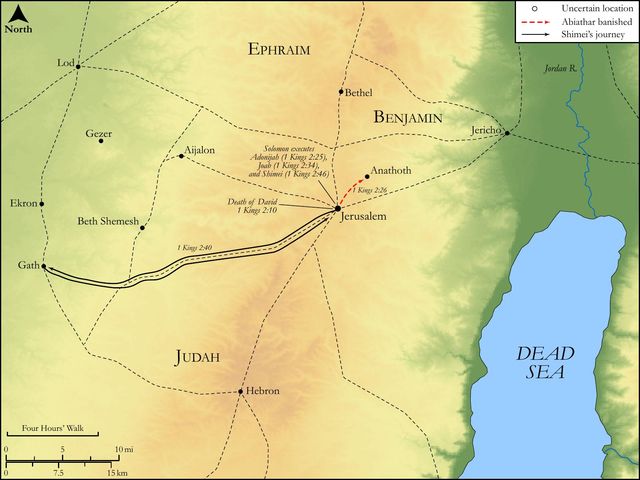
Abiathar and Joab were both aiding and abetting in Adonijah's rebellious attempt, and it is probable were at the bottom of this new motion made of Adonijah for Abishag, and it should seem Solomon knew it, Kg1 2:22. This was, in both, an intolerable affront both to God and to the government, and the worse because of their high station and the great influence their examples might have upon many. They therefore come next to be reckoned with. They are both equally guilty of the treason, but, in the judgment passed upon them, a difference is made and with good reason.
I.Abiathar, in consideration of his old services, is only degraded, Kg1 2:26, Kg1 2:27.
1. Solomon convicts him, and by his great wisdom finds him guilty: "Thou art worthy of death, for joining with Adonijah, when thou knewest on whose head God intended to set the crown." 2. He calls to mind the respect he had formerly shown to David his father, and that he had both ministered to him in holy things (had borne before him the ark of the Lord), and also had tenderly sympathized with him in his afflictions and been afflicted in them all, particularly when he was in exile and distress both by Saul's persecution and Absalom's rebellion. Note, Those that show kindness to God's people shall have it remembered to their advantage one time or other. 3. For this reason he spares Abiathar's life, but deposes him from his offices, and confines him to his country seat at Anathoth, forbids him the court, the city, the tabernacle, the altar, and all inter-meddling in public business, with an intimation likewise that he was upon his good behaviour, and that though Solomon did not put him to death at this time he might another time, if he did not conduct himself well. But, for the present, he was only thrust out from being priest, as rendered unworthy that high station by the opposition he had given to that which he knew to be the will of God. Saul, for a supposed crime, had barbarously slain Abiathar's father, and eighty-five priests, their families, and city. Solomon spares Abiathar himself, though guilty of a real crime. Thus was Saul's government ruined and Solomon's established. As men are to God's ministers, they will find him to them. 4. The depriving of Abiathar was the fulfilling of the threatening against the house of Eli (Sa1 2:30), for he was the last high priest of that family. It was now above eighty years since the ruin was threatened; but God's judgments, though not executed speedily, will be executed surely.
II.Joab, in consideration of his old sins, is put to death.
1.His guilty conscience sent him to the horns of the altar. He heard that Adonijah was executed and Abiathar deposed, and therefore, fearing his turn would be next, he fled for refuge to the altar. Many that, in the day of their security, care not for the service of the altar, will be glad of the protection of it in the day of their distress. Some think Joab designed thereby to devote himself for the future to a constant attendance upon the altar, hoping thereby to obtain his pardon, as some that have lived a dissolute life all their days have thought to atone for their crimes by retiring into a monastery when they are old, leaving the world when it has left them and no thanks to them.
2.Solomon ordered him to be put to death there for the murder of Abner and Amasa; for these were the crimes upon which he thought fit to ground the sentence, rather than upon his treasonable adherence to Adonijah. Joab was indeed worthy of death for turning after Adonijah, in contempt of Solomon and his designation to the throne, though he had not turned after Absalom, Kg1 2:28. Former fidelity will not serve to excuse any after treachery; yet, besides that, Joab had merited well of the house of David, to which and to his country he had done a great deal of good service in his day, in consideration of which, it is probable, Solomon would have pardoned him his offence against him (for clemency gives great reputation and establishment to an infant government), and would have only displaced him as he did Abiathar; but he must die for the murders he had formerly been guilty of, which his father had charged Solomon to call him to an account for. The debt he owed to the innocent blood that was shed, by answering its cries with the blood of him that shed, he could not pay himself, but left it to his son to pay it, who, having power wherewithal, failed not to do it. On this he grounds the sentence, aggravating the crime (Kg1 2:32), that he fell upon two men more righteous and better than he, that had done him no wrong nor meant him any, and, had they lived, might probably have done David better service (if the blood shed be not only innocent, but excellent, the life more valuable that common lives, the crime is the more heinous), that David knew not of it, and yet the case was such that he would be suspected as privy to it; so that Joab endangered his prince's reputation in taking away the life of his rivals, which was a further aggravation. For these crimes,
(1.)He must die, and die by the sword of public justice. By man must his blood be shed, and it lies upon his own head (Kg1 2:32), as theirs does whom he had murdered, Kg1 2:33. Woe to the head that lies under the guilt of blood! Vengeance for murder was long in coming upon Joab; but, when it did come, it remained the longer, being here entailed upon the head of his seed for ever (Kg1 2:33), who, instead of deriving honour, as otherwise they might have done, from his heroic actions, derived guilt, and shame, and a curse, from his villainous actions, on account of which they fared the worse in this world. The seed of such evil doers shall never be renowned.
(2.)He must die at the altar, rather than escape. Joab resolved not to stir from the altar (Kg1 2:30), hoping thereby either to secure himself or else to render Solomon odious to the people, as a profaner of the holy place, if he should put him to death there. Benaiah made a scruple of either killing him there or dragging him thence; but Solomon knew the law, that the altar of God should give no protection to wilful murderers. Exo 21:14, Thou shalt take him from my altar that he may die, may die a sacrifice. In case of such sins as the blood of beasts would atone for the altar was a refuge, but not in Joab's case. He therefore orders him to be executed there, if he could not be got thence, to show that he feared not the censure of the people in doing his duty, but would rectify their mistake, and let them know that the administration of justice is better than sacrifice, and that the holiness of any place should never countenance the wickedness of any person. Those who, by a lively faith, take hold on Christ and his righteousness, with a resolution, if they perish, to perish there, shall find in him a more powerful protection than Joab found at the horns of the altar. Benaiah slew him (Kg1 2:34), with the solemnity, no doubt, of a public execution. The law being thus satisfied, he was buried in his own house in the wilderness, privately, like a criminal, not pompously, like a soldier; yet no indignity was done to his dead body. It is not for man to lay the iniquity upon the bones, whatever God does.
3.Solomon pleased himself with this act of justice, not as it gratified any personal revenge, but as it was the fulfilling of his father's orders and a real kindness to himself and his own government.
(1.)Guilt was hereby removed, Kg1 2:31. By returning the innocent blood that had been shed upon the head of him that shed it, it was taken away from him and from the house of his father, which implies that the blood which is not required from the murderer will be required from the magistrate, at least there is danger lest it should. Those that would have their houses safe and built up must put away iniquity far from them.
(2.)Peace was hereby secured (Kg1 2:33) upon David. He does not mean his person, but, as he explains himself in the next words, Upon his seed, his house, and his throne, shall there be peace for ever from the Lord; thus he expresses his desire that it may be so and his hope that it shall be so. "Now that justice is done, and the cry of blood is satisfied, the government will prosper." Thus righteousness and peace kiss each other. Now that such a turbulent man as Joab is removed there shall be peace. Take away the wicked from before the king, and his throne shall be established in righteousness, Pro 25:5. Solomon, in this blessing of peace upon his house and throne, piously looks upward to God as the author of it. "It shall be peace from the Lord, and peace for ever from the Lord." The Lord of peace himself give us that peace which is everlasting.
Continue studying 1 Kings 2:31 across the web’s major study libraries — every link below opens this exact verse, chapter, or book on the destination site.
Read & Compare
 BibleGatewayThis verse in more than 200 translations and 70 languages.
 Bible.comThe YouVersion reader — hundreds of translations, reading plans, and highlights.
 ESV.orgCrossway's official English Standard Version reader.
 NET BibleThe NET translation with 60,000+ translators' notes on every rendering decision.
 STEP BibleTyndale House's free study tool — original text, vocabulary, and scholarly resources.
 BibliaLogos Bible Software's free web reader.
 USCCBThe New American Bible (Revised Edition) with the U.S. bishops' study notes.
Commentaries
 BibleHub CommentariesDozens of classic commentaries on this verse, gathered on one page.
 StudyLightMore than 100 commentary sets — the largest collection on the web.
 BibleRefPlain-English commentary on what this verse means, verse by verse.
 Enduring WordDavid Guzik's free commentary on this chapter, widely used by Bible teachers.
 Bible Study ToolsVerse commentary alongside Greek and Hebrew study aids.
Original Language & Research
- BibleHub InterlinearThe verse word by word — original language, transliteration, and English.
- BibleHub LexiconEvery word's original-language definition and Strong's entry.
 Blue Letter BibleDeep-study tools — Strong's numbers, concordance, and word studies.
 SefariaThe Hebrew text with Rashi and centuries of Jewish commentary.
Sermons, Hymns & Audio


TrulyRandomVerse is not affiliated with these sites and doesn’t control their content. They’re linked because they’re genuinely useful.
Summary
King Solomon's command in 1 Kings 2:31 marks a pivotal moment in the consolidation of his reign, establishing it upon principles of divine justice and moral purity. By ordering the execution of Joab, his father David's former military commander, Solomon explicitly seeks to remove the defilement of "innocent blood" from himself and the royal house. This decisive act is presented not merely as political expediency but as a necessary spiritual cleansing, fulfilling a divine mandate to address unpunished atrocities and ensure the integrity and blessing of the kingdom.
Context
ShowHideLiterary Context
This verse represents the culmination of Solomon's initial, decisive actions to secure his newly inherited throne following the death of King David. David's dying instructions to Solomon included specific charges regarding Joab, who had committed egregious and treacherous murders, notably of Abner 2 Samuel 3:27 and Amasa 2 Samuel 20:10. Furthermore, Joab had recently demonstrated disloyalty by supporting Adonijah's failed attempt to usurp the throne 1 Kings 1:7. Fearing Solomon's retribution, Joab had fled to the tabernacle and grasped the horns of the altar, seeking traditional asylum 1 Kings 2:28. Solomon's response, delivered through Benaiah, asserts that the altar's sanctuary does not extend to those guilty of premeditated murder, particularly the shedding of innocent blood. This command powerfully demonstrates Solomon's unwavering resolve to execute justice and fulfill David's final wish, thereby legitimizing his rule and purifying the kingdom from past defilement.
Historical & Cultural Context
In ancient Israel, the shedding of innocent blood was considered a profoundly grave offense that defiled the land and brought collective guilt upon the community and, especially, the ruling house. Mosaic Law stipulated that such bloodguilt required expiation, typically through the execution of the perpetrator, to cleanse the land and avert divine judgment (e.g., [Numbers 35:33-34 "Numbers 35:33-34 - Land Defiled by Bloodshed"] and Deuteronomy 21:1-9). While the altar indeed provided a temporary sanctuary for those who had committed unintentional homicide, it explicitly did not protect those guilty of premeditated murder Exodus 21:14. Solomon's actions precisely reflect this established legal and theological understanding, asserting the supremacy of divine justice over ritual asylum for capital offenses. His swift consolidation of power also aligns with the practice among the kings of that day, where new monarchs often eliminated potential rivals and those disloyal to ensure stability and unchallenged authority.
Key Themes
ShowHideThe primary themes interwoven within this verse and the broader chapter are Justice and Accountability, as Solomon meticulously establishes his reign on a foundation of righteous judgment, ensuring that even powerful and entrenched figures are held responsible for their crimes. This powerfully underscores the Consequences of Bloodguilt, emphasizing that the unpunished shedding of innocent blood profoundly defiles the land and brings a curse upon the royal house, necessitating decisive action for spiritual cleansing. Solomon's act is also framed as a Divine Mandate and Cleansing, fulfilling a spiritual principle to remove lingering guilt and avert potential divine judgment from David's lineage. This purification is presented as absolutely essential for the legitimacy and ultimate blessing of Solomon's reign, demonstrating his unwavering commitment to God's law and the moral order of the kingdom.
Exposition and Analysis
ShowHideKey Word Analysis
ShowHideThis word signifies something done "without cause," "for nothing," or "gratuitously." In the context of "innocent blood," it emphasizes the causeless, unprovoked, and unjust nature of Joab's murders. It highlights that the victims were not guilty of a capital crime deserving of death, nor were their deaths a result of lawful warfare, but rather acts of treacherous and unwarranted violence.
This term refers to the vital fluid, often associated with life itself. When shed, especially "innocent blood," it carries profound theological weight, representing a violation of the sanctity of life. In biblical thought, the shedding of blood pollutes the land and demands expiation, signifying a moral stain and a call for divine justice.
This verb means "to turn off," "to remove," "to depart," or "to put away." In this specific context, Solomon's command to "take away" the innocent blood signifies an act of cleansing, expiation, or purification. It is not merely about punishing Joab, but about actively removing the moral stain and potential divine judgment that Joab's unpunished deeds had brought upon the royal house of David. This action aims to restore spiritual and legal purity to the kingdom.
Verse Breakdown
ShowHide"And the king said unto him, Do as he hath said, and fall upon him, and bury him;"
Solomon's direct and unequivocal command to Benaiah, his chief captain, underscores the legal and moral imperative of Joab's execution. "Do as he hath said" refers to the prior instruction to kill Joab even while he clung to the altar, confirming that the altar's sanctuary does not extend to those guilty of premeditated murder. The phrase "fall upon him" is a common euphemism for carrying out an execution, while "bury him" indicates that, despite the capital nature of the crime, a proper, albeit perhaps swift, burial should be afforded, showing a measure of order and finality to the act.
"that thou mayest take away the innocent blood, which Joab shed, from me, and from the house of my father."
This clause provides the profound theological and legal motivation behind Solomon's command. The execution is not merely an act of political vengeance or consolidation of power, but a divinely mandated imperative. Solomon understood that Joab's unpunished shedding of innocent blood (specifically the murders of Abner and Amasa) had brought a defilement or curse upon David's house. By executing Joab, Solomon aims to "take away" this bloodguilt, thereby purifying himself and his lineage from the moral stain and potential divine retribution, legitimizing his reign, and ensuring God's continued blessing upon his kingdom.
Literary Devices
ShowHideThe passage employs several potent literary devices to amplify its significance and convey its weighty message. Symbolism is paramount, with "innocent blood" representing not merely physical death but a profound spiritual defilement and moral culpability that contaminates the land and the royal lineage. The act of "taking away" this blood symbolizes a spiritual cleansing and the restoration of divine justice. The Altar itself serves as a powerful symbol of sanctuary and divine presence, but its inability to protect Joab highlights the absolute and unyielding nature of God's justice regarding premeditated murder, demonstrating that certain sins cannot be atoned for by ritualistic asylum alone. There is also a subtle Irony in Joab, the ruthless military commander who shed so much blood throughout his career, ultimately meeting his end due to the very principle of bloodguilt he so flagrantly disregarded. This narrative also functions as a form of Foreshadowing, setting the tone for Solomon's reign as one characterized by wisdom, decisive judgment, and a steadfast commitment to upholding divine law and justice within the kingdom.
Theological and Thematic Connections
ShowHideThe concept of bloodguilt and its necessary removal is a pervasive and profound theme throughout the Old Testament, underscoring God's unwavering demand for justice and the sanctity of human life, which is created in His divine image. Solomon's decisive action in 1 Kings 2:31 serves as a vivid and stark demonstration of the principle that unpunished sin, particularly the heinous crime of murder, defiles the land and brings a curse upon those associated with it. This act of expiation is presented as absolutely crucial for the spiritual well-being of the nation and the legitimacy of its leadership, reflecting God's righteous character and His expectation that His people uphold justice and moral order. It powerfully highlights that true peace, stability, and divine blessing are profoundly contingent upon addressing wrongdoing and diligently seeking moral purity, both individually and corporately, within the covenant community.
Reflection and Application
ShowHideSolomon's decisive action to remove the "innocent blood" from his house serves as a powerful and enduring reminder that unaddressed sin, especially grave injustices and moral failings, can have far-reaching and lingering consequences, impacting not just individuals but entire communities, institutions, and even generations. For leaders in any sphere—whether governmental, corporate, or ecclesiastical—this passage underscores the profound and solemn responsibility to uphold justice, ensure accountability, and courageously address corruption or wrongdoing, even when it involves powerful or influential figures who may seem untouchable. True leadership, as exemplified by Solomon here, requires immense moral courage to confront and rectify past wrongs for the health, integrity, and spiritual vitality of the collective. For believers today, it highlights the profound seriousness of sin in God's eyes, particularly those actions that violate the sanctity of human life or cause deep harm. While we are no longer under the specific judicial laws of ancient Israel, the spiritual principle remains: unconfessed and unrepented sin creates spiritual defilement that hinders our relationship with God and others. This passage calls us to a deep and honest self-examination, to identify any unaddressed "bloodguilt" in our own lives—whether literal or metaphorical, through our actions, inactions, or complicity—and to seek God's cleansing and forgiveness through sincere repentance and faith in Christ.
Questions for Reflection
ShowHideFAQ
ShowHideWhy couldn't Joab find asylum at the altar?
ShowHideIn ancient Israel, the altar served as a place of temporary sanctuary for those who had committed unintentional homicide, allowing them to await a fair trial and potentially flee to a city of refuge Exodus 21:13. However, this right of asylum explicitly did not extend to those guilty of premeditated murder. [Exodus 21:14 "Exodus 21:14 - No Altar Asylum for Premeditated Murder"] states, "But if a man come presumptuously upon his neighbour, to slay him with guile; thou shalt take him from mine altar, that he may die." Joab's murders of Abner 2 Samuel 3:27 and Amasa 2 Samuel 20:10 were clearly treacherous and premeditated acts, not accidental, thus unequivocally disqualifying him from altar asylum under divine law. Solomon's command upheld this critical legal and theological distinction.
What does "innocent blood" mean in this context, and why was its removal so important?
ShowHide"Innocent blood" (Hebrew: dam naqi) refers to the blood of someone murdered unjustly and without legitimate cause. It signifies a profound violation of God's command against murder and the inherent sanctity of human life, which is created in His image. Its shedding was believed to deeply defile the land and bring a curse or collective guilt upon the community or, as in this case, upon the royal house Numbers 35:33-34. For Solomon, removing this bloodguilt was of paramount importance because it was perceived as a moral and spiritual stain that could invite severe divine judgment upon his reign and the entire house of David. By executing Joab, Solomon was not merely punishing a disloyal general but performing a crucial act of spiritual cleansing, ensuring the purity, legitimacy, and divine blessing of his kingdom.
Was Solomon's action against Joab just, especially given Joab's past service to David?
ShowHideFrom the perspective of biblical law and the narrative presented in [1 Kings 2 "1 Kings 2 - Solomon Consolidates Power"], Solomon's action was meticulously framed as a righteous and necessary act of justice. King David himself, on his deathbed, had explicitly instructed Solomon to deal with Joab, acknowledging Joab's past treachery and the bloodguilt he had incurred (1 Kings 2:5-6). While Joab had indeed served David faithfully and courageously in numerous military campaigns, his premeditated murders of Abner and Amasa, along with his recent support for Adonijah's attempted rebellion, constituted capital offenses that, under Mosaic Law, demanded expiation. Solomon's decision, therefore, was presented as upholding divine justice and purifying the kingdom from the defilement of unpunished innocent blood, rather than being merely a political vendetta or an act of personal revenge.
Christ-Centered Fulfillment
ShowHideThe profound and urgent need to "take away the innocent blood" from the house of David, as vividly demonstrated in Solomon's decisive actions, finds its ultimate, perfect, and eternally redemptive fulfillment in Jesus Christ. While Solomon's act was a necessary earthly cleansing to remove the defilement of human bloodshed and secure a temporal kingdom, it powerfully foreshadowed a deeper, spiritual cleansing that only the Messiah could accomplish. Humanity collectively bears the "bloodguilt" of sin, a pervasive stain that defiles not just the land but the very soul, leading inevitably to spiritual death and separation from God. Jesus, the true and greater Son of David, is the only one who could truly and eternally "take away" this ultimate innocent blood – not by shedding the blood of another, but by offering His own perfectly innocent and spotless blood. He is the divine Lamb of God who takes away the sin of the world, whose sacrificial death on the cross cleanses us from all unrighteousness 1 John 1:7. Through His unparalleled atoning work, the ultimate "bloodguilt" of humanity is removed, not from a physical house or earthly lineage, but from the hearts and consciences of all who believe, ushering in a new covenant of grace and true reconciliation with God Hebrews 9:14. He establishes a kingdom founded not on the execution of the guilty, but on the boundless grace that justifies the ungodly, offering eternal life and perfect justice through the redemptive power of His shed blood (Romans 5:8-9).