


2 Samuel 3:28
Bible text: King James Version (1769 Blayney text) · Public domain
Bible text: King James Version with Strong's numbers · Public domain
Bible text: Berean Standard Bible · Public domain
Bible text: American Standard Version (1901) · Public domain
Bible text: World English Bible, Messianic edition · Public domain
Bible text: Geneva Bible (1599) · Public domain
Bible text: Young's Literal Translation · Public domain
- וַיִּשְׁמַעvai·yish·Ma'and he heardH8085Conj-w ¦ V-Qal-ConsecImperf-3msVerb Qal Consecutive Imperfect 3rd Singular Masculineוַandיִּשְׁמַעhe heard
- דָּוִדda·VidDavidH1732N-proper-mNoun Proper Masculine
- מֵאַחֲרֵיme·'A·cha·reifrom afterH310Prep-m ¦ Adj-mpcAdjective Numerical Plural Masculine Constructמֵfromאַחֲרֵיafter
- כֵןKhenthusH3651AdvAdverb
- וַיֹּאמֶרvai·Yo·merand he saidH559Conj-w ¦ V-Qal-ConsecImperf-3msVerb Qal Consecutive Imperfect 3rd Singular Masculineוַandיֹּאמֶרhe said
- נָקִיna·Ki[am] innocentH5355Adj-msAdjective Singular Masculine Absolute
- אָנֹכִי'a·no·KhiIH595Pro-1csPronoun Personal 1st Singular common gender
- וּמַמְלַכְתִּיu·mam·lakh·Tiand my kingdomH4467Conj-w ¦ N-fsc ¦ 1csNoun Singular Feminine Constructוּandמַמְלַכְתִּkingdomיmy
- מֵעִםme·'Imfrom withH5973Prep-m ¦ PrepPrepositionמֵfromעִםwith
- יְהוָהYah·wehYahwehH3068N-properNoun Proper Title
- עַד'aduntilH5704PrepPreposition
- עוֹלָםo·LamperpetuityH5769N-msNoun Singular Masculine Absolute
- מִדְּמֵיmi·de·Meifrom [the] blood<s> ofH1818Prep-m ¦ N-mpcNoun Plural Masculine Constructמִfromדְּמֵי[the] blood<s> of
- אַבְנֵר'av·NerAbnerH74N-proper-mNoun Proper Masculine
- בֶּןben[the] son ofH1121N-mscNoun Singular Masculine Construct
- נֵרNerNerH5369N-proper-mNoun Proper Masculine
English is a literal word-by-word gloss of the Hebrew, not the KJV's wording. Why?
This is the original text the KJV's translators worked from — each Hebrew word with its own literal English meaning in this verse, prepared by scholars at Tyndale House, Cambridge. The KJV translates whole sentences, not word by word, so its wording differs: one Hebrew word can become several English words, and the KJV may choose “the LORD” where the gloss reads “Yahweh”. Both are faithful — they answer different questions. For the KJV's own rendering, switch to the KJV text.
Details
See on the biblical-era maps

Study this verse
Public-domain commentary
Matthew Henry
From his Commentary on the Whole Bible. Henry comments on passages, not single verses — this entry covers 2 Samuel 3:22–39. His three-level outline is real structure in the source text, so it is rendered as structure.
We have here an account of the murder of Abner by Joab, and David's deep resentment of it.
I.Joab very insolently fell foul upon David for treating with Abner.
He happened to be abroad upon service when Abner was with David, pursuing a troop, either of Philistines or of Saul's party; but, upon his return, he was informed that Abner was just gone (Sa2 3:22, Sa2 3:23), and that a great many kind things had passed between David and him. He had all the reason in the world to be satisfied of David's prudence and to acquiesce in the measures he took, knowing him to be a wise and good man himself and under a divine conduct in all his affairs; and yet, as if he had the same sway in David's cause that Abner had in Ish-bosheth's, he chides David, and reproaches him to his face as impolitic (Sa2 3:24, Sa2 3:25): What hast thou done? As if David were accountable to him for what he did: "Why hast thou sent him away, when thou mightest have made him a prisoner? He came as a spy, and will certainly betray thee." I know not whether to wonder more that Joab had impudence enough to give such an affront to his prince or that David had patience enough to take it. He does, in effect, call David a fool when he tells him he knew Abner came to deceive him and yet he trusted him. We find no answer that David gave him, not because he feared him, as Ish-bosheth did Abner (Sa2 3:11), but because he despised him, or because Joab had not so much good manners as to stay for an answer.
II.He very treacherously sent for Abner back, and, under colour of a private conference with him, barbarously killed him with his own hand.
That he made use of David's name, under pretence of giving him some further instructions, is intimated in that, but David knew it not, Sa2 3:26. Abner, designing no harm, feared none, but very innocently returned to Hebron, and, when he found Joab waiting for him at the gate, turned aside with him to speak with him privately, forgetting what he himself had said when he slew Asahel, How shall I hold up my face to Joab thy brother? (Sa2 2:22), and there Joab murdered him (Sa2 3:27), and it is intimated (Sa2 3:30) that Abishai was privy to the design, and was aiding and abetting, and would have come in to his brother's assistance if there had been occasion; he is therefore charged as an accessary: Joab and Abishai slew Abner, though perhaps he only knew it who is privy to the thoughts and intents of men's hearts. Now in this,
1.It is certain that the Lord was righteous. Abner had maliciously, and against the convictions of his conscience, opposed David. He had now basely deserted Ish-bosheth, and betrayed him, under pretence of regard to God and Israel, but really from a principle of pride, and revenge, and impatience of control. God will not therefore use so bad a man, though David might, in so good a work as the uniting of Israel. Judgments are prepared for such scorners as Abner was. But,
2.It is as certain that Joab was unrighteous, and, in what he did, did wickedly. David was a man after God's own heart, but could not have those about him, no, not in places of the greatest trust, after his own heart. Many a good prince, and a good master, has been forced to employ bad men.
(1.)Even the pretence for doing this was very unjust. Abner had indeed slain his brother Asahel, and Joab and Abishai pretended herein to be the avengers of his blood (Sa2 3:27, Sa2 3:30); but Abner slew Asahel in an open war, wherein Abner indeed had given the challenge, but Joab himself had accepted it and had slain many of Abner's friends. He did it likewise in his own defence, and not till he had given him fair warning (which he would not take), and he did it with reluctancy; but Joab here shed the blood of war in peace, Kg1 2:5.
(2.)That which we have reason to think was at the bottom of Joab's enmity to Abner made it much worse. Joab was now general of David's forces; but, if Abner should come into his interest, he would possibly be preferred before him, being a senior officer, and more experienced in the art of war. This Joab was jealous of, and could better bear the guilt of blood than the thoughts of a rival.
(3.)He did it treacherously, and under pretence of speaking peaceably to him, Deu 27:24. Had he challenged him, he would have done like a soldier; but to assassinate him was done villainously and like a coward. His words were softer than oil, yet were they drawn swords, Psa 55:21. Thus he basely slew Amasa, Sa2 20:9, Sa2 20:10.
(4.)The doing of it was a great affront and injury to David, who was now in treaty with Abner, as Joab knew. Abner was now actually in his master's service, so that, through his side, he struck at David himself.
(5.)It was a great aggravation of the murder that he did it in the gate, openly and avowedly, as one that was not ashamed, nor could blush. The gate was the place of judgment and the place of concourse, to that he did it in defiance of justice, both the just sentence of the magistrates and the just resentment of the crowd, as one that neither feared God nor regarded men, but thought himself above all control: and Hebron was a Levites' city and a city of refuge.
III.David laid deeply to heart and in many ways expressed his detestation of this execrable villany.
1.He washed his hands from the guilt of Abner's blood. Lest any should suspect that Joab had some secret intimation from David to do as he did (and the rather because he went so long unpunished), he here solemnly appeals to God concerning his innocency: I and my kingdom are guiltless (and my kingdom is so because I am so) before the Lord for ever, Sa2 3:28. It is a comfort to be able to say, when any bad thing is done, that we had no hand in it. We have not shed this blood, Deu 21:7. However we may be censured or suspected, our hearts shall not reproach us.
2.He entailed the curse for it upon Joab and his family (Sa2 3:29): "Let it rest on the head of Joab. Let the blood cry against him, and let divine vengeance follow him. Let the iniquity be visited upon his children and children's children, in some hereditary disease or other. The longer the punishment is delayed, the longer let it last when it shall come. Let his posterity be stigmatized, blemished with an issue or a leprosy, which will shut them out from society; let them be beggars, or cripples, or come to some untimely end, that it may be said, He is one of Joab's race." This intimates that the guilt of blood brings a curse upon families; if men do not avenge it, God will, and will lay up the iniquity for the children. But methinks a resolute punishment of the murderer himself would better have become David than this passionate imprecation of God's judgments upon his posterity.
3.He called upon all about him, even Joab himself, to lament the death of Abner (Sa2 3:31): Rend your clothes and mourn before Abner, that is, before the hearse of Abner, as Abraham is said to mourn before his dead (Gen 23:2, Gen 23:3), and he gives a reason why they should attend his funeral with sincere and solemn mourning (Sa2 3:38), because there is a prince and a great man fallen this day in Israel. His alliance to Saul, his place as general, his interest, and the great services he had formerly done, were enough to denominate him a prince and a great man. When he could not call him a saint or a good man, he said nothing of that, but what was true he gave him the praise of, though he had been his enemy, that he was a prince and a great man. "Such a man has fallen in Israel, and fallen this day, just when he was doing the best deed he ever did in his life, this day, when he was likely to be so serviceable to the public peace and welfare and could so ill be spared." (1.) Let them all lament it. The humbling change death puts all men under is to be lamented, especially as affecting princes and great men. Alas! alas! (see Rev 18:10) how mean, how little, are those made by death who made themselves the terror of the mighty in the land of the living! But we are especially obliged to lament the fall of useful men in the midst of their usefulness and when there is most need of them. A public loss must be every man's grief, for every man shares in it. Thus David took care that honour should be done to the memory of a man of merit, to animate others. (2.) Let Joab, in a particular manner, lament it, which he has less heart but more reason to do than any of them. If he could be brought to do it sincerely, it would be an expression of repentance for his sin in slaying him. If he did it in show only, as it is likely he did, yet it was a sort of penance imposed upon him, and a present commutation of the punishment. If he do not as yet expiate the murder with his blood, let him do something towards it with tears. This, perhaps, Joab submitted to with no great reluctancy, now he had gained his point. Now that he is on the bier, no matter in what pomp he lies. Sit divus, modo non sit vivus - Let him be canonized, so that he be but killed.
4.David himself followed the corpse as chief mourner, and made a funeral oration at the grave. He attended the bier (Sa2 3:31) and wept at the grave, Sa2 3:32. Though Abner had been his enemy, and might possibly have proved no very firm friend, yet because he had been a man of bravery in the field, and might have done great service in the public counsels at this critical juncture, all former quarrels are forgotten and David is a true mourner for his fall. What he said over the grave fetched fresh floods of tears from the eyes of all that were present, when they thought they had already paid the debt in full (Sa2 3:33, Sa2 3:34): Died Abner as a fool dieth?
(1.)He speaks as one vexed that Abner was fooled out of his life, that so great a man as he, so famed for conduct and courage, should be imposed upon by a colour of friendship, slain by surprise, and so die as a fool dies. The wisest and stoutest of men have no fence against treachery. To see Abner, who thought himself the main hinge on which the great affairs of Israel turned, so considerable as himself to be able to turn the scale of a trembling government, his head full of great projects and great prospects, to see him made a fool of by a base rival, and falling on a sudden a sacrifice to his ambition and jealousy - this stains the pride of all glory, and should put one out of conceit with worldly grandeur. Put not your trust in princes, Psa 146:3, Psa 146:4. And let us therefore make that sure which we cannot be fooled out of. A man may have his life, and all that is dear to him, taken from him, and not be able to prevent it with all his wisdom, care, and integrity; but there is that which no thief can break through to steal. See here how much more we are beholden to God's providence than to our own prudence for the continuance of our lives and comforts. Were it not for the hold God has of the consciences of bad men, how soon would the weak and innocent become an easy prey to the strong and merciless and the wisest die as fools! Or,
(2.)He speaks as one boasting that Abner did not fool himself out of his life: "Died Abner as a fool dies? No, he did not, not as a criminal, a traitor or felon, that forfeits his life into the hands of public justice; his hands were not pinioned, nor his feet fettered, as those of malefactors are: Abner falls not before just men, by a judicial sentence; but as a man, an innocent man, falleth before wicked men, thieves and robbers, so fellest thou." Died Abner as Nabal died? so the Septuagint reads it. Nabal died as he lived, like himself, like a sot; but Abner's fate was such as might have been the fate of the wisest and best man in the world. Abner did not throw away his life as Asahel did, who wilfully ran upon the spear, after fair warning, but he was struck by surprise. Note, It is a sad thing to die like a fool, as those do that in any way shorten their own days, and much more those that make no provision for another world.
5.He fasted all that day, and would by no means be persuaded to eat any thing till night, Sa2 3:35. It was then the custom of great mourners to refrain for the time from bodily refreshments, as Sa2 1:12; Sa1 31:13. How incongruous is it then to turn the house of mourning into a house of feasting! This respect which David paid to Abner was very pleasing to the people and satisfied them that he was not, in the least, accessory to the murder (Sa2 3:36, Sa2 3:37), of which he was solicitous to avoid the suspicion, lest Joab's villany should make him odious, as that of Simeon and Levi did Jacob, Gen 34:30. On this occasion it is said, Whatever the king did pleased all the people. This intimates,
(1.)His good affection to them. He studied to please them in every thing and carefully avoided what might be disobliging.
(2.)Their good opinion of him. They thought every thing he did well done. Such a mutual willingness to please, and easiness to be pleased, will make every relation comfortable.
6.He bewailed it that he could not with safety do justice on the murderers, Sa2 3:30. He was weak, his kingdom was newly planted, and a little shake would overthrow it. Joab's family had a great interest, were bold and daring, and to make them his enemies now might be of bad consequence. These sons of Zeruiah were too hard for him, too big for the law to take hold of; and therefore, though by man, by the magistrate, the blood of a murderer should be shed (Gen 9:6), David bears the sword in vain, and contents himself, as a private person, to leave them to the judgment of God: The Lord shall reward the doer of evil according to his wickedness. Now this is a diminution,
(1.)To David's greatness. He is anointed king, and yet is kept in awe by his own subjects, and some of them are too hard for him. Who would be fond of power when a man may have the name of it, and must be accountable for it, and yet be hampered in the use of it?
(2.)To David's goodness. He ought to have done his duty, and trusted God with the issue. Fiat justitia, ruat coelum - Let justice be done, though the heavens should fall asunder. If the law had had its course against Joab, perhaps the murder of Ishbosheth, Amnon, and others, would have been prevented. It was carnal policy and cruel pity that spared Joab. Righteousness supports the throne and will never shake it. Yet it was only a reprieve that David gave to Joab; on his death-bed he left it to Solomon (who could the better wield the sword of justice because he had no occasion to draw the sword of war) to avenge the blood of Abner. Evil pursues sinners, and will overtake them at last. David preferred Abner's son Jaasiel, Ch1 27:21.
Historical interpretation
Historical reception
1 surviving comment on this verse from the historical church.
Although he [Saul] was a king, he sinned if he killed the innocent. Finally, even David, when he was in possession of his kingdom and had heard that an innocent man named Abner was slain by Joab, the leader of his army, said, “I and my kingdom are innocent now and forever of the blood of Abner the son of Ner,” and he fasted in sorrow.These things I have written not to disconcert you but that the example of kings may stir you to remove this sin from your kingdom, for you will remove it by humbling your soul before God. You are a man, you have met temptation—conquer it. Sin is not removed except by tears and penance. No angel or archangel can remove it; it is God himself who alone can say, "I am with you"; if we have sinned, he does not forgive us unless we do penance.
Continue studying 2 Samuel 3:28 across the web’s major study libraries — every link below opens this exact verse, chapter, or book on the destination site.
Read & Compare
 BibleGatewayThis verse in more than 200 translations and 70 languages.
 Bible.comThe YouVersion reader — hundreds of translations, reading plans, and highlights.
 ESV.orgCrossway's official English Standard Version reader.
 NET BibleThe NET translation with 60,000+ translators' notes on every rendering decision.
 STEP BibleTyndale House's free study tool — original text, vocabulary, and scholarly resources.
 BibliaLogos Bible Software's free web reader.
 USCCBThe New American Bible (Revised Edition) with the U.S. bishops' study notes.
Commentaries
 BibleHub CommentariesDozens of classic commentaries on this verse, gathered on one page.
 StudyLightMore than 100 commentary sets — the largest collection on the web.
 BibleRefPlain-English commentary on what this verse means, verse by verse.
 Enduring WordDavid Guzik's free commentary on this chapter, widely used by Bible teachers.
 Bible Study ToolsVerse commentary alongside Greek and Hebrew study aids.
Original Language & Research
- BibleHub InterlinearThe verse word by word — original language, transliteration, and English.
- BibleHub LexiconEvery word's original-language definition and Strong's entry.
 Blue Letter BibleDeep-study tools — Strong's numbers, concordance, and word studies.
 SefariaThe Hebrew text with Rashi and centuries of Jewish commentary.
Sermons, Hymns & Audio


TrulyRandomVerse is not affiliated with these sites and doesn’t control their content. They’re linked because they’re genuinely useful.
Summary
Following the treacherous assassination of Abner, the commander of Saul's army, by Joab, David makes a solemn and public declaration in 2 Samuel 3:28, proclaiming his and his kingdom's innocence from the bloodguilt of Abner's death. This pivotal statement was crucial for David to distance himself from the heinous act, preserve his moral authority, and secure the trust of the northern tribes as he sought to unite all Israel under his rule, demonstrating his unwavering commitment to justice before both man and God in a politically volatile period.
Context
ShowHideLiterary Context
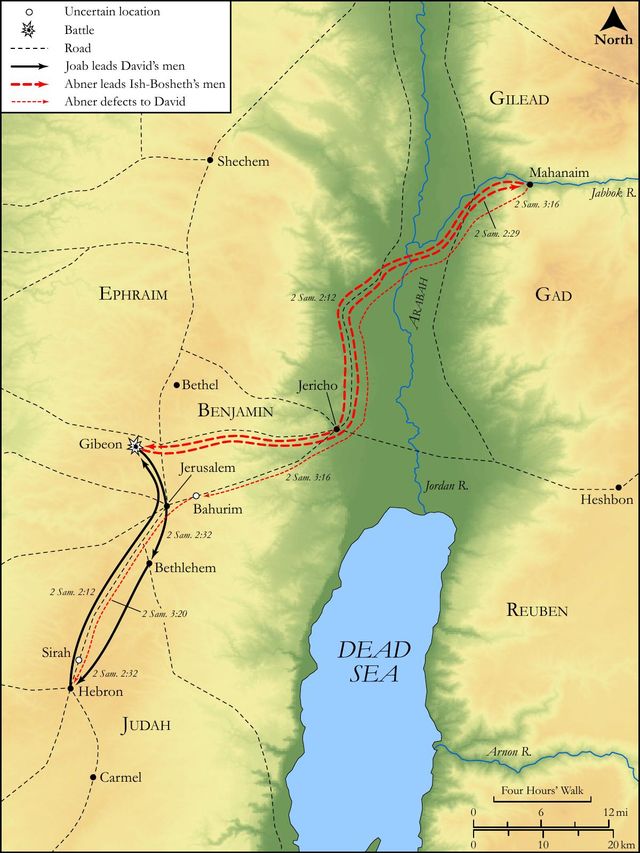
This verse immediately follows the shocking and politically destabilizing murder of Abner by Joab, David's own military commander, in Hebron. Abner, having previously served Saul and supported Ish-bosheth, had recently defected to David, promising to bring all Israel under David's kingship. David had received Abner with honor and sent him away in peace, a gesture crucial for fostering unity. Joab, however, driven by personal vengeance for Abner killing his brother Asahel in battle (as recounted in 2 Samuel 2:23), lured Abner back and murdered him. David's declaration here is his immediate, public response to this act, which could have been perceived as a calculated political assassination orchestrated by him, thereby undermining his legitimacy and the fragile peace he was building. The verses that follow (2 Samuel 3:31-39) detail David's elaborate and sincere mourning for Abner, further reinforcing his dissociation from the crime and demonstrating his profound grief to the people.
Historical & Cultural Context
In Israel, bloodguilt (Hebrew: dam) was a profound theological and legal concept. Unjustly shed blood was believed to defile the land and bring divine judgment upon the perpetrator, their family, and even the nation if the crime went unpunished, as seen in passages like Numbers 35:33-34. Kings were expected to uphold justice and maintain the purity of the land, acting as God's representatives. David's public declaration was not merely a political maneuver to manage public perception; it was a deeply religious act to clear himself and his nascent kingdom of the spiritual stain of bloodguilt before the Lord. Furthermore, the political landscape was extremely volatile, with the northern tribes still loyal to Saul's house. Abner was a respected military and political leader among them, and his death, if attributed to David, would have severely jeopardized his efforts to unite the kingdom, potentially sparking further civil war. David's actions were therefore critical for both his spiritual standing and his political survival and legitimacy.
Key Themes
ShowHideThis verse powerfully contributes to several key themes within 2 Samuel and the broader Deuteronomistic History. It highlights the theme of Justice and Righteous Rule, demonstrating David's commitment to divine law and his desire to govern justly, even when it means confronting the heinous actions of those closest to him. The declaration underscores the theme of Leadership Integrity, as David publicly distances himself from a treacherous act, thereby preserving his moral authority and legitimacy in the eyes of the people and, more importantly, "before the LORD." It also implicitly reinforces the negative theme of Consequences of Unchecked Vengeance, as Joab's personal vendetta creates a significant crisis for David and foreshadows the eventual reckoning for Joab's actions later in David's reign, as hinted at in 1 Kings 2:5-6. Finally, the phrase "before the LORD" emphasizes the pervasive theme of Divine Sovereignty and Witness, acknowledging God as the ultimate judge and arbiter of truth and justice in all human affairs, especially those involving leadership.
Exposition and Analysis
ShowHideKey Word Analysis
ShowHideThis term signifies being clean, innocent, or free from culpability, particularly in a legal or moral sense. It denotes a state of purity from defilement, often associated with bloodshed. David's use of naqiy here is a strong legal and theological assertion, declaring that he and his kingdom are not implicated in the moral and spiritual defilement associated with Abner's murder. It functions as a solemn plea of innocence before both God and humanity, aiming to prevent the stain of this crime from adhering to his reign.
The term "blood" in this context refers to "bloodguilt," a profound concept in ancient Israelite law and theology. It signifies the moral and legal responsibility for taking a life unjustly. Unjustly shed blood was believed to cry out from the ground, as seen in Genesis 4:10, and to defile the land, requiring either the death of the perpetrator or specific atonement to cleanse it, as outlined in Numbers 35:33. David's declaration aims to absolve himself and his kingdom from this severe spiritual and legal liability, emphasizing the gravity of the crime.
This is the sacred covenant name of God, Yahweh. The phrase "before the LORD" (Hebrew: liphney YHWH) emphasizes the divine witness and ultimate judgment. It elevates David's declaration from a mere political statement to a solemn oath made in the presence of the Almighty. It signifies that David is not only concerned with his reputation among men but, more importantly, with his standing before God, who sees all, knows all, and judges righteously. This underscores the theological dimension of David's kingship and his profound understanding of his accountability to God for the moral state of his kingdom.
Verse Breakdown
ShowHide"And afterward when David heard [it],"
This clause immediately establishes the context and the catalyst for David's pronouncement – the news of Abner's murder. It highlights David's reactive stance, emphasizing that the act was not pre-meditated or sanctioned by him. This detail is crucial for portraying David as genuinely shocked and distressed by the news, rather than complicit.
"he said,"
This simple phrase introduces David's public and authoritative pronouncement. In Israel, the king's public word carried immense weight and was essential for conveying official positions, shaping public perception, and establishing legal or moral decrees. David's immediate verbal response underscores the urgency and gravity of the situation.
"I and my kingdom [are] guiltless"
This is the core of David's emphatic declaration. By stating "I and my kingdom," David takes responsibility not only for his personal actions but also for the moral and spiritual standing of the entire realm under his authority. He asserts a complete lack of complicity or responsibility for Abner's death, aiming to clear any suspicion that might attach to his reign and to prevent the defilement of his emerging kingdom.
"before the LORD for ever"
This phrase elevates the declaration to a divine oath and a perpetual truth. David invokes God as his ultimate witness and judge, asserting his innocence not just in the eyes of men but in the ultimate court of heaven. The phrase "for ever" (Hebrew: ʻôwlâm) implies a lasting and unwavering state of innocence regarding this specific event, ensuring that this bloodguilt will not be attributed to his dynasty or legacy in perpetuity.
"from the blood of Abner the son of Ner:"
This final clause precisely specifies the particular crime from which David and his kingdom are absolved. It explicitly names Abner, the victim, ensuring there is no ambiguity about the subject of the bloodguilt. By naming the victim, David acknowledges the gravity of the crime and the specific nature of the defilement he is disavowing, demonstrating his recognition of the profound injustice committed.
Literary Devices
ShowHideThe verse primarily employs Public Declaration, a common literary and political device in the narratives of kings, where rulers make formal pronouncements to establish their position, assert authority, or clarify matters of state. David's statement is a clear example, designed to shape public opinion and affirm his moral standing. There is also a strong element of Contrast at play, setting David's righteous indignation and desire for justice against Joab's vengeful and treacherous act, highlighting the moral chasm between the king's intentions and his commander's actions. Furthermore, the phrase "before the LORD for ever" functions as a powerful Divine Appeal, invoking God as the ultimate witness and judge, thereby lending immense weight, solemnity, and eternal validity to David's words. This appeal also carries a subtle sense of Foreshadowing, as David's declaration of innocence regarding Abner's bloodguilt implicitly sets the stage for a future reckoning, which eventually occurs when Joab is punished by Solomon, fulfilling David's delayed desire for justice (1 Kings 2:5-6).
Theological and Thematic Connections
ShowHideDavid's fervent declaration in 2 Samuel 3:28 resonates deeply with biblical themes of justice, accountability, and the nature of righteous leadership. It underscores the profound seriousness with which the Old Testament regards the shedding of innocent blood and the concept of bloodguilt, which could corrupt a nation and invite divine judgment. David's immediate and public disavowal of complicity demonstrates his understanding that true kingship, particularly in Israel, derived its legitimacy not merely from military prowess or political maneuvering, but from adherence to God's moral law and a commitment to justice. His appeal "before the LORD" highlights the theological truth that all human actions, especially those of leaders, are ultimately judged by a holy God. This verse serves as a powerful reminder that even in the chaotic and morally ambiguous world of ancient politics, God's standards of righteousness remain supreme, and leaders are held accountable for upholding them, lest their land become defiled.
Reflection and Application
ShowHideDavid's emphatic declaration of innocence regarding Abner's blood offers profound lessons for contemporary life and leadership. In a world where accountability is often evaded, and reputations are easily tarnished by association, David's immediate and public dissociation from injustice serves as a powerful model. It teaches us the importance of maintaining integrity, not just in our direct actions, but also in how we respond to the wrongs committed by those around us, especially those under our authority or within our sphere of influence. True leadership requires moral courage to denounce evil, even when it is inconvenient or perpetrated by allies, friends, or family. Furthermore, David's concern for being "guiltless before the LORD" reminds us that our ultimate accountability is to God. It encourages us to live with a clear conscience, seeking to honor God in all our decisions and to actively distance ourselves from any form of complicity in injustice, knowing that our actions and inactions are witnessed by the Almighty. This verse calls us to cultivate a deep commitment to righteousness, to speak out against wrongdoing, and to strive for a life that reflects God's justice and purity, even when it demands difficult choices or confrontations.
Questions for Reflection
ShowHideFAQ
ShowHideWhy was David's public declaration so important?
ShowHideDavid's public declaration was critically important for several reasons. Politically, it was essential to distance himself from Abner's murder, as Abner was a key figure in uniting the northern tribes with David's kingdom. Any suspicion of David's complicity could have shattered this fragile unity and led to widespread civil war. Theologically, in ancient Israel, the shedding of innocent blood brought "bloodguilt" upon the land and its people, requiring atonement or punishment to cleanse it, as seen in Numbers 35:33. By declaring himself and his kingdom "guiltless before the LORD," David was performing a spiritual act of cleansing, affirming his righteous standing before God and ensuring that this sin would not be attributed to his reign or his descendants. It was a powerful demonstration of his integrity and his commitment to divine justice in a tumultuous period.
Why didn't David punish Joab immediately for Abner's murder?
ShowHideWhile David was clearly distraught and condemned Joab's actions, he did not immediately punish him for several complex reasons, as he himself lamented in 2 Samuel 3:39. Joab was David's loyal and powerful military commander, deeply entrenched with the army, and executing him could have led to a mutiny or severely destabilized David's nascent kingdom, which was still consolidating power over all Israel. David acknowledged that the "sons of Zeruiah" (Joab and Abishai) were "too hard" for him, indicating their formidable influence and the political constraints on his immediate action. Furthermore, David was still establishing his authority over all Israel, and punishing Joab might have been perceived as weakness or ingratitude by some of his loyalists. However, David did not forget this injustice, later instructing his son Solomon to deal with Joab for his past transgressions, including Abner's murder, as recorded in 1 Kings 2:5-6.
What is "bloodguilt" in the biblical context?
ShowHide"Bloodguilt" (Hebrew: dam) is a significant theological and legal concept in the Bible, referring to the moral and spiritual responsibility for the unjust shedding of human blood. According to Mosaic Law, the life is in the blood (Leviticus 17:11), and the shedding of innocent blood profoundly defiled the land and brought divine judgment upon the perpetrator, their family, and even the community or nation if the crime went unpunished, as detailed in Deuteronomy 19:10. It was considered a severe offense against God's covenant and human life, requiring specific legal and ritual actions to cleanse the land and atone for the sin, often through capital punishment of the murderer (Numbers 35:33). David's declaration in 2 Samuel 3:28 was an act to ritually and publicly clear himself and his kingdom from this defilement and its associated divine consequences.
Christ-Centered Fulfillment
ShowHideDavid's desperate need to be declared "guiltless before the LORD for ever from the blood of Abner" foreshadows the ultimate and perfect innocence of Jesus Christ. David, though a man after God's own heart, was still a flawed king, unable to perfectly cleanse his kingdom from the stain of sin and injustice, as evidenced by Joab's unpunished act and David's own later moral failures. His declaration, while sincere and politically necessary, was an attempt to mitigate the consequences of another's sin and protect his own legacy. In stark contrast, Jesus Christ is the truly innocent one, "who committed no sin, nor was any deceit found in his mouth" (1 Peter 2:22). He willingly bore the bloodguilt of all humanity upon himself, not by being complicit in sin, but by becoming the perfect, unblemished sacrifice. The shedding of His innocent blood on the cross did not defile the land, but rather cleansed it and all who believe from the guilt of their sins, purifying even the conscience from dead works to serve the living God (Hebrews 9:14). While David sought to distance himself from the blood of Abner, Christ drew near to the blood of all humanity, taking it upon Himself to offer true and eternal absolution. His kingdom is one of perfect righteousness and justice, established not by human declarations or political maneuvering, but by His atoning sacrifice, making all who are in Him truly "guiltless before the LORD for ever" (Romans 8:1) and presenting them holy and blameless before God (Colossians 1:22).