


1 Chronicles 19:5
- וַיֵּלְכוּvai·ye·le·Khuand people wentH1980Conj-w ¦ V-Qal-ConsecImperf-3mpVerb Qal Consecutive Imperfect 3rd Plural Masculineוַandיֵּלְכוּpeople went
- וַיַּגִּידוּvai·ya·Gi·duand they toldH5046Conj-w ¦ V-Hiphil-ConsecImperf-3mpVerb Hiphil Consecutive Imperfect 3rd Plural Masculineוַandיַּגִּידוּthey told
- לְדָוִידle·da·Vidto DavidH1732Prep-l ¦ N-proper-mNoun Proper MasculineלְtoדָוִידDavid
- עַל'alonH5921PrepPreposition
- הָאֲנָשִׁיםha·'a·na·Shimthe menH582Art ¦ N-mpNoun Plural Masculine Absoluteהָtheאֲנָשִׁיםmen
- וַיִּשְׁלַחvai·yish·Lachand he sentH7971Conj-w ¦ V-Qal-ConsecImperf-3msVerb Qal Consecutive Imperfect 3rd Singular Masculineוַandיִּשְׁלַחhe sent
- לִקְרָאתָםlik·ra·Tamto meet themH7122Prep-l ¦ V-Qal-Inf ¦ 3mpVerb Qal Infinitive Constructלִtoקְרָאתָmeetםthem
- כִּיkiforH3588PrtParticle Conditional
- הָיוּha·Yuthey wereH1961V-Qal-Perf-3cpVerb Qal Perfect 3rd Plural common gender
- הָאֲנָשִׁיםha·'a·na·Shimthe menH582Art ¦ N-mpNoun Plural Masculine Absoluteהָtheאֲנָשִׁיםmen
- נִכְלָמִיםnikh·la·MimhumiliatedH3637V-Niphal-Prtcpl-mpVerb Niphal Participle Plural Masculine Absolute
- מְאֹדme·'OdexceedinglyH3966Adj-msAdjective Numerical Singular Masculine Absolute
- וַיֹּאמֶרvai·Yo·merand he saidH559Conj-w ¦ V-Qal-ConsecImperf-3msVerb Qal Consecutive Imperfect 3rd Singular Masculineוַandיֹּאמֶרhe said
- הַמֶּלֶךְha·Me·lekhthe kingH4428Art ¦ N-msNoun Singular Masculine Absoluteהַtheמֶּלֶךְking
- שְׁבוּshe·VuremainH3427V-Qal-Imp-2mpVerb Qal Imperative 2nd Plural Masculine
- בִירֵחוֹvi·re·Choat JerichoH3405Prep-b ¦ N-properNoun Proper LocationבִatירֵחוֹJericho
- עַד'aduntilH5704PrepPreposition
- אֲשֶׁר'a·SherthatH834RelParticle Relative
- יְצַמַּחye·tza·Machit will grow backH6779V-Piel-Imperf-3msVerb Piel Imperfect 3rd Singular Masculine
- זְקַנְכֶםze·kan·Khemyour beardH2206N-msc ¦ 2mpNoun Singular Masculine Constructזְקַנְbeardכֶםyour
- וְשַׁבְתֶּםve·shav·Temand you will returnH7725Conj-w ¦ V-Qal-ConsecPerf-2mpVerb Qal Consecutive Perfect 2nd Plural Masculineוְandשַׁבְתֶּםyou will return
English is a literal word-by-word gloss of the Hebrew, not the KJV's wording. Why?
This is the original text the KJV's translators worked from — each Hebrew word with its own literal English meaning in this verse, prepared by scholars at Tyndale House, Cambridge. The KJV translates whole sentences, not word by word, so its wording differs: one Hebrew word can become several English words, and the KJV may choose “the LORD” where the gloss reads “Yahweh”. Both are faithful — they answer different questions. For the KJV's own rendering, switch to the KJV text.
Details
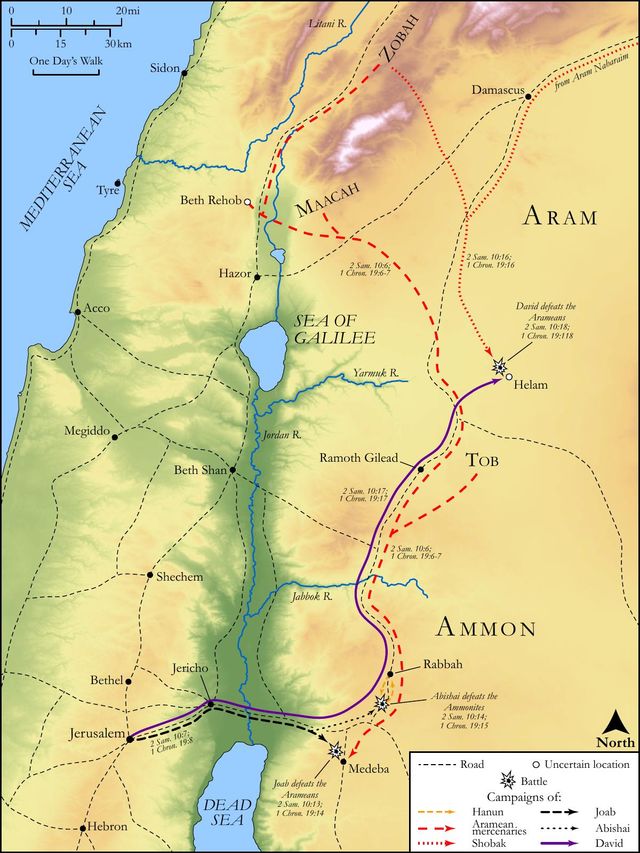
See on the biblical-era map
Study this verse
Public-domain commentary
Matthew Henry
From his Commentary on the Whole Bible. Henry comments on passages, not single verses — this entry covers 1 Chronicles 19:1–5.
Let us here observe, 1. That is becomes good people to be neighbourly, and especially to be grateful. David will pay respect to Hanun because he is his neighbour; and religion teaches us to be civil and obliging to all, to honour all men, and to be ready to do all offices of kindness to those we live among; nor must difference in religion be any obstruction to this. But, besides this, David remembered the kindness which his father showed to him. Those that have received kindness must return it as they have ability and opportunity: those that have received it from the parents must return it to the children when they are gone. 2. That, as saith the proverb of the ancients, Wickedness proceedeth from the wicked, Sa1 24:13. The vile person will speak villany, and the instruments of the churl will be evil, to destroy those with lying words that speak right, Isa 32:6, Isa 32:7. Those that are base, and design ill themselves, are apt to be jealous and to suspect ill of others without cause. Hanun's servant suggested that David's ambassadors came as spies, as if so great and mighty a man as David needed to do so mean a thing (if he had any design upon the Ammonites, he could effect it by open force, and had no occasion for any fraudulent practices), or as if a man of such virtue and honour would do so base a thing. Yet Hanun hearkened to the suggestion, and, against the law of nations, treated David's ambassadors villainously. 3. Masters ought to protect their servants, and with the greatest tenderness to concern themselves for them if they come by any loss or damage in their service. David did so for his ambassadors, Ch1 19:5. Christ will do so for his ministers; and let all masters thus give unto their servants that which is just and equal.
Continue studying 1 Chronicles 19:5 across the web’s major study libraries — every link below opens this exact verse, chapter, or book on the destination site.
Read & Compare
 BibleGatewayThis verse in more than 200 translations and 70 languages.
 Bible.comThe YouVersion reader — hundreds of translations, reading plans, and highlights.
 ESV.orgCrossway's official English Standard Version reader.
 NET BibleThe NET translation with 60,000+ translators' notes on every rendering decision.
 STEP BibleTyndale House's free study tool — original text, vocabulary, and scholarly resources.
 BibliaLogos Bible Software's free web reader.
 USCCBThe New American Bible (Revised Edition) with the U.S. bishops' study notes.
Commentaries
 BibleHub CommentariesDozens of classic commentaries on this verse, gathered on one page.
 StudyLightMore than 100 commentary sets — the largest collection on the web.
 BibleRefPlain-English commentary on what this verse means, verse by verse.
 Enduring WordDavid Guzik's free commentary on this chapter, widely used by Bible teachers.
 Bible Study ToolsVerse commentary alongside Greek and Hebrew study aids.
Original Language & Research
- BibleHub InterlinearThe verse word by word — original language, transliteration, and English.
- BibleHub LexiconEvery word's original-language definition and Strong's entry.
 Blue Letter BibleDeep-study tools — Strong's numbers, concordance, and word studies.
 SefariaThe Hebrew text with Rashi and centuries of Jewish commentary.
Sermons, Hymns & Audio


TrulyRandomVerse is not affiliated with these sites and doesn’t control their content. They’re linked because they’re genuinely useful.
Summary
1 Chronicles 19:5 captures King David's immediate, empathetic, and strategic response to the severe public humiliation inflicted upon his diplomatic envoys by Hanun, the Ammonite king. Upon receiving news that his messengers had been disgracefully treated—their beards shaved and garments cut—David swiftly dispatched a delegation to intercept them, recognizing the profound shame they felt. He then wisely instructed them to remain in Jericho, a discreet location, until their beards had regrown, thereby allowing them to recover their dignity and honor before returning to the public sphere in Jerusalem.
Context
ShowHideLiterary Context
This verse serves as the pivotal turning point following the egregious insult perpetrated by Hanun, the king of Ammon, against David's diplomatic delegation. David had initially extended an olive branch, sending messengers to express condolences for the death of Hanun's father, Nahash, an act rooted in a previous covenant or goodwill (1 Chronicles 19:1-2). However, Hanun's suspicious advisors, misinterpreting David's intentions, convinced him that the envoys were spies sent to reconnoiter the city (1 Chronicles 19:3). Consequently, Hanun subjected the messengers to extreme public humiliation by shaving off half their beards and cutting their garments at the buttocks, exposing them to profound disgrace (1 Chronicles 19:4). David's compassionate and strategic response in verse 5 is the direct consequence of this unparalleled affront, immediately preceding and setting the stage for the ensuing military conflict between Israel and Ammon detailed in the remainder of 1 Chronicles 19 and extending into 1 Chronicles 20.
Historical & Cultural Context
In the ancient Near East, the beard was far more than mere facial hair; it was a paramount symbol of a man's honor, dignity, maturity, and social standing. To shave or cut a man's beard was an act of extreme public humiliation, a deliberate emasculation, and a profound declaration of contempt. It was a visible mark of disgrace that rendered a man unfit for public appearance or social interaction. Similarly, cutting one's garments to expose the buttocks was a deeply shameful act, stripping an individual of their modesty and public respect. Such an affront to diplomatic envoys was not merely a personal insult to the individuals but a direct challenge and act of war against the sovereign they represented, signifying utter disdain and a complete breakdown of diplomatic relations. David's instruction for the men to "Tarry at Jericho" was strategically sound because Jericho, located across the Jordan River, offered a relatively safe and discreet place away from the immediate public scrutiny of Jerusalem, allowing the men to recover physically and psychologically before facing the court and the capital's populace.
Key Themes
ShowHideThis passage highlights several significant themes that resonate throughout the biblical narrative. Firstly, the theme of Profound Humiliation and Shame is central, explicitly stated by the men being "greatly ashamed." This underscores the severity of Hanun's actions and the deep disgrace inflicted upon the envoys, which transcended mere inconvenience to become a stripping of personal and national dignity. Secondly, David's response exemplifies Compassionate and Strategic Leadership. Rather than allowing his disgraced men to return directly to Jerusalem in their shamed state, David demonstrates profound empathy and practical wisdom by providing them with a place of refuge and time for recovery. This action prioritizes their emotional well-being and the restoration of their honor before any military retribution. Lastly, the narrative introduces the theme of Consequences of Insult and the Pursuit of Justice. Hanun's actions were a direct affront to David and the entire nation of Israel, inevitably leading to a just and necessary conflict. David's immediate care for his men, while deeply compassionate, also subtly prepares for the necessary military response to restore national honor, as seen in the subsequent verses describing the war against Ammon and Syria (1 Chronicles 19:6-19).
Exposition and Analysis
ShowHideKey Word Analysis
ShowHideThe combination of H3966 (mᵉʼôd), meaning "vehemently" or "exceedingly," with H3637 (kâlam), meaning "to wound," "to taunt," or "to be put to confusion," conveys a profound sense of utter disgrace and humiliation. It signifies a public stripping of honor and dignity that leaves one utterly exposed, confounded, and deeply wounded. The men were not merely embarrassed but experienced a fundamental assault on their identity and social standing.
H3427 (yâshab) is a primitive root meaning "to sit down," and by implication, "to dwell" or "to remain." David's command for them to "tarry" suggests a deliberate and necessary period of settled residence and waiting, implying a time of withdrawal and recovery rather than a brief stopover. It highlights the need for a sustained period to heal from the deep emotional and psychological wounds of their humiliation.
H2206 (zâqân) refers to "the beard" as a symbol indicating age, maturity, honor, and masculinity. In ancient Near Eastern culture, its defilement was a direct assault on one's identity and reputation. David's instruction to wait until their beards had regrown was not merely about physical appearance but about the restoration of an outward sign of their inner dignity, social standing, and fitness to return to public life and the royal court.
Verse Breakdown
ShowHide"Then there went [certain], and told David how the men were served."
This clause highlights the swift and urgent communication of the traumatic event to King David. The phrase "how the men were served" is a poignant euphemism for the horrific and deeply humiliating treatment they endured, emphasizing the severity and gravity of the news that reached the king's ears. It underscores the immediate crisis that demanded David's attention.
"And he sent to meet them: for the men were greatly ashamed."
David's immediate and proactive response demonstrates his compassionate and protective leadership. He did not wait for his disgraced envoys to make the humiliating journey back to Jerusalem in their shamed state, which would have subjected them to further public ridicule. Instead, he dispatched a delegation to intercept them, showing profound empathy and a desire to shield them from additional exposure. The explicit reason, "for the men were greatly ashamed," underscores David's deep understanding of their emotional and psychological distress.
"And the king said, Tarry at Jericho until your beards be grown, and [then] return."
This final clause reveals David's practical wisdom and strategic foresight. By instructing them to stay in Jericho, a city relatively close to Jerusalem but across the Jordan River, he provided a safe and discreet haven where they could recuperate away from the immediate public gaze of the capital. The specific instruction to wait "until your beards be grown" directly addresses the most visible and culturally significant aspect of their humiliation, ensuring their full physical and symbolic restoration of honor before their reintegration into society and the royal court.
Literary Devices
ShowHideThe passage effectively employs several literary devices to convey its profound message and emotional weight. Pathos is powerfully evident in the explicit mention of the men being "greatly ashamed," immediately evoking deep sympathy and understanding for their plight. This emotional appeal highlights the depth of their disgrace and the severity of the insult. The narrative also uses Foreshadowing, as the profound and deliberate insult against David's envoys, coupled with his strategic and protective response, clearly signals the inevitable military conflict that will follow between Israel and Ammon, transforming a diplomatic incident into a declaration of war. Furthermore, Symbolism is powerfully at play, particularly with the "beard" representing a man's honor, dignity, and social standing in ancient Near Eastern culture. Its forced removal symbolizes the stripping away of these vital aspects of identity, making its regrowth a symbolic restoration of self and public image. Jericho, in this context, functions as a Symbol of refuge, healing, and restoration, a temporary sanctuary from public scrutiny and a place where dignity can be quietly reclaimed. Finally, the stark Contrast between Hanun's cruel, contemptuous, and short-sighted actions and David's empathetic, wise, and protective leadership is a prominent literary feature, emphasizing David's character as a compassionate and discerning shepherd-king.
Theological and Thematic Connections
ShowHideThis incident profoundly illustrates the biblical emphasis on human dignity and the compassionate restoration of those who have been shamed. David's immediate and thoughtful response to his humiliated envoys reflects a divine principle: God cares deeply for the downtrodden, the disgraced, and those who suffer injustice. Just as David did not abandon his men to their shame but actively sought to restore their honor and provide a path to recovery, so too does God extend grace and restoration to those broken by sin, public humiliation, or societal injustice. This passage reminds us that true leadership, whether in a family, community, or nation, involves not only strategic foresight but also profound empathy and a commitment to upholding the inherent dignity of others. It underscores that healing from deep shame often requires both time and a safe space—a "Jericho" where one can recover before re-engaging with the world. This divine pattern of restoration is a recurring theme in Scripture, demonstrating God's heart for the broken.
Reflection and Application
ShowHideDavid's response in 1 Chronicles 19:5 offers a powerful model for how we, as individuals and communities, should engage with those who have experienced profound shame or humiliation. In a world where public shaming, whether intentional or accidental, is increasingly common through various platforms, David's empathy stands out as a beacon of godly character. He didn't dismiss their feelings, nor did he demand they immediately return to face public scrutiny. Instead, he recognized their deep emotional pain ("greatly ashamed") and provided a practical, compassionate solution: a safe space and time for healing. This challenges us to consider how we respond to the wounded and disgraced among us. Do we offer a "Jericho"—a place of refuge, understanding, and non-judgmental support—or do we inadvertently exacerbate their shame through indifference, gossip, or premature demands for their return to normalcy? This passage calls us to cultivate a posture of active compassion, seeking to restore dignity and facilitate healing, rather than leaving the shamed to languish in their distress. It also implicitly acknowledges that healing from deep emotional wounds takes time and often requires a period of withdrawal and quiet recovery, away from the pressures of public expectation. Our actions should always aim to uplift and restore, reflecting the heart of God for the broken.
Questions for Reflection
ShowHideFAQ
ShowHideWhy was shaving half the beard and cutting garments such a profound insult in ancient times?
ShowHideIn the ancient Near East, a man's beard was an extremely potent symbol of his masculinity, honor, wisdom, and social standing. To shave or cut it was a deliberate act of public humiliation, emasculation, and a profound stripping away of dignity. It was a visible sign of disgrace that rendered a man unfit for public appearance or social interaction. Similarly, cutting one's garments to expose the buttocks was a deeply shameful act, violating modesty and further exposing the individual to ridicule and contempt. Such actions against diplomatic envoys were not merely personal affronts but a direct act of war against the sovereign they represented, signifying utter disdain and a complete breakdown of diplomatic relations. This level of insult was designed to provoke a military response, as it challenged the very honor of the king and his nation.
Why did David tell them to go to Jericho specifically, and what was the significance of waiting for their beards to grow?
ShowHideDavid's instruction to "Tarry at Jericho" was both compassionate and strategically astute. Jericho was located relatively close to Jerusalem but across the Jordan River, providing a discreet and somewhat isolated location away from the immediate public eye of the capital. It offered a safe haven where the men could recover physically and psychologically without facing further public scrutiny in their disgraced state. The instruction to wait "until your beards be grown" directly addressed the most visible and culturally significant aspect of their humiliation. The regrowth of their beards symbolized the restoration of their honor, dignity, and public acceptability. It allowed them to regain their composure and outward appearance, ensuring their full physical and symbolic restoration before they returned to Jerusalem and reintegrated into society and the royal court. This wise counsel protected the men from further shame and allowed them to regain their sense of self before facing the public.
Christ-Centered Fulfillment
ShowHideDavid's compassionate act in 1 Chronicles 19:5, providing refuge and a path to restoration for his shamed envoys, beautifully foreshadows the ultimate redemptive work of Jesus Christ. Just as David met his disgraced men before they could fully experience the shame of public return, so Christ, the greater King, meets us in our profound shame, not allowing us to wallow in the disgrace of our sin. The humiliation of David's envoys—the stripping of their dignity through a defiled beard and exposed nakedness—finds its ultimate echo in the suffering of the Messiah. Isaiah 50:6 prophesied that the Suffering Servant would "offer My back to those who strike Me, and My cheeks to those who pluck out the beard." Indeed, Jesus himself endured ultimate shame, being stripped naked and publicly humiliated on the cross, bearing the full weight of humanity's disgrace and sin (Philippians 2:7-8). Yet, unlike David who sent his men to a temporary Jericho for recovery, Christ Himself is our permanent "Jericho"—our place of refuge, healing, and complete restoration. He takes our shame and, through His perfect sacrifice, clothes us in His righteousness, restoring our dignity and making us fit to stand before God as His beloved children (2 Corinthians 5:21). He is not ashamed to call us brothers and sisters, even in our former state of disgrace (Hebrews 2:11), offering not just a temporary reprieve but an eternal identity rooted in His unblemished honor and glory.