


1 Chronicles 19:6
- וַיִּרְאוּvai·yir·'Uand they sawH7200Conj-w ¦ V-Qal-ConsecImperf-3mpVerb Qal Consecutive Imperfect 3rd Plural Masculineוַandיִּרְאוּthey saw
- בְּנֵיbe·Nei[the] people ofH1121N-mpcNoun Plural Masculine Construct
- עַמּוֹןa·MonAmmonH5983N-proper-mNoun Proper Masculine
- כִּיkithatH3588PrtParticle Conditional
- הִתְבָּאֲשׁוּhit·ba·'a·Shuthey had made themselves odiousH887V-Hithpael-Perf-3cpVerb Hithpael Perfect 3rd Plural common gender
- עִם'imwithH5973PrepPreposition
- דָּוִידda·VidDavidH1732N-proper-mNoun Proper Masculine
- וַיִּשְׁלַחvai·yish·Lachand he sentH7971Conj-w ¦ V-Qal-ConsecImperf-3msVerb Qal Consecutive Imperfect 3rd Singular Masculineוַandיִּשְׁלַחhe sent
- חָנוּןCha·nunHanunH2586N-proper-mNoun Proper Masculine
- וּבְנֵיu·ve·Neiand [the] people ofH1121Conj-w ¦ N-mpcNoun Plural Masculine Constructוּandבְנֵי[the] people of
- עַמּוֹןa·MonAmmonH5983N-proper-mNoun Proper Masculine
- אֶלֶף'E·lefone thousandH505N-csNoun Singular common gender Absolute
- כִּכַּרki·kartalent[s] ofH3603N-fscNoun Singular Feminine Construct
- כֶּסֶףKe·sefsilverH3701N-msNoun Singular Masculine Absolute
- לִשְׂכֹּרlis·Korto hireH7936Prep-l ¦ V-Qal-InfVerb Qal Infinitive Constructלִtoשְׂכֹּרhire
- לָהֶםLa·hemfor themselvesPrep-l ¦ 3mpSuffix Personal 3rd Plural Masculineלָforהֶםthemselves
- מִןminfromH4480PrepPreposition
- אֲרַם'a·RamAramH763N-properNoun Proper Location
- נַהֲרַיִםna·ha·Ra·yimNaharaimH763N-properNoun Proper Location
- וּמִןu·minand fromH4480Conj-w ¦ PrepPrepositionוּandמִןfrom
- אֲרַם'a·RamAramH758N-properNoun Proper Location
- מַעֲכָהma·'a·KhahMaacahH4601N-properNoun Proper Location
- וּמִצּוֹבָהu·mi·tzo·Vahand from ZobahH6678Conj-w ¦ Prep-m ¦ N-properNoun Proper LocationוּandמִfromצּוֹבָהZobah
- רֶכֶבRe·khevchariotryH7393N-msNoun Singular Masculine Absolute
- וּפָרָשִׁיםu·fa·ra·Shimand horsemenH6571Conj-w ¦ N-mpNoun Plural Masculine Absoluteוּandפָרָשִׁיםhorsemen
English is a literal word-by-word gloss of the Hebrew, not the KJV's wording. Why?
This is the original text the KJV's translators worked from — each Hebrew word with its own literal English meaning in this verse, prepared by scholars at Tyndale House, Cambridge. The KJV translates whole sentences, not word by word, so its wording differs: one Hebrew word can become several English words, and the KJV may choose “the LORD” where the gloss reads “Yahweh”. Both are faithful — they answer different questions. For the KJV's own rendering, switch to the KJV text.
Details
See on the biblical-era map
Study this verse
Public-domain commentary
Matthew Henry
From his Commentary on the Whole Bible. Henry comments on passages, not single verses — this entry covers 1 Chronicles 19:6–19.
We may see here, 1. How the hearts of sinners that are marked for ruin are hardened to their destruction. The children of Ammon saw that they had made themselves odious to David (Ch1 19:6), and then it would have been their wisdom to desire conditions of peace, to humble themselves and offer any satisfaction for the injury they had done him, the rather because they had made themselves not only odious to David, but obnoxious to the justice of God, who is King of nations, and will assert the injured rights and maintain the violated laws of nations. But, instead of this, they prepared for war, and so brought upon themselves, by David's hand, those desolations which he never intended them. 2. How the courage of brave men is heightened and invigorated by difficulties. When Joab saw that the battle was set against him before and behind (Ch1 19:10), instead of meditating a retreat, he doubled his resolution; and, though he could not double, he divided his army, and not only spoke, but acted, like a gallant man, that had great presence of mind when he saw himself surrounded. He engaged with his brother for mutual assistance (Ch1 19:12), excited himself and the rest of the officers to act vigorously in their respective posts, with an eye to God's glory and their country's good, not to any honour and advantage of their own, and then left the issue to God: Let the Lord do that which is right in his sight. 3. How vain the greatest art and strength are against justice and equity. The Ammonites did their utmost to make the best of their position: they brought as good a force into the field, and disposed it with as much policy as possible; yet, having a bad cause, and acting in defence of wrong, it would not do; they were put to the worst. Right will prevail and triumph at last. 4. To how little purpose it is for those to rally again, and reinforce themselves, that have not God on their side. The Syrians, though in no way concerned in the merits of the cause, but serving only as mercenaries to the Ammonites, when they were beaten, thought themselves concerned to retrieve their honour, and therefore called in the assistance of the Syrians on the other side Euphrates; but to no purpose, for still they fled before Israel (Ch1 19:18); they lost 7000 men, who are said to be the men of 700 chariots, Sa2 10:18. For, as now in a man of war for sea-service they allot ten men to a gun, so then, in land-service, ten men to a chariot. 5. those who have meddled with strife that belongs not to them, and have found that they meddled to their own heart, do well to learn wit at length and meddle no further. The Syrians, finding that Israel was the conquering side, not only broke off their alliance with the Ammonites and would help them no more (Ch1 19:19), but made peace with David and became his servants. Let those who have in vain stood it out against God be thus wise for themselves, and agree with him quickly, while they are in the way. Let them become his servants; for they cannot but see themselves undone if they be his enemies.
Continue studying 1 Chronicles 19:6 across the web’s major study libraries — every link below opens this exact verse, chapter, or book on the destination site.
Read & Compare
 BibleGatewayThis verse in more than 200 translations and 70 languages.
 Bible.comThe YouVersion reader — hundreds of translations, reading plans, and highlights.
 ESV.orgCrossway's official English Standard Version reader.
 NET BibleThe NET translation with 60,000+ translators' notes on every rendering decision.
 STEP BibleTyndale House's free study tool — original text, vocabulary, and scholarly resources.
 BibliaLogos Bible Software's free web reader.
 USCCBThe New American Bible (Revised Edition) with the U.S. bishops' study notes.
Commentaries
 BibleHub CommentariesDozens of classic commentaries on this verse, gathered on one page.
 StudyLightMore than 100 commentary sets — the largest collection on the web.
 BibleRefPlain-English commentary on what this verse means, verse by verse.
 Enduring WordDavid Guzik's free commentary on this chapter, widely used by Bible teachers.
 Bible Study ToolsVerse commentary alongside Greek and Hebrew study aids.
Original Language & Research
- BibleHub InterlinearThe verse word by word — original language, transliteration, and English.
- BibleHub LexiconEvery word's original-language definition and Strong's entry.
 Blue Letter BibleDeep-study tools — Strong's numbers, concordance, and word studies.
 SefariaThe Hebrew text with Rashi and centuries of Jewish commentary.
Sermons, Hymns & Audio


TrulyRandomVerse is not affiliated with these sites and doesn’t control their content. They’re linked because they’re genuinely useful.
Summary
After King Hanun of Ammon severely insulted King David's ambassadors, he and the Ammonite people immediately recognized the profound offense they had committed, understanding that their actions had made them utterly detestable in David's eyes. In a desperate attempt to prepare for the inevitable military retaliation, they committed an immense sum—a thousand talents of silver—to hire a formidable mercenary army of chariots and horsemen from powerful Aramean kingdoms: Mesopotamia, Syriamaachah, and Zobah. This verse vividly portrays the Ammonites' fear, their costly reliance on foreign military might, and the direct consequence of their egregious disrespect.
Context
ShowHideLiterary Context
This verse is situated within a critical narrative detailing the escalating conflict between King David and the Ammonites. It immediately follows David's benevolent gesture of sending ambassadors to comfort Hanun after the death of his father, Nahash, a demonstration of diplomatic goodwill and an attempt to honor a previous covenant (1 Chronicles 19:1-2). However, Hanun, swayed by his suspicious and cynical advisors, tragically misinterpreted David's kindness as a deceptive ploy for espionage, leading him to grotesquely humiliate David's envoys by shaving half their beards and cutting their garments in the middle (1 Chronicles 19:3-4). David's measured and compassionate response was to instruct his shamed men to remain in Jericho until their beards grew back, allowing them to recover from the public disgrace before returning to Jerusalem (1 Chronicles 19:5). Verse 6 marks the Ammonites' dawning realization of the immense gravity of their offense and their immediate, costly preparations for the war they knew was coming. The subsequent verses detail the ensuing battles, David's strategic military response led by Joab, and the ultimate defeat of the formidable Ammonite-Syrian coalition (1 Chronicles 19:7-19). This entire episode is also recorded in the parallel account in 2 Samuel 10.
Historical & Cultural Context
In the ancient Near East, ambassadors were considered sacrosanct, and their diplomatic immunity was universally respected as a fundamental tenet of inter-state relations. Mutilating or shaming them was an extreme act of aggression, universally understood as tantamount to a direct declaration of war. Beards were profound symbols of honor, manhood, and social status in Israelite and surrounding cultures, while garments signified dignity and social standing. Shaving half a beard and cutting garments in the middle was therefore a profound public disgrace, designed to humiliate and strip the envoys of their honor and identity. The Ammonites' immediate and costly response in hiring mercenaries highlights the common practice of smaller kingdoms in the region forming alliances or employing professional soldiers from more powerful neighbors to bolster their military might. Mesopotamia (specifically Aram-naharaim), Syriamaachah (Aram-Maacah), and Zobah (Aram-Zobah) were powerful Aramean city-states or kingdoms known for their formidable military capabilities, particularly their skilled chariots and horsemen, which were crucial assets in ancient warfare. The "thousand talents of silver" was an astronomical sum, demonstrating the Ammonites' extreme desperation and the perceived existential threat from David's Israel, indicating they were willing to expend a significant portion of their national treasury.
Key Themes
ShowHideThis verse powerfully contributes to several key themes within the book of Chronicles and the broader biblical narrative. Firstly, it underscores the consequences of offense and pride. Hanun's foolish and prideful act of disrespect towards David's messengers directly precipitates a devastating war, illustrating the timeless biblical principle that "pride goes before destruction, and a haughty spirit before a fall" (Proverbs 16:18). Secondly, it highlights the theme of reliance on worldly power versus divine guidance. Instead of seeking reconciliation, repentance, or divine intervention, the Ammonites immediately turn to foreign military might, pouring immense resources into human strength and alliances rather than seeking peace or God's favor. This contrasts sharply with David's consistent reliance on the Lord in his battles, as seen throughout his reign (1 Chronicles 14:10-11). Finally, the verse implicitly sets the stage for the theme of God's vindication of His anointed. David, though insulted, is God's chosen king, and the subsequent narrative will demonstrate God's faithfulness in upholding His covenant with David and delivering victory to Israel against those who defy His anointed, reinforcing the divine protection over His chosen instruments (1 Chronicles 17:7-14).
Exposition and Analysis
ShowHideKey Word Analysis
ShowHideFrom a primitive root meaning "to smell bad," this verb figuratively conveys "to be offensive morally," "to be abhorred," or "to become detestable." In this context, it powerfully communicates the depth of David's indignation and the Ammonites' acute awareness that their actions had rendered them utterly abhorrent and offensive in the eyes of the powerful Israelite king. It signifies a profound moral and relational breach, leading to an irreparable breakdown of peace and the certainty of retribution.
A "talent" was a substantial unit of weight, typically estimated at around 75 pounds (or 34 kilograms) of silver in the ancient Near East. Therefore, "a thousand talents of silver" would amount to approximately 75,000 pounds (or 34,000 kilograms) of silver. This represents an astronomical sum, underscoring the immense financial sacrifice and desperate measures taken by the Ammonites to assemble a formidable mercenary force, revealing the perceived severity of the impending conflict and their willingness to pay any price for military security.
This primitive root means "to hire" or "to earn wages." Here, it specifically denotes the act of employing foreign mercenaries for military service. The Ammonites' decision to "hire" these forces highlights their lack of sufficient indigenous military strength to face David's army alone, forcing them to expend vast wealth to secure professional soldiers and specialized units like chariots and horsemen from powerful neighboring kingdoms. This act of hiring underscores their strategic desperation and reliance on external, paid military assistance.
Verse Breakdown
ShowHide"And when the children of Ammon saw that they had made themselves odious to David"
This clause reveals the Ammonites' dawning realization and assessment of their dire situation. They understood the gravity of their offense—that their act of humiliating David's envoys was not merely a diplomatic faux pas but a direct and profound insult that had made them utterly detestable to a powerful monarch, guaranteeing a severe reprisal. Their "seeing" implies a clear and undeniable understanding of the inevitable consequences of their actions, moving from arrogant defiance to fearful apprehension.
"Hanun and the children of Ammon sent a thousand talents of silver to hire them chariots and horsemen"
This part details the immediate, desperate, and costly response. King Hanun, acting on behalf of his people (the "children of Ammon"), committed an unprecedented amount of wealth to secure military aid. The specific mention of "chariots and horsemen" highlights the type of elite military units they sought, indicating a desire for superior offensive and defensive capabilities against David's army, which was primarily infantry-based. This was a massive investment, reflecting their profound fear and perceived existential threat.
"out of Mesopotamia, and out of Syriamaachah, and out of Zobah"
This specifies the sources of the hired mercenaries. These were powerful Aramean kingdoms known for their military prowess, particularly in chariot warfare. By naming these specific regions (Aram-naharaim, Aram-Maacah, and Aram-Zobah), the text emphasizes the extensive network of alliances and the formidable, professional nature of the army the Ammonites managed to assemble, indicating the scale and severity of the threat David would face. It underscores the regional power dynamics and the Ammonites' desperate reach for external strength.
Literary Devices
ShowHideThe verse employs several literary devices to enhance its impact and convey the gravity of the situation. Foreshadowing is prominent, as the Ammonites' desperate and costly military preparations clearly signal the impending large-scale war with Israel, setting the stage for the narrative that follows. The immense sum of "a thousand talents of silver" functions as a form of hyperbole, emphasizing the extreme desperation and the significant resources the Ammonites were willing to expend, thereby highlighting the gravity of their perceived threat and the depth of their fear. There is an implicit contrast between David's initial act of kindness and Hanun's hostile, prideful response, which serves as the catalyst for the entire conflict. Furthermore, the narrative contains a subtle yet poignant irony: Hanun's attempt to secure his kingdom by insulting David directly leads to the very war he seeks to prepare for, demonstrating the self-defeating and destructive nature of pride and aggression.
Theological and Thematic Connections
ShowHideThis verse serves as a potent reminder of the principle that actions have consequences, particularly when they involve pride, disrespect, and a rejection of peace. The Ammonites' realization that they had made themselves "odious" to David underscores the weight of their transgression and the inevitability of divine or human justice. Their subsequent reliance on vast financial resources and foreign military might, rather than seeking reconciliation or turning to the Lord for guidance, illustrates a recurring biblical theme: the futility of trusting in human strength and worldly alliances over the power and provision of God. This narrative implicitly contrasts with David's own trust in the Lord, even when facing overwhelming odds, consistently seeking God's will before battle. It highlights how human pride and self-sufficiency can lead to immense cost and ultimately, defeat, while humility and reliance on God lead to true security and victory.
Reflection and Application
ShowHideThe Ammonites' desperate measures in 1 Chronicles 19:6 offer a sobering mirror for our own lives. We often find ourselves in situations where our words or actions, born of pride, misunderstanding, or fear, create "odious" circumstances with others, leading to conflict and costly consequences. This verse challenges us to consider the true cost of our offenses, not just in financial terms, but in broken relationships, lost peace, and wasted resources. It also exposes the human tendency to respond to fear and perceived threats by amassing worldly resources—be it wealth, power, influence, or human alliances—instead of seeking reconciliation, wisdom, or divine intervention. True security is not found in the strength of chariots and horsemen, but in humble submission to God and a commitment to righteous living. When we recognize our offenses, our first impulse should be repentance and reconciliation, seeking to mend what is broken, rather than a frantic scramble for self-preservation through worldly means. This passage calls us to examine where our ultimate trust lies in times of crisis.
Questions for Reflection
ShowHideFAQ
ShowHideWhat was the significance of shaving half their beards and cutting their garments?
ShowHideThis act was an extreme form of public humiliation and a direct declaration of war in the ancient Near East. Beards were deeply significant symbols of honor, masculinity, and social status in Israelite and surrounding cultures. To shave half a man's beard was to strip him of his dignity and make him an object of ridicule, often associated with slavery or disgrace. Similarly, cutting garments in the middle exposed the wearer's nakedness and brought profound shame, as modesty was highly valued. Together, these actions were designed to utterly disgrace David's ambassadors, thereby insulting David himself and provoking an inevitable military response. It was a deliberate, calculated act of profound disrespect that violated sacred diplomatic protocols.
How much was "a thousand talents of silver" in modern terms?
ShowHideWhile direct modern equivalents are difficult due to differences in economic systems, purchasing power, and the nature of wealth, "a thousand talents of silver" was an astronomical sum in the ancient world. A single talent was approximately 75 pounds (34 kilograms) of silver. Therefore, a thousand talents would be around 75,000 pounds (34,000 kilograms) of silver. To put this into perspective, the entire annual tribute of the wealthy kingdom of Judah to Assyria in the 8th century BC was often only 300 talents of silver. This immense expenditure by the Ammonites underscores their extreme desperation and the perceived existential threat they faced from David's Israel. It would have represented a significant portion, if not all, of their national treasury, indicating the severity of the crisis they believed they faced.
Who were Mesopotamia, Syriamaachah, and Zobah?
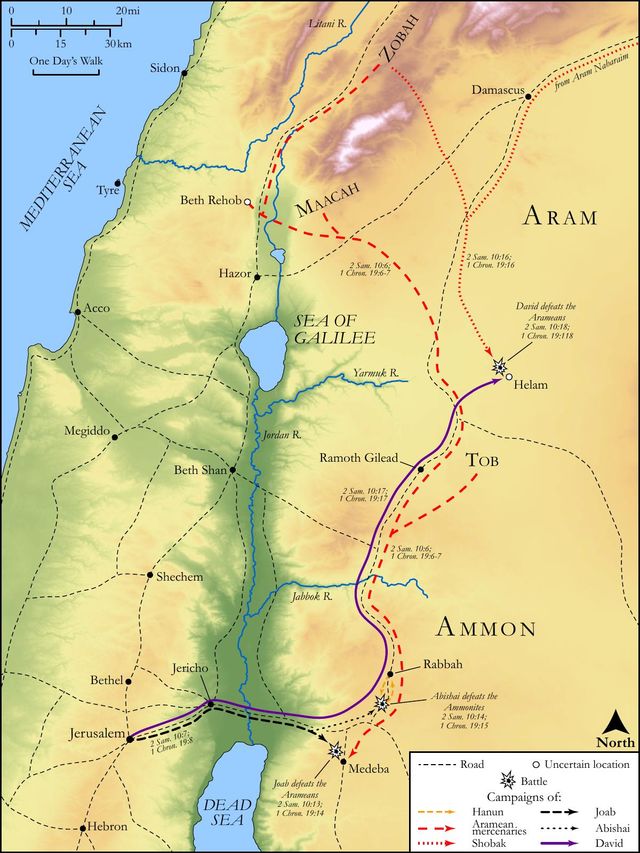
ShowHideThese were powerful Aramean kingdoms located to the north and northeast of Israel, renowned for their military strength. Mesopotamia here refers specifically to Aram-naharaim, meaning "Aram of the two rivers" (between the Tigris and Euphrates), a region known for its formidable military capabilities. Syriamaachah (Aram-Maacah) was an Aramean kingdom likely situated near Mount Hermon, north of the Sea of Galilee, a smaller but militarily capable state. Zobah (Aram-Zobah) was a particularly formidable Aramean kingdom, often a dominant power in the region and frequently in conflict with Israel, known for its extensive chariotry. These kingdoms were highly sought-after mercenary forces due to their well-trained armies, especially their effective use of chariots and horsemen, which were crucial assets in ancient warfare.
Christ-Centered Fulfillment
ShowHideThe narrative of Hanun's foolish rejection of David's kindness and his subsequent desperate reliance on worldly power finds profound Christ-centered fulfillment. Just as Hanun, swayed by suspicious counsel, rejected the benevolent overtures of David, humanity, influenced by sin and the deceit of the enemy, has consistently rejected the gracious advances of God. The Lord Jesus Christ, the ultimate Son of David, came not to condemn but to save, extending an invitation of peace and reconciliation to a world that had made itself "odious" through sin (John 3:17). Yet, humanity, like Hanun, often responds with hostility, suspicion, and a preference for self-reliance over divine grace, as many "did not receive him" when He came to His own (John 1:11). The "thousand talents of silver" spent by the Ammonites to avert David's wrath pales in comparison to the infinite, immeasurable cost of redemption paid by God Himself through the sacrifice of His Son. While Hanun sought to purchase salvation through mercenaries, Christ freely offers salvation through His own blood, a price no human could ever pay, demonstrating His love for us "while we were still sinners" (Romans 5:8). Unlike the Ammonites who trusted in chariots and horsemen, those who trust in Christ find their ultimate security and victory not in worldly might, but in His finished work on the cross, where He triumphed over all the powers of darkness, disarming them and making a public spectacle of them (Colossians 2:15). He is the true King who extends grace, and against Him, no earthly alliance can stand. His kingdom is not built on hired armies but on the transforming power of His Spirit, offering true peace to all who humble themselves and receive His unmerited favor by grace through faith (Ephesians 2:8-9).