


2 Chronicles 16:3
Bible text: King James Version (1769 Blayney text) · Public domain
Bible text: King James Version with Strong's numbers · Public domain
Bible text: Berean Standard Bible · Public domain
Bible text: American Standard Version (1901) · Public domain
Bible text: World English Bible, Messianic edition · Public domain
Bible text: Geneva Bible (1599) · Public domain
Bible text: Young's Literal Translation · Public domain
- בְּרִיתbe·Rita covenantH1285N-fsNoun Singular Feminine Absolute
- בֵּינִיbei·Ni[be] between meH996Adj-msc ¦ 1csAdjective Numerical Singular Masculine Constructבֵּינִ[be] betweenיme
- וּבֵינֶךָu·vei·Ne·khaand between youH996Conj-w ¦ Adj-msc ¦ 2msAdjective Numerical Singular Masculine Constructוּandבֵינֶbetweenךָyou
- וּבֵיןu·Veinand betweenH996Conj-w ¦ Adj-mscAdjective Numerical Singular Masculine Constructוּandבֵיןbetween
- אָבִי'a·Vimy fatherH1N-msc ¦ 1csNoun Singular Masculine Constructאָבִfatherיmy
- וּבֵיןu·Veinand betweenH996Conj-w ¦ Adj-mscAdjective Numerical Singular Masculine Constructוּandבֵיןbetween
- אָבִיךָ'a·Vi·khayour fatherH1N-msc ¦ 2msNoun Singular Masculine Constructאָבִיfatherךָyour
- הִנֵּהhi·Nehhere!H2009PrtParticle Interjection
- שָׁלַחְתִּיsha·Lach·tiI have sentH7971V-Qal-Perf-1csVerb Qal Perfect 1st Singular common gender
- לְךָle·Khato youPrep-l ¦ 2msSuffix Personal 2nd Singular Masculineלְtoךָyou
- כֶּסֶףKe·sefsilverH3701N-msNoun Singular Masculine Absolute
- וְזָהָבve·za·Havand goldH2091Conj-w ¦ N-msNoun Singular Masculine Absoluteוְandזָהָבgold
- לֵךְlekhgoH1980V-Qal-Imp-2msVerb Qal Imperative 2nd Singular Masculine
- הָפֵרha·FerbreakH6565V-Hiphil-Imp-2msVerb Hiphil Imperative 2nd Singular Masculine
- בְּרִיתְךָbe·ri·te·Khayour covenantH1285N-fsc ¦ 2msNoun Singular Feminine Constructבְּרִיתְcovenantךָyour
- אֶת'etwithH854PrepPreposition
- בַּעְשָׁאba'·Sha'BaashaH1201N-proper-mNoun Proper Masculine
- מֶלֶךְMe·lekh[the] king ofH4428N-mscNoun Singular Masculine Construct
- יִשְׂרָאֵלYis·ra·'ElIsraelH3478N-properNoun Proper Location
- וְיַעֲלֶהve·ya·'a·Lehso he may go upH5927Conj-w ¦ V-Qal-ConjImperf-3msVerb Qal Conjunction+Imperfect 3rd Singular Masculineוְsoיַעֲלֶהhe may go up
- מֵעָלָיme·'a·Laifrom on <the> meH5921Prep-m ¦ Prep ¦ 1csPreposition Definiteמֵfromעָלָon <the>יme
English is a literal word-by-word gloss of the Hebrew, not the KJV's wording. Why?
This is the original text the KJV's translators worked from — each Hebrew word with its own literal English meaning in this verse, prepared by scholars at Tyndale House, Cambridge. The KJV translates whole sentences, not word by word, so its wording differs: one Hebrew word can become several English words, and the KJV may choose “the LORD” where the gloss reads “Yahweh”. Both are faithful — they answer different questions. For the KJV's own rendering, switch to the KJV text.
Details
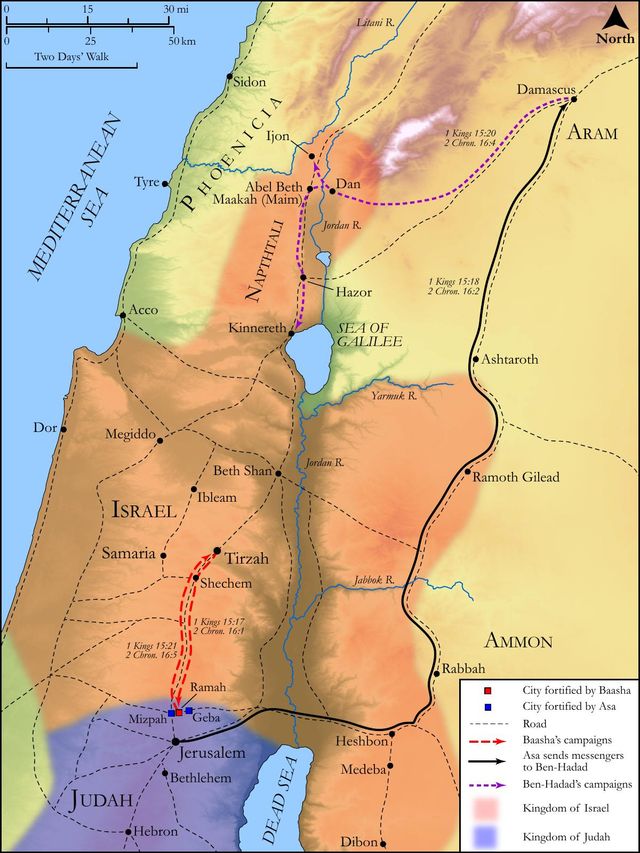
See on the biblical-era map
Study this verse
Public-domain commentary
Matthew Henry
From his Commentary on the Whole Bible. Henry comments on passages, not single verses — this entry covers 2 Chronicles 16:1–6.
How to reconcile the date of this event with the history of the kings I am quite at a loss. Baasha died in the twenty-sixth year of Asa, Kg1 16:8. How then could this be done in his thirty-sixth year, when Baasha's family was quite cut off, and Omri was upon the throne? It is generally said to be meant of the thirty-sixth year of the kingdom of Asa, namely, that of Judah, beginning from the first of Rehoboam, and so it coincides with the sixteenth of Asa's reign; but then Ch2 15:19 must be so understood; and how could it be spoken of as a great thing that there was no more war till the fifteenth year of Asa, when that passage immediately before was in his fifteenth year? (Ch2 15:10), and after this miscarriage of his, here recorded, he had wars, Ch2 16:9. Josephus places it in his twenty-sixth year, and then we must suppose a mistake in the transcriber here and Ch2 15:19, the admission of which renders the computation easy. This passage we had before (Kg1 15:17, etc.) and Asa was in several ways faulty in it. 1. He did not do well to make a league with Benhadad, a heathen king, and to value himself so much upon it as he seems to have done, Ch2 16:3. Had he relied more upon his covenant, and his father's, with God, he would not have boasted so much of his league, and his father's, with the royal family of Syria. 2. If he had had a due regard to the honour of Israel in general, he would have found some other expedient to give Baasha a diversion than by calling in a foreign force, and inviting into the country a common enemy, who, in process of time, might be a plague to Judah too. 3. It was doubtless a sin in Benhadad to break his league with Baasha upon no provocation, but merely through the influence of a bribe; and, if so, certainly it was a sin in Asa to move him to it, especially to hire him to do it. The public faith of kings and kingdoms must not be made so cheap a thing. 4. To take silver and gold out of the house of the Lord for this purpose was a great aggravation of the sin, Ch2 16:2. Must the temple be plundered to serve his carnal politics? He had better have brought gifts and offerings with prayers and supplications, to the house of the Lord, that he might have engaged God on his side and made him his friend; then he would not have needed to be at this expense to make Benhadad his friend. 5. It was well if Asa had not to answer for all the mischief that the army of Benhadad did unjustly to the cities of Israel, all the blood they shed and all the spoil they made, Ch2 16:4. Perhaps Asa intended not that they should carry the matter so far. But those that draw others to sin know not what they do, nor where it will end. The beginning of sin is as the letting forth of water. However the project succeeded. Benhadad gave Baasha a powerful diversion, obliged him to leave off building Ramah and betake himself to the defence of his own country northward, which gave Asa an opportunity, not only to demolish his fortifications, but to seize the materials and convert them to his own use.
Continue studying 2 Chronicles 16:3 across the web’s major study libraries — every link below opens this exact verse, chapter, or book on the destination site.
Read & Compare
 BibleGatewayThis verse in more than 200 translations and 70 languages.
 Bible.comThe YouVersion reader — hundreds of translations, reading plans, and highlights.
 ESV.orgCrossway's official English Standard Version reader.
 NET BibleThe NET translation with 60,000+ translators' notes on every rendering decision.
 STEP BibleTyndale House's free study tool — original text, vocabulary, and scholarly resources.
 BibliaLogos Bible Software's free web reader.
 USCCBThe New American Bible (Revised Edition) with the U.S. bishops' study notes.
Commentaries
 BibleHub CommentariesDozens of classic commentaries on this verse, gathered on one page.
 StudyLightMore than 100 commentary sets — the largest collection on the web.
 BibleRefPlain-English commentary on what this verse means, verse by verse.
 Enduring WordDavid Guzik's free commentary on this chapter, widely used by Bible teachers.
 Bible Study ToolsVerse commentary alongside Greek and Hebrew study aids.
Original Language & Research
- BibleHub InterlinearThe verse word by word — original language, transliteration, and English.
- BibleHub LexiconEvery word's original-language definition and Strong's entry.
 Blue Letter BibleDeep-study tools — Strong's numbers, concordance, and word studies.
 SefariaThe Hebrew text with Rashi and centuries of Jewish commentary.
Sermons, Hymns & Audio


TrulyRandomVerse is not affiliated with these sites and doesn’t control their content. They’re linked because they’re genuinely useful.
Summary
King Asa of Judah, facing a military threat from Baasha of Israel, strategically abandoned his prior reliance on God. Instead, he appealed to Ben-hadad I, king of Syria (Aram), invoking a long-standing "league" between their families and offering a substantial bribe of silver and gold. His objective was to persuade Ben-hadad to break his alliance with Baasha and attack Israel, thereby forcing Baasha to withdraw from Judah's borders. While achieving immediate military success, this maneuver marked a significant spiritual decline for Asa, demonstrating a shift from divine trust to human manipulation and worldly alliances.
Context
ShowHideLiterary Context
This verse is a pivotal moment in the narrative of King Asa's reign, marking a distinct turning point from his earlier exemplary faith and obedience. Previously, 2 Chronicles 14 vividly describes Asa's zealous reforms against idolatry and his unwavering reliance on the Lord, culminating in a miraculous victory over the vast Ethiopian army led by Zerah. In that crisis, Asa famously cried out to God, declaring, "Lord, it is nothing with thee to help, whether with many, or with them that have no power" (2 Chronicles 14:11). The immediate context of 2 Chronicles 16 reveals Baasha of Israel fortifying Ramah, a strategically vital border town that threatened Judah. Asa's decision to seek a foreign alliance rather than divine intervention sets the stage for the prophet Hanani's severe rebuke in 2 Chronicles 16:7-10 and foreshadows the subsequent decline in Asa's reign, including his reliance on physicians instead of God during his illness (2 Chronicles 16:12).
Historical & Cultural Context
Following the division of Solomon's kingdom, Judah (the southern kingdom) and Israel (the northern kingdom) were frequently embroiled in conflict. King Baasha of Israel's fortification of Ramah was a significant military threat, as it controlled a vital route into Judah, effectively blockading Jerusalem. Treaties and alliances between nations were common in that day, as between Solomon and Hiram of Tyre, often cemented with gifts, tributes, or even marriages. These "leagues" (Hebrew: bᵉrît) were solemn agreements, sometimes involving oaths to deities. Asa's appeal to a pre-existing "league" between their fathers (likely referring to the alliance between Abijah of Judah and Tabrimmon of Aram, and perhaps earlier agreements involving Rehoboam and Hezion) was a culturally understood diplomatic maneuver. However, for a king of Judah, whose covenant with Yahweh was paramount, seeking such an alliance with a pagan nation, especially when facing a threat that God had previously delivered them from, represented a profound spiritual misstep and a failure to live up to the covenantal expectations placed upon Israel's kings.
Key Themes
ShowHideThis verse powerfully illustrates the theme of reliance on human alliances versus divine trust. Asa, who had previously demonstrated profound faith in God's ability to deliver, now turns to a worldly solution, highlighting the spiritual danger of seeking human strength or geopolitical maneuvering over divine intervention. This action also underscores the theme of spiritual decline and its consequences, even in the life of a previously faithful leader. While Asa's immediate military problem is resolved, his lack of trust in God leads to a period of continuous warfare for Judah, as prophesied by Hanani (2 Chronicles 16:9), and ultimately to personal suffering and a lack of peace for Asa himself (2 Chronicles 16:12). The narrative also touches on the nature of ancient treaties as a means of political maneuvering, contrasting them with the steadfastness of God's covenant. It serves as a cautionary tale against leaning on one's own understanding rather than trusting fully in the Lord (Proverbs 3:5-6).
Exposition and Analysis
ShowHideKey Word Analysis
ShowHideThese terms represent the material wealth and resources that Asa offers as a bribe or tribute to Ben-hadad. More than mere currency, they symbolize the worldly means and human power that Asa now places his trust in, contrasting sharply with the spiritual resources (prayer, faith, divine intervention) he had previously relied upon. The offering of "silver and gold" highlights Asa's attempt to purchase security and manipulate geopolitical outcomes through earthly means, rather than seeking God's provision.
Verse Breakdown
ShowHide"[There is] a league between me and thee, as [there was] between my father and thy father"
Asa initiates his appeal to Ben-hadad by invoking the historical precedent of an existing treaty or alliance between the ruling houses of Judah and Aram. This statement serves to establish a basis for his request, suggesting continuity, mutual obligation, and a shared history of diplomatic relations, thereby attempting to obligate Ben-hadad to his cause through a sense of inherited alliance.
"behold, I have sent thee silver and gold"
This clause reveals the practical means by which Asa seeks to secure Ben-hadad's cooperation. The "silver and gold" function as a substantial bribe or tribute, designed to incentivize Ben-hadad to act in Judah's favor. This act underscores Asa's reliance on material wealth and human persuasion, a stark departure from his earlier faith-filled reliance on God's power alone. It signifies a transaction where divine trust is exchanged for earthly currency.
"go, break thy league with Baasha king of Israel, that he may depart from me"
Asa's ultimate objective is clearly stated: to disrupt the alliance between Aram and Israel, thereby forcing Baasha to withdraw from his fortification efforts at Ramah and relieve the pressure on Judah. This demonstrates Asa's strategic cunning but also his spiritual shortsightedness, as he seeks to resolve a divine problem (Baasha's aggression as a potential judgment or test) through purely human, manipulative means, rather than seeking God's direct intervention.
Literary Devices
ShowHideThe passage employs several significant literary devices that underscore its theological message. Irony is profoundly evident, as King Asa, who previously demonstrated profound faith and received miraculous deliverance from God against a vastly superior army, now resorts to worldly tactics and human alliances. This reversal of character creates a poignant irony, highlighting the fragility of even strong faith when faced with new pressures. There is also a clear Contrast between Asa's earlier, God-centered actions (e.g., his prayer in 2 Chronicles 14:11) and his current reliance on a pagan king and material wealth. This contrast vividly underscores the spiritual decline. Furthermore, the narrative uses Foreshadowing, as Asa's decision to trust in human power rather than God sets the stage for the prophet Hanani's rebuke and the subsequent troubles and illness that mark the latter part of Asa's reign, indicating that spiritual compromise has long-term, detrimental consequences.
Theological and Thematic Connections
ShowHideKing Asa's decision in 2 Chronicles 16:3 serves as a profound theological object lesson on the dangers of trusting in human strength and worldly resources over the sovereign power and faithfulness of God. While seemingly a pragmatic political move, it represented a fundamental betrayal of the covenant relationship between God and His king. Asa's earlier reign was marked by a vibrant faith that saw God deliver Judah from overwhelming odds; here, he operates as if God is either unwilling or unable to help, or as if human ingenuity is superior. This shift highlights the subtle but insidious nature of idolatry, where trust is subtly transferred from the Creator to the created, whether it be military might, political alliances, or material wealth. The passage reminds us that God desires our complete reliance, and that seeking worldly solutions for spiritual problems often leads to further complications and a diminished experience of God's peace and provision.
Reflection and Application
ShowHideKing Asa's story in 2 Chronicles 16:3 offers a sobering mirror for believers today. It reveals how easily even those with a history of profound faith can slip into relying on human strategies, connections, or resources when faced with daunting challenges, rather than seeking God's guidance and trusting in His supernatural provision. The temptation to "send silver and gold" – to leverage our wealth, influence, or cleverness – instead of falling on our knees in prayer, is ever-present. This passage calls us to examine our default responses to pressure: do we immediately turn to our own intellect, our network, or our bank account, or do we first and foremost seek the Lord's wisdom and intervention? True security and lasting victory are found not in the strength of human alliances or the depth of our pockets, but in the unwavering faithfulness of God. Asa's experience reminds us that a momentary lapse in trust can have far-reaching consequences, impacting our peace, our relationships, and our ability to experience God's full blessing, leading to a life of "wars" rather than divine peace.
Questions for Reflection
ShowHideFAQ
ShowHideWhy was Asa's action considered a spiritual failure if it achieved the desired military outcome?
ShowHideWhile Asa's alliance with Ben-hadad did achieve the immediate military objective of drawing Baasha away from Ramah, it was considered a spiritual failure because it demonstrated a profound lack of trust in God. Asa had previously experienced God's miraculous deliverance when he faced the massive Ethiopian army, crying out to the Lord and witnessing a divine victory (2 Chronicles 14:11-12). In this instance, instead of seeking the Lord, he turned to a pagan king and relied on worldly wealth and political maneuvering. The prophet Hanani later rebuked Asa for this very reason, stating, "Because thou hast relied on the king of Syria, and not relied on the LORD thy God, therefore is the host of the king of Syria escaped out of thine hand" (2 Chronicles 16:7). Immediate success does not equate to divine approval, and Asa's spiritual compromise led to a period of continuous warfare and his own personal suffering, as detailed later in 2 Chronicles 16.
Christ-Centered Fulfillment
ShowHideKing Asa's misguided reliance on a pagan king and material wealth in 2 Chronicles 16:3 stands in stark contrast to the perfect and ultimate reliance on God found in Jesus Christ. Asa sought a human deliverer through a fragile, self-serving "league" and a bribe of "silver and gold," which could only offer temporary and compromised security. In Christ, however, we find the true and eternal covenant, not established by human agreements or earthly treasures, but by the precious blood of the Lamb of God, who takes away the sin of the world. While Asa's actions demonstrated a failure of faith, Jesus perfectly embodied absolute trust in the Father, even unto death on the cross (Philippians 2:8). He is the mediator of a better covenant, one founded on grace and divine promises, not on human bargaining or fleeting alliances. Our security and victory are not found in worldly resources or strategic maneuvers, but in the finished work of Christ, who has overcome the world (John 16:33) and in whom we are made complete. Unlike Asa's reliance on a king who would ultimately fail him, our trust in Christ provides an unshakable foundation and an eternal peace that transcends all earthly circumstances, securing for us the ultimate and everlasting deliverance.