


1 Chronicles 19:7
- וַיִּשְׂכְּרוּvai·yis·ke·Ruand they hiredH7936Conj-w ¦ V-Qal-ConsecImperf-3mpVerb Qal Consecutive Imperfect 3rd Plural Masculineוַandיִּשְׂכְּרוּthey hired
- לָהֶםla·Hemfor themselvesPrep-l ¦ 3mpSuffix Personal 3rd Plural Masculineלָforהֶםthemselves
- שְׁנַיִםshe·na·YimtwoH8147N-cdNoun Dual common gender Absolute
- וּשְׁלֹשִׁיםu·she·lo·Shimand thirtyH7970Conj-w ¦ N-mpNoun Plural Masculine Absoluteוּandשְׁלֹשִׁיםthirty
- אֶלֶף'E·lefthousandH505N-csNoun Singular common gender Absolute
- רֶכֶבRe·khevchariot[s]H7393N-msNoun Singular Masculine Absolute
- וְאֶתve·'Etand <obj.>H853Conj-w ¦ DirObjMParticle Object Indicatorוְandאֶת<obj.>
- מֶלֶךְMe·lekh[the] king ofH4428N-mscNoun Singular Masculine Construct
- מַעֲכָהma·'a·KhahMaacahH4601N-properNoun Proper Location
- וְאֶתve·'Etand <obj.>H853Conj-w ¦ DirObjMParticle Object Indicatorוְandאֶת<obj.>
- עַמּוֹa·Mohis peopleH5971N-msc ¦ 3msNoun Singular Masculine Constructעַמּpeopleוֹhis
- וַיָּבֹאוּvai·ya·Vo·'uand they cameH935Conj-w ¦ V-Qal-ConsecImperf-3mpVerb Qal Consecutive Imperfect 3rd Plural Masculineוַandיָּבֹאוּthey came
- וַיַּחֲנוּvai·ya·cha·Nuand they encampedH2583Conj-w ¦ V-Qal-ConsecImperf-3mpVerb Qal Consecutive Imperfect 3rd Plural Masculineוַandיַּחֲנוּthey encamped
- לִפְנֵיlif·Nei<to> beforeH6440Prep-l ¦ N-mpcNoun Plural Masculine Constructלִ<to>פְנֵיbefore
- מֵידְבָאmeid·Va'MedebaH4311N-properNoun Proper Location
- וּבְנֵיu·ve·Neiand [the] people ofH1121Conj-w ¦ N-mpcNoun Plural Masculine Constructוּandבְנֵי[the] people of
- עַמּוֹןa·MonAmmonH5983N-proper-mNoun Proper Masculine
- נֶאֶסְפוּne·'es·Futhey gatheredH622V-Niphal-Perf-3cpVerb Niphal Perfect 3rd Plural common gender
- מֵעָרֵיהֶםme·'A·rei·Hemfrom their citiesH5892Prep-m ¦ N-mpc ¦ 3mpNoun Plural Masculine Constructמֵfromעָרֵיcitiesהֶםtheir
- וַיָּבֹאוּvai·ya·Vo·'uand they cameH935Conj-w ¦ V-Qal-ConsecImperf-3mpVerb Qal Consecutive Imperfect 3rd Plural Masculineוַandיָּבֹאוּthey came
- לַמִּלְחָמָהla·mil·cha·Mahfor <the> battleH4421Prep-l ¦ N-fsNoun Singular Feminine Absoluteלַfor <the>מִּלְחָמָהbattle
English is a literal word-by-word gloss of the Hebrew, not the KJV's wording. Why?
This is the original text the KJV's translators worked from — each Hebrew word with its own literal English meaning in this verse, prepared by scholars at Tyndale House, Cambridge. The KJV translates whole sentences, not word by word, so its wording differs: one Hebrew word can become several English words, and the KJV may choose “the LORD” where the gloss reads “Yahweh”. Both are faithful — they answer different questions. For the KJV's own rendering, switch to the KJV text.
Details
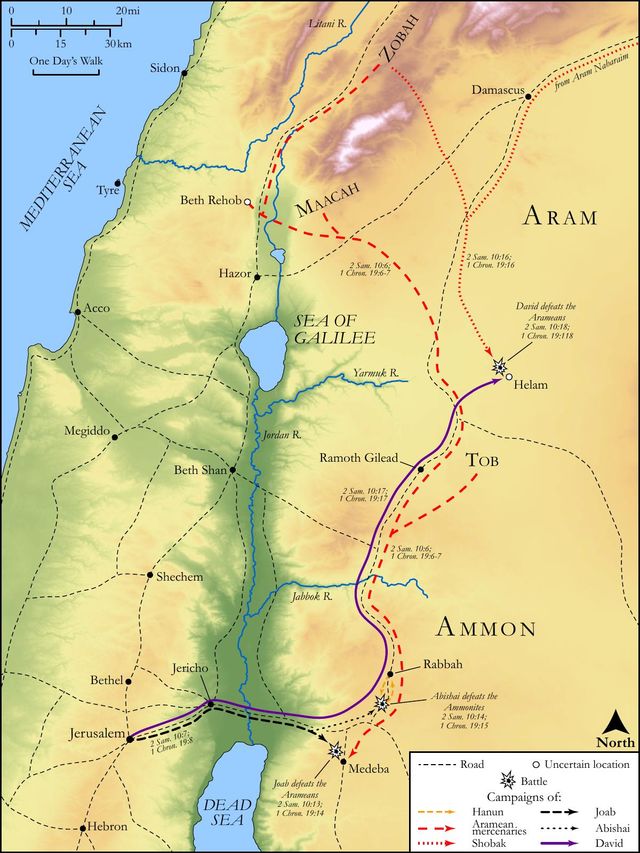
See on the biblical-era map
Study this verse
Public-domain commentary
Matthew Henry
From his Commentary on the Whole Bible. Henry comments on passages, not single verses — this entry covers 1 Chronicles 19:6–19.
We may see here, 1. How the hearts of sinners that are marked for ruin are hardened to their destruction. The children of Ammon saw that they had made themselves odious to David (Ch1 19:6), and then it would have been their wisdom to desire conditions of peace, to humble themselves and offer any satisfaction for the injury they had done him, the rather because they had made themselves not only odious to David, but obnoxious to the justice of God, who is King of nations, and will assert the injured rights and maintain the violated laws of nations. But, instead of this, they prepared for war, and so brought upon themselves, by David's hand, those desolations which he never intended them. 2. How the courage of brave men is heightened and invigorated by difficulties. When Joab saw that the battle was set against him before and behind (Ch1 19:10), instead of meditating a retreat, he doubled his resolution; and, though he could not double, he divided his army, and not only spoke, but acted, like a gallant man, that had great presence of mind when he saw himself surrounded. He engaged with his brother for mutual assistance (Ch1 19:12), excited himself and the rest of the officers to act vigorously in their respective posts, with an eye to God's glory and their country's good, not to any honour and advantage of their own, and then left the issue to God: Let the Lord do that which is right in his sight. 3. How vain the greatest art and strength are against justice and equity. The Ammonites did their utmost to make the best of their position: they brought as good a force into the field, and disposed it with as much policy as possible; yet, having a bad cause, and acting in defence of wrong, it would not do; they were put to the worst. Right will prevail and triumph at last. 4. To how little purpose it is for those to rally again, and reinforce themselves, that have not God on their side. The Syrians, though in no way concerned in the merits of the cause, but serving only as mercenaries to the Ammonites, when they were beaten, thought themselves concerned to retrieve their honour, and therefore called in the assistance of the Syrians on the other side Euphrates; but to no purpose, for still they fled before Israel (Ch1 19:18); they lost 7000 men, who are said to be the men of 700 chariots, Sa2 10:18. For, as now in a man of war for sea-service they allot ten men to a gun, so then, in land-service, ten men to a chariot. 5. those who have meddled with strife that belongs not to them, and have found that they meddled to their own heart, do well to learn wit at length and meddle no further. The Syrians, finding that Israel was the conquering side, not only broke off their alliance with the Ammonites and would help them no more (Ch1 19:19), but made peace with David and became his servants. Let those who have in vain stood it out against God be thus wise for themselves, and agree with him quickly, while they are in the way. Let them become his servants; for they cannot but see themselves undone if they be his enemies.
Continue studying 1 Chronicles 19:7 across the web’s major study libraries — every link below opens this exact verse, chapter, or book on the destination site.
Read & Compare
 BibleGatewayThis verse in more than 200 translations and 70 languages.
 Bible.comThe YouVersion reader — hundreds of translations, reading plans, and highlights.
 ESV.orgCrossway's official English Standard Version reader.
 NET BibleThe NET translation with 60,000+ translators' notes on every rendering decision.
 STEP BibleTyndale House's free study tool — original text, vocabulary, and scholarly resources.
 BibliaLogos Bible Software's free web reader.
 USCCBThe New American Bible (Revised Edition) with the U.S. bishops' study notes.
Commentaries
 BibleHub CommentariesDozens of classic commentaries on this verse, gathered on one page.
 StudyLightMore than 100 commentary sets — the largest collection on the web.
 BibleRefPlain-English commentary on what this verse means, verse by verse.
 Enduring WordDavid Guzik's free commentary on this chapter, widely used by Bible teachers.
 Bible Study ToolsVerse commentary alongside Greek and Hebrew study aids.
Original Language & Research
- BibleHub InterlinearThe verse word by word — original language, transliteration, and English.
- BibleHub LexiconEvery word's original-language definition and Strong's entry.
 Blue Letter BibleDeep-study tools — Strong's numbers, concordance, and word studies.
 SefariaThe Hebrew text with Rashi and centuries of Jewish commentary.
Sermons, Hymns & Audio


TrulyRandomVerse is not affiliated with these sites and doesn’t control their content. They’re linked because they’re genuinely useful.
Summary
1 Chronicles 19:7 meticulously details the extensive military preparations undertaken by the Ammonites and their Aramean allies in anticipation of war with King David. Following a profound diplomatic insult to David's envoys, the Ammonites, acutely aware of their military inferiority against Israel's formidable army, spared no expense. They hired a massive mercenary contingent, notably "thirty and two thousand chariots," along with the full forces of various Aramean kingdoms, including Maachah. This verse precisely outlines the immense scale of the impending conflict, highlighting the strategic assembly of these combined forces at Medeba, thereby setting the stage for one of the most significant and costly military confrontations during David's reign.
Context
ShowHideLiterary Context
This verse is a critical turning point in the unfolding conflict detailed in 1 Chronicles 19. The narrative commences with King David's benevolent act of sending envoys to console Hanun, the new Ammonite king, upon the death of his father, Nahash, a gesture of goodwill often extended in ancient Near Eastern diplomacy (1 Chronicles 19:1-2). However, Hanun, swayed by his suspicious and ill-advised advisors, grievously misinterpreted David's intentions, subjecting the messengers to an unthinkable humiliation: shaving half their beards and cutting their garments (1 Chronicles 19:3-4). This act was not merely disrespectful but a profound public shaming, an unpardonable insult that unequivocally constituted a declaration of war. Verses 1 Chronicles 19:6-7 then pivot to describe the Ammonites' immediate and extensive military response to David's inevitable retaliation, emphasizing their desperate effort to match Israel's strength through foreign alliances. This specific verse, 1 Chronicles 19:7, focuses on the sheer magnitude of the hired forces and their strategic assembly point, directly preceding the detailed accounts of the subsequent battles in 1 Chronicles 19:8-19.
Historical & Cultural Context
The events of 1 Chronicles 19 are situated within the zenith of King David's reign, a period characterized by the robust consolidation of Israelite power and frequent engagements with surrounding kingdoms. The Ammonites, descendants of Lot, were a persistent rival of Israel, often contending for control over territories east of the Jordan River. In the intricate world of ancient Near Eastern diplomacy, the inviolability of envoys was sacrosanct; any harm or humiliation inflicted upon them was considered a direct affront to the sovereign they represented, tantamount to an act of war. The shaving of beards and cutting of garments were particularly egregious forms of public shaming, designed to strip the men of their honor and dignity. Recognizing the formidable military prowess of David's unified kingdom and his seasoned army, the Ammonites, rather than confronting Israel alone, resorted to a prevalent practice of the era: hiring mercenaries. Powerful Aramean (Syrian) kingdoms, notably Aram-Zobah, Aram-Rehob, and Maachah, were renowned for their formidable chariot forces and were frequently available for hire or formed alliances based on strategic interests. Medeba, located east of the Jordan River in Moabite territory (often contested by Ammon), served as a crucial strategic gathering point due to its defensible position and access routes, making it an ideal staging ground for a large combined army.
Key Themes
ShowHideThis verse contributes significantly to several overarching themes within 1 Chronicles, particularly concerning the nature of power, conflict, and divine sovereignty:
Consequences of Pride and Disrespect
The entire conflict is ignited by Hanun's arrogant and ill-advised decision to insult David's messengers (1 Chronicles 19:3-4). This verse vividly illustrates the immediate, massive, and costly military mobilization provoked by that singular act of pride and misjudgment. It profoundly underscores how human folly and a lack of wisdom can escalate into widespread suffering and devastating conflict, demonstrating the far-reaching repercussions of dishonorable conduct.
Reliance on Human Strength vs. Divine Sovereignty
The Ammonites' desperate and extensive hiring of a vast mercenary force, including "thirty and two thousand chariots," starkly highlights their reliance on overwhelming human military might to counter David. This stands in sharp contrast to the chronicler's broader theological emphasis on God's active involvement in Israel's battles and His granting of victory, often despite numerical disadvantages, as seen later in the chapter when David's forces ultimately prevail (1 Chronicles 19:13-19). The chronicler subtly sets up this contrast, demonstrating that even the most formidable human alliances and impressive armaments are ultimately insufficient against God's chosen king and His divine purpose.
The Scale of David's Kingdom and Influence
The sheer fact that the Ammonites felt compelled to gather such an enormous and diverse coalition of forces speaks volumes about the perceived strength and military prowess of David's kingdom. It implicitly acknowledges David's growing regional dominance, the stability of his reign, and the fear or respect he inspired in neighboring nations, underscoring the significant power Israel had attained under his leadership.
Exposition and Analysis
ShowHideKey Word Analysis
ShowHideThe verb "hired" (שׂכר, H7936, śāḵar') signifies the act of employing someone for wages or compensation, indicating a contractual agreement for service. In this context, it emphasizes that the Ammonites did not merely form alliances based on mutual interest but explicitly paid for the military services of these foreign armies and their elite chariot units. This points to a significant expenditure of national resources, underscoring the Ammonites' desperation and the perceived existential threat posed by David's retaliation. It also highlights the prevalent mercenary nature of warfare in the ancient Near East, where military strength could be directly acquired.
The term "chariots" (רֶכֶב, H7393, reḵeḇ') refers to the two-wheeled, horse-drawn vehicles used primarily for warfare, particularly by the Aramean (Syrian) kingdoms. Chariots were the premier fighting units of the ancient world, analogous to modern tanks, providing unparalleled speed, shock value, and a mobile platform for archers or spearmen. The figure "thirty and two thousand chariots" (32,000) represents an extraordinarily large and perhaps hyperbolic number, likely intended to convey the vastness and formidable nature of the enemy force, possibly including the accompanying infantry and support personnel, rather than a literal count of individual chariots. This emphasizes the overwhelming numerical and technological superiority the Ammonites sought to achieve.
Medeba (מֵידְבָא, H4311, Mêydᵉbâʾ') was an ancient city situated strategically east of the Jordan River, in what is modern-day Jordan. It was important due to its location on a plateau offering good visibility and access to various trade and military routes. Its mention as the place where the allied forces "pitched" (encamped) signifies its crucial role as a primary staging ground and rallying point for the combined Ammonite and Aramean armies before they advanced to engage David's forces. This geographical detail provides concrete grounding for the narrative and highlights the meticulous strategic planning involved in the impending conflict.
Verse Breakdown
ShowHide"So they hired thirty and two thousand chariots"
This opening clause immediately reveals the Ammonites' primary response to David's military threat: a massive investment in foreign military aid. The "thirty and two thousand chariots" (32,000) represents an almost impossibly large and certainly formidable number of elite fighting vehicles, signifying the Ammonites' determination to counter David's army with overwhelming numerical superiority and advanced weaponry. It underscores their profound fear and desperation.
"and the king of Maachah and his people;"
This specifies one of the key Aramean allies secured by the Ammonites. Maachah was an Aramean kingdom located north of Israel, renowned for its military prowess. The inclusion of "his people" indicates that the king brought his entire army, not merely a contingent of chariots, demonstrating a comprehensive military alliance rather than just a mercenary transaction for equipment. This highlights the broad and formidable coalition formed against David.
"who came and pitched before Medeba."
This describes the strategic assembly point for the vast allied forces. Medeba, a city often contested but within Ammonite or allied territory, was chosen as the primary encampment. "Pitched before" indicates they established their military camp, preparing for battle. This detail emphasizes the organized nature of their mobilization and their clear intent to engage David's forces in a decisive confrontation.
"And the children of Ammon gathered themselves together from their cities, and came to battle."
This final clause clarifies that in addition to the hired mercenaries, the native Ammonite forces also fully mobilized from their own cities. They were not merely relying on their allies but were actively participating in their own defense and aggression. This completes the picture of a fully mobilized and determined enemy, poised for a major war.
Literary Devices
ShowHideThe verse effectively employs several literary devices to convey the gravity and immense scale of the impending conflict. Hyperbole is strikingly evident in the mention of "thirty and two thousand chariots," a number so vast that it serves to emphasize the overwhelming numerical superiority and formidable nature of the enemy forces rather than a precise literal count. This deliberate exaggeration heightens the sense of existential threat and the immense challenge faced by David. Imagery is powerfully used to paint a vivid mental picture of the massive military buildup, with diverse armies gathering and pitching camp before Medeba, allowing the reader to visualize the formidable array of forces. Furthermore, the verse functions as a powerful form of foreshadowing, building dramatic tension and signaling the imminence of a major, large-scale battle that will severely test David's military prowess and, more importantly, God's faithfulness to His chosen king. The detailed enumeration of allies and their strategic movements adds to the sense of an unfolding, epic confrontation.
Theological and Thematic Connections
ShowHideThis verse, detailing the immense human effort and resources marshaled against David, serves as a powerful theological foil. It highlights the human tendency to rely on overwhelming strength, vast alliances, and impressive armaments when faced with perceived threats, contrasting sharply with the biblical narrative's consistent emphasis on God's sovereign power and His ability to grant victory regardless of numerical superiority. The Ammonites' desperate and expensive recruitment of 32,000 chariots and multiple Aramean armies underscores their complete reliance on human might—a reliance that will ultimately prove futile against the Lord's anointed king. This sets the stage for the dramatic demonstration of divine faithfulness, where God's intervention, not the size of an army or the sophistication of weaponry, ultimately determines the outcome of battles. It profoundly reminds believers that true security and lasting victory come not from accumulated resources or powerful human alliances, but from trusting in God's provision, strength, and unwavering sovereignty.
Reflection and Application
ShowHideThe narrative of 1 Chronicles 19:7, while describing an ancient military buildup, offers profound and timeless lessons for contemporary life. It serves as a stark reminder that actions, especially those rooted in pride, disrespect, or misjudgment, can trigger disproportionately large and costly consequences. Hanun's foolish insult to David's envoys escalated into a full-blown war, draining national resources and costing countless lives. This serves as a powerful warning against impulsive decisions, urging us to seek wise counsel, exercise humility, and carefully consider the long-term repercussions of our words and deeds. Furthermore, the Ammonites' reliance on a vast mercenary force—the "thirty and two thousand chariots"—speaks to the pervasive human tendency to place our trust in visible, tangible strengths, be it wealth, power, connections, overwhelming numbers, or personal abilities. In our own lives, when faced with challenges or conflicts, are we quick to gather our "chariots" (our own resources, strategies, or human alliances), or do we first turn to the Lord, recognizing that true victory, peace, and security ultimately come from Him? This verse implicitly challenges us to evaluate where our ultimate trust lies, especially when the odds seem stacked against us, and to remember that God's power is not limited by the strength of our adversaries or the size of our own perceived weaknesses.
Questions for Reflection
ShowHideFAQ
ShowHideWhy did the Ammonites hire so many chariots and allies?
ShowHideThe Ammonites hired such a massive force, including "thirty and two thousand chariots" and armies from various Aramean kingdoms, primarily out of profound fear and desperation. They had committed a grave and unpardonable insult against King David by humiliating his messengers (1 Chronicles 19:3-4), which was an undeniable act of war in the ancient Near East. Recognizing the formidable military strength of David's unified kingdom and his seasoned army, the Ammonites understood they could not possibly face Israel alone. Therefore, they sought to overwhelm David's army through sheer numerical superiority and the elite fighting power of chariots, which were the ancient world's most advanced and devastating military technology. This extensive hiring of mercenaries was a common strategic practice in the ancient Near East for nations seeking to bolster their defenses or offensive capabilities against a superior foe.
Christ-Centered Fulfillment
ShowHideWhile 1 Chronicles 19:7 vividly describes an ancient military conflict driven by human pride and reliance on earthly power, it subtly points to the ultimate spiritual warfare and the nature of true victory found in Christ. The Ammonites' desperate gathering of "thirty and two thousand chariots" and their vast human alliances represent the world's reliance on visible, tangible might to achieve security and triumph. This stands in stark contrast to the kingdom of God, which operates not by human strength or impressive armaments, but by divine power and spiritual truth. In the New Testament, Jesus Christ is revealed as the true King, who did not come with chariots and horses but in profound humility, conquering sin and death not through military might but through sacrificial love on the cross (Philippians 2:6-8). Our spiritual battles are not against "flesh and blood, but against the rulers, against the authorities, against the cosmic powers over this present darkness, against the spiritual forces of evil in the heavenly places" (Ephesians 6:12). Just as David's ultimate victory was not predicated on the size of his enemy's chariots but on God's favor and strategic guidance, so too is the believer's triumph secured through Christ's finished work, enabling us to overcome the world not by our own power but by faith in Him (1 John 5:4-5). The seemingly overwhelming forces gathered against David foreshadow the seemingly insurmountable forces of sin, death, and spiritual evil that Christ decisively defeated, leading His people to ultimate, eternal victory and true peace.