


Numbers 21:30
Bible text: King James Version (1769 Blayney text) · Public domain
Bible text: Berean Standard Bible · Public domain
Bible text: American Standard Version (1901) · Public domain
Bible text: World English Bible, Messianic edition · Public domain
Bible text: Geneva Bible (1599) · Public domain
Bible text: Young's Literal Translation · Public domain
- וַנִּירָםva·ni·Ramand we shot at themH3384Conj-w ¦ V-Qal-ConsecImperf-1cp ¦ 3mpVerb Qal Consecutive Imperfect 1st Plural common genderוַandנִּירָwe shot atםthem
- אָבַד'a·Vadit has perishedH6V-Qal-Perf-3msVerb Qal Perfect 3rd Singular Masculine
- חֶשְׁבּוֹןchesh·BonHeshbonH2809N-properNoun Proper Location
- עַד'adtoH5704PrepPreposition
- דִּיבוֹןdi·VonDibonH1769N-properNoun Proper Location
- וַנַּשִּׁיםva·na·Shimand we have devastatedH8074Conj-w ¦ V-Hiphil-ConsecImperf-1cpVerb Hiphil Consecutive Imperfect 1st Plural common genderוַandנַּשִּׁיםwe have devastated
- עַד'adtoH5704PrepPreposition
- נֹפַחNo·fachNophahH5302N-properNoun Proper Location
- אֲשֶׁרׄ'a·SherwhichH834RelParticle Relative
- עַד'ad[is] toH5704PrepPreposition
- מֵידְבָאMei·de·Va'MedebaH4311N-properNoun Proper Location
English is a literal word-by-word gloss of the Hebrew, not the KJV's wording. Why?
This is the original text the KJV's translators worked from — each Hebrew word with its own literal English meaning in this verse, prepared by scholars at Tyndale House, Cambridge. The KJV translates whole sentences, not word by word, so its wording differs: one Hebrew word can become several English words, and the KJV may choose “the LORD” where the gloss reads “Yahweh”. Both are faithful — they answer different questions. For the KJV's own rendering, switch to the KJV text.
Details
See on the biblical-era maps
Study this verse
Public-domain commentary
Matthew Henry
From his Commentary on the Whole Bible. Henry comments on passages, not single verses — this entry covers Numbers 21:21–35. His four-level outline is real structure in the source text, so it is rendered as structure.
We have here an account of the victories obtained by Israel over Sihon and Og, which must be distinctly considered, not only because they are here distinctly related, but because long afterwards the memorial of them is distinctly celebrated, and they are severally assigned as instances of everlasting mercy. He slew Sihon king of the Amorites, for his mercy endureth for ever, and Og the king of Bashan, for his mercy endureth for ever, Psa 136:19, Psa 136:20.
I.Israel sent a peaceable message to Sihon king of the Amorites (Num 21:21), but received an unpeaceable return, worse than that of the Edomites to the like message, Num 20:18, Num 20:20. For the Edomites only refused them a passage, and stood upon their own defence to keep them out; but Sihon went out with his forces against Israel in the wilderness, out of his own borders, without any provocation given him (Num 21:23), and so ran himself upon his own ruin. Jephtha intimates that he was prompted by his politics to do this (Jdg 11:20), Sihon trusted not Israel to pass through his coast; but his politics deceived him, for Moses says, God hardened his spirit and made his heart obstinate, that he might deliver him into the hand of Israel, Deu 2:30. The enemies of God's church are often infatuated in those very counsels which they think most wisely taken. Sihon's army was routed, and not only so, but all his country came into the possession of Israel, Num 21:24, Num 21:25. This seizure is justified,
1.Against the Amorites themselves, for they were the aggressors, and provoked the Israelites to battle; and yet, perhaps, that would not have been sufficient to entitle Israel to their land, but that God himself, the King of nations, the Lord of the whole earth, had given them a grant of it. The Amorites formed one of the devoted nations whose land God had promised to Abraham and his seed, which promise should be performed when the iniquity of the Amorites should be full, Gen 15:16. Jephtha insists upon this grant as their title, Jdg 11:23, Jdg 11:24. The victory which God gave them over the Amorites put them in possession, and then, the promise made to their fathers having given them a right, by virtue of that they kept possession.
2.Against the Moabites, who had formerly been the lords-proprietors of this country. If they should ever lay claim to it, and should plead that God himself had provided that none of their land should be given to Israel for a possession (Deu 2:9), Moses here furnishes posterity with a replication to their plea, and Jephtha makes use of it against the Amorites 260 years afterwards, when Israel's title to this country was questioned.
(1.)The justification itself is that though it was true this country had belonged to the Moabites, yet the Amorites had taken it from them some time before, and were now in full and quiet possession of it, Num 21:26. The Israelites did not take it out of the hands of the Moabites, they had before lost it to the Amorites, and were constrained to give up their pretensions to it; and, when Israel had taken it from the Amorites, they were under no obligation to restore it to the Moabites, whose title to it was long since extinguished. See here the uncertainty of worldly possessions, how often they change their owners, and how soon we may be deprived of them, even when we think ourselves most sure of them; they make themselves wings. It is our wisdom therefore to secure the good part which cannot be taken away from us. See also the wisdom of the divine Providence and its perfect foresight, by which preparation is made long before for the accomplishment of all God's purposes in their season. This country being designed in due time for Israel, it is beforehand put into the hand of the Amorites, who little think that they have it but as trustees till Israel come of age, and then must surrender it. We understand not the vast reaches of Providence, but known unto God are all his works, as appears in this instance, that he set the bounds of the people according to the number of the children of Israel, Deu 32:8. All that land which he intended for his chosen people he put into the possession of the devoted nations, that were to be driven out.
(2.)For proof of the allegation, he refers to the authentic records of the country, for so their proverbs or songs were, one of which he quotes some passages out of (Num 21:27-30), which sufficiently proves what is vouched for, namely,
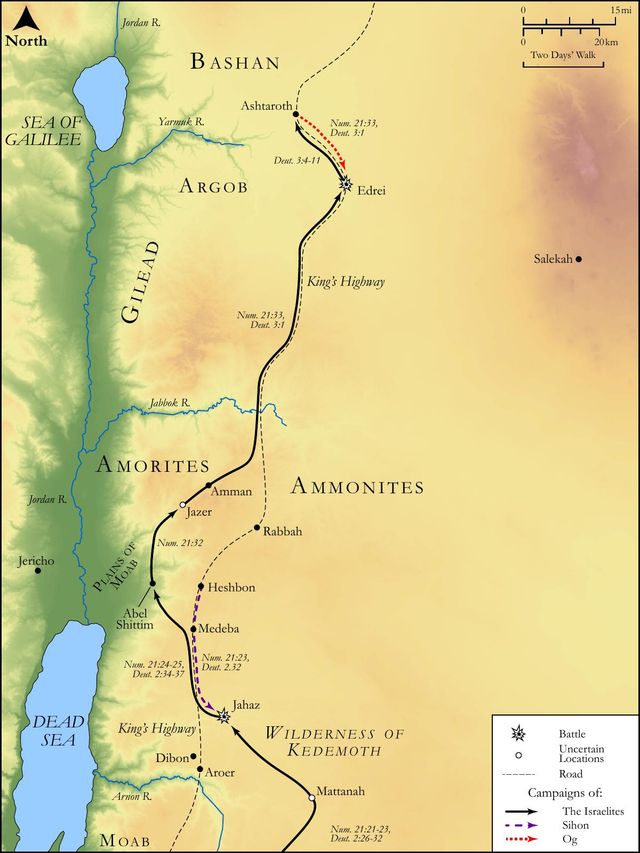
[1.]That such and such places that are here named, though they had been in the possession of the Moabites, had by right of war become the dominion of Sihon king of the Amorites. Heshbon had become his city, and he obtained such a quiet possession of it that it was built and prepared for him (Num 21:27), and the country to Dibon and Nophah was likewise subdued, and annexed to the kingdom of the Amorites, Num 21:30,
[2.]That the Moabites were utterly disabled ever to regain the possession. Even Ar of Moab, though not taken or attempted by Sihon, but still remaining the metropolis of Moab, yet was so wasted by this loss that is would never be able to make head, Num 21:28. The Moabites were undone, and even Chemosh their god had given them up, as unable to rescue them out of the hands of Sihon, Num 21:29. By all this it appears that the Moabites' claim to this country was barred for ever. There may be a further reason for inserting this Amorite poem, namely, to show that the triumphing of the wicked is short. Those that had conquered the Moabites, and insulted over them, were now themselves conquered and insulted over by the Israel of God. It is very probable that the same Sihon, king of the Amorites, that had got this country from the Moabites, now lost it to the Israelites; for, though it is said to be taken from a former king of Moab (Num 21:26), yet not by a former king of the Amorites; and then it shows how sometimes justice makes men to see the loss of that which they got by violence, and were puffed up with the gain of. They are exalted but for a little while, Job 24:24.
II.Og king of Bashan, instead of being warned by the fate of his neighbours to make peace with Israel, is instigated by it to make war with them, which proves in like manner to be his destruction. Og was also an Amorite, and therefore perhaps thought himself better able to deal with Israel than his neighbours were, and more likely to prevail, because of his own gigantic strength and stature, which Moses takes notice of, Deu 3:11, where he gives a more full account of this story. Here observe,
1.That the Amorite begins the war (Num 21:33): He went out to battle against Israel. His country was very rich and pleasant. Bashan was famous for the best timber (witness the oaks of Bashan), and the best breed of cattle, witness the bulls and kine of Bashan, and the lambs and rams of that country, which are celebrated, Deu 32:14. Wicked men do their utmost to secure themselves and their possessions against the judgments of God, but all in vain, when their day comes, on which they must fall.
2.That God interests himself in the cause, bids Israel not to fear this threatening force, and promises a complete victory: "I have delivered him into thy hand (Num 21:34); the thing is as good as done already, it is all thy own, enter and take possession." Giants are but worms before God's power.
3.That Israel is more than a conqueror, not only routs the enemies' army, but gains the enemies' country, which afterwards was part of the inheritance of the two tribes and a half that were first seated on the other side Jordan. God gave Israel these successes, while Moses was yet with them, both for his comfort (that he might see the beginning of that glorious work, which he must not live to see the finishing of) and for the encouragement of the people in the war of Canaan under Joshua. Though this was to them in comparison but as the day of small things, yet it was an earnest of great things.
Continue studying Numbers 21:30 across the web’s major study libraries — every link below opens this exact verse, chapter, or book on the destination site.
Read & Compare
 BibleGatewayThis verse in more than 200 translations and 70 languages.
 Bible.comThe YouVersion reader — hundreds of translations, reading plans, and highlights.
 ESV.orgCrossway's official English Standard Version reader.
 NET BibleThe NET translation with 60,000+ translators' notes on every rendering decision.
 STEP BibleTyndale House's free study tool — original text, vocabulary, and scholarly resources.
 BibliaLogos Bible Software's free web reader.
 USCCBThe New American Bible (Revised Edition) with the U.S. bishops' study notes.
Commentaries
 BibleHub CommentariesDozens of classic commentaries on this verse, gathered on one page.
 StudyLightMore than 100 commentary sets — the largest collection on the web.
 BibleRefPlain-English commentary on what this verse means, verse by verse.
 Enduring WordDavid Guzik's free commentary on this chapter, widely used by Bible teachers.
 Bible Study ToolsVerse commentary alongside Greek and Hebrew study aids.
Original Language & Research
- BibleHub InterlinearThe verse word by word — original language, transliteration, and English.
- BibleHub LexiconEvery word's original-language definition and Strong's entry.
 Blue Letter BibleDeep-study tools — Strong's numbers, concordance, and word studies.
 SefariaThe Hebrew text with Rashi and centuries of Jewish commentary.
Sermons, Hymns & Audio


TrulyRandomVerse is not affiliated with these sites and doesn’t control their content. They’re linked because they’re genuinely useful.
Summary
Numbers 21:30 is a powerful and ironic fragment from an ancient Amorite victory song, preserved within the biblical narrative to highlight Israel's divinely orchestrated triumph over King Sihon of Heshbon. Originally a boast describing Sihon's extensive devastation of Moabite cities—Heshbon, Dibon, Nophah, and Medeba—the verse now serves as a profound testament to the fleeting nature of human power and the ultimate sovereignty of God, who used the very extent of Sihon's former conquests to underscore the magnitude of Israel's new, God-given territory.
Context
ShowHideLiterary Context
Numbers 21:30 serves as the concluding line of the "Song of Heshbon" (Numbers 21:27-30), a poetic excerpt quoted by the Israelites immediately following their decisive military victory over Sihon, king of the Amorites. This song, originally composed by the Amorites to celebrate their conquest of Moabite territory, is strategically re-appropriated by the biblical author. Its inclusion directly after the detailed account of Israel's triumph over Sihon (Numbers 21:21-26) creates a profound literary and theological irony. The very words that once lauded Sihon's might and territorial expansion now, by their new context, serve to magnify Israel's divinely empowered victory, demonstrating that the one who conquered Moab has himself been conquered by Yahweh's people. This re-contextualization transforms a pagan boast into an unwitting testimony of God's supreme sovereignty and His faithfulness to His covenant promises.
Historical & Cultural Context
The events described in Numbers 21 occur as the Israelites are journeying through the Transjordan region, an area east of the Jordan River, on their way to the Promised Land. King Sihon of Heshbon was a formidable Amorite ruler who had recently expanded his kingdom by conquering significant territory from the Moabites, including their capital, Heshbon. The cities mentioned—Heshbon, Dibon, Nophah, and Medeba—were crucial urban centers in this region, marking the geographical extent of Sihon's dominion. Among the nations of that day, warfare often involved total devastation of conquered cities, and the composition of victory songs was a common cultural practice. These songs served to glorify the conquering king, intimidate rivals, and memorialize military achievements. The Amorite song, therefore, reflects the brutal realities of regional power struggles and territorial expansion, while its inclusion in the biblical text highlights the unique nature of Israel's conquest as divinely ordained, rather than merely a human military feat.
Key Themes
ShowHideThis verse, situated within its broader narrative, contributes significantly to several overarching themes. It powerfully illustrates Divine Sovereignty, showing how God orchestrates historical events, even using the boasts and conquests of pagan kings to fulfill His purposes for Israel. The swift downfall of Sihon, despite his impressive prior conquests, underscores the Fleeting Nature of Human Power and Pride, reminding readers that earthly kingdoms are temporary and subject to God's ultimate authority, a theme consistently echoed throughout the Old Testament in the rise and fall of nations (e.g., Deuteronomy 2:30-34). Furthermore, the explicit mention of specific cities like Heshbon and Dibon emphasizes the Geographical Extent of Conquest, marking the precise boundaries of the territory Israel acquired in the Transjordan. This acquisition was a crucial step in their progress towards inheriting the land promised to Abraham's descendants, demonstrating God's faithfulness in providing for His people.
Exposition and Analysis
ShowHideKey Word Analysis
ShowHideA primitive root meaning "to flow as water (i.e. to rain); transitively, to lay or throw (especially an arrow, i.e. to shoot); figuratively, to point out (as if by aiming the finger), to teach." In this context, "shot" refers to a forceful, aggressive military action, likely involving projectiles or a swift, overwhelming attack that brought about ruin and devastation. It conveys the sense of a direct and effective assault leading to conquest.
A primitive root meaning "to wander away, i.e. lose oneself; by implication to perish (causative, destroy)." This word emphasizes complete ruin, utter destruction, and desolation. When applied to a city like Heshbon, it signifies not merely defeat but its absolute loss of former status, inhabitants, and vitality, reflecting the severe and comprehensive consequences of ancient warfare.
A primitive root meaning "to stun (or intransitively, grow numb), i.e. devastate or (figuratively) stupefy (both usually in a passive sense)." This term powerfully reinforces the idea of utter destruction and desolation, indicating that the conquered cities were left empty, ruined, and uninhabited. It paints a vivid picture of a landscape ravaged by war, where once-thriving communities are reduced to rubble and emptiness, a testament to the conqueror's destructive power.
Verse Breakdown
ShowHide"We have shot at them; Heshbon is perished even unto Dibon"
The "We" in this line refers to the Amorites, specifically King Sihon and his forces, boasting of their prior conquest of Moabite territory. "Shot at them" describes their aggressive and destructive military action. Heshbon, which would become Sihon's capital, is here identified as a city he himself conquered from the Moabites. Its "perishing" is linked geographically to Dibon, indicating a wide scope of the Amorite devastation of Moabite territory. This phrase sets up the profound irony, as Heshbon, the very center of Sihon's power, would soon "perish" at Israel's hands.
"and we have laid them waste even unto Nophah"
This clause reiterates and intensifies the extent of the Amorite conquest. "Laid them waste" emphasizes the thoroughness and totality of the destruction, leaving cities desolate and uninhabited. The mention of Nophah further extends the geographical reach of Sihon's former dominion over Moab, highlighting the significant territory he had subdued and devastated.
"which [reacheth] unto Medeba"
The KJV's interpretive addition "[reacheth]" clarifies that the devastation described extends all the way to Medeba. Medeba was another significant city in the region, located south of Heshbon. Its inclusion completes the geographical sweep, indicating that the Amorite conquest of Moab was comprehensive, covering a substantial area from Heshbon in the north to Medeba in the south. This extensive prior conquest by Sihon ironically underscores the even greater, divinely-empowered conquest by Israel, as they took possession of all this very territory.
Literary Devices
ShowHideNumbers 21:30, as the concluding line of the "Song of Heshbon," masterfully employs several literary devices that enhance its impact and theological significance. The most prominent is Irony, where the Amorite boast of their destructive power is re-contextualized within the biblical narrative to highlight their own downfall. The very words celebrating Sihon's conquest of Moab now serve as an unwitting prelude to his defeat by Israel, demonstrating a dramatic reversal of fortunes and God's ultimate control over human affairs. There is also an element of Hyperbole in the strong language of "perished" and "laid them waste," which is common in ancient victory songs to emphasize the totality of destruction and the conqueror's overwhelming might. Furthermore, the listing of specific cities—Heshbon, Dibon, Nophah, and Medeba—functions as a Geographical Merism, a literary technique where parts are named to represent the whole, indicating the complete and widespread nature of the Amorite conquest (and subsequently, Israel's acquisition of this entire region). The verse itself is a Poetic Fragment, preserving the rhythmic and impactful language characteristic of ancient oral traditions and songs.
Theological and Thematic Connections
ShowHideNumbers 21:30, though brief, is rich in profound theological implications. It serves as a powerful reminder that while human kingdoms rise and fall, and human leaders boast of their might, it is God who ultimately holds the reins of history. The Amorite song, originally intended to glorify Sihon and his conquests, becomes an unwitting prophecy of his own demise and the expansion of God's people. It teaches us that no human power, no matter how formidable or extensive its dominion, can ultimately thwart the divine plan. God uses even the actions and words of His enemies to accomplish His sovereign will, demonstrating His unwavering faithfulness to His covenant promises to Israel. This passage thus powerfully underscores the transient and ultimately fragile nature of worldly power versus the eternal stability and unshakeable purposes of God.
Reflection and Application
ShowHideThe profound irony embedded in Numbers 21:30 offers timeless lessons for believers, challenging us to critically examine where we place our trust and what we boast in. Just as Sihon's impressive conquests and boasts ultimately led to his downfall, so too can our reliance on human strength, personal achievements, or worldly power prove fleeting, deceptive, and ultimately inadequate. This verse calls us to profound humility, reminding us that true and lasting victory, security, and dominion belong only to God. It encourages us to recognize God's sovereign hand at work even in seemingly chaotic, adversarial, or unexpected circumstances, trusting that He is always moving to fulfill His purposes, often in ways we least expect or understand. In a world that frequently celebrates self-sufficiency, human might, and the accumulation of earthly power, Numbers 21:30 redirects our gaze to the One who is truly in control, inviting us to rest in His faithfulness and to boast only in Him, for He alone is worthy of all glory and praise.
Questions for Reflection
ShowHideFAQ
ShowHideWhat is the "Song of Heshbon" and why is it included in the Book of Numbers?
ShowHideThe "Song of Heshbon" (Numbers 21:27-30) is an ancient poetic fragment, originally composed by the Amorites to celebrate their king Sihon's conquest of Moabite territory, including the city of Heshbon. It is included in the Book of Numbers by Moses immediately after Israel's decisive victory over Sihon. Its purpose is profoundly ironic and theological: it re-contextualizes the Amorite boast, transforming it into a powerful testimony to God's greater power and faithfulness. The song, which once glorified Sihon's might, now serves to highlight the extent of the land Israel conquered from him, thereby magnifying Yahweh's sovereignty and faithfulness in giving His people the promised territory (see Numbers 21:24).
What is the significance of the specific cities mentioned in Numbers 21:30?
ShowHideThe cities mentioned—Heshbon, Dibon, Nophah, and Medeba—were key urban centers in the Transjordan region, east of the Jordan River. Heshbon was the capital of King Sihon's Amorite kingdom. Dibon, Nophah, and Medeba were significant cities in the Moabite territory that Sihon had previously conquered. Their mention in the song serves two primary purposes: first, to emphasize the extensive geographical reach of Sihon's former conquests over Moab; and second, by extension, to highlight the vast and strategically important territory that Israel subsequently acquired from Sihon. This demonstrates the magnitude of Israel's divinely-given inheritance and the thoroughness of their victory, fulfilling God's promise to give them the land (compare with Deuteronomy 2:36).
Christ-Centered Fulfillment
ShowHideNumbers 21:30, with its narrative of a powerful earthly king's boast being ironically turned into a testimony of his downfall, finds its ultimate and profound fulfillment in the person and redemptive work of Jesus Christ. While Sihon's conquest was of land and his victory temporary, Christ's conquest reaches all creation and is eternal. He is the true Victor who has "shot at" and "laid waste" the ultimate enemies of humanity: sin, death, and the power of the devil. The boast of human autonomy, the dominion of spiritual darkness, and the pride of earthly kingdoms, much like Sihon's fleeting might, are utterly undone and rendered powerless by Christ's cross and glorious resurrection. Just as Israel inherited the land conquered from Sihon, believers in Christ inherit an eternal kingdom, not through earthly warfare, but through His sacrificial victory. The seemingly foolish act of the cross became the means by which God disarmed the powers and authorities, triumphing over them in it (as seen in Colossians 2:15). Christ's kingdom, unlike any earthly empire, will never perish; it is the eternal dominion that will ultimately fill the whole earth (Daniel 2:44). Thus, the transient nature of Sihon's power points forward to the everlasting reign of the Lamb of God, who truly takes away the sin of the world and establishes a kingdom that knows no end (Revelation 11:15).