


1 Chronicles 19:8
- וַיִּשְׁמַעvai·yish·Ma'and he heardH8085Conj-w ¦ V-Qal-ConsecImperf-3msVerb Qal Consecutive Imperfect 3rd Singular Masculineוַandיִּשְׁמַעhe heard
- דָּוִידda·VidDavidH1732N-proper-mNoun Proper Masculine
- וַיִּשְׁלַחvai·yish·Lachand he sentH7971Conj-w ¦ V-Qal-ConsecImperf-3msVerb Qal Consecutive Imperfect 3rd Singular Masculineוַandיִּשְׁלַחhe sent
- אֶת'et<obj.>H853DirObjMParticle Object Indicator
- יוֹאָבyo·'AvJoabH3097N-proper-mNoun Proper Masculine
- וְאֵתve·'Etand <obj.>H853Conj-w ¦ DirObjMParticle Object Indicatorוְandאֵת<obj.>
- כָּלkolallH3605N-mscNoun Singular Masculine Construct
- צָבָאtza·Va'[the] armyH6635N-msNoun Singular Masculine Absolute
- הַגִּבּוֹרִיםha·gi·bo·Rimthe warriorsH1368Art ¦ N-mpNoun Plural Masculine Absoluteהַtheגִּבּוֹרִיםwarriors
English is a literal word-by-word gloss of the Hebrew, not the KJV's wording. Why?
This is the original text the KJV's translators worked from — each Hebrew word with its own literal English meaning in this verse, prepared by scholars at Tyndale House, Cambridge. The KJV translates whole sentences, not word by word, so its wording differs: one Hebrew word can become several English words, and the KJV may choose “the LORD” where the gloss reads “Yahweh”. Both are faithful — they answer different questions. For the KJV's own rendering, switch to the KJV text.
Details
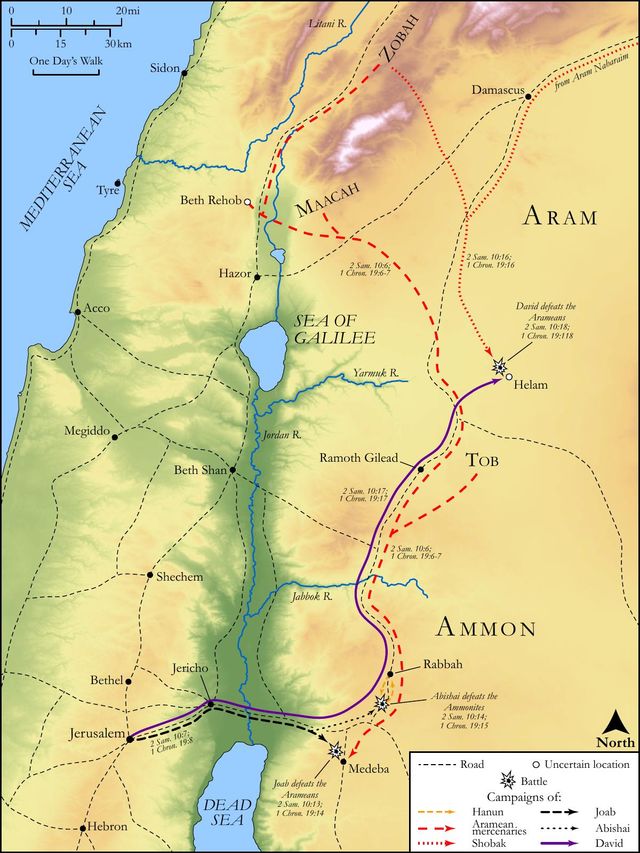
See on the biblical-era map
Study this verse
Public-domain commentary
Matthew Henry
From his Commentary on the Whole Bible. Henry comments on passages, not single verses — this entry covers 1 Chronicles 19:6–19.
We may see here, 1. How the hearts of sinners that are marked for ruin are hardened to their destruction. The children of Ammon saw that they had made themselves odious to David (Ch1 19:6), and then it would have been their wisdom to desire conditions of peace, to humble themselves and offer any satisfaction for the injury they had done him, the rather because they had made themselves not only odious to David, but obnoxious to the justice of God, who is King of nations, and will assert the injured rights and maintain the violated laws of nations. But, instead of this, they prepared for war, and so brought upon themselves, by David's hand, those desolations which he never intended them. 2. How the courage of brave men is heightened and invigorated by difficulties. When Joab saw that the battle was set against him before and behind (Ch1 19:10), instead of meditating a retreat, he doubled his resolution; and, though he could not double, he divided his army, and not only spoke, but acted, like a gallant man, that had great presence of mind when he saw himself surrounded. He engaged with his brother for mutual assistance (Ch1 19:12), excited himself and the rest of the officers to act vigorously in their respective posts, with an eye to God's glory and their country's good, not to any honour and advantage of their own, and then left the issue to God: Let the Lord do that which is right in his sight. 3. How vain the greatest art and strength are against justice and equity. The Ammonites did their utmost to make the best of their position: they brought as good a force into the field, and disposed it with as much policy as possible; yet, having a bad cause, and acting in defence of wrong, it would not do; they were put to the worst. Right will prevail and triumph at last. 4. To how little purpose it is for those to rally again, and reinforce themselves, that have not God on their side. The Syrians, though in no way concerned in the merits of the cause, but serving only as mercenaries to the Ammonites, when they were beaten, thought themselves concerned to retrieve their honour, and therefore called in the assistance of the Syrians on the other side Euphrates; but to no purpose, for still they fled before Israel (Ch1 19:18); they lost 7000 men, who are said to be the men of 700 chariots, Sa2 10:18. For, as now in a man of war for sea-service they allot ten men to a gun, so then, in land-service, ten men to a chariot. 5. those who have meddled with strife that belongs not to them, and have found that they meddled to their own heart, do well to learn wit at length and meddle no further. The Syrians, finding that Israel was the conquering side, not only broke off their alliance with the Ammonites and would help them no more (Ch1 19:19), but made peace with David and became his servants. Let those who have in vain stood it out against God be thus wise for themselves, and agree with him quickly, while they are in the way. Let them become his servants; for they cannot but see themselves undone if they be his enemies.
Continue studying 1 Chronicles 19:8 across the web’s major study libraries — every link below opens this exact verse, chapter, or book on the destination site.
Read & Compare
 BibleGatewayThis verse in more than 200 translations and 70 languages.
 Bible.comThe YouVersion reader — hundreds of translations, reading plans, and highlights.
 ESV.orgCrossway's official English Standard Version reader.
 NET BibleThe NET translation with 60,000+ translators' notes on every rendering decision.
 STEP BibleTyndale House's free study tool — original text, vocabulary, and scholarly resources.
 BibliaLogos Bible Software's free web reader.
 USCCBThe New American Bible (Revised Edition) with the U.S. bishops' study notes.
Commentaries
 BibleHub CommentariesDozens of classic commentaries on this verse, gathered on one page.
 StudyLightMore than 100 commentary sets — the largest collection on the web.
 BibleRefPlain-English commentary on what this verse means, verse by verse.
 Enduring WordDavid Guzik's free commentary on this chapter, widely used by Bible teachers.
 Bible Study ToolsVerse commentary alongside Greek and Hebrew study aids.
Original Language & Research
- BibleHub InterlinearThe verse word by word — original language, transliteration, and English.
- BibleHub LexiconEvery word's original-language definition and Strong's entry.
 Blue Letter BibleDeep-study tools — Strong's numbers, concordance, and word studies.
 SefariaThe Hebrew text with Rashi and centuries of Jewish commentary.
Sermons, Hymns & Audio


TrulyRandomVerse is not affiliated with these sites and doesn’t control their content. They’re linked because they’re genuinely useful.
Summary
This verse succinctly captures King David's immediate and decisive military response to the profound diplomatic insult inflicted upon his ambassadors by Hanun, the king of Ammon. Following the deliberate and egregious humiliation of his envoys—an act that flagrantly violated ancient diplomatic protocols and constituted a clear declaration of war—David swiftly mobilized the elite forces of Israel under the seasoned command of his general, Joab. This rapid and forceful action marks the commencement of a significant military campaign between Israel and Ammon, powerfully underscoring David's role as a vigilant, formidable, and honor-bound leader committed to defending the dignity and security of his kingdom.
Context
ShowHideLiterary Context
This verse serves as the immediate and pivotal turning point following a severe diplomatic incident detailed in the preceding verses of 1 Chronicles 19:1-7. David, extending a gesture of kindness and condolence to Hanun, the new king of Ammon, upon the death of his father Nahash (who had previously shown favor to David), dispatched messengers. However, influenced by suspicious and hostile advisors, Hanun tragically misconstrued David's benevolent intent as a deceptive ruse for espionage. In a shocking and unprecedented act of contempt, Hanun severely humiliated David's ambassadors by shaving off half their beards and cutting their garments in the middle, up to their buttocks. This public shaming was not merely rude; it was a profound violation of ancient diplomatic norms and a direct, unambiguous declaration of war. Recognizing the gravity of their provocation, the Ammonites then strategically began to hire mercenary forces from Aram, anticipating Israel's inevitable and righteous retaliation, as recounted in 1 Chronicles 19:6-7. David's swift dispatch of his military forces in 1 Chronicles 19:8 is thus a direct, necessary, and proportionate counter-response to this egregious affront, setting the stage for the ensuing and significant military conflict that dominates the remainder of the chapter.
Historical & Cultural Context
In the ancient Near East, diplomatic relations were governed by deeply ingrained codes of honor, hospitality, and inviolability. An ambassador was considered sacred, representing the very person and authority of the king who sent him. To insult an ambassador was, therefore, a direct and profound insult to the king himself and a grave act of national dishonor. Beards, for men in this culture, were not merely facial hair but potent symbols of honor, dignity, maturity, and social standing; their mutilation was an extreme form of public disgrace and emasculation. Similarly, cutting garments in a manner that exposed one's nakedness rendered the wearer utterly shamed and ridiculed, a profound act of humiliation. These actions against David's ambassadors were not accidental or trivial; they were deliberate, calculated provocations designed to shame Israel and incite war. The Ammonites, a long-standing and often hostile neighbor of Israel, likely harbored deep-seated animosity, and Hanun's advisors exploited this historical tension to escalate relations into open warfare. The subsequent hiring of Aramean mercenaries (from powerful city-states like Zobah, Rehob, Maacah, and Tob) by the Ammonites vividly illustrates their full awareness of the war they had provoked and their strategic preparation for it, highlighting the volatile geopolitical landscape of shifting alliances and constant warfare prevalent in the region during the Davidic era.
Key Themes
ShowHideThis verse powerfully contributes to several overarching themes central to 1 Chronicles and the broader Davidic narrative. It underscores the theme of David's Decisive and Righteous Leadership, showcasing his ability to respond swiftly, effectively, and justly to threats against his kingdom's honor and security. This contrasts sharply with his initial gesture of kindness, which was so tragically misconstrued. The deployment of "Joab, and all the host of the mighty men" emphasizes the theme of Israel's Military Might and Preparedness under David's reign, a testament to his success in consolidating power and establishing Israel as a formidable regional force. This military strength is often presented by the Chronicler as a manifestation of God's blessing on David's kingdom. Furthermore, the entire incident serves as a stark example of Retribution and Justice, where a profound act of dishonor demands a proportionate and forceful response, reflecting the ancient understanding of justice in international relations. The Chronicler frequently highlights God's justice in dealing with nations that oppose His chosen people, and this conflict, initiated by Ammon's transgression, ultimately leads to Israel's expansion and further solidifies David's dominion, a recurring motif in the Chronicler's portrayal of David's divinely sanctioned reign, as seen in passages like 1 Chronicles 14:17. This narrative also subtly touches upon the theme of Divine Sovereignty and Human Agency, as David, though a chosen king, must navigate real-world geopolitical challenges with strategic and decisive human action, trusting in God's ultimate guidance.
Exposition and Analysis
ShowHideKey Word Analysis
ShowHideThis primitive root means "to hear intelligently (often with implication of attention, obedience, etc.; causatively, to tell, etc.)". In this context, David's "hearing" is not passive reception but an active, intelligent comprehension of the gravity of the insult. It implies he fully grasped the implications of the Ammonite act—that it was a deliberate provocation and a declaration of war—and thus prepared him for a decisive response. His hearing leads directly to action, underscoring his attentiveness as a ruler.
This primitive root means "to send away, for, or out (in a great variety of applications)". Here, it signifies a deliberate, authoritative, and purposeful dispatch. David's "sending" of Joab and the army is not a casual or hesitant act but a direct royal command, indicating his intentional initiation of a full-scale military operation. It reflects the king's direct involvement and the gravity of the situation, demonstrating his decisive leadership in mobilizing the kingdom's resources for war.
This term is an intensive form meaning "powerful; by implication, warrior, tyrant; champion, chief, [idiom] excel, giant, man, mighty (man, one), strong (man), valiant man." This refers to David's elite corps of warriors, renowned for their exceptional courage, skill, and unwavering loyalty. Their individual feats were often legendary and recorded (e.g., 2 Samuel 23:8-39). Their deployment signifies that David was committing his most potent and formidable military asset, signaling a full-scale, no-compromise military engagement. The presence of the gibbôwr underscored the formidable nature of Israel's army and the king's absolute determination to restore honor and secure victory.
Verse Breakdown
ShowHide"And when David heard [of it]"
This opening clause establishes David's immediate, informed, and consequential reaction. The implied phrase "[of it]" (supplied in the KJV translation for clarity) refers to the news of the severe humiliation inflicted upon his ambassadors by Hanun, as detailed in the preceding verses. David's reception and understanding of this news serve as the direct catalyst for his subsequent military action, highlighting his role as a vigilant king who is acutely aware of threats to his kingdom's honor and security and is prepared to respond decisively.
"he sent Joab"
This signifies David's decisive and strategic leadership in the face of provocation. Joab, as David's seasoned, trusted, and often ruthless commander-in-chief, was the natural and most capable choice to lead a major military campaign of this magnitude. David's act of "sending" Joab indicates a direct royal command and the immediate initiation of an offensive military operation, demonstrating that David's response was not merely defensive but a forceful counter-attack to the Ammonite aggression.
"and all the host of the mighty men"
This phrase emphasizes both the scale and the elite quality of the military force deployed. "The host" (Hebrew: ha-tzava) refers to the entire army or a significant, organized portion of it, while "the mighty men" (ha-gibborim) specifically designates David's renowned elite warriors. This was not a token force or a mere skirmish contingent, but the full might of Israel's professional and highly capable army, indicating David's unwavering determination to swiftly, overwhelmingly, and definitively defeat the Ammonites and restore Israel's national honor.
Literary Devices
ShowHideThe verse employs Conciseness and Action-Oriented Language to powerfully convey David's immediate, resolute, and decisive response. The simple, declarative sentence structure—"he sent Joab, and all the host of the mighty men"—cuts directly to the core of the action, reflecting both the swiftness of David's decision and the rapid mobilization of his forces. The mention of "Joab" and "the mighty men" functions as a form of Metonymy or Synecdoche, where the parts (the supreme commander and the elite troops) stand in for the entire formidable military might of Israel, effectively communicating the overwhelming nature of the impending conflict without needing to list every unit. This selective focus also creates a strong sense of Foreshadowing, hinting at the significant battles and decisive victories that will inevitably follow, thereby establishing David's military prowess and the strength of his kingdom as a central and recurring theme in the Chronicler's narrative.
Theological and Thematic Connections
ShowHideThis account in 1 Chronicles 19:8, detailing David's swift military response to Ammonite aggression, underscores several profound theological and thematic connections within the broader biblical narrative. It illustrates the principle that even divinely appointed leaders are called to exercise justice and protect the honor, security, and well-being of their people, sometimes through necessary and decisive force. David's action here reflects a king acting as God's agent of justice against those who would scorn His people, echoing the consistent Old Testament theme of God's defense of Israel against its enemies. Furthermore, the narrative highlights the severe consequences of human sin, arrogance, and foolishness, as Hanun's egregious and insulting act directly leads to a devastating war for his people and the subsequent loss of territory and sovereignty. The Chronicler emphasizes David's strength and the might of Israel's army, portraying a kingdom established, blessed, and empowered by God, capable of defending its divine mandate and expanding its influence in the region.
Reflection and Application
ShowHideWhile believers today live under the New Covenant, a different era with a new understanding of warfare (primarily spiritual, not physical), the principles embedded in David's response in 1 Chronicles 19:8 offer invaluable insights for contemporary spiritual life. David's immediate and decisive action, though leading to physical war, was rooted in the defense of national honor and the protection of his people from a grave affront. For us, this might translate into the spiritual realm: recognizing when spiritual attacks, theological distortions, or moral affronts against God's truth and the integrity of the Gospel require a firm, decisive stand, rather than passive retreat or compromise. It challenges us to consider what we are truly willing to defend—the honor of Christ, the purity of His Church, the integrity of the Word, or the dignity of fellow believers. Just as David mobilized his best forces, we are called to bring our "mighty men" (our spiritual gifts, discernment, courage, and unwavering faith) to bear in defending truth and justice within our spheres of influence, always relying on God's strength and wisdom. This passage also reminds leaders, whether in the church, family, or community, of their solemn responsibility to protect and shepherd those under their charge, even when difficult, unpopular, or confrontational decisions are required. It is a call to courageous, principled action in the face of affronts to what is sacred, true, and righteous in God's eyes.
Questions for Reflection
ShowHideFAQ
ShowHideWhy was the humiliation of David's ambassadors considered such a grave offense?
ShowHideIn the ancient Near East, ambassadors were considered extensions of their king's person and authority, enjoying diplomatic immunity. To insult an ambassador was a direct insult to the king himself and a profound act of national dishonor. The specific acts of shaving half a beard (a symbol of male dignity and honor) and cutting garments to expose one's nakedness were extreme forms of public shaming, designed to strip the men of their dignity and make them objects of ridicule. This was not merely rude behavior but a deliberate, calculated provocation, a clear declaration of hostility and a flagrant violation of established diplomatic norms, unequivocally signaling the intent for war. The severity of such an act demanded a military response to restore national honor and deter future aggression, as vividly demonstrated by David's swift mobilization of forces in 1 Chronicles 19:8.
How does 1 Chronicles 19:8 relate to the parallel account in 2 Samuel 10?
ShowHideThe narrative in 1 Chronicles 19 is a parallel account to that found in 2 Samuel 10. Both books recount the same core historical events: David's initial gesture of kindness towards Hanun, Hanun's insulting and aggressive response to David's ambassadors, and David's subsequent military retaliation. The Chronicler's account, written for a post-exilic audience, often emphasizes aspects relevant to the restored community, such as the legitimacy and divine blessing of the Davidic line, the importance of proper worship, and the strength of Israel under God's favor. While the core events are consistent, slight differences in wording, emphasis, or detail may exist between the two accounts, but they generally complement each other, providing a fuller and richer picture of this significant conflict in David's reign and its implications for Israel's history and identity.
Christ-Centered Fulfillment
ShowHideWhile 1 Chronicles 19:8 depicts David as a formidable warrior-king defending his kingdom's honor through military might, it finds its ultimate Christ-centered fulfillment not in physical warfare, but in the spiritual triumph of Jesus Christ. David's decisive action against those who dishonored him and his kingdom foreshadows Christ's ultimate and definitive victory over the forces of sin, death, and the devil, who relentlessly seek to dishonor God and enslave His people. Jesus, the true King of Israel and the Son of David, did not send an army of "mighty men" to conquer earthly enemies through bloodshed. Instead, through His own sacrificial, redemptive act on the cross, He disarmed the spiritual powers and authorities, triumphing over them publicly (as powerfully described in Colossians 2:15). He is the Lamb of God who takes away the sin of the world (John 1:29), demonstrating humility and self-sacrifice. Yet, He is also the Lion of Judah (Revelation 5:5) who will return in glory to execute righteous judgment and establish His eternal kingdom, leading the armies of heaven (Revelation 19:11-16). David's defense of his kingdom's honor points to Christ's unwavering commitment to uphold the glory of God and secure the eternal well-being of His redeemed people, not through earthly armies, but through His divine authority, saving power, and the ultimate peace that surpasses all understanding, which He bestows upon those who trust in Him (Philippians 4:7).