


1 Chronicles 19:9
- וַיֵּצְאוּvai·ye·tze·'Uand they went outH3318Conj-w ¦ V-Qal-ConsecImperf-3mpVerb Qal Consecutive Imperfect 3rd Plural Masculineוַandיֵּצְאוּthey went out
- בְּנֵיbe·Nei[the] people ofH1121N-mpcNoun Plural Masculine Construct
- עַמּוֹןa·MonAmmonH5983N-proper-mNoun Proper Masculine
- וַיַּעַרְכוּvai·ya·'ar·Khuand they deployedH6186Conj-w ¦ V-Qal-ConsecImperf-3mpVerb Qal Consecutive Imperfect 3rd Plural Masculineוַandיַּעַרְכוּthey deployed
- מִלְחָמָהmil·cha·MahbattleH4421N-fsNoun Singular Feminine Absolute
- פֶּתַחPe·tach[the] entrance ofH6607N-mscNoun Singular Masculine Construct
- הָעִירha·'Irthe cityH5892Art ¦ N-fsNoun Singular Feminine Absoluteהָtheעִירcity
- וְהַמְּלָכִיםve·ha·me·la·Khimand the kingsH4428Conj-w ¦ Art ¦ N-mpNoun Plural Masculine Absoluteוְandהַtheמְּלָכִיםkings
- אֲשֶׁר'a·SherwhoH834RelParticle Relative
- בָּאוּBa·'uthey had comeH935V-Qal-Perf-3cpVerb Qal Perfect 3rd Plural common gender
- לְבַדָּםle·va·Damto alone themH905Prep-l ¦ N-msc ¦ 3mpNoun Singular Masculine Constructלְtoבַדָּaloneםthem
- בַּשָּׂדֶהba·sa·Deh[were] in the open countryH7704Prep-b ¦ N-msNoun Singular Masculine Absoluteבַּ[were] in theשָּׂדֶהopen country
English is a literal word-by-word gloss of the Hebrew, not the KJV's wording. Why?
This is the original text the KJV's translators worked from — each Hebrew word with its own literal English meaning in this verse, prepared by scholars at Tyndale House, Cambridge. The KJV translates whole sentences, not word by word, so its wording differs: one Hebrew word can become several English words, and the KJV may choose “the LORD” where the gloss reads “Yahweh”. Both are faithful — they answer different questions. For the KJV's own rendering, switch to the KJV text.
Details
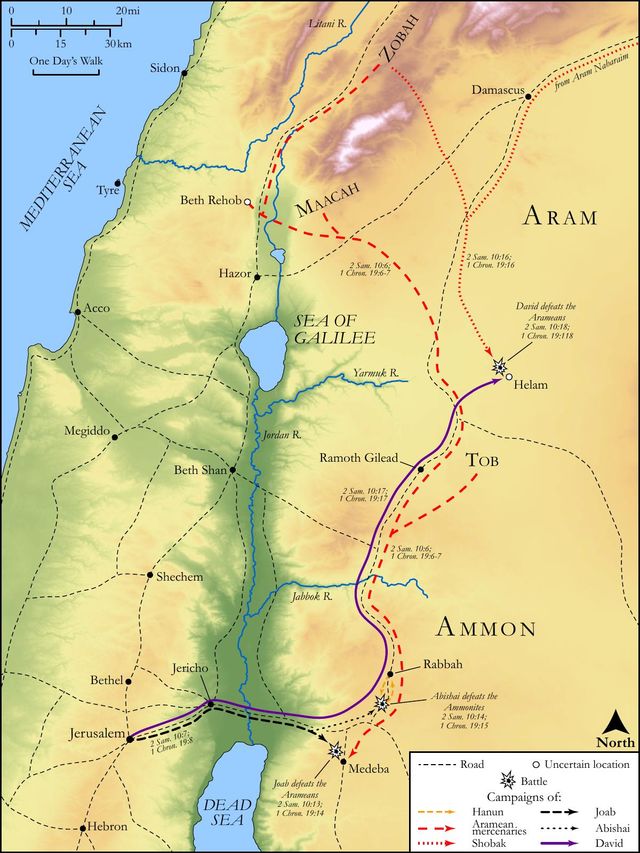
See on the biblical-era map
Study this verse
Public-domain commentary
Matthew Henry
From his Commentary on the Whole Bible. Henry comments on passages, not single verses — this entry covers 1 Chronicles 19:6–19.
We may see here, 1. How the hearts of sinners that are marked for ruin are hardened to their destruction. The children of Ammon saw that they had made themselves odious to David (Ch1 19:6), and then it would have been their wisdom to desire conditions of peace, to humble themselves and offer any satisfaction for the injury they had done him, the rather because they had made themselves not only odious to David, but obnoxious to the justice of God, who is King of nations, and will assert the injured rights and maintain the violated laws of nations. But, instead of this, they prepared for war, and so brought upon themselves, by David's hand, those desolations which he never intended them. 2. How the courage of brave men is heightened and invigorated by difficulties. When Joab saw that the battle was set against him before and behind (Ch1 19:10), instead of meditating a retreat, he doubled his resolution; and, though he could not double, he divided his army, and not only spoke, but acted, like a gallant man, that had great presence of mind when he saw himself surrounded. He engaged with his brother for mutual assistance (Ch1 19:12), excited himself and the rest of the officers to act vigorously in their respective posts, with an eye to God's glory and their country's good, not to any honour and advantage of their own, and then left the issue to God: Let the Lord do that which is right in his sight. 3. How vain the greatest art and strength are against justice and equity. The Ammonites did their utmost to make the best of their position: they brought as good a force into the field, and disposed it with as much policy as possible; yet, having a bad cause, and acting in defence of wrong, it would not do; they were put to the worst. Right will prevail and triumph at last. 4. To how little purpose it is for those to rally again, and reinforce themselves, that have not God on their side. The Syrians, though in no way concerned in the merits of the cause, but serving only as mercenaries to the Ammonites, when they were beaten, thought themselves concerned to retrieve their honour, and therefore called in the assistance of the Syrians on the other side Euphrates; but to no purpose, for still they fled before Israel (Ch1 19:18); they lost 7000 men, who are said to be the men of 700 chariots, Sa2 10:18. For, as now in a man of war for sea-service they allot ten men to a gun, so then, in land-service, ten men to a chariot. 5. those who have meddled with strife that belongs not to them, and have found that they meddled to their own heart, do well to learn wit at length and meddle no further. The Syrians, finding that Israel was the conquering side, not only broke off their alliance with the Ammonites and would help them no more (Ch1 19:19), but made peace with David and became his servants. Let those who have in vain stood it out against God be thus wise for themselves, and agree with him quickly, while they are in the way. Let them become his servants; for they cannot but see themselves undone if they be his enemies.
Continue studying 1 Chronicles 19:9 across the web’s major study libraries — every link below opens this exact verse, chapter, or book on the destination site.
Read & Compare
 BibleGatewayThis verse in more than 200 translations and 70 languages.
 Bible.comThe YouVersion reader — hundreds of translations, reading plans, and highlights.
 ESV.orgCrossway's official English Standard Version reader.
 NET BibleThe NET translation with 60,000+ translators' notes on every rendering decision.
 STEP BibleTyndale House's free study tool — original text, vocabulary, and scholarly resources.
 BibliaLogos Bible Software's free web reader.
 USCCBThe New American Bible (Revised Edition) with the U.S. bishops' study notes.
Commentaries
 BibleHub CommentariesDozens of classic commentaries on this verse, gathered on one page.
 StudyLightMore than 100 commentary sets — the largest collection on the web.
 BibleRefPlain-English commentary on what this verse means, verse by verse.
 Enduring WordDavid Guzik's free commentary on this chapter, widely used by Bible teachers.
 Bible Study ToolsVerse commentary alongside Greek and Hebrew study aids.
Original Language & Research
- BibleHub InterlinearThe verse word by word — original language, transliteration, and English.
- BibleHub LexiconEvery word's original-language definition and Strong's entry.
 Blue Letter BibleDeep-study tools — Strong's numbers, concordance, and word studies.
 SefariaThe Hebrew text with Rashi and centuries of Jewish commentary.
Sermons, Hymns & Audio


TrulyRandomVerse is not affiliated with these sites and doesn’t control their content. They’re linked because they’re genuinely useful.
Summary
1 Chronicles 19:9 meticulously details the initial strategic deployment of the combined Ammonite and Aramean (Syrian) forces as they prepared to confront King David's Israelite army. This verse vividly portrays the enemy's immediate readiness for battle, with the Ammonites defensively arrayed before their city's gate and their Syrian allies positioned separately in the open field, thereby setting a complex and formidable challenge for Joab and the Israelite forces.
Context
ShowHideLiterary Context
This verse is an integral part of the larger narrative detailing David's war against the Ammonites, which begins in 1 Chronicles 19. The conflict was ignited by King Hanun of Ammon's egregious humiliation of David's ambassadors, who had been sent with a message of condolence following the death of Hanun's father, Nahash. David, remembering Nahash's past kindness, sought to extend grace, but Hanun, misled by his advisors, publicly shamed David's envoys by shaving half their beards and cutting their garments in half at the buttocks (1 Chronicles 19:4). Recognizing the gravity of this insult and anticipating David's inevitable retaliation, the Ammonites wisely sought allies, hiring a vast mercenary force from various Aramean kingdoms, including Beth-rehob, Zobah, Maachah, and Ish-tob, for a substantial sum (1 Chronicles 19:6). In response, David dispatched his formidable commander Joab with the entire Israelite army (1 Chronicles 19:8). Verse 9 precisely describes the enemy's strategic positioning just as Joab's forces arrived, setting the immediate tactical challenge that Joab would ingeniously address in the subsequent verses (1 Chronicles 19:10).
Historical & Cultural Context
The events of 1 Chronicles 19 occur during the consolidation of David's kingdom, a period marked by both internal stability and external conflicts with surrounding nations. The Ammonites, a Transjordanian people, were frequent adversaries of Israel, sharing a complex history rooted in their shared ancestry through Lot. Their capital, Rabbah (modern Amman, Jordan), was a strategically important fortified city. The act of shaving beards and cutting garments was a profound public humiliation in ancient Near Eastern culture, designed to shame and dishonor, particularly for envoys who represented their king's dignity. Such an insult was considered an act of war. The hiring of Aramean (Syrian) mercenaries was a common practice among smaller kingdoms seeking to bolster their military strength against larger powers. These Aramean kingdoms, located to the north and east of Israel, were often powerful and skilled warriors, making their alliance a significant threat. The strategic deployment "before the gate of the city" and "in the field" reflects typical ancient siege and field battle tactics, where a city's defenses were crucial, and open-field engagements determined broader control.
Key Themes
ShowHideThe passage in 1 Chronicles 19 and specifically verse 9 contribute to several key themes. Firstly, it underscores the consequences of pride and disrespect, demonstrating how a foolish act of humiliation by King Hanun directly escalated into a costly and bloody war. This serves as a stark reminder of the far-reaching ripple effects of human sin and folly. Secondly, the verse highlights the reality of conflict and opposition, both human and spiritual, that God's people often face. The detailed description of the enemy's strategic array emphasizes the formidable nature of the challenges. Thirdly, it subtly introduces the theme of strategic preparation and divine wisdom in warfare, foreshadowing Joab's brilliant tactical response in the face of a divided but dangerous enemy. Ultimately, within the broader narrative of Chronicles, this conflict reaffirms God's sovereignty over nations and battles, even when human actions initiate them, and demonstrates His faithfulness to David's kingdom as it expands and faces external threats, as seen in the broader context of David's reign and God's covenant with him (2 Samuel 7).
Exposition and Analysis
ShowHideKey Word Analysis
ShowHideThis primitive root means "to set in a row, i.e. arrange, put in order." It conveys a sense of deliberate, disciplined, and organized military formation, rather than a chaotic or spontaneous charge. The Ammonites were not merely gathering; they were strategically positioning their troops, forming ranks, and preparing for a structured engagement. This emphasizes their preparedness and the serious nature of the impending conflict, indicating a well-thought-out defensive and offensive posture.
This noun refers to "a battle (i.e. the engagement); generally, war (i.e. warfare)." When combined with ‘ârak (array), it signifies the formal and intentional preparation for a military confrontation. It highlights that the enemy's actions were not a skirmish but a full-scale, organized "war" or "engagement," underscoring the gravity of the situation for David's forces.
This noun denotes "an opening (literally), i.e. door (gate) or entrance way." In ancient cities, the gate was the most critical and often the most fortified point of entry and defense. Positioning forces "before the gate" indicates a primary defensive line, designed to protect the capital city (likely Rabbah) from direct assault. This move suggests the Ammonites intended to draw the Israelites into a frontal assault on their most fortified position.
Verse Breakdown
ShowHide"And the children of Ammon came out"
This initial clause signifies the active, decisive movement of the Ammonite forces from within their city or encampment. It portrays their readiness and intent to engage, indicating they were not waiting passively to be attacked but were taking the initiative in their defensive preparations.
"and put the battle in array before the gate of the city"
This describes the Ammonites' specific strategic maneuver. They organized their troops into battle formation directly in front of the primary entrance to their capital. This placement suggests a strong defensive posture, aiming to protect their stronghold and possibly force the Israelite army into a difficult frontal assault against a fortified position.
"and the kings that were come [were] by themselves in the field."
This final clause reveals the dual deployment of the enemy forces. The "kings that were come" refers to the Aramean (Syrian) mercenary allies. Their positioning "by themselves in the field" indicates a separate, distinct formation, likely outside the immediate vicinity of the city gate. This separation suggests a flanking maneuver, a pincer movement, or an independent offensive force, designed to attack the Israelite army from a different direction or to prevent their retreat, creating a complex tactical challenge for Joab.
Literary Devices
ShowHideThe verse primarily employs Strategic Imagery and Juxtaposition. The vivid description of the Ammonites "put[ting] the battle in array before the gate of the city" and the allied kings being "by themselves in the field" creates a clear mental picture of the enemy's formidable and layered deployment. This Strategic Imagery immediately establishes the high stakes and the tactical complexity of the impending conflict. The use of Juxtaposition is evident in the contrasting locations of the two enemy contingents: one defensively positioned at the city's vulnerable gate, and the other independently arrayed in the open field. This highlights the multi-pronged threat faced by Joab's army and effectively Foreshadows the strategic dilemma that Joab must resolve, as detailed in the subsequent verses. The precise, almost military report-like language, underscores the gravity and organized nature of the opposition.
Theological and Thematic Connections
ShowHideThis seemingly straightforward military report in 1 Chronicles 19:9 carries significant theological weight, illustrating how human actions, particularly those rooted in pride and disrespect, can unleash devastating consequences, yet God remains sovereign over the unfolding of history and even the outcomes of battles. The meticulous detailing of the enemy's strategic array serves as a reminder that the people of God often face formidable, well-organized opposition, whether from physical adversaries or spiritual forces. It implicitly calls for discernment, wisdom, and reliance on divine strategy rather than mere human strength. The narrative, while focusing on military strategy, ultimately points to the truth that victory is not solely dependent on the might of armies or the cleverness of generals, but on the Lord's favor and intervention, reinforcing the chronicler's consistent message of divine providence in Israel's history.
Reflection and Application
ShowHide1 Chronicles 19:9, while describing an ancient military engagement, offers profound insights into the nature of conflict and preparation in our own lives. Just as the Ammonites and Syrians meticulously "put the battle in array," we too will inevitably face moments where opposition is strategically deployed against us—be it personal challenges, professional obstacles, or spiritual warfare. This verse encourages us to recognize the reality of such opposition, to discern its nature and positioning, and to understand that simply ignoring or underestimating it is perilous. It prompts us to consider how we "array" ourselves for the battles of life, not in terms of human might, but in spiritual readiness, prayer, and reliance on God's wisdom. The ripple effect of Hanun's pride leading to this war also serves as a potent reminder of how our words and actions, particularly those driven by arrogance or disrespect, can unleash unforeseen and destructive consequences, urging us towards humility and grace in our interactions.
Questions for Reflection
ShowHideFAQ
ShowHideWhy did the Ammonites position their forces in two separate locations?
ShowHideThe Ammonites and their Syrian allies strategically divided their forces to create a more complex and challenging tactical situation for Joab's Israelite army. By positioning the Ammonites "before the gate of the city" (likely their capital, Rabbah), they established a strong defensive line to protect their stronghold, potentially forcing a difficult frontal assault. Simultaneously, the Syrian mercenary kings positioned "by themselves in the field" created a second, independent threat. This dual deployment likely aimed to execute a pincer movement, a flanking maneuver, or to prevent an Israelite retreat, forcing Joab to divide his forces and fight on two fronts, as he indeed does in 1 Chronicles 19:10-12. This strategy sought to overwhelm the Israelites by presenting a multi-directional attack.
What was the significance of "the gate of the city" in ancient warfare?
ShowHideIn ancient Near Eastern cities, the "gate of the city" was far more than just an entrance; it was the hub of civic life, commerce, and legal proceedings, and critically, the most vulnerable yet most heavily fortified point of a city's defenses. It was typically constructed with massive doors, towers, and often multiple layers of walls to withstand assault. Militarily, controlling the gate meant controlling access to the city and its resources. Positioning forces "before the gate" indicated a primary defensive stand, aiming to protect the city from direct assault and to draw the enemy into a concentrated engagement at a point where the defenders had the advantage of fortifications and short supply lines. It was a common and crucial strategy to make a stand at this critical juncture, as seen in many biblical accounts of sieges and battles, such as Joshua 8:29.
Christ-Centered Fulfillment
ShowHideWhile 1 Chronicles 19:9 describes a physical battle between earthly kingdoms, it subtly foreshadows the greater spiritual conflict and the ultimate victory secured by Christ. David, as king and warrior, serves as a type of Christ, who confronts and overcomes formidable opposition. The "battle in array" before the city gate and in the field, representing a well-organized and multi-faceted enemy, mirrors the arrayed forces of darkness—sin, death, and Satan—that stand opposed to God's kingdom. Just as Joab faced a complex tactical challenge, Christ faced the full, arrayed might of spiritual principalities and powers. However, unlike human generals, Christ's victory was not achieved through conventional warfare, but through His sacrificial death and resurrection. On the cross, He disarmed the spiritual rulers and authorities, triumphing over them (Colossians 2:15). His resurrection shattered the power of death and the devil (Hebrews 2:14-15), securing a decisive and eternal victory. Thus, this ancient battle, with its strategic positioning and eventual triumph, points to the ultimate King, Jesus Christ, who has already "put the battle in array" against our ultimate enemies and emerged victorious, leading His people to eternal peace and security in His kingdom, a kingdom that will never be overthrown (Revelation 19:11-16) and whose victory is celebrated for all eternity (Revelation 5:9-10).