


1 Chronicles 19:10
- וַיַּרְאvai·Yar'and he sawH7200Conj-w ¦ V-Qal-ConsecImperf-3msVerb Qal Consecutive Imperfect 3rd Singular Masculineוַandיַּרְאhe saw
- יוֹאָבyo·'AvJoabH3097N-proper-mNoun Proper Masculine
- כִּיkithatH3588PrtParticle Conditional
- הָיְתָהha·ye·Tahit wasH1961V-Qal-Perf-3fsVerb Qal Perfect 3rd Singular Feminine
- פְנֵיfe·nei[the] face ofH6440N-mpcNoun Plural Masculine Construct
- הַמִּלְחָמָהha·mil·cha·Mahthe battleH4421Art ¦ N-fsNoun Singular Feminine Absoluteהַtheמִּלְחָמָהbattle
- אֵלָיו'e·Lavagainst himH413Prep ¦ 3msPrepositionאֵלָיagainstוhim
- פָּנִיםpa·NimfaceH6440N-mpNoun Plural Masculine Absolute
- וְאָחוֹרve·'a·Chorand backH268Conj-w ¦ N-msNoun Singular Masculine Absoluteוְandאָחוֹרback
- וַיִּבְחַרvai·yiv·Charand he choseH977Conj-w ¦ V-Qal-ConsecImperf-3msVerb Qal Consecutive Imperfect 3rd Singular Masculineוַandיִּבְחַרhe chose
- מִכָּלmi·kolfrom everyH3605Prep-m ¦ N-mscNoun Singular Masculine Constructמִfromכָּלevery
- בָּחוּרba·Churchosen [man]H977V-Qal-PassPrtcpl-msVerb Qal Participle Passive Singular Masculine Absolute
- בְּיִשְׂרָאֵלbe·Yis·ra·'Elin IsraelH3478Prep-b ¦ N-properNoun Proper LocationבְּinיִשְׂרָאֵלIsrael
- וַיַּעֲרֹךְvai·ya·'a·Rokhand he deployedH6186Conj-w ¦ V-Qal-ConsecImperf-3msVerb Qal Consecutive Imperfect 3rd Singular Masculineוַandיַּעֲרֹךְhe deployed
- לִקְרַאתlik·Ratto meetH7122Prep-l ¦ V-Qal-InfVerb Qal Infinitive Constructלִtoקְרַאתmeet
- אֲרָם'a·RamAramH758N-properNoun Proper Location
English is a literal word-by-word gloss of the Hebrew, not the KJV's wording. Why?
This is the original text the KJV's translators worked from — each Hebrew word with its own literal English meaning in this verse, prepared by scholars at Tyndale House, Cambridge. The KJV translates whole sentences, not word by word, so its wording differs: one Hebrew word can become several English words, and the KJV may choose “the LORD” where the gloss reads “Yahweh”. Both are faithful — they answer different questions. For the KJV's own rendering, switch to the KJV text.
Details
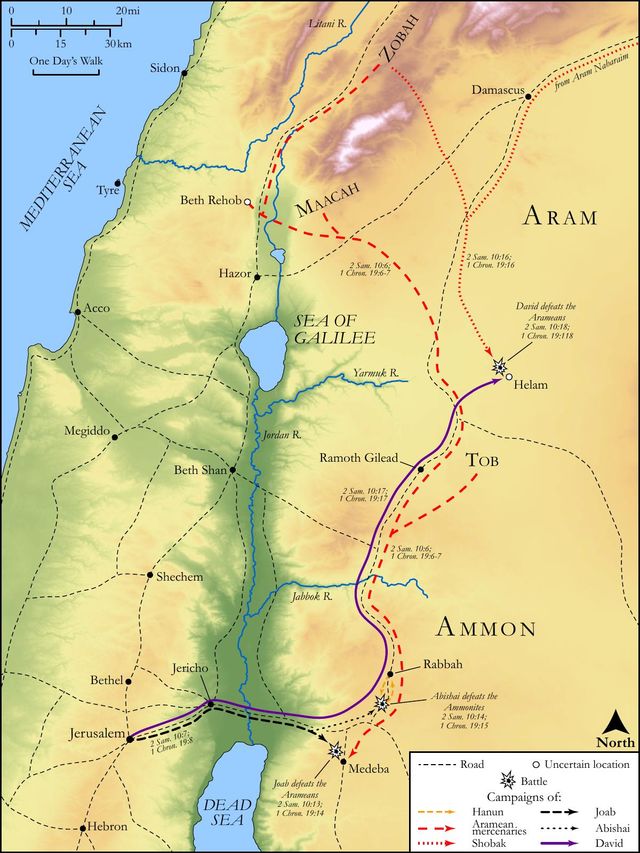
See on the biblical-era map
Study this verse
Public-domain commentary
Matthew Henry
From his Commentary on the Whole Bible. Henry comments on passages, not single verses — this entry covers 1 Chronicles 19:6–19.
We may see here, 1. How the hearts of sinners that are marked for ruin are hardened to their destruction. The children of Ammon saw that they had made themselves odious to David (Ch1 19:6), and then it would have been their wisdom to desire conditions of peace, to humble themselves and offer any satisfaction for the injury they had done him, the rather because they had made themselves not only odious to David, but obnoxious to the justice of God, who is King of nations, and will assert the injured rights and maintain the violated laws of nations. But, instead of this, they prepared for war, and so brought upon themselves, by David's hand, those desolations which he never intended them. 2. How the courage of brave men is heightened and invigorated by difficulties. When Joab saw that the battle was set against him before and behind (Ch1 19:10), instead of meditating a retreat, he doubled his resolution; and, though he could not double, he divided his army, and not only spoke, but acted, like a gallant man, that had great presence of mind when he saw himself surrounded. He engaged with his brother for mutual assistance (Ch1 19:12), excited himself and the rest of the officers to act vigorously in their respective posts, with an eye to God's glory and their country's good, not to any honour and advantage of their own, and then left the issue to God: Let the Lord do that which is right in his sight. 3. How vain the greatest art and strength are against justice and equity. The Ammonites did their utmost to make the best of their position: they brought as good a force into the field, and disposed it with as much policy as possible; yet, having a bad cause, and acting in defence of wrong, it would not do; they were put to the worst. Right will prevail and triumph at last. 4. To how little purpose it is for those to rally again, and reinforce themselves, that have not God on their side. The Syrians, though in no way concerned in the merits of the cause, but serving only as mercenaries to the Ammonites, when they were beaten, thought themselves concerned to retrieve their honour, and therefore called in the assistance of the Syrians on the other side Euphrates; but to no purpose, for still they fled before Israel (Ch1 19:18); they lost 7000 men, who are said to be the men of 700 chariots, Sa2 10:18. For, as now in a man of war for sea-service they allot ten men to a gun, so then, in land-service, ten men to a chariot. 5. those who have meddled with strife that belongs not to them, and have found that they meddled to their own heart, do well to learn wit at length and meddle no further. The Syrians, finding that Israel was the conquering side, not only broke off their alliance with the Ammonites and would help them no more (Ch1 19:19), but made peace with David and became his servants. Let those who have in vain stood it out against God be thus wise for themselves, and agree with him quickly, while they are in the way. Let them become his servants; for they cannot but see themselves undone if they be his enemies.
Continue studying 1 Chronicles 19:10 across the web’s major study libraries — every link below opens this exact verse, chapter, or book on the destination site.
Read & Compare
 BibleGatewayThis verse in more than 200 translations and 70 languages.
 Bible.comThe YouVersion reader — hundreds of translations, reading plans, and highlights.
 ESV.orgCrossway's official English Standard Version reader.
 NET BibleThe NET translation with 60,000+ translators' notes on every rendering decision.
 STEP BibleTyndale House's free study tool — original text, vocabulary, and scholarly resources.
 BibliaLogos Bible Software's free web reader.
 USCCBThe New American Bible (Revised Edition) with the U.S. bishops' study notes.
Commentaries
 BibleHub CommentariesDozens of classic commentaries on this verse, gathered on one page.
 StudyLightMore than 100 commentary sets — the largest collection on the web.
 BibleRefPlain-English commentary on what this verse means, verse by verse.
 Enduring WordDavid Guzik's free commentary on this chapter, widely used by Bible teachers.
 Bible Study ToolsVerse commentary alongside Greek and Hebrew study aids.
Original Language & Research
- BibleHub InterlinearThe verse word by word — original language, transliteration, and English.
- BibleHub LexiconEvery word's original-language definition and Strong's entry.
 Blue Letter BibleDeep-study tools — Strong's numbers, concordance, and word studies.
 SefariaThe Hebrew text with Rashi and centuries of Jewish commentary.
Sermons, Hymns & Audio


TrulyRandomVerse is not affiliated with these sites and doesn’t control their content. They’re linked because they’re genuinely useful.
Summary
1 Chronicles 19:10 captures a pivotal moment in the war between Israel and the combined forces of Ammon and Syria. It vividly portrays Joab, King David's chief commander, demonstrating exceptional military leadership and strategic brilliance. Faced with a dire tactical predicament—his forces encircled by enemy armies both in front and behind—Joab remains composed. The verse highlights his decisive action in immediately selecting and strategically deploying the elite Israelite troops against the most formidable threat, the Syrians, thereby initiating a crucial counter-maneuver to overcome overwhelming odds.
Context
ShowHideLiterary Context
This verse is deeply embedded within the historical narrative of King David's reign, specifically detailing the significant war against the Ammonites and their Syrian allies, chronicled in 1 Chronicles 19 and paralleled in 2 Samuel 10. The preceding verses (1 Chronicles 19:1-9) establish the casus belli: King Hanun of Ammon's egregious humiliation of David's diplomatic envoys, an act of profound disrespect that necessitated a military response to uphold Israel's honor. Joab, leading the Israelite army to the Ammonite capital, Rabbah, unexpectedly finds himself in a strategically perilous position. The Ammonites are arrayed at the city gate, while a substantial contingent of hired Syrian mercenaries has positioned themselves in the open field, effectively creating a pincer movement around Joab's forces. This "before and behind" encirclement directly sets the stage for Joab's immediate and crucial tactical response detailed in this verse.
Historical & Cultural Context
The conflict depicted reflects the complex geopolitical landscape of the ancient Near East, where alliances were often fluid and perceived insults could rapidly escalate into full-scale warfare. The Ammonites, a Transjordanian people, were long-standing adversaries of Israel. Their alliance with various Aramean (Syrian) kingdoms, such as Zobah and Rehob, indicates the formation of a formidable regional power bloc arrayed against David's expanding kingdom. The act of publicly humiliating envoys—by shaving half their beards and cutting their garments (1 Chronicles 19:4)—was an undeniable declaration of hostility and a profound cultural affront, demanding a robust military response to restore national honor and deter future aggression. The widespread use of mercenaries, a common practice in this era, further underscores the significant military might of the combined enemy forces Joab faced.
Key Themes
ShowHideThis verse powerfully illustrates several key themes prevalent in the Books of Chronicles and the broader biblical narrative. Firstly, it highlights Decisive Leadership in Crisis. Joab's immediate, calm, and strategic response to being encircled, without succumbing to panic, exemplifies the critical importance of clear thinking and swift action under extreme pressure. Secondly, the verse emphasizes Strategic Resource Allocation. Joab's discerning choice of "the choice of Israel" (his most elite troops) for the most critical front against the Syrians demonstrates wisdom in deploying superior resources where they are most needed, a principle vital for success in any endeavor, whether military or otherwise. Finally, it underscores the theme of Facing Overwhelming Adversity. The description of the battle being "set against him before and behind" vividly conveys a situation of seemingly insurmountable challenge, requiring not only courage but also tactical brilliance to overcome. This moment foreshadows the subsequent victory, emphasizing that even in dire straits, God's people, led by capable individuals, can prevail through strategic action, as seen in the broader account of 1 Chronicles 19.
Exposition and Analysis
ShowHideKey Word Analysis
ShowHideFrom the primitive root H7200, meaning "to see, literally or figuratively." In this context, Joab's "seeing" (וַיַּרְא, wayyarʾ) implies far more than mere visual perception. It denotes a keen discernment and immediate strategic assessment of the perilous situation. He didn't just observe the enemy's positions; he comprehended the full tactical implications of being encircled, allowing him to formulate an immediate and effective counter-strategy. This highlights his military acumen and ability to quickly grasp complex battlefield dynamics.
From the primitive root H6186, meaning "to set in a row, i.e., arrange, put in order." The phrase "the battle was set against him" (הַמִּלְחָמָה הָיְתָה עֲרוּכָה עָלָיו, hammilḥāmāh hāyĕtāh ʻărûkhāh ʻālāyw) uses the passive participle, indicating that the enemy had already arranged or deployed their forces in a hostile manner. This verb emphasizes the deliberate and organized nature of the enemy's encirclement, creating a classic pincer movement. Joab's subsequent action to "put them in array" against the Syrians uses the same root, highlighting his own counter-arrangement of forces.
From the primitive root H977, meaning "to try, i.e., (by implication) select; acceptable, appoint, choose (choice), excellent." The phrase "the choice of Israel" (מִבְחַר יִשְׂרָאֵל, mivḥar Yisrāʼēl) uses a noun derived from this root, signifying "the chosen," "the select," or "the best." Joab's decision to deploy these "choice" troops underscores his strategic wisdom; he recognized that the most formidable part of the enemy force (the Syrians) required the highest caliber of soldiers, demonstrating his reliance on the most capable resources for the critical task at hand.
Verse Breakdown
ShowHide"Now when Joab saw that the battle was set against him before and behind,"
This opening clause establishes the immediate and severe tactical crisis Joab faced. The verb "saw" (וַיַּרְא, wayyarʾ) denotes not just visual observation but a rapid and accurate strategic assessment of the situation. The phrase "battle was set against him before and behind" vividly describes the Israelite forces being caught in a classic pincer movement, with the Ammonites at the city gate in front and the Syrian mercenaries in the open field behind. This created an extremely dangerous and potentially devastating encirclement, demanding an immediate and decisive response.
"he chose out of all the choice of Israel,"
Faced with this overwhelming and perilous challenge, Joab demonstrates remarkable composure and decisive leadership. He does not panic but immediately selects the most elite, skilled, and capable soldiers from his entire army. This action underscores his strategic thinking, recognizing that the most formidable part of the enemy force (the Syrians) required the very best of Israel's military might. It highlights the crucial importance of discerning and deploying one's strongest assets in moments of extreme crisis.
"and put [them] in array against the Syrians."
This final clause describes Joab's immediate and brilliant tactical deployment. He strategically positioned his elite chosen troops to directly confront the Syrian forces, who represented the greater and more immediate threat in the open field. This move was crucial, as it allowed him to divide his forces effectively—placing the second division under his brother Abishai to face the Ammonites—and address the most pressing danger with his most capable soldiers, thereby setting the stage for a coordinated counter-attack that ultimately led to Israel's victory.
Literary Devices
ShowHideThe verse employs striking Imagery to convey the intensity of Joab's predicament, particularly with the phrase "the battle was set against him before and behind." This vivid description immediately paints a picture of encirclement and overwhelming odds, allowing the reader to grasp the severity of the tactical challenge. The author's focus on Joab's immediate and decisive action, rather than internal monologue or fear, serves as a powerful form of Characterization, portraying him as a calm, astute, and courageous military leader. Furthermore, the selection of "the choice of Israel" can be seen as a form of Synecdoche, where a part (the elite soldiers) represents the best of the whole Israelite army, emphasizing their exceptional quality and Joab's discerning leadership in deploying them.
Theological and Thematic Connections
ShowHide1 Chronicles 19:10, while detailing a specific military maneuver, offers profound insights into themes of leadership, wisdom, and reliance in the face of overwhelming odds. Joab's ability to remain composed and strategically allocate resources under immense pressure reflects a principle applicable beyond the battlefield: effective leadership often requires clear-headedness and decisive action, even when circumstances seem dire. This human wisdom, however, is consistently presented in Chronicles as operating within the larger framework of divine sovereignty. While Joab's tactical brilliance is evident, the broader narrative of Chronicles attributes ultimate victory and success not merely to human prowess but to God's favor and presence with His people. This verse thus serves as a testament to the human capacity for strategic thought, yet it implicitly points to the need for such efforts to be consecrated and aligned with God's purposes for true and lasting triumph, reminding us that even the most formidable human plans require divine blessing and ultimately find their success in God's overarching plan.
Reflection and Application
ShowHideJoab's response to being surrounded in 1 Chronicles 19:10 provides a powerful and enduring model for navigating the inevitable crises and challenges of life. Just as Joab faced an enemy from multiple directions, we often encounter situations that feel overwhelming, attacking us from various fronts—be they financial pressures, relational conflicts, health struggles, or spiritual battles. This verse encourages us to cultivate a similar spirit of composure, strategic thinking, and decisive action. Instead of succumbing to panic, despair, or paralysis, we are called to calmly assess the situation, identify the most pressing threats, and strategically deploy our available resources—our skills, our relationships, our faith, our time, and our spiritual disciplines—to address them effectively. It reminds us that decisive action, informed by wisdom and courage, is often the key to overcoming adversity. Furthermore, it subtly points to the importance of identifying and relying on our "choice" resources, whether those are our strongest personal attributes, our most trusted allies, or, most importantly, our unwavering faith in God's provision and guidance, recognizing that even our best efforts are empowered by His grace.
Questions for Reflection
ShowHideFAQ
ShowHideWhat was the significance of the "choice of Israel" in Joab's strategy?
ShowHideThe "choice of Israel" (מִבְחַר יִשְׂרָאֵל, mivḥar Yisrāʼēl) refers to the elite, most skilled, and most experienced soldiers within the Israelite army. Joab's decision to deploy these specific troops against the Syrians was highly significant for several reasons. Firstly, it demonstrated his strategic acumen: he recognized that the Syrian forces posed the greater and more immediate threat in the open field, requiring the highest caliber of soldiers. Secondly, it maximized his chances of success by putting his best resources where they were most needed. This strategic allocation of elite forces allowed him to divide his army effectively, with his brother Abishai leading the other half against the Ammonites, ensuring both fronts were adequately addressed. It underscores the principle of leveraging one's strengths against the most formidable challenges, a tactic that ultimately led to Israel's victory as detailed in 1 Chronicles 19:15-19.
Christ-Centered Fulfillment
ShowHideWhile Joab's military genius and strategic prowess in 1 Chronicles 19:10 offer a powerful example of human leadership in crisis, the ultimate fulfillment of such decisive action is found in Christ. Joab faced a physical battle with earthly enemies, but Jesus confronted the ultimate "battle set against him before and behind"—the spiritual forces of sin, death, and the devil. Unlike Joab, who had to choose his "elite" soldiers, Christ, as the perfect Lamb of God, faced this cosmic conflict alone, yet with divine authority and power. His strategic "deployment" was His willing submission to the cross, where He disarmed the principalities and powers, triumphing over them (see Colossians 2:15). Joab's victory was temporary and physical, securing Israel's earthly kingdom; Christ's victory on the cross secured eternal salvation and established a spiritual kingdom that knows no end, offering true peace and freedom to all who believe (as promised in John 14:27). Thus, Joab's tactical brilliance foreshadows the infinitely greater strategic wisdom of God, manifested in Christ's singular, decisive triumph over the ultimate enemy, securing victory for all eternity and inviting us into His eternal triumph, as Romans 8:37 proclaims.