


Joshua 8:22
- וְאֵלֶּהve·'E·lehand these [men]H428Conj-w ¦ PrtParticle Demonstrativeוְandאֵלֶּהthese [men]
- יָצְאוּya·tze·'Uthey came outH3318V-Qal-Perf-3cpVerb Qal Perfect 3rd Plural common gender
- מִןminfromH4480PrepPreposition
- הָעִירha·'Irthe cityH5892Art ¦ N-fsNoun Singular Feminine Absoluteהָtheעִירcity
- לִקְרָאתָםlik·ra·Tamto meet themH7122Prep-l ¦ V-Qal-Inf ¦ 3mpVerb Qal Infinitive Constructלִtoקְרָאתָmeetםthem
- וַיִּהְיוּvai·yih·Yuand they wereH1961Conj-w ¦ V-Qal-ConsecImperf-3mpVerb Qal Consecutive Imperfect 3rd Plural Masculineוַandיִּהְיוּthey were
- לְיִשְׂרָאֵלle·Yis·ra·'Elto IsraelH3478Prep-l ¦ N-properNoun Proper LocationלְtoיִשְׂרָאֵלIsrael
- בַּתָּוֶךְba·Ta·vekhin the middleH8432Prep-b ¦ N-msNoun Singular Masculine Absoluteבַּin theתָּוֶךְmiddle
- אֵלֶּה'E·lehtheseH428PrtParticle Demonstrative
- מִזֶּהmi·Zehfrom thisH2088Prep-m ¦ PrtParticle Demonstrativeמִfromזֶּהthis
- וְאֵלֶּהve·'E·lehand theseH428Conj-w ¦ PrtParticle Demonstrativeוְandאֵלֶּהthese
- מִזֶּהmi·Zehfrom thisH2088Prep-m ¦ PrtParticle Demonstrativeמִfromזֶּהthis
- וַיַּכּוּvai·ya·Kuand they struck downH5221Conj-w ¦ V-Hiphil-ConsecImperf-3mpVerb Hiphil Consecutive Imperfect 3rd Plural Masculineוַandיַּכּוּthey struck down
- אוֹתָם'o·Tam<obj.> themH853DirObjM ¦ 3mpParticle Object Indicatorאוֹתָ<obj.>םthem
- עַד'aduntilH5704PrepPreposition
- בִּלְתִּיbil·TinotH1115N-csNoun Singular common gender Absolute
- הִשְׁאִירhish·'irhe had leftH7604V-Hiphil-Perf-3msVerb Hiphil Perfect 3rd Singular Masculine
- לוֹloto <the> himPrep-l ¦ 3msSuffix Personal 3rd Singular Masculineלto <the>וֹhim
- שָׂרִידsa·Rida survivorH8300N-msNoun Singular Masculine Absolute
- וּפָלִיטu·fa·Litand a fugitiveH6412Conj-w ¦ N-msNoun Singular Masculine Absoluteוּandפָלִיטa fugitive
English is a literal word-by-word gloss of the Hebrew, not the KJV's wording. Why?
This is the original text the KJV's translators worked from — each Hebrew word with its own literal English meaning in this verse, prepared by scholars at Tyndale House, Cambridge. The KJV translates whole sentences, not word by word, so its wording differs: one Hebrew word can become several English words, and the KJV may choose “the LORD” where the gloss reads “Yahweh”. Both are faithful — they answer different questions. For the KJV's own rendering, switch to the KJV text.
Details
See on the biblical-era map
Study this verse
Public-domain commentary
Matthew Henry
From his Commentary on the Whole Bible. Henry comments on passages, not single verses — this entry covers Joshua 8:3–22. His three-level outline is real structure in the source text, so it is rendered as structure.
We have here an account of the taking of Ai by stratagem. The stratagem here used, we are sure, was lawful and good; God himself appointed it, and we have no reason to think but that the like is lawful and good in other wars. Here was no league broken, no treaty of peace, that the advantage was gained; no, these are sacred things, and not to be jested with, nor used to serve a turn; truth, when once it is plighted, becomes a debt even to the enemy. But in this stratagem here was no untruth told; nothing was concealed but their own counsels, which no enemy ever pretended a right to be entrusted with; nothing was dissembled, nothing counterfeited but a retreat, which was no natural or necessary indication at all of their inability to maintain their onset, or of any design not to renew it. The enemy ought to have been upon their guard, and to have kept within the defence of their own walls. Common prudence, had they been governed by it, would have directed them not to venture on the pursuit of an army which they saw was so far superior to them in numbers, and leave their city unguarded; but (si populus vult decipi, decipiatur - if the people will be deceived, let them) if the Canaanites will be so easily imposed upon, and in pursuit of God's Israel will break through all the laws of policy and good management, the Israelites are not at all to be blamed for taking advantage of their fury and thoughtlessness; nor is it any way inconsistent with the character God is pleased to give of them, that they are children that will not lie. Now in the account here given of this matter,
I.There is some difficulty in adjusting the numbers that were employed to effect it.
Mention is made (Jos 8:3) of 30,000 that were chosen and sent away by night, to whom the charge was given to surprise the city as soon as ever they perceived it was evacuated, Jos 8:4, Jos 8:7, Jos 8:8. And yet afterwards (Jos 8:12) it is said, Joshua took 5000 men and set them to lie in ambush behind the city, and that ambush entered the city, and set it on fire, Jos 8:19. Now,
1.Some think there were two parties sent out to lie in ambush, 30,000 first, and afterwards 5000 to guard the roads, and to intercept those that were first sent out; and that Joshua made his open attack upon the city with all the thousands of Israel. So the learned bishop Patrick, insisting upon God's command (Jos 8:1) to take all the people of war with him. But,
2.Others think that all the people were taken only to encamp before the city, and that out of them Joshua chose out 30,000 men to be employed in the action, out of which he sent out 5000 to lie in ambush, which were as many as could be supposed to march incognito - without being discovered (more would have been seen, and thus the design would have been broken) and that then with the other 25,000 he made the open attack, as Masius thinks, or with the 30,000, which, as Calvin thinks, he kept entire for that purpose, having, besides them, sent out 5000 for an ambuscade. And those 5000 (they think) must be meant by those (Jos 8:3) whom he sent away by night, with orders to lie in wait behind the city, though the particular number is not specified till Jos 8:12. If we admit such a seeming disturbance in the order of the narrative (of which, perhaps, similar instances might be cited from the other scripture histories), it seems most probable that there was but one ambushment, which consisted only of 5000, enough for such a purpose.
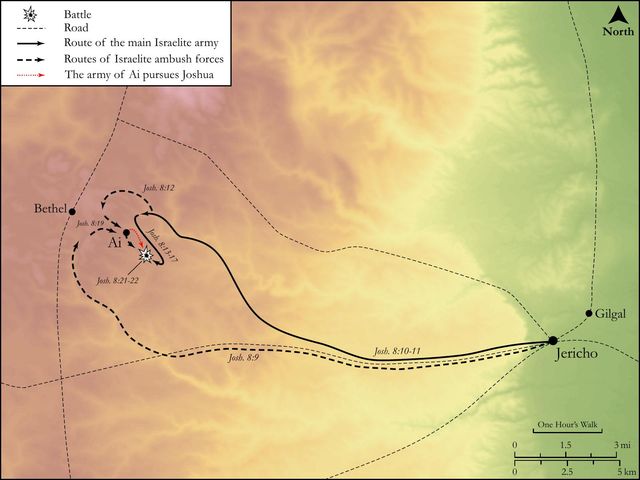
II.Yet the principal parts of the story are plain enough, that a detachment being secretly marched behind the city, on the other side to that on which the main body of the army lay (the situation of the country, it is probable, favouring their concealment), Joshua, and the forces with him, faced the city; the garrison made a vigorous sally out upon them, whereupon they withdrew, gave ground, and retreated in some seeming disorder towards the wilderness, which being perceived by the men of Ai, they drew out all the force they had to pursue them. This gave a fair opportunity for those that lay in ambush to make themselves masters of the city, whereof when they had given notice by a smoke to Joshua, he, with all his force, returned upon the pursuers, who now, when it was too late, were aware of the snare they were drawn into, and, their retreat being intercepted, they were every man of them cut off. The like artifice we find used, Jdg 20:30, etc. Now in this story we may observe,
1.What a brave commander Joshua was. See,
(1.)His conduct and prudence. God gave him the hint (v. 2) that he should lay an ambush behind the city, but left him to himself to order the particulars, which he did admirably well. Doubtless wisdom strengthens the wise more than ten mighty men, Ecc 7:19.
(2.)His care and industry (Jos 8:10): He rose up early in the morning, that he might lose no time, and to show how intent his mind was upon his business. Those that would maintain their spiritual conflicts must not love their ease.
(3.)His courage and resolution; though an army of Israelites had been repulsed before Ai, yet he resolves to lead them on in person the second time, Jos 8:5. Being himself also an elder, he took the elders of Israel with him to make this attack upon the city (Jos 8:10), as if he were going rather to sit in judgment upon them as criminals than to fight them as enemies.
(4.)His caution and consideration (Jos 8:13): He went that night into the midst of the valley, to make the necessary dispositions for an attack, and to see that every thing was in good order. It is the pious conjecture of the learned bishop Patrick that he went into the valley alone, to pray to God for a blessing upon his enterprise, and he did not seek in vain.
(5.)His constancy and perseverance; when he had stretched out his spear towards the city (Jos 8:18, a spear almost as fatal and formidable to the enemies of Israel as the rod of Moses was) he never drew back his hand till the work was done. His hands in fighting, like Moses's in interceding, were steady till the going down of the sun. Those that have stretched out their hands against their spiritual enemies must never draw them back. Lastly, What Joshua did in the stratagem is applicable to our Lord Jesus, of whom he was a type. Joshua conquered by yielding, as if he had himself been conquered; so our Lord Jesus, when he bowed his head and gave up the ghost, seemed as if death and triumphed over him, and as if he and all his interests had been routed and ruined; but in his resurrection he rallied again and gave the powers of darkness a total defeat; he broke the serpent's head, by suffering him to bruise his heel. A glorious stratagem!
2.What an obedient people Israel was. What Joshua commanded them to do, according to the commandment of the Lord (Jos 8:8), they did it without murmuring or disputing. Those that were sent to lie in ambush between Beth-el and Ai (two cities confederate against them) were in a post of danger, and had they been discovered might all have been cut off, and yet they ventured; and, when the body of the army retreated and fled, it was both disgraceful and perilous, and yet, in obedience to Joshua, they did it.
3.What an infatuated enemy the king of Ai was,
(1.)That he did not by his scouts discover those that lay in ambush behind the city, Jos 8:14. Some observe it as a remarkable instance of the power of God in making men blind to their own interest, and the things that belong to their peace, that he wist not that there were liers in wait against him. Those are most in danger who are least aware that they are so.
(2.)That when Israel seemed to fly he drew out all his forces to pursue them, and left none to guard his city and to secure his retreat, Jos 8:17. Thus the church's enemies often run themselves into destruction by their own fury and the violence of their rage against the Israel of God. Pharaoh plunged himself into the Red Sea by the eagerness with which he pursued Israel.
(3.)That from the killing of thirty-six men out of 3000, when Israel made the former attack upon his city, he should infer the total routing of so great an army as now he had to deal with (Jos 8:6): They flee before us as at the first. See how the prosperity of fools destroys them and hardens them to their ruin. God had made use of the men of Ai as a scourge to chastise his people for meddling with the accursed thing, and this had puffed them up with a conceit that they must have the honour of delivering their country from these formidable invaders; but they were soon made to see their mistake, and that when the Israelites had reconciled themselves to their God they could have no power against them. God had made use of them only for the rebuking of Israel, with a purpose, when the correction was over, to throw the rod itself into the fire; howbeit, they meant not so, but it was in their heart to destroy and cut off, Isa 10:5-7.
4.What a complete victory Israel obtained over them by the favour and blessing of God. Each did his part: the divided forces of Israel, by signals agreed on, understood one another, and every thing succeeded according to the project; so that the men of Ai, even when they were most confident of victory, found themselves surrounded, so that they had neither spirit to resist nor room to fly, but were under a fatal necessity of yielding their lives to the destroyers. And now it is hard to say whether the shouts of the men of Israel, or the shrieks of the men of Ai, were the louder, but easy to imagine what terror and confusion they were filled with, when their highest assurances sunk so suddenly into the heaviest despair. Note, The triumphing of the wicked is short, Job 20:5. They are exalted for a little while, that their fall and ruin may be the sorer, Job 24:24. See how easily, how quickly, the scale turns against those that have not God on their side.
Historical interpretation
Historical reception
2 surviving comments on this verse. Each one is dated, so this reads as a timeline rather than a list.
You will read in the Holy Scriptures about the battles of the just ones, about the slaughter and carnage of murderers, and that the saints spare none of their deeply rooted enemies. If they do spare them, they are even charged with sin, just as Saul was charged because he had preserved the life of Agag king of Amalek. You should understand the wars of the just by the method I set forth above, that these wars are waged by them against sin. But how will the just ones endure if they reserve even a little bit of sin? Therefore, this is said of them: “They did not leave behind even one who might be saved or might escape.”Do you perhaps not believe me that the battle is joined against our sin? Then believe Paul as he says, “Not yet to the shedding of blood have you resisted against sin.” Do you see that the fight proposed for you is against sin and that you must complete the battle even to the shedding of blood? Is it not evident that the divine Scripture indicates these things, even as it habitually says, “Sanctify war,” and, “You will fight the battle of the Lord”?
When the Jews read these things, they become cruel and thirst after human blood, thinking that even holy persons so struck those who were living in Ai that not one of them was left “who might be saved or who might escape.” They do not understand that mysteries are dimly shadowed in these words and that they more truly indicate to us that we ought not to leave any of those demons deeply within, whose dwelling place is chaos and who rule in the abyss, but to destroy them all. We slay demons, but we do not annihilate their essence. For their work and endeavor is to cause persons to sin. If we sin, they have life; but if we do not sin, they are destroyed. Therefore, all holy persons kill the inhabitants of Ai; they both annihilate and do not release any of them. These are doubtless those who guard their heart with all diligence so that evil thoughts do not proceed from it, and those who heed their mouth, so that “no evil word” proceeds from it. Not to leave any who flee means this: when no evil word escapes them.
Continue studying Joshua 8:22 across the web’s major study libraries — every link below opens this exact verse, chapter, or book on the destination site.
Read & Compare
 BibleGatewayThis verse in more than 200 translations and 70 languages.
 Bible.comThe YouVersion reader — hundreds of translations, reading plans, and highlights.
 ESV.orgCrossway's official English Standard Version reader.
 NET BibleThe NET translation with 60,000+ translators' notes on every rendering decision.
 STEP BibleTyndale House's free study tool — original text, vocabulary, and scholarly resources.
 BibliaLogos Bible Software's free web reader.
 USCCBThe New American Bible (Revised Edition) with the U.S. bishops' study notes.
Commentaries
 BibleHub CommentariesDozens of classic commentaries on this verse, gathered on one page.
 StudyLightMore than 100 commentary sets — the largest collection on the web.
 BibleRefPlain-English commentary on what this verse means, verse by verse.
 Enduring WordDavid Guzik's free commentary on this chapter, widely used by Bible teachers.
 Bible Study ToolsVerse commentary alongside Greek and Hebrew study aids.
Original Language & Research
- BibleHub InterlinearThe verse word by word — original language, transliteration, and English.
- BibleHub LexiconEvery word's original-language definition and Strong's entry.
 Blue Letter BibleDeep-study tools — Strong's numbers, concordance, and word studies.
 SefariaThe Hebrew text with Rashi and centuries of Jewish commentary.
Sermons, Hymns & Audio


TrulyRandomVerse is not affiliated with these sites and doesn’t control their content. They’re linked because they’re genuinely useful.
Summary
Joshua 8:22 powerfully encapsulates the climactic moment of Israel's decisive victory over the city of Ai. Following God's meticulously designed ambush strategy, the men of Ai, lured out of their city by a feigned Israelite retreat, found themselves caught in a devastating pincer movement. Surrounded on all sides by the main Israelite force and the hidden ambush unit, they were utterly overwhelmed and annihilated, with not a single one escaping, marking a complete reversal of Israel's prior humiliating defeat and a resounding demonstration of divine faithfulness.
Context
ShowHideLiterary Context
Joshua 8:22 stands as the triumphant culmination of the second battle for Ai, a pivotal event immediately following Israel's initial, humiliating defeat detailed in Joshua 7. The preceding chapter meticulously recounts Achan's sin of taking devoted things, which resulted in God's withdrawal of favor and Israel's vulnerability. Only after Achan's judgment and the restoration of God's presence did the Lord Himself provide Joshua with a detailed, strategic plan for attacking Ai, outlined in Joshua 8:1-8. This divine strategy involved a large ambush force positioned behind the city, while a smaller main force feigned retreat to draw Ai's defenders out. Verse 22 precisely captures the moment this elaborate trap springs shut, with the men of Ai caught between the two Israelite contingents, ensuring their complete destruction. This verse seamlessly transitions into the immediate aftermath, including the burning of Ai and the hanging of its king, as recounted in Joshua 8:23-29.
Historical & Cultural Context
The conquest of Canaan, as depicted in Joshua, was a divinely mandated act of judgment against the wicked Canaanite nations, whose practices included egregious idolatry, child sacrifice, and pervasive immorality. The command for herem, or "devotion to destruction," applied to certain cities like Ai, was not an act of arbitrary savagery but a judicial decree by God to purge the land of profound evil and protect Israel from spiritual contamination by these abhorrent practices. Ai itself was a strategically important city, likely guarding a major route through the central highlands of Canaan. The battle tactics employed, particularly the elaborate ambush, were common in ancient Near Eastern warfare, but in this instance, they were supernaturally guided by God's precise instructions. The complete annihilation described in the verse reflects the severe consequences of divine judgment and the absolute nature of the herem command, as explicitly outlined in passages such as Deuteronomy 7:1-6.
Key Themes
ShowHideThis verse powerfully underscores several major themes woven throughout the book of Joshua and the broader Old Testament narrative. Firstly, it highlights Divine Sovereignty and Strategy: the overwhelming victory at Ai was not solely due to Israel's military prowess or cleverness, but to God's precise, divinely revealed plan, demonstrating His active and sovereign involvement in the conquest. Secondly, it emphasizes the Consequences of Obedience and Disobedience: in stark contrast to the humiliating defeat in Joshua 7:4-5, this resounding triumph showcases the blessings that flow from Israel's renewed and complete obedience to God's commands. Thirdly, the phrase "let none of them remain or escape" exemplifies the theme of Divine Judgment and Herem, illustrating God's righteous wrath against the profound wickedness of the Canaanites and His determination to purify the land for His covenant people. Finally, it reinforces God's Faithfulness to His Covenant Promises to give Israel the land, even after their initial stumble, demonstrating His restorative grace when His people repent and obey, a faithfulness ultimately affirmed in Joshua 21:43-45.
Exposition and Analysis
ShowHideKey Word Analysis
ShowHideThis primitive root signifies to strike, often with decisive force, leading to defeat, injury, or death. In the context of warfare, it conveys a complete and overwhelming defeat, indicating that the Israelite forces engaged with full might, leaving no doubt as to the outcome. It suggests a relentless and thorough execution of the divine judgment against Ai, a forceful and unyielding blow.
This word refers to a survivor or a remnant. Its inclusion in the negative ("none...remain") emphasizes the absolute nature of the destruction, indicating that no one from the fighting force of Ai was left alive to tell the tale or pose a future threat. This highlights the totality of God's judgment and the success of the ambush in achieving complete annihilation.
This term denotes a refugee or one who flees to safety. Paired with "remain" and used in the negative ("none...escape"), it further underscores the utter and comprehensive annihilation of Ai's fighting men. It signifies that no one managed to break free from the trap and flee the battlefield, illustrating the inescapable nature of the divine judgment executed by Israel.
Verse Breakdown
ShowHide"And the other issued out of the city against them;"
This clause refers to the ambush force (H428, ʼêl-leh), which had been strategically hidden behind Ai. Once the main Israelite force had successfully drawn the men of Ai out of their city in pursuit, this hidden contingent (H3318, yâtsâʼ) entered the now-defenseless city and then emerged to attack the Ai army from the rear, completing the divinely orchestrated pincer movement.
"so they were in the midst of Israel, some on this side, and some on that side:"
This clause vividly describes the successful execution of God's ambush strategy. The men of Ai, having eagerly pursued the feigning Israelite force, suddenly found themselves trapped. The main Israelite contingent was in front of them, while the ambush force was behind them (H8432, tâvek), effectively surrounding them and cutting off any possibility of retreat back to the safety of their city (H5892, ʻîyr).
"and they smote them, so that they let none of them remain or escape."
This is the decisive outcome of the battle. Caught in an inescapable trap, the men of Ai were utterly defeated (H5221, nâkâh). The phrase emphasizes the totality of the destruction (H5704, ʻad). The Israelite forces carried out God's command for herem with precision and completeness, leaving no survivors (H8300, sârîyd) from the fighting men of Ai, nor any who could flee (H6412, pâlîyṭ) to safety.
Literary Devices
ShowHideThe narrative in Joshua 8:22 masterfully employs several potent literary devices to convey its theological message. Irony is profoundly evident, as the men of Ai, puffed up by their previous victory and eager to pursue what they perceived as a fleeing enemy, unwittingly run directly into a divinely orchestrated trap. Their overconfidence, stemming from the initial success in Joshua 7, becomes their ultimate undoing. There is also a strong sense of Contrast between Israel's humiliating and devastating defeat in the first battle for Ai and this overwhelming, total victory. This stark difference highlights the profound consequences of disobedience versus the blessings of renewed obedience. Furthermore, the meticulous detail of the ambush strategy and its flawless execution demonstrate Divine Omniscience and Sovereignty, portraying God not merely as a participant but as the ultimate strategist who controls the outcome of battles, ensuring His will is accomplished.
Theological and Thematic Connections
ShowHideJoshua 8:22 is a powerful testament to God's unwavering faithfulness, His strategic wisdom, and the severe consequences of divine judgment. It demonstrates that true victory for God's people is not achieved through human might or cleverness alone, but through humble and complete obedience to His specific instructions. The complete annihilation of Ai's fighting force underscores the seriousness of God's judgment against the profound wickedness of the Canaanites, serving as a stark reminder that sin has ultimate consequences and that God is just in His dealings with humanity. This victory also serves as a profound reassurance of God's restorative grace; despite Israel's previous failure due to Achan's sin, God, upon their repentance and obedience, restored His favor and granted them a resounding triumph, fulfilling His covenant promises to give them the land.
Reflection and Application
ShowHideThe overwhelming victory at Ai, as depicted in Joshua 8:22, offers profound and enduring lessons for believers today. It reminds us that even after significant failures or setbacks, God's grace and strategic wisdom can lead us to complete triumph if we humble ourselves, confess our sins, and diligently seek and obey His guidance. Just as Israel needed to deal decisively with Achan's sin before they could experience victory, we too must be vigilant in identifying and eradicating areas of disobedience or compromise in our lives. The thoroughness of Ai's defeat challenges us to consider whether we are truly dealing decisively with spiritual strongholds or persistent sinful patterns, leaving "none to remain or escape" their influence over us. God's faithfulness to His promises, even after our stumbles, should inspire us to trust Him implicitly, knowing that when we align our will with His, He empowers us to overcome seemingly insurmountable obstacles and experience His restorative power in our lives.
Questions for Reflection
ShowHideFAQ
ShowHideWhy was the destruction of Ai's army so complete, "leaving none to remain or escape"?
ShowHideThe total destruction of Ai's fighting force was in accordance with God's command for herem, or "devotion to destruction," which applied to certain Canaanite cities. This was not an act of wanton cruelty but a divinely ordained judgment against the extreme wickedness, idolatry, and depravity of the Canaanite nations (Deuteronomy 9:4-5). It served multiple purposes: to punish their egregious sins, to prevent their corrupting influence from spreading to Israel, and to demonstrate God's absolute power and faithfulness in giving the land to His chosen people. The completeness of the destruction underscored the finality of God's judgment and the seriousness of His holy war against evil, ensuring the land could be settled without the pervasive spiritual contamination of its former inhabitants.
Christ-Centered Fulfillment
ShowHideThe decisive and total victory over Ai, where "none of them remain or escape," powerfully foreshadows the ultimate triumph achieved by Jesus Christ. Just as Joshua, whose name means "Yahweh saves," led Israel to conquer a fortified city and its wicked inhabitants, Jesus, the greater Joshua, leads His people in a far more profound and eternal conquest. His death on the cross and glorious resurrection constitute the ultimate divine ambush, decisively defeating sin, death, and the spiritual powers of darkness that held humanity captive. Through His finished work, Christ "disarmed the rulers and authorities and put them to open shame, by triumphing over them in Him" (Colossians 2:15). The completeness of Ai's defeat mirrors the absolute and irreversible victory of Christ; no enemy of God's kingdom—no sin, no spiritual stronghold, no fear of death—can ultimately "remain or escape" His sovereign authority. Believers, united with Christ through faith, participate in this cosmic victory, knowing that the spiritual warfare they engage in is fought from a position of triumph, secured by the Lamb of God who takes away the sin of the world and who promises that the gates of hell will not prevail against His church (Matthew 16:18).