


Joshua 7:12
Bible text: King James Version (1769 Blayney text) · Public domain
Bible text: King James Version with Strong's numbers · Public domain
Bible text: Berean Standard Bible · Public domain
Bible text: American Standard Version (1901) · Public domain
Bible text: World English Bible, Messianic edition · Public domain
Bible text: Geneva Bible (1599) · Public domain
Bible text: Young's Literal Translation · Public domain
- וְלֹאve·Lo'and notH3808Conj-w ¦ NegParticle Negativeוְandלֹאnot
- יֻכְלוּyukh·Luthey are ableH3201V-Qal-Imperf-3mpVerb Qal Imperfect 3rd Plural Masculine
- בְּנֵיbe·Nei[the] people ofH1121N-mpcNoun Plural Masculine Construct
- יִשְׂרָאֵלYis·ra·'ElIsraelH3478N-properNoun Proper Location
- לָקוּםla·Kumto standH6965Prep-l ¦ V-Qal-InfVerb Qal Infinitive Constructלָtoקוּםstand
- לִפְנֵיlif·Nei<to> beforeH6440Prep-l ¦ N-mpcNoun Plural Masculine Constructלִ<to>פְנֵיbefore
- אֹיְבֵיהֶם'o·ye·vei·Hemtheir enemiesH341V-Qal-Prtcpl-mp ¦ 3mpVerb Qal Participle Plural Masculine Constructאֹיְבֵיenemiesהֶםtheir
- עֹרֶף'O·refa neckH6203N-msNoun Singular Masculine Absolute
- יִפְנוּyif·Nuthey turnH6437V-Qal-Imperf-3mpVerb Qal Imperfect 3rd Plural Masculine
- לִפְנֵיlif·Nei<to> beforeH6440Prep-l ¦ N-mpcNoun Plural Masculine Constructלִ<to>פְנֵיbefore
- אֹיְבֵיהֶם'o·ye·vei·Hemtheir enemiesH341V-Qal-Prtcpl-mp ¦ 3mpVerb Qal Participle Plural Masculine Constructאֹיְבֵיenemiesהֶםtheir
- כִּיkiforH3588PrtParticle Conditional
- הָיוּha·Yuthey have becomeH1961V-Qal-Perf-3cpVerb Qal Perfect 3rd Plural common gender
- לְחֵרֶםle·Che·rem<into> a devoted thingH2764Prep-l ¦ N-msNoun Singular Masculine Absoluteלְ<into>חֵרֶםa devoted thing
- לֹאlo'notH3808NegParticle Negative
- אוֹסִיף'o·SifI will repeatH3254V-Hiphil-Imperf-1csVerb Hiphil Imperfect 1st Singular common gender
- לִהְיוֹתlih·Yotto beH1961Prep-l ¦ V-Qal-InfVerb Qal Infinitive Constructלִtoהְיוֹתbe
- עִמָּכֶם'i·ma·Khemwith youH5973Prep ¦ 2mpPreposition Definiteעִמָּwithכֶםyou
- אִם'imifH518PrtParticle Conditional
- לֹאlo'notH3808NegParticle Negative
- תַשְׁמִידוּtash·Mi·duyou will destroyH8045V-Hiphil-Imperf-2mpVerb Hiphil Imperfect 2nd Plural Masculine
- הַחֵרֶםha·Che·remthe devoted thing[s]H2764Art ¦ N-msNoun Singular Masculine Absoluteהַtheחֵרֶםdevoted thing[s]
- מִקִּרְבְּכֶםMi·kir·be·Khemfrom your midstH7130Prep-m ¦ N-msc ¦ 2mpNoun Singular Masculine Constructמִfromקִּרְבְּmidstכֶםyour
English is a literal word-by-word gloss of the Hebrew, not the KJV's wording. Why?
This is the original text the KJV's translators worked from — each Hebrew word with its own literal English meaning in this verse, prepared by scholars at Tyndale House, Cambridge. The KJV translates whole sentences, not word by word, so its wording differs: one Hebrew word can become several English words, and the KJV may choose “the LORD” where the gloss reads “Yahweh”. Both are faithful — they answer different questions. For the KJV's own rendering, switch to the KJV text.
Details
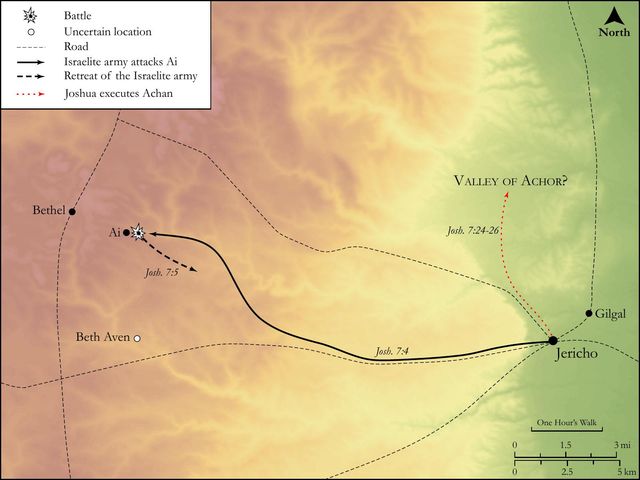
See on the biblical-era map
Study this verse
Public-domain commentary
Matthew Henry
From his Commentary on the Whole Bible. Henry comments on passages, not single verses — this entry covers Joshua 7:10–15. His three-level outline is real structure in the source text, so it is rendered as structure.
We have here God's answer to Joshua's address, which, we may suppose, came from the oracle over the ark, before which Joshua had prostrated himself, v. 6. Those that desire to know the will of God must attend with their desires upon the lively oracles, and wait at wisdom's gates for wisdom's dictates, Pro 8:34. And let those that find themselves under the tokens of God's displeasure never complain of him, but complain to him, and they shall receive an answer of peace. The answer came immediately, while he was yet speaking (Isa 65:24), as that to Daniel, Dan 9:20, etc.
I.God encourages Joshua against his present despondencies, and the black and melancholy apprehensions he had of the present posture of Israel's affairs (Jos 7:10): "Get thee up, suffer not thy spirits to droop and sink thus; wherefore liest thou thus upon thy face?" No doubt Joshua did well to humble himself before God, and mourn as he did, under the tokens of his displeasure; but now God told him it was enough, he would not have him continue any longer in that melancholy posture, for God delights not in the grief of penitents when they afflict their souls further than as it qualifies them for pardon and peace; the days even of that mourning must be ended. Arise, shake thyself from the dust, Isa 53:2. Joshua continued his mourning till eventide (Jos 7:6), so late that they could do nothing that night towards the discovery of the criminal, but were forced to put it off till next morning. Daniel (Dan 9:21), and Ezra (Ezr 9:5, Ezr 9:6), continued their mourning only till the time of the evening sacrifice; that revived them both: but Joshua went past that time, and therefore is thus roused: "Get thee up, do not lie all night there." Yet we find that Moses fell down before the Lord forty days and forty nights, to make intercession for Israel, Deu 9:18. Joshua must get up because he has other work to do than to lie there; the accursed thing must be discovered and cast out, and the sooner the better; Joshua is the man that must do it, and therefore it is time for him to lay aside his mourning weeds, and put on his judge's robes, and clothe himself with zeal as a cloak. Weeping must not hinder sowing, nor one duty of religion jostle out another. Every thing is beautiful in its season. Shechaniah perhaps had an eye to this in what he said to Ezra upon a like occasion. See Ezr 10:2-4.
II.He informs him of the true and only cause of this disaster, and shows him wherefore he contended with them (Jos 7:11):
Israel hath sinned. "Think not that God's mind is changed, his arm shortened, or his promise about to fail; no, it is sin, it is sin, that great mischief-maker, that has stopped the current of divine favours and has made this breach upon you." The sinner is not named, though the sin is described, but it is spoken of as the act of Israel in general, till they have fastened it upon the particular person, and their godly sorrow have so wrought a clearing of themselves, as theirs did, Co2 7:11. Observe how the sin is here made to appear exceedingly sinful.
1.They have transgressed my covenant, an express precept with a penalty annexed to it. It was agreed that God should have all the spoil of Jericho, and they should have the spoil of the rest of the cities of Canaan; but, in robbing God of his part, they transgressed this covenant.
2.They have even taken of the devoted thing, in contempt of the curse which was so solemnly denounced against him that should dare to break in upon God's property, as if that curse had nothing in it formidable.
3.They have also stolen; they did it clandestinely, as if they could conceal it from the divine omniscience, and they were ready to say, The Lord shall not see, or will not miss so small a matter out of so great a spoil. Thus thou thoughtest I was altogether such a one as thyself.
4.They have dissembled also. Probably, when the action was over, Joshua called all the tribes, and asked them whether they had faithfully disposed of the spoil according to the divine command, and charged them, if they knew of any transgression, that they should discover it, but Achan joined with the rest in a general protestation of innocency, and kept his countenance, like the adulterous woman that eats and wipes her mouth, and says, I have done no wickedness. Nay,
5.They have put the accursed thing among their own goods, as if they had as good a title to that as to any thing they have, never expecting to be called to an account, nor designing to make restitution. All this Joshua, though a wise and vigilant ruler, knew nothing of, till God told him, who knows all the secret wickedness that is in the world, which men know nothing of God could at this time have told him who the person was that had done this thing, but he does not,
(1.)To exercise the zeal of Joshua and Israel, in searching out the criminal.
(2.)To give the sinner himself space to repent and make confession. Joshua no doubt proclaimed it immediately throughout the camp that there was such a transgression committed, upon which, if Achan had surrendered himself, and penitently owned his guilt, and prevented the scrutiny, who knows but he might have had the benefit of that law which accepted of a trespass-offering, with restitution, from those that had sinned through ignorance in the holy things of the law? Lev 5:15, Lev 5:16. But Achan never discovering himself till the lot discovered him evidenced the hardness of his heart, and therefore he found no mercy.
III.He awakens him to enquire further into it, by telling him,
1.That this was the only ground for the controversy God had with them, this, and nothing else; so that when this accursed thing was put away he needed not fear, all would be well, the stream of their successes, when this one obstruction was removed, would run as strong as ever.
2.That if this accursed thing were not destroyed they could not expect the return of God's gracious presence; in plain terms, neither will I be with you any more as I have been, except you destroy the accursed, that is, the accursed person, who is made so by the accursed thing. That which is accursed will be destroyed; and those whom God has entrusted to bear the sword bear it in vain if they make it not a terror to that wickedness which brings these judgments of God on a land. By personal repentance and reformation, we destroy the accursed thing in our own hearts, and, unless we do this, we must never expect the favour of the blessed God. Let all men know that it is nothing but sin that separates between them and God, and, if it be not sincerely repented of and forsaken, it will separate eternally.
IV.He directs him in what method to make this enquiry and prosecution.
1.He must sanctify the people, now over-night, that is, as it is explained, he must command them to sanctify themselves, Jos 7:13. And what can either magistrates or ministers do more towards sanctification? They must put themselves into a suitable frame to appear before God and submit to the divine scrutiny, must examine themselves, now that God was coming to examine them, must prepare to meet their God. They were called to sanctify themselves when they were to receive the divine law (Ex. 19), and now also when they were to come under the divine judgment; for in both God is to be attended with the utmost reverence. "There is an accursed thing in the midst of you, and therefore sanctify yourselves," that is, Let all that are innocent be able to clear themselves, and be the more careful to cleanse themselves. The sin of others may be improved by us as furtherances of our sanctification, as the scandal of the incestuous Corinthian occasioned a blessed reformation in that church, Co2 7:11.
2.He must bring them all under the scrutiny of the lot (Jos 7:14); the tribe which the guilty person was of should first be discovered by lot, then the family, then the household, and last of all the person. The conviction came upon him thus gradually that he might have some space given him to come in and surrender himself; for God is not willing that any should perish, but that all should come to repentance. Observe, The Lord is said to take the tribe, and family, and household, on which the lot fell, because the disposal of the lot is of the Lord, and, however casual it seems, is under the direction of infinite wisdom and justice; and to show that when the sin of sinners finds them out God is to be acknowledged in it; it is he that seizes them, and the arrests are in his name. God hath found out the iniquity of thy servants, Gen 44:16. It is also intimated with what a certain and unerring judgment the righteous God does and will distinguish between the innocent and the guilty, so that though for a time they seem involved in the same condemnation, as the whole tribe did when it was first taken by the lot, yet he who has his fan in his hand will effectually provide for the taking out of the precious from the vile; so that though the righteous be of the same tribe, and family, and household, with the wicked, yet they shall never be treated as the wicked, Gen 18:25.
3.When the criminal was found out he must be put to death without mercy (Heb 10:28), and with all the expressions of a holy detestation, Jos 7:15. He and all that he has must be burnt with fire, that there might be no remainders of the accursed thing among them; and the reason given for this severe sentence is because the criminal has,
(1.)Given a great affront to God: He has transgressed the covenant of the Lord, who is jealous particularly for the honour of the holy covenant.
(2.)He has done a great injury to the church of God: He has wrought folly in Israel, has shamed that nation which is looked upon by all its neighbours to be a wise and understanding people, has infected that nation which is sanctified to God, and troubled that nation of which he is the protector. These being crimes so heinous in their nature, and of such pernicious consequence and example, the execution, which otherwise would have come under the imputation of cruelty, is to be applauded as a piece of necessary justice. It was sacrilege; it was invading God's rights, alienating his property, and converting to a private use that which was devoted to his glory and appropriated to the service of his sanctuary - this was the crime to be thus severely punished, for warning to all people in all ages to take heed how they rob God.
Historical interpretation
Historical reception
1 surviving comment on this verse from the historical church.
For we find that some sins are also a punishment for other sins … as in the flight of the Israelites from the face of the enemy out of the city of Ai because fear was instilled into their hearts so that they fled. And this was done to punish their sin and to punish it as it deserved to be punished, which is why the Lord said to Joshua, the son of Nun, “The children of Israel shall not be able to stand before their enemies.” What is the meaning of “shall not be able to stand”? Why did they not use their free will to stand rather than take flight because their wills were thrown into confusion by fear? Was it not for the simple reason that God, as Master of people’s wills, can in his anger instill fear into the hearts of whomsoever he pleases? Was it not of their own free choice that the enemies of the Israelites fought against God’s own people when they had Joshua, son of Nun, as their leader? And yet the Scripture tells us that “it was by the will of the Lord that their hearts should be strengthened that they should fight against Israel … and should be destroyed.”
Continue studying Joshua 7:12 across the web’s major study libraries — every link below opens this exact verse, chapter, or book on the destination site.
Read & Compare
 BibleGatewayThis verse in more than 200 translations and 70 languages.
 Bible.comThe YouVersion reader — hundreds of translations, reading plans, and highlights.
 ESV.orgCrossway's official English Standard Version reader.
 NET BibleThe NET translation with 60,000+ translators' notes on every rendering decision.
 STEP BibleTyndale House's free study tool — original text, vocabulary, and scholarly resources.
 BibliaLogos Bible Software's free web reader.
 USCCBThe New American Bible (Revised Edition) with the U.S. bishops' study notes.
Commentaries
 BibleHub CommentariesDozens of classic commentaries on this verse, gathered on one page.
 StudyLightMore than 100 commentary sets — the largest collection on the web.
 BibleRefPlain-English commentary on what this verse means, verse by verse.
 Enduring WordDavid Guzik's free commentary on this chapter, widely used by Bible teachers.
 Bible Study ToolsVerse commentary alongside Greek and Hebrew study aids.
Original Language & Research
- BibleHub InterlinearThe verse word by word — original language, transliteration, and English.
- BibleHub LexiconEvery word's original-language definition and Strong's entry.
 Blue Letter BibleDeep-study tools — Strong's numbers, concordance, and word studies.
 SefariaThe Hebrew text with Rashi and centuries of Jewish commentary.
Sermons, Hymns & Audio


TrulyRandomVerse is not affiliated with these sites and doesn’t control their content. They’re linked because they’re genuinely useful.
Summary
Joshua 7:12 delivers a profound and sobering divine declaration, explaining Israel's humiliating defeat at Ai immediately following their miraculous victory at Jericho. The verse reveals that the nation's inability to stand before their enemies and their subsequent retreat was a direct consequence of a hidden corporate sin: the presence of "accursed" items among them. God emphatically states that His divine presence and favor would be withheld until this defilement was identified and purged from the community, underscoring the absolute necessity of holiness and obedience for His people to experience His blessing and victory.
Context
ShowHideLiterary Context
This verse is pivotal in the narrative arc of Joshua, marking a dramatic shift from the triumphant conquest of Jericho in Joshua 6 to the unexpected and demoralizing defeat at Ai in Joshua 7. The preceding chapter detailed God's specific instructions concerning the spoils of Jericho, designating everything as ḥērem (accursed/devoted) to the Lord, with strict prohibitions against taking anything for personal gain (Joshua 6:17-19). Immediately following the defeat at Ai, Joshua's desperate plea to God is met with this stark explanation, revealing that the military failure was not due to a lack of strength or strategy, but a direct spiritual consequence of Achan's transgression, which is detailed in Joshua 7:1. This verse sets the stage for the subsequent investigation, confession, and judgment of Achan and his family, leading to Israel's purification and eventual victory at Ai in Joshua 8.
Historical & Cultural Context
The concept of ḥērem, or "the ban," was a crucial aspect of Israel's warfare under divine command. It signified something "devoted" or "set apart" to the LORD, often for complete destruction, and was strictly forbidden for human appropriation. In the context of Israel's holy war against the Canaanites, ḥērem served as an act of judgment against the wickedness of the inhabitants and a demonstration of God's absolute sovereignty and holiness. Achan's act of taking forbidden items was not merely theft; it was a sacrilege, a violation of something consecrated to God, which was understood to pollute the entire community. The Israelite covenant was corporate in nature; the actions of one individual, especially a public sin against God's direct command, could have ramifications for the entire nation, breaking their covenant relationship with Yahweh and leading to the withdrawal of divine favor and presence, which was essential for their military success and overall well-being.
Key Themes
ShowHideJoshua 7:12 powerfully underscores several major theological and narrative themes prevalent throughout the book of Joshua and the Pentateuch. Firstly, it highlights the consequences of disobedience to God's explicit commands. Israel's military failure was a direct result of their transgression, demonstrating that divine favor is contingent upon covenant faithfulness. Secondly, the verse emphasizes corporate responsibility, illustrating that the sin of one individual could bring judgment upon the entire community. This principle is deeply rooted in Israel's identity as a covenant people, where the well-being of the whole was intrinsically linked to the obedience of its members, as seen in the broader covenant curses and blessings outlined in Deuteronomy 28. Thirdly, it reveals God's absolute holiness and justice. God's declaration, "neither will I be with you any more, except ye destroy the accursed from among you," underscores His inability to tolerate sin in His midst. His presence, which guarantees victory and blessing, cannot abide with impurity, demanding that the "accursed thing" be removed for fellowship to be restored. Finally, the verse points to the necessity of purification and repentance. God's path to restoration was clear: the sin had to be identified, confessed, and purged from the community, demonstrating that true repentance involves decisive action to remove that which offends God.
Exposition and Analysis
ShowHideKey Word Analysis
ShowHideThis is the central theological term in the verse, translated from the Hebrew חֶרֶם (H2764). It refers to a "doomed object" or "extermination," signifying something "set apart" or "devoted" to God, usually for complete destruction. In this context, it is a thing that "should have been utterly destroyed" but was instead appropriated, rendering the community "accursed" and subject to divine judgment.
The phrase "could not stand" uses the Hebrew verb קוּᆷ (H6965), meaning "to rise," "to stand up," or "to endure." In a military context, it denotes the inability to hold one's ground or to be victorious against an enemy. Spiritually, it implies a loss of divine enablement and protection, preventing Israel from prevailing.
The phrase "neither will I be with you any more" uses the Hebrew root יָסַף (H3254), meaning "to add or augment," often adverbially to "continue to do a thing." Here, it signifies a cessation or discontinuation of God's active presence and support, indicating that He would not "add" His presence to them further under the current conditions.
Verse Breakdown
ShowHide"Therefore the children of Israel could not stand before their enemies, [but] turned [their] backs before their enemies"
This clause describes the immediate, humiliating consequence of the hidden sin. The military defeat at Ai was not due to the enemy's strength or Israel's conventional weakness, but rather a direct result of God's withdrawal. Their turning their backs signifies a rout, a complete and ignominious retreat, a stark contrast to their recent overwhelming victory at Jericho. This physical defeat is a visible sign of a deeper spiritual problem.
"because they were accursed"
This is the divine explanation for the defeat. The nation, collectively, had become "accursed" or "devoted to destruction" in God's eyes, not because every individual had sinned, but because one individual (Achan) had brought the "accursed thing" (the ḥērem) into the camp, thereby defiling the entire community under the terms of their covenant with God. This corporate imputation of guilt meant that God's favor was withdrawn from the whole.
"neither will I be with you any more"
This is a grave declaration of divine withdrawal. God's presence was the source of Israel's strength, protection, and success in the conquest. His declaration signifies a cessation of His active support in battle and His blessing upon the nation. This is the most severe consequence, indicating a breach in the covenant relationship that jeopardized their entire mission to conquer the land.
"except ye destroy the accursed from among you"
This clause provides the condition for the restoration of God's presence and favor. It is a divine command for purification. The "accursed thing" (the forbidden spoils taken by Achan) had to be identified and utterly removed from the community. This act of "destroying" or purging was not merely about physical removal but signified a spiritual cleansing and a renewed commitment to God's holiness and commands. Only through this decisive action could the covenant relationship be restored and God's presence return to lead them to victory.
Literary Devices
ShowHideJoshua 7:12 powerfully employs Cause and Effect to explain Israel's defeat. The effect (Israel's inability to stand before their enemies) is directly attributed to its cause ("because they were accursed"). This clear causal link underscores the direct relationship between Israel's obedience (or disobedience) and God's favor. The verse also features Divine Speech, as God directly addresses Joshua, revealing the hidden sin and His terms for restoration. This direct address emphasizes the divine authority and the seriousness of the situation. Furthermore, the narrative employs Contrast by juxtaposing the miraculous victory at Jericho, where God's presence was evident, with the humiliating defeat at Ai, where His presence was explicitly withdrawn due to sin. This highlights the absolute necessity of holiness for God's people to experience His blessing.
Theological and Thematic Connections
ShowHideJoshua 7:12 stands as a stark reminder of God's uncompromising holiness and the profound implications of sin within a covenant community. It illustrates that God's presence and blessing are not automatic but are contingent upon the purity and obedience of His people. The corporate nature of Israel's covenant meant that the sin of one could affect the many, highlighting a principle of solidarity that extends beyond the individual. This passage underscores that God is not merely concerned with external rituals but with the internal integrity and faithfulness of His people. His justice demands that sin be addressed and purged, not out of vindictiveness, but to maintain the sanctity of His relationship with His chosen nation and to ensure their ultimate well-being and success in His mission. The withdrawal of His presence was the most severe consequence, demonstrating that fellowship with God is the ultimate good, and anything that compromises it must be decisively removed.
Reflection and Application
ShowHideJoshua 7:12 serves as a timeless and potent warning for believers and the church today. Just as Israel experienced defeat and the withdrawal of God's active presence due to hidden sin, so too can individuals and communities in the New Covenant experience a hindrance to God's blessing, power, and fruitfulness when sin is tolerated or ignored. This passage challenges us to engage in rigorous self-examination, asking if there are "accursed things" in our personal lives—unconfessed sins, unholy compromises, or idols—that hinder our walk with God and our effectiveness for His kingdom. Corporately, it calls the church to a profound sense of shared responsibility for holiness. The actions of one member can indeed impact the witness and spiritual vitality of the whole body. Therefore, we are called not only to personal purity but also to lovingly and truthfully address sin within the community, seeking restoration and cleansing, so that God's presence may dwell richly among us and His mission be unhindered. The greatest loss we can suffer is the withdrawal of God's active presence and favor, making the pursuit of holiness not merely a moral obligation but a vital necessity for spiritual flourishing and divine empowerment.
Questions for Reflection
ShowHideFAQ
ShowHideWhy was the whole nation punished for one man's sin?
ShowHideThis question highlights the concept of corporate responsibility, which was foundational to ancient Israel's covenant relationship with God. In the Old Testament, Israel was understood as a single corporate entity, a covenant people. The actions of individuals, especially those that violated the covenant in a significant way, could affect the entire community. Achan's sin was not merely a private transgression; it was an act of sacrilege against God's explicit command concerning the ḥērem (accursed things) at Jericho. By bringing the forbidden items into the camp, he effectively defiled the entire nation, making them "accursed" in God's sight. God's holiness demanded that the sin be addressed corporately because the covenant was corporate. This principle is seen elsewhere in Scripture, such as in Numbers 16, where the rebellion of Korah, Dathan, and Abiram led to judgment upon their families and the threat of judgment upon the entire congregation. While the New Covenant emphasizes individual responsibility for sin, the principle of corporate impact remains relevant for the church as a body (1 Corinthians 12:26).
What does "accursed" mean in this context, and why was it so serious?
ShowHideIn Joshua 7:12, "accursed" translates the Hebrew term ḥērem (חֵרֶם). This term refers to something "devoted" or "set apart" to God, often for complete destruction, and thus strictly forbidden for human appropriation or use. In the context of the holy war against Jericho, God had commanded that all the city's spoils, except for certain precious metals to be consecrated to the Lord's treasury, were to be utterly destroyed as an act of devotion to God and a judgment against the wickedness of the Canaanites (Joshua 6:17-19). Achan's act of taking and hiding these forbidden items was not just theft; it was a profound act of sacrilege, a direct defiance of God's explicit command and a violation of something consecrated to Him. It demonstrated a lack of reverence for God's holiness and His authority, bringing spiritual pollution upon the entire camp and incurring divine wrath. The seriousness lay in its direct challenge to God's sovereignty and holiness, which was paramount in Israel's covenant relationship.
Does God still withdraw His presence from believers or the church today because of sin?
ShowHideUnder the New Covenant, the nature of God's presence and our relationship with Him is fundamentally different due to the finished work of Christ. Believers are indwelt by the Holy Spirit (1 Corinthians 6:19), and God promises never to leave or forsake His children (Hebrews 13:5). Therefore, God does not "withdraw" His Spirit from a true believer as He did His manifest presence from Old Testament Israel. However, unconfessed sin can grieve the Holy Spirit (Ephesians 4:30), quench His work (1 Thessalonians 5:19), hinder our fellowship with God (1 John 1:6), and diminish our spiritual effectiveness and joy. For the church, unaddressed corporate sin can certainly hinder its witness, unity, and the manifest power of God in its midst, leading to a lack of spiritual fruitfulness or even divine discipline (1 Corinthians 11:30). While the ultimate security of salvation is guaranteed in Christ, the experience of God's blessing and power in our daily lives and ministries remains deeply connected to our pursuit of holiness and obedience.
Christ-Centered Fulfillment
ShowHideJoshua 7:12, with its stark message of sin, divine judgment, and the necessity of purification for the restoration of God's presence, finds its ultimate and profound fulfillment in Jesus Christ. The "accursed thing" in Israel's camp brought a curse upon the entire nation, leading to separation from God's favor and military defeat. This foreshadows humanity's universal predicament: our sin has made us "accursed" in God's holy sight, separating us from His life-giving presence and leading to spiritual death (Romans 3:23). However, the New Testament reveals that Jesus Christ Himself became the ultimate "accursed one" for us. Galatians 3:13 declares, "Christ hath redeemed us from the curse of the law, being made a curse for us: for it is written, Cursed is every one that hangeth on a tree." He bore the full weight of God's righteous judgment against sin, taking upon Himself the curse that was due to humanity. Through His atoning sacrifice on the cross, Jesus "destroyed the accursed thing" of sin from among us, not by merely removing an external object, but by cleansing our very hearts and consciences (Hebrews 9:14). His blood purifies us from all unrighteousness, making us holy and blameless before God (Ephesians 5:25-27). Consequently, through faith in Christ, God's presence is not merely restored but indwells believers through the Holy Spirit (John 14:23, 1 Corinthians 6:19), ensuring that we can always "stand before our enemies" (spiritual forces) in His power and live in unbroken fellowship with the Father.