


Judges 2:14
- וַיִּחַרvai·yi·charand it burnedH2734Conj-w ¦ V-Qal-ConsecImperf-3msVerb Qal Consecutive Imperfect 3rd Singular Masculineוַandיִּחַרit burned
- אַף'af[the] anger ofH639N-mscNoun Singular Masculine Construct
- יְהוָהYah·wehYahwehH3068N-properNoun Proper Title
- בְּיִשְׂרָאֵלbe·Yis·ra·'Elon IsraelH3478Prep-b ¦ N-properNoun Proper LocationבְּonיִשְׂרָאֵלIsrael
- וַיִּתְּנֵםvai·yi·te·Nemand he gave themH5414Conj-w ¦ V-Qal-ConsecImperf-3ms ¦ 3mpVerb Qal Consecutive Imperfect 3rd Singular Masculineוַandיִּתְּנֵhe gaveםthem
- בְּיַדbe·yadin [the] hand ofH3027Prep-b ¦ N-cscNoun Singular common gender Constructבְּinיַד[the] hand of
- שֹׁסִיםsho·SimplunderersH8154V-Qal-Prtcpl-mpVerb Qal Participle Plural Masculine Absolute
- וַיָּשֹׁסּוּvai·ya·Sho·suand they plunderedH8155Conj-w ¦ V-Qal-ConsecImperf-3mpVerb Qal Consecutive Imperfect 3rd Plural Masculineוַandיָּשֹׁסּוּthey plundered
- אוֹתָם'o·Tam<obj.> themH853DirObjM ¦ 3mpParticle Object Indicatorאוֹתָ<obj.>םthem
- וַיִּמְכְּרֵםvai·yim·ke·Remand he sold themH4376Conj-w ¦ V-Qal-ConsecImperf-3ms ¦ 3mpVerb Qal Consecutive Imperfect 3rd Singular Masculineוַandיִּמְכְּרֵhe soldםthem
- בְּיַדbe·Yadin [the] hand ofH3027Prep-b ¦ N-cscNoun Singular common gender Constructבְּinיַד[the] hand of
- אוֹיְבֵיהֶם'oy·vei·Hemtheir enemiesH341V-Qal-Prtcpl-mp ¦ 3mpVerb Qal Participle Plural Masculine Constructאוֹיְבֵיenemiesהֶםtheir
- מִסָּבִיבmi·sa·Vivfrom round aboutH5439Prep-m ¦ N-csNoun Singular common gender Absoluteמִfromסָּבִיבround about
- וְלֹאve·lo'and notH3808Conj-w ¦ NegParticle Negativeוְandלֹאnot
- יָכְלוּya·khe·Luthey were ableH3201V-Qal-Perf-3cpVerb Qal Perfect 3rd Plural common gender
- עוֹדodstillH5750Adj-msAdjective Numerical Singular Masculine Absolute
- לַעֲמֹדla·'a·Modto standH5975Prep-l ¦ V-Qal-InfVerb Qal Infinitive Constructלַtoעֲמֹדstand
- לִפְנֵיlif·Nei<to> beforeH6440Prep-l ¦ N-mpcNoun Plural Masculine Constructלִ<to>פְנֵיbefore
- אוֹיְבֵיהֶם'oy·vei·Hemtheir enemiesH341V-Qal-Prtcpl-mp ¦ 3mpVerb Qal Participle Plural Masculine Constructאוֹיְבֵיenemiesהֶםtheir
English is a literal word-by-word gloss of the Hebrew, not the KJV's wording. Why?
This is the original text the KJV's translators worked from — each Hebrew word with its own literal English meaning in this verse, prepared by scholars at Tyndale House, Cambridge. The KJV translates whole sentences, not word by word, so its wording differs: one Hebrew word can become several English words, and the KJV may choose “the LORD” where the gloss reads “Yahweh”. Both are faithful — they answer different questions. For the KJV's own rendering, switch to the KJV text.
Details
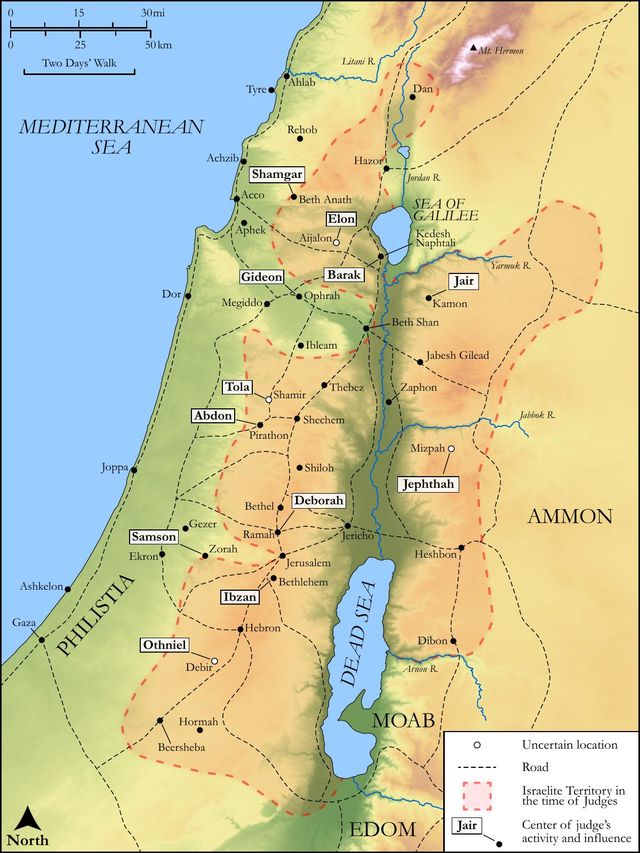
See on the biblical-era map
Study this verse
Public-domain commentary
Matthew Henry
From his Commentary on the Whole Bible. Henry comments on passages, not single verses — this entry covers Judges 2:6–23. His three-level outline is real structure in the source text, so it is rendered as structure.
The beginning of this paragraph is only a repetition of what account we had before of the people's good character during the government of Joshua, and of his death and burial (Jos 24:29, Jos 24:30), which comes in here again only to make way for the following account, which this chapter gives, of their degeneracy and apostasy. The angel had foretold that the Canaanites and their idols would be a snare to Israel; now the historian undertakes to show that they were so, and, that this may appear the more clear, he looks back a little, and takes notice, 1. Of their happy settlement in the land of Canaan. Joshua, having distributed this land among them, dismissed them to the quiet and comfortable possession of it (Jdg 2:6): He sent them away, not only every tribe, but every man to his inheritance, no doubt giving them his blessing. 2. Of their continuance in the faith and fear of God's holy name as long as Joshua lived, Jdg 2:7. As they went to their possessions with good resolutions to cleave to God, so they persisted for some time in these good resolutions, as long as they had good rulers that set them good examples, gave them good instructions, and reproved and restrained the corruptions that crept in among them, and as long as they had fresh in remembrance the great things God did for them when he brought them into Canaan: those that had seen these wonders had so much sense as to believe their own eyes, and so much reason as to serve that God who had appeared so gloriously on their behalf; but those that followed, because they had not seen, believed not. 3. Of the death and burial of Joshua, which gave a fatal stroke to the interests of religion among the people, Jdg 2:8, Jdg 2:9. Yet so much sense they had of their obligations to him that they did him honour at his death, and buried him in Timnath-heres; so it is called here, not, as in Joshua, Timnath-serah. Heres signifies the sun, a representation of which, some think, was set upon his sepulchre, and gave name to it, in remembrance of the sun's standing still at his word. So divers of the Jewish writers say; but I much question whether an image of the sun would be allowed to the honour of Joshua at that time, when, by reason of men's general proneness to worship the sun, it would be in danger of being abused to the dishonour of God. 4. Of the rising of a new generation, Jdg 2:10. All that generation in a few years wore off, their good instructions and examples died and were buried with them, and there arose another generation of Israelites who had so little sense of religion, and were in so little care about it, that, notwithstanding all the advantages of their education, one might truly say that they knew not the Lord, knew him not aright, knew him not as he had revealed himself, else they would not have forsaken him. They were so entirely devoted to the world, so intent upon the business of it or so indulgent of the flesh in ease and luxury, that they never minded the true God and his holy religion, and so were easily drawn aside to false gods and their abominable superstitions.
And so he comes to give us a general idea of the series of things in Israel during the time of the judges, the same repeated in the same order.
I.The people of Israel forsook the God of Israel, and gave that worship and honour to the dunghill deities of the Canaanites which was due to him alone. Be astonished, O heavens! at this, and wonder, O earth! Hath a nation, such a nation, so well fed, so well taught, changed its God, such a God, a God of infinite power, unspotted purity, inexhaustible goodness, and so very jealous of a competitor, for stocks and stones that could do neither good nor evil? Jer 2:11, Jer 2:12. Never was there such an instance of folly, ingratitude, and perfidiousness. Observe how it is described here, Jdg 2:11-13. In general, they did evil, nothing could be more evil, that is, more provoking to God, nor more prejudicial to themselves, and it was in the sight of the Lord; all evil is before him, but he takes special notice of the sin of having any other god. In particular,
1.They forsook the Lord (Jdg 2:12, and again Jdg 2:13); this was one of the two great evils they were guilty of, Jer 2:13. They had been joined to the Lord in covenant, but now they forsook him, as a wife treacherously departs from her husband. "They forsook the worship of the Lord," so the Chaldee: for those that forsake the worship of God do in effect forsake God himself. It aggravated this that he was the God of their fathers, so that they were born in his house, and therefore bound to serve him; and that he brought them out of the land of Egypt, he loosed their bonds, and upon that account also they were obliged to serve him.
2.When they forsook the only true God they did not turn atheists, nor were they such fools as to say, There is no God; but they followed other gods: so much remained of pure nature as to own a God, yet so much appeared of corrupt nature as to multiply gods, and take up with any, and to follow the fashion, not the rule, in religious worship. Israel had the honour of being a peculiar people and dignified above all others, and yet so false were they to their own privileges that they were fond of the gods of the people that were round about them. Baal and Ashtaroth, he-gods and she-gods; they made their court to sun and moon, Jupiter and Juno. Baalim signifies lords, and Ashtaroth blessed ones, both plural, for when they forsook Jehovah, who is one, they had gods many and lords many, as a luxuriant fancy pleased to multiply them. Whatever they took for their gods, they served them and bowed down to them, gave honour to them and begged favours from them.
II.The God of Israel was hereby provoked to anger, and delivered them up into the hand of their enemies, Jdg 2:14, Jdg 2:15.
He was wroth with them, for he is a jealous God and true to the honour of his own name; and the way he took to punish them for their apostasy was to make those their tormentors whom they yielded to as their tempters. They made themselves as mean and miserable by forsaking God as they would have been great and happy if they had continued faithful to him.
1.The scale of victory turned against them. After they forsook God, whenever they took the sword in hand they were as sure to be beaten as before they had been sure to conquer. Formerly their enemies could not stand before them, but, wherever they went, the hand of the Lord was for them; when they began to cool in their religion, God suspended his favour, stopped the progress of their successes, and would not drive out their enemies any more (Jdg 2:3), only suffered them to keep their ground; but now, when they had quite revolted to idolatry, the war turned directly against them, and they could not any longer stand before their enemies. God would rather give the success to those that had never known nor owned him than to those that had done both, but had now deserted him. Wherever they went, they might perceive that God himself had turned to be their enemy, and fought against them, Isa 63:10.
2.The balance of power then turned against them of course. Whoever would might spoil them, whoever would might oppress them. God sold them into the hands of their enemies; not only he delivered them up freely, as we do that which we have sold, but he did it upon a valuable consideration, that he might get himself honour as a jealous God, who would not spare even his own peculiar people when they provoked him. He sold them as insolvent debtors are sold (Mat 18:25), by their sufferings to make some sort of reparation to his glory for the injury it sustained by their apostasy. Observe how their punishment,
(1.)Answered what they had done. They served the gods of the nations that were round about them, even the meanest, and God made then serve the princes of the nations that were round about them, even the meanest. He that is company for every fool is justly made a fool of by every company.
(2.)How it answered what God has spoken. The hand of heaven was thus turned against them, as the Lord had said, and as the Lord had sworn (Jdg 2:15), referring to the curse and death set before them in the covenant, with the blessing and life. Those that have found God true to his promises may thence infer that he will be as true to his threatenings.
III.The God of infinite mercy took pity on them in their distresses, though they had brought themselves into them by their own sin and folly, and wrought deliverance for them. Nevertheless, though their trouble was the punishment of their sin and the accomplishment of God's word, yet they were in process of time saved out of their trouble, Jdg 2:16-18. Here observe,
1.The inducement of their deliverance. It came purely from God's pity and tender compassion; the reason was fetched from within himself. It is not said, It repented them because of their iniquities (for it appears, Jdg 2:17, that many of them continued unreformed), but, It repented the Lord because of their groanings; though it is not so much the burden of sin as the burden of affliction that they are said to groan under. It is true they deserved to perish for ever under his curse, yet, this being the day of his patience and our probation, he does not stir up all his wrath. He might in justice have abandoned them, but he could not for pity do it.
2.The instruments of their deliverance. God did not send angels from heaven to rescue them, nor bring in any foreign power to their aid, but raised up judges from among themselves, as there was occasion, men to whom God gave extraordinary qualifications for, and calls to, that special service for which they were designed, which was to reform and deliver Israel, and whose great attempts he crowned with wonderful success: The Lord was with the judges when he raised them up, and so they became saviours. Observe,
(1.)In the days of the greatest degeneracy and distress of the church there shall be some whom God will either find or make to redress its grievances and set things to rights.
(2.)God must be acknowledged in the seasonable rising up of useful men for public service. He endues men with wisdom and courage, gives them hearts to act and venture. All that are in any way the blessings of their country must be looked upon as the gifts of God.
(3.)Whom God calls he will own, and give them his presence; whom he raises up he will be with.
(4.)The judges of a land are its saviours.
IV.The degenerate Israelites were not effectually and thoroughly reformed, no, not by their judges, Jdg 2:17-19.
1.Even while their judges were with them, and active in the work of reformation, there were those that would not hearken to their judges, but at that very time went a whoring after other gods, so mad were they upon their idols, and so obstinately bent to backslide. They had been espoused to God, but broke the marriage-covenant, and went a whoring after these gods. Idolatry is spiritual adultery, so vile, and base, and perfidious a thing is it, and so hardly are those reclaimed that are addicted to it.
2.Those that in the times of reformation began to amend yet turned quickly out of the way again, and became as bad as ever. The way they turned out of was that which their godly ancestors walked in, and set them out in; but they soon started from under the influence both of their fathers' good example and of their own good education. The wicked children of godly parents do so, and will therefore have a great deal to answer for. However, when the judge was dead, they looked upon the dam which checked the stream of their idolatry as removed, and then it flowed down again with so much the more fury, and the next age seemed to be rather the worse for the attempts that had been made towards reformation, Jdg 2:19. They corrupted themselves more than their fathers, strove to outdo them in multiplying strange gods and inventing profane and impious rites of worship, as it were in contradiction to their reformers. They ceased not from, or, as the word is, they would not let fall, any of their own doings, grew not ashamed of those idolatrous services that were most odious nor weary of those that were most barbarous, would not so much as diminish one step of their hard and stubborn way. Thus those that have forsaken the good ways of God, which they have once known and professed, commonly grow most daring and desperate in sin, and have their hearts most hardened.
V.God's just resolution hereupon was still to continue the rod over them,
1.Their sin was sparing the Canaanites, and this in contempt and violation of the covenant God had made with them and the commands he had given them, Jdg 2:20.
2.Their punishment was that the Canaanites were spared, and so they were beaten with their own rod. They were not all delivered into the hand of Joshua while he lived, Jdg 2:23. Our Lord Jesus, though he spoiled principalities and powers, yet did not complete his victory at first. We see not yet all things put under him; there are remains of Satan's interest in the church, as there were of the Canaanites in the land; but our Joshua lives for ever, and will in the great day perfect his conquest. After Joshua's death, little was done for a long time against the Canaanites: Israel indulged them, and grew familiar with them, and therefore God would not drive them out any more, Jdg 2:21. If they will have such inmates as these among them, let them take them, and see what will come of it. God chose their delusions, Isa 66:4. Thus men cherish and indulge their own corrupt appetites and passions, and, instead of mortifying them, make provision for them, and therefore God justly leaves them to themselves under the power of their sins, which will be their ruin. So shall their doom be; they themselves have decided it. These remnants of the Canaanites were left to prove Israel (Jdg 2:22), whether they would keep the way of the Lord or not; not that God might know them, but that they might know themselves. It was to try,
(1.)Whether they could resist the temptations to idolatry which the Canaanites would lay before them. God had told them they could not, Deu 7:4. But they thought they could. "Well," said God, "I will try you;" and, upon trial, it was found that the tempters' charms were far too strong for them. God has told us how deceitful and desperately wicked our hearts are, but we are not willing to believe it till by making bold with temptation we find it too true by sad experience.
(2.)Whether they would make a good use of the vexations which the remaining natives would give them, and the many troubles they would occasion them, and would thereby be convinced of sin and humbled for it, reformed, and driven to God and their duty, whether by continual alarms from them they would be kept in awe and made afraid of provoking God.
Historical interpretation
Historical reception
2 surviving comments on this verse. Each one is dated, so this reads as a timeline rather than a list.
Select a marker to jump to its quote. Markers stagger vertically where authors wrote within a few decades of each other.
After the death of Joshua the son of Nave [Nun] they forsook the God of their fathers and served idols, Baalim and Ashtaroth; and the Lord in anger delivered them up to the hands of plunderers, and they continued to be plundered by them and to be sold to their adversaries, and [they] could not at all stand before their enemies. Wherever they went forth, his hand was upon them for evil, and they were greatly distressed. And after this God sets judges, the same as our censors, over them. But not even these did they continue steadfastly to obey. So soon as one of the judges died, they proceeded to transgress more than their fathers had done by going after the gods of others and serving and worshiping them. Therefore the Lord was angry. “Since, indeed,” he says, “this nation has transgressed my covenant which I established with their fathers and has not hearkened to my voice, I will not remove from them any of the nations which Joshua left at his death.” And thus, throughout almost all the annals of the judges and of the kings who succeeded them, while the strength of the surrounding nations was preserved, he meted wrath out to Israel by war and captivity and a foreign yoke, as often as they turned aside from him, especially to idolatry.
As long as a people serves God, they are not "delivered into the hands of plunderers." But when they "abandon the Lord" and begin to serve their own passions, then it is said of them that "God gave them over to shameful passions" and, again, "He gave them over to a reprobate mind, that they would do unsuitable things." Why? Because, he says, "they were filled with every iniquity, wickedness, fornication, greed" and all other evils. It was because "they served and worshiped Baal and Ashtaroth" that "God delivered them into the hands of plunderers and handed them over to their enemies." This, as I have often said before, the Jews read as though it were merely a record of past events. We, however, "for whose sake this was written," it is said, ought to know that if we sin against the Lord and against our own souls by indulging the desires of the flesh as though we were worshiping our God, we also betray ourselves and concede our apostolic authority into the hands of Zebulun. Listen, then, to [Paul] speaking about one who sins: "I delivered this man to Satan for the destruction of the flesh, that his spirit might be saved." You can see, therefore, that it was not only through his apostles that God "delivered" sinners "over to their enemies," but even now, through those who govern the church and have the power not only of releasing but also of binding, sinners "are delivered for the destruction of the flesh" when they are separated from the body of Christ for their crimes.
Continue studying Judges 2:14 across the web’s major study libraries — every link below opens this exact verse, chapter, or book on the destination site.
Read & Compare
 BibleGatewayThis verse in more than 200 translations and 70 languages.
 Bible.comThe YouVersion reader — hundreds of translations, reading plans, and highlights.
 ESV.orgCrossway's official English Standard Version reader.
 NET BibleThe NET translation with 60,000+ translators' notes on every rendering decision.
 STEP BibleTyndale House's free study tool — original text, vocabulary, and scholarly resources.
 BibliaLogos Bible Software's free web reader.
 USCCBThe New American Bible (Revised Edition) with the U.S. bishops' study notes.
Commentaries
 BibleHub CommentariesDozens of classic commentaries on this verse, gathered on one page.
 StudyLightMore than 100 commentary sets — the largest collection on the web.
 BibleRefPlain-English commentary on what this verse means, verse by verse.
 Enduring WordDavid Guzik's free commentary on this chapter, widely used by Bible teachers.
 Bible Study ToolsVerse commentary alongside Greek and Hebrew study aids.
Original Language & Research
- BibleHub InterlinearThe verse word by word — original language, transliteration, and English.
- BibleHub LexiconEvery word's original-language definition and Strong's entry.
 Blue Letter BibleDeep-study tools — Strong's numbers, concordance, and word studies.
 SefariaThe Hebrew text with Rashi and centuries of Jewish commentary.
Sermons, Hymns & Audio


TrulyRandomVerse is not affiliated with these sites and doesn’t control their content. They’re linked because they’re genuinely useful.
Summary
Judges 2:14 starkly portrays the severe and direct consequences Israel faced due to their persistent spiritual rebellion and idolatry. It marks a critical juncture where the LORD's righteous indignation, ignited by Israel's abandonment of their covenant with Him, led to His active withdrawal of protection. Consequently, God delivered them into the hands of plunderers and sold them into the power of their surrounding enemies, rendering them utterly helpless and unable to resist. This verse powerfully inaugurates the recurring cycle of apostasy, divine judgment, and subsequent oppression that defines the historical period of the Judges.
Context
ShowHideLiterary Context
This verse is a pivotal theological statement following a tragic spiritual decline in Israel's post-Joshua era. Judges 2:6-10 recounts the passing of Joshua and the generation that faithfully served the LORD. Critically, Judges 2:11-13 then introduces a new generation that "did not know the LORD or the works that he had done for Israel," leading them to forsake the covenant God and worship the Canaanite deities, Baal and Ashtaroth. Judges 2:14, therefore, serves as the divine explanation and direct consequence of this profound spiritual apostasy. It establishes the theological framework for the entire book of Judges, explaining why Israel repeatedly experienced cycles of oppression and setting the stage for the subsequent narratives of judges raising up to deliver them from the very enemies God had "sold" them to. This verse is not an isolated event but the foundational principle for the unfolding narrative.
Historical & Cultural Context
The period of the Judges (approximately 14th to 11th centuries BC) was characterized by a decentralized tribal confederation in Canaan, lacking a strong central government or consistent spiritual leadership. Israel was surrounded by various Canaanite peoples who adhered to polytheistic fertility cults, particularly those of Baal and Asherah (often associated with Ashtaroth). These cults were deeply embedded in the local agrarian society, promising agricultural abundance, and thus presented a constant, alluring temptation for Israel, who were explicitly commanded to eradicate these pagan practices and peoples from the land (e.g., Deuteronomy 7:1-5). The concept of a deity "selling" a people into the hands of their enemies was a recognized motif in the ancient Near East, signifying a complete divine abandonment and subjugation, typically as a result of a broken covenant. For Israel, this was a direct and terrifying fulfillment of the curses outlined in the Mosaic Law for covenant disobedience (e.g., Deuteronomy 28:15-68).
Key Themes
ShowHideJudges 2:14 is foundational to several overarching themes that permeate the book of Judges. Foremost is the theme of Divine Displeasure and Judgment, demonstrating that God's "hot anger" is a holy and just response to covenant unfaithfulness and idolatry, not an arbitrary outburst. This leads directly to the theme of Consequences of Disobedience, where God's protective hand and favor are shown to be conditional upon Israel's faithfulness to their covenant. When Israel turned away, God withdrew His divine assistance, allowing their enemies to prevail. The devastating outcome, "they could not any longer stand before their enemies," powerfully underscores the theme of Israel's Utter Dependence on God. Their strength, victory, and even survival were not rooted in their military might or numbers, but solely in their covenant relationship with the LORD. Without His divine assistance, they were powerless against the very nations they were commanded to conquer. This verse thus initiates the infamous Cycle of Sin, Suffering, Supplication, and Salvation that structures the entire narrative arc of Judges, revealing God's pattern of discipline and eventual deliverance.
Exposition and Analysis
ShowHideKey Word Analysis
ShowHideThis term literally refers to the "nose" or "nostril," but figuratively, and especially when used in connection with God, it denotes fierce wrath or indignation, often indicated by rapid breathing or flaring nostrils. In Judges 2:14, it signifies God's intense, righteous displeasure and holy indignation against Israel's deliberate and persistent covenant breaking and idolatry. It is not a capricious emotion but a just response from a holy God to sin.
A primitive root meaning "to glow or grow warm," this verb is frequently used figuratively to describe the kindling or blazing up of intense emotions, particularly anger, zeal, or jealousy. When applied to the LORD's anger, as here, it conveys the consuming, burning nature of His righteous wrath. It emphasizes the severity and intensity of God's indignation, indicating that His patience had been exhausted by Israel's repeated provocations.
This verb means "to sell," either literally (as merchandise, a daughter in marriage, or into slavery) or figuratively (to surrender). In this context, it is a powerful and vivid metaphor indicating complete surrender, abandonment, and subjugation. When God "sold" Israel into the hands of their enemies, it implies that they were treated as property or slaves by their adversaries, utterly losing their freedom and autonomy. This metaphor underscores the severity of their subjugation and serves as a direct parallel to their spiritual enslavement to foreign gods, highlighting the profound irony of their situation.
Verse Breakdown
ShowHide"And the anger of the LORD was hot against Israel"
This initial clause establishes the divine cause of Israel's suffering. God's righteous indignation was kindled to an intense degree due to Israel's profound spiritual rebellion, specifically their abandonment of Him and their worship of foreign gods, as detailed in the preceding verses (Judges 2:11-13). This "hot anger" is a just and holy response to their deliberate covenant breaking and spiritual infidelity.
"and he delivered them into the hands of spoilers that spoiled them"
As a direct consequence of His burning anger, God actively removed His protective hand from Israel. The verb "delivered" (Hebrew: nātan) emphasizes God's sovereign agency; He "handed them over" or "gave them up" to hostile groups—raiders and plunderers—who then exploited and robbed them of their resources and security. This demonstrates God's direct involvement in orchestrating the consequences of their disobedience.
"and he sold them into the hands of their enemies round about"
This phrase intensifies the previous one, using the powerful metaphor of "selling" to convey a more complete and severe form of subjugation. It implies that Israel was treated as property, losing their freedom and becoming utterly subservient to the surrounding nations who were hostile to them. This "selling" signifies a profound loss of national identity, divine favor, and autonomy, a direct result of their spiritual "selling out" to idols. The phrase "round about" emphasizes the pervasive nature of their oppression.
"so that they could not any longer stand before their enemies"
This final clause describes the devastating and humiliating outcome of God's judgment. Israel was rendered utterly weak, vulnerable, and defeated. They lacked the strength, unity, or divine assistance necessary to resist or overcome their adversaries. This highlights their absolute dependence on God for their strength and success, and the tragic reality of their powerlessness when His favor was withdrawn, leaving them exposed and defeated.
Literary Devices
ShowHideJudges 2:14 masterfully employs several literary devices to convey its powerful and sobering message. Anthropomorphism is clearly evident in the phrase "the anger of the LORD was hot," attributing a human emotion (anger) and a physical sensation (heat, burning) to God to help the audience grasp the intensity and righteous nature of His indignation. The powerful phrase "he sold them into the hands of their enemies" functions as a striking metaphor, likening Israel's complete subjugation to the act of being sold as property or slaves. This vividly emphasizes their profound loss of freedom, dignity, and autonomy. This also introduces a profound irony, as Israel, chosen by God to conquer and possess the land, became dispossessed and enslaved by the very nations they were meant to overcome. The verse is structured primarily by cause and effect, clearly delineating Israel's sin (implied by God's anger) as the cause, and their subjugation and defeat as the direct, divinely orchestrated effect. The repetition of similar concepts, such as being "delivered" and "sold" into the "hands of spoilers" and "hands of their enemies," creates powerful emphasis, reinforcing the totality, severity, and inescapable nature of God's judgment.
Theological and Thematic Connections
ShowHideJudges 2:14 profoundly illustrates the immutable character of God as both holy and just, who responds to sin and covenant unfaithfulness with righteous anger and judgment. It underscores the foundational biblical principle that disobedience to God's commands carries severe and tangible consequences, demonstrating that His protection, blessing, and empowering presence are intrinsically linked to a people's faithfulness to His covenant. This verse also highlights God's absolute sovereignty, showing that He is actively involved in the affairs of humanity, even to the extent of using hostile nations as instruments of His divine purpose to discipline His people and call them back to Himself. While the immediate outcome is suffering and defeat, the larger narrative of Judges reveals that God's judgment is often a prelude to His mercy, designed not for destruction but to bring about repentance and restoration, demonstrating His enduring love and faithfulness even amidst His justice.
Reflection and Application
ShowHideJudges 2:14 serves as a timeless and sobering reminder that there are profound and often painful consequences for spiritual rebellion and disobedience, both for individuals and communities. It compels us to examine our own lives and societies for areas where we might be subtly or overtly "selling ourselves" into bondage by prioritizing worldly desires, material possessions, self-gratification, or even human ideologies over our relationship with God and adherence to His revealed will. The verse challenges us to consider what "spoilers" or "enemies"—whether spiritual strongholds, destructive habits, or cultural pressures—might be gaining ground in our lives because we have, perhaps subtly, allowed our devotion to grow cold or our covenant with God to be neglected. It underscores the critical importance of spiritual vigilance, consistent faithfulness, and an active, vibrant pursuit of God's presence. Our ability to "stand" against the spiritual battles and challenges of life is directly tied to our walk with the LORD; when we forsake Him, we forfeit His divine protection and empowering presence, leaving us vulnerable and defeated. This verse calls us to a renewed commitment to God, recognizing that true strength, security, and victory are found only in Him, and that faithfulness is not merely a duty but the pathway to flourishing.
Questions for Reflection
ShowHideFAQ
ShowHideWas God's anger arbitrary or capricious in Judges 2:14?
ShowHideNo, God's anger described in Judges 2:14 was not arbitrary or capricious but a righteous and just response to Israel's deliberate and persistent covenant unfaithfulness and idolatry. The preceding verses (Judges 2:11-13) clearly state that Israel "forsook the LORD" and "served the Baals and the Ashtaroth." God had explicitly warned them in the Mosaic Law (e.g., Deuteronomy 28:15-68) about the severe consequences of such disobedience. His anger was a holy indignation against sin that violated the sacred covenant He had established with them, demonstrating His unwavering commitment to His own character, His holiness, and His covenant promises. It was a measured and just response to their deliberate rebellion.
What does it mean that God "sold them into the hands of their enemies"?
ShowHideThe phrase "sold them" is a powerful metaphor, not a literal transaction in the sense of a commercial exchange. It signifies a complete and utter surrender or abandonment of Israel to the power of their adversaries. In the ancient Near East, being "sold" often implied becoming a slave or a captive, losing all freedom, dignity, and autonomy. Here, it illustrates that God withdrew His divine protection and actively allowed Israel to become utterly subjugated and exploited by their surrounding enemies. It underscores the severity of their punishment and highlights the profound irony: by spiritually "selling themselves" to false gods and abandoning the true God, they were justly "sold" into physical bondage and oppression by the very God they had forsaken. This emphasizes the direct link between their spiritual idolatry and their physical oppression.
Does God still get "hot" with anger today, and how does this relate to believers?
ShowHideYes, God's character is unchanging, and His holiness still responds to sin with righteous anger (e.g., Romans 1:18). While the specific outworking of His judgment differs under the New Covenant, the principle of divine displeasure against unrighteousness remains. For believers in Christ, the "hot anger" of God against sin was fully poured out upon Jesus on the cross (e.g., Isaiah 53:5-6). Therefore, those who are "in Christ" are no longer under the condemnation of God's wrath (e.g., Romans 8:1). However, God still disciplines His children out of love (e.g., Hebrews 12:5-11) and expects faithfulness. There are natural and spiritual consequences for disobedience even for believers, though not the same wrath of condemnation that unbelievers face.
Christ-Centered Fulfillment
ShowHideJudges 2:14, with its stark depiction of God's "hot anger" and Israel's utter inability to "stand before their enemies," powerfully foreshadows humanity's universal predicament and ultimate need for a divine deliverer. Israel's cyclical pattern of sin, subjugation, and cries for help reveals a deeper spiritual truth: humanity, in its fallen state, is perpetually prone to forsake God, leading to spiritual bondage and an inability to stand against the true enemies of sin, death, and the devil. The "anger of the LORD" against Israel's idolatry points to God's righteous wrath against all ungodliness and unrighteousness, a wrath that is universally revealed from heaven (as seen in Romans 1:18). Yet, in the person of Jesus Christ, we find the ultimate fulfillment and resolution to this ancient cycle of judgment and bondage. Jesus, the perfect Lamb of God, willingly bore the full brunt of God's "hot anger" on the cross, becoming the atoning sacrifice for the sins of the world (as declared in John 1:29 and profoundly explained in 2 Corinthians 5:21). Through His substitutionary sacrifice, believers are no longer "sold into the hands of their enemies" (sin and death), but are redeemed, set free from the dominion of darkness, and transferred into the kingdom of His beloved Son (as taught in Colossians 1:13-14). Furthermore, where Israel could not "stand before their enemies" in their own strength, Christ enables His followers to "stand firm" in the face of spiritual opposition, clothed in His righteousness and empowered by His Spirit (as exhorted in Ephesians 6:13). Thus, Judges 2:14 ultimately points to the profound necessity and glorious sufficiency of Christ as our only true deliverer from divine judgment and spiritual defeat.