


Judges 2:3
- וְגַםve·Gamand alsoH1571Conj-w ¦ AdvAdverbוְandגַםalso
- אָמַרְתִּי'a·Mar·tiI sayH559V-Qal-Perf-1csVerb Qal Perfect 1st Singular common gender
- לֹאlo'notH3808NegParticle Negative
- אֲגָרֵשׁ'a·ga·ReshI will drive outH1644V-Piel-Imperf-1csVerb Piel Imperfect 1st Singular common gender
- אוֹתָם'o·Tam<obj.> themH853DirObjM ¦ 3mpParticle Object Indicatorאוֹתָ<obj.>םthem
- מִפְּנֵיכֶםmi·pe·nei·Khemfrom before youH6440Prep-m ¦ N-mpc ¦ 2mpNoun Plural Masculine Constructמִfromפְּנֵיbeforeכֶםyou
- וְהָיוּve·ha·Yuand they will becomeH1961Conj-w ¦ V-Qal-ConsecPerf-3cpVerb Qal Consecutive Perfect 3rd Plural common genderוְandהָיוּthey will become
- לָכֶםla·Khemfor <the> youPrep-l ¦ 2mpSuffix Personal 2nd Plural Masculineלָfor <the>כֶםyou
- לְצִדִּיםle·tzi·Dim<into> sidesH6654Prep-l ¦ N-mpNoun Plural Masculine Absoluteלְ<into>צִדִּיםsides
- וֵאלֹהֵיהֶםve·Lo·hei·Hemand their godsH430Conj-w ¦ N-mpc ¦ 3mpNoun Plural Masculine Constructוֵandאלֹהֵיgodsהֶםtheir
- יִהְיוּyih·Yuthey will becomeH1961V-Qal-Imperf-3mpVerb Qal Imperfect 3rd Plural Masculine
- לָכֶםla·Khemfor <the> youPrep-l ¦ 2mpSuffix Personal 2nd Plural Masculineלָfor <the>כֶםyou
- לְמוֹקֵשׁle·mo·Kesh<into> a snareH4170Prep-l ¦ N-msNoun Singular Masculine Absoluteלְ<into>מוֹקֵשׁa snare
English is a literal word-by-word gloss of the Hebrew, not the KJV's wording. Why?
This is the original text the KJV's translators worked from — each Hebrew word with its own literal English meaning in this verse, prepared by scholars at Tyndale House, Cambridge. The KJV translates whole sentences, not word by word, so its wording differs: one Hebrew word can become several English words, and the KJV may choose “the LORD” where the gloss reads “Yahweh”. Both are faithful — they answer different questions. For the KJV's own rendering, switch to the KJV text.
Details
See on the biblical-era map
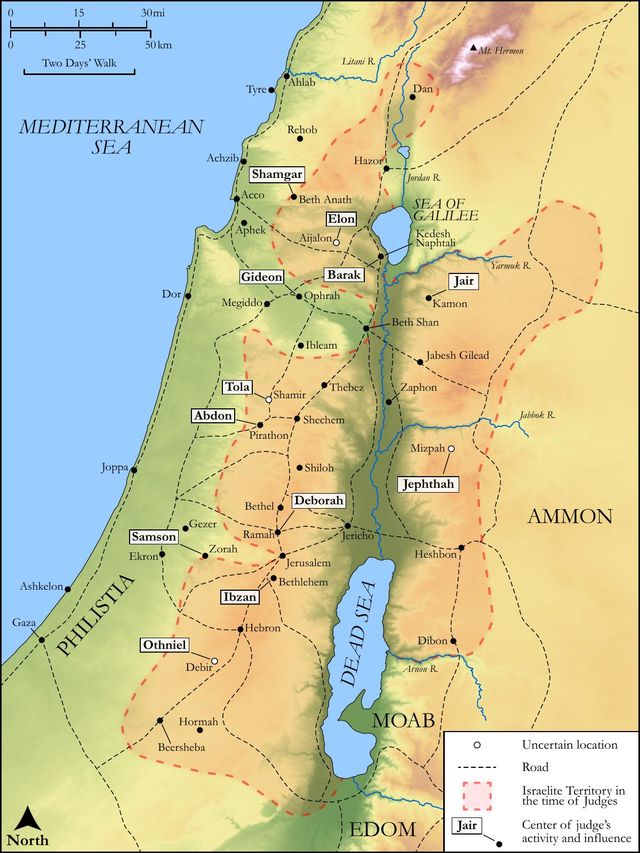
Study this verse
Public-domain commentary
Matthew Henry
From his Commentary on the Whole Bible. Henry comments on passages, not single verses — this entry covers Judges 2:1–5. His three-level outline is real structure in the source text, so it is rendered as structure.
It was the privilege of Israel that they had not only a law in general sent them from heaven, once for all, to direct them into and keep them in the way of happiness, but that they had particular messages sent them from heaven, as there was occasion, for reproof, for correction, and for instruction in righteousness, when at any time they turned aside out of that way. Besides the written word which they had before them to read, they often heard a word behind them, saying, This is the way, Isa 30:21. Here begins that way of God's dealing with them. When they would not hear Moses, let it be tried whether they will hear the prophets. In these verses we have a very awakening sermon that was preached to them when they began to cool in their religion.
I.The preacher was an angel of the Lord (Jdg 2:1), not a prophet, not Phinehas, as the Jews conceit; gospel ministers are indeed called angels of the churches, but the Old Testament prophets are never called angels of the Lord; no doubt this was a messenger we from heaven. Such extraordinary messengers we sometimes find in this book employed in the raising up of the judges that delivered Israel, as Gideon and Samson; and now, to show how various are the good offices they do for God's Israel, here is one sent to preach to them, to prevent their falling into sin and trouble. This extraordinary messenger was sent to command, if possible, the greater regard to the message, and to affect the minds of a people whom nothing seemed to affect but what was sensible. The learned bishop Patrick is clearly of opinion that this was not a created angel, but the Angel of the covenant, the same that appeared to Joshua as captain of the hosts of the Lord, who was God himself. Christ himself, says Dr. Lightfoot; who but God and Christ could say, I made you to go up out of Egypt? Joshua had lately admonished them to take heed of entangling themselves with the Canaanites, but they regarded not the words of a dying man; the same warning therefore is here brought them by the living God himself, the Son of God appearing as an angel. If they slight his servants, surely they will reverence his Son. This angel of the Lord is said to come up from Gilgal, perhaps not walking on the earth, but flying swiftly, as the angel Gabriel did to Daniel, in the open firmament of heaven; but, whether walking or flying, he seemed to come from Gilgal for a particular reason. Gilgal was long their headquarters after they came into Canaan, many signal favours they had there received from God, and there the covenant of circumcision was renewed (Mic 6:5), of all which it was designed they should be reminded by his coming from Gilgal. The remembrance of what we have received and heard will prepare us for a warning to hold fast, Rev 3:2, Rev 3:3.
II.The persons to whom this sermon was preached were all the children of Israel, Jdg 2:4.
A great congregation for a great preacher! They were assembled either for war, each tribe sending in its forces for some great expedition, or rather for worship, and then the place of their meeting must be Shiloh, where the tabernacle was, at which they were all to come together three times a year. When we attend upon God in instituted ordinances we may expect to hear from him, and to receive his gifts at his own gates. The place is called Bochim (Jdg 2:1), because it gained that name upon this occasion. All Israel needed the reproof and warning here given, and therefore it is spoken to them all.
III.The sermon itself is short, but very close. God here tells them plainly,
1.What he had done for them, Jdg 2:1. He had brought them out of Egypt, a land of slavery and toil, into Canaan, a land of rest, liberty, and plenty. The miseries of the one served as a foil to the felicities of the other. God had herein been kind to them, true to the oath sworn to their fathers, had given such proofs of his power as left them inexcusable if they distrusted it, and such engagements to his service as left them inexcusable if they deserted it.
2.What he had promised them: I said, I will never break my covenant with you. When he took them to be his peculiar people, it was not with any design to cast them off again, or to change them for another people at his pleasure; let them but be faithful to him, and they should find him unchangeably constant to them. He told them plainly that the covenant he entered into with them should never break, unless it broke on their side.
3.What were his just and reasonable expectations from them (Jdg 2:2): that being taken into covenant with God they should make no league with the Canaanites, who were both his enemies and theirs, - that having set up his altar they should throw down their altars, lest they should be a temptation to them to serve their gods. Could any thing be demanded more easy?
4.How they had in this very thing, which he had most insisted on, disobeyed him: "But you have not in so small a matter obeyed my voice." In contempt of their covenant with God, and their confederacy with each other in that covenant, they made leagues of friendship with the idolatrous devoted Canaanites, and connived at their altars, though they stood in competition with God's. "Why have you done this? What account can you give of this perverseness of yours at the bar of right reason? What apology can you make for yourselves, or what excuse can you offer?" Those that throw off their communion with God, and have fellowship with the unfruitful works of darkness, know not what they do now, and will have nothing to say for themselves in the day of account shortly.
5.How they must expect to smart by and by for this their folly, Jdg 2:3. Their tolerating the Canaanites among them would,
(1.)Put a period to their victories: "You will not drive them out," says God, "and therefore I will not;" thus their sin was made their punishment. Thus those who indulge their lusts and corruptions, which they should mortify, forfeit the grace of God, and it is justly withdrawn from them. If we will not resist the devil, we cannot expect that God should tread him under our feet.
(2.)It would involve them in continual troubles. "They shall be thorns in your sides to gore you, which way soever you turn, always doing you one mischief or other." Those deceive themselves who expect advantage by friendship with those that are enemies to God.
(3.)It would (which was worst of all) expose them to constant temptation and draw them to sin. "Their gods" (their abominations, so the Chaldee) "will be a snare to you; you will find yourselves wretchedly entangled in an affection to them, and it will be your ruin," so some read it. Those that approach sin are justly left to themselves to fall into sin and to perish in it. God often makes men's sin their punishment; and thorns and snares are in the way of the froward, who will walk contrary to God.
IV.The good success of this sermon is very remarkable: The people lifted up their voice and wept, Jdg 2:4.
1.The angel had told them of their sins, for which they thus expressed their sorrow: the lifted up their voice in confession of sin, crying out against their own folly and ingratitude, and wept, as those that were both ashamed of themselves and angry at themselves, as having acted so directly contrary both to their reason and to their interest.
2.The angel had threatened them with the judgments of God, of which they thus expressed their dread: they lifted up their voice in prayer to God to turn away his wrath from them, and wept for fear of that wrath. They relented upon this alarm, and their hearts melted within them, and trembled at the word, and not without cause. This was good, and a sign that the word they heard made an impression upon them: it is a wonder sinners can ever read their Bible with dry eyes. But this was not enough; they wept, but we do not find that they reformed, that they went home and destroyed all the remains of idolatry and idolaters among them. Many are melted under the word that harden again before they are cast into a new mould. However, this general weeping,
(1.)Gave a new name to the place (Jdg 2:5): they called it Bochim, Weepers, a good name for our religious assemblies to answer. Had they kept close to God and their duty, no voice but that of singing would have been heard in their congregation; but by their sin and folly the had made other work for themselves, and now nothing is to be heard but the voice of weeping.
(2.)It gave occasion for a solemn sacrifice: They sacrificed there unto the Lord, having (as is supposed) met at Shiloh, where God's altar was. They offered sacrifice to turn away God's wrath, and to obtain his favour, and in token of their dedication of themselves to him, and to him only, making a covenant by this sacrifice. The disease being thus taken in time, and the physic administered working so well, one would have hoped a cure might be effected. But by the sequel of the story it appears to have been too deeply rooted to be wept out.
Continue studying Judges 2:3 across the web’s major study libraries — every link below opens this exact verse, chapter, or book on the destination site.
Read & Compare
 BibleGatewayThis verse in more than 200 translations and 70 languages.
 Bible.comThe YouVersion reader — hundreds of translations, reading plans, and highlights.
 ESV.orgCrossway's official English Standard Version reader.
 NET BibleThe NET translation with 60,000+ translators' notes on every rendering decision.
 STEP BibleTyndale House's free study tool — original text, vocabulary, and scholarly resources.
 BibliaLogos Bible Software's free web reader.
 USCCBThe New American Bible (Revised Edition) with the U.S. bishops' study notes.
Commentaries
 BibleHub CommentariesDozens of classic commentaries on this verse, gathered on one page.
 StudyLightMore than 100 commentary sets — the largest collection on the web.
 BibleRefPlain-English commentary on what this verse means, verse by verse.
 Enduring WordDavid Guzik's free commentary on this chapter, widely used by Bible teachers.
 Bible Study ToolsVerse commentary alongside Greek and Hebrew study aids.
Original Language & Research
- BibleHub InterlinearThe verse word by word — original language, transliteration, and English.
- BibleHub LexiconEvery word's original-language definition and Strong's entry.
 Blue Letter BibleDeep-study tools — Strong's numbers, concordance, and word studies.
 SefariaThe Hebrew text with Rashi and centuries of Jewish commentary.
Sermons, Hymns & Audio


TrulyRandomVerse is not affiliated with these sites and doesn’t control their content. They’re linked because they’re genuinely useful.
Summary
Judges 2:3 presents a solemn divine declaration of judgment against the Israelites, pronounced by the Angel of the Lord. It reveals God's consequence for Israel's failure to fully obey His command to dispossess the Canaanite inhabitants of the Promised Land. This pivotal verse decrees that the remaining peoples would become a perpetual source of affliction, and their idolatrous practices a spiritual trap, thereby explaining the recurring cycles of sin, oppression, and partial deliverance that characterize the entire Book of Judges.
Context
ShowHideLiterary Context
Judges 2:3 immediately follows a profound rebuke delivered by the Angel of the Lord at Bochim, a place aptly named "weepers" due to the Israelites' response to the divine message. The preceding verses, specifically Judges 2:1-2, recount the Angel's reminder of God's unwavering covenant faithfulness in bringing Israel into Canaan and His explicit, non-negotiable command to make no covenant with the land's inhabitants and to dismantle their altars. Israel's documented failure to adhere to this command, vividly detailed in the preceding chapter Judges 1, directly precipitates the severe divine judgment articulated in verse 3. This verse functions as the theological linchpin for the entire book, establishing the narrative framework that explains Israel's subsequent cycles of apostasy, divine punishment, and eventual, though often temporary, deliverance through judges.
Historical & Cultural Context
The period of the Judges represents a tumultuous transitional era for Israel, following the unified conquest under Joshua. Rather than a cohesive nation, Israel existed as a loose confederation of tribes, each struggling to secure and settle its allotted territory. The Canaanites, deeply rooted in the land, practiced a polytheistic religion centered on fertility cults, particularly the worship of Baal and Asherah, which often involved ritual prostitution, child sacrifice, and other abhorrent practices. God's repeated command to utterly dispossess these peoples, as found in passages like Deuteronomy 7:2-5, was not arbitrary but essential for Israel's spiritual purity, covenant fidelity, and distinct identity as Yahweh's chosen people. Israel's failure to complete the conquest was a profound act of disobedience, driven by a lack of faith, complacency, or even a pragmatic desire to exploit Canaanite labor or resources, rather than trusting in God's power and provision.
Key Themes
ShowHideJudges 2:3 is rich with foundational themes that reverberate throughout biblical narrative. It powerfully illustrates the theme of Divine Judgment and Consequences, demonstrating that God's covenant blessings are contingent upon obedience, and that disobedience inevitably invites divine discipline. What was initially a command for Israel's protection and purity now becomes a punitive measure. The verse also underscores the Danger of Compromise, highlighting that partial obedience is, in God's sight, a form of rebellion. Israel's failure to fully eradicate the Canaanites led to a spiritual erosion, a direct violation of covenant stipulations outlined in texts such as Exodus 23:32-33. Furthermore, the warning that "their gods shall be a snare unto you" emphasizes the pervasive theme of the Spiritual Snare of Idolatry. This foreshadows the repeated cycles of Israel abandoning Yahweh to worship foreign deities, as explicitly detailed later in the chapter, for instance, in Judges 2:11-13. Finally, the vivid metaphor of "thorns in your sides" portrays the theme of Persistent Trouble and Opposition, signifying the ongoing irritation, conflict, and harassment Israel would endure from these unconquered peoples.
Exposition and Analysis
ShowHideKey Word Analysis
ShowHideThis primitive root signifies to expel, cast out, or divorce someone from a possession. In this context, it refers to God's command for Israel to completely dispossess the Canaanite inhabitants from the land. The divine declaration "I will not drive them out" signifies God's withdrawal of His active assistance in this task, directly linking Israel's failure to obey with the cessation of divine aid in the conquest.
This word literally means "side" or "flank." In the KJV, the phrase "as thorns in your sides" is an interpretive rendering that captures the metaphorical meaning. The literal "sides" here are used to convey a constant, irritating, and painful presence, much like a thorn continually pricking the body. It denotes a persistent source of annoyance, affliction, and obstruction, preventing peace or progress.
This term refers to a noose or trap used for catching animals. Figuratively, it denotes something that leads one into ruin, moral entanglement, or spiritual captivity. In Judges 2:3, the "snare" specifically refers to the idolatrous practices and false worship of the Canaanite gods, which would prove an irresistible temptation, leading Israel into spiritual apostasy and its devastating consequences.
Verse Breakdown
ShowHide"Wherefore I also said, I will not drive them out from before you;"
This clause marks a pivotal moment of divine judgment. The phrase "I also said" emphasizes that this is a direct, authoritative pronouncement from God, a fixed decree. Because Israel failed to fulfill their covenant obligation to dispossess the Canaanites, God declares that He will no longer provide the supernatural assistance necessary for their expulsion. This is not a change in God's character but a just and righteous consequence of Israel's unfaithfulness, demonstrating that divine blessing and aid are conditional upon human obedience and trust.
"but they shall be [as thorns] in your sides,"
This is the first, immediate consequence of God's withdrawal of assistance. The unconquered Canaanites, whom Israel tolerated, would become a perpetual source of trouble and affliction. The metaphor of "thorns in your sides" vividly communicates a constant, irritating, and painful presence that would hinder Israel's peace and prosperity. These remaining peoples would harass, oppress, and serve as a constant reminder of Israel's failure to fully obey, preventing them from fully enjoying their promised inheritance.
"and their gods shall be a snare unto you."
This is the second and arguably more severe consequence, highlighting the spiritual danger. The physical presence of the Canaanites directly leads to the spiritual threat of their deities. Their idolatrous practices, initially tolerated, would become a "snare"—a deceptive trap that would ensnare Israel in spiritual apostasy. This underscores the insidious nature of compromise: tolerating paganism inevitably leads to participating in it, drawing Israel away from the exclusive worship of the one true God and into cycles of sin, judgment, and oppression.
Literary Devices
ShowHideJudges 2:3 masterfully employs several potent literary devices to convey its stark message of divine judgment and its consequences. The most striking is Metaphor, particularly in the phrase "thorns in your sides." This vivid image transforms the abstract concept of persistent trouble and affliction into a tangible, painful reality, making the consequences of disobedience immediately relatable and impactful for the audience. The term "snare" functions as powerful Symbolism, where a physical trap represents the insidious spiritual danger of idolatry and the moral entanglement it brings. This is a recurring biblical motif, highlighting the deceptive and destructive nature of sin when one deviates from God's path. Furthermore, the entire verse is presented as a Divine Pronouncement or Prophecy, delivered with absolute authority by the Angel of the Lord. The direct, declarative nature of God's statement ("I also said, I will not drive them out...") emphasizes the certainty and irrevocability of the consequences, setting the stage for the recurring narrative cycles of the Book of Judges.
Theological and Thematic Connections
ShowHideJudges 2:3 serves as a profound theological statement on the gravity of covenant disobedience and the principle that God's blessings are contingent upon faithfulness. It powerfully illustrates God's unyielding justice and His commitment to holding His people accountable for their choices. While God had faithfully promised Israel the land, their failure to fulfill their part of the covenant—namely, to utterly dispossess the inhabitants—meant that the full realization of that promise would be hindered and marred by persistent conflict and spiritual corruption. This verse highlights the insidious nature of spiritual compromise: what begins as a tolerated presence quickly escalates into a corrupting influence and a spiritual trap. It teaches that half-hearted or partial obedience is, in essence, a form of rebellion against God's perfect will, and that the consequences of such rebellion often involve the very things we refuse to deal with becoming our greatest adversaries. It is a timeless lesson in the necessity of radical, uncompromising obedience and the grave dangers of syncretism, where the worship of God is mixed with worldly or pagan practices.
Reflection and Application
ShowHideJudges 2:3 stands as a timeless and sobering warning for believers today, underscoring the critical importance of wholehearted obedience and the insidious dangers of spiritual compromise. Just as ancient Israel was called to decisively dispossess the Canaanites to secure their inheritance and maintain spiritual purity, so too are Christians called to decisively deal with sin, worldly influences, and spiritual apathy in their lives. Lingering areas of disobedience, unaddressed sinful habits, or unmortified flesh can become "thorns in our sides," causing persistent spiritual struggles, hindering our growth in grace, and robbing us of the peace, joy, and abundant life found in a full and unhindered relationship with Christ. Furthermore, worldly attitudes, cultural temptations, or false teachings can subtly become a "snare," drawing us away from singular devotion to God and entangling us in destructive patterns that compromise our witness and diminish our spiritual vitality. This verse profoundly challenges us to examine our lives for any areas where we have made "covenants" with the world, tolerating what God explicitly calls us to eradicate or renounce. True freedom, spiritual vitality, and the fullness of God's blessings come not from partial or convenient obedience, but from a radical, uncompromising commitment to follow Him in every area of our lives, trusting that His commands are always for our ultimate good and protection.
Questions for Reflection
ShowHideFAQ
ShowHideWhy didn't God simply drive out the Canaanites later if Israel failed?
ShowHideGod's actions in Judges 2:3 are not a sign of His inability or a change in His power, but rather a profound demonstration of His justice, His commitment to human responsibility, and the nature of His covenant with Israel. God had already provided Israel with the power and opportunity to drive out the Canaanites, as evidenced by their initial successes under Joshua's leadership and the clear commands given in the Torah (e.g., Deuteronomy 9:4-5). Their failure was a direct act of disobedience and a profound lack of faith in God's provision and command. By declaring, "I will not drive them out from before you," God holds Israel accountable for their choices and demonstrates that His blessings and active assistance are often conditional upon human faithfulness to His commands. The ongoing presence of the Canaanites served as a constant reminder of Israel's failure and the painful consequences of compromising with sin, ultimately teaching them through suffering the lessons of their apostasy and the insidious nature of idolatry. This divine withdrawal of assistance highlights a crucial biblical principle: while God is sovereign, He also works through human obedience and holds His people responsible for their actions within the covenant relationship.
Christ-Centered Fulfillment
ShowHideJudges 2:3, with its stark portrayal of Israel's failure to fully obey and the resulting "thorns" and "snares," powerfully underscores humanity's deep need for a perfect deliverer and a new, more enduring covenant. Israel's repeated inability to fully dispossess their spiritual enemies and their subsequent entanglement in idolatry vividly illustrate the futility of human effort to achieve spiritual purity or lasting victory apart from divine grace. This verse highlights humanity's inherent weakness, our propensity to compromise, and our desperate need for a radical transformation that only Christ can provide. Jesus, the true and greater Israel, perfectly fulfilled the obedience that the nation of Israel failed to render. He did not compromise with the "thorns" of temptation or the "snares" of sin; rather, He perfectly resisted them, even to the point of death on the cross. Through His atoning work, Christ disarmed the spiritual powers that would ensnare us Colossians 2:13-15, freeing us from the "snare" of sin and death John 8:34-36. The "thorns" in our sides, representing the lingering effects of the flesh and the world's temptations, are now battled not in our own strength, but by the power of the indwelling Holy Spirit, who empowers us to walk in newness of life and overcome sin Galatians 5:16-17. In Christ, believers receive a complete spiritual inheritance, not one hindered by unconquered enemies, for He has conquered all things, enabling us to run the race set before us, fixing our eyes on Him, the author and perfecter of our faith Hebrews 12:1-2.