


Revelation 3:2
- γίνουginoudo beG1096V-PNM-2SVerb Present Middle Or Passive Deponent Imperative 2nd Singular
- γρηγορῶνgrēgorōnwatchingG1127V-PAP-NSMVerb Present Active Participle Nominative Singular Masculine
- καὶkaiandG2532CONJConjunction
- στήρισονstērisondo strengthenG4741V-AAM-2SVerb Aorist Active Imperative 2nd Singular
- τὰtathe [things]G3588T-APNDefinite article Accusative Plural Neuter
- λοιπὰloipathat remainG3062A-APNAdjective Accusative Plural Neuter
- ἃhawhichG3739R-NPNRelative pronoun Nominative Plural Neuter
- ἔμελλονemellon<they> were aboutG3195V-IAI-3PVerb Imperfect Active Indicative 3rd Plural
- ἀποθανεῖν·apothaneinto dieG599V-2AANVerb 2nd Aorist Active Infinitive
- οὐounotG3756PRT-NNegative Particle Negative
- γὰρgarforG1063CONJConjunction
- εὕρηκάheurēkaI have foundG2147V-RAI-1SVerb Perfect Active Indicative 1st Singular
- σουsouyourG4771P-2GSPersonal pronoun Genitive 2nd Singular
- τὰta<the>G3588T-APNDefinite article Accusative Plural Neuter
- ἔργαergaworksG2041N-APNNoun Accusative Plural Neuter
- πεπληρωμέναpeplērōmenacompletedG4137V-RPP-APNVerb Perfect Passive Participle Accusative Plural Neuter
- ἐνώπιονenōpionin the sight ofG1799PREPPreposition
- τοῦtoutheG3588T-GSMDefinite article Genitive Singular Masculine
- θεοῦtheouGodG2316N-GSM-TNoun Genitive Singular Masculine Title
English is a literal word-by-word gloss of the Greek, not the KJV's wording. Why?
This is the original text the KJV's translators worked from — each Greek word with its own literal English meaning in this verse, prepared by scholars at Tyndale House, Cambridge. The KJV translates whole sentences, not word by word, so its wording differs: one Greek word can become several English words, and the KJV may choose “charity” where the gloss reads “love”. Both are faithful — they answer different questions. For the KJV's own rendering, switch to the KJV text.
Details
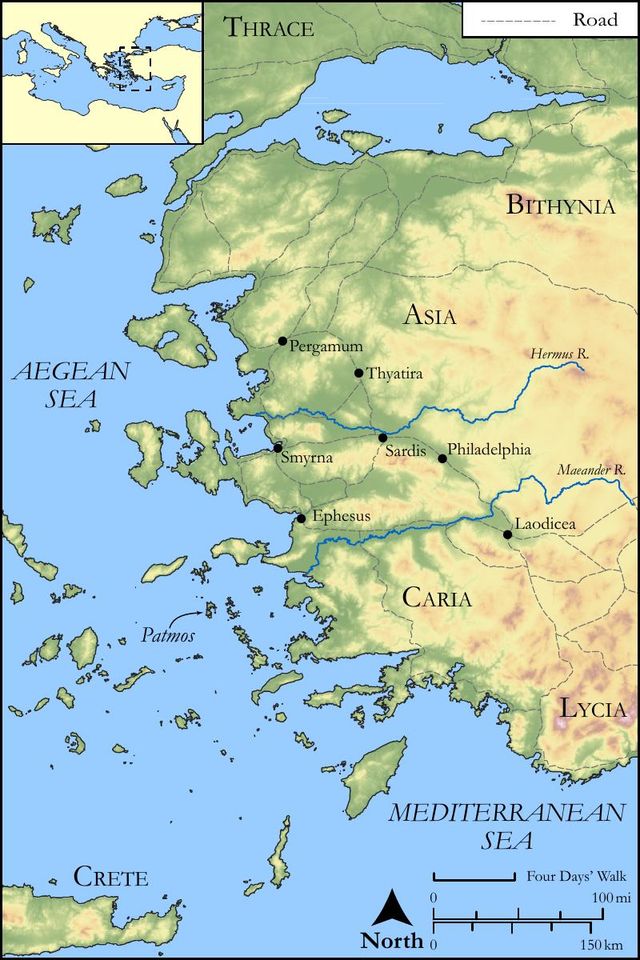
See on the biblical-era map

Study this verse
Public-domain commentary
Matthew Henry
From his Commentary on the Whole Bible. Henry comments on passages, not single verses — this entry covers Revelation 3:1–6. His four-level outline is real structure in the source text, so it is rendered as structure.
Here is, I. The preface, showing, 1. To whom this letter is directed: To the angel of the church of Sardis, an ancient city of Lydia, on the banks of the mountain Tmolus, said to have been the chief city of Asia the Less, and the first city in that part of the world that was converted by the preaching of John; and, some say, the first that revolted from Christianity, and one of the first that was laid in its ruins, in which it still lies, without any church or ministry. 2. By whom this message was sent - the Lord Jesus, who here assumes the character of him that hath the seven spirits of God, and the seven stars, taken out of Rev 1:4, where the seven spirits are said to be before the throne. (1.) He hath the seven spirits, that is, the Holy Spirit with his various powers, graces, and operations; for he is personally one, though efficaciously various, and may be said here to be seven, which is the number of the churches, and of the angels of the churches, to show that to every minister, and to every church, there is a dispensation and measure of the Spirit given for them to profit withal - a stock of spiritual influence for that minister and church to improve, both for enlargement and continuance, which measure of the Spirit is not ordinarily withdrawn from them, till they forfeit it by misimprovement. Churches have their spiritual stock and fund, as well as particular believers; and, this epistle being sent to a languishing ministry and church, they are very fitly put in mind that Christ has the seven spirits, the Spirit without measure and in perfection, to whom they may apply themselves for the reviving of his work among them. (2.) He hath the seven stars, the angels of the churches; they are disposed of by him, and accountable to him, which should make them faithful and zealous. He has ministers to employ, and spiritual influences to communicate to his ministers for the good of his church. The Holy Spirit usually works by the ministry, and the ministry will be of no efficacy without the Spirit; the same divine hand holds them both.
II.The body of this epistle.
There is this observable in it, that whereas in the other epistles Christ begins with commending what is good in the churches, and then proceeds to tell them what is amiss, in this (and in the epistle to Laodicea) he begins,
1.With a reproof, and a very severe one: I know thy works, that thou hast a name that thou livest, and art dead. Hypocrisy, and a lamentable decay in religion, are the sins charged upon this church, by one who knew her well, and all her works.
(1.)This church had gained a great reputation; it had a name, and a very honourable one, for a flourishing church, a name for vital lively religion, for purity of doctrine, unity among themselves, uniformity in worship, decency, and order. We read not of any unhappy divisions among themselves. Every thing appeared well, as to what falls under the observation of men.
(2.)This church was not really what it was reputed to be. They had a name to live, but they were dead; there was a form of godliness, but not the power, a name to live, but not a principle of life. If there was not a total privation of life, yet there was a great deadness in their souls and in their services, a great deadness in the spirits of their ministers, and a great deadness in their ministrations, in their praying, in their preaching, in their converse, and a great deadness in the people in hearing, in prayer, and in conversation; what little life was yet left among them was, in a manner, expiring, ready to die.
2.Our Lord proceeds to give this degenerate church the best advice: Be watchful, and strengthen the things, etc., Rev 3:2.
(1.)He advises them to be upon their watch. The cause of their sinful deadness and declension was that they had let down their watch. Whenever we are off our watch, we lose ground, and therefore must return to our watchfulness against sin, and Satan, and whatever is destructive to the life and power of godliness.
(2.)To strengthen the things that remain, and that are ready to die. Some understand this of persons; there were some few who had retained their integrity, but they were in danger of declining with the rest. It is a difficult thing to keep up to the life and power of godliness ourselves, when we see a universal deadness and declension prevailing round about us. Or it may be understood of practices, as it follows: I have not found thy works perfect before God, not filled up; there is something wanting in them; there is the shell, but not the kernel; there is the carcase, but not the soul - the shadow, but not the substance. The inward thing is wanting, thy works are hollow and empty; prayers are not filled up with holy desires, alms-deeds not filled up with true charity, sabbaths not filled up with suitable devotion of soul to God; there are not inward affections suitable to outward acts and expressions. Now when the spirit is wanting the form cannot long subsist.
(3.)To recollect themselves, and remember how they have received and heard (Rev 3:3); not only to remember what they had received and heard, what messages they had received from God, what tokens of his mercy and favour towards them, what sermons they had heard, but how they had received and heard, what impressions the mercies of God had made upon their souls at first, what affections they felt working under their word and ordinances, the love of their espousals, the kindness of their youth, how welcome the gospel and the grace of God were to them when they first received them. Where is the blessedness they then spoke of?
(4.)To hold fast what they had received, that they might not lose all, and repent sincerely that they had lost so much of the life of religion, and had run the risk of losing all.
3.Christ enforces his counsel with a dreadful threatening in case it should be despised: I will come unto thee as a thief, and thou shalt not know the hour, Rev 3:3. Observe,
(1.)When Christ leaves a people as to his gracious presence, he comes to them in judgment; and his judicial presence will be very dreadful to those who have sinned away his gracious presence.
(2.)His judicial approach to a dead declining people will be surprising; their deadness will keep them in security, and, as it procures an angry visit from Christ to them, it will prevent their discerning it and preparing for it.
(3.)Such a visit from Christ will be to their loss; he will come as a thief, to strip them of their remaining enjoyments and mercies, not by fraud, but in justice and righteousness, taking the forfeiture they have made of all to him.
4.Our blessed Lord does not leave this sinful people without some comfort and encouragement: In the midst of judgment he remembers mercy (Rev 3:4), and here (1.) He makes honourable mention of the faithful remnant in Sardis, though but small: Thou hast a few names in Sardis which have not defiled their garments; they had not given into the prevailing corruptions and pollution of the day and place in which they lived. God takes notice of the smallest number of those who abide with him; and the fewer they are the more precious in his sight. (2.) He makes a very gracious promise to them: They shall walk with me in white, for they are worthy - in the stola, the white robes of justification, and adoption, and comfort, or in the white robes of honour and glory in the other world. They shall walk with Christ in the pleasant walks of the heavenly paradise; and what delightful converse will there be between Christ and them when they thus walk together! This is an honour proper and suitable to their integrity, which their fidelity has prepared them for, and which it is no way unbecoming Christ to confer upon them, though it is not a legal but a gospel worthiness that is ascribed to them, not merit but meetness. Those who walk with Christ in the clean garments of real practical holiness here, and keep themselves unspotted from the world, shall walk with Christ in the white robes of honour and glory in the other world: this is a suitable reward.
III.We now come to the conclusion of this epistle, in which, as before, we have,
1.A great reward promised to the conquering Christian (Rev 3:5), and it is very much the same with what has been already mentioned: He that overcometh shall be clothed in white raiment. The purity of grace shall be rewarded with the perfect purity of glory. Holiness, when perfected, shall be its own reward; glory is the perfection of grace, differing not in kind, but in degree. Now to this is added another promise very suitable to the case: I will not blot his name out of the book of life, but will confess his name before my Father, and before his angels. Observe,
(1.)Christ has his book of life, a register and roll of all who shall inherit eternal life.
[1.]The book of eternal election.
[2.]The book of remembrance of all those who have lived to God, and have kept up the life and power of godliness in evil times.
(2.)Christ will not blot the names of his chosen and faithful ones out of this book of life; men may be enrolled in the registers of the church, as baptized, as making a profession, as having a name to live, and that name may come to be blotted out of the roll, when it appears that it was but a name, a name to live, without spiritual life; such often lose the very name before they die, they are left of God to blot out their own names by their gross and open wickedness. But the names of those that overcome shall never be blotted out.
(3.)Christ will produce this book of life, and confess the names of the faithful who stand there, before God, and all the angels; he will do this as their Judge, when the books shall be opened; he will do this as their captain and head, leading them with him triumphantly to heaven, presenting them to the Father: Behold me, and the children that thou hast given me. How great will this honour and reward be!
2.The demand of universal attention finishes the message. Every word from God deserves attention from men; that which may seem more particularly directed to one body of men has something in it instructive to all.
Historical interpretation
Eight Centuries of Reception
9 surviving comments on this verse. Each one is dated, so this reads as a timeline rather than a list.
Select a marker to jump to its quote. Markers stagger vertically where authors wrote within a few decades of each other.
He imputes to the Ephesians "forsaken love; " reproaches the Thyatirenes with "fornication," and "eating of things sacrificed to idols; " accuses the Sardians of "works not full; " censures the Pergamenes for teaching perverse things; upbraids the Laodiceans for trusting to their riches; and yet gives them all general monitions to repentance-under comminations, it is true; but He would not utter comminations to one unrepentant if He did not forgive the repentant.
The fifth class, company, or association of saints, sets forth men who are careless, and who are carrying on in the world other transactions than those which they ought-Christians only in name. And therefore He exhorts them that by any means they should be turned away from negligence, and be saved; and to this effect He says:-
"Be watchful, and strengthen the other things which were ready to die; for I have not found thy works perfect before God." For it is not enough for a tree to live and to have no fruit, even as it is not enough to be called a Christian and to confess Christ, but not to have Himself in our work, that is, not to do His precepts.
And another Scripture says, "I came not to call the righteous, but sinners." This means that those who are perishing must be saved. For it is indeed a great and admirable thing to establish not the things which are standing, but those that are falling. Thus also did Christ desire to save the things which were perishing, [Matthew 18:11] and has saved many by coming and calling us when hastening to destruction.
He rebukes those idle persons who do not trust in God with the whole mind and keep the right faith only hypocritically. They are Christians in name only. And so they are said to be living, but in fact they are dead. For that reason they are rebuked that they might be vigilant and strengthen what remains of that from which they had fallen. And so he urges them, “Remember what you received and heard, and repent.” He wishes that they remember the apostolic doctrine, and he warns them to preserve that which they received at the beginning of their faith and to repent of their past sins. And so he threatens whomever does not do this, “If you will not be vigilant, I will come like a thief, and you will not know at what hour I will come upon you.” The judgment of God will be sudden, and no one knows the secret hour when he intends to come.
“I will come like a thief.” This is reasonably written. For neither the death of any individual nor the common consummation is known to anyone. To those who are prepared, it will be the cessation of toil; however, to those who are unprepared, like a “thief” he will bring on spiritual death.
For I have not found your works perfect before my God. The works of a ruler are not perfect before God if he does not strive to rouse others, even if he seems blameless to men.
And to the angel of the church of Sardis, write: These things saith he, that hath the seven spirits of God, and the seven stars: I know thy works, that thou hast the name of being alive: but thou art dead. Be watchful and strengthen the things that remain, which were ready to die. The Lord has the seven spirits in a different way from the way he has the stars, for he has the sevenfold Spirit as an entity equal to him in the nature of the divinity, while he has the sevenfold Church as an entity subject to him in his power, as a servant. Now if he indicates that this angel, whether in the preachers or in some of his listeners, has the name of being alive through confession of faith alone, but is dead in works, how is it that he adds in order to warn the same, Be watchful, and strengthen the things that remain, which were ready to die? One should know therefore that he shows that he is partly dead through his faults, and partly alive through good works. Now how can someone be partly alive if he is dead, even because of one fault, if not because, if he rises again from sin through penance, he does not even lose, once he is alive, the good things he did when he was dead, because those things are themselves brought back to life with him? This is why he hears, Be watchful, and strengthen the things that remain, which were ready to die, which means, “If you come back to life in that part in which you are dead, you strengthen the other things that are still alive in you, in order that they do not die.” Alternatively, there are many people within the bosom of the Church who, keeping their lives from all fault, are considered alive by men, but are regarded as dead by God because their intention is not right, and these are told, Be watchful, and strengthen the things that remain, which were ready to die, as if they were told, “If you want the framework of your merits to be alive, watch the intention behind your works; pride will be alive.” For I find not thy works full before my God. That is, since the head, which is intention, has lost its vigor, the limbs, which are the merits, are by no means vigorous, full or plump, but they languish, meagre and almost dead.
QUESTION: What is meant by for I find not thy works full before my God? ANSWER: A leader's works are not full before God if he does not strive to rouse others as well, however innocent he may seem to people.
But he says, Awaken from the sleep of sin and strengthen the things which remain, that are ready to die. Moreover, he says, short tasks and incomplete practices remain for you, having not fully died. Therefore, guard these things while alive, flowing already toward death. For to strengthen means to stabilize and support what is slack and prone to collapse. For none of your efforts is complete, but some have died, and others are about to die. Therefore, how you have received the faith and heard the word concerning it, and some of your works still live in your life. But repent concerning those that have died.
Continue studying Revelation 3:2 across the web’s major study libraries — every link below opens this exact verse, chapter, or book on the destination site.
Read & Compare
 BibleGatewayThis verse in more than 200 translations and 70 languages.
 Bible.comThe YouVersion reader — hundreds of translations, reading plans, and highlights.
 ESV.orgCrossway's official English Standard Version reader.
 NET BibleThe NET translation with 60,000+ translators' notes on every rendering decision.
 STEP BibleTyndale House's free study tool — original text, vocabulary, and scholarly resources.
 BibliaLogos Bible Software's free web reader.
 USCCBThe New American Bible (Revised Edition) with the U.S. bishops' study notes.
Commentaries
 BibleHub CommentariesDozens of classic commentaries on this verse, gathered on one page.
 StudyLightMore than 100 commentary sets — the largest collection on the web.
 BibleRefPlain-English commentary on what this verse means, verse by verse.
 Enduring WordDavid Guzik's free commentary on this chapter, widely used by Bible teachers.
 Bible Study ToolsVerse commentary alongside Greek and Hebrew study aids.
Original Language & Research
- BibleHub InterlinearThe verse word by word — original language, transliteration, and English.
- BibleHub LexiconEvery word's original-language definition and Strong's entry.
 Blue Letter BibleDeep-study tools — Strong's numbers, concordance, and word studies.
 CNTR CollationThe earliest Greek manuscripts of this verse, collated letter by letter.
Sermons, Hymns & Audio


TrulyRandomVerse is not affiliated with these sites and doesn’t control their content. They’re linked because they’re genuinely useful.
Summary
Revelation 3:2 delivers a stern yet redemptive command from Jesus Christ to the church in Sardis, urging them to awaken from spiritual lethargy and fortify the remnants of their faith before they are completely extinguished. This divine admonition highlights the critical need for vigilance and earnest effort, as their outward actions and reputation for spiritual vitality were, in God's sight, incomplete and falling short of His divine standard. It serves as a poignant call to immediate spiritual renewal and a warning against complacency.
Context
ShowHideLiterary Context
This verse is part of Jesus Christ's seven letters to the churches in Asia Minor, found in Revelation chapters 2 and 3. Specifically, it follows the immediate and severe rebuke in Revelation 3:1 where the church in Sardis is declared to have "a name that thou livest, and art dead." Verse 2, therefore, is not merely a general exhortation but a direct, urgent imperative issued in response to a profound state of spiritual decay. It sets the stage for the subsequent call to remember, hold fast, and repent in Revelation 3:3, emphasizing that the church's very existence as a vibrant spiritual entity is at stake. The preceding letters to Ephesus, Smyrna, Pergamum, and Thyatira establish a pattern of commendation, rebuke, and exhortation, making Sardis's situation particularly stark due to the absence of initial praise.
Historical & Cultural Context
The city of Sardis, once the opulent capital of the ancient kingdom of Lydia and renowned for its wealth (especially from gold found in the Pactolus River), held a significant place in history. Its acropolis was considered impregnable, yet it had been famously captured twice due to overconfidence and a lack of vigilance: first by Cyrus the Great in 546 BC, and later by Antiochus III in 214 BC. In both instances, the city fell because defenders were complacent, believing their fortifications sufficient, and failed to maintain watch. This historical pattern of sudden, unexpected defeat due to spiritual slumber provides a powerful and ironic backdrop to Christ's warning to the church. The church in Sardis, much like its city, had a reputation for life and strength, but was internally vulnerable and spiritually unwatchful, mirroring the city's past failures.
Key Themes
ShowHideThe central themes embedded within this verse and the broader message to Sardis include Spiritual Vigilance and Authenticity vs. Appearance. The command "Be watchful" directly addresses the complacency and spiritual sleep that had overtaken the church, echoing broader biblical calls for alertness found in passages like Matthew 24:42 and 1 Peter 5:8. This theme underscores the necessity of continuous spiritual engagement and awareness to avoid falling into temptation or spiritual decline. Furthermore, the declaration "I have not found thy works perfect before God" highlights the critical theme of Divine Scrutiny and True Righteousness. It reveals that God's assessment goes beyond outward reputation or superficial activity, probing the depth, sincerity, and completeness of one's obedience and service. This contrasts sharply with the church's self-perception or public image, emphasizing that genuine faith is demonstrated by works that are complete and fully aligned with God's will, a concept echoed in James 2:17. The precarious state of "things which remain, that are ready to die" also introduces the theme of Preservation and Revival, suggesting that even in severe decline, there may be a remnant of spiritual life worth salvaging and strengthening.
Exposition and Analysis
ShowHideKey Word Analysis
ShowHideDerived from a verb meaning "to keep awake," this word signifies active spiritual alertness, vigilance, and readiness. It implies a conscious effort to remain spiritually awake, aware of one's condition, and prepared for divine encounter or spiritual attack. It directly counters the spiritual "death" described in Revelation 3:1, calling for a reversal of their complacent state.
This term means "to set fast," "to establish," or "to confirm." It's an imperative to firmly fix or make steadfast what little spiritual life or truth remains. It suggests an active, deliberate effort to reinforce and stabilize the fragile vestiges of faith and good works that are on the verge of complete extinction. It implies a need for internal fortification and resolve.
From the root meaning "to make replete" or "full," this word here means "complete" or "fulfilled." When applied to "works," it implies that their actions were lacking in fullness, sincerity, or thoroughness. They were not brought to their proper conclusion or standard in the sight of God. This is not about moral flawlessness, but about the quality and completeness of their spiritual output, indicating a deficiency in genuine commitment and obedience.
Verse Breakdown
ShowHide"Be watchful,"
This is a direct, urgent command (imperative mood) for the church to awaken from its spiritual slumber and become alert. It implies a state of spiritual lethargy or sleep that has rendered them vulnerable and ineffective. The call is to an active, conscious state of vigilance, recognizing the danger of their current condition.
"and strengthen the things which remain, that are ready to die:"
Following the call to vigilance, this is a second imperative. It acknowledges that not all is lost; there are still "things which remain" – perhaps a few faithful individuals, remnants of true doctrine, or vestiges of genuine spiritual activity. However, these remaining elements are in a critical state, "ready to die," meaning they are on the verge of complete extinction. The command is to actively reinforce, nourish, and stabilize these fragile remnants before they perish entirely. This suggests a last opportunity for revival and preservation.
"for I have not found thy works perfect before God."
This clause provides the divine rationale and justification for the preceding commands. The "for" (Greek, gár') introduces the reason: Christ's assessment of their spiritual output. Their "works" – their deeds, actions, and spiritual activities – were not "perfect" or "complete" when evaluated in God's presence. This implies a superficiality, a lack of depth, sincerity, or full commitment in their service and obedience, failing to meet the divine standard of completeness and integrity. Their reputation might have been alive, but their reality before God was one of deficiency.
Literary Devices
ShowHideThe verse employs several potent literary devices to convey its urgent message. Imperative Mood is prominent with commands like "Be watchful" and "strengthen," underscoring the immediate and non-negotiable nature of Christ's demands. The phrase "ready to die" functions as a powerful Metaphor for spiritual decay, likening the church's dwindling spiritual vitality to a living organism on the brink of expiration, contrasting sharply with their outward reputation of being "alive." The entire declaration serves as a divine Reproach, a severe criticism from Christ, highlighting the stark Contrast between the church's perceived state ("a name that thou livest") and its actual condition in God's eyes ("dead," "works not perfect"). This contrast emphasizes the theme of spiritual authenticity versus mere appearance, a recurring motif in the letters to the churches.
Theological and Thematic Connections
ShowHideRevelation 3:2 resonates deeply with the biblical emphasis on genuine faith demonstrated through active obedience and perseverance. It underscores the truth that God's evaluation of His people is not based on outward reputation or past glory, but on the present reality of their spiritual vitality and the completeness of their works. This passage serves as a powerful reminder that spiritual life is not static; it requires continuous vigilance, intentional nurturing, and a commitment to completing what God has called us to do. The danger of spiritual complacency and the deceptive nature of a mere "name" without substance are central theological warnings. It also highlights God's grace in offering a final opportunity for repentance and strengthening, even when a community is on the brink of spiritual death.
Reflection and Application
ShowHideRevelation 3:2 stands as a timeless mirror for both individual believers and the collective church, prompting profound introspection. It challenges us to move beyond superficial religiosity or a mere "name" of faith to a vibrant, authentic spiritual reality. Are we truly "watchful" in our spiritual lives, actively guarding against the insidious creep of complacency, distraction, and spiritual apathy? Do we recognize the "things which remain" – those last embers of passion, commitment, or truth – and are we diligently strengthening them before they are extinguished? This verse calls us to a rigorous self-examination, urging us to assess the quality and completeness of our "works" before God. It's not about achieving human perfection, but about the sincerity, depth, and wholeheartedness of our obedience and service. It reminds us that God sees beyond our outward appearance, evaluating the true condition of our hearts and the integrity of our actions. This passage is a merciful warning, an invitation to awaken, repent, and revitalize our commitment to Christ before spiritual death becomes irreversible.
Questions for Reflection
ShowHideFAQ
ShowHideWhat does "perfect" mean in "I have not found thy works perfect before God"?
ShowHideThe Greek word translated "perfect" here is plēróō (G4137), which means "to make replete," "to fill up," or "to complete." In this context, it does not imply moral flawlessness or sinless perfection, but rather that the works of the church in Sardis were incomplete, lacking in fullness, sincerity, or thoroughness. Their actions, though perhaps outwardly religious, were deficient in quality and commitment when measured against God's divine standard. They were not "filled up" to what God expected or required, indicating a lack of genuine devotion and spiritual vitality. This contrasts with a complete or wholehearted service, as seen in Colossians 4:12.
Christ-Centered Fulfillment
ShowHideRevelation 3:2, with its stark warning to the church in Sardis, finds its ultimate fulfillment and redemptive answer in the person and work of Jesus Christ. The very commands "Be watchful" and "strengthen the things which remain" point to Christ as the source of true spiritual life and the one who empowers vigilance and endurance. He is the one who "holds the seven stars in his right hand" and "walks among the seven golden candlesticks" (Revelation 2:1), possessing all authority to give life and to judge. Where Sardis's works were "not perfect," Christ's work on the cross was the perfect, complete, and once-for-all sacrifice, fully satisfying divine justice and making a way for humanity's reconciliation with God (Hebrews 10:14). He is the one who gives "life" to those who are spiritually "dead" (Ephesians 2:4-5), and it is through His indwelling Spirit that believers are strengthened and enabled to produce genuine, complete works that glorify God (Philippians 2:13). The call to strengthen what remains is a call to lean into Christ, who is our strength and the finisher of our faith (Hebrews 12:2), enabling us to live watchful, vibrant lives that truly reflect His perfect work within us.