


Matthew 4:17
Bible text: King James Version (1769 Blayney text) · Public domain
Bible text: Berean Standard Bible · Public domain
Bible text: American Standard Version (1901) · Public domain
Bible text: World English Bible, Messianic edition · Public domain
Bible text: Geneva Bible (1599) · Public domain
Bible text: Young's Literal Translation · Public domain
- ἈπὸApoFromG575PREPPreposition
- τότεtotethat timeG5119ADVAdverb
- ἤρξατοērxatobeganG757V-ADI-3SVerb Aorist Middle Deponent Indicative 3rd Singular
- ὁho<the>G3588T-NSMDefinite article Nominative Singular Masculine
- ἸησοῦςIēsousJesusG2424N-NSM-PNoun Nominative Singular Masculine Individual
- κηρύσσεινkērusseinto proclaimG2784V-PANVerb Present Active Infinitive
- καὶkaiandG2532CONJConjunction
- λέγειν·legeinto sayG3004V-PANVerb Present Active Infinitive
- μετανοεῖτε·metanoeitedo repentG3340V-PAM-2PVerb Present Active Imperative 2nd Plural
- ἤγγικενēngikenhas drawn nearG1448V-RAI-3SVerb Perfect Active Indicative 3rd Singular
- γὰρgarforG1063CONJConjunction
- ἡhētheG3588T-NSFDefinite article Nominative Singular Feminine
- βασιλείαbasileiakingdomG932N-NSFNoun Nominative Singular Feminine
- τῶνtōnof theG3588T-GPMDefinite article Genitive Plural Masculine
- οὐρανῶνouranōnheavensG3772N-GPMNoun Genitive Plural Masculine
English is a literal word-by-word gloss of the Greek, not the KJV's wording. Why?
This is the original text the KJV's translators worked from — each Greek word with its own literal English meaning in this verse, prepared by scholars at Tyndale House, Cambridge. The KJV translates whole sentences, not word by word, so its wording differs: one Greek word can become several English words, and the KJV may choose “charity” where the gloss reads “love”. Both are faithful — they answer different questions. For the KJV's own rendering, switch to the KJV text.
Details
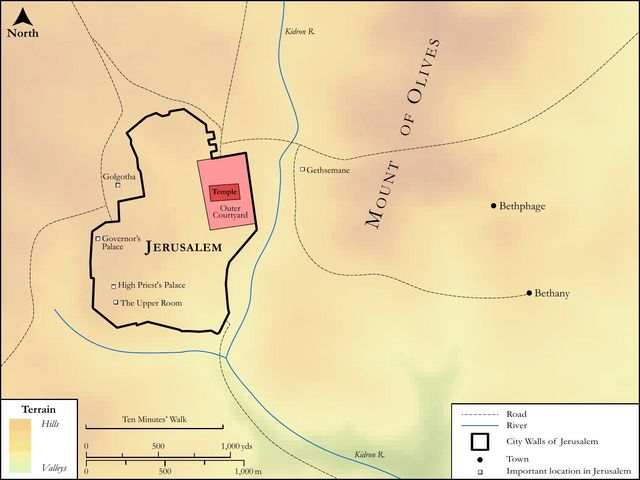
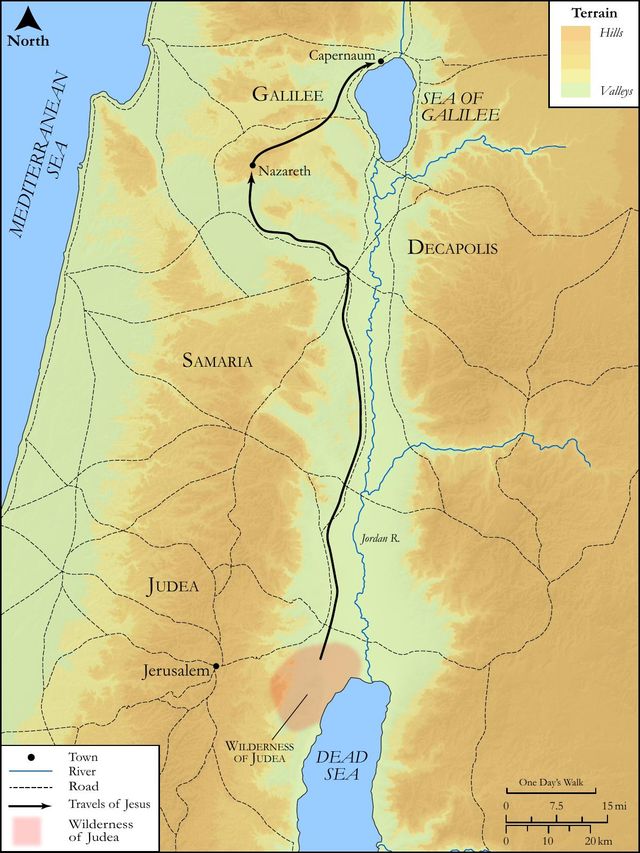
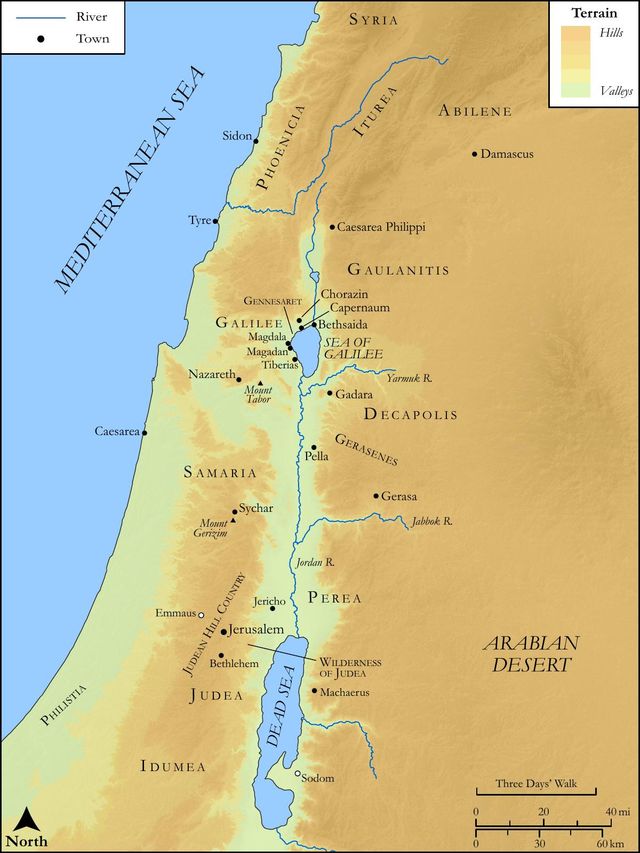
See on the biblical-era maps
Study this verse
Public-domain commentary
Matthew Henry
From his Commentary on the Whole Bible. Henry comments on passages, not single verses — this entry covers Matthew 4:12–17. His two-level outline is real structure in the source text, so it is rendered as structure.
We have here an account of Christ's preaching in the synagogues of Galilee, for he came into the world to be a Preacher; the great salvation which he wrought out, he himself began to publish (Heb 2:3) to show how much his heart was upon it, and ours should be.
Several passages in the other gospels, especially in that of St. John, are supposed, in the order of the story of Christ's life, to intervene between his temptation and his preaching in Galilee. His first appearance after his temptation, was when John Baptist pointed to him, saying, Behold the Lamb of God, Joh 1:29. After that, he went up to Jerusalem, to the passover (Jn. 2), discoursed with Nicodemus (Jn. 3), with the woman of Samaria (Jn. 4), and then returned into Galilee, and preached there. But Matthew, having had his residence in Galilee, begins his story of Christ's public ministry with his preaching there, which here we have an account of. Observe,
I.The time; When Jesus had heard that John was cast into prison, then he went into Galilee, Mat 4:12.
Note, The cry of the saints' sufferings comes up into the ears of the Lord Jesus. If John be cast into prison, Jesus hears it, takes cognizance of it, and steers his course accordingly: he remembers the bonds and afflictions that abide his people. Observe,
1.Christ did not go into the country, till he heard of John's imprisonment; for he must have time given him to prepare the way of the Lord, before the Lord himself appear. Providence wisely ordered it, that John should be eclipsed before Christ shone forth; otherwise the minds of people would have been distracted between the two; one would have said, I am of John, and another, I am of Jesus. John must be Christ's harbinger, but not his rival. The moon and stars are lost when the sun rises. John had done his work by the baptism of repentance, and then he was laid aside. The witnesses were slain when they had finished their testimony, and not before, Rev 11:7.
2.He did go into the country as soon as he heard of John's imprisonment; not only to provide for his own safety, knowing that the Pharisees in Judea were as much enemies to him as Herod was to John, but to supply the want of John Baptist, and to build upon the good foundation he had laid. Note, God will not leave himself without witness, nor his church without guides; when he removes one useful instrument, he can raise up another, for he has the residue of the Spirit, and he will do it, if he has work to do. Moses my servant is dead, John is cast into prison; now, therefore, Joshua, arise; Jesus, arise.
II.The place where he preached; in Galilee, a remote part of the country, that lay furthest from Jerusalem, as was there looked upon with contempt, as rude and boorish. The inhabitants of that country were reckoned stout men, fit for soldiers, but not polite men, or fit for scholars. Thither Christ went, there he set up the standard of his gospel; and in this, as in other things, he humbled himself. Observe,
1.The particular city he chose for his residence; not Nazareth, where he had been bred up; no, he left Nazareth; particular notice is taken of that, Mat 4:13. And with good reason did he leave Nazareth; for the men of that city thrust him out from among them, Luk 4:29. He made them his first, and a very fair, offer of his service, but they rejected him and his doctrine, and were filled with indignation at him and it; and therefore he left Nazareth, and shook off the dust of his feet for a testimony against those there, who would not have him to teach them. Nazareth was the first place that refused Christ, and was therefore refused by him. Note, It is just with God, to take the gospel and the means of grace from those that slight them, and thrust them away. Christ will not stay long where he is not welcome. Unhappy Nazareth! If thou hadst known in this thy day the things that belong to thy peace, how well had it been for thee! But now they are hid from thine eyes.
But he came and dwelt in Capernaum, which was a city of Galilee, but many miles distant from Nazareth, a great city and of much resort. It is said here to be on the sea coast, not the great sea, but the sea of Tiberias, an inland water, called also the lake of Gennesaret. Close by the falling of Jordan into the sea stood Capernaum, in the tribe of Naphtali, but bordering upon Zebulun; hither Christ came, and here he dwelt. Some think that his father Joseph had a habitation here, others that he took a house or lodgings at least; and some think it more than probable, that he dwelt in the house of Simon Peter; however, here he fixed not constantly, for he went about doing good; but this was for some time his head quarters: what little rest he had, was here; here he had a place, though not a place of his own, to lay his head on. And at Capernaum, it should seem, he was welcome, and met with better entertainment than he had at Nazareth. Note, If some reject Christ, yet others will receive him, and bid him welcome. Capernaum is glad of Nazareth's leavings. If Christ's own countrymen be not gathered, yet he will be glorious. "And thou, Capernaum, has now a day of it; thou art now lifted up to heaven; be wise for thyself, and know the time of thy visitation."
2.The prophecy that was fulfilled is this, Mat 4:14-16. It is quoted from Isa 9:1, Isa 9:2, but with some variation. The prophet in that place is foretelling a greater darkness of affliction to befall the contemners of Immanuel, than befell the countries there mentioned, either in their first captivity under Benhadad, which was but light (Kg1 15:20), or in their second captivity under the Assyrian, which was much heavier, Kg2 15:29. The punishment of the Jewish nation for rejecting the gospel should be sorer than either (see Isa 8:21, Isa 8:22); for those captivated places had some reviving in their bondage, and saw a great light again, Isa 9:2. This is Isaiah's sense; but the Scripture has many fulfillings; and the evangelist here takes only the latter clause, which speaks of the return of the light of liberty and prosperity to those countries that had been in the darkness of captivity, and applies it to the appearing of the gospel among them.
The places are spoken of, Mat 4:15. The land of Zebulun is rightly said to be by the sea coast, for Zebulun was a haven of ships, and rejoiced in her going out, Gen 49:13; Deu 33:18. Of Naphtali, it had been said, that he should give goodly words (Gen 49:21), and should be satisfied with favour (Deu 33:23), for from him began the gospel; goodly words indeed, and such as bring to a soul God's satisfying favour. The country beyond Jordan is mentioned likewise, for there we sometimes find Christ preaching, and Galilee of the Gentiles, the upper Galilee to which the Gentiles resorted for traffic, and where they were mingled with the Jews; which intimates a kindness in reserve for the poor Gentiles. When Christ came to Capernaum, the gospel came to all those places round about; such diffusive influences did the Sun of righteousness cast.
Now, concerning the inhabitants of these places, observe, (1.) The posture they were in before the gospel came among them (Mat 4:16); they were in darkness. Note, Those that are without Christ, are in the dark, nay, they are darkness itself; as the darkness that was upon the face of the deep. Nay, they were in the region and shadow of death; which denotes not only great darkness, as the grave is a land of darkness, but great danger. A man that is desperately sick, and not likely to recover, is in the valley of the shadow of death, though not quite dead; so the poor people were on the borders of damnation, though not yet damned-dead in law. And, which is worst of all, they were sitting in this condition. Sitting in a continuing posture; where we sit, we mean to stay; they were in the dark, and likely to be so, despairing to find the way out. And it is a contented posture; they were in the dark, and they loved darkness, they chose it rather than light; they were willingly ignorant. Their condition was sad; it is still the condition of many great and mighty nations, which are to be thought of, and prayed for, with pity. But their condition is more sad, who sit in darkness in the midst of gospel-light. He that is in the dark because it is night, may be sure that the sun will shortly arise; but he that is in the dark because he is blind, will not so soon have his eyes opened. We have the light, but what will that avail us, if we be not the light in the Lord? (2.) The privilege they enjoyed, when Christ and his gospel came among them; it was as great a reviving as ever light was to a benighted traveller. Note, When the gospel comes, light comes; when it comes to any place, when it comes to any soul, it makes day there, Joh 3:19; Luk 1:78, Luk 1:79. Light is discovering, it is directing; so is the gospel.
It is a great light; denoting the clearness and evidence of gospel-revelations; not like the light of a candle, but the light of the sun when he goes forth in his strength. Great in comparison with the light of the law, the shadows of which were now done away. It is a great light, for it discovers great things and of vast consequence; it will last long, and spread far. And it is a growing light, intimated in that word, It is sprung up. It was but spring of day with them; now the day dawned, which afterward shone more and more. The gospel-kingdom, like a grain of mustard-seed or the morning light, was small in its beginnings, gradual in its growth, but great in its perfection.
Observe, the light sprang up to them; they did not go to seek it, but were prevented with the blessings of this goodness. It came upon them ere they were aware, at the time appointed, by the disposal of him who commandeth the morning, and causes the day-spring to know its place, that it may take hold of the ends of the earth, Job 38:12, Job 38:13.
III.The text he preached upon (Mat 4:17):
From that time, that is, from the time of his coming into Galilee, into the land of Zebulun and Naphtali, from that time, he began to preach. He had been preaching, before this, in Judea, and had made and baptized many disciples (Joh 4:1); but his preaching was no so public and constant as now it began to be. The work of the ministry is so great and awful, that it is fit to be entered upon by steps and gradual advances.
The subject which Christ dwelt upon now in his preaching (and it was indeed the sum and substance of all his preaching), was the very same John has preached upon (Mat 3:2); Repent, for the kingdom of heaven is at hand; for the gospel is the same for substance under various dispensations; the commands the same, and the reasons to enforce them the same; an angel from heaven dares not preach any other gospel (Gal 1:8), and will preach this, for it is the everlasting gospel. Fear God, and, by repentance, give honour to him, Rev 14:6, Rev 14:7. Christ put a great respect upon John's ministry, when he preached to the same purport that John had preached before him. By this he showed that John was his messenger and ambassador; for when he brought the errand himself, it was the same that he had sent by him. Thus did God confirm the word of his messenger, Isa 44:26. The Son came on the same errand that the servants came on (Mat 21:37), to seek fruit, fruits meet for repentance. Christ had lain in the bosom of the Father, and could have preached sublime notions of divine and heavenly things, that should have alarmed and amused the learned world, but he pitches upon this old, plain text, Repent, for the kingdom of heaven is at hand. [1.] This he preached first upon; he began with this. Ministers must not be ambitious of broaching new opinions, framing new schemes, or coining new expressions, but must content themselves with plain, practical things, with the word that is nigh us, even in our mouth, and in our heart. We need not go up to heaven, nor down to the deep, for matter or language in our preaching. As John prepared Christ's way, so Christ prepared his own, and made way for the further discoveries he designed, with the doctrine of repentance. If any man will do this part of his will, he shall know more of his doctrine, Joh 7:17. [2.] This is preached often upon; wherever he went, this was his subject, and neither he nor his followers ever reckoned it worn threadbare, as those would have done, that have itching ears, and are fond of novelty and variety more than that which is truly edifying. Note, That which has been preached and heard before, may yet very profitably be preached and heard again; but then it should be preached and heard better, and with new affections; what Paul had said before, he said again, weeping, Phi 3:1, Phi 3:18. [3.] This he preached as gospel; "Repent, review your ways, and return to yourselves." Note, The doctrine of repentance is right gospel-doctrine. Not only the austere Baptist, who was looked upon as a melancholy, morose man, but the sweet and gracious Jesus, whose lips dropped as a honey-comb, preached repentance; for it is an unspeakable privilege that room is left for repentance. [4.] The reason is still the same; The kingdom of heaven is at hand; for it was not reckoned to be fully come, till that pouring out of the Spirit after Christ's ascension. John had preached the kingdom of heaven at hand above a year before this; but now it was so much the stronger; now is the salvation nearer, Rom 13:11. We should be so much the more quickened to our duty, as we see the day approaching, Heb 10:25.
Historical interpretation
Nine Centuries of Reception
12 surviving comments on this verse. Each one is dated, so this reads as a timeline rather than a list.
Select a marker to jump to its quote. Markers stagger vertically where authors wrote within a few decades of each other.
John’s preaching of repentance was not precisely the same as the preaching of Jesus, yet the Savior preaches in ways commensurable with John, for there is one God who sent them both. John first says “repent” in order to make ready a “people prepared” for God. Jesus, when he has received a people who have been made ready and who have already repented, does not merely say to them, “Repent.” For he does not preach in competition with the law and the prophets. When John had fulfilled the old covenant, Jesus “began to preach” the new, being himself the beginning of it. For this reason the words “he began” are not written of John, for he was an end. Moreover, the one preaches in the wilderness, the other in the midst of the people.
“The kingdom of heaven” is not in a place but in disposition. For it is “within” us. John preaches the coming of that kingdom of heaven, which Christ the King will deliver up “to God, even the Father.”
(H. E. iii. 24.) It is related that John preached the Gospel almost up to the close of his life without setting forth any thing in writing, and at length came to write for this reason. The three first written Gospels having come to his knowledge, he confirmed the truth of their history by his own testimony; but there were yet some things wanting, especially an account of what the Lord had done at the first beginning of His preaching. And it is true that the other three Gospels seem to contain only those things which were done in that year in which John the Baptist was put into prison, or executed. For Matthew, after the temptation, proceeds immediately, Hearing that John was delivered up; and Mark in like manner. Luke again, even before relating one of Christ's actions, tells that Herod had shut up John in prison. The Apostle John then was requested to put into writing what the preceding Evangelists had left out before the imprisonment of John; hence he says in his Gospel, this beginning of miracles did Jesus.
The voice of the Lord urging the people to repentance—the Holy Spirit made it known to the people that they might take heed, saying, “Today, when you hear his voice, do not harden your hearts as in the rebellion, as in the day of testing in the wilderness.” In the same psalm above, he made clear that he was urging the sinful people to repentance and showed the state of a repentant soul, saying, “Come, let us fall down before him and lament before the Lord who made us, for he is our God.” The Lord urges the people to repentance, and he promises to pardon their sins, according to Isaiah’s words: “I, even I, am the one who wipes out your iniquities, and I will not be mindful of your sins. But you be mindful, declare first your iniquities that you may be justified.” Rightly then does the Lord urge the people to repentance when he says, “Repent, for the kingdom of heaven is at hand,” so that through this confession of sins they may be made worthy to approach the kingdom of heaven. For no one can receive the grace of the heavenly God unless one has been cleansed of every stain of sin by the confession of repentance, through the gift of the saving baptism of our Lord and Savior.
"From that time:" what time? After John was cast into prison. And wherefore did He not preach to them from the beginning? Indeed what occasion for John at all, when the witness of His works was proclaiming Him?
That hence also thou mightest learn His dignity; namely, that as the Fathers, so He too hath prophets; to which purpose Zacharias also spake; "And thou, child, shalt be called the prophet of the Highest."
And moreover it was necessary that what concerned Him should be spoken by another first and not by Himself. For if even after both testimonies and demonstrations so many and so great, they said, "Thou bearest record of Thyself, Thy record is not true:" had He, without John's saying anything, come into the midst, and first borne record Himself; what would they not have said? For this cause, neither did He preach before John, nor did He work miracles, until John was cast into prison; lest in this way the multitude should be divided. Therefore also John did no miracle at all; that by this means also might give over the multitude to Jesus, His miracles drawing them unto Him.
Again, if even after so many divine precautions, John's disciples, both before and after his imprisonment, were jealousy disposed towards Him, and the people too suspected not Him but John to be the Christ; what would not the result have been, had none of these things taken place? For this cause both Matthew distinctly notes, that "from that time He began to preach;" and when He began His preaching. He Himself also taught this same doctrine, which the other used to preach; and no word as yet concerning Himself doth the doctrine which he preached say. Because it was for the time a great thing even for this to be received, forasmuch as they had not as yet the proper opinion about Him. Therefore also at the beginning He puts nothing severe or grievous, as the other did, mentioning an axe, and a tree cut down; a fan, and a threshing-floor, and unquenchable fire; but His preludes are gracious: the Heavens and the kingdom there are the good tidings which he declares to His hearers.
For another cause also He did not preach till John was in prison, that the multitude might not be split into two parties; or as John did no miracle, all men would have been drawn to Christ by His miracles.
Also observe how that in this His first address He says nothing of Himself openly; and that very suitably to the case, for they had yet no right opinion concerning Him. In this commencement moreover He speaks nothing severe, nothing burdensome, as John had concerning the axe laid to the root of the condemned tree, and the like; but he puts first things merciful, preaching the glad tidings of the kingdom of heaven.
(Verse 17, 18.) Then Jesus began to preach and say, 'Repent, for the kingdom of heaven is near.' And as Jesus was walking by the Sea of Galilee, he saw two brothers, Simon called Peter and his brother Andrew, casting a net into the sea; for they were fishermen. And he said to them. When John was handed over, he begins to preach rightly: as the Law ends, the Gospel arises accordingly. But if the Savior preaches the same things that John the Baptist had foretold before, he shows himself to be the Son of the same God, whose prophet John was.
Shewing also thereby that He was Son of that same God whose prophet John was; and therefore He says, Repent ye.
Mystically interpreted, Christ begins to preach as soon as John was delivered to prison, because when the Law ceased, the Gospel commenced.
Christ's Gospel should be preached by him who can control his appetites, who contemns the goods of this life, and desires not empty honours. From this time began Jesus to preach, that is, after having been tempted, He had overcome hunger in the desert, despised covetousness on the mountain, rejected ambitious desires in the temple. Or from the time that John was delivered up; for had He begun to preach while John was yet preaching, He would have made John be lightly accounted of, and John's preaching would have been thought superfluous by the side of Christ's teaching; as when the sun rises at the same time with the morning star, the star's brightness is hid.
He did wisely in making now the beginning of His preaching, that He should not trample upon John's teaching, but that He might the rather confirm it and demonstrate him to have been a true witness.
He does not straightway preach righteousness which all knew, but repentance, which all needed. Who then dared to say, 'I desire to be good, but am not able?' For repentance corrects the will; and if ye will not repent through fear of evil, at least ye may for the pleasure of good things; hence He says, the kingdom of heaven is at hand; that is, the blessings of the heavenly kingdom. As if He had said, Prepare yourselves by repentance, for the time of eternal reward is at hand.
And note, He does not say the kingdom of the Canaanite, or the Jebusite, is at hand; but the kingdom of heaven. The law promised worldly goods, but the Lord heavenly kingdoms.
In this He further teaches that none should despise the words of a person inferior to Him; as also the Apostle, If any thing be revealed to him that sits, let the first hold his peace. (1 Cor. 14:30.)
From the time John was arrested, Jesus began to preach. For Jesus waited for John to first bear witness to Him and to prepare the way for Him, in the same manner in which servants make preparations for their masters. Being equal to the Father, the Lord also had John as a prophet, just as God the Father had the prophets who were before John; yet in truth these were the prophets of both the Father and the Son.
The kingdom of heaven is Christ and it is also the life of virtue. For when someone lives as an angel on earth, is he not heavenly? So the kingdom of heaven is within each one of us when we live as angels.
Continue studying Matthew 4:17 across the web’s major study libraries — every link below opens this exact verse, chapter, or book on the destination site.
Read & Compare
 BibleGatewayThis verse in more than 200 translations and 70 languages.
 Bible.comThe YouVersion reader — hundreds of translations, reading plans, and highlights.
 ESV.orgCrossway's official English Standard Version reader.
 NET BibleThe NET translation with 60,000+ translators' notes on every rendering decision.
 STEP BibleTyndale House's free study tool — original text, vocabulary, and scholarly resources.
 BibliaLogos Bible Software's free web reader.
 USCCBThe New American Bible (Revised Edition) with the U.S. bishops' study notes.
Commentaries
 BibleHub CommentariesDozens of classic commentaries on this verse, gathered on one page.
 StudyLightMore than 100 commentary sets — the largest collection on the web.
 BibleRefPlain-English commentary on what this verse means, verse by verse.
 Enduring WordDavid Guzik's free commentary on this chapter, widely used by Bible teachers.
 Bible Study ToolsVerse commentary alongside Greek and Hebrew study aids.
Original Language & Research
- BibleHub InterlinearThe verse word by word — original language, transliteration, and English.
- BibleHub LexiconEvery word's original-language definition and Strong's entry.
 Blue Letter BibleDeep-study tools — Strong's numbers, concordance, and word studies.
 CNTR CollationThe earliest Greek manuscripts of this verse, collated letter by letter.
Sermons, Hymns & Audio


TrulyRandomVerse is not affiliated with these sites and doesn’t control their content. They’re linked because they’re genuinely useful.
Summary
Matthew 4:17 marks the pivotal inauguration of Jesus' public ministry in Galilee, following His temptation and John the Baptist's arrest. From this moment, Jesus began to proclaim a foundational and urgent message that would define His entire earthly mission: a direct call for humanity to "Repent," because "the kingdom of heaven is at hand." This declaration signaled the dawn of a new era, announcing that God's long-anticipated sovereign rule was no longer a distant hope but an immediate, accessible reality breaking into human history through Jesus Himself.
Context
ShowHideLiterary Context
This verse is strategically placed within Matthew's narrative, signaling a significant transition. It immediately follows Jesus' triumphant resistance to Satan's temptations in the wilderness, demonstrating His perfect obedience and readiness for ministry. The subsequent news of John the Baptist's imprisonment serves as a clear demarcation, indicating the conclusion of John's preparatory ministry and the commencement of Jesus' active public phase. Jesus then withdraws to Galilee, specifically settling in Capernaum by the Sea of Galilee, a strategic location that fulfills the ancient prophecy from Isaiah 9:1-2, highlighting that "the people dwelling in darkness have seen a great light" (Matthew 4:14-16). This geographical shift from Judea to Galilee of the Gentiles underscores the universal scope of His message, which begins with the profound declaration of repentance and the kingdom's arrival.
Historical & Cultural Context
Jesus' ministry begins in Galilee, a region often looked down upon by the Judean religious elite due to its mixed population and perceived spiritual laxity. Yet, it was a vibrant, populous area, making it an ideal launching point for a public movement. The Jewish people of this era lived under Roman occupation, longing for the promised Messiah who would deliver them and establish God's kingdom. Their understanding of the "kingdom" was often nationalistic and political, expecting a visible, earthly reign that would overthrow Roman rule. Jesus' message, while affirming the kingdom's arrival, subtly redefines it, emphasizing a spiritual and moral transformation (repentance) as a prerequisite for entry, challenging the prevailing political expectations. The phrase "kingdom of heaven" is Matthew's characteristic way of referring to "the kingdom of God," a reverential circumlocution common in Jewish thought to avoid direct utterance of God's name, reflecting the cultural piety of the time.
Key Themes
ShowHideMatthew 4:17 encapsulates several foundational themes that permeate Jesus' ministry throughout the Gospels. Firstly, the call to Repentance (Greek: metanoéō) is paramount, signifying not merely sorrow for sin but a radical change of mind, heart, and direction, turning away from self and sin toward God. This theme echoes the message of John the Baptist, establishing continuity while highlighting Jesus' unique authority. Secondly, the Kingdom of Heaven (or Kingdom of God) is the central subject of Jesus' preaching. This refers to God's dynamic, sovereign rule and reign, which is both a present spiritual reality breaking into the world through Jesus and a future, consummated reality. It is not primarily a geographical territory but the sphere where God's will is perfectly done. Thirdly, the declaration that the kingdom "is at hand" (Greek: engízō) conveys a profound sense of Imminence and Accessibility. It signifies that the long-awaited reign of God, prophesied throughout the Old Testament, has drawn near and is now breaking into human history through the person and work of Jesus Christ, making it available for entry. Finally, this verse marks the Inauguration of Jesus' Public Ministry, setting the stage for all His subsequent teachings, miracles, and the formation of His church, as seen in the broader narrative of Matthew's Gospel.
Exposition and Analysis
ShowHideKey Word Analysis
ShowHideDerived from metá (after, with) and noiéō (to perceive, to think), this word literally means "to change one's mind" or "to think differently afterwards." In the biblical context, especially as used by Jesus and John the Baptist, it signifies far more than intellectual assent or mere regret. It denotes a fundamental, decisive reorientation of one's entire being – a moral and spiritual transformation that involves turning away from sin and self-reliance and turning towards God in obedient faith. It implies a complete change of direction in one's life, leading to corresponding changes in attitude and behavior.
This term, from basileús (king), primarily denotes "royalty," "rule," or "reign." Secondarily, it can refer to the "realm" over which a king rules. In the phrase "kingdom of heaven," it refers to God's active, sovereign rule and kingly dominion, rather than merely a geographical territory. It encompasses God's present reign in the hearts of believers and His future, ultimate reign over all creation. Matthew's use of "heaven" (ouranós) instead of "God" is a common Jewish reverence, avoiding direct mention of the divine name.
From engýs (near), this verb means "to make near" or "to approach." Its perfect tense form, as used here, indicates a state of having drawn near and now being present. It conveys a sense of arrival and accessibility, not merely an approaching future event. The kingdom is not just coming; it has arrived in the person and ministry of Jesus Christ, making its benefits and demands immediately available to those who respond.
Verse Breakdown
ShowHide"From that time Jesus began to preach,"
This clause marks a decisive turning point in Jesus' life and the Gospel narrative. "From that time" (G5119, tóte) emphasizes the immediate commencement of His public ministry following the events of His temptation and John's imprisonment. The word "began" (G756, árchomai) indicates the initiation of a new phase, while "to preach" (G2784, kērýssō) signifies His role as a herald, publicly proclaiming a message with divine authority, much like a town crier announcing a royal decree. This was not a private teaching but a public declaration to all who would listen.
"and to say, 'Repent:'"
This introduces the core content of Jesus' inaugural message. The conjunction "and" (G2532, kaí) connects His preaching with the specific command. The imperative "Repent" (G3340, metanoéō) is a direct, urgent, and non-negotiable call to a radical transformation of mind, heart, and life. It is the foundational prerequisite for entering into the new reality Jesus is announcing. This command, echoing John the Baptist's message, is now delivered with the ultimate authority of the King Himself.
"for the kingdom of heaven is at hand."
This clause provides the compelling reason (G1063, gár) for the urgent call to repentance. The "kingdom of heaven" (G932, basileía G3772, ouranós) refers to God's active, sovereign rule. The crucial phrase "is at hand" (G1448, engízō) signifies that this divine rule has drawn near, has arrived, and is now accessible. It is not merely a future hope but a present reality that has broken into human history through Jesus. This declaration imbues the call to repentance with immense significance, as it is the appropriate response to the immediate presence of God's reign.
Literary Devices
ShowHideMatthew 4:17 is rich in literary significance, primarily employing Proclamation and Urgency. Jesus' "preaching" (kērýssō) implies a public, authoritative declaration, much like a herald announcing a royal decree. This is not a suggestion but a divine imperative. The direct command "Repent!" carries an inherent Urgency, demanding an immediate and decisive response from the audience. This urgency is further amplified by the accompanying reason: "for the kingdom of heaven is at hand." The causal conjunction "for" (gár) links the command directly to the imminent arrival of God's reign, creating a powerful logical and theological imperative. The phrase "kingdom of heaven" itself functions as a Metonymy, where "heaven" stands for God, reflecting the Jewish reverence for the divine name. This concise verse, therefore, serves as a powerful, authoritative, and urgent Summary Statement of Jesus' entire mission.
Theological and Thematic Connections
ShowHideMatthew 4:17 serves as the theological bedrock for understanding Jesus' entire ministry, establishing the core tenets of His message: the necessity of repentance and the reality of God's kingdom. It signifies that with Jesus' arrival, God's long-prophesied reign has definitively broken into human history, demanding a transformed response from humanity. This "kingdom" is not primarily a political or earthly domain, but God's active, dynamic rule over hearts and lives, bringing salvation, righteousness, and peace. The call to repentance underscores that entry into this kingdom is conditioned not on birthright or ritual, but on a radical change of allegiance and a turning towards God. This verse connects the Old Testament prophecies of a coming king and kingdom with their New Testament fulfillment in Jesus, revealing that the eschatological age has dawned.
Reflection and Application
ShowHideMatthew 4:17 remains a timeless and profoundly relevant call to every generation. Jesus' inaugural message demands a personal, transformative response: "Repent, for the kingdom of heaven is at hand." This isn't a one-time act of sorrow for past sins, but an ongoing posture of humility, a continuous reorientation of our lives towards God's will, and a turning away from anything that opposes His reign. Living in light of the kingdom's nearness means actively submitting to God's sovereign rule in every area of our lives – our thoughts, words, actions, relationships, and priorities. It calls us to embody the values of the kingdom: justice, mercy, humility, and love. The kingdom is both a present reality to be lived out and a future hope to be anticipated, compelling us to live with both urgency and joyful expectation, knowing that God's reign is accessible now through Christ.
Questions for Reflection
ShowHideFAQ
ShowHideWhat does "the kingdom of heaven" mean, and why does Matthew use this phrase?
ShowHide"The kingdom of heaven" refers to God's active, sovereign rule and reign, rather than a physical territory. It is the sphere in which God's will is perfectly accomplished. Matthew, writing primarily to a Jewish audience, uses "kingdom of heaven" (G932, basileía G3772, ouranós) as a respectful circumlocution for "kingdom of God," a common Jewish practice to avoid directly uttering the divine name out of reverence. This phrase emphasizes God's transcendent authority and heavenly origin, yet it is a kingdom that breaks into the earthly realm through Jesus. It is both a present reality (God's rule in hearts) and a future consummation (when God's rule is fully established over all creation). Jesus' teachings, particularly in the Sermon on the Mount, elaborate extensively on the nature and demands of this kingdom.
What is the difference between "repentance" and simply feeling sorry for one's sins?
ShowHideWhile feeling sorry for one's sins (remorse or regret) can be a component of repentance, biblical "repentance" (G3340, metanoéō) is a much deeper and more transformative concept. It means a fundamental "change of mind" that leads to a complete reorientation of one's life, a turning away from sin and self-centeredness, and a turning towards God in obedient faith. It involves a shift in one's core values, attitudes, and behaviors, resulting in a new direction for one's life. As seen in Acts 26:20, true repentance is demonstrated by "deeds consistent with repentance," meaning a visible change in how one lives. It's not just a feeling, but a decisive act of the will that impacts one's entire being and trajectory.
What does it mean that the kingdom "is at hand"? Is it here now or still coming?
ShowHideThe phrase "is at hand" (G1448, engízō) indicates that the kingdom has drawn near and is now present and accessible. It signifies that with the arrival of Jesus Christ, the long-awaited reign of God has definitively broken into human history. This concept is often described as "already and not yet." The kingdom is "already" present in the person and work of Jesus – His teachings, miracles, death, and resurrection inaugurated God's rule. Believers can experience its power and blessings now by submitting to Christ as King. However, it is "not yet" fully consummated; its full manifestation will occur at Christ's second coming, when all things are brought under His complete and visible dominion (Revelation 11:15). Therefore, the kingdom is both a present spiritual reality and a future eschatological hope, demanding an immediate response while inviting ongoing anticipation.
Christ-Centered Fulfillment
ShowHideMatthew 4:17 is profoundly Christ-centered, for Jesus Himself is the embodiment and inaugurator of the kingdom of heaven. His declaration, "Repent: for the kingdom of heaven is at hand," is not merely a message about a coming reality, but an announcement that the King has arrived, and with Him, His kingdom. Jesus does not merely preach about the kingdom; He brings it. His very presence, His authoritative teaching, His miraculous deeds of healing and deliverance (Matthew 4:23-24), and ultimately His death and resurrection, are all manifestations of God's sovereign rule breaking into a fallen world. The call to repentance is a call to turn to Him, the King, and to align one's life with His reign. Through His atoning sacrifice on the cross, Jesus conquered sin and death, establishing the spiritual reality of the kingdom and making entry possible for all who believe (Colossians 1:13-14). His resurrection and ascension confirm His cosmic kingship (Philippians 2:9-11), and He now reigns from heaven, actively building His church, which is the present manifestation of His kingdom on earth (Matthew 16:18-19). Thus, Matthew 4:17 is not just an ancient historical proclamation, but a living invitation to enter into the present, transformative reign of Jesus Christ, the King of kings.