


John 7:17
Bible text: King James Version (1769 Blayney text) · Public domain
Bible text: King James Version with Strong's numbers · Public domain
Bible text: Berean Standard Bible · Public domain
Bible text: American Standard Version (1901) · Public domain
Bible text: World English Bible, Messianic edition · Public domain
Bible text: Geneva Bible (1599) · Public domain
Bible text: Young's Literal Translation · Public domain
- ἐάνeanIfG1437CONDConjunction
- τιςtisanyoneG5100X-NSMIndefinite pronoun Nominative Singular Masculine
- θέλῃthelēshall desireG2309V-PAS-3SVerb Present Active Subjunctive 3rd Singular
- τὸtotheG3588T-ASNDefinite article Accusative Singular Neuter
- θέλημαthelēmawillG2307N-ASNNoun Accusative Singular Neuter
- αὐτοῦautouof HimG846P-GSMPersonal pronoun Genitive Singular Masculine
- ποιεῖνpoieinto doG4160V-PANVerb Present Active Infinitive
- γνώσεταιgnōsetaihe will knowG1097V-FDI-3SVerb Future Middle Deponent Indicative 3rd Singular
- περὶpericoncerningG4012PREPPreposition
- τῆςtēstheG3588T-GSFDefinite article Genitive Singular Feminine
- διδαχῆςdidachēsteachingG1322N-GSFNoun Genitive Singular Feminine
- πότερονpoteronwhetherG4220ADVAdverb
- ἐκekfromG1537PREPPreposition
- τοῦtou<the>G3588T-GSMDefinite article Genitive Singular Masculine
- θεοῦtheouGodG2316N-GSM-TNoun Genitive Singular Masculine Title
- ἐστινestinit isG1510V-PAI-3SVerb Present Active Indicative 3rd Singular
- ἢēorG2228CONJConjunction
- ἐγὼegōI myselfG1473P-1NSPersonal pronoun Nominative 1st Singular
- ἀπ᾽ap᾽fromG575PREPPreposition
- ἐμαυτοῦemautouMyselfG1473F-1GSMReflexive pronoun Genitive 1st Singular Masculine
- λαλῶlalōspeakG2980V-PAI-1SVerb Present Active Indicative 1st Singular
English is a literal word-by-word gloss of the Greek, not the KJV's wording. Why?
This is the original text the KJV's translators worked from — each Greek word with its own literal English meaning in this verse, prepared by scholars at Tyndale House, Cambridge. The KJV translates whole sentences, not word by word, so its wording differs: one Greek word can become several English words, and the KJV may choose “charity” where the gloss reads “love”. Both are faithful — they answer different questions. For the KJV's own rendering, switch to the KJV text.
Details
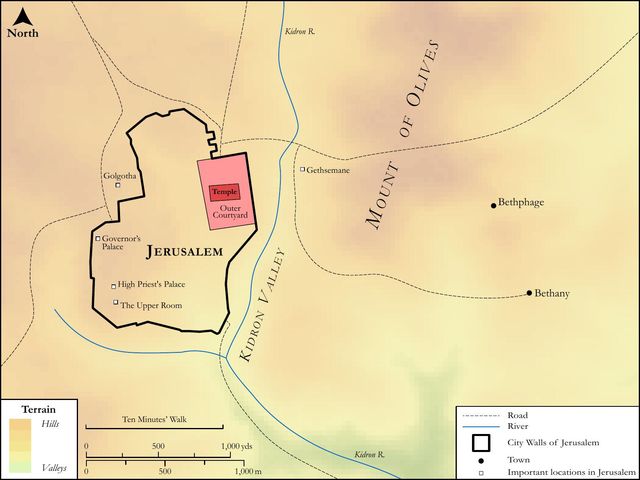
See on the biblical-era maps


Study this verse
Public-domain commentary
Matthew Henry
From his Commentary on the Whole Bible. Henry comments on passages, not single verses — this entry covers John 7:14–36. His four-level outline is real structure in the source text, so it is rendered as structure.
Here is, I. Christ's public preaching in the temple (v. 14): He went up into the temple, and taught, according to his custom when he was at Jerusalem. His business was to preach the gospel of the kingdom, and he did it in every place of concourse. His sermon is not recorded, because, probably, it was to the same purport with the sermons he had preached in Galilee, which were recorded by the other evangelists. For the gospel is the same to the plain and to the polite. But that which is observable here is that it was about the midst of the feast; the fourth or fifth day of the eight. Whether he did not come up to Jerusalem till the middle of the feast, or whether he came up at the beginning, but kept private till now, is not certain. But, Query, Why did he not go to the temple sooner, to preach? Answer, 1. Because the people would have more leisure to hear him, and, it might be hoped, would be better disposed to hear him, when they had spent some days in their booths, as they did at the feast of tabernacles. 2. Because he would choose to appear when both his friends and his enemies had done looking for him; and so give a specimen of the method he would observe in his appearances, which is to come at midnight, Matt. xxv. 6. But why did he appear thus publicly now? Surely it was to shame his persecutors, the chief priests and elders. (1.) By showing that, though they were very bitter against him, yet he did not fear them, nor their power. See Isa. l. 7, 8. (2.) By taking their work out of their hands. Their office was to teach the people in the temple, and particularly at the feast of tabernacles, Neh. viii. 17, 18. But they either did not teach them at all or taught for doctrines the commandments of men, and therefore he goes up to the temple and teaches the people. When the shepherds of Israel made a prey of the flock it was time for the chief Shepherd to appear, as was promised. Ezek. xxxiv. 22, 23; Mal. iii. 1.
II.His discourse with the Jews hereupon; and the conference is reducible to four heads:
1.Concerning his doctrine. See here,
(1.)How the Jews admired it (v. 15): They marvelled, saying, How knoweth this man letters, having never learned? Observe here,
[1.]That our Lord Jesus was not educated in the schools of the prophets, or at the feet of the rabbin; not only did not travel for learning, as the philosophers did, but did not make any use of the schools and academies in his own country. Moses was taught the learning of the Egyptians, but Christ was not taught so much as the learning of the Jews; having received the Spirit without measure, he needed not receive any knowledge from man, or by man. At the time of Christ's appearing, learning flourished both in the Roman empire and in the Jewish church more than in any age before or since, and in such a time of enquiry Christ chose to establish his religion, not in an illiterate age, lest it should look like a design to impose upon the world; yet he himself studied not the learning then in vogue.
[2.]That Christ had letters, though he had never learned them; was mighty in the scriptures, though he never had any doctor of the law for his tutor. It is necessary that Christ's ministers should have learning, as he had; and since they cannot expect to have it as he had it, by inspiration, they must take pains to get it in an ordinary way.
[3.]That Christ's having learning, though he had not been taught it, made him truly great and wonderful; the Jews speak of it here with wonder. First, Some, it is likely, took notice of it to his honour: He that had no human learning, and yet so far excelled all that had, certainly must be endued with a divine knowledge. Secondly, Others, probably, mentioned it in disparagement and contempt of him: Whatever he seems to have, he cannot really have any true learning, for he was never at the university, nor took his degree. Thirdly, Some perhaps suggested that he had got his learning by magic arts, or some unlawful means or other. Since they know not how he could be a scholar, they will think him a conjurer.
(2.)What he asserted concerning it; three things:—
[1.]That his doctrine is divine (v. 16): My doctrine is not mine, but his that sent me. They were offended because he undertook to teach though he had never learned, in answer to which he tells them that his doctrine was such as was not to be learned, for it was not the product of human thought and natural powers enlarged and elevated by reading and conversation, but it was a divine revelation. As God, equal with the Father, he might truly have said, My doctrine is mine, and his that sent me; but being now in his estate of humiliation, and being, as Mediator, God's servant, it was more congruous to say, "My doctrine is not mine, not mine only, nor mine originally, as man and mediator, but his that sent me; it does not centre in myself, nor lead ultimately to myself, but to him that sent me." God had promised concerning the great prophet that he would put his words into his mouth (Deut. xviii. 18), to which Christ seems here to refer. Note, It is the comfort of those who embrace Christ's doctrine, and the condemnation of those who reject it, that it is a divine doctrine: it is of God and not of man.
[2.]That the most competent judges of the truth and divine authority of Christ's doctrine are those that with a sincere and upright heart desire and endeavour to do the will of God (v. 17): If any man be willing to do the will of God, have his will melted into the will of God, he shall know of the doctrine whether it be of God or whether I speak of myself. Observe here, First, What the question is, concerning the doctrine of Christ, whether it be of God or no; whether the gospel be a divine revelation or an imposture. Christ himself was willing to have his doctrine enquired into, whether it were of God or no, much more should his ministers; and we are concerned to examine what grounds we go upon, for, if we be deceived, we are miserably deceived. Secondly, Who are likely to succeed in this search: those that do the will of God, at least are desirous to do it. Now see, 1. Who they are that will do the will of God. They are such as are impartial in their enquiries concerning the will of God, and are not biassed by any lust or interest, and such as are resolved by the grace of God, when they find out what the will of God is, to conform to it. They are such as have an honest principle of regard to God, and are truly desirous to glorify and please him. 2. Whence it is that such a one shall know of the truth of Christ's doctrine. (1.) Christ has promised to give knowledge to such; he hath said, He shall know, and he can give an understanding. Those who improve the light they have, and carefully live up to it, shall be secured by divine grace from destructive mistakes. (2.) They are disposed and prepared to receive that knowledge. He that is inclined to submit to the rules of the divine law is disposed to admit the rays of divine light. To him that has shall be given; those have a good understanding that do his commandments, Ps. cxi. 10. Those who resemble God are most likely to understand him.
[3.]That hereby it appeared that Christ, as a teacher, did not speak of himself, because he did not seek himself, v. 18. First, See here the character of a deceiver: he seeketh his own glory, which is a sign that he speaks of himself, as the false Christs and false prophets did. Here is the description of the cheat: they speak of themselves, and have no commission nor instructions from God; no warrant but their own will, no inspiration but their own imagination, their own policy and artifice. Ambassadors speak not of themselves; those ministers disclaim that character who glory in this that they speak of themselves. But see the discovery of the cheat; by this their pretensions are disproved, they consult purely their own glory; self-seekers are self-speakers. Those who speak from God will speak for God, and for his glory; those who aim at their own preferment and interest make it to appear that they had no commission form God. Secondly, See the contrary character Christ gives of himself and his doctrine: He that seeks his glory that sent him, as I do, makes it to appear that he is true. 1. He was sent of God. Those teachers, and those only, who are sent of God, are to be received and entertained by us. Those who bring a divine message must prove a divine mission, either by special revelation or by regular institution. 2. He sought the glory of God. It was both the tendency of his doctrine and the tenour of his whole conversation to glorify God. 3. This was a proof that he was true, and there was no unrighteousness in him. False teachers are most unrighteous; they are unjust to God whose name they abuse, and unjust to the souls of men whom they impose upon. There cannot be a greater piece of unrighteousness than this. But Christ made it appear that he was true, that he was really what he said he was, that there was no unrighteousness in him, no falsehood in his doctrine, no fallacy nor fraud in his dealings with us.
2.They discourse concerning the crime that was laid to his charge for curing the impotent man, and bidding him carry his bed on the sabbath day, for which they had formerly prosecuted him, and which was still the pretence of their enmity to him.
(1.)He argues against them by way of recrimination, convicting them of far worse practices, v. 19. How could they for shame censure him for a breach of the law of Moses, when they themselves were such notorious breakers of it? Did not Moses give you the law? And it was their privilege that they had the law, no nation had such a law; but it was their wickedness that none of them kept the law, that they rebelled against it, and lived contrary to it. Many that have the law given them, when they have it do not keep it. Their neglect of the law was universal: None of you keepeth it: neither those of them that were in posts of honour, who should have been most knowing, nor those who were in posts of subjection, who should have been most obedient. They boasted of the law, and pretended a zeal for it, and were enraged at Christ for seeming to transgress it, and yet none of them kept it; like those who say that they are for the church, and yet never go to church. It was an aggravation of their wickedness, in persecuting Christ for breaking the law, that they themselves did not keep it: "None of you keepeth the law, why then go ye about to kill me for not keeping it?" Note, Those are commonly most censorious of others who are most faulty themselves. Thus hypocrites, who are forward to pull a mote out of their brother's eye, are not aware of a beam in their own. Why go ye about to kill me? Some take this as the evidence of their not keeping the law: "You keep not the law; if you did, you would understand yourselves better than to go about to kill me for doing a good work." Those that support themselves and their interest by persecution and violence, whatever they pretend (though they may call themselves custodes utriusque tabulæ—the guardians of both tables), are not keepers of the law of God. Chemnitius understands this as a reason why it was time to supersede the law of Moses by the gospel, because the law was found insufficient to restrain sin: "Moses gave you the law, but you do not keep it, nor are kept by it from the greatest wickedness; there is therefore need of a clearer light and better law to be brought in; why then do you aim to kill me for introducing it?"
Here the people rudely interrupted him in his discourse, and contradicted what he said (v. 20): Thou has a devil; who goes about to kill thee? This intimates, [1.] The good opinion they had of their rulers, who, they think, would never attempt so atrocious a thing as to kill him; no, such a veneration they had for their elders and chief priests that they would swear for them they would do no harm to an innocent man. Probably the rulers had their little emissaries among the people who suggested this to them; many deny that wickedness which at the same time they are contriving. [2.] The ill opinion they had of our Lord Jesus: "Thou hast a devil, thou art possessed with a lying spirit, and art a bad man for saying so;" so some: or rather, "Thou art melancholy, and art a weak man; thou frightenest thyself with causeless fears, as hypochondriacal people are apt to do." Not only open frenzies, but silent melancholies, were then commonly imputed to the power of Satan. "Thou art crazed, has a distempered brain." Let us not think it strange if the best of men are put under the worst of characters. To this vile calumny our Saviour returns no direct answer, but seems as if he took no notice of it. Note, Those who would be like Christ must put up with affronts, and pass by the indignities and injuries done them; must not regard them, much less resent them, and least of all revenge them. I, as a deaf man, heard not. When Christ was reviled, he reviled not again,
(2.)He argues by way of appeal and vindication.
[1.]He appeals to their own sentiments of this miracle: "I have done one work, and you all marvel, v. 21. You cannot choose but marvel at it as truly great, and altogether supernatural; you must all own it to be marvellous." Or, "Though I have done but one work that you have any colour to find fault with, yet you marvel, you are offended and displeased as if I had been guilty of some heinous or enormous crime."
[2.]He appeals to their own practice in other instances: "I have done one work on the sabbath, and it was done easily, with a word's speaking, and you all marvel, you make a mighty strange thing of it, that a religious man should dare do such a thing, whereas you yourselves many a time do that which is a much more servile work on the sabbath day, in the case of circumcision; if it be lawful for you, nay, and your duty, to circumcise a child on the sabbath day, when it happens to be the eighth day, as no doubt it is, much more was it lawful and good for me to heal a diseased man on that day." Observe,
First, The rise and origin of circumcision: Moses gave you circumcision, gave you the law concerning it. Here, 1. Circumcision is said to be given, and (v. 23) they are said to receive it; it was not imposed upon them as a yoke, but conferred upon them as a favour. Note, The ordinances of God, and particularly those which are seals of the covenant, are gifts given to men, and are to be received as such. 2. Moses is said to give it, because it was a part of that law which was given by Moses; yet, as Christ said of the manna (ch. vi. 32), Moses did not give it them, but God; nay, and it was not of Moses first, but of the fathers, v. 22. Though it was incorporated into the Mosaic institution, yet it was ordained long before, for it was a seal of the righteousness of faith, and therefore commenced with the promise four hundred and thirty years before, Gal. iii. 17. The church membership of believers and their seed was not of Moses or his law, and therefore did not fall with it; but was of the fathers, belonged to the patriarchal church, and was part of that blessing of Abraham which was to come upon the Gentiles, Gal. iii. 14.
Secondly, The respect paid to the law of circumcision above that of the sabbath, in the constant practice of the Jewish church. The Jewish casuists frequently take notice of it, Circumcisio et ejus sanatio pellit sabbbatum—Circumcision and its cure drive away the sabbath; so that if a child was born one sabbath day it was without fail circumcised the next. If then, when the sabbath rest was more strictly insisted on, yet those works were allowed which were in ordine ad spiritualia—for the keeping up of religion, much more are they allowed now under the gospel, when the stress is laid more upon the sabbath work.
Thirdly, The inference Christ draws hence in justification of himself, and of what he had done (v. 23): A man-child on the sabbath day receives circumcision, that the law of circumcision might not be broken; or, as the margin reads it, without breaking the law, namely, of the sabbath. Divine commands must be construed so as to agree with each other. "Now, if this be allowed by yourselves, how unreasonable are you, who are angry with me because I have made a man every whit whole on the sabbath day!" emoi cholate. The word is used only here, from choge—fel, gall. They were angry at him with the greatest indignation; it was a spiteful anger, anger with gall in it. Note, It is very absurd and unreasonable for us to condemn others for that in which we justify ourselves. Observe the comparison Christ here makes between their circumcising a child and his healing a man on the sabbath day. 1. Circumcision was but a ceremonial institution; it was of the fathers indeed, but not from the beginning; but what Christ did was a good work by the law of nature, a more excellent law than that which made circumcision a good work. 2. Circumcision was a bloody ordinance, and made sore; but what Christ did was healing, and made whole. The law works pain, and, if that work may be done on the sabbath day, much more a gospel work, which produces peace. 3. Especially considering that whereas, when they had circumcised a child, their care was only to heal up that part which was circumcised, which might be done and yet the child remain under other illnesses, Christ had made this man every whit whole, holon anthropon hygie—I have made the whole man healthful and sound. The whole body was healed, for the disease affected the whole body; and it was a perfect cure, such as left no relics of the disease behind; nay, Christ not only healed his body, but his soul too, by that admonition, Go, and sin no more, and so indeed made the whole man sound, for the soul is the man. Circumcision indeed was intended for the good of the soul, and to make the whole man as it should be; but they had perverted it, and turned it into a mere carnal ordinance; but Christ accompanied his outward cures with inward grace, and so made them sacramental, and healed the whole man.
He concludes this argument with that rule (v. 24): Judge not according to the appearance, but judge righteous judgment. This may be applied, either, First, In particular, to this work which they quarrelled with as a violation of the law. Be not partial in your judgment; judge not, kat opsin—with respect of persons; knowing faces, as the Hebrew phrase is, Deut. i. 17. It is contrary to the law of justice, as well as charity, to censure those who differ in opinion from us as transgressors, in taking that liberty which yet in those of our own party, and way, and opinion, we allow of; as it is also to commend that in some as necessary strictness and severity which in others we condemn as imposition and persecution. Or, Secondly, In general, to Christ's person and preaching, which they were offended at and prejudiced against. Those things that are false, and designed to impose upon men, commonly appear best when they are judged of according to the outward appearance, they appear most plausible prima facie—at the first glance. It was this that gained the Pharisees such an interest and reputation, that they appeared right unto men (Matt. xxiii. 27, 28), and men judged of them by that appearance, and so were sadly mistaken in them. "But," saith Christ, "be not too confident that all are real saints who are seeming ones." With reference to himself, his outward appearance was far short of his real dignity and excellency, for he took upon him the form of a servant (Phil. ii. 7), was in the likeness of sinful flesh (Rom. viii. 3), had no form nor comeliness, Isa. liii. 2. So that those who undertook to judge whether he was the Son of God or no by his outward appearance were not likely to judge righteous judgment. The Jews expected the outward appearance of the Messiah to be pompous and magnificent, and attended with all the ceremonies of secular grandeur; and, judging of Christ by that rule, their judgment was from first to last a continual mistake, for the kingdom of Christ was not to be of this world, nor to come with observation. If a divine power accompanied him, and God bore him witness, and the scriptures were fulfilled in him, though his appearance was ever so mean, they ought to receive him, and to judge by faith, and not by the sight of the eye. See Isa. xi. 3, and 1 Sam. xvi. 7. Christ and his doctrine and doings desire nothing but righteous judgment; if truth and justice may but pass the sentence, Christ and his cause will carry the day. We must not judge concerning any by their outward appearance, not by their titles, the figure they make in the world, and their fluttering show, but by their intrinsic worth, and the gifts and graces of God's Spirit in them.
3.Christ discourses with them here concerning himself, whence he came, and whither he was going, v. 25-36.
(1.)Whence he came, v. 25-31. In the account of this observe,
[1.]The objection concerning this stated by some of the inhabitants of Jerusalem, who seem to have been of all others most prejudiced against him, v. 25. One would think that those who lived at the fountain-head of knowledge and religion should have been most ready to receive the Messiah: but it proved quite contrary. Those that have plenty of the means of knowledge and grace, if they are not made better by them, are commonly made worse; and our Lord Jesus has often met with the least welcome from those that one would expect the best from. But it was not without some just cause that it came into a proverb, The nearer the church the further from God. These people of Jerusalem showed their ill-will to Christ,
First, By their reflecting on the rulers, because they let him alone: Is not this he whom they seek to kill? The multitude of the people that came up out of the country to the feast did not suspect there was any design on foot against him, and therefore they said, Who goes about to kill thee? v. 20. But those of Jerusalem knew the plot, and irritated their rulers to put it into execution: "Is not this he whom they seek to kill? Why do they not do it then? Who hinders them? They say that they have a mind to get him out of the way, and yet, lo, he speaketh boldly, and they say nothing to him; do the rulers know indeed that this is the very Christ?" v. 26. Here they slyly and maliciously insinuate two things, to exasperate the rulers against Christ, when indeed they needed to spur. 1. That by conniving at his preaching they brought their authority into contempt. "Must a man that is condemned by the sanhedrim as a deceiver be permitted to speak boldly, without any check or contradiction? This makes their sentence to be but brutem fulmen—a vain menace; if our rulers will suffer themselves to be thus trampled upon, they may thank themselves if none stand in awe of them and their laws." Note, The worst of persecutions have often been carried on under colour of the necessary support of authority and government. 2. That hereby they brought their judgment into suspicion. Do they know that this is the Christ? It is spoken ironically, "How came they to change their mind? What new discovery have they lighted on? They give people occasion to think that they believe him to be the Christ, and it behoves them to act vigorously against him to clear themselves from the suspicion." Thus the rulers, who had made the people enemies to Christ, made them seven times more the children of hell than themselves, Matt. xxiii. 15. When religion and the profession of Christ's name are out of fashion, and consequently out of repute, many are strongly tempted to persecute and oppose them, only that they may not be thought to favour them and incline to them. And for this reason apostates, and the degenerate offspring of good parents, have been sometimes worse than others, as it were to wipe off the stain of their profession. It was strange that the rulers, thus irritated, did not seize Christ; but his hour was not yet come; and God can tie men's hands to admiration, though he should not turn their hearts.
Secondly, By their exception against his being the Christ, in which appeared more malice than matter, v. 27. "If the rulers think him to be the Christ, we neither can nor will believe him to be so, for we have this argument against it, that we know this man, whence he is; but when Christ comes no man knows whence he is." Here is a fallacy in the argument, for the propositions are not body ad idem—adapted to the same view of the subject. 1. If they speak of his divine nature, it is true that when Christ comes no man knows whence he is, for he is a priest after the order of Melchizedek, who was without descent, and his goings forth have been from of old, from everlasting, Mic. v. 2. But then it is not true that as for this man they knew whence he was, for they knew not his divine nature, nor how the Word was made flesh. 2. If they speak of his human nature, it is true that they knew whence he was, who was his mother, and where he was bred up; but then it is false that ever it was said of the Messiah that none should know whence he was, for it was known before where he should be born, Matt. ii. 4, 5. Observe, (1.) How they despised him, because they knew whence he was. Familiarity breeds contempt, and we are apt to disdain the use of those whom we know the rise of. Christ's own received him not, because he was their own, for which very reason they should the rather have loved him, and been thankful that their nation and their age were honoured with his appearance. (2.) How they endeavoured unjustly to fasten the ground of their prejudice upon the scriptures, as if they countenanced them, when there was no such thing. Therefore people err concerning Christ, because they know not the scripture.
[2.]Christ's answer to this objection, v. 28, 29.
First, He spoke freely and boldly, he cried in the temple, as he taught, he spoke this louder than the rest of his discourse, 1. To express his earnestness, being grieved for the hardness of their hearts. There may be a vehemency in contending for the truth where yet there is no intemperate heat nor passion. We may instruct gainsayers with warmth, and yet with meekness. 2. The priests and those that were prejudiced against him, did not come near enough to hear his preaching, and therefore he must speak louder than ordinary what he will have them to hear. Whoever has ears to hear, let him hear this.
Secondly, His answer to their cavil is, 1. By way of concession, granting that they did or might know his origin as to the flesh: "You both know me, and you know whence I am. You know I am of your own nation, and one of yourselves." It is no disparagement to the doctrine of Christ that there is that in it which is level to the capacities of the meanest, plain truths, discovered even by nature's light, of which we may say, We know whence they are. "You know me, you think you know me; but you are mistaken; you take me to be the carpenter's son, and born at Nazareth, but it is not so." 2. By way of negation, denying that that which they did see in him, and know of him, was all that was to be known; and therefore, if they looked no further, they judged by the outward appearance only. They knew whence he came perhaps, and where he had his birth, but he will tell them what they knew not, from whom he came. (1.) That he did not come of himself; that he did not run without sending, nor come as a private person, but with a public character. (2.) That he was sent of his Father; this is twice mentioned: He hath sent me. And again, "He hath sent me, to say what I say, and do what I do." This he was himself well assured of, and therefore knew that his Father would bear him out; and it is well for us that we are assured of it too, that we may with holy confidence go to God by him. (3.) That he was from his Father, par autou eimi—I am from him; not only sent from him as a servant from his master, but from him by eternal generation, as a son from his father, by essential emanation, as the beams from the sun. (4.) That the Father who sent him is true; he had promised to give the Messiah, and, though the Jews had forfeited the promise, yet he that made the promise is true, and has performed it. He had promised that the Messiah should see his seed, and be successful in his undertaking; and, though the generality of the Jews reject him and his gospel, yet he is true, and will fulfil the promise in the calling of the Gentiles. (5.) That these unbelieving Jews did not know the Father: He that sent me, whom you know not. There is much ignorance of God even with many that have a form of knowledge; and the true reason why people reject Christ is because they do not know God; for there is such a harmony of the divine attributes in the work of redemption, and such an admirable agreement between natural and revealed religion, that the right knowledge of the former would not only admit, but introduce, the latter. (6.) Our Lord Jesus was intimately acquainted with the Father that sent him: but I know him. He knew him so well that he was not at all in doubt concerning his mission from him, but perfectly assured of it; nor at all in the dark concerning the work he had to do, but perfectly apprized of it, Matt. xi. 27.
[3.]The provocation which this gave to his enemies, who hated him because he told them the truth, v. 30. They sought therefore to take him, to lay violent hands on him, not only to do him a mischief, but some way or other to be the death of him; but by the restraint of an invisible power it was prevented; nobody touched him, because his hour was not yet come; this was not their reason why they did it not, but God's reason why he hindered them from doing it. Note, First, The faithful preachers of the truths of God, though they behave themselves with ever so much prudence and meekness, must expect to be hated and persecuted by those who think themselves tormented by their testimony, Rev. xi. 10. Secondly, God has wicked men in a chain, and, whatever mischief they would do, they can do no more than God will suffer them to do. The malice of persecutors is impotent even when it is most impetuous, and, when Satan fills their hearts, yet God ties their hands. Thirdly, God's servants are sometimes wonderfully protected by indiscernible unaccountable means. Their enemies do not do the mischief they designed, and yet neither they themselves nor any one else can tell why they do not. Fourthly, Christ had his hour set, which was to put a period to his day and work on earth; so have all his people and all his ministers, and, till that hour comes, the attempts of their enemies against them are ineffectual, and their day shall be lengthened as long as their Master has any work for them to do; nor can all the powers of hell and earth prevail against them, until they have finished their testimony.
[4.]The good effect which Christ's discourse had, notwithstanding this, upon some of his hearers (v. 31): Many of the people believed on him. As he was set for the fall of some, so for the rising again of others. Even where the gospel meets with opposition there may yet be a great deal of good done, 1 Thess. ii. 2. Observe here, First, Who they were that believed; not a few, but many, more than one would have expected when the stream ran so strongly the other way. But these many were of the people, ek tou ochlou—of the multitude, the crowd, the inferior sort, the mob, the rabble, some would have called them. We must not measure the prosperity of the gospel by its success among the great ones; nor much ministers say that they labour in vain, though none but the poor, and those of no figure, receive the gospel, 1 Cor. i. 26. Secondly, What induced them to believe: the miracles which he did, which were not only the accomplishment of the Old-Testament prophecies (Isa. xxxv. 5, 6), but an argument of a divine power. He that had an ability to do that which none but God can do, to control and overrule the powers of nature, no doubt had authority to enact that which none but God can enact, a law that shall bind conscience, and a covenant that shall give life. Thirdly, How weak their faith was: they do not positively assert, as the Samaritans did, This is indeed the Christ, but they only argue, When Christ comes will he do more miracles than these? They take it for granted that Christ will come, and, when he comes, will do many miracles. "Is not this he then? In him we see, though not all the worldly pomp we have fancied, yet all the divine power we have believed the Messiah should appear in; and therefore why may not this be he?" They believe it, but have not courage to own it. Note, Even weak faith may be true faith, and so accounted, so accepted, by the Lord Jesus, who despises not the day of small things.
(2.)Whither he was going, v. 32-36. Here observe,
[1.]The design of the Pharisees and chief priests against him, v. 32. First, The provocation given them was that they had information brought them by their spies, who insinuated themselves into the conversation of the people, and gathered stories to carry to their jealous masters, that the people murmured such things concerning him, that there were many who had a respect and value for him, notwithstanding all they had done to render him odious. Though the people did but whisper these things, and had not courage to speak out, yet the Pharisees were enraged at it. The equity of that government is justly suspected by others which is so suspicious of itself as to take notice of, or be influenced by, the secret, various, uncertain mutterings of the common people. The Pharisees valued themselves very much upon the respect of the people, and were sensible that if Christ did thus increase they must decrease. Secondly, The project they laid hereupon was to seize Jesus, and take him into custody: They sent officers to take him, not to take up those who murmured concerning him and frighten them; no, the most effectual way to disperse the flock is to smite the shepherd. The Pharisees seem to have been the ringleaders in this prosecution, but they, as such, had no power, and therefore they god the chief priests, the judges of the ecclesiastical court, to join with them, who were ready enough to do so. The Pharisees were the great pretenders to learning, and the chief priests to sanctify. As the world by wisdom knew not God, but the greatest philosophers were guilty of the greatest blunders in natural religion, so the Jewish church by their wisdom knew not Christ, but their greatest rabbin were the greatest fools concerning him, nay, they were the most inveterate enemies to him. Those wicked rulers had their officers, officers of their court, church-officers, whom they employed to take Christ, and who were ready to go on their errand, though it was an ill errand. If Saul's footmen will not turn and fall upon the priests of the Lord, he has a herdsman that will, 1 Sam. xxii. 17, 18.
[2.]The discourse of our Lord Jesus hereupon (v. 33, 34): Yet a little while I am with you, and then I go to him that sent me; you shall seek me, and shall not find me; and where I am, thither you cannot come. These words, like the pillar of cloud and fire, have a bright side and a dark side.
First, They have a bright side towards our Lord Jesus himself, and speak abundance of comfort to him and all his faithful followers that are exposed to difficulties and dangers for his sake. Three things Christ here comforted himself with:—1. That he had but a little time to continue here in this troublesome world. He sees that he is never likely to have a quiet day among them; but the best of it is his warfare will shortly be accomplished, and then he shall be no more in this world, ch. xvii. 11. Whomsoever we are with in this world, friends or foes, it is but a little while that we shall be with them; and it is a matter of comfort to those who are in the world, but not of it, and therefore are hated by it and sick of it, that they shall not be in it always, they shall not be in it long. We must be awhile with those that are pricking briars and grieving thorns; but thanks be to God, it is but a little while, and we shall be out of their reach. Our days being evil, it is well they are few. 2. That, when he should quit this troublesome world, he should go to him that sent him; I go. Not, "I am driven away by force," but, "I voluntarily go; having finished my embassy, I return to him on whose errand I came. When I have done my work with you, then, and not till then, I go to him that sent me, and will receive me, will prefer me, as ambassadors are preferred when they return." Their rage against him would not only not hinder him from, but would hasten him to the glory and joy that were set before him. Let those who suffer for Christ comfort themselves with this, that they have a God to go to, and are going to him, going apace, to be for ever with him. 3. That, though they persecuted him here, wherever he went, yet none of their persecutions could follow him to heaven: You shall seek me, and shall not find me. It appears, by their enmity to his followers when he was gone, that if they could have reached him they would have persecuted him: "But you cannot enter into that temple as you do into this." Where I am, that is, where I then shall be; but he expressed it thus because, even when he was on earth, by his divine nature and divine affections he was in heaven, ch. iii. 13. Or it denotes that he should be so soon there that he was as good as there already. Note, It adds to the happiness of glorified saints that they are out of the reach of the devil and all his wicked instruments.
Secondly, These words have a black and dark side towards those wicked Jews that hated and persecuted Christ. They now longed to be rid of him, Away with him from the earth; but let them know, 1. That according to their choice so shall their doom be. They were industrious to drive him from them, and their sin shall be their punishment; he will not trouble them long, yet a little while and he will depart from them. It is just with God to forsake those that think his presence a burden. They that are weary of Christ need no more to make them miserable than to have their wish. 2. That they would certainly repent their choice when it was too late. (1.) They should in vain seek the presence of the Messiah: "You shall seek me, and shall not find me. You shall expect the Christ to come, but your eyes shall fail with looking for him, and you shall never find him." Those who rejected the true Messiah when he did come were justly abandoned to a miserable and endless expectation of one that should never come. Or, it may refer to the final rejection of sinners from the favours and grace of Christ at the great day: those who now seek Christ shall find him, but the day is coming when those who now refuse him shall seek him, and shall not find him. See Prov. i. 28. They will in vain cry, Lord, Lord, open to us. Or, perhaps, these words might be fulfilled in the despair of some of the Jews, who possibly might be convinced and not converted, who would wish in vain to see Christ, and to hear him preach again; but the day of grace is over (Luke xvii. 22); yet this is not all. (2.) They should in vain expect a place in heaven: Where I am, and where all believers shall be with me, thither ye cannot come. Not only because they are excluded by the just and irreversible sentence of the judge, and the sword of the angel at every gate of the new Jerusalem, to keep the way of the tree of life against those who have no right to enter, but because they are disabled by their own iniquity and infidelity: You cannot come, because you will not. Those who hate to be where Christ is, in his word and ordinances on earth, are very unfit to be where he is in his glory in heaven; for indeed heaven would be no heaven to them, such are the antipathies of an unsanctified soul to the felicities of that state.
Historical interpretation
Two Centuries of Reception
14 surviving comments on this verse. Each one is dated, so this reads as a timeline rather than a list.
Select a marker to jump to its quote. Markers stagger vertically where authors wrote within a few decades of each other.
For the teaching of piety is a gift, but faith is grace. "For by doing the will of God we know the will of God."
"Now about the middle of the feast Jesus went up and taught." By the delay He made them more attentive; for they who had sought Him on the first days and said, "Where is He?" when they saw Him suddenly present, observe how they drew near, and were like to press upon Him as He was speaking, both those who said that He was a good man, and those who said that He was not such; the former so as to profit by and admire Him, the latter to lay hold on and detain Him. One party then said, "He deceiveth the people," by reason of the teaching and the doctrines, not understanding His meaning; the other on account of the miracles said, "He is a good man." He therefore thus came among them when He had slackened their anger, so that they might hear His words at leisure, when passion no longer stopped their ears.
But how is the doctrine His and not His? For He said not, "This doctrine is not Mine"; but having first said, "it is Mine," and having claimed it as His own, He then added, "it is not Mine." How then can the same thing be both "His" and not "His"? It is "His," because He spake it not as one who had been taught; and it is "not His," because it was the doctrine of the Father. "For if because the doctrine is the Father's, it is not thine, that other assertion is false, for according to that it ought to be thine." But the "is not Mine," affords a strong proof that His doctrine and the Father's are one; as if He had said, "It hath nothing different, as though it were another's. For though My Person be different, yet so do I speak and do as not to be supposed to speak or do anything contrary to the Father, but rather the very same things that the Father saith and doeth."
(Hom. xlix. 1) Observe, the corruption is in the rulers: the common people are sound in their judgment, but have not liberty of speech, as is generally their case.
(Hom. xlix. 1. Aug.) Our Lord delays His visit, in order to excite men's attention, and goes up not the first day, but about the middle of the feast: Now about the midst of the feast Jesus went up into the temple, and taught. Those who had been searching for Him, when they saw Him thus suddenly appear, would be more attentive to His teaching, both favourers and enemies; the one to admire and profit by it; the other to find an opportunity of laying hands on Him.
(Hom. xlix. 1) What His teaching is, the Evangelist does not say; but that it was very wonderful is shown by its effect even upon those who had accused Him of deceiving the people, who turned round and began to admire Him: And the Jews marvelled, saying, How knoweth this Man letters, having never learned? See how perverse they are even in their admiration. It is not His doctrine they admire, but another thing altogether.
(Hom. xlix. 1) Their wonder might have led them to infer, that our Lord became possessed of this learning in some divine way, and not by any human process. But they would not acknowledge this, and contented themselves with wondering. So our Lord repeated it to them: Jesus answered them and said, My doctrine is not Mine, but His that sent Me.
(Hom. xlix. 2) Or He calls it His own, inasmuch as He taught it; not His own, inasmuch as the doctrine was of the Father. If all things however which the Father hath are His, the doctrine for this very reason is His; i. e. because it is the Father's. Rather that He says, Is not Mine own, shows very strongly, that His doctrine and the Father's are one: as if He said, I differ nothing from Him; but so act, that it may be thought I say and do nothing else than doth the Father.
(Hom. xlix. 1) This is as much as to say, Put away the anger, envy, and hatred which you have towards Me, and there will be nothing to prevent your knowing, that the words which I speak are from God. Then He brings in an irresistible argument taken from human experience: He that speaketh of himself, seeketh his own glory: as if to say, He who aims at establishing some doctrine of his own, does so for no purpose, but to get glory. But I seek the glory of Him that sent me, and wish to teach you for His, i. e. another's, sake: and then it follows, But he that seeketh His glory that sent Him, the same is true, and there is no unrighteousness in Him.
(Hom. xlix. 2) Observe, the reason why He spake so humbly of Himself, is to let men know, that He does not aim at glory, or power; and to accommodate Himself to their weakness, and to teach them moderation, and a humble, as distinguished from an assuming, way of speaking of themselves.
"If any man do His will, he shall know of the doctrine." What meaneth, "If any man do His will?" "If any man be a lover of the life which is according to virtue, he shall know the power of the sayings." "If any man will give heed to the prophecies, to see whether I speak according to them or not."
"He that speaketh of himself seeketh his own glory." That is, "He that desireth to establish any doctrine of his own, desireth to do so only that he himself may enjoy the glory. Now if I desire not to enjoy glory, wherefore should I desire to establish any doctrine of My own? He that speaketh of himself, that is, who speaketh anything peculiar or different from others, speaketh on this account, that he may establish his own glory; but if I seek the glory of Him that sent Me, wherefore should I choose to teach other things?"
There are many reasons for His using lowly words, as that He might not be deemed unbegotten, or opposed to God, His being clothed with flesh, the infirmity of His hearers, that He might teach men to be modest, and to speak no great thing of themselves: while for speaking lofty words one could only find one reason, the greatness of His Nature.
"If any man will do His will, he shall know of the doctrine, whether it be of God, or whether I speak of Myself." What He saith is this, "Cast out from yourselves the malice and wrath and envy and hatred which has without cause been conceived against Me, then there is nothing to hinder you from knowing that My words are indeed the words of God. For at present these things cast a darkness over you, and destroy the light of right judgment, while if ye remove them this shall no longer be your case."
"How knoweth this man letters, having never learned?" Observest thou how the Evangelist showeth here also their marveling to be full of wickedness? for he saith not, that they admired the teaching, or that they received the words, but simply that they "marveled." That is, were thrown into a state of astonishment, and doubted, saying, "Whence hath this man these things"? when they ought from this very difficulty to have known that there was nothing merely human in Him. But because they would not confess this, but stopped at wondering only, hear what He saith.
"My doctrine is not Mine." Again He answereth to their secret thoughts, referring them to the Father, and so desiring to stop their mouths.
(Tract. xxix. s. 3) Mine is not mine, appears a contradiction; why did He not say, This doctrine is not Mine? Because the doctrine of the Father being the Word of the Father, and Christ Himself being that Word, Christ Himself is the doctrine of the Father. And therefore He calls the doctrine both His own, and the Father's. A word must be a word of some one's. What is so much Thine as Thou, and what is so much not Thine as Thou, if what Thou art, Thou art of another. His saying then, My doctrine is not Mine own, seems briefly to express the truth, that He is not from Himself; it refutes the Sabellian heresy, which dares to assert that the Son is the same as the Father, there being only two names for one thing.
(de Trin. i. c. xi) Or thus: In one sense He calls it His, in another sense not His; according to the form of the Godhead His, according to the form of the servant not His.
(Tract. xxix. s. 6) Should any one however not understand this, let him hear the advice which immediately follows from our Lord: If any man will do His will, he shall know of the doctrine, whether it be of God, or whether I speak of Myself. What meaneth this, If any man will do His will? To do His will is to believe on Him, as He Himself says, This is the work of God, that ye believe on Him whom He hath sent. (c. 6:29) And who does not know, that to work the work of God, is to do His will? To know is to understand. Do not then seek to understand in order to believe, but believe in order to understand, for, Except ye believe, ye shall not understand. (Is. 7:9. Vulg.)
How then did the Lord answer those that were marvelling how He knew letters which He had not learned? "My doctrine," saith He, "is not mine, but His that sent me." This is the first profundity. For He seems as if in a few words He had spoken contraries. For He says not, This doctrine is not mine; but, "My doctrine is not mine." If not Thine, how Thine? If Thine, how not Thine? For Thou sayest both: both, "my doctrine;" and, "not mine." For if He had said, This doctrine is not mine, there would have been no question. But now, brethren, in the first place, consider well the question, and so in due order expect the solution. For he who sees not the question proposed, how can he understand what is expounded? The subject of inquiry, then, is that which He says, "My, not mine" this appears to be contrary; how "my," how "not mine"? If we carefully look at what the holy evangelist himself says in the beginning of his Gospel, "In the beginning was the Word, and the Word was with God, and the Word was God;" thence hangs the solution of this question. What then is the doctrine of the Father, but the Father's Word? Therefore, Christ Himself is the doctrine of the Father, if He is the Word of the Father. But since the Word cannot be of none, but of some one, He said both "His doctrine," namely, Himself, and also, "not His own," because He is the Word of the Father. For what is so much "Thine" as Thyself? And what so much not Thine as Thyself, if that Thou art is of another?
The Word then is God; and it is also the Word of a stable, unchangeable doctrine, not such as can be sounded by syllables and fleeting, but abiding with the Father, to which abiding doctrine let us be converted, being admonished by the transitory sounds of the voice. For that which is transitory does not so admonish us as to call us to transitory things. We are admonished to love God. All this that I have said were syllables; they smote through the air to reach your sense of hearing, and by sounding passed away: that, however, which I advise you ought not so to pass away, because He whom I exhort you to love passes not away; and when you, exhorted in transient syllables, shall have been converted, you shall not pass away, but shall abide with Him who is abiding. There is therefore in the doctrine this great matter, this deep and eternal thing which is permanent: whither all things that pass away in time call us, when they mean well and are not falsely put forward. For, in fact, all the signs which we produce by sounds do signify something which is not sound. For God is not the two short syllables "Deus," and it is not the two short syllables that we worship, and it is not the two short syllables that we adore, nor is it to the two short syllables that we desire to come-two syllables which almost cease to sound before they have begun to sound; nor in sounding them is there room for the second until the first has passed away. There remains, then, something great which is called "God," although the sound does not remain when we say the word "God." Thus direct your thoughts to the doctrine of Christ, and ye shall arrive at the Word of God; and when you have arrived at the Word of God, consider this, "The Word was God," and you will see that it was said truly, "my doctrine:" consider also whose the Word is, and you will see that it was rightly said, "is not mine."
Therefore, to speak briefly, beloved, it seems to me that the Lord Jesus Christ said, "My doctrine is not mine," meaning the same thing as if He said, "I am not from myself." For although we say and believe that the Son is equal to the Father, and that there is not any diversity of nature and substance in them, that there has not intervened any interval of time between Him that begets and Him that is begotten, nevertheless we say these things, while keeping and guarding this, that the one is the Father, the other the Son. But Father He is not if He have not a Son, and Son He is not if He have not a Father: but yet the Son is God from the Father; and the Father is God, but not from the Son. The Father of the Son, not God from the Son: but the other is Son of the Father, and God from the Father. For the Lord Christ is called Light from Light. The Light then which is not from Light, and the equal Light which is not from Light, are together one Light not two Lights.
If we have understood this, thanks be to God; but if any has not sufficiently understood, man has done as far as he could: as for the rest, let him see whence he may hope to understand. As laborers outside, we can plant and water; but it is of God to give the increase. "My doctrine," saith He, "is not mine, but His that sent me." Let him who says he has not yet understood hear counsel. For since it was a great and profound matter that had been spoken, the Lord Christ Himself did certainly see that all would not understand this so profound a matter, and He gave counsel in the sequel. Dost thou wish to understand? Believe. For God has said by the prophet: "Except ye believe, ye shall not understand." To the same purpose what the Lord here also added as He went on "If any man is willing to do His will, he shall know concerning the doctrine, whether it be of God, or whether I speak from myself." What is the meaning of this, "If any man be willing to do His will"? But I had said, if any man believe; and I gave this counsel: If thou hast not understood, said I, believe. For understanding is the reward of faith. Therefore do not seek to understand in order to believe, but believe that thou mayest understand; since, "except ye believe, ye shall not understand." Therefore when I would counsel the obedience of believing toward the possibility of understanding, and say that our Lord Jesus Christ has added this very thing in the following sentence, we find Him to have said, "If any man be willing to do His will, he shall know of the doctrine." What is "he shall know"? It is the same thing as "he shall understand." But what is "If any man be willing to do His will"? It is the same thing as to believe. All men indeed perceive that "shall know" is the same thing as "shall understand:" but that the saying, "If any man be willing to do His will," refers to believing, all do not perceive; to perceive this more accurately, we need the Lord Himself for expounder, to show us whether the doing of the Father's will does in reality refer to believing. But who does not know that this is to do the will of God, to work the work of God; that is, to work that work which is pleasing to Him? But the Lord Himself says openly in another place: "This is the work of God, that ye believe on Him whom He has sent." "That ye believe on Him," not, that ye believe Him. But if ye believe on Him, ye believe Him; yet he that believes Him does not necessarily believe on Him. For even the devils believed Him, but they did not believe on Him. Again, moreover, of His apostles we can say, we believe Paul; but not, we believe on Paul: we believe Peter; but not, we believe on Peter. For, "to him that believeth on Him that justifieth the ungodly, his faith is counted unto him for righteousness." What then is "to believe on Him"? By believing to love Him, by believing to esteem highly, by believing to go into Him and to be incorporated in His members. It is faith itself then that God exacts from us: and He finds not that which He exacts, unless He has bestowed what He may find. What faith, but that which the apostle has most amply defined in another place, saying, "Neither circumcision availeth anything, nor uncircumcision, but faith that worketh by love?" Not any faith of what kind soever, but "faith that worketh by love:" let this faith be in thee, and thou shalt understand concerning the doctrine. What indeed shalt thou understand? That "this doctrine is not mine, but His that sent me;" that is, thou shalt understand that Christ the Son of God, who is the doctrine of the Father, is not from Himself, but is the Son of the Father.
This sentence overthrows the Sabellian heresy. The Sabellians have dared to affirm that the Son is the very same as He who is also the Father: that the names are two, but the reality one. If the names were two and reality one, it would not be said, "My doctrine is not mine." Anyhow, if Thy doctrine is not Thine, O Lord, whose is it, unless there be another whose it is? The Sabellians understand not what Thou saidst; for they see not the trinity, but follow the error of their own heart. Let us worshippers of the trinity and unity of Father, Son, and Holy Ghost, and one God, understand concerning Christ's doctrine, how it is not His. And He said that He spoke not from Himself for this reason, because Christ is the Son of the Father, and the Father is the Father of Christ; and the Son is from God the Father, God, but God the Father is God not from God the Son.
He tells them, You will fully know that “my doctrine” comes from God the Father when you choose to follow his will rather than your own.… He justly accuses them because they unreasonably mock what he teaches, even though God the Father consents and agrees with what he is teaching, and (what is also true) even co-teaches and co-interprets [with Jesus] … No person of sound mind would ever think that Jesus here casts aspersions on his own words. Rather, he is saying that his words will never be anything other than in agreement with the will of God the Father. For the Father speaks by his own Word and Wisdom and offspring. But that [offspring] in no way speaks differently from the [Father]. How could it?
We ought uncritically and without all doubt to receive the words of the Truth, and to believe that a thing once said, cannot be otherwise than as it was declared to be. But He permits not His saying to be without proof, on account of the unbelievers, but introduces a most evident and exceeding clear solution, tempering with much skill the fashion of His words. And what the skill is, what the order of the economy, we will again say. They were seeking to kill Him on account of the paralytic, him (I mean) that was healed on the sabbath day. Gently then does He alike scare them from their dreadful purpose against Him, and clearly does He convict those who are travailing with their blood-thirsty purpose against Him, that they were choosing to fulfil their own lust rather than the will of the Law-giver. For then (saith He) shall ye know perfectly of My doctrine, that it is of God the Father, when ye shall choose to follow His Will rather than your own. But the Will of the Law-giver and of God, is to abstain wholly from murder. Then, then (He saith) shall ye, not holden beforehand by unjust hatred, nor thrust forth in brutish guise to no seasonable anger, know clearly, whether the word of My teaching is of God, or whether I am speaking of Myself. Having therefore interwoven reproof with profit, He with justice accuses them, for that they unreasonably mock at what He teaches, though God the Father consenteth and co-willeth, or what also is true, co-teacheth and co-interpreteth. But He puts Of Myself, for, Privately and wholly severed from being after the Co-Will and Purpose of the Father. And I do not suppose any person of sound mind will think that He accuses His own words of being spurious, but says that they will never be otherwise than in accordance with the Will of God the Father. For He speaks by His own Word and Wisdom, His Own Offspring; but That speaks not at all diversely from Himself, for how could It?
Continue studying John 7:17 across the web’s major study libraries — every link below opens this exact verse, chapter, or book on the destination site.
Read & Compare
 BibleGatewayThis verse in more than 200 translations and 70 languages.
 Bible.comThe YouVersion reader — hundreds of translations, reading plans, and highlights.
 ESV.orgCrossway's official English Standard Version reader.
 NET BibleThe NET translation with 60,000+ translators' notes on every rendering decision.
 STEP BibleTyndale House's free study tool — original text, vocabulary, and scholarly resources.
 BibliaLogos Bible Software's free web reader.
 USCCBThe New American Bible (Revised Edition) with the U.S. bishops' study notes.
Commentaries
 BibleHub CommentariesDozens of classic commentaries on this verse, gathered on one page.
 StudyLightMore than 100 commentary sets — the largest collection on the web.
 BibleRefPlain-English commentary on what this verse means, verse by verse.
 Enduring WordDavid Guzik's free commentary on this chapter, widely used by Bible teachers.
 Bible Study ToolsVerse commentary alongside Greek and Hebrew study aids.
Original Language & Research
- BibleHub InterlinearThe verse word by word — original language, transliteration, and English.
- BibleHub LexiconEvery word's original-language definition and Strong's entry.
 Blue Letter BibleDeep-study tools — Strong's numbers, concordance, and word studies.
 CNTR CollationThe earliest Greek manuscripts of this verse, collated letter by letter.
Sermons, Hymns & Audio


TrulyRandomVerse is not affiliated with these sites and doesn’t control their content. They’re linked because they’re genuinely useful.
Summary
John 7:17 articulates a profound spiritual epistemology: the pathway to discerning divine truth is paved by a sincere willingness to obey God's will. Amidst the intense scrutiny of His teachings during the Feast of Tabernacles, Jesus offers a direct, experiential criterion for validating the divine origin of His message, asserting that genuine commitment to God's purposes unlocks the spiritual understanding necessary to recognize whether His doctrine originates from God or merely from Himself.
Context
ShowHideLiterary Context
This verse is embedded within Jesus' discourse during the Feast of Tabernacles in Jerusalem, a period of heightened tension and public debate surrounding His identity and authority. In John 7:14-15, Jesus begins teaching in the Temple, astonishing the crowds with His wisdom, prompting questions about His unlearned status. Immediately preceding John 7:17, Jesus declares in John 7:16 that His "doctrine is not Mine, but His that sent Me." Verse 17 then provides the practical, moral condition for verifying this claim, inviting anyone to test the divine origin of His words through a commitment to God's will, thereby addressing the skepticism and offering a path to genuine spiritual discernment.
Historical & Cultural Context
The Feast of Tabernacles (Sukkot) was one of the three major pilgrimage festivals, drawing thousands of Jews to Jerusalem. It was a time of great national celebration, commemorating God's provision during the wilderness wandering and looking forward to the Messianic age. The atmosphere was festive, yet also highly charged with religious and political fervor, making the Temple courts a prominent venue for public teaching and debate. Jewish leaders, particularly the Pharisees and chief priests, were intensely scrutinizing Jesus, questioning His authority, His messianic claims, and the source of His teachings. The concept of a prophet's authenticity was often tied to their message aligning with the Torah and their ability to perform signs, but Jesus introduces a deeper, internal criterion for discernment.
Key Themes
ShowHideJohn 7:17 contributes significantly to several major themes within the Gospel of John and broader biblical theology. Foremost is the Divine Authority of Jesus' Teaching, directly addressing the central question of whether Jesus speaks on His own human authority or as the sent Son of God. This verse posits that Obedience as a Prerequisite for Spiritual Understanding is essential; intellectual assent alone is insufficient for discerning divine truth. It suggests that genuine understanding of God's will and the authenticity of Christ's message is not merely an intellectual exercise but an experiential one, rooted in practical commitment, echoing the principle that those who truly seek God will find Him, as seen in Jeremiah 29:13. Furthermore, the verse highlights the theme of Experiential Knowledge, implying a deep, personal, and transformative "knowing" (Greek ginōskō) that transcends mere intellectual comprehension, providing an internal conviction about the truth of Christ's doctrine. This contrasts with the superficial understanding of those who merely heard His words but refused to believe, as illustrated throughout John 7.
Exposition and Analysis
ShowHideKey Word Analysis
ShowHideThis word, G2309, signifies a determination, an active option from subjective impulse, a conscious choice or preference. It implies more than mere intellectual assent or passive willingness; it denotes a deep desire, an inclination, or a readiness of heart to align with God's purposes. When combined with "do" (G4160, poiéō), it emphasizes an active, intentional commitment to carrying out God's will, not just an abstract thought.
This verb describes a profound, experiential knowledge, distinct from simple intellectual apprehension (oida). It implies a personal, intimate acquaintance with truth that comes from direct experience and relationship. In this context, it suggests that by actively pursuing God's will, one gains an internal, convicting understanding of the divine origin of Jesus' doctrine, moving beyond mere speculation to a settled assurance.
This term refers to instruction, teaching, or the content of what is taught. Here, it specifically denotes the body of truth and principles that Jesus was proclaiming. The verse posits that the authenticity and divine source of this teaching can be verified through the practical application of God's will in one's life.
Verse Breakdown
ShowHide"If any man will do his will"
This opening clause establishes a crucial condition. The phrase "will do" (from thelei poiein) points to a willing, desiring, and active commitment to obey God's will (His thélēma). It's not about perfect performance, but about a sincere disposition and a readiness of heart to align one's life with God's revealed purposes. This implies a moral and spiritual posture of openness and submission to divine authority.
"he shall know of the doctrine"
This is the promised outcome of the condition. The word "know" (ginōskō) signifies an experiential, deep, and personal understanding, not just intellectual assent. It means to come to a settled conviction and inner certainty about the truth being taught. This knowledge is a direct consequence of the prior commitment to obedience, suggesting that spiritual truth is often revealed through practical engagement rather than purely intellectual inquiry.
"whether it be of God, or [whether] I speak of myself."
This final clause clarifies the object of discernment: the origin of Jesus' teaching. The individual who is committed to doing God's will will be able to distinguish between doctrine that genuinely originates from God (divine revelation) and doctrine that is merely human in origin (Jesus speaking "of myself"). This directly addresses the central controversy surrounding Jesus' authority and the source of His message.
Literary Devices
ShowHideJohn 7:17 employs several significant literary devices. It functions as a Conditional Statement, clearly outlining a cause-and-effect relationship: "If X, then Y." This structure highlights the necessary prerequisite for spiritual discernment. The verse also presents a stark Dichotomy or Contrast between two possible origins of Jesus' teaching: "of God" versus "of myself." This binary choice underscores the critical nature of the decision facing the audience and emphasizes the divine authority Jesus claims. Furthermore, the verse implicitly uses Epistemology (the study of knowledge) to suggest that true spiritual knowledge is not merely intellectual but is profoundly experiential and volitional, rooted in the will. The promise of "knowing" through "doing" is a form of Experiential Learning applied to spiritual truth, where active participation leads to deeper understanding and conviction.
Theological and Thematic Connections
ShowHideJohn 7:17 is a cornerstone for understanding the relationship between human will, divine revelation, and spiritual discernment. It asserts that intellectual curiosity alone is insufficient for grasping ultimate truth; instead, a moral and volitional commitment to God's will is the prerequisite for genuine spiritual insight. This principle transcends mere academic inquiry, positing that the heart's disposition towards obedience unlocks the mind's capacity to discern the divine. It challenges the notion that one must fully comprehend before believing, suggesting instead that belief and obedience often precede full comprehension, leading to an experiential knowledge of God's truth. This verse underscores the active role of the human agent in the process of revelation, emphasizing that God reveals Himself most fully to those who are willing to respond in faith and obedience.
Reflection and Application
ShowHideJohn 7:17 offers a profound and liberating truth for anyone grappling with faith, doubt, or the pursuit of spiritual understanding. It teaches us that the path to knowing God's truth is not primarily through intellectual debate or philosophical reasoning, but through a sincere willingness to align our lives with His revealed will. If you are seeking clarity on a spiritual matter, struggling to understand a biblical teaching, or wrestling with the claims of Christ, this verse invites you to shift your posture from passive skepticism to active engagement. Begin by sincerely seeking to obey what you already know of God's will, even in small ways. As you step out in faith and obedience, a deeper, experiential knowledge often follows, bringing conviction and clarity that intellectual arguments alone cannot provide. This principle encourages us to cultivate a heart that desires to please God, knowing that such a heart is uniquely positioned to receive and recognize divine truth.
Questions for Reflection
ShowHideFAQ
ShowHideDoes "will do his will" mean I have to be perfect to understand God's doctrine?
ShowHideNo, the phrase "will do his will" (Greek thelei poiein) emphasizes a sincere desire and willingness to obey, rather than flawless execution. It speaks to the heart's inclination and commitment. God knows our limitations and imperfections. The point is the disposition of the heart—a genuine readiness to align with God's purposes, to be a "doer" rather than just a "hearer" (James 1:22). It's about a posture of submission and openness to divine instruction, which then enables spiritual discernment.
Is the "knowledge" mentioned here intellectual or spiritual?
ShowHideThe Greek word for "know" (G1097, ginṓskō) in John 7:17 denotes a deep, experiential, and personal knowledge, rather than mere intellectual apprehension or factual information. It's a knowledge that comes from intimate acquaintance and direct experience, leading to conviction and certainty. While it certainly involves the intellect, it transcends it, encompassing the whole person—mind, will, and emotions. It's the kind of knowledge that transforms, providing an internal witness to the truth of God's word.
How does this verse apply to someone who is not yet a believer?
ShowHideFor someone who is not yet a believer, John 7:17 offers a pathway to faith. If they are genuinely seeking truth and are willing to act on what they understand to be God's will (even if initially limited), they will gain clarity regarding Jesus' claims. This might involve acting on moral convictions, seeking truth with an open heart, or exploring the teachings of Jesus with a willingness to obey if they prove true. Jesus promises that such a posture will lead to discernment, helping them recognize the divine origin of His message and ultimately, the truth of the Gospel. It's an invitation to test the claims of Christ experientially.
Christ-Centered Fulfillment
ShowHideJohn 7:17 finds its ultimate fulfillment and deepest meaning in Christ Himself. Jesus is not merely the one who teaches God's will; He is the embodiment of God's will, the perfect "doer" of the Father's desires (John 4:34). Therefore, to "do His will" (God's will) is inherently to align oneself with Christ, who perfectly reveals and executes that will. It is through Christ that we gain access to the true knowledge of God, as He declares, "No one knows the Father except the Son and anyone to whom the Son chooses to reveal Him" (Matthew 11:27). The "doctrine" Jesus speaks of is Himself—His life, death, resurrection, and the truth He embodies as the Word made flesh (John 1:14). Thus, the promise of knowing whether His doctrine is "of God" is fulfilled in the Spirit-empowered recognition of Jesus as the Son of God, the very truth and life (John 14:6). Our willingness to obey God's will, made possible by the indwelling Holy Spirit, enables us to truly "know" Christ and, through Him, the Father, leading us into the fullness of divine revelation and salvation.