


John 12:49
- ὅτιhotiForG3754CONJConjunction
- ἐγὼegōI myselfG1473P-1NSPersonal pronoun Nominative 1st Singular
- ἐξexfromG1537PREPPreposition
- ἐμαυτοῦemautouMyselfG1473F-1GSMReflexive pronoun Genitive 1st Singular Masculine
- οὐκouknotG3756PRT-NNegative Particle Negative
- ἐλάλησαelalēsaspokeG2980V-AAI-1SVerb Aorist Active Indicative 1st Singular
- ἀλλ᾽all᾽butG235CONJConjunction
- ὁhotheG3588T-NSMDefinite article Nominative Singular Masculine
- πέμψαςpempsashaving sentG3992V-AAP-NSMVerb Aorist Active Participle Nominative Singular Masculine
- μεmeMeG3165P-1ASPersonal pronoun Accusative 1st Singular
- πατήρpatērFatherG3962N-NSM-TNoun Nominative Singular Masculine Title
- αὐτόςautosHimselfG846P-NSMPersonal pronoun Nominative Singular Masculine
- μοιmoiMeG3165P-1DSPersonal pronoun Dative 1st Singular
- ἐντολὴνentolēna commandmentG1785N-ASFNoun Accusative Singular Feminine
- δέδωκενdedōkenhas givenG1325V-RAI-3SVerb Perfect Active Indicative 3rd Singular
- τίtiwhatG5101I-ASNInterrogative pronoun Accusative Singular Neuter
- εἴπωeipōI may sayG2036V-2AAS-1SVerb 2nd Aorist Active Subjunctive 1st Singular
- καὶkaiandG2532CONJConjunction
- τίtiwhatG5101I-ASNInterrogative pronoun Accusative Singular Neuter
- λαλήσωlalēsōI may speakG2980V-AAS-1SVerb Aorist Active Subjunctive 1st Singular
English is a literal word-by-word gloss of the Greek, not the KJV's wording. Why?
This is the original text the KJV's translators worked from — each Greek word with its own literal English meaning in this verse, prepared by scholars at Tyndale House, Cambridge. The KJV translates whole sentences, not word by word, so its wording differs: one Greek word can become several English words, and the KJV may choose “charity” where the gloss reads “love”. Both are faithful — they answer different questions. For the KJV's own rendering, switch to the KJV text.
Details
See on the biblical-era map
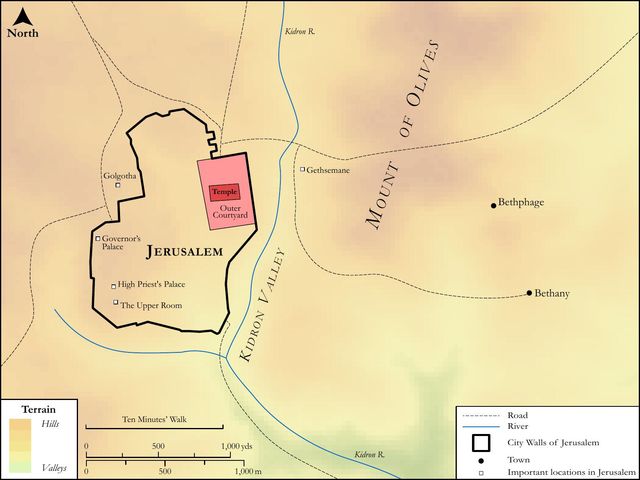
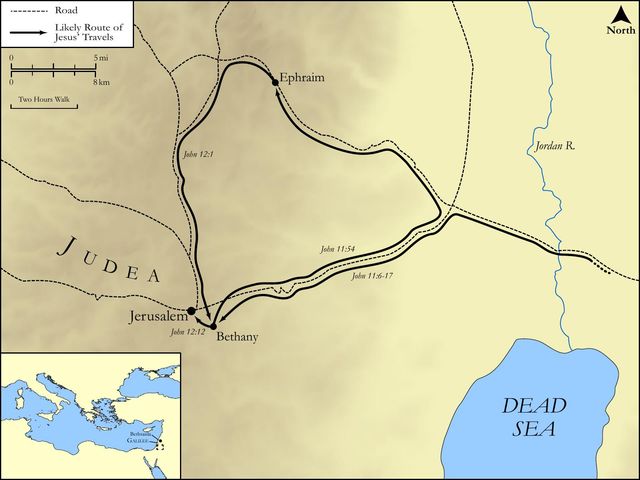
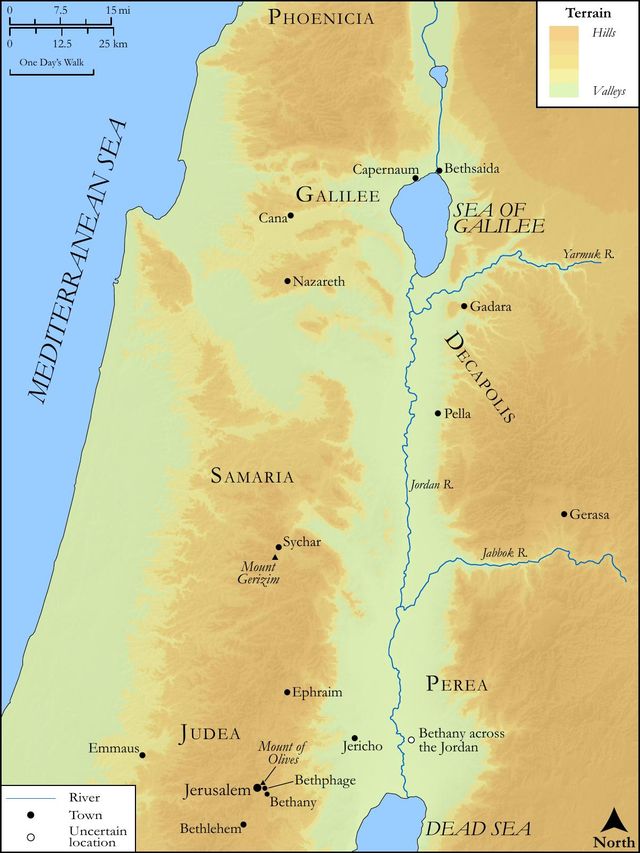
Study this verse
Public-domain commentary
Matthew Henry
From his Commentary on the Whole Bible. Henry comments on passages, not single verses — this entry covers John 12:44–50. His four-level outline is real structure in the source text, so it is rendered as structure.
We have here the honour Christ not assumed, but asserted, to himself, in the account he gave of his mission and his errand into the world. Probably this discourse was not at the same time with that before (for them he departed, Joh 12:36), but some time after, when he made another public appearance; and, as this evangelist records it, it was Christ's farewell sermon to the Jews, and his last public discourse; all that follows was private with his disciples. Now observe how our Lord Jesus delivered this parting word: he cried and said. Doth not wisdom cry (Pro 8:1), cry without? Pro 1:20. The raising of his voice and crying intimate, 1. His boldness in speaking. Though they had not courage openly to profess faith in his doctrine, he had courage openly to publish it; if they were ashamed of it, he was not, but set his face as a flint, Isa 50:7. 2. His earnestness in speaking. He cried as one that was serious and importunate, and in good earnest in what he said, and was willing to impart to them, not only the gospel of God, but even his own soul. 3. It denotes his desire that all might take notice of it. This being the last time of the publication of his gospel by himself in person, he makes proclamation, "Whoever will hear me, let them come now." Now what is the conclusion of the whole matter, this closing summary of all Christ's discourses? It is much like that of Moses (Deu 30:15): See, I have set before you life and death. So Christ here takes leave of the temple, with a solemn declaration of three things: -
I.The privileges and dignities of those that believe; this gives great encouragement to us to believe in Christ and to profess that faith.
It is a thing of such a nature that we need not be shy either of doing it or of owning it; for,
1.By believing in Christ we are brought into an honourable acquaintance with God (Joh 12:44, Joh 12:45): He that believes on me, and so sees me, believes on him that sent me, and so sees him. He that believes on Christ,
(1.)He does not believe in a mere man, such a one as he seemed to be, and was generally taken to be, but he believes in one that is the Son of God and equal in power and glory with the Father. Or rather,
(2.)His faith does not terminate in Christ, but through him it is carried out to the Father, that sent him, to whom, as our end, we come by Christ as our way. The doctrine of Christ is believed and received as the truth of God. The rest of a believing soul is in God through Christ as Mediator; for its resignation to Christ is in order to being presented to God. Christianity is made up, not of philosophy nor politics, but pure divinity. This is illustrated, Joh 12:45. He that sees me (which is the same with believing in him, for faith is the eye of the soul) sees him that sent me; in getting an acquaintance with Christ, we come to the knowledge of God. For,
[1.]God makes himself known in the face of Christ (Co2 4:6), who is the express image of his person, Heb 1:3.
[2.]All that have a believing sight of Christ are led by him to the knowledge of God, whom Christ has revealed to us by his word and Spirit. Christ, as God, was the image of his Father's person; but Christ, as Mediator, was his Father's representative in his relation to man, the divine light, law, and love, being communicated to us in and through him; so that in seeing him (that is, in eying him as our Saviour, Prince, and Lord, in the right of redemption), we see and eye the Father as our owner, ruler, and benefactor, in the right of creation: for God is pleased to deal with fallen man by proxy.
2.We are hereby brought into a comfortable enjoyment of ourselves (Joh 12:46): I am come a light into the world, that whoever believes in me, Jew or Gentile, should not abide in darkness. Observe,
(1.)The character of Christ: I am come a light into the world, to be a light to it. This implies that he had a being, and a being as light, before he came into the world, as the sun is before it rises; the prophets and apostles were made lights to the world, but it was Christ only that came a light into this world, having before been a glorious light in the upper world, Joh 3:19.
(2.)The comfort of Christians: They do not abide in darkness.
[1.]They do not continue in that dark condition in which they were by nature; they are light in the Lord. They are without any true comfort, or joy, or hope, but do not continue in that condition; light is sown for them.
[2.]Whatever darkness of affliction, disquietment, or fear, they may afterwards be in, provision is made that they may not long abide in it.
[3.]They are delivered from that darkness which is perpetual, and which abideth for ever, that utter darkness where there is not the least gleam of light nor hope of it.
II.The peril and danger of those that believe not, which gives fair warning to take heed of persisting in unbelief (Joh 12:47, Joh 12:48):
"If any man hear my words, and believe not, I judge him not, not I only, or not now, lest I should be looked upon as unfair in being judge in my own cause; yet let not infidelity think therefore to go unpunished, though I judge him not, there is one that judgeth him." So that we have here the doom of unbelief. Observe,
1.Who they are whose unbelief is here condemned: those who hear Christ's words and yet believe them not. Those shall not be condemned for their infidelity that never had, nor could have, the gospel; every man shall be judged according to the dispensation of light he was under: Those that have sinned without law shall be judged without law. But those that have heard, or might have heard, and would not, lie open to this doom.
2.What is the constructive malignity of their unbelief: not receiving Christ's word; it is interpreted (Joh 12:48) a rejecting of Christ, ho athetōn eme. It denotes a rejection with scorn and contempt. Where the banner of the gospel is displayed, no neutrality is admitted; every man is either a subject or an enemy.
3.The wonderful patience and forbearance of our Lord Jesus, exercised towards those who slighted him when he was come here upon earth: I judge him not, not now. Note, Christ was not quick or hasty to take advantage against those who refused the first offers of his grace, but continued waiting to be gracious. He did not strike those dumb or dead who contradicted him, never made intercession against Israel, as Elias did; though he had authority to judge, he suspended the execution of it, because he had work of another nature to do first, and that was to save the world.
(1.)To save effectually those that were given him before he came to judge the degenerate body of mankind.
(2.)To offer salvation to all the world, and thus far to save them that it is their own fault if they be not saved. He was to put away sin by the sacrifice of himself. Now the executing of the power of a judge was not congruous with that undertaking, Act 8:33. In his humiliation his judgment was taken away, it was suspended for a time.
4.The certain and unavoidable judgment of unbelievers at the great day, the day of the revelation of the righteous judgment of God: unbelief will certainly be a damning sin. Some think when Christ saith, I judge no man, he means that they are condemned already. There needs no process, they are self-judged; no execution, they are self-ruined; judgment goes against them of course, Heb 2:3. Christ needs not appear against them as their accuser, they are miserable if he do not appear for them as their advocate; however, he tells them plainly when and where they will be reckoned with.
(1.)There is one that judgeth them. Nothing is more dreadful than abused patience, and grace trampled on; though for awhile mercy rejoiceth against judgment, yet there will be judgment without mercy.
(2.)Their final judgment is reserved to the last day; to that day of judgment Christ here binds over all unbelievers, to answer then for all the contempts they have put upon him. Divine justice has appointed a day, and adjourns the sentence to that day, as Mat 26:64.
(3.)The word of Christ will judge them then: The words that I have spoken, how light soever you have made of them, the same shall judge the unbeliever in the last day; as the apostles, the preachers of Christ's word, are said to judge, Luk 22:30. Christ's words will judge unbelievers two ways: - [1.] As the evidence of their crime, they will convict them. Every word Christ spoke, every sermon, every argument, every kind offer, will be produced as a testimony against those who slighted all he said. [2.] As the rule of their doom, they will condemn them; they shall be judged according to the tenour of that covenant which Christ procured and published. That word of Christ, He that believes not shall be damned, will judge all unbelievers to eternal ruin; and there are many such like words.
III.A solemn declaration of the authority Christ had to demand our faith, and require us to receive his doctrine upon pain of damnation, Joh 12:49, Joh 12:50, where observe,
1.The commission which our Lord Jesus received from the Father to deliver his doctrine to the world (Joh 12:49): I have not spoken myself, as a mere man, much less as a common man; but the Father gave me a commandment what I should say. This is the same with what he said Joh 7:16. My doctrine is,
(1.)Not mine, for I have not spoken of myself. Christ, as Son of man, did not speak that which was of human contrivance or composure; as Son of God, he did not act separately, or by himself alone, but what he said was the result of the counsels of peace; as Mediator, his coming into the world was voluntary, and with his full consent, but not arbitrary, and of his own head. But,
(2.)It was his that sent him. God the Father gave him,
[1.]His commission. God sent him as his agent and plenipotentiary, to concert matters between him and man, to set a treaty of peace on foot, and to settle the articles.
[2.]His instructions, here called a commandment, for they were like those given to an ambassador, directing him not only what he may say, but what he must say. The messenger of the covenant was entrusted with an errand which he must deliver. Note, Our Lord Jesus learned obedience himself, before he taught it to us, though he was a Son. The Lord God commanded the first Adam, and he by his disobedience ruined us; he commanded the second Adam, and he by his obedience saved us. God commanded him what he should say and what he should speak, two words signifying the same thing, to denote that every word was divine. The Old Testament prophets sometimes spoke of themselves; but Christ spoke by the Spirit at all times. Some make this distinction: He was directed what he should say in his set sermons, and what he should speak in his familiar discourses. Others this: He was directed what he should say in his preaching now, and what he should speak in his judging at the last day; for he had commission and instruction for both.
2.The scope, design, and tendency of this commission: I know that his commandment is life everlasting, Joh 12:50. The commission given to Christ had a reference to the everlasting state of the children of men, and was in order to their everlasting life and happiness in that state: the instructions given to Christ as a prophet were to reveal eternal life (Jo1 5:11); the power, given to Christ as a king was to give eternal life, Joh 17:2. Thus the command given him was life everlasting. This Christ says he knew: "I know it is so," which intimates how cheerfully and with what assurance Christ pursued his undertaking, knowing very well that he went upon a good errand, and that which would bring forth fruit unto life eternal. It intimates likewise how justly those will perish who reject Christ and his word. Those who disobey Christ despise everlasting life, and renounce it; so that not only Christ's words will judge them, but even their own; so shall their doom be, themselves have decided it; and who can except against it?
3.Christ's exact observance of the commission and instructions given him, and his steady acting in pursuance of them: Whatsoever I speak, it is as the Father said unto me. Christ was intimately acquainted with the counsels of God, and was faithful in discovering so much of them to the children of men as it was agreed should be discovered, and kept back nothing that was profitable. As the faithful witness delivers souls, so did he, and spoke the truth, the whole truth, and nothing but the truth. Note,
(1.)This is a great encouragement to faith; the sayings of Christ, rightly understood, are what we may venture our souls upon.
(2.)It is a great example of obedience. Christ said as he was bidden, and so must we, communicated what the Father had said to him, and so must we. See Act 4:20. In the midst of all the respect paid to him, this is the honour he values himself upon, that what the Father had said to him that he spoke, and in the manner as he was directed so he spoke. This was his glory, that, as a Son, he was faithful to him that appointed him; and, by an unfeigned belief of every word of Christ, and an entire subjection of soul to it, we must give him the glory due to his name.
Historical interpretation
Nine Centuries of Reception
11 surviving comments on this verse. Each one is dated, so this reads as a timeline rather than a list.
Select a marker to jump to its quote. Markers stagger vertically where authors wrote within a few decades of each other.
How so? Even because, (as He afterwards declares, ) "I have not spoken from myself, but the Father which sent me: He hath given me a commandment what I should say, and what I should speak." For "the Lord God hath given me the tongue of the learned, that I should know when I ought to speak" the word which I actually speak.
It is not because Jesus lacks deliberate purpose or initiative, nor is it because he has to wait for some prearranged signal, that he employs language of this kind. His purpose is to make plain that his own will is connected in indissoluble union with the Father. Let us not then understand that what he calls a “commandment” is a peremptory mandate delivered by organs of speech, and giving orders to the Son, as to a subordinate concerning what he ought to do. Let us rather, in a sense befitting the Godhead, perceive a transmission of will, like the reflection of an object in a mirror, passing without note of time from Father to Son.… Everything the Father has also belongs to the Son. The Son does not acquire it piecemeal. Rather, he has it all at once. Among people, the workman who has been thoroughly taught his craft through long training and experience is able to work for his own future, utilizing that training he has received. And are we to suppose that the wisdom of God, the Maker of all creation, he who is eternally perfect, who is wise without a teacher, the Power of God, “in whom are hidden all the treasures of wisdom and knowledge,” needs piecemeal instruction to mark out the manner and measure of his operations?… If you consistently follow this line of reasoning, you will turn the Son into an eternal student who is never able to graduate since the Father’s wisdom is infinite.
Through all these words [Jesus] is guiding us to the knowledge of the Father and referring our wonder at all that is brought into existence to him, to the end that “through him” we may know the Father.
(Hom. lxviii. 2) And what word? This, viz. that I have not spoken of Myself, but the Father which sent Me gave Me a commandment what I should say, and what I should speak. All these things were said on their account, that they might have no excuse.
"For I have not spoken of Myself, but the Father which sent Me, He gave Me a commandment what I should say, and what I should speak."
Surely these things were said for their sakes, that they might have no pretense of excuse. Since if this were not the case, what shall He have more than Isaiah? for he too saith the very same thing, "The Lord God giveth me the tongue of the learned, that I should know when I ought to speak a word." (Isa. l. 4, LXX.) What more than Jeremiah? for he too when he was sent was inspired. (Jer. i. 9.) What then Ezekiel? for he too, after eating the roll, so spake. (Ezek. iii. 1.) Otherwise also, they who were about to hear what He said shall be found to be causes of His knowledge. For if when He was sent, He then received commandment what He should say, thou wilt then argue that before He was sent He knew not. And what more impious than these assertions? if (that is) one take the words of Christ in this sense, and understand not the cause of their lowliness? Yet Paul saith, that both he and those who were made disciples knew "what was that good and acceptable and perfect will of God" (Rom. xii. 2), and did the Son not know until He had received commandment? How can this be reasonable? Seest thou not that He bringeth His expressions to an excess of humility, that He may both draw those men over, and silence those who should come after.
"And I know that His commandment is life everlasting; whatsoever I speak therefore, even as the Father said unto Me, so I speak."
Seest thou the humility of the words? For he that hath received a commandment is not his own master. Yet He saith, "As the Father raiseth up the dead and quickeneth them, even so the Son quickeneth whom He will." (c. v. 21.) Hath He then power to quicken whom He will, and to say what He will hath He not power? What He intendeth then by the words is this; "The action hath not natural possibility, that He should speak one set of words, and I should utter another." "And I know that His commandment is life everlasting." He said this to those that called Him a deceiver, and asserted that He had come to do hurt. But when He saith, "I judge not," He showeth that He is not the cause of the perdition of these men. By this He all but plainly testifies, when about to remove from, and to be no more with, them, that "I converse with you, speaking nothing as of Myself, but all as from the Father." And for this cause He confined His discourse to them to humble expressions, that He might say, "Even until the end did I utter this, My last word, to them." What word was that? "As the Father said unto Me, so I speak." "Had I been opposed to God I should have said the contrary, that I speak nothing of what is pleasing to God, so as to attract the honor to Myself, but now I have so referred all things to Him, as to call nothing My own. Why then do ye not believe Me when I say that 'I have received a commandment,' and when I so vehemently remove your evil suspicion respecting rivalry? For as it is impossible for those who have received a commandment to do or say anything but what their senders wish, as long as they fulfill the commandment, and do not forge anything; so neither is it possible for Me to say or do anything except as My Father willeth. For what I do He doeth, because He is with Me, and 'the Father hath not left Me alone.'" (c. viii. 29.) Seest thou how everywhere He showeth Himself connected with Him who begat Him, and that there is no separation? For when He saith, "I am not come of Myself," He saith it not, as depriving Himself of power, but as taking away all alienation or opposition. For if men are masters of themselves, much more the Only-begotten Son.
We need to consider the purpose of the words. Indeed he means This is the purpose of my advent—salvation for all. You who do not believe will be condemned—but not by me because this is contrary to my passion, and it is not your condemnation I am after. Because of your [evil] mind you will be condemned by my own words which leave no excuse to the unbelievers on judgment day. These are the words that I spoke many times. In other words, I want nothing that is against the will of the Father, nor do I intend to establish a congregation for myself alone. I always led you all to the Father with my words by telling you that I was sent by him and that it was from him that I received the command to tell you the right words. Therefore I spoke to you words that were in agreement with his will. And this same thing I testify now to you: By those same words you will be condemned. Indeed you will not be able to come up with any excuses, as if you were defending the honor of God, because I always led you to him.
"For I have not," He says, "spoken of myself." He says that He has not spoken of Himself, because He is not of Himself. Of this we have frequently discoursed already; so that now, without any more instruction, we have simply to remind you of it as a truth with which you are familiar. "But the Father who sent me, He gave me a commandment what I should say, and what I should speak." We would not stay to elaborate this, did we know that we were now speaking with those with whom we have spoken on former occasions, and of these, not with all, but such only whose memories have retained what they heard: but because there are perhaps some now present who did not hear, and some in a similar condition who have forgotten what they heard, on their account let those who remember what they have heard bear with our delay. How giveth the Father a commandment to His only Son? With what words doth He speak to the Word, seeing that the Son Himself is the only-begotten Word? Could it be by an angel, seeing that by Him the angels were created? Was it by means of a cloud, which, when it gave forth its sound to the Son, gave it not on His account, as He Himself also tells us elsewhere, but for the sake of others who were needing to hear it? Could it be by any sound issuing from the lips, where bodily form was wanting, and where there is no such local distance separating the Son from the Father as to admit of any intervening air, to give effect, by its percussion, to the voice, and render it audible? Let us put away all such unworthy notions of that incorporeal and ineffable subsistence. The only Son is the Word and the Wisdom of the Father, and therein are all the commandments of the Father. For there was no time that the Son knew not the Father's commandment, so as to make it necessary for Him to possess in course of time what He possessed not before. For what He has received from the Father, He received in being born, and was given it in being begotten.
(Tr. liv. 7) When the Father gave the Son a commandment, He did not give Him what He had not: for in the Wisdom of the Father, i. e. in the Word, are all the commandments of the Father. The commandment is said to be given, because it is not from him to whom it is said to be given. But to give the Son that which He never was without, is the same as to beget the Son who never was not.
Since Jesus was the living and personal Word of God the Father, he is necessarily the medium of interpreting what is in the Father. Thus, by saying that he has received a commandment, Jesus means that he brings to light that which is, as it were, the set will and purpose of his own Father.
He reminds the people of the Jews of the things that had been aforetime proclaimed concerning Him by Moses, and by this means skilfully rebukes them; and, exposing the impiety that was in them, He clearly proves that they were caring nothing for having insolently outraged even the Law itself, although it was believed to have been given from God. For what God said concerning Christ by Moses is well known to all men, but still I will quote it because of the necessity of perceiving the exact idea; I will raise them up a Prophet from the midst of His brethren, like unto thee; that is to say, a lawgiver, and a mediator between God and men: and I will put My word in His mouth, and He shall speak unto them according as I may command Him; and the man who will not hearken to whatsoever the Prophet may speak in My Name, I will take vengeance on him. At one and the same time therefore our Lord Jesus the Christ censures the boastful temper of the Jewish people, displayed in their fighting even, against God the Father; and, by saying that He has received a commandment from the Father and speaks not of Himself, clearly proves that He Himself is the Prophet fore-announced by the Law and heralded by the voice of God the Father from ages long before. And in a way He calls to their remembrance, although their minds were sluggish in comprehending it, that if they refused to be persuaded by the words that came from Him, they would certainly fall a prey to inevitable punishment, and would endure all that God had said. For they who transgress the Divine commandment of God the Father, and thrust away from themselves the life-giving word of God our Saviour Christ, shall surely be cast down into most utter misery, and shall remain without any part in the life that comes from Him; with good reason hearing that which was spoken by the voice of the prophet: O earth, earth, hear, O hear the word of the Lord. Behold, I bring evils upon this people, as the fruit of their turning away, because they obeyed not My Law, and ye rejected My word. For we shall find that the Jews were liable to a twofold accusation: for they failed to honour the Law itself, although it was generally held dear and accounted an object of reverence, in that they refused to believe on Him Whom the Law proclaimed; and they turned a deaf ear to the words of our Saviour Christ, although He announced openly that He was certainly the Prophet spoken of in the oracles of the Law, when He declared that it was from God the Father that He was supplied with His words.
And let no one suppose that the saying of the Lord----that nothing is spoken by Himself, but that all comes from the Father----can do Him injustice in any way at all, as regards the estimate either of His Essence or of His God-befitting dignity; but first let the matter be thought over again, and let an answer be given to this question of ours:----"Can any one really suppose that the name and exercise of the prophetic office befit Him Who altogether is and is regarded as being in His Nature God?" Surely, I think, every one, however simple he may be, would answer in the negative, and say that it is incredible that the God Who speaks in prophets should Himself be called a prophet: for He it was Who multiplied visions, as it is written, and was likened to similitudes by the hands of the prophets. Since however He assumed the name of servitude and the outward fashion of resemblance to ourselves and with regard to His resemblance to us was called a Prophet, it necessarily follows also that the Law has endued Him with the attributes befitting the prophet, that is to say, the privilege of hearing somewhat from the Father and of receiving a commandment, what He should say and what He should speak. And moreover I shall feel obliged to say this much also. The Jews, possessed with a strong prejudice concerning the Law, believing that it had been spoken from God, could not have been expected to accept the words of the Saviour when He changed the form of the ordinances of old into a spiritual service.
And what cause had they to allege for being unwilling to accept the transformation of the types into their veritable significance? They were not aware that He was by Nature God, nor did they even admit the supposition that the Only-Begotten, being the Word of the Father, had borne our flesh for our sakes: for else, in immediate submission to God, they would have changed their opinion in any way whatever without hesitation, and would have faithfully revered His Divine glory. But the wretched men rather thought that He was altogether one like ourselves, and that, although a mere man, He had thought so highly of Himself as even to attempt to put an end to the very laws which came from God the Father. For instance they once said to Him plainly: For a good work we stone Thee not, but for blasphemy; because Thou, being a Man, makest Thyself God. Our Lord Jesus therefore, by much wisdom and with a definite design, seeking to turn His hearers from the idea that had taken possession of their minds, changes the subject of His discourse from that which was simply and solely the human personality to Him Who was the object of acknowledged and undisputed adoration, I mean of course God the Father; thinking it right to use every means of importunately pleading with the uneducated heart of the Jews, and striving by every possible method to lead on their dull minds to the desire to learn true and more befitting doctrines. So much then may suffice in the way of argument and speculation for any one who would get rid of the carping criticisms of the unholy heretics, when they suppose that the Son will make Himself in any respect whatever inferior to His own Father by saying that He speaks nothing of Himself, but that a commandment has been given Him, and that He speaks according as He has heard.
Since the Son is the Word of the Father, and reveals completely what is in the mind of the Father, He says He receives a commandment what He should say, and what He should speak: just as our word, if we say what we think, brings out what is in our minds.
And I know that His commandment is life everlasting.
Continue studying John 12:49 across the web’s major study libraries — every link below opens this exact verse, chapter, or book on the destination site.
Read & Compare
 BibleGatewayThis verse in more than 200 translations and 70 languages.
 Bible.comThe YouVersion reader — hundreds of translations, reading plans, and highlights.
 ESV.orgCrossway's official English Standard Version reader.
 NET BibleThe NET translation with 60,000+ translators' notes on every rendering decision.
 STEP BibleTyndale House's free study tool — original text, vocabulary, and scholarly resources.
 BibliaLogos Bible Software's free web reader.
 USCCBThe New American Bible (Revised Edition) with the U.S. bishops' study notes.
Commentaries
 BibleHub CommentariesDozens of classic commentaries on this verse, gathered on one page.
 StudyLightMore than 100 commentary sets — the largest collection on the web.
 BibleRefPlain-English commentary on what this verse means, verse by verse.
 Enduring WordDavid Guzik's free commentary on this chapter, widely used by Bible teachers.
 Bible Study ToolsVerse commentary alongside Greek and Hebrew study aids.
Original Language & Research
- BibleHub InterlinearThe verse word by word — original language, transliteration, and English.
- BibleHub LexiconEvery word's original-language definition and Strong's entry.
 Blue Letter BibleDeep-study tools — Strong's numbers, concordance, and word studies.
 CNTR CollationThe earliest Greek manuscripts of this verse, collated letter by letter.
Sermons, Hymns & Audio


TrulyRandomVerse is not affiliated with these sites and doesn’t control their content. They’re linked because they’re genuinely useful.
Summary
In John 12:49, Jesus unequivocally declares the divine origin and absolute authority of His words, asserting that His message does not stem from His own human initiative or wisdom but is a direct, authoritative commandment given to Him by God the Father who sent Him. This profound statement serves as a foundational pillar for understanding Jesus' unique relationship with the Father, the inherent truthfulness of His teachings, and the ultimate source of His mission and authority as the Son of God.
Context
ShowHideLiterary Context
This declaration is part of Jesus' final public discourse in the Gospel of John, immediately following His lament over Jerusalem's unbelief and a summary of His ministry (John 12:44-48). Having just pronounced a severe warning about the judgment awaiting those who reject Him and His words, Jesus now reinforces the ultimate authority behind those words. The preceding verses emphasize His identity as the "Light" (John 12:46) and the consequence of believing or rejecting Him. John 12:49-50 serves as a concluding affirmation of the divine mandate for all He has said and done, underscoring that His entire ministry is an act of perfect obedience to the Father's will, not a self-conceived endeavor.
Historical & Cultural Context
Jesus' ministry occurred within a Jewish context deeply rooted in the concept of divine revelation through prophets. The people of Israel were familiar with the idea that a true prophet spoke only what God commanded (e.g., Deuteronomy 18:18). Jesus' claim to speak only what the Father commanded would have resonated with this prophetic tradition, yet it also elevated His status far beyond that of a mere prophet, hinting at His unique filial relationship with God. Furthermore, the setting in Jerusalem during the Passover week amplifies the tension and the stakes, as Jesus' public ministry is drawing to a close, and His claims are reaching their climax before His crucifixion.
Key Themes
ShowHideThis verse powerfully contributes to several overarching themes in John's Gospel. It highlights the Divine Authority of Jesus, establishing that His words are not merely human wisdom but divine revelation, directly from God. It also underscores Jesus' Perfect Obedience and Submission to the Father, a recurring motif where Jesus consistently states that He does nothing of His own accord, but only what He sees or hears from the Father. This obedience is the basis for the Truthfulness and Reliability of His Message, as His words are inherently God's words, carrying eternal life or judgment (as articulated in John 12:48).
Exposition and Analysis
ShowHideKey Word Analysis
ShowHideThis verb means "to talk, utter words, speak, tell." It emphasizes the act of verbal communication. In this context, Jesus uses it to refer to the content and manner of His public teaching and declarations. The negation "not spoken of myself" asserts that the origin and content of His utterance are external to His human will or independent thought.
G1537 (ek) and G1683 (emautoû). The preposition ek means "from, out of," denoting origin or source. Emautoû is the reflexive pronoun "myself." Combined, "of myself" means "from my own initiative, from my own being, or by my own independent authority." Jesus denies that His words originate from His personal will or human wisdom, emphasizing His complete dependence on the Father's directive.
This noun signifies an "injunction" or "authoritative prescription." It's more than a suggestion; it's a direct, binding order or directive. By stating the Father gave Him a "commandment," Jesus highlights the obligatory and authoritative nature of His message, indicating that His every word is a fulfillment of a divine mandate.
Verse Breakdown
ShowHide"For I have not spoken of myself;"
Jesus emphatically denies that His message originates from His own human will, wisdom, or independent authority. The Greek phrase "ek emautou" (out of myself) stresses that the source and content of His words are not self-generated but external to His personal human initiative. This sets up a crucial contrast with the true source of His message.
"but the Father which sent me, he gave me a commandment, "
This clause introduces the true, divine source of Jesus' words: God the Father. The Father is identified as the one "who sent" Jesus, emphasizing Jesus' role as a divinely commissioned messenger. The Father's act of "giving a commandment" underscores the authoritative and obligatory nature of Jesus' mission and message. His words are not merely inspired thoughts but direct divine directives.
"what I should say, and what I should speak."
This final phrase elaborates on the content of the Father's commandment, specifying that it encompasses both "what I should say" (Greek: épō, G2036, referring to the specific content or message) and "what I should speak" (Greek: laléō, G2980, referring to the act of uttering or proclaiming). The repetition with slightly different verbs emphasizes the comprehensive nature of the Father's instruction, covering every aspect of Jesus' verbal ministry. Jesus' entire public discourse is presented as a direct, word-for-word transmission of the Father's will.
Literary Devices
ShowHideJohn 12:49 employs several potent literary devices to convey its profound theological truth. Most prominent is Contrast, where Jesus explicitly distinguishes between speaking "of myself" (which He denies) and speaking what the Father commanded (which He affirms). This sharp juxtaposition highlights the divine origin of His words and the complete absence of human autonomy in His message. There is also strong Assertion and Emphasis through the direct and declarative nature of Jesus' statement, reinforced by the repetition of "what I should say, and what I should speak," which underscores the comprehensive and precise nature of the Father's directive. This linguistic precision serves to solidify the Divine Authority of Jesus' teachings, presenting them not as mere human philosophy but as the very voice of God.
Theological and Thematic Connections
ShowHideJohn 12:49 is a pivotal verse for understanding the very nature of Jesus' authority and His relationship with God the Father. It reveals that the Son's words are not merely a reflection of the Father's will, but are, in essence, the Father's own words spoken through the Son. This profound unity in mission and message underscores the co-equality and intimate relationship within the Godhead. It means that to hear Jesus is to hear God, and to reject Jesus' words is to reject God Himself. This divine authentication of Jesus' message provides the ultimate basis for its truthfulness, trustworthiness, and eternal significance, compelling all who hear to respond in faith and obedience.
Reflection and Application
ShowHideJohn 12:49 invites us to a profound reflection on the source and authority of truth in our lives. If Jesus' words are not His own, but the direct commandment of the Father, then they carry the full weight and eternal significance of divine revelation. This understanding should cultivate in us a deep reverence for Christ's teachings, recognizing them as the very voice of God speaking into our existence. It calls us to move beyond superficial engagement with Scripture to a posture of humble submission and eager obedience, knowing that in His words we encounter the life-giving will of the Almighty. This verse challenges us to align our thoughts, words, and actions not with fleeting human philosophies or personal desires, but with the unchanging, authoritative truth revealed through Jesus, the perfect embodiment of the Father's commandment.
Questions for Reflection
ShowHideFAQ
ShowHideDoes John 12:49 imply that Jesus lacked His own will or divine nature?
ShowHideNo, John 12:49 does not imply that Jesus lacked His own will or divine nature. Instead, it speaks to His perfect unity and submission within the Trinity. As the Son of God, Jesus possesses a divine will that is always in perfect harmony with the Father's will. The phrase "not spoken of myself" emphasizes that His words and actions were not self-initiated or contrary to the Father's purpose, but were always in complete obedience and alignment with the divine plan. This highlights His role as the Father's faithful and authoritative messenger, demonstrating His profound love and devotion to the Father, as seen throughout John's Gospel. It underscores His unique identity as the one who perfectly reveals God.
Why is it important that Jesus' words are a "commandment" from the Father?
ShowHideIt is crucial that Jesus' words are a "commandment" from the Father because it establishes their absolute authority and binding nature. A commandment is not a suggestion or an opinion; it is an authoritative directive that demands obedience. By stating that the Father gave Him a "commandment" regarding what to say and speak, Jesus underscores that His entire message is a direct, divinely mandated revelation. This means that His teachings are not merely human wisdom or philosophical insights, but the very will and word of God, carrying eternal consequences for those who hear and respond, or those who reject them, as highlighted in John 12:48.
Christ-Centered Fulfillment
ShowHideJohn 12:49 profoundly illuminates the Christ-centered nature of God's redemptive plan. Jesus, as the perfectly obedient Son, embodies the ultimate fulfillment of God's prophetic word. He is the Prophet like Moses, through whom God speaks directly to humanity, as foretold in Deuteronomy 18:18. Every word Jesus uttered, being a direct commandment from the Father, carried the weight of divine truth and the power of eternal life. His perfect submission to the Father's will, even unto death on the cross, demonstrates that His entire life was an embodiment of the Father's commandment, culminating in the ultimate act of love and atonement. Thus, in Christ, humanity encounters the very voice of God, not merely in spoken words, but in the living Word made flesh, who perfectly reveals the Father and accomplishes His saving purpose, offering grace and truth to all who believe in the name of the only begotten Son. His words, therefore, are not just doctrine, but the very means by which we come to know the Father and receive eternal life.