


2 Samuel 10:14
Bible text: King James Version (1769 Blayney text) · Public domain
Bible text: King James Version with Strong's numbers · Public domain
Bible text: Berean Standard Bible · Public domain
Bible text: American Standard Version (1901) · Public domain
Bible text: World English Bible, Messianic edition · Public domain
Bible text: Geneva Bible (1599) · Public domain
Bible text: Young's Literal Translation · Public domain
- וּבְנֵיu·ve·Neiand [the] people ofH1121Conj-w ¦ N-mpcNoun Plural Masculine Constructוּandבְנֵי[the] people of
- עַמּוֹןa·MonAmmonH5983N-proper-mNoun Proper Masculine
- רָאוּra·'Uthey sawH7200V-Qal-Perf-3cpVerb Qal Perfect 3rd Plural common gender
- כִּיkithatH3588PrtParticle Conditional
- נָסnasit had fledH5127V-Qal-Perf-3msVerb Qal Perfect 3rd Singular Masculine
- אֲרָם'a·RamAramH758N-properNoun Proper Location
- וַיָּנֻסוּvai·ya·Nu·suand they fledH5127Conj-w ¦ V-Qal-ConsecImperf-3mpVerb Qal Consecutive Imperfect 3rd Plural Masculineוַandיָּנֻסוּthey fled
- מִפְּנֵיmi·pe·Neifrom beforeH6440Prep-m ¦ N-mpcNoun Plural Masculine Constructמִfromפְּנֵיbefore
- אֲבִישַׁי'a·vi·ShaiAbishaiH52N-proper-mNoun Proper Masculine
- וַיָּבֹאוּvai·ya·Vo·'uand they wentH935Conj-w ¦ V-Qal-ConsecImperf-3mpVerb Qal Consecutive Imperfect 3rd Plural Masculineוַandיָּבֹאוּthey went
- הָעִירha·'Irthe cityH5892Art ¦ N-fsNoun Singular Feminine Absoluteהָtheעִירcity
- וַיָּשָׁבvai·Ya·shovand he returnedH7725Conj-w ¦ V-Qal-ConsecImperf-3msVerb Qal Consecutive Imperfect 3rd Singular Masculineוַandיָּשָׁבhe returned
- יוֹאָבyo·'AvJoabH3097N-proper-mNoun Proper Masculine
- מֵעַלme·'Alfrom onH5921Prep-m ¦ PrepPrepositionמֵfromעַלon
- בְּנֵיbe·Nei[the] people ofH1121N-mpcNoun Plural Masculine Construct
- עַמּוֹןa·MonAmmonH5983N-proper-mNoun Proper Masculine
- וַיָּבֹאvai·ya·Vo'and he cameH935Conj-w ¦ V-Qal-ConsecImperf-3msVerb Qal Consecutive Imperfect 3rd Singular Masculineוַandיָּבֹאhe came
- יְרוּשָׁלִָםye·ru·sha·LimJerusalemH3389N-properNoun Proper Location
English is a literal word-by-word gloss of the Hebrew, not the KJV's wording. Why?
This is the original text the KJV's translators worked from — each Hebrew word with its own literal English meaning in this verse, prepared by scholars at Tyndale House, Cambridge. The KJV translates whole sentences, not word by word, so its wording differs: one Hebrew word can become several English words, and the KJV may choose “the LORD” where the gloss reads “Yahweh”. Both are faithful — they answer different questions. For the KJV's own rendering, switch to the KJV text.
Details
See on the biblical-era maps

Study this verse
Public-domain commentary
Matthew Henry
From his Commentary on the Whole Bible. Henry comments on passages, not single verses — this entry covers 2 Samuel 10:6–14. His two-level outline is real structure in the source text, so it is rendered as structure.
Here we have, I. The preparation which the Ammonites made for war, Sa2 10:6. They saw they had made themselves very odious to David and obnoxious to his just displeasure. This they might easily have foreseen when they abused his ambassadors, which was no other than a challenge to war, and a bold defiance of him. Yet, it seems, they had not considered how unable they were, with their thousands, to meet his; for now they found themselves an unequal match, and were forced to hire forces of other nations into their service. Thus sinners daringly provoke God, and expose themselves to his wrath, and never consider that he is stronger than they, Co1 10:22. The Ammonites gave the affront first, and they were the first that raised forces to justify it. Had they humbled themselves, and begged David's pardon, probably an honorary satisfaction might have atoned for the offence. But, when they were thus desperately resolved to stand by what they had done, they courted their own ruin.
II.The speedy descent which David's forces made upon them, Sa2 10:7.
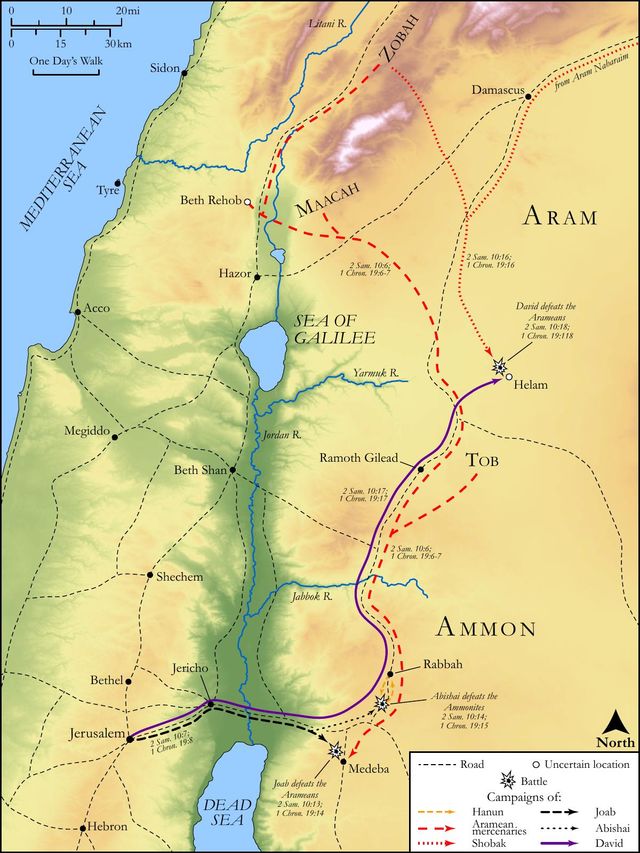
When David heard of their military preparations, he sent Joab with a great army to attack them, Sa2 10:7. Those that are at war with the Son of David not only give the provocation, but begin the war; for he waits to be gracious, but they strengthen themselves against him, and therefore, if they turn not, he will whet his sword, Psa 7:12. God has forces to send against those that set his wrath at defiance (Isa 5:19), which will convince them, when it is too late, that none ever hardened his heart against God and prospered. It was David's prudence to carry the war into their country, and fight them at the entering in of the gate of their capital city, Rabbah, as some think, or Medeba, a city in their borders, before which they pitched to guard their coast, Ch1 19:7. Such are the terrors and desolations of war that every good prince will, in love to his people, keep it as much as may be at a distance from them.
III.Preparations made on both sides for an engagement.
1.The enemy disposed themselves into two bodies, one of Ammonites, which, being their own, were posted at the gate of the city; the other of Syrians, whom they had taken into their pay, and who were therefore posted at a distance in the field, to charge the forces of Israel in the flank or rear, while the Ammonites charged them in the front, Sa2 10:8.
2.Joab, like a wise general, was soon aware of the design, and accordingly divided his forces: the choicest men he took under his own command, to fight the Syrians, whom probably he knew to be the better soldiers, and, being hired men, better versed in the arts of war, Sa2 10:9. The rest of the forces he put under the command of Abishai his brother, to engage the Ammonites, Sa2 10:10. It should seem, Joab found the enemy so well prepared to receive them that his conduct and courage were never so tried as now.
IV.Joab's speech before the battle, Sa2 10:11, Sa2 10:12. It is not long, but pertinent, and brave.
1.He prudently concerts the matter with Abishai his brother, that the dividing of the forces might not be the weakening of them, but that, which part soever was borne hard upon, the other should come in to its assistance. He supposes the worst, that one of them should be obliged to give back; and in that case, upon a signal given, the other should send a detachment to relieve it. Note, Mutual helpfulness is brotherly duty. If occasion be, thou shalt help me, and I will help thee. Christ's soldiers should thus strengthen one another's hands in their spiritual warfare. The strong must succour and help the weak. Those that through grace are conquerors over temptation must counsel, and comfort, and pray for, those that are tempted. When thou art converted, strengthen thy brethren, Luk 22:32. The members of the natural body help one another, Co1 12:21.
2.He bravely encourages himself, and his brother, and the rest of the officers and soldiers, to do their utmost. Great dangers put an edge upon true courage. When Joab saw the front of the battle was against him, both before and behind, instead of giving orders to make an honourable retreat, he animated his men to charge so much more furiously: Be of good courage and let us play the men, not for pay and preferment, for honour and fame, but for our people, and for the cities of our God, for the public safety and welfare, in which the glory of God is so much interested. God and our country was the word. "Let us be valiant, from a principle of love to Israel, that are our people, descended from the same stock, for whom we are employed, and in whose peace we shall have peace; and from a principle of love to God, for they are his cities that we are fighting in the defence of." The relation which any person or thing stands in to God should endear it to us, and engage us to do our utmost in its service.
3.He piously leaves the issue with God: "When we have done our part, according to the duty of our place, let the Lord do that which seemeth to him good." Let nothing be wanting in us, whatever the success be; let God's work be done by us, and then God's will be done concerning us. When we make conscience of doing our duty we may, with the greatest satisfaction, leave the event with God, not thinking that our valour binds him to prosper us, but that still he may do as he pleases, yet hoping for his salvation in his own way and time.
V.The victory Joab obtained over the confederate forces of Syria and Ammon, Sa2 10:13, Sa2 10:14.
He provided for the worst, and put the case that the Syrians and Ammonites might prove too strong for him (Sa2 10:11), but he proved too strong for them both. We do not hinder our success by preparing for disappointment. The Syrians were first routed by Joab, and then the Ammonites by Abishai; the Ammonites seem not to have fought at all, but, upon the retreat of the Syrians, to have fled into the city. It is a temptation to soldiers to fly when they have a city at their backs to fly to. It is one thing when men may either fight or fly and another thing when they must either fight or die.
Continue studying 2 Samuel 10:14 across the web’s major study libraries — every link below opens this exact verse, chapter, or book on the destination site.
Read & Compare
 BibleGatewayThis verse in more than 200 translations and 70 languages.
 Bible.comThe YouVersion reader — hundreds of translations, reading plans, and highlights.
 ESV.orgCrossway's official English Standard Version reader.
 NET BibleThe NET translation with 60,000+ translators' notes on every rendering decision.
 STEP BibleTyndale House's free study tool — original text, vocabulary, and scholarly resources.
 BibliaLogos Bible Software's free web reader.
 USCCBThe New American Bible (Revised Edition) with the U.S. bishops' study notes.
Commentaries
 BibleHub CommentariesDozens of classic commentaries on this verse, gathered on one page.
 StudyLightMore than 100 commentary sets — the largest collection on the web.
 BibleRefPlain-English commentary on what this verse means, verse by verse.
 Enduring WordDavid Guzik's free commentary on this chapter, widely used by Bible teachers.
 Bible Study ToolsVerse commentary alongside Greek and Hebrew study aids.
Original Language & Research
- BibleHub InterlinearThe verse word by word — original language, transliteration, and English.
- BibleHub LexiconEvery word's original-language definition and Strong's entry.
 Blue Letter BibleDeep-study tools — Strong's numbers, concordance, and word studies.
 SefariaThe Hebrew text with Rashi and centuries of Jewish commentary.
Sermons, Hymns & Audio


TrulyRandomVerse is not affiliated with these sites and doesn’t control their content. They’re linked because they’re genuinely useful.
Summary
2 Samuel 10:14 describes the pivotal moment in the initial engagement of Israel's war against the Ammonites and their Aramean allies. Following the decisive routing of the Aramean mercenary forces by Joab, the Ammonite army, witnessing the flight of their primary support, also broke ranks and retreated before Abishai's contingent, seeking refuge within the fortified walls of their capital city. This verse signifies a significant field victory for David's army, marking the successful conclusion of this phase of the battle and Joab's subsequent return to Jerusalem.
Context
ShowHideLiterary Context
This verse serves as the immediate culmination of the first military engagement detailed in 2 Samuel 10. The narrative begins with the Ammonites' profound insult to David's envoys, transforming a diplomatic overture into a casus belli (2 Samuel 10:1-5). Fearing David's retaliation, the Ammonites hired vast Aramean mercenary forces from various kingdoms, setting the stage for conflict (2 Samuel 10:6). David responded by sending his elite forces under Joab and Abishai. The preceding verses, particularly 2 Samuel 10:9-12, detail Joab's brilliant tactical division of his army, positioning himself against the Arameans and Abishai against the Ammonites, with a mutual pledge of support. Verse 13 then recounts Joab's successful engagement with the Arameans, leading to their flight. Thus, 2 Samuel 10:14 functions as the direct consequence of the Aramean retreat, directly impacting the Ammonites and bringing this phase of the conflict to a close before the narrative shifts to the Arameans' regrouping and subsequent, larger defeat in 2 Samuel 10:15-19.
Historical & Cultural Context
The conflict between Israel and Ammon was a common feature of the geopolitical landscape of David's day. Ammon, a Transjordanian kingdom descended from Lot, frequently clashed with Israel over territorial claims and regional dominance. The practice of hiring mercenary armies, particularly from the various Aramean city-states (such as Zobah, Rehob, Ish-tob, and Maacah), was a widespread military strategy of the era. These professional soldiers were paid for their service and often fought for the highest bidder, making their loyalty primarily economic rather than nationalistic. This often meant their resolve could falter quickly in the face of strong opposition, as seen here. The retreat into a fortified city, like Rabbah (the Ammonite capital), was a standard defensive maneuver when a field army was defeated, allowing for a prolonged siege rather than a decisive rout in open battle. Joab's return to Jerusalem signifies the completion of the immediate military objective and the standard procedure of reporting back to the king after a successful campaign.
Key Themes
ShowHideThis verse powerfully underscores several key themes evident throughout 2 Samuel 10. Firstly, it highlights the consequences of pride and aggression, as the Ammonites' initial humiliation of David's envoys (2 Samuel 10:4-5) directly led to this devastating military defeat. Secondly, it showcases effective military leadership and strategy under Joab and Abishai, whose coordinated efforts and tactical acumen secured a swift victory. Joab's brilliant division of forces, as described in 2 Samuel 10:9, proved instrumental in overcoming a numerically superior foe. Thirdly, the narrative implicitly conveys divine favor and protection over David's kingdom, as Israel's army consistently triumphs over formidable allied forces, echoing the Lord's promise to fight for His people (Deuteronomy 20:4). Finally, while a significant victory, the retreat of the Ammonites into their city signifies that the war was not yet fully concluded, setting the stage for the subsequent siege of Rabbah, a pivotal event detailed in 2 Samuel 11.
Exposition and Analysis
ShowHideKey Word Analysis
ShowHideThis verb (H5127) signifies a rapid, often panicked, withdrawal or escape. Its usage here emphasizes the immediate and unorganized flight of both the Aramean and then the Ammonite forces, indicating a decisive rout rather than a strategic retreat. It conveys the complete breaking of their morale and fighting spirit in the face of Israel's advance, leading to their vanishing from the battlefield.
This verb (H7725) indicates a turning back or going back to a previous place or state. In the context of Joab, it signifies the successful completion of his immediate military objective in the field. His return to Jerusalem underscores the temporary conclusion of this phase of the campaign, bringing the army back to their base after achieving their goal of scattering the enemy forces.
This noun (H5892) refers to a fortified settlement, a place guarded by a watch. The Ammonites' entry into "the city" (Rabbah) highlights their desperate attempt to seek refuge within its defensive walls after their field army was defeated. It signifies a shift from open battle to a defensive siege posture, indicating that while the field was won, the war was not yet over.
Verse Breakdown
ShowHide"And when the children of Ammon saw that the Syrians were fled"
This clause establishes the crucial cause-and-effect relationship that dictated the Ammonites' actions. Their resolve and strategic positioning were heavily dependent on the presence and performance of their mercenary allies. Once the Arameans, their primary reinforcement and a formidable fighting force, were decisively routed by Joab's contingent, the Ammonites lost their strategic advantage, their morale plummeted, and their confidence in continued resistance evaporated.
"then fled they also before Abishai, and entered into the city"
This details the Ammonites' immediate and desperate response to the Arameans' flight. Their retreat was specifically "before Abishai," indicating that Abishai's contingent had successfully pressed their attack, driving the Ammonites from the field. Their objective was not merely to flee the battlefield in disarray but to seek the protection of their fortified capital, Rabbah, signifying a strategic retreat to a defensive position rather than a complete surrender or annihilation in the open.
"So Joab returned from the children of Ammon, and came to Jerusalem"
This final clause marks the immediate conclusion of this phase of the military campaign. Joab, having achieved his objective of defeating the combined forces in the open field and scattering the enemy, leads his victorious army back to the capital. This action signifies the successful execution of King David's command and the consolidation of the initial victory, though the larger war itself would continue with the subsequent siege of Rabbah.
Literary Devices
ShowHideThe verse employs several literary devices to convey its meaning effectively. Cause and Effect is prominently featured, as the flight of the Syrians is presented as the direct cause of the Ammonites' subsequent retreat. This highlights the interdependency of the allied forces and the strategic impact of Joab's initial victory over the Arameans. There is also an element of Parallelism, as both the Syrians and the Ammonites are depicted as "fleeing," reinforcing the completeness and decisiveness of the Israelite victory over both contingents. The narrative structure itself is a classic Military Narrative, focusing on the actions of commanders, the movement of armies, and the decisive outcome of battle. The retreat "into the city" also serves as a form of Foreshadowing, subtly indicating that while the field battle was won, the war was not entirely over, setting the stage for the subsequent siege of Rabbah, which would become a central event in the following chapters.
Theological and Thematic Connections
ShowHideThis verse, while describing a military victory, implicitly points to deeper theological truths. The swift and decisive defeat of the Ammonites and their allies, despite their numerical superiority and mercenary strength, can be seen as an illustration of divine sovereignty in battle. God's favor rests upon His chosen king and people, granting them victory against those who oppose them or disrespect His anointed. The humiliation of the Ammonites serves as a stark reminder of the consequences of pride and arrogance, particularly when directed against God's representatives. It reinforces the biblical principle that "pride goes before destruction, and a haughty spirit before a fall" (Proverbs 16:18). The strategic brilliance of Joab, while a testament to human skill, can also be viewed through the lens of God granting wisdom and success to His servants, demonstrating that true victory comes from reliance on the Lord, not merely on chariots or horses.
Reflection and Application
ShowHide2 Samuel 10:14 offers valuable insights beyond its historical narrative, providing principles applicable to our spiritual and practical lives. It reminds us that even in the face of formidable opposition, strategic wisdom, courage, and unity can lead to decisive victory. For the believer, this can translate into approaching life's challenges with prayerful planning, relying on God-given wisdom, and acting with conviction. The Ammonites' reliance on external, hired strength (mercenaries) and their subsequent collapse when that strength failed serves as a profound cautionary tale: true security and lasting victory come not from fleeting alliances or worldly power, but from a steadfast reliance on God. Furthermore, the verse highlights the importance of discerning the opportune moment for action and for consolidation. Joab's decision to return to Jerusalem after the field victory, rather than immediately pursuing a siege, demonstrates wise leadership in knowing when to press forward and when to regroup. This teaches us the value of strategic patience and discernment in our own endeavors, recognizing that not every battle is won in a single charge, and sometimes, a phase must conclude before the next can begin, trusting God's timing for ultimate triumph.
Questions for Reflection
ShowHideFAQ
ShowHideWhy did the Ammonites flee so quickly after the Syrians?
ShowHideThe Ammonites had hired the Aramean (Syrian) forces as their primary military reinforcement, indicating a lack of confidence in their own ability to withstand David's army alone. When Joab decisively routed the Arameans, the Ammonites lost their mercenary support and, crucially, their morale. Seeing their well-paid and supposedly formidable allies flee, the Ammonites realized their position was untenable. Their flight was a direct consequence of the Arameans' defeat, highlighting the fragility of alliances based solely on mercenary contracts rather than shared national or ideological commitment. This immediate retreat into their city, Rabbah, was a desperate attempt to salvage their defense and avoid total annihilation in the open field.
Was the war with Ammon over when Joab returned to Jerusalem?
ShowHideNo, the war was not over. 2 Samuel 10:14 marks the successful conclusion of the initial field battle, where the combined forces of Ammon and Aram were defeated and scattered. However, the Ammonites themselves retreated into their fortified capital city, Rabbah. The subsequent chapters, particularly 2 Samuel 11 and 2 Samuel 12, detail the prolonged siege of Rabbah, which ultimately led to its capture. Joab's return to Jerusalem signified the completion of the first phase of the campaign and the reporting of the victory to King David, but the full conquest of Ammon required a sustained effort against their stronghold.
Christ-Centered Fulfillment
ShowHideThe decisive victory of David's army over the Ammonites and Arameans, culminating in their panicked flight and retreat, powerfully foreshadows the ultimate and complete triumph of King Jesus over all His enemies. Just as David, a type of Christ, led his forces to scatter those who opposed his kingdom and disrespected his authority, so too does Christ, the true Son of David, achieve a definitive and eternal victory over sin, death, and the powers of darkness. The enemies of God's people, though seemingly formidable and allied, are ultimately routed before the unassailable power of the true King. The flight of the Ammonites and Syrians into their city, though a temporary refuge, points to the futility of any stronghold or defense against the advancing kingdom of God. Christ's victory on the cross disarmed and triumphed over the spiritual principalities and powers (Colossians 2:15), and His glorious resurrection ensures that death itself, the last enemy, will be utterly destroyed (1 Corinthians 15:26). Just as Joab returned to Jerusalem having secured a significant victory, Christ ascended to heaven, having accomplished redemption and establishing His eternal reign at the right hand of the Father, from which He will return to fully subjugate all who oppose Him and bring His kingdom to its consummation (Revelation 19:11-16). The narrative of 2 Samuel 10:14, therefore, is a historical echo of the spiritual reality of Christ's unassailable reign and the ultimate, certain defeat of all who stand against His glorious kingdom.