


1 Chronicles 19:11
- וְאֵתve·'Etand <obj.>H853Conj-w ¦ DirObjMParticle Object Indicatorוְandאֵת<obj.>
- יֶתֶרYe·ter[the] rest ofH3499N-mscNoun Singular Masculine Construct
- הָעָםha·'Amthe peopleH5971Art ¦ N-msNoun Singular Masculine Absoluteהָtheעָםpeople
- נָתַןna·Tanhe putH5414V-Qal-Perf-3msVerb Qal Perfect 3rd Singular Masculine
- בְּיַדbe·Yadin [the] hand ofH3027Prep-b ¦ N-cscNoun Singular common gender Constructבְּinיַד[the] hand of
- אַבְשַׁי'av·ShaiAbishaiH52N-proper-mNoun Proper Masculine
- אָחִיו'a·Chivhis brotherH251N-msc ¦ 3msNoun Singular Masculine Constructאָחִיbrotherוhis
- וַיַּעַרְכוּvai·Ya·'ar·Khuand they deployedH6186Conj-w ¦ V-Qal-ConsecImperf-3mpVerb Qal Consecutive Imperfect 3rd Plural Masculineוַandיַּעַרְכוּthey deployed
- לִקְרַאתlik·Ratto meetH7122Prep-l ¦ V-Qal-InfVerb Qal Infinitive Constructלִtoקְרַאתmeet
- בְּנֵיbe·Nei[the] people ofH1121N-mpcNoun Plural Masculine Construct
- עַמּוֹןa·MonAmmonH5983N-proper-mNoun Proper Masculine
English is a literal word-by-word gloss of the Hebrew, not the KJV's wording. Why?
This is the original text the KJV's translators worked from — each Hebrew word with its own literal English meaning in this verse, prepared by scholars at Tyndale House, Cambridge. The KJV translates whole sentences, not word by word, so its wording differs: one Hebrew word can become several English words, and the KJV may choose “the LORD” where the gloss reads “Yahweh”. Both are faithful — they answer different questions. For the KJV's own rendering, switch to the KJV text.
Details
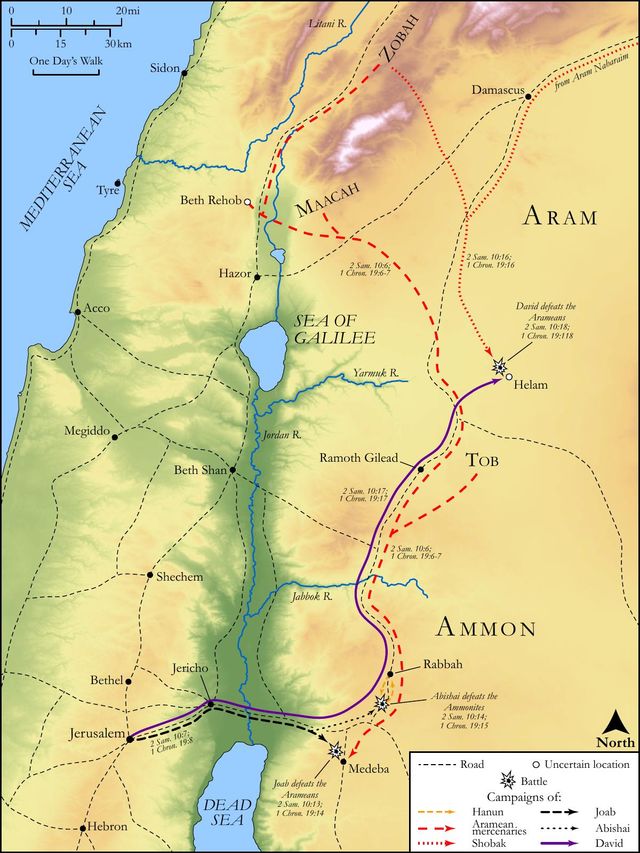
See on the biblical-era map
Study this verse
Public-domain commentary
Matthew Henry
From his Commentary on the Whole Bible. Henry comments on passages, not single verses — this entry covers 1 Chronicles 19:6–19.
We may see here, 1. How the hearts of sinners that are marked for ruin are hardened to their destruction. The children of Ammon saw that they had made themselves odious to David (Ch1 19:6), and then it would have been their wisdom to desire conditions of peace, to humble themselves and offer any satisfaction for the injury they had done him, the rather because they had made themselves not only odious to David, but obnoxious to the justice of God, who is King of nations, and will assert the injured rights and maintain the violated laws of nations. But, instead of this, they prepared for war, and so brought upon themselves, by David's hand, those desolations which he never intended them. 2. How the courage of brave men is heightened and invigorated by difficulties. When Joab saw that the battle was set against him before and behind (Ch1 19:10), instead of meditating a retreat, he doubled his resolution; and, though he could not double, he divided his army, and not only spoke, but acted, like a gallant man, that had great presence of mind when he saw himself surrounded. He engaged with his brother for mutual assistance (Ch1 19:12), excited himself and the rest of the officers to act vigorously in their respective posts, with an eye to God's glory and their country's good, not to any honour and advantage of their own, and then left the issue to God: Let the Lord do that which is right in his sight. 3. How vain the greatest art and strength are against justice and equity. The Ammonites did their utmost to make the best of their position: they brought as good a force into the field, and disposed it with as much policy as possible; yet, having a bad cause, and acting in defence of wrong, it would not do; they were put to the worst. Right will prevail and triumph at last. 4. To how little purpose it is for those to rally again, and reinforce themselves, that have not God on their side. The Syrians, though in no way concerned in the merits of the cause, but serving only as mercenaries to the Ammonites, when they were beaten, thought themselves concerned to retrieve their honour, and therefore called in the assistance of the Syrians on the other side Euphrates; but to no purpose, for still they fled before Israel (Ch1 19:18); they lost 7000 men, who are said to be the men of 700 chariots, Sa2 10:18. For, as now in a man of war for sea-service they allot ten men to a gun, so then, in land-service, ten men to a chariot. 5. those who have meddled with strife that belongs not to them, and have found that they meddled to their own heart, do well to learn wit at length and meddle no further. The Syrians, finding that Israel was the conquering side, not only broke off their alliance with the Ammonites and would help them no more (Ch1 19:19), but made peace with David and became his servants. Let those who have in vain stood it out against God be thus wise for themselves, and agree with him quickly, while they are in the way. Let them become his servants; for they cannot but see themselves undone if they be his enemies.
Continue studying 1 Chronicles 19:11 across the web’s major study libraries — every link below opens this exact verse, chapter, or book on the destination site.
Read & Compare
 BibleGatewayThis verse in more than 200 translations and 70 languages.
 Bible.comThe YouVersion reader — hundreds of translations, reading plans, and highlights.
 ESV.orgCrossway's official English Standard Version reader.
 NET BibleThe NET translation with 60,000+ translators' notes on every rendering decision.
 STEP BibleTyndale House's free study tool — original text, vocabulary, and scholarly resources.
 BibliaLogos Bible Software's free web reader.
 USCCBThe New American Bible (Revised Edition) with the U.S. bishops' study notes.
Commentaries
 BibleHub CommentariesDozens of classic commentaries on this verse, gathered on one page.
 StudyLightMore than 100 commentary sets — the largest collection on the web.
 BibleRefPlain-English commentary on what this verse means, verse by verse.
 Enduring WordDavid Guzik's free commentary on this chapter, widely used by Bible teachers.
 Bible Study ToolsVerse commentary alongside Greek and Hebrew study aids.
Original Language & Research
- BibleHub InterlinearThe verse word by word — original language, transliteration, and English.
- BibleHub LexiconEvery word's original-language definition and Strong's entry.
 Blue Letter BibleDeep-study tools — Strong's numbers, concordance, and word studies.
 SefariaThe Hebrew text with Rashi and centuries of Jewish commentary.
Sermons, Hymns & Audio


TrulyRandomVerse is not affiliated with these sites and doesn’t control their content. They’re linked because they’re genuinely useful.
Summary
1 Chronicles 19:11 vividly portrays a crucial moment in David's war against the Ammonites and their Syrian allies, highlighting the strategic brilliance of Joab, David's commander, and the disciplined readiness of Israel's military forces. This verse specifically details Joab's delegation of a significant portion of the Israelite army to his brother, Abishai, who then meticulously positioned his troops for direct engagement with the Ammonite forces, demonstrating essential military foresight and preparedness on the eve of a major confrontation.
Context
ShowHideLiterary Context
This verse is intricately woven into the broader narrative of David's war against the Ammonites, which is initiated in 1 Chronicles 19:1. The conflict escalates dramatically after King Hanun of Ammon, misinterpreting David's gesture of condolence for his deceased father, grievously humiliates David's envoys by shaving half their beards and cutting their garments in half (1 Chronicles 19:4). Recognizing the gravity of their offense, the Ammonites wisely hire a formidable coalition of Syrian mercenaries from various kingdoms, creating a perilous two-front threat for Israel. Joab, David's seasoned general, assesses the overwhelming enemy forces positioned both at the city gate (Ammonites) and in the open field (Syrians). In a brilliant tactical maneuver described in 1 Chronicles 19:9-10, he divides his army: taking the elite troops to face the Syrians, while entrusting the remaining contingent, as detailed in this verse, to his brother Abishai to engage the Ammonites. This strategic division and the subsequent arraying of troops set the stage for the climactic battles described in the following verses, where Israel achieves a decisive victory.
Historical & Cultural Context
The practice of hiring mercenary forces, as exemplified by the Ammonites employing Syrians, was a common and pragmatic military strategy in the ancient Near East. This reflects the fluid alliances, shifting power dynamics, and diverse military capabilities of the period. The humiliation of envoys, such as shaving half their beards and cutting their garments, was an extreme act of public dishonor and a direct challenge to the dignity and authority of the sending king, effectively serving as an unequivocal declaration of war. The meticulous "arraying" of troops, as mentioned in the verse, was not merely a formality but a critical component of ancient warfare. Armies would form disciplined lines, phalanxes, or other tactical formations, with specific units (e.g., chariots, infantry, archers) strategically positioned for maximum effectiveness, often leveraging advantageous terrain. This required highly skilled leadership, rigorous training, and disciplined soldiers, indicative of Israel's growing military sophistication and prowess under David's reign. The geographical setting, likely near Rabbah (modern Amman), the Ammonite capital, was strategically vital, as control of such fortified cities often dictated regional power and influence.
Key Themes
ShowHideThis verse powerfully illustrates several key themes central to the Chronicler's narrative and the broader biblical message. Firstly, it highlights Strategic Leadership and Delegation, as Joab, faced with a complex and overwhelming military problem, demonstrates astute tactical planning by dividing his forces and entrusting a crucial command to his capable brother. This reflects the importance of wise decision-making and effective delegation in moments of crisis, a principle echoed in various leadership contexts throughout Scripture, such as Moses delegating judicial responsibilities in Exodus 18:13-26. Secondly, the passage underscores Preparedness and Discipline in Conflict. The phrase "set themselves in array" emphasizes the Israelite army's organized and disciplined approach to battle, rather than a chaotic charge. This readiness for conflict, both physically and mentally, is presented as vital for success, aligning with the broader biblical emphasis on diligence and order, as seen in 1 Corinthians 14:40. Lastly, it subtly points to the theme of Divine Sovereignty and Human Responsibility. While Joab and Abishai execute brilliant strategy, the Chronicler often frames Israel's military successes as ultimately dependent on God's favor and presence, a theme Joab himself articulates in his pre-battle exhortation in 1 Chronicles 19:13.
Exposition and Analysis
ShowHideKey Word Analysis
ShowHideThis word, derived from a root meaning "to overhang" or "to be left over," signifies an excess, superiority, or remainder. In this context, it refers to the remaining portion of the Israelite army after Joab selected the elite troops for his own command. It implies a substantial, capable contingent that was "left over" but still formidable, entrusted to Abishai. The term suggests a significant, though not necessarily inferior, part of the overall force.
This primitive word denotes the open hand, often indicating power, means, or direction. When used with "delivered unto the hand of," it signifies the direct transfer of authority, control, and responsibility. It emphasizes that Abishai was given full command and dominion over the assigned troops, highlighting the trust and empowerment bestowed upon him by Joab.
This verb means "to set in a row," "to arrange," or "to put in order." It is a technical military term describing the deliberate and disciplined formation of troops for battle. This action involves organizing soldiers into specific ranks and files, positioning units strategically, and preparing for coordinated engagement. It speaks to the professionalism, readiness, and tactical precision of the Israelite army under Abishai's command.
Verse Breakdown
ShowHide"And the rest of the people he delivered unto the hand of Abishai his brother"
This initial clause details Joab's strategic delegation of military command. Having personally taken the most formidable and elite troops to confront the Syrian mercenaries, Joab entrusts the remaining, yet still substantial and capable, contingent of the Israelite army to his brother, Abishai. This act underscores Joab's astute leadership, his ability to effectively divide forces to address a two-front threat, and his profound confidence in Abishai's proven military capabilities and loyalty. The idiom "delivered unto the hand of Abishai" signifies that Abishai was given complete authority and operational control over this segment of the army, empowering him to lead them into battle.
"and they set [themselves] in array against the children of Ammon"
This second clause describes the immediate and decisive action taken by the troops under Abishai's command. The phrase "set themselves in array" indicates a deliberate, disciplined, and methodical formation of the soldiers into battle lines. This was not a chaotic or spontaneous movement but a precise military maneuver, positioning the troops for optimal combat effectiveness, whether for offense or defense. The specific mention of "the children of Ammon" clarifies that Abishai's objective was the primary Ammonite forces, likely positioned near their capital, Rabbah, while Joab simultaneously engaged their Syrian allies. This highlights the coordinated and well-executed nature of the Israelite offensive.
Literary Devices
ShowHideThe verse effectively employs several literary devices to convey its military action and underlying themes. Military Imagery is central, with terms like "delivered unto the hand" and "set themselves in array" painting a vivid picture of ancient warfare and strategic deployment. The phrase "unto the hand of Abishai" functions as a Synecdoche, where "hand" represents the full authority, control, and command of Abishai over the troops, emphasizing the complete transfer of responsibility. The entire verse also serves as Foreshadowing, building tension and anticipation for the impending battle. By emphasizing the meticulous preparation and disciplined readiness of the Israelite army, it suggests that their subsequent victory was not accidental but the result of careful planning and execution, thereby setting the stage for the climactic engagements that follow.
Theological and Thematic Connections
ShowHideThe strategic division and disciplined arraying of troops in 1 Chronicles 19:11, while a military account, carries profound theological and thematic weight. It implicitly affirms the importance of wise human leadership and diligent preparation, even when ultimate victory rests with God. The Chronicler often highlights David's military successes as evidence of God's favor and the strength He grants to His anointed king and His people. This verse demonstrates that God works through human agency, empowering leaders like Joab and Abishai with the wisdom and skill necessary to execute His purposes. It suggests that faith does not negate the need for strategic thinking and disciplined action, but rather undergirds and empowers it. The readiness of the Israelite army to confront a formidable enemy also speaks to the broader biblical theme of standing firm and prepared in the face of adversity, trusting in divine assistance and recognizing that God often uses human effort to achieve His sovereign will.
Reflection and Application
ShowHideWhile set in the context of ancient warfare, 1 Chronicles 19:11 offers timeless principles for navigating life's challenges and pursuing spiritual goals. Just as Joab and Abishai strategically prepared for a multi-front war, believers are called to approach their spiritual battles and life's complexities with intentionality and discipline. This verse reminds us of the importance of strategic planning, not just rushing into situations, but thoughtfully assessing the "enemy" (whether sin, temptation, or life's adversities) and deploying our resources wisely. It underscores the value of delegation and trust within leadership, whether in a family, church, or workplace, recognizing and empowering others for their unique roles and gifts within the body of Christ. Furthermore, the "arraying" of troops serves as a powerful metaphor for spiritual preparedness: equipping ourselves with the "whole armor of God" (Ephesians 6:11) and standing firm in our faith, disciplined and ready to face whatever comes our way, knowing that the ultimate victory belongs to God. Our diligent preparation is an act of faithfulness, trusting that God will bless our efforts and fight on our behalf.
Questions for Reflection
ShowHideFAQ
ShowHideWhat was the significance of Joab entrusting "the rest of the people" to Abishai?
ShowHideThis act signifies Joab's astute military leadership and his deep trust in his brother, Abishai. By dividing the army, Joab effectively addressed the two-front threat posed by the Ammonites and their formidable Syrian allies. Entrusting a significant contingent to Abishai, a proven and loyal commander, allowed Joab to focus his elite forces on the more challenging Syrian mercenary force, while ensuring the Ammonite threat was also decisively engaged. It highlights the importance of effective delegation and the reliance on capable subordinates in high-stakes situations, a common practice in successful military campaigns. Abishai was not merely a subordinate but a trusted co-commander, often mentioned alongside Joab in David's campaigns, as seen in 2 Samuel 10:10 and other passages.
What does "set themselves in array" (KJV) mean in the context of ancient warfare?
ShowHideThe phrase "set themselves in array" (Hebrew, ʿārak) refers to the deliberate and disciplined formation of troops into battle lines or specific military configurations. In ancient warfare, this was a critical pre-battle maneuver, essential for maximizing combat effectiveness and maintaining cohesion. Armies would arrange their soldiers, often in ranks and files, positioning different units (e.g., spearmen, archers, chariots) to create strong defensive fronts or prepare for specific offensive maneuvers. This process required discipline, extensive training, and clear command, indicating that the Israelite army under Abishai was well-organized and ready for a direct, strategic confrontation, rather than a disorganized rush. It speaks to their military professionalism and strategic readiness, a key factor in their subsequent victory.
Christ-Centered Fulfillment
ShowHideWhile 1 Chronicles 19:11 describes a military strategy in ancient Israel, its underlying principles find profound Christ-centered fulfillment. Joab's strategic leadership and Abishai's disciplined execution foreshadow the ultimate Commander, Jesus Christ. He is the one who perfectly "arrays" His forces, not for earthly conquest, but for the spiritual battle against sin, death, and the powers of darkness. Just as Joab delegated authority to Abishai, Christ, as the Head of the Church, empowers and sends out His disciples, entrusting them with the mission of proclaiming the Gospel and building His Kingdom (Matthew 28:18-20). His victory on the cross was the ultimate strategic triumph, where He disarmed the spiritual rulers and authorities, making a public spectacle of them (Colossians 2:15). Believers, as members of Christ's body, are called to be "arrayed" and prepared for spiritual warfare, putting on the full armor of God (Ephesians 6:10-18), standing firm in the faith, and participating in His ongoing mission, knowing that the battle belongs to the Lord and victory is assured through Him (1 Corinthians 15:57). In Christ, our human efforts in spiritual discipline and strategic living are not in vain but are empowered by His divine authority and lead to ultimate triumph.