


1 Chronicles 19:12
- וַיֹּאמֶרvai·Yo·merand he saidH559Conj-w ¦ V-Qal-ConsecImperf-3msVerb Qal Consecutive Imperfect 3rd Singular Masculineוַandיֹּאמֶרhe said
- אִם'imifH518PrtParticle Conditional
- תֶּחֱזַקte·che·Zakit will be [too] strongH2388V-Qal-Imperf-3fsVerb Qal Imperfect 3rd Singular Feminine
- מִמֶּנִּיmi·Me·nifor meH4480Prep ¦ 1csPrepositionמִמֶּforנִּיme
- אֲרָם'a·RamAramH758N-properNoun Proper Location
- וְהָיִיתָve·ha·Yi·taand you will becomeH1961Conj-w ¦ V-Qal-ConsecPerf-2msVerb Qal Consecutive Perfect 2nd Singular Masculineוְandהָיִיתָyou will become
- לִּיlifor mePrep-l ¦ 1csSuffix Personal 1st Singular common genderלִּforיme
- לִתְשׁוּעָהlit·shu·'Ah<into> deliveranceH8668Prep-l ¦ N-fsNoun Singular Feminine Absoluteלִ<into>תְשׁוּעָהdeliverance
- וְאִםve·'imand ifH518Conj-w ¦ PrtParticle Conditionalוְandאִםif
- בְּנֵיbe·Nei[the] people ofH1121N-mpcNoun Plural Masculine Construct
- עַמּוֹןa·MonAmmonH5983N-proper-mNoun Proper Masculine
- יֶחֶזְקוּye·chez·Kuthey will be [too] strongH2388V-Qal-Imperf-3mpVerb Qal Imperfect 3rd Plural Masculine
- מִמְּךָmi·me·Khafor youH4480Prep ¦ 2msPrepositionמִמְּforךָyou
- וְהוֹשַׁעְתִּיךָve·ho·sha'·Ti·khaand I will deliver youH3467Conj-w ¦ V-Hiphil-ConsecPerf-1cs ¦ 2msVerb Hiphil Consecutive Perfect 1st Singular common genderוְandהוֹשַׁעְתִּיI will deliverךָyou
English is a literal word-by-word gloss of the Hebrew, not the KJV's wording. Why?
This is the original text the KJV's translators worked from — each Hebrew word with its own literal English meaning in this verse, prepared by scholars at Tyndale House, Cambridge. The KJV translates whole sentences, not word by word, so its wording differs: one Hebrew word can become several English words, and the KJV may choose “the LORD” where the gloss reads “Yahweh”. Both are faithful — they answer different questions. For the KJV's own rendering, switch to the KJV text.
Details
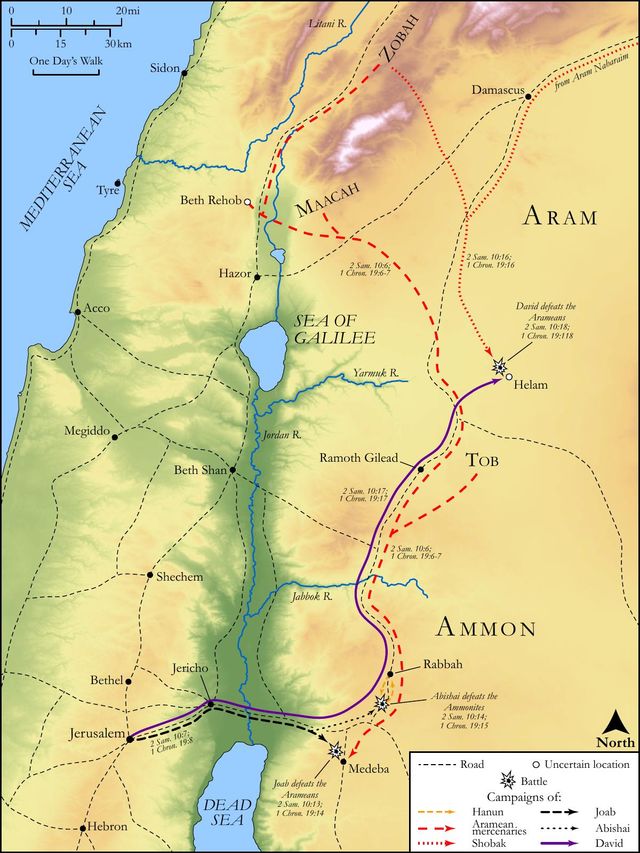
See on the biblical-era map
Study this verse
Public-domain commentary
Matthew Henry
From his Commentary on the Whole Bible. Henry comments on passages, not single verses — this entry covers 1 Chronicles 19:6–19.
We may see here, 1. How the hearts of sinners that are marked for ruin are hardened to their destruction. The children of Ammon saw that they had made themselves odious to David (Ch1 19:6), and then it would have been their wisdom to desire conditions of peace, to humble themselves and offer any satisfaction for the injury they had done him, the rather because they had made themselves not only odious to David, but obnoxious to the justice of God, who is King of nations, and will assert the injured rights and maintain the violated laws of nations. But, instead of this, they prepared for war, and so brought upon themselves, by David's hand, those desolations which he never intended them. 2. How the courage of brave men is heightened and invigorated by difficulties. When Joab saw that the battle was set against him before and behind (Ch1 19:10), instead of meditating a retreat, he doubled his resolution; and, though he could not double, he divided his army, and not only spoke, but acted, like a gallant man, that had great presence of mind when he saw himself surrounded. He engaged with his brother for mutual assistance (Ch1 19:12), excited himself and the rest of the officers to act vigorously in their respective posts, with an eye to God's glory and their country's good, not to any honour and advantage of their own, and then left the issue to God: Let the Lord do that which is right in his sight. 3. How vain the greatest art and strength are against justice and equity. The Ammonites did their utmost to make the best of their position: they brought as good a force into the field, and disposed it with as much policy as possible; yet, having a bad cause, and acting in defence of wrong, it would not do; they were put to the worst. Right will prevail and triumph at last. 4. To how little purpose it is for those to rally again, and reinforce themselves, that have not God on their side. The Syrians, though in no way concerned in the merits of the cause, but serving only as mercenaries to the Ammonites, when they were beaten, thought themselves concerned to retrieve their honour, and therefore called in the assistance of the Syrians on the other side Euphrates; but to no purpose, for still they fled before Israel (Ch1 19:18); they lost 7000 men, who are said to be the men of 700 chariots, Sa2 10:18. For, as now in a man of war for sea-service they allot ten men to a gun, so then, in land-service, ten men to a chariot. 5. those who have meddled with strife that belongs not to them, and have found that they meddled to their own heart, do well to learn wit at length and meddle no further. The Syrians, finding that Israel was the conquering side, not only broke off their alliance with the Ammonites and would help them no more (Ch1 19:19), but made peace with David and became his servants. Let those who have in vain stood it out against God be thus wise for themselves, and agree with him quickly, while they are in the way. Let them become his servants; for they cannot but see themselves undone if they be his enemies.
Continue studying 1 Chronicles 19:12 across the web’s major study libraries — every link below opens this exact verse, chapter, or book on the destination site.
Read & Compare
 BibleGatewayThis verse in more than 200 translations and 70 languages.
 Bible.comThe YouVersion reader — hundreds of translations, reading plans, and highlights.
 ESV.orgCrossway's official English Standard Version reader.
 NET BibleThe NET translation with 60,000+ translators' notes on every rendering decision.
 STEP BibleTyndale House's free study tool — original text, vocabulary, and scholarly resources.
 BibliaLogos Bible Software's free web reader.
 USCCBThe New American Bible (Revised Edition) with the U.S. bishops' study notes.
Commentaries
 BibleHub CommentariesDozens of classic commentaries on this verse, gathered on one page.
 StudyLightMore than 100 commentary sets — the largest collection on the web.
 BibleRefPlain-English commentary on what this verse means, verse by verse.
 Enduring WordDavid Guzik's free commentary on this chapter, widely used by Bible teachers.
 Bible Study ToolsVerse commentary alongside Greek and Hebrew study aids.
Original Language & Research
- BibleHub InterlinearThe verse word by word — original language, transliteration, and English.
- BibleHub LexiconEvery word's original-language definition and Strong's entry.
 Blue Letter BibleDeep-study tools — Strong's numbers, concordance, and word studies.
 SefariaThe Hebrew text with Rashi and centuries of Jewish commentary.
Sermons, Hymns & Audio


TrulyRandomVerse is not affiliated with these sites and doesn’t control their content. They’re linked because they’re genuinely useful.
Summary
1 Chronicles 19:12 captures a pivotal strategic agreement between King David's seasoned generals, Joab and Abishai, as they prepare to engage a formidable combined force of Ammonite and Syrian armies. This verse articulates a crucial principle of mutual military support and proactive foresight, ensuring that neither commander's flank would be overwhelmed without immediate reinforcement, thereby maximizing their collective strength and chances of victory in a challenging two-front battle.
Context
ShowHideLiterary Context
This verse is deeply embedded within the detailed narrative of David's war against the Ammonites and their Syrian allies, chronicled in 1 Chronicles 19. The conflict was ignited by King Hanun of Ammon's egregious insult to David's envoys, transforming a gesture of condolence into a profound national affront against Israel (1 Chronicles 19:4). David responded decisively by dispatching his elite forces under the command of Joab. Upon reaching Rabbah, the Ammonite capital, Joab encountered a cunning enemy deployment: the Ammonites fortified at the city gate, and a powerful coalition of Syrian forces (from Beth-rehob, Zobah, Maacah, and Zobah) positioned in the open field (1 Chronicles 19:6-7). Faced with this two-pronged tactical dilemma, Joab shrewdly divided his army, taking command of the choicest troops to engage the Syrians, while entrusting his brother Abishai with the remainder to confront the Ammonites. Verse 12 serves as the explicit articulation of their contingency plan, a testament to their military acumen, fraternal trust, and the necessity of coordinated action in the heat of battle. A parallel account of this critical strategic moment is also found in 2 Samuel 10:12.
Historical & Cultural Context
The era of King David's reign (c. 1010-970 BC) was characterized by significant expansion and consolidation of the Israelite kingdom, frequently involving intense military campaigns against surrounding nations. The Ammonites, a Transjordanian people descended from Lot, were perennial adversaries of Israel, and their alliance with powerful Syrian city-states like Zobah represented a substantial regional threat to Israel's burgeoning empire. Ancient Near Eastern warfare relied heavily on disciplined infantry, often supported by chariots (a specialty of the Syrians), and effective, adaptive leadership. Battles were frequently decided by tactical maneuvers, the morale of the troops, and the ability of commanders to respond to rapidly changing circumstances. The concept of mutual support among commanders was not merely a matter of personal loyalty but a strategic imperative; a collapse on one flank could lead to a catastrophic rout for the entire army. The division of forces, as seen here, was a common tactic for dealing with multiple threats, but it inherently carried the risk of isolating segments of the army, making the explicit agreement for mutual reinforcement in 1 Chronicles 19:12 a crucial element of Joab's brilliant and pragmatic strategy.
Key Themes
ShowHideThis verse powerfully illustrates several enduring themes pertinent to both ancient warfare and timeless principles of community. Firstly, it highlights mutual support and solidarity, emphasizing that shared burdens and collective strength are vital in overcoming overwhelming odds. Joab and Abishai's commitment to assist each other underscores the principle that individual strength is amplified through cooperative effort, a concept echoed in wisdom literature such as Ecclesiastes 4:9-12. Secondly, the verse showcases strategic planning and foresight. Joab's command is a masterclass in military prudence, anticipating potential weaknesses and establishing a clear protocol for reinforcement, thereby minimizing risk and maximizing the army's chances of success. This reflects a practical wisdom that prepares for various outcomes, aligning with the biblical emphasis on thoughtful consideration before action, as seen in Proverbs 21:5. Lastly, the agreement speaks to the profound importance of trust and reliance among allies. For this contingency plan to succeed, Joab and Abishai had to possess deep confidence in each other's commitment, competence, and readiness to act swiftly, illustrating the necessity of dependable partnerships in any challenging endeavor, whether military or communal (Romans 12:5).
Exposition and Analysis
ShowHideKey Word Analysis
ShowHideFrom a primitive root, this verb means "to say" with great latitude, encompassing speaking, commanding, declaring, or determining. In this context, it signifies Joab's authoritative declaration and the establishment of a binding agreement. It's not merely a suggestion but a directive that forms the foundation of their battle plan, highlighting the weight and intentionality behind the words spoken.
A primitive root meaning "to fasten upon; hence, to seize, be strong (figuratively, courageous, causatively strengthen, cure, help, repair, fortify), obstinate." When used in the phrase "be too strong for me/thee," it conveys the idea of being overpowered, outmatched, or overwhelmed by the enemy's might, numbers, or tactical advantage. It denotes a critical situation where one's own forces are insufficient to withstand the opposing pressure, necessitating external aid to prevent collapse.
A primitive root meaning "to be open, wide or free, i.e. (by implication) to be safe; causatively, to free or succor." This verb implies active intervention to bring relief, rescue, or deliverance from a perilous situation. In the military context of this verse, it signifies the provision of crucial reinforcement and strategic assistance, where one brother's forces would move to support the other, turning the tide of battle and securing victory.
Verse Breakdown
ShowHide"And he said, If the Syrians be too strong for me, then thou shalt help me:"
This initial clause establishes Joab's strategic foresight and the first half of the reciprocal agreement. Joab, leading the elite troops against the formidable Syrian contingent, acknowledges the realistic possibility that his forces might be overwhelmed by the enemy's strength or numbers. In such a scenario, he explicitly commands Abishai to come to his aid. This demonstrates Joab's humility in recognizing potential vulnerability and his prudence in planning for it. It also underscores the clear chain of command and the expectation of immediate, decisive action from Abishai.
"but if the children of Ammon be too strong for thee, then I will help thee."
This second clause completes the mutual pact, addressing Abishai's potential vulnerability against the Ammonites and Joab's unwavering commitment to reciprocate. It underscores the equal importance of both flanks to the overall success of the campaign and the shared responsibility for the army's well-being. The conjunction "but" (וְאִם, wə'im) introduces the parallel, alternative condition, creating a balanced and comprehensive contingency plan that covers both potential points of failure and solidifies the bond between the commanders.
Literary Devices
ShowHideThe verse is a masterful example of Parallelism, specifically Antithetical Parallelism in its structure, where two contrasting or complementary clauses are set against each other to convey a unified thought. Here, the two conditional statements ("If the Syrians be too strong for me, then thou shalt help me" and "but if the children of Ammon be too strong for thee, then I will help thee") mirror each other in form and content, creating a balanced and emphatic expression of mutual commitment. This parallelism is further enhanced by a subtle Chiasm (an ABBA' structure), where the sequence of "Syrians (A) - me (B) - thee (B') - Ammon (A')" implicitly reinforces the reciprocal nature of the agreement, emphasizing the interchangeability of roles in providing and receiving aid. The device of Strategic Dialogue is also profoundly at play, as Joab's words are not merely a command but a foundational agreement that defines the operational parameters for the entire battle, demonstrating his astute leadership and the critical importance of clear communication and trust in high-stakes situations.
Theological and Thematic Connections
ShowHideWhile rooted in the pragmatism of military strategy, the principles articulated in 1 Chronicles 19:12 resonate deeply with broader theological truths concerning community, interdependence, and the very nature of God's people. The mutual commitment between Joab and Abishai serves as a powerful metaphor for the call to bear one another's burdens within the spiritual community. Just as these commanders recognized their individual limitations and the absolute necessity of collective strength against a common foe, so too are believers called to support each other in the face of spiritual challenges, personal struggles, and the advancement of God's kingdom. This verse underscores that God often works through the faithful cooperation of His people, empowering them to accomplish tasks that are too great for any one individual. It reminds us that while ultimate victory belongs to the Lord, He often orchestrates His triumph through the strategic and loving interdependence of His servants, reflecting the communal nature of the body of Christ.
Reflection and Application
ShowHideThe strategic wisdom of Joab and Abishai in 1 Chronicles 19:12 offers profound lessons for contemporary life, extending far beyond the battlefield. In our families, churches, workplaces, and communities, we frequently encounter challenges that are too formidable for any one person to bear alone. This verse calls us to cultivate a spirit of mutual support, recognizing that true strength often lies in our willingness to share burdens, offer assistance, and stand in solidarity with one another. It encourages us to be proactive in planning for difficulties, not merely reacting to crises, by establishing networks of trust and reciprocal commitment. Just as Joab anticipated potential weaknesses, we are invited to consider how we can prepare for future trials, building relationships where we can both give and receive help. Ultimately, this passage reminds us that while our human strategies and alliances are crucial, our ultimate reliance must be on God, who empowers our efforts and provides the ultimate strength for every battle, whether physical, emotional, or spiritual. It challenges us to move beyond isolated individualism towards a robust, interdependent community, mirroring the divine design for humanity.
Questions for Reflection
ShowHideFAQ
ShowHideHow does this military strategy relate to trusting God for victory?
ShowHideWhile 1 Chronicles 19:12 details a human military strategy, it does not negate reliance on God; rather, it illustrates how God often works through wise human planning and faithful cooperation. Joab's foresight and the mutual commitment between the brothers demonstrate responsible stewardship of the resources and abilities God has given. The broader narrative of Chronicles consistently emphasizes that true victory comes from the Lord, often in response to prayer and obedience (1 Chronicles 5:20; 1 Chronicles 14:10-11). Even as they planned, David and his generals would have prayed and sought divine guidance. Thus, the verse teaches that trusting God isn't passive; it involves active, strategic engagement, knowing that God blesses and empowers our diligent efforts and our interdependent relationships. It's a profound balance of human responsibility and divine sovereignty.
Christ-Centered Fulfillment
ShowHideWhile 1 Chronicles 19:12 describes a strategic military pact between human commanders, its underlying principle of mutual support and sacrificial aid finds its ultimate and most profound fulfillment in Jesus Christ. He is the one who, seeing humanity "too strong" for itself in the grip of sin, death, and spiritual enemies, stepped in to provide ultimate help and deliverance. The Son of God, in His infinite love, did not merely offer assistance from a distance but fully identified with our weakness, becoming flesh to fight our battle for us (Hebrews 2:14-15). His entire life and ministry were an embodiment of strategic self-giving, culminating in His decisive victory over sin, death, and evil on the cross, where He bore the full weight of our spiritual enemies and disarmed the powers (Colossians 2:15). Moreover, Christ continues to be our unfailing Helper and Intercessor at the right hand of God, continually strengthening us when we are weak and interceding on our behalf (Romans 8:34; Hebrews 7:25). In the church, the body of Christ, His Spirit empowers believers to live out this mutual aid, becoming His hands and feet to support one another, just as Joab and Abishai committed to each other, but now in a spiritual warfare where Christ Himself is our commanding General and our unfailing reinforcement (Ephesians 4:16).