


2 Samuel 10:12
Bible text: King James Version (1769 Blayney text) · Public domain
Bible text: Berean Standard Bible · Public domain
Bible text: American Standard Version (1901) · Public domain
Bible text: World English Bible, Messianic edition · Public domain
Bible text: Geneva Bible (1599) · Public domain
Bible text: Young's Literal Translation · Public domain
- חֲזַקcha·Zakbe strongH2388V-Qal-Imp-2msVerb Qal Imperative 2nd Singular Masculine
- וְנִתְחַזַּקve·nit·cha·Zakso we may show ourselves strongH2388Conj-w ¦ V-Hithpael-ConjImperf-1cpVerb Hithpael Conjunction+Imperfect 1st Plural common genderוְsoנִתְחַזַּקwe may show ourselves strong
- בְּעַדbe·'adforH1157Adj-cscAdjective Numerical Singular common gender Construct
- עַמֵּנוּ'a·Me·nuour peopleH5971N-msc ¦ 1cpNoun Singular Masculine Constructעַמֵּpeopleנוּour
- וּבְעַדu·ve·'Adand forH1157Conj-w ¦ Adj-cscAdjective Numerical Singular common gender Constructוּandבְעַדfor
- עָרֵי'a·Rei[the] cities ofH5892N-mpcNoun Plural Masculine Construct
- אֱלֹהֵינוּ'e·lo·Hei·nuour GodH430N-mpc ¦ 1cpNoun Plural Masculine ConstructאֱלֹהֵיGodנוּour
- וַיהוָהva·Yah·wehand YahwehH3068Conj-w ¦ N-properNoun Proper TitleוַandיהוָהYahweh
- יַעֲשֶׂהya·'a·Sehhe will doH6213V-Qal-Imperf-3msVerb Qal Imperfect 3rd Singular Masculine
- הַטּוֹבha·Tovthe goodH2896Art ¦ Adj-msAdjective Singular Masculine Absoluteהַtheטּוֹבgood
- בְּעֵינָיוbe·'ei·Navin his viewH5869Prep-b ¦ N-fdc ¦ 3msNoun Dual Feminine Constructבְּinעֵינָיviewוhis
English is a literal word-by-word gloss of the Hebrew, not the KJV's wording. Why?
This is the original text the KJV's translators worked from — each Hebrew word with its own literal English meaning in this verse, prepared by scholars at Tyndale House, Cambridge. The KJV translates whole sentences, not word by word, so its wording differs: one Hebrew word can become several English words, and the KJV may choose “the LORD” where the gloss reads “Yahweh”. Both are faithful — they answer different questions. For the KJV's own rendering, switch to the KJV text.
Details
See on the biblical-era maps

Study this verse
Public-domain commentary
Matthew Henry
From his Commentary on the Whole Bible. Henry comments on passages, not single verses — this entry covers 2 Samuel 10:6–14. His two-level outline is real structure in the source text, so it is rendered as structure.
Here we have, I. The preparation which the Ammonites made for war, Sa2 10:6. They saw they had made themselves very odious to David and obnoxious to his just displeasure. This they might easily have foreseen when they abused his ambassadors, which was no other than a challenge to war, and a bold defiance of him. Yet, it seems, they had not considered how unable they were, with their thousands, to meet his; for now they found themselves an unequal match, and were forced to hire forces of other nations into their service. Thus sinners daringly provoke God, and expose themselves to his wrath, and never consider that he is stronger than they, Co1 10:22. The Ammonites gave the affront first, and they were the first that raised forces to justify it. Had they humbled themselves, and begged David's pardon, probably an honorary satisfaction might have atoned for the offence. But, when they were thus desperately resolved to stand by what they had done, they courted their own ruin.
II.The speedy descent which David's forces made upon them, Sa2 10:7.
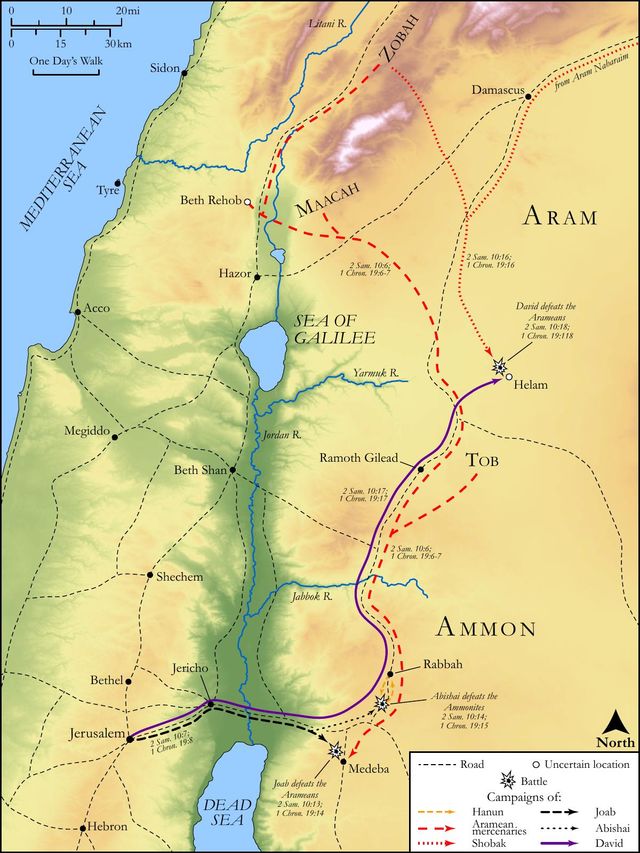
When David heard of their military preparations, he sent Joab with a great army to attack them, Sa2 10:7. Those that are at war with the Son of David not only give the provocation, but begin the war; for he waits to be gracious, but they strengthen themselves against him, and therefore, if they turn not, he will whet his sword, Psa 7:12. God has forces to send against those that set his wrath at defiance (Isa 5:19), which will convince them, when it is too late, that none ever hardened his heart against God and prospered. It was David's prudence to carry the war into their country, and fight them at the entering in of the gate of their capital city, Rabbah, as some think, or Medeba, a city in their borders, before which they pitched to guard their coast, Ch1 19:7. Such are the terrors and desolations of war that every good prince will, in love to his people, keep it as much as may be at a distance from them.
III.Preparations made on both sides for an engagement.
1.The enemy disposed themselves into two bodies, one of Ammonites, which, being their own, were posted at the gate of the city; the other of Syrians, whom they had taken into their pay, and who were therefore posted at a distance in the field, to charge the forces of Israel in the flank or rear, while the Ammonites charged them in the front, Sa2 10:8.
2.Joab, like a wise general, was soon aware of the design, and accordingly divided his forces: the choicest men he took under his own command, to fight the Syrians, whom probably he knew to be the better soldiers, and, being hired men, better versed in the arts of war, Sa2 10:9. The rest of the forces he put under the command of Abishai his brother, to engage the Ammonites, Sa2 10:10. It should seem, Joab found the enemy so well prepared to receive them that his conduct and courage were never so tried as now.
IV.Joab's speech before the battle, Sa2 10:11, Sa2 10:12. It is not long, but pertinent, and brave.
1.He prudently concerts the matter with Abishai his brother, that the dividing of the forces might not be the weakening of them, but that, which part soever was borne hard upon, the other should come in to its assistance. He supposes the worst, that one of them should be obliged to give back; and in that case, upon a signal given, the other should send a detachment to relieve it. Note, Mutual helpfulness is brotherly duty. If occasion be, thou shalt help me, and I will help thee. Christ's soldiers should thus strengthen one another's hands in their spiritual warfare. The strong must succour and help the weak. Those that through grace are conquerors over temptation must counsel, and comfort, and pray for, those that are tempted. When thou art converted, strengthen thy brethren, Luk 22:32. The members of the natural body help one another, Co1 12:21.
2.He bravely encourages himself, and his brother, and the rest of the officers and soldiers, to do their utmost. Great dangers put an edge upon true courage. When Joab saw the front of the battle was against him, both before and behind, instead of giving orders to make an honourable retreat, he animated his men to charge so much more furiously: Be of good courage and let us play the men, not for pay and preferment, for honour and fame, but for our people, and for the cities of our God, for the public safety and welfare, in which the glory of God is so much interested. God and our country was the word. "Let us be valiant, from a principle of love to Israel, that are our people, descended from the same stock, for whom we are employed, and in whose peace we shall have peace; and from a principle of love to God, for they are his cities that we are fighting in the defence of." The relation which any person or thing stands in to God should endear it to us, and engage us to do our utmost in its service.
3.He piously leaves the issue with God: "When we have done our part, according to the duty of our place, let the Lord do that which seemeth to him good." Let nothing be wanting in us, whatever the success be; let God's work be done by us, and then God's will be done concerning us. When we make conscience of doing our duty we may, with the greatest satisfaction, leave the event with God, not thinking that our valour binds him to prosper us, but that still he may do as he pleases, yet hoping for his salvation in his own way and time.
V.The victory Joab obtained over the confederate forces of Syria and Ammon, Sa2 10:13, Sa2 10:14.
He provided for the worst, and put the case that the Syrians and Ammonites might prove too strong for him (Sa2 10:11), but he proved too strong for them both. We do not hinder our success by preparing for disappointment. The Syrians were first routed by Joab, and then the Ammonites by Abishai; the Ammonites seem not to have fought at all, but, upon the retreat of the Syrians, to have fled into the city. It is a temptation to soldiers to fly when they have a city at their backs to fly to. It is one thing when men may either fight or fly and another thing when they must either fight or die.
Continue studying 2 Samuel 10:12 across the web’s major study libraries — every link below opens this exact verse, chapter, or book on the destination site.
Read & Compare
 BibleGatewayThis verse in more than 200 translations and 70 languages.
 Bible.comThe YouVersion reader — hundreds of translations, reading plans, and highlights.
 ESV.orgCrossway's official English Standard Version reader.
 NET BibleThe NET translation with 60,000+ translators' notes on every rendering decision.
 STEP BibleTyndale House's free study tool — original text, vocabulary, and scholarly resources.
 BibliaLogos Bible Software's free web reader.
 USCCBThe New American Bible (Revised Edition) with the U.S. bishops' study notes.
Commentaries
 BibleHub CommentariesDozens of classic commentaries on this verse, gathered on one page.
 StudyLightMore than 100 commentary sets — the largest collection on the web.
 BibleRefPlain-English commentary on what this verse means, verse by verse.
 Enduring WordDavid Guzik's free commentary on this chapter, widely used by Bible teachers.
 Bible Study ToolsVerse commentary alongside Greek and Hebrew study aids.
Original Language & Research
- BibleHub InterlinearThe verse word by word — original language, transliteration, and English.
- BibleHub LexiconEvery word's original-language definition and Strong's entry.
 Blue Letter BibleDeep-study tools — Strong's numbers, concordance, and word studies.
 SefariaThe Hebrew text with Rashi and centuries of Jewish commentary.
Sermons, Hymns & Audio


TrulyRandomVerse is not affiliated with these sites and doesn’t control their content. They’re linked because they’re genuinely useful.
Summary
Joab's powerful declaration in 2 Samuel 10:12 serves as a pivotal rallying cry to the Israelite army, facing a formidable combined force of Ammonites and Syrians. It encapsulates a profound blend of human courage, military resolve, and unwavering trust in divine sovereignty. Facing overwhelming odds and a two-front battle, Joab exhorts his men to fight valiantly for their people and the cities of their God, while simultaneously acknowledging that the ultimate outcome rests entirely in the hands of the Lord, who will do what is good in His sight. This verse masterfully balances human responsibility with divine omnipotence, offering a timeless principle for navigating life's most challenging circumstances with faith and determination.
Context
ShowHideLiterary Context
This verse is situated at a critical juncture in the escalating conflict between Israel and Ammon, triggered by King Hanun's egregious humiliation of David's envoys. David, intending a gesture of kindness and respect following the death of Hanun's father, sent messengers of condolence. However, Hanun, swayed by his suspicious advisors, subjected them to extreme public dishonor by shaving half their beards and cutting their garments in the middle, up to their buttocks. This act was a profound insult, a calculated act of war, and an assault on David's honor and, by extension, Israel's. David responded by dispatching his elite army under the command of Joab and Abishai. The narrative immediately preceding 2 Samuel 10:12 details the strategic dilemma Joab faced: the Ammonites had hired a large contingent of Syrian mercenaries, effectively creating a two-front battle, with enemies positioned both before and behind the Israelite forces. Joab's words are a direct, tactical, and theological response to this dire situation, as he divides his forces, assigning Abishai to face the Ammonites and taking command against the Syrians, preparing for a desperate yet determined engagement. The subsequent verses recount the successful execution of Joab's battle plan, leading to the initial rout of the Syrians and the subsequent retreat of the Ammonites.
Historical & Cultural Context
In the days of David, Israel and the nations round about lived amid shifting alliances, rivalries, and endemic warfare. Acts of diplomacy, such as David's initial overture, carried immense weight, and their deliberate desecration, as perpetrated by Hanun, was an extreme provocation, universally understood as a declaration of war. Public shaming of envoys was deeply offensive, striking at the honor of both the individuals and the sovereign they represented, often leading to bloody retaliation. The practice of hiring mercenaries was common among smaller kingdoms or those lacking sufficient military strength, like Ammon, to confront larger, more established powers such as Israel. The phrase "cities of our God" reflects the profound connection between the Israelite people, their divinely promised land, and their covenant relationship with Yahweh. In this worldview, battles were often perceived not merely as clashes between armies but as contests between their respective deities. The Israelites, as God's chosen people, understood their battles to possess a sacred dimension, fought for the preservation of their divinely appointed heritage, the integrity of their covenant, and the honor of their God. This context underscores the gravity of Joab's exhortation, transforming a military engagement into a sacred defense.
Key Themes
ShowHide2 Samuel 10:12 powerfully encapsulates several overarching themes prevalent in the book of 2 Samuel and the broader Deuteronomistic History. First, it highlights the theme of courage and decisive leadership in the face of overwhelming adversity, exemplified by Joab's resolute command and strategic acumen. This echoes the repeated divine calls for strength and steadfastness found throughout Israel's foundational narratives, such as God's commission to Joshua to "be strong and courageous" as he led Israel into the promised land (Joshua 1:9). Second, the verse underscores the theme of national identity and sacred duty, as the soldiers are called to fight "for our people, and for the cities of our God." This emphasizes that their struggle is not for personal gain or mere territorial expansion, but for the preservation of the covenant community and its divinely designated territories—a concept deeply rooted in the promises made to Abraham and the laws given in Deuteronomy. Finally, and most profoundly, the verse articulates the enduring biblical theme of divine sovereignty and human responsibility. Joab's declaration, "and the LORD do that which seemeth him good," is a profound expression of humble trust in God's ultimate control over all outcomes, even amidst intense human effort. This theological tension—between diligent human action and humble submission to God's ultimate will—is a recurring motif in biblical narratives, often seen in the life of King David himself, who consistently sought the Lord's guidance before engaging in battle (2 Samuel 5:19).
Exposition and Analysis
ShowHideKey Word Analysis
ShowHideThe KJV phrase "Be of good courage" translates the Hebrew verb root châzaq (H2388), which fundamentally means "to fasten upon; hence, to seize, be strong (figuratively, courageous, causatively strengthen, cure, help, repair, fortify), obstinate." It is an active imperative, a command not merely to feel brave, but to demonstrate strength, valor, and unwavering resolve. In a military context, it implies holding one's ground, standing firm against an enemy, and acting with determined fortitude. This word is frequently used in the Old Testament to encourage leaders and people to be strong in the Lord, often in the face of daunting tasks or formidable enemies, as seen in God's repeated instruction to Joshua.
The term "God" in "cities of our God" is the Hebrew word ʼĕlôhîym (H430). This plural noun, often used with a singular verb, refers to the supreme God of Israel, Yahweh, but can also denote gods in the ordinary sense, magistrates, or even be used as a superlative. Here, with the possessive "our," it unequivocally refers to Yahweh, emphasizing His covenant relationship with Israel and His ownership of their land and cities. It underscores the sacred dimension of the conflict, implying that the battle is not merely for territory but for the honor and dominion of the true God.
The concluding phrase, "seemeth him good," employs the Hebrew word ṭôwb (H2896), meaning "good (as an adjective) in the widest sense; used likewise as a noun... beautiful, best, better, bountiful, cheerful, at ease, fair, favour, fine, glad, good (deed, -lier, -liest, -ly, -ness, -s), graciously, joyful, kindly, kindness, liketh (best), loving, merry, most, pleasant, pleaseth, pleasure, precious, prosperity, ready, sweet, wealth, welfare, (be) well(-favoured)." When applied to God, it emphasizes that whatever He decides or brings to pass will ultimately be in accordance with His perfect character, His benevolent will, and His wise purposes. It signifies that God's actions are inherently righteous, morally perfect, and ultimately lead to the best possible outcome from His divine perspective, even if it is not immediately apparent or desirable from a human viewpoint.
Verse Breakdown
ShowHide"Be of good courage"
This opening imperative is a direct, forceful command to the soldiers to steel their resolve, overcome fear, and prepare their minds for the arduous task ahead. It is a call to mental and spiritual fortitude, recognizing that true courage is not the absence of fear but the determination to act decisively despite it. It sets the tone for the subsequent call to action, emphasizing the internal disposition necessary for effective combat and steadfastness.
"and let us play the men for our people, and for the cities of our God"
This clause provides the profound motivation and sacred purpose for their courage. "Let us play the men" is an idiomatic expression, urging them to act like true warriors, to embody masculine strength, bravery, and unwavering commitment, fulfilling their duty with honor. The objects of their defense are twofold and deeply intertwined: "our people" (their families, kin, the entire nation of Israel, and their very identity as God's chosen community) and "the cities of our God" (the physical dwelling places of the covenant community, sacred because they are where God's people reside, worship, and where His presence is manifest). This elevates the battle from a mere territorial dispute to a sacred defense of their identity, heritage, and unique covenant relationship with Yahweh.
"and the LORD do that which seemeth him good."
This concluding statement represents a profound theological pivot and a remarkable expression of faith. After exhorting maximal human effort, courage, and strategic action, Joab immediately shifts the ultimate responsibility and outcome to God. It is an expression of humble submission and profound trust in divine sovereignty. It acknowledges that despite their best efforts and the most valiant human endeavors, the final victory or defeat rests solely in God's hands, and whatever He chooses to do will be inherently righteous, wise, and ultimately "good" from His perfect perspective. This perspective prevents human pride in victory and offers solace and steadfast hope in potential defeat, anchoring their ultimate confidence in God's perfect and benevolent will.
Literary Devices
ShowHideJoab's declaration is a masterclass in Rhetoric and Exhortation. It functions as a powerful rallying cry, strategically designed to inspire, unify, and steel the resolve of the troops in a moment of extreme peril and tactical disadvantage. The direct address through the imperative "Be of good courage" and the cohortative "let us play the men" directly engages the soldiers, fostering a profound sense of shared purpose and collective responsibility. There is a clear and intentional Juxtaposition between human responsibility and divine sovereignty: the urgent call to courageous action is immediately followed by a humble surrender to God's ultimate will. This creates a theological Paradox where diligent human effort is maximized, yet ultimate control and the final outcome are relinquished to divine providence. The phrase "for our people, and for the cities of our God" employs effective Parallelism and Merism, encompassing the totality of what they are fighting for—their national, familial, and spiritual identity, their very existence as God's covenant people. The subtle repetition of the concept of "good" (being of "good courage," and God doing what is "good") subtly reinforces the righteous nature of their cause and the benevolent character of God.
Theological and Thematic Connections
ShowHide2 Samuel 10:12 masterfully weaves together the biblical themes of human responsibility, courage, and divine sovereignty. It teaches a crucial theological principle: while we are called to exert our utmost effort, wisdom, and bravery in the face of life's challenges and spiritual battles, the ultimate outcome belongs entirely to God. This balance is indispensable for a healthy, robust faith, preventing both fatalistic passivity (where one does nothing, presuming God will do it all) and arrogant self-reliance (where one presumes their efforts alone determine success). Joab's words remind us that our actions have purpose and consequence within God's sovereign plan, but our trust must ultimately rest in the One who orchestrates all things according to His perfect will. It is a profound call to courageous faithfulness, coupled with humble submission, acknowledging that God's definition of "good" is always ultimate, true, and eternally beneficial, even when it diverges from our immediate desires or understanding.
Reflection and Application
ShowHideJoab's ancient battle cry transcends its original military context to offer profound and timeless guidance for believers navigating the "battles" of modern life. We are frequently confronted with situations that demand courage—whether it's standing for biblical truth in a compromising culture, persevering through personal suffering or chronic illness, making difficult ethical decisions in the workplace, or faithfully raising children in a challenging world. This verse calls us to "be of good courage" and to "play the men" (or, in a broader sense, "play the men/women"), meaning to act with integrity, strength, resolve, and moral fortitude, not shrinking from our God-given responsibilities. Our "people" and "cities of our God" today might represent our families, our local communities, the global Church, or even the broader cause of justice, righteousness, and the spread of the Gospel. We are to fight for these with all our God-given might and resources. Yet, crucially, after we have exerted every effort and poured ourselves into the task, we are to echo Joab's profound faith: "and the LORD do that which seemeth him good." This surrender to divine sovereignty frees us from the paralyzing grip of anxiety over outcomes, allowing us to rest in God's perfect wisdom and benevolent plan, knowing that His definition of "good" is always ultimate and true. It cultivates a spirit of diligent effort coupled with peaceful, confident trust.
Questions for Reflection
ShowHideFAQ
ShowHideWhat does "play the men" mean in this context?
ShowHideThe phrase "play the men" (KJV) is an idiomatic expression derived from the Hebrew, meaning to act courageously, bravely, and with the strength, fortitude, and unwavering resolve expected of mature warriors. It is a powerful exhortation to demonstrate valor, steadfastness, and determination in the face of danger, rather than succumbing to fear, weakness, or retreat. It's a call to embody the highest ideals of a soldier or a person facing a formidable challenge, fighting with all one's might for a noble and righteous cause. It implies taking full responsibility for one's actions in battle and giving one's utmost effort, as seen in other calls to strength and manliness in the Old Testament, such as when King David instructs his son Solomon to "be strong, therefore, and show yourself a man" as he prepares to assume the throne in 1 Kings 2:2.
How does this verse balance human responsibility and divine sovereignty?
ShowHideThis verse provides a beautiful and profound balance between human responsibility and divine sovereignty, a central tension in biblical theology. Joab first commands his soldiers to "be of good courage" and "play the men," emphasizing their active role, their duty, and their need for personal resolve, diligence, and effort. This highlights human agency and the importance of faithful action in the face of adversity. Immediately following this, however, he declares, "and the LORD do that which seemeth him good." This second part acknowledges that despite human effort, the ultimate outcome is not in their hands but rests entirely with God's sovereign will and perfect wisdom. It teaches that humans are to act with courage, diligence, and faithfulness, fulfilling their part, while simultaneously surrendering the results to God, trusting in His perfect control and benevolent purposes. This theological tension is a cornerstone of biblical faith, encouraging faithful action without presumption, and humble trust without passivity. This principle is echoed in passages like Proverbs 21:31, which states, "The horse is made ready for the day of battle, but victory rests with the LORD."
Christ-Centered Fulfillment
ShowHide2 Samuel 10:12, while a battle cry from ancient Israel, finds its ultimate and most profound fulfillment in the person and redemptive work of Jesus Christ. Joab's call to "be of good courage" and "play the men" for "our people, and for the cities of our God" powerfully foreshadows the ultimate courageous act of the true King and Commander, Jesus. He faced the battle against sin, death, and the powers of darkness, not with swords and shields, but with unwavering resolve, perfect obedience, and unparalleled love for His Father's will and His chosen people. He courageously "played the man" by enduring the cross, despising its shame, for the sake of His "people"—the elect from every tribe and nation whom He came to redeem and save from their sins (Matthew 1:21). His ultimate sacrifice was for the "cities of our God," not merely the earthly Jerusalem, but the heavenly Jerusalem, the New Creation, and His Church, which is the spiritual dwelling place of God among humanity, a city with foundations whose architect and builder is God (Revelation 21:2-3). Most significantly, Jesus perfectly embodied the final phrase: "and the LORD do that which seemeth him good." In the Garden of Gethsemane, facing unimaginable suffering and the weight of the world's sin, He prayed, "Nevertheless, not my will, but yours, be done" (Luke 22:42). His entire life, ministry, and redemptive work were an act of perfect submission to the Father's "good" and sovereign plan, even unto death on the cross. Through His courageous obedience and ultimate submission, Christ secured the decisive and eternal victory, demonstrating that true courage is found in absolute trust in God's perfect will, leading to the salvation of His people and the establishment of His eternal kingdom (Hebrews 12:2).