


Nehemiah 4:14
Bible text: King James Version (1769 Blayney text) · Public domain
Bible text: King James Version with Strong's numbers · Public domain
Bible text: Berean Standard Bible · Public domain
Bible text: American Standard Version (1901) · Public domain
Bible text: World English Bible, Messianic edition · Public domain
Bible text: Geneva Bible (1599) · Public domain
Bible text: Young's Literal Translation · Public domain
- וָאֵרֶאva·'E·re'and I sawH7200Conj-w ¦ V-Qal-ConsecImperf-1csVerb Qal Consecutive Imperfect 1st Singular common genderוָandאֵרֶאI saw
- וָאָקוּםva·'a·Kumand I aroseH6965Conj-w ¦ V-Qal-ConsecImperf-1csVerb Qal Consecutive Imperfect 1st Singular common genderוָandאָקוּםI arose
- וָאֹמַרva·'o·Marand I saidH559Conj-w ¦ V-Qal-ConsecImperf-1csVerb Qal Consecutive Imperfect 1st Singular common genderוָandאֹמַרI said
- אֶל'eltoH413PrepPreposition
- הַחֹרִיםha·cho·Rimthe noblesH2715Art ¦ N-mpNoun Plural Masculine Absoluteהַtheחֹרִיםnobles
- וְאֶלve·'eland toH413Conj-w ¦ PrepPrepositionוְandאֶלto
- הַסְּגָנִיםha·se·ga·Nimthe officialsH5461Art ¦ N-mpNoun Plural Masculine Absoluteהַtheסְּגָנִיםofficials
- וְאֶלve·'eland toH413Conj-w ¦ PrepPrepositionוְandאֶלto
- יֶתֶרYe·ter[the] rest ofH3499N-mscNoun Singular Masculine Construct
- הָעָםha·'Amthe peopleH5971Art ¦ N-msNoun Singular Masculine Absoluteהָtheעָםpeople
- אַל'almay notH408NegParticle Negative
- תִּירְאוּti·re·'Uyou be afraidH3372V-Qal-Imperf-2mpVerb Qal Imperfect 2nd Plural Masculine
- מִפְּנֵיהֶםmi·pe·nei·Hemof <before> themH6440Prep-m ¦ N-mpc ¦ 3mpNoun Plural Masculine Constructמִofפְּנֵי<before>הֶםthem
- אֶת'et<obj.>H853DirObjMParticle Object Indicator
- אֲדֹנָי'a·do·Nai[the] LordH136N-properNoun Proper Title
- הַגָּדוֹלha·ga·Dol<the> greatH1419Art ¦ Adj-msAdjective Singular Masculine Absoluteהַ<the>גָּדוֹלgreat
- וְהַנּוֹרָאve·ha·no·Ra'and <the> awesomeH3372Conj-w ¦ Art ¦ V-Niphal-Prtcpl-msVerb Niphal Participle Singular Masculine Absoluteוְandהַ<the>נּוֹרָאawesome
- זְכֹרוּze·Kho·rurememberH2142V-Qal-Imp-2mpVerb Qal Imperative 2nd Plural Masculine
- וְהִלָּחֲמוּve·hi·la·cha·Muand fightH3898Conj-w ¦ V-Niphal-Imp-2mpVerb Niphal Imperative 2nd Plural Masculineוְandהִלָּחֲמוּfight
- עַל'alonH5921PrepPreposition
- אֲחֵיכֶם'a·chei·Khemyour brothersH251N-mpc ¦ 2mpNoun Plural Masculine Constructאֲחֵיbrothersכֶםyour
- בְּנֵיכֶםbe·nei·Khemyour sonsH1121N-mpc ¦ 2mpNoun Plural Masculine Constructבְּנֵיsonsכֶםyour
- וּבְנֹתֵיכֶםu·ve·no·tei·Khemand your daughtersH1323Conj-w ¦ N-fpc ¦ 2mpNoun Plural Feminine Constructוּandבְנֹתֵיdaughtersכֶםyour
- נְשֵׁיכֶםne·shei·Khemyour wivesH802N-mpc ¦ 2mpNoun Plural Masculine Constructנְשֵׁיwivesכֶםyour
- וּבָתֵּיכֶםu·va·tei·Khemand your housesH1004Conj-w ¦ N-mpc ¦ 2mpNoun Plural Masculine Constructוּandבָתֵּיhousesכֶםyour
English is a literal word-by-word gloss of the Hebrew, not the KJV's wording. Why?
This is the original text the KJV's translators worked from — each Hebrew word with its own literal English meaning in this verse, prepared by scholars at Tyndale House, Cambridge. The KJV translates whole sentences, not word by word, so its wording differs: one Hebrew word can become several English words, and the KJV may choose “the LORD” where the gloss reads “Yahweh”. Both are faithful — they answer different questions. For the KJV's own rendering, switch to the KJV text.
Details
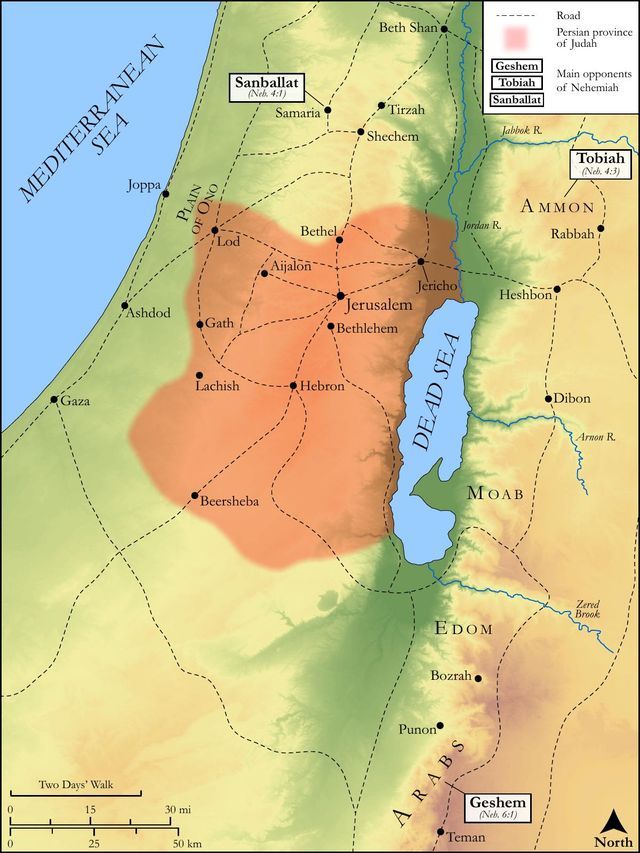
See on the biblical-era map
Study this verse
Public-domain commentary
Matthew Henry
From his Commentary on the Whole Bible. Henry comments on passages, not single verses — this entry covers Nehemiah 4:7–15. His three-level outline is real structure in the source text, so it is rendered as structure.
We have here,
I.The conspiracy which the Jews' enemies formed against them, to stay the building by slaying the builders.
The conspirators were not only Sanballat and Tobiah, but other neighbouring people whom they had drawn into the plot. They flattered themselves with a fancy that the work would soon stand still of itself; but, when they heard that it went on a prospered, they were angry at the Jews for being so hasty to push the work forward and angry at themselves for being so slow in opposing it (Neh 4:7): They were very wroth. Cursed be their anger, for it was fierce, and their wrath, for it was cruel. Nothing would serve but they would fight against Jerusalem, Neh 4:8. Why, what quarrel had they with the Jews? Had they done them any wrong? Or did they design them any? No, they lived peaceably by them; but it was merely out of envy and malice; they hated the Jews' piety, and were therefore vexed at their prosperity and sought their ruin. Observe,
1.How unanimous they were: They conspired all of them together, though of different interests among themselves, yet one in their opposition to the work of God.
2.How close they were; they said, "They shall not know, neither see, till we have them at our mercy." Thus they took crafty counsel, and digged deep to hide it from the Lord, and promised themselves security and success from the secresy of their management.
3.How cruel they were: We will come and slay them. If nothing less than the murder of the workmen will put a stop to the work, they will not stick at that; nay, it is their blood they thirst for, and they are glad of any pretence to glut themselves with it.
4.What the design was and how confident they were of success: it was to cause the work to cease (Neh 4:11), and this they were confident that they should effect. The hindering of good work is that which bad men aim at and promise themselves; but good work is God's work, and it shall prosper.
II.The discouragements which the builders themselves laboured under.
At the very time when the adversaries said, Let us cause the work to cease, Judah said, "Let us even let it fall, for we are not able to go forward with it," Neh 4:10. They represent the labourers as tired, and the remaining difficulties, even of that first part of their work, the removing of the rubbish, as insuperable, and therefore they think it advisable to desist for the present. Can Judah, that warlike valiant tribe, sneak thus? Active leading men have many times as much ado to grapple with the fears of their friends as with the terrors of their enemies.
III.The information that was brought to Nehemiah of the enemies' designs, Neh 4:12.
There were Jews that dwelt by them, in the country, who, though they had not zeal enough to bring them to Jerusalem to help their brethren in building the wall, yet, having by their situation opportunity to discover the enemies' motions, had so much honesty and affection to the cause as to give intelligence of them; nay, that their intelligence might be the more credited, they came themselves to give it, and they said it ten times, repeating it as men in earnest, and under a concern, and the report was confirmed by many witnesses. The intelligence they gave is expressed abruptly, and finds work for the critics to make out the sense of it, which perhaps is designed to intimate that they gave this intelligence as men out of breath and in confusion, whose very looks would make up the deficiencies of their words. I think it may be read, without supplying any thing: "Whatever place you turn to, they are against us, so that you have need to be upon your guard on all sides," Note, God has many ways of bringing to light, and so bringing to nought, the devices and designs of his and his church's enemies. Even the cold and feeble Jews that contentedly dwell by them shall be made to serve as spies upon them; nay, rather than fail, a bird of the air shall carry their voice.
IV.The pious and prudent methods which Nehemiah, hereupon, took to baffle the design, and to secure his work and workmen.
1.It is said (Neh 4:14) he looked.
(1.)He looked up, engaged God for him, and put himself and his cause under the divine protection (Neh 4:9): We made our prayer unto our God. That was the way of this good man, and should be our way; all his cares, all his griefs, all his fears, he spread before God, and thereby made himself easy. This was the first thing he did; before he used any means, he made his prayer to God, for with him we must always begin.
(2.)He looked about him. Having prayed, he set a watch against them. The instructions Christ has given us in our spiritual warfare agree with this example, Mat 26:41. Watch and pray. If we think to secure ourselves by prayer only, without watchfulness, we are slothful and tempt God; if by watchfulness, without prayer, we are proud and slight God; and, either way, we forfeit his protection.
2.Observe,
(1.)How he posted the guards, Neh 4:13. In the lower places he set them behind the wall, that they might annoy the enemy over it, as a breast-work; but in the higher places, where the wall was raised to its full height, he set them upon it, that from the top of it they might throw down stones or darts upon the heads of the assailants: he set them after their families, that mutual relation might engage them to mutual assistance.
(2.)How he animated and encouraged the people, Neh 4:14. He observed even the nobles and rulers themselves, as well as the rest of the people, to be in a great consternation upon the intelligence that was brought them, and ready to conclude that they were all undone, by which their hands were weakened both for work and war, and therefore, he endeavours to silence their fears. "Come," says he, "be not afraid of them, but behave yourselves valiantly, considering, [1.] Whom you fight under. You cannot have a better captain: Remember the Lord, who is great and terrible; you think your enemies great and terrible, but what are they in comparison with God, especially in opposition to him? He is great above them to control them, and will be terrible to them when he comes to reckon with them." Those that with an eye of faith see the church's God to be great and terrible will see the church's enemies to be mean and despicable. The reigning fear of God is the best antidote against the ensnaring fear of man. He that is afraid of a man that shall die forgets the Lord his Maker, Isa 51:12, Isa 51:13. [2.] "Whom you fight for. You cannot have a better cause; you fight for your brethren (Psa 122:8), your sons, and your daughters. All that is dear to you in their world lies at stake; therefore behave yourselves valiantly."
V.The happy disappointment which this gave to the enemies, Neh 4:15.
When they found that their design was discovered, and that the Jews were upon their guard, they concluded that it was to no purpose to attempt any thing, but that God had brought their counsel to nought. They knew they could not gain their point but by surprise, and, if their plot was known, it was quashed. The Jews hereupon returned every one to his work, with so much the more cheerfulness because they saw plainly that God owned it and owned them in the doing of it. Note, God's care of our safety should engage and encourage us to go on with vigour in our duty. As soon as ever a danger is over let us return to our work, and trust God another time.
Continue studying Nehemiah 4:14 across the web’s major study libraries — every link below opens this exact verse, chapter, or book on the destination site.
Read & Compare
 BibleGatewayThis verse in more than 200 translations and 70 languages.
 Bible.comThe YouVersion reader — hundreds of translations, reading plans, and highlights.
 ESV.orgCrossway's official English Standard Version reader.
 NET BibleThe NET translation with 60,000+ translators' notes on every rendering decision.
 STEP BibleTyndale House's free study tool — original text, vocabulary, and scholarly resources.
 BibliaLogos Bible Software's free web reader.
 USCCBThe New American Bible (Revised Edition) with the U.S. bishops' study notes.
Commentaries
 BibleHub CommentariesDozens of classic commentaries on this verse, gathered on one page.
 StudyLightMore than 100 commentary sets — the largest collection on the web.
 BibleRefPlain-English commentary on what this verse means, verse by verse.
 Enduring WordDavid Guzik's free commentary on this chapter, widely used by Bible teachers.
 Bible Study ToolsVerse commentary alongside Greek and Hebrew study aids.
Original Language & Research
- BibleHub InterlinearThe verse word by word — original language, transliteration, and English.
- BibleHub LexiconEvery word's original-language definition and Strong's entry.
 Blue Letter BibleDeep-study tools — Strong's numbers, concordance, and word studies.
 SefariaThe Hebrew text with Rashi and centuries of Jewish commentary.
Sermons, Hymns & Audio


TrulyRandomVerse is not affiliated with these sites and doesn’t control their content. They’re linked because they’re genuinely useful.
Summary
Nehemiah 4:14 presents a pivotal moment in the post-exilic rebuilding of Jerusalem's walls, where Nehemiah, observing the widespread fear among the Jewish returnees due to escalating enemy threats, rises to deliver a powerful exhortation. He courageously rallies the nobles, rulers, and the common people, urging them to cast off their apprehension by actively remembering the Lord, who is supremely great and awe-inspiring. This divine remembrance serves as the foundation for his call to resolute action: to fight valiantly not merely for the physical structure of the wall, but for the sacred preservation of their families, their homes, and the very fabric of their covenant community, transforming their paralyzing fear into faith-driven resolve.
Context
ShowHideLiterary Context
Nehemiah 4:14 is strategically placed within a narrative of escalating opposition to the reconstruction of Jerusalem's walls. Following initial ridicule from adversaries like Sanballat, Tobiah, and Geshem in Nehemiah 2:19, the hostility intensifies in chapter 4. As the wall progresses towards completion, their derision transforms into a concrete conspiracy to launch a military attack on Jerusalem, aiming to halt the work and sow chaos (Nehemiah 4:7-8). This tangible and imminent threat understandably instilled profound fear and demoralization among the builders, leading to a sense of vulnerability and a potential cessation of the vital work. In response, Nehemiah had already implemented practical security measures, arming the workers and establishing continuous watches (Nehemiah 4:9), but he recognized the deeper need for a spiritual and psychological intervention. Verse 14 serves as Nehemiah's direct, impassioned address to all segments of the community, designed to reorient their focus from the formidable nature of their human enemies to the absolute sovereignty and overwhelming power of their God, thereby rekindling their courage and unwavering resolve to complete the divinely appointed task.
Historical & Cultural Context
The events described in the book of Nehemiah transpired during the post-exilic period, specifically around 445 BCE, under the reign of Artaxerxes I of Persia. The Jewish people, having returned from Babylonian captivity, constituted a vulnerable minority in their ancestral homeland, surrounded by hostile regional powers such as the Samaritans, Ammonites, and Arabs. These neighbors perceived the restoration of Jerusalem's defenses as a direct threat to their existing influence and control over the region. The rebuilding of the city wall was far more than a mere construction project; it was a profound act of national and religious restoration, signifying the re-establishment of Jewish identity, security, and the distinct covenant community God had called them to be. In the ancient Near East, robust city walls were indispensable for defense, symbolizing a city's strength, independence, and the safety of its inhabitants. The threats from the enemies were not empty boasts; they represented a genuine and immediate danger of military incursion, plunder, and the potential re-enslavement or even annihilation of the nascent community. Nehemiah's urgent call to "fight for your brethren, your sons, and your daughters, your wives, and your houses" directly appealed to the deeply ingrained patriarchal and communal values prevalent in ancient Israel, where the protection of one's family and property was considered a sacred and paramount duty.
Key Themes
ShowHideThis verse powerfully contributes to several overarching themes woven throughout the book of Nehemiah and broader biblical theology. It profoundly highlights the theme of Overcoming Adversity Through Faith, demonstrating how Spirit-empowered leadership can effectively transform paralyzing fear into courageous action by strategically directing attention towards God's omnipotence rather than the overwhelming magnitude of the challenge. The imperative to "remember the Lord, [which is] great and terrible" underscores the theme of God's Majestic Power and Sovereignty, serving as a potent reminder to the people that their God is infinitely more powerful and capable than any earthly opposition, a truth consistently affirmed throughout scripture, such as in Deuteronomy 10:17. Furthermore, Nehemiah's impassioned appeal to fight for family and home emphatically emphasizes the theme of Defending God's People and Covenant Values, illustrating that spiritual and physical battles are often inextricably intertwined with the preservation of community, identity, and the sacred values entrusted by God to His people. Finally, the verse serves as a preeminent example of Godly Leadership in Crisis, as Nehemiah's decisive actions—his careful observation, his authoritative rising, his direct communication, and his inspiring exhortation—provide a compelling model for how leaders can empower their people to persevere with unwavering resolve in the face of daunting challenges, trusting implicitly in divine assistance, a principle also seen in Proverbs 29:18.
Exposition and Analysis
ShowHideKey Word Analysis
ShowHideThis is far more than a passive mental recollection; it signifies an active, deliberate engagement with past truths and experiences of God's faithfulness. In a biblical context, to "remember" the Lord means to call to mind His unchanging character, His inviolable covenant promises, and His mighty acts of deliverance (e.g., the Exodus event), allowing these profound truths to profoundly shape one's present actions, attitudes, and emotional state. It is a dynamic call to trust implicitly in God's unwavering faithfulness and omnipotent power, which directly serves as the spiritual antidote to the paralyzing fear induced by the enemies.
This term describes God's attributes, signifying "great," "mighty," "magnificent," or "vast." It emphasizes His immense power, supreme authority, and boundless majesty. When applied to God, it speaks of His incomparable nature, His infinite capacity, and His absolute superiority over all creation and any earthly opposition.
This word, derived from a primitive root meaning "to fear" or "to revere," when used to describe God, means "awe-inspiring," "dreadful," or "reverence-inducing." It does not suggest a God who causes terror in His people in a negative sense, but rather one whose majesty, holiness, and power are so overwhelmingly profound that they evoke deep reverence, holy fear, and worship. This combined description ("great and terrible") reminds the people that their God is not only infinitely powerful but also worthy of ultimate respect, trust, and adoration, far surpassing the strength or influence of any human adversary.
This primitive root means "to feed on," "to consume," and by implication, "to battle" or "to wage war." In this specific context, it is an urgent call to active, courageous, and determined engagement against the existential threats facing the community. It implies not only physical defense but also a spiritual resolve to resist the demoralizing tactics of the enemy. Nehemiah is not advocating for offensive warfare or aggression but for a determined, defensive stance to protect what is most precious to them—their families and their homes—which are foundational to the very existence and continuity of the covenant community.
Verse Breakdown
ShowHide"And I looked, and rose up, and said unto the nobles, and to the rulers, and to the rest of the people,"
This opening clause vividly portrays Nehemiah's proactive and decisive leadership. "I looked" conveys a careful, discerning assessment of the dire situation, indicating his recognition of the pervasive fear and demoralization that had gripped the community. "Rose up" signifies a posture of authority, readiness for immediate action, and a bold intention to directly address the crisis. His comprehensive address to "the nobles, and to the rulers, and to the rest of the people" demonstrates his strategic approach, ensuring that his crucial message resonated with and mobilized all strata of society, from the highest leadership down to the common laborer, thereby fostering essential unity in purpose and action.
"Be not ye afraid of them:"
This is a direct, emphatic, and imperative command, confronting the paralyzing fear that had permeated the community. Nehemiah, with pastoral insight, acknowledges their legitimate apprehension but immediately challenges them to reject its debilitating power. This command serves as an indispensable prerequisite for any effective action, as fear inherently paralyzes initiative and demoralizes the spirit. It powerfully sets the stage for the profound spiritual antidote he is about to offer.
"remember the Lord, [which is] great and terrible,"
This clause represents the theological core of Nehemiah's exhortation and the ultimate antidote to their fear. The command to "remember" is not a passive recall but an active, faith-filled, and intentional commitment to God's unchanging character and His mighty past actions. By remembering the Lord as "great and terrible" (i.e., awe-inspiring in His boundless power and majestic holiness), the people are called to fundamentally shift their focus from the perceived might of their human enemies to the absolute sovereignty, overwhelming power, and incomparable majesty of their God. This divinely informed perspective inherently diminishes the perceived threat of their adversaries in comparison to the limitless capacity and protective power of the Almighty.
"and fight for your brethren, your sons, and your daughters, your wives, and your houses."
This concluding clause provides the practical application and compelling motivation for their renewed courage and resolve. The command to "fight" is directly and inextricably linked to the remembrance of God's character. It transforms a potentially overwhelming and daunting task into a sacred duty—a determined defense of their most cherished possessions: their families and their homes. These foundational elements are essential to the very existence and flourishing of the covenant community. This powerful appeal to their deepest loyalties and natural affections provides a tangible, profoundly personal, and communal reason to overcome fear, persevere through hardship, and engage in the necessary conflict, underscoring that their labor and potential battle are not abstract but profoundly personal and vital.
Literary Devices
ShowHideNehemiah 4:14 masterfully employs several potent literary devices to achieve its profound persuasive and motivational effect. The primary device is Exhortation, a direct, passionate, and authoritative appeal designed to vigorously encourage, motivate, and inspire immediate action in the face of daunting challenges. Nehemiah's words are a powerful and urgent call to courage and unwavering faith amidst overwhelming odds. There is also a clear Contrast vividly established between the debilitating "fear" of the enemies and the empowering "remembrance" of God, presenting two fundamentally opposing responses to adversity and emphatically highlighting the superior, faith-rooted alternative. The verse also utilizes effective Parallelism in the comprehensive list of what the people are exhorted to fight for ("your brethren, your sons, and your daughters, your wives, and your houses"), creating a rhythmic, emphatic, and emotionally resonant appeal to their most fundamental values and sacred relationships. This detailed list also functions as a form of Climax, building from the broader community ("brethren") to the most intimate and personal spheres ("your houses"), thereby intensifying the profound sense of what is truly at stake. Finally, the powerful phrase "great and terrible" functions as a profound Epithet for God, a descriptive title that encapsulates His awe-inspiring nature, His supreme power, and His absolute majesty, serving as a foundational theological truth upon which the people's renewed courage and unwavering trust are to be firmly built.
Theological and Thematic Connections
ShowHideNehemiah 4:14 offers profound theological insights into the very nature of God, the appropriate human response to fear, and the divine call to courageous action in the face of formidable opposition. It teaches that true courage is not merely the absence of fear, but rather the Spirit-empowered decision to act in faith despite its presence, a decision firmly grounded in a robust and accurate understanding of God's character. The imperative to "remember the Lord" underscores a critical biblical principle: our theological understanding and vibrant memory of God's greatness directly and profoundly impact our practical living; a vivid recollection of God's past faithfulness and His present omnipotence is the ultimate antidote to present anxieties and demoralization. This verse also highlights the sacred duty incumbent upon God's people to protect and preserve their community, their families, and their spiritual heritage. It powerfully demonstrates that spiritual battles often manifest in tangible, physical ways, thus requiring both prayerful reliance on God's sovereign power and active, responsible engagement from His people. It serves as a timeless reminder that God's covenant people are called to be vigilant, resolute, and courageous in defending their faith, their families, and their communities against all forces that seek to undermine or destroy them.
Reflection and Application
ShowHideNehemiah 4:14 resonates deeply with believers across all generations, offering timeless and universally applicable principles for navigating life's inevitable and often daunting challenges. We, too, frequently encounter "enemies"—whether they manifest as spiritual attacks, pervasive societal pressures, debilitating personal anxieties, or circumstances that directly threaten our faith, our families, or our core values. In such moments of intense pressure, the temptation to succumb to fear, despair, and paralysis is incredibly strong. Nehemiah's powerful exhortation calls us to a radical reorientation of our perspective: instead of fixating on the intimidating size or perceived strength of the threat, we are commanded to fix our gaze steadfastly upon the incomparable greatness and majesty of our God. Actively remembering His absolute sovereignty, His boundless power, and His unwavering faithfulness profoundly transforms our perspective, enabling us to transcend paralysis and move into purposeful, faith-driven action. This verse profoundly encourages us to stand firm, not merely for our own well-being, but for the sake of those we deeply love and for the precious spiritual heritage we are divinely called to uphold and transmit. It is a clarion call to courageous vigilance, to actively engage in the spiritual and practical battles of our contemporary world, trusting implicitly that the "great and terrible" Lord fights alongside us as we contend valiantly for what is righteous, true, and eternally significant.
Questions for Reflection
ShowHideFAQ
ShowHideWhat does "great and terrible" mean when referring to God?
ShowHideThe phrase "great and terrible" (Hebrew: _gâdôwl v'nora'_) when applied to God does not imply that He is terrifying in a negative, fear-inducing sense for His people, but rather that He is supremely awe-inspiring, majestic, and immensely powerful. "Great" (gâdôwl) speaks to His immense power, supreme authority, and magnificent nature. "Terrible" (yârêʼ, the root of nora) comes from a root meaning "to fear" or "to revere," indicating that His holiness, might, and majesty are so overwhelming that they evoke profound reverence, holy dread, and worship. It's a "holy fear" that acknowledges His absolute sovereignty and incomparable superiority over all creation and any earthly adversaries. This description is specifically meant to inspire unwavering confidence and deep trust in His protective power among His people, not to instill paralyzing dread. It serves as a powerful reminder that our God is infinitely greater than any challenge or enemy we might ever face, a truth consistently affirmed throughout scripture, as also seen in Deuteronomy 7:21.
Why were the people so afraid, and how did Nehemiah address their fear?
ShowHideThe people were gripped by profound fear because of the escalating and very real threats from their surrounding enemies, primarily Sanballat, Tobiah, and Geshem. These adversaries had moved beyond mere mockery and derision to actively conspiring to launch a direct military attack on Jerusalem, which would have inevitably halted the vital wall-building project, potentially resulted in significant casualties, and re-established their dominance over the vulnerable Jewish returnees. The builders themselves were physically exhausted, inherently vulnerable, and significantly outnumbered, leading to widespread demoralization and a sense of hopelessness. Nehemiah addressed their pervasive fear with remarkable spiritual and practical wisdom. He first acknowledged their legitimate apprehension with the direct command, "Be not ye afraid of them," thereby validating their feelings. Immediately following this, he provided the potent spiritual antidote: a commanding call to "remember the Lord, [which is] great and terrible." He strategically redirected their focus from the visible, daunting threat of their human enemies to the invisible, yet infinitely more powerful, sovereign God. Furthermore, he provided a tangible, deeply motivating reason to fight: the sacred protection of their cherished families and their precious homes, thereby grounding their spiritual resolve in their deepest human affections and covenantal responsibilities. This strategic combination of profound theological truth and practical, personal motivation profoundly empowered them to overcome their fear and resume the work with renewed courage and unwavering determination, as vividly described in Nehemiah 4:15-18.
Christ-Centered Fulfillment
ShowHideNehemiah 4:14, while a powerful Old Testament example of courageous faith and resolute action in the face of physical threats, finds its ultimate fulfillment and deeper redemptive meaning in the person and work of Jesus Christ. The "great and terrible" Lord whom Nehemiah exhorted the people to remember is fully and perfectly revealed in Jesus Christ, who embodies the absolute fullness of God's power, majesty, and unapproachable holiness, yet also His profound, self-sacrificial love and ultimate redemptive purpose. While Nehemiah's people were called to fight for physical walls and the preservation of their earthly families and homes, believers today are called to engage in a far more profound spiritual battle, not against "flesh and blood, but against the rulers, against the authorities, against the cosmic powers over this present darkness, against the spiritual forces of evil in the heavenly places" (Ephesians 6:12). Jesus, the ultimate Lamb of God who takes away the sin of the world (John 1:29) and the conquering Lion of Judah, has already secured the decisive and eternal victory over sin, death, and all the powers of darkness through His crucifixion and glorious resurrection (Colossians 2:15). Our "fight" as New Testament believers is therefore one of unwavering faith, steadfast perseverance, and firm standing in the truth of the Gospel, knowing with absolute certainty that our Captain, Christ Jesus, has already won the war. We remember the Lord Jesus, who is truly "great and terrible" in His saving power, His sovereign authority, and His ultimate triumph, and we are empowered by the Holy Spirit to fight for the advancement of His eternal Kingdom, the spiritual well-being and discipleship of our "brethren" in Christ, and the sanctity of our "houses" as vibrant centers of worship, fellowship, and Christian formation, assured of His ultimate and glorious triumph (Philippians 1:27).