


Judges 20:43
Bible text: King James Version (1769 Blayney text) · Public domain
Bible text: Berean Standard Bible · Public domain
Bible text: American Standard Version (1901) · Public domain
Bible text: World English Bible, Messianic edition · Public domain
Bible text: Geneva Bible (1599) · Public domain
Bible text: Young's Literal Translation · Public domain
- כִּתְּרוּki·te·Ruthey surroundedH3803V-Piel-Perf-3cpVerb Piel Perfect 3rd Plural common gender
- אֶת'et<obj.>H853DirObjMParticle Object Indicator
- בִּנְיָמִןbin·ya·MinBenjaminH1144N-proper-mNoun Proper Masculine
- הִרְדִיפֻהוּhir·di·Fu·huthey pursued himH7291V-Hiphil-Perf-3cp ¦ 3msVerb Hiphil Perfect 3rd Plural common genderהִרְדִיפֻthey pursuedהוּhim
- מְנוּחָהme·nu·ChahrestH4496N-fsNoun Singular Feminine Absolute
- הִדְרִיכֻהוּhid·ri·Khu·huthey trod down himH1869V-Hiphil-Perf-3cp ¦ 3msVerb Hiphil Perfect 3rd Plural common genderהִדְרִיכֻthey trod downהוּhim
- עַד'adtoH5704PrepPreposition
- נֹכַחNo·khachoppositeH5227Adj-mscAdjective Numerical Singular Masculine Construct
- הַגִּבְעָהha·giv·'Ah<the> GibeahH1390Art ¦ N-properNoun Proper Locationהַ<the>גִּבְעָהGibeah
- מִמִּזְרַחmi·miz·rachfrom [the] rising ofH4217Prep-m ¦ N-mscNoun Singular Masculine Constructמִfromמִּזְרַח[the] rising of
- שָׁמֶשׁSha·mesh[the] sunH8121N-csNoun Singular common gender Absolute
English is a literal word-by-word gloss of the Hebrew, not the KJV's wording. Why?
This is the original text the KJV's translators worked from — each Hebrew word with its own literal English meaning in this verse, prepared by scholars at Tyndale House, Cambridge. The KJV translates whole sentences, not word by word, so its wording differs: one Hebrew word can become several English words, and the KJV may choose “the LORD” where the gloss reads “Yahweh”. Both are faithful — they answer different questions. For the KJV's own rendering, switch to the KJV text.
Details
See on the biblical-era maps
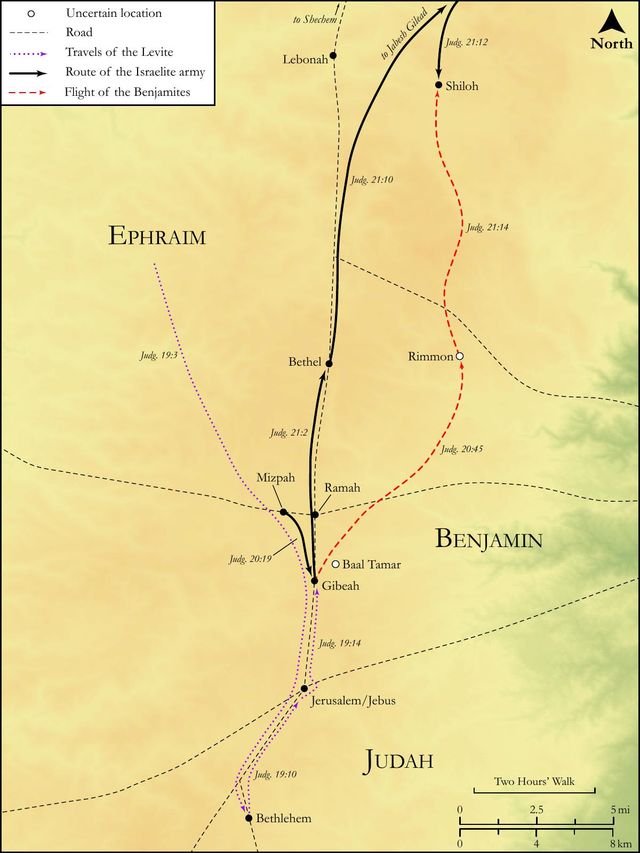
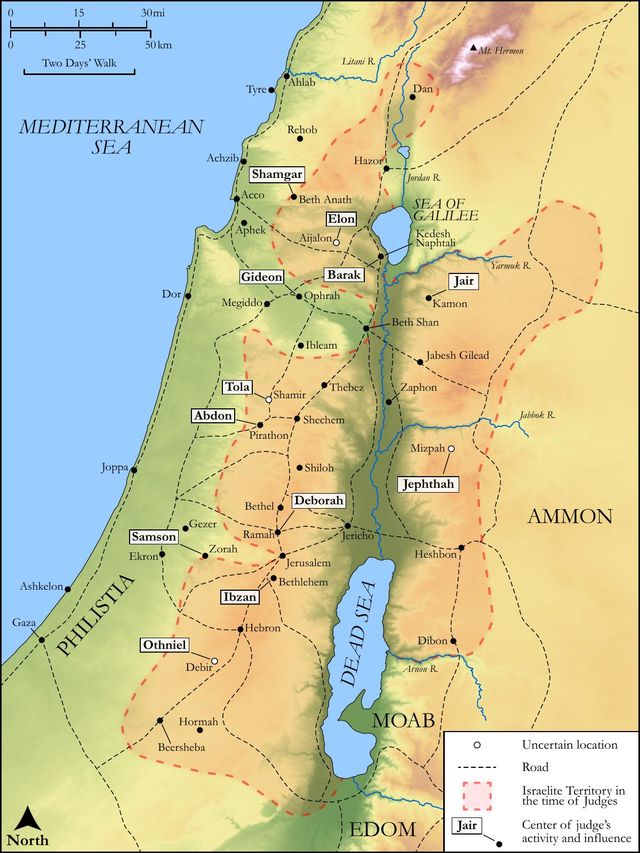
Study this verse
Public-domain commentary
Matthew Henry
From his Commentary on the Whole Bible. Henry comments on passages, not single verses — this entry covers Judges 20:26–48. His four-level outline is real structure in the source text, so it is rendered as structure.
We have here a full account of the complete victory which the Israelites obtained over the Benjamites in the third engagement: the righteous cause was victorious at last, when the managers of it amended what had been amiss; for, when a good cause suffers, it is for want of good management. Observe then how the victory was obtained, and how it was pursued.
I.How the victory was obtained.
Two things they had trusted too much to in the former engagements - the goodness of their cause and the superiority of their numbers. It was true that they had both right and strength on their side, which were great advantages; but they depended too much upon them, to the neglect of those duties to which now, this third time, when they see their error, they apply themselves.
1.They were previously so confident of the goodness of their cause that they thought it needless to address themselves to God for his presence and blessing. They took it for granted that God would bless them, nay, perhaps they concluded that he owed them his favour, and could not in justice withhold it, since it was in defence of virtue that they appeared and took up arms. But God having shown them that he was under no obligation to prosper their enterprise, that he neither needed them nor was tied to them, that they were more indebted to him for the honour of being ministers of his justice than he to them for the service, now they became humble petitioners for success. Before they only consulted God's oracle, Who shall go up first? And, Shall we go up? But now they implored his favour, fasted and prayed, and offered burnt-offerings and peace-offerings (Jdg 20:26), to make an atonement for sin and an acknowledgment of their dependence upon God, and as an expression of their desire towards him. We cannot expect the presence of God with us, unless we thus seek it in the way he has appointed. And when they were in this frame, and thus sought the Lord, then he not only ordered them to go up against the Benjamites the third time, but gave them a promise of victory: Tomorrow I will deliver them into thy hand, Jdg 20:28.
2.They were previously so confident of the greatness of their strength that they thought it needless to use any art, to lay any ambush, or form a stratagem, not doubting but to conquer purely by a strong hand; but now they saw it was requisite to use some policy, as if they had an enemy to deal with them that had been superior in number; accordingly, they set liers in wait (Jdg 20:29), and gained their point, as their fathers did before Ai (Jos. 8), stratagems of that kind being most likely to take effect after a previous defeat, which has flushed the enemy, and made the pretended flight the less suspected. The management of this artifice is here very largely described. The assurance God had given them of success in this day's action, instead of making them remiss and presumptuous, set all heads and hands on work for the effecting of what God had promised.
(1.)Observe the method they took. The body of the army faced the city of Gibeah, as they had done before, advancing towards the gates, Jdg 20:30. The Benjamites, the body of whose army was now quartered at Gibeah, sallied out upon them, and charged them with great bravery. The besiegers gave back. retired with precipitation, as if their hearts failed them upon the sight of the Benjamites, which they were willing to believe, proudly imagining that by their former success they had made themselves very formidable. Some loss the Israelites sustained in this counterfeit flight, about thirty men being cut off in their rear, Jdg 20:31, Jdg 20:39. But, when the Benjamites were all drawn out of the city, the ambush seized the city (Jdg 20:37), gave a signal to the body of the army (Jdg 20:38, Jdg 20:40), which immediately turned upon them (Jdg 20:41), and, it should seem, another considerable party that was posted at Baal-tamar came upon them at the same time (Jdg 20:33); so that the Benjamites were quite surrounded, which put them into the greatest consternation that could be. A sense of guilt now disheartened them, and the higher their hopes had been raised the more grievous was this confusion. At first the battle was sore (Jdg 20:34), the Benjamites fought with fury; but, when they saw what a snare they were drawn into, they thought one pair of heels (as we say) was worth two pair of hands, and they made the best of their way towards the wilderness (Jdg 20:42); but in vain: the battle overtook them, and, to complete their distress, those who came out of the cities of Israel, that waited to see the event of the battle, joined with their pursuers, and helped to cut them off. Every man's hand was against them.
(2.)Observe in this story,
[1.]That the Benjamites, in the beginning of the battle, were confident that the day was their own: They are smitten down before us, Jdg 20:32, Jdg 20:39. Sometimes God suffers wicked men to be lifted up in successes and hopes, that their fall may be the sorer. See how short their joy is, and their triumphing but for a moment. Let not him that girdeth on the harness boast, except he has reason to boast in God.
[2.]Evil was near them and they did not know it, Jdg 20:34. But (Jdg 20:41) they saw, when it was too late to prevent it, that evil had come upon them. What evils may at any time be near us we cannot tell, but the less they are feared the heavier they fall. Sinners will not be persuaded to see evil near them, but how dreadful will it be when it comes and there is no escaping! Th1 5:3.
[3.]Though the men of Israel played their parts so well in this engagement, yet the victory is ascribed to God (Jdg 20:35): The Lord smote Benjamin before Israel. The battle was his, and so was the success.
[4.]They trode down the men of Benjamin with ease when God fought against them, Jdg 20:43. It is an easy thing to trample upon those who have made God their enemy. See Mal 4:3.
II.How the victory was prosecuted and improved in a military execution done upon these sinners against their own souls.
1.Gibeah itself, that nest of lewdness, was destroyed in the first place. The ambush that entered the city by surprise drew themselves along, that is, dispersed themselves into the several parts of it, which they might easily do, now that all the men of war had sallied out and very presumptuously left it defenceless; and they smote all they found, even women and children, with the sword (Jdg 20:37), and set fire to the city, Jdg 20:40. Sin brings ruin upon cities.
2.The army in the field was quite routed and cut off: 18,000 men of valour lay dead upon the spot, Jdg 20:44.
3.Those that escaped from the field were pursued, and cut off in their flight, to the number of 7000, Jdg 20:45. It is to no purpose to think of out-running divine vengeance. Evil pursues sinners, and it will overtake them.
4.Even those that tarried at home were involved in the ruin. They let their sword devour for ever, not considering that it would be bitterness in the latter end, as Abner pleads long after, when he was at the head of an army of Benjamites, probably with an eye to this very story, Sa2 2:25, Sa2 2:26. They put to the sword all that breathed, and set fire to all the cities, Jdg 20:48. So that of all the tribe of Benjamin, for aught that appears, there remained none alive but 600 men that took shelter in the rock Rimmon, and lay close there four months, Jdg 20:47. Now,
(1.)It is difficult to justify this severity as it was Israel's act. The whole tribe of Benjamin was culpable; but must they therefore be treated as devoted Canaanites? That it was done in the heat of war, that this was the way of prosecuting victories which the sword of Israel had been accustomed to, that the Israelites were extremely exasperated against the Benjamites for the slaughter they had made among them in the two former engagements, will go but a little way to excuse the cruelty of this execution. It is true they had sworn that whosoever did not come up to Mizpeh should be put to death, Jdg 21:5. But that, if it was a justifiable oath, yet extended only to the men of war; the rest were not expected to come. Yet,
(2.)It is easy to justify the hand of God in it. Benjamin had sinner against him, and God had threatened that, if they forgot him, they should perish as the nations that were before them perished (Deu 8:20), who were all in this manner cut off.
(3.)It is easy likewise to improve it for warning against the beginnings of sin: they are like the letting forth of water, therefore leave it off before it be meddled with, for we know not what will be in the end thereof. The eternal ruin of souls will be worse, and more fearful, than all these desolations of a tribe. This affair of Gibeah is twice spoken of by the prophet Hosea as the beginning of the corruption of Israel and a pattern to all that followed (Hos 9:9): They have deeply corrupted themselves as in the days of Gibeah; and (Hos 10:9), Thou hast sinned from the days of Gibeah; and it is added that the battle in Gibeah against the children of iniquity did not (that is, did not at first) overtake them.
Historical interpretation
Historical reception
4 surviving comments on this verse. Each one is dated, so this reads as a timeline rather than a list.
Select a marker to jump to its quote. Markers stagger vertically where authors wrote within a few decades of each other.
When this [what had happened to the concubine] became known, (to be brief) almost all the people of Israel broke out into war. The war remained doubtful with an uncertain issue, but in the third engagement the people of Benjamin were delivered to the people of Israel, and being condemned by the divine judgment [they] paid the penalty for their widely immoral behavior.…And when at first the people of Israel were defeated, yet unmoved by fear at the reverses of the war, they disregarded the sorrow the avenging of chastity cost them. They rushed into the battle ready to wash out with their own blood the stains of the crime that had been committed.
A proud retort was made, and plans for peace were changed to war. In the first and second encounters, when many were harmed by a few, the Israelites considered yielding, since the battles were so unfavorable. There were four hundred thousand men warring against twenty-five thousand of the tribe of Benjamin, and they strove with seven hundred Gabanites [Gibeonites] experienced in war. When two battles were unfavorable, Israel with eager spirit did not lose hope of victory nor of vengeance for the hope they had fostered.Superior in cause and number they yet fell back defeated in the battle’s outcome, and, feeling that God was offended, they tried with fasting and much weeping to gain a reconciliation of heaven’s favor. Begging the Lord’s peace, they returned more boldly to war, and they to whom prayer had given courage and who had entertained much hope were now able to do what they planned. On a pretext of withdrawing their front lines, setting ambushes at night in the rear of the city, where a segment of the enemy was located, they followed as some retired and thus were provided with an opportunity for invading the unprotected city. Fires were quickly set and flared up while raging flames and waves of heat revealed the sight of the taken city. Their spirits broken, they faced the enemy. The men of Benjamin who thought they were shut in and surrounded, even before they were invaded from the rear, began scattering and fleeing to the desert, while Israel pressed after with doubled force and pursued them as they wandered in rout.
About twenty-five thousand were slain, therefore, that is, almost all the men of Benjamin except six hundred who seized a fortification on a rough cliff and by virtue of its situation and with the help of nature and partly through fear were a terror to their victors. Success advises caution; in adversity, revenge is esteemed rather than victory. Not even a minority of the women stayed clear of that struggle, but all the women of the tribe of Benjamin, along with boys and girls of every age, were wiped out by sword or fire, and an oath was taken that no one would give his daughter to a man of that tribe in marriage, so that all chance of repairing the name was abolished.
After you found out what transpired in our court, you kept to yourself; therefore, I now summon, as it were, part of my own soul, for I have a friendly yet sorrowful complaint against you for the outrage done to chastity. Was it necessary for an unsurpassed, unheard-of case of virginity to be subjected to a sentence? Could it not have been dismissed? In other words, unless with injury to herself she had been handed over from honored modesty to an indecent surrender of her body, though she offered strong proof regarding herself, she would be exposed to ridicule and marked out as a wanton individual! You have tendered this privilege to virginity, honor of a sort, to which they are pleased to be summoned and invited who plan to recover this boon! Thus, they lose the liberty of a common reputation, nor do they protect themselves by the statutes of sacred or public law; they may not ask their accuser or oppose an informer but may only put on shamelessness and expose themselves to harm.Our ancestors did not think chastity so to be despised; rather, they showed it such reverence that they would wage war on violators of modesty. In fact, so great was their desire for revenge that all the tribe of Benjamin would have been destroyed unless the six hundred who remained out of the war had been protected by a natural hill. This is the expression found in the account of the sacred lesson whose meaning it is profitable to consider.
At Gibeah also, now a complete ruin, she stopped for a little while remembering its sin, and the cutting of the concubine into pieces, and how in spite of all this three hundred men of the tribe of Benjamin were saved that in after days Paul might be called a Benjamite.
Continue studying Judges 20:43 across the web’s major study libraries — every link below opens this exact verse, chapter, or book on the destination site.
Read & Compare
 BibleGatewayThis verse in more than 200 translations and 70 languages.
 Bible.comThe YouVersion reader — hundreds of translations, reading plans, and highlights.
 ESV.orgCrossway's official English Standard Version reader.
 NET BibleThe NET translation with 60,000+ translators' notes on every rendering decision.
 STEP BibleTyndale House's free study tool — original text, vocabulary, and scholarly resources.
 BibliaLogos Bible Software's free web reader.
 USCCBThe New American Bible (Revised Edition) with the U.S. bishops' study notes.
Commentaries
 BibleHub CommentariesDozens of classic commentaries on this verse, gathered on one page.
 StudyLightMore than 100 commentary sets — the largest collection on the web.
 BibleRefPlain-English commentary on what this verse means, verse by verse.
 Enduring WordDavid Guzik's free commentary on this chapter, widely used by Bible teachers.
 Bible Study ToolsVerse commentary alongside Greek and Hebrew study aids.
Original Language & Research
- BibleHub InterlinearThe verse word by word — original language, transliteration, and English.
- BibleHub LexiconEvery word's original-language definition and Strong's entry.
 Blue Letter BibleDeep-study tools — Strong's numbers, concordance, and word studies.
 SefariaThe Hebrew text with Rashi and centuries of Jewish commentary.
Sermons, Hymns & Audio


TrulyRandomVerse is not affiliated with these sites and doesn’t control their content. They’re linked because they’re genuinely useful.
Summary
Judges 20:43 vividly portrays the climactic and devastating defeat of the tribe of Benjamin by the united tribes of Israel, marking the near-annihilation of Benjamin in a brutal civil war. This verse encapsulates the final, relentless pursuit and overwhelming subjugation of the Benjamite forces, highlighting the tragic consequences of unchecked sin and internal strife within God's people during a period characterized by profound moral decay and a desperate lack of righteous leadership. It serves as a stark testament to the severe judgment that can befall a community when it collectively condones and defends egregious wickedness, leading to self-inflicted wounds.
Context
ShowHideLiterary Context
Judges 20:43 is the grim culmination of one of the most harrowing and tragic narratives in the book of Judges, spanning chapters 19 through 21. The conflict originates from a horrific act of depravity in Gibeah, a city within Benjamin's territory, where a Levite's concubine was brutally abused, leading to her death. This heinous crime, reminiscent of the wickedness of Sodom, outraged the other tribes of Israel, who gathered at Mizpah demanding justice. When the tribe of Benjamin defiantly refused to surrender the perpetrators, choosing instead to protect them, the other tribes declared war, leading to a devastating civil conflict. Despite divine instruction to proceed, Israel suffered two massive defeats, losing tens of thousands of men, before finally receiving assurance of victory after intense prayer, fasting, and burnt offerings. Judges 20:43 details the final, decisive phase of this third battle, where the Benjamites, once formidable, were utterly overwhelmed and routed, their resistance completely broken.
Historical & Cultural Context
The events of Judges 19-21, including the devastating rout described in Judges 20:43, are set during the tumultuous period of the Judges, a time when "there was no king in Israel; every man did that which was right in his own eyes" (Judges 21:25). This era was characterized by a decentralized tribal confederacy, frequent cycles of apostasy, oppression by foreign powers, repentance, and deliverance through divinely appointed judges. The profound lack of a central, righteous authority led to moral anarchy, internal strife, and a breakdown of covenantal fidelity. The incident at Gibeah and Benjamin's subsequent defiance illustrate the profound moral degradation and tribal disunity that plagued Israel. The concept of tribal solidarity was paramount, yet Benjamin's protection of the criminals over the demands of justice from the other tribes shattered this unity, leading to a catastrophic internal war that threatened the very existence of one of Jacob's twelve sons, highlighting the dangers of a society unmoored from divine law.
Key Themes
ShowHideThis verse powerfully underscores several major themes prevalent in the book of Judges. Firstly, it highlights the consequences of unchecked sin and moral decay. The horrific sin in Gibeah and Benjamin's obstinate refusal to administer justice led directly to their near-annihilation, serving as a stark warning about the destructive power of communal wickedness. Secondly, it emphasizes the fragility of Israel's tribal unity in the absence of righteous leadership. The civil war demonstrates how internal corruption and a lack of adherence to God's law could lead to devastating conflict among God's own people, nearly destroying one of the twelve tribes. Thirdly, the narrative, culminating in this verse, illustrates the cycle of judgment and divine intervention, albeit in a complex and tragic manner. While Israel suffered initial defeats, their eventual victory, granted after repentance and seeking God, shows divine justice at work, even when exercised through the painful means of internal conflict. This tragic episode ultimately points to the desperate need for a righteous king to bring order, justice, and spiritual fidelity to the nation, a theme that resonates throughout the latter part of Judges and into the monarchy's establishment in 1 Samuel.
Exposition and Analysis
ShowHideKey Word Analysis
ShowHideThis primitive root (H3803) means "to enclose," "to compass about," or "to besiege." In this context, it describes the hostile act of the Israelite forces surrounding the Benjamites, effectively cutting off their escape and trapping them. It implies a deliberate and strategic maneuver to prevent their dispersal and ensure their complete subjugation, leaving them no avenue for retreat or regrouping.
A primitive root (H7291) meaning "to run after," "to pursue," or "to put to flight," usually with hostile intent. Here, it emphasizes the relentless and aggressive pursuit of the fleeing Benjamites. It conveys the idea of a sustained, unyielding pursuit, where the victorious Israelites gave no quarter, pressing their advantage to ensure the total rout and destruction of their adversaries. This was not merely a defeat but a systematic hunting down of the remnants.
This primitive root (H1869) means "to tread" or "to tread down." In this context, it powerfully depicts the utter subjugation and crushing defeat of the Benjamites, likened to trampling something underfoot. The phrase "with ease" (derived from H4496, mᵉnûwchâh, meaning repose or peacefully) in the KJV text, while not part of this specific Hebrew word's definition, reinforces the absolute one-sidedness of the final phase of the battle, suggesting the Benjamites offered virtually no resistance, being utterly broken and helpless.
Verse Breakdown
ShowHide"Thus they inclosed the Benjamites round about,"
This clause describes the strategic maneuver of the Israelite forces. Having drawn the Benjamites out from Gibeah and into the open, the larger Israelite army executed a pincer movement or encirclement, effectively trapping the Benjamite remnants. This act of "inclosing" signifies the sealing of their fate, cutting off any hope of escape or retreat and setting the stage for their complete destruction.
"[and] chased them,"
Following the encirclement, the Israelite forces launched a relentless pursuit. This was not a static battle but a dynamic, overwhelming rout where the Benjamites were forced into a desperate flight. The "chasing" highlights the sustained aggression and the utter lack of mercy shown by the victorious Israelites, intent on annihilating their kin.
"[and] trode them down with ease"
This powerful phrase depicts the utter devastation and effortless subjugation of the Benjamites. The imagery of "treading down" conveys a complete crushing and humiliating defeat, as if the Benjamites were mere dust underfoot. The addition "with ease" underscores the absolute lack of resistance from the Benjamites, who were by this point broken in spirit and strength, making their final destruction a simple task for the pursuing Israelites.
"over against Gibeah toward the sunrising."
This final geographical detail specifies the location of this climactic phase of the rout. "Over against Gibeah" indicates that the final, decisive action occurred in the vicinity of the very city where the initial heinous crime took place, bringing a grim sense of poetic justice or tragic irony to the scene. "Toward the sunrising" (eastward) further pinpoints the direction of the pursuit and the area of Benjamin's final stand or collapse, emphasizing the comprehensive nature of the defeat across their territory.
Literary Devices
ShowHideJudges 20:43 employs several powerful literary devices to convey the horror and finality of Benjamin's defeat. Imagery is central, with phrases like "inclosed... round about," "chased them," and "trode them down" painting a vivid picture of a relentless, overwhelming assault and a helpless, desperate flight. The visual of being "trod down" evokes a sense of utter subjugation and dehumanization, emphasizing the complete crushing of the Benjamite forces. The use of Polysyndeton through the repeated conjunction "and" ("and chased them, and trode them down") emphasizes the continuous, relentless, and cumulative nature of the Israelite attack, highlighting the overwhelming pressure on the Benjamites and the unstoppable momentum of their pursuers. The entire narrative of Judges 19-21, culminating in this verse, is a profound Tragedy, depicting the self-inflicted wounds of God's people due to moral depravity and internal strife. There is also a strong sense of Irony, as Benjamin, a tribe renowned for its fierce warriors and slingers, is utterly crushed, not by foreign enemies, but by their own brethren, in a conflict ignited by their own sin and stubbornness.
Theological and Thematic Connections
ShowHideJudges 20:43 stands as a stark biblical testament to the devastating consequences of unaddressed sin and the perils of moral relativism within a community. The near-annihilation of Benjamin underscores God's righteous judgment against wickedness, even when it manifests within His covenant people. It reveals that communal sin, particularly the protection of egregious evil, can lead to catastrophic internal conflict and divine chastisement. The verse also highlights the profound importance of justice and accountability within God's people, demonstrating that a failure to uphold righteousness can unravel the very fabric of society and lead to self-destruction. This tragic episode serves as a powerful reminder that true peace and unity are not merely the absence of external threats but are rooted in a shared commitment to God's moral law and a willingness to confront sin, even when it is painful.
Reflection and Application
ShowHideJudges 20:43 is far more than a historical account of ancient warfare; it is a profound cautionary tale for all generations, including our own. It compels us to examine the moral health of our communities, our churches, and even our own hearts. The verse vividly illustrates the destructive power of unaddressed sin, reminding us that complicity or indifference to evil can lead to devastating consequences, not just for individuals but for entire groups. It challenges us to consider where we might be protecting or tolerating sin, either personally or corporately, that could be leading to division, decay, or judgment. Furthermore, it underscores the critical need for righteous leadership—in homes, churches, and nations—that is committed to upholding God's truth and administering justice, rather than allowing "every man to do what is right in his own eyes." Ultimately, this passage calls us to a deep humility, recognizing our propensity for sin and our desperate need for divine guidance and the transformative power of God's Spirit to live in unity, righteousness, and peace, avoiding the tragic pitfalls of moral compromise.
Questions for Reflection
ShowHideFAQ
ShowHideWhy did the other tribes of Israel pursue Benjamin with such ferocity, leading to their near-annihilation?
ShowHideThe extreme ferocity stemmed from the heinous crime committed in Gibeah, a city of Benjamin, where a Levite's concubine was brutally gang-raped and murdered (Judges 19:22-28). This act was considered an abomination, "such a thing has not been seen or done since the day the Israelites came up out of Egypt until this day" (Judges 19:30). When the other tribes demanded that Benjamin surrender the perpetrators for justice, Benjamin defiantly refused, choosing instead to protect the wicked men of Gibeah and prepare for war against their brethren (Judges 20:12-14). This refusal to uphold justice and their subsequent armed defiance transformed the situation from a demand for accountability into a full-scale civil war, viewed by the other tribes as a necessary act of divine judgment to purge evil from Israel. The intensity of the pursuit and the near-annihilation reflect the deep outrage and the perceived need for a complete cleansing of such profound moral corruption from the covenant community.
Christ-Centered Fulfillment
ShowHideThe chaos, moral decay, and devastating civil war depicted in Judges 20:43 and the surrounding chapters powerfully underscore Israel's desperate need for a true and righteous King—a need ultimately fulfilled in Jesus Christ. The era of the Judges, where "every man did that which was right in his own eyes," led to internal strife, shocking brutality, and the near-destruction of a tribe. This highlights humanity's inherent inability to govern itself righteously without divine authority and perfect leadership. Jesus, as the Son of God and the promised Davidic King, is the ultimate answer to this chaos. Unlike the flawed and temporary judges, or the absent king in Judges, Christ brings perfect justice and true peace. He is the one who perfectly upholds God's law, not by destroying a tribe, but by offering Himself as the Lamb of God who takes away the sin of the world. Where the Benjamites were "trod down" by their brethren, Christ was "trod down" by the wrath of God on the cross, bearing the judgment for all humanity's sin, including the kind of depravity seen in Gibeah. Through His sacrifice, He reconciles not only individuals to God but also breaks down the walls of hostility between people, creating a new humanity united under His righteous reign (Ephesians 2:14-16). He is the King who leads not by force and destruction, but by servant leadership, ultimately bringing true order, justice, and spiritual wholeness to His people, fulfilling the longing for a perfect ruler that the book of Judges so tragically reveals.