


1 Chronicles 11:47
Bible text: King James Version (1769 Blayney text) · Public domain
Bible text: Berean Standard Bible · Public domain
Bible text: American Standard Version (1901) · Public domain
Bible text: World English Bible, Messianic edition · Public domain
Bible text: Geneva Bible (1599) · Public domain
Bible text: Young's Literal Translation · Public domain
- אֱלִיאֵל'e·li·'ElElielH447N-proper-mNoun Proper Masculine
- וְעוֹבֵדve·'o·Vedand ObedH5744Conj-w ¦ N-proper-mNoun Proper MasculineוְandעוֹבֵדObed
- וְיַעֲשִׂיאֵלve·ya·'a·si·'Eland JaasielH3300Conj-w ¦ N-proper-mNoun Proper MasculineוְandיַעֲשִׂיאֵלJaasiel
- הַמְּצֹבָיָהha·me·tzoa·Yahthe MezobaiteH4677Art ¦ N-properNoun Proper LocationהַtheמְּצֹבָיָהMezobaite
English is a literal word-by-word gloss of the Hebrew, not the KJV's wording. Why?
This is the original text the KJV's translators worked from — each Hebrew word with its own literal English meaning in this verse, prepared by scholars at Tyndale House, Cambridge. The KJV translates whole sentences, not word by word, so its wording differs: one Hebrew word can become several English words, and the KJV may choose “the LORD” where the gloss reads “Yahweh”. Both are faithful — they answer different questions. For the KJV's own rendering, switch to the KJV text.
Details
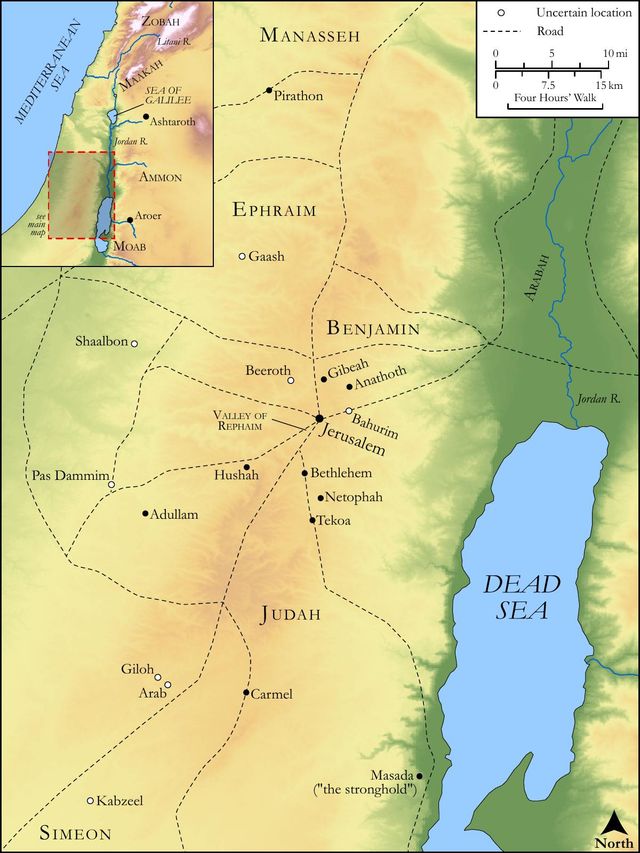
See on the biblical-era map
Study this verse
Public-domain commentary
Matthew Henry
From his Commentary on the Whole Bible. Henry comments on passages, not single verses — this entry covers 1 Chronicles 11:10–47. His two-level outline is real structure in the source text, so it is rendered as structure.
We have here an account of David's worthies, the great men of his time that served him and were preferred by him. The first edition of this catalogue we had, Sa2 23:8, etc. This is much the same, only that those named here from Ch1 11:41 to the end are added. Observe,
I.The connexion of this catalogue with that which is said concerning David, Ch1 11:9.
1.David waxed greater and greater, and these were his mighty men. Much of the strength and honour of great men is borrowed from their servants and depends upon them, which cannot but somewhat diminish pomp and power in the opinion of those that are wise. David is great because he has great men about him; take these away, and he is where he was.
2.The Lord of hosts was with him, and these were the mighty men which he had. God was with him and wrought for him, but by men and means and the use of second causes. By this it appeared that God was with him, that he inclined the hearts of those to come over to him that were able to serve his interest. As, if God be for us none can be against us, so, if God be for us, all shall be for us that we have occasion for. Yet David ascribed his success and increase, not to the hosts he had, but to the Lord of hosts, not to the mighty men that were with him, but to the mighty God whose presence with us is all in all.
II.The title of this catalogue (Ch1 11:10):
These are the men who strengthened themselves with him. In strengthening him they strengthened themselves and their own interest; for his advancement was theirs. What we do in our places for the support of the kingdom of the Son of David we shall be gainers by. In strengthening it we strengthen ourselves. It may be read, They held strongly with him and with all Israel. Note, When God has work to do he will not want fit instruments to do it with. If it be work that requires mighty men, mighty men shall either be found or made to effect it, according to the word of the Lord.
III.That which made all these men honourable was the good service that they did to their king and country; they helped to make David king (Ch1 11:10) - a good work. They slew the Philistines, and other public enemies, and were instrumental to save Israel. Note, The way to be great is to do good. Nor did they gain this honour without labour and the hazard of their lives. The honours of Christ's kingdom are prepared for those that fight the good fight of faith, that labour and suffer, and are willing to venture all, even life itself, for Christ and a good conscience. It is by a patient continuance in well-doing that we must seek for glory, and honour, and immortality; and those that are faithful to the Son of David shall find their names registered and enrolled much more to their honour than these are in the records of fame.
IV.Among all the great exploits of David's mighty men, here is nothing great mentioned concerning David himself but his pouring out water before the Lord which he had longed for, Ch1 11:18, Ch1 11:19. Four very honourable dispositions of David appeared in that action, which, for aught I know, made it as great as any of the achievements of those worthies.
1.Repentance for his own weakness. It is really an honour to a man, when he is made sensible that he has said or done any thing unadvisedly, to unsay it and undo it again by repentance, as it is a shame to a man when he has said or done amiss to stand to it.
2.Denial of his own appetite. He longed for the water of the well of Bethlehem; but, when he had it, he would not drink it, because he would not so far humour himself and gratify a foolish fancy. He that has such a rule as this over his own spirit is better than the mighty. It is an honour to a man to have the command of himself; but he that will command himself must sometimes cross himself.
3.Devotion towards God. That water which he thought too good, too precious, for his own drinking, he poured out to the Lord for a drink offering. If we have any thing better than another, let God be honoured with it, who is the best, and should have the best.
4.Tenderness of his servants. It put him into the greatest confusion imaginable to think that three brave men should hazard their lives to fetch water for him. In his account it turns the water into blood. It is the honour of great men not to be prodigal of the blood of those they employ, but, in all the commands they give them, to put their own souls into their souls' stead.
V.In the wonderful achievements of these heroes the power of God must be acknowledged.
How could one slay 300 and another the same number (Ch1 11:11, Ch1 11:20), another two lion-like men (Ch1 11:22), and another an Egyptian giant (Ch1 11:23), if they had not had the extraordinary presence of God with them, according to that promise, Jos 23:10, One man of you shall chase a thousand, for the Lord your God fighteth for you?
VI.One of these worthies is said to be an Ammonite (Ch1 11:39), another a Moabite (Ch1 11:46), and yet the law was that an Ammonite and a Moabite should not enter into the congregation of the Lord, Deu 23:3. These, it is likely, had approved themselves so hearty for the interest of Israel that in their case it was thought fit to dispense with that law, and the rather because it was an indication that the Son of David would have worthies among the Gentiles: with him there is neither Greek nor Jew.
Continue studying 1 Chronicles 11:47 across the web’s major study libraries — every link below opens this exact verse, chapter, or book on the destination site.
Read & Compare
 BibleGatewayThis verse in more than 200 translations and 70 languages.
 Bible.comThe YouVersion reader — hundreds of translations, reading plans, and highlights.
 ESV.orgCrossway's official English Standard Version reader.
 NET BibleThe NET translation with 60,000+ translators' notes on every rendering decision.
 STEP BibleTyndale House's free study tool — original text, vocabulary, and scholarly resources.
 BibliaLogos Bible Software's free web reader.
 USCCBThe New American Bible (Revised Edition) with the U.S. bishops' study notes.
Commentaries
 BibleHub CommentariesDozens of classic commentaries on this verse, gathered on one page.
 StudyLightMore than 100 commentary sets — the largest collection on the web.
 BibleRefPlain-English commentary on what this verse means, verse by verse.
 Enduring WordDavid Guzik's free commentary on this chapter, widely used by Bible teachers.
 Bible Study ToolsVerse commentary alongside Greek and Hebrew study aids.
Original Language & Research
- BibleHub InterlinearThe verse word by word — original language, transliteration, and English.
- BibleHub LexiconEvery word's original-language definition and Strong's entry.
 Blue Letter BibleDeep-study tools — Strong's numbers, concordance, and word studies.
 SefariaThe Hebrew text with Rashi and centuries of Jewish commentary.
Sermons, Hymns & Audio


TrulyRandomVerse is not affiliated with these sites and doesn’t control their content. They’re linked because they’re genuinely useful.
Summary
1 Chronicles 11:47 concludes the comprehensive register of King David's elite warriors, known as his "mighty men," by specifically naming Eliel, Obed, and Jasiel the Mesobaite. This verse, as part of the broader catalog, transcends mere historical record-keeping, serving as a profound theological affirmation of David's divinely ordained leadership. It powerfully showcases the extensive loyalty and diverse support he commanded, underscoring the Chronicler's meticulous attention to detail and highlighting that every individual's contribution, regardless of their prominence in wider narratives, is profoundly valued and meticulously recorded within God's overarching plan for His chosen king and the establishment of His kingdom.
Context
ShowHideLiterary Context
1 Chronicles 11:47 stands as the culminating verse in a lengthy and highly significant enumeration of David's "mighty men," a list that commences in 1 Chronicles 11:10. This chapter immediately follows the pivotal events of David's anointing as king over all Israel and his strategic capture of Jerusalem, which he subsequently established as his capital, as detailed in 1 Chronicles 11:1-9. The Chronicler's deliberate inclusion of such an exhaustive roster, notably more expansive than its parallel in 2 Samuel 23, serves to underscore the undeniable legitimacy and formidable strength of David's reign. It meticulously illustrates the widespread support David garnered from various tribes and geographical regions, portraying him as a divinely chosen leader whose success was powerfully bolstered by a loyal and exceptionally capable fighting force—a foundational element in the establishment of the unified monarchy. The conclusion of this detailed list in verse 47 marks a transition, setting the stage for subsequent narratives detailing further aspects of David's reign.
Historical & Cultural Context
The historical period encapsulated by 1 Chronicles 11 corresponds to the early phase of David's reign, a critical era characterized by the consolidation of power and the establishment of a centralized kingdom in Israel. Among the kings of that day, a monarch's strength and stability were often directly correlated with the loyalty, prowess, and numerical strength of his military elite. These "mighty men" were far more than mere soldiers; they functioned as personal bodyguards, trusted advisors, and key commanders, forming the indispensable backbone of David's military campaigns and administrative structure. Their names, frequently accompanied by epithets such as "the Mesobaite," provided vital clues regarding their tribal or geographical origins, vividly illustrating the diverse backgrounds from which David drew his unwavering support. This inherent diversity was paramount for successfully unifying the disparate Israelite tribes under a single, cohesive monarchy. The Chronicler, addressing a post-exilic audience, strategically employs these historical details to powerfully reinforce the enduring continuity of God's covenant with David, thereby instilling hope and encouraging faithfulness among a people striving to rebuild their identity and nation.
Key Themes
ShowHideThe meticulous inclusion of Eliel, Obed, and Jasiel the Mesobaite within this extensive and revered list contributes significantly to several overarching themes central to the Chronicler's narrative. Firstly, it profoundly reinforces the theme of unwavering loyalty and faithfulness to God's chosen leader. These individuals, by virtue of their presence on this esteemed roster, are implicitly affirmed as dedicated servants of King David, thereby indirectly serving God's overarching purposes through their allegiance. Secondly, the sheer volume of names, even those without accompanying narratives of specific exploits, powerfully highlights the meticulous nature of divine record-keeping and recognition. This suggests a profound theological truth: every individual contribution, no matter how seemingly minor or uncelebrated by human metrics, is meticulously noted and profoundly valued by God. This resonates deeply with the broader biblical principle that God observes and rewards all acts of faithfulness and love shown for His name, as affirmed in Hebrews 6:10. Thirdly, the diverse origins implied by designations like "the Mesobaite" powerfully reinforce the theme of comprehensive support and unity under David's divinely appointed leadership, illustrating how God sovereignly brought together people from various backgrounds to establish His kingdom. This universal reach subtly foreshadows the expansive and inclusive nature of God's future covenant community, extending far beyond narrow tribal lines, as envisioned in Isaiah 2:2-4.
Exposition and Analysis
ShowHideKey Word Analysis
ShowHideThis is a common and deeply significant theophoric name in ancient Israel, meaning "God of (his) God." Theophoric names, which incorporate a divine element (like "El" for God), were pervasive and often reflected the religious devotion, theological understanding, or even a parental prayer at the time of a child's birth. While the biblical text provides no further details about this specific Eliel's deeds, his name itself stands as a quiet yet powerful testimony to the pervasive presence of faith in Israelite society and the personal identification with God that characterized the era.
Derived from the Hebrew verb meaning "to serve," this name translates directly to "serving." Like Eliel, Obed is a relatively common name found elsewhere in the biblical narrative (e.g., Obed, the father of Jesse and grandfather of King David, mentioned in Ruth 4:17). The inherent meaning of the name itself suggests a character marked by service or devotion, a fitting attribute for a loyal warrior serving in David's formidable army.
This name is composed of two Hebrew elements: "asah" (to make or do) and "El" (God), thus meaning "made of God." This profound meaning suggests a divine origin or purpose for the individual, implying that Jasiel's very existence or perhaps his capabilities were seen as a direct work or gift from God. As the final named "mighty man" on this extensive list, his name carries a subtle theological weight, suggesting that even at the list's conclusion, God's hand is evident.
While the Strong's data for H4677 refers to a place "Metsobajah" meaning "found of Jah," the term "Mesobaite" in the verse functions as an ethnic or geographical designation. It indicates that Jasiel hailed from a specific place or clan called Mesoba. Such designations were critically important in Israel for identifying individuals' origins, tribal affiliations, and sometimes even specific skills or characteristics associated with their region. The inclusion of such a specific, albeit obscure, epithet underscores the Chronicler's unwavering commitment to historical detail and highlights the remarkably diverse geographical reach of David's loyal support base.
Verse Breakdown
ShowHide"Eliel"
The first name presented in this concluding triad of David's mighty men. Its inclusion signifies an individual whose unwavering loyalty and dedicated service were deemed worthy of perpetual record by the Chronicler, even in the absence of specific heroic deeds attributed to him within the narrative.
"and Obed"
The second individual meticulously listed, further emphasizing the collective and formidable nature of David's support system. The simple conjunction "and" seamlessly links these men together, presenting them as an integral part of a continuous stream of faithful and capable warriors who profoundly contributed to David's unparalleled success and the enduring stability of his burgeoning kingdom.
"and Jasiel the Mesobaite"
The final name on the entire, extensive list of David's mighty men. The precise addition of "the Mesobaite" provides a specific and unique identifier, marking Jasiel's distinct origin or clan. This meticulous detail, even for a figure otherwise unelaborated upon, powerfully reinforces the Chronicler's commitment to historical accuracy and highlights the remarkably diverse backgrounds of those who enthusiastically rallied to David's cause, thereby contributing to the comprehensive and divinely blessed picture of his reign.
Literary Devices
ShowHideThe predominant literary device at play in 1 Chronicles 11:47, and indeed throughout the entire chapter from verse 10 onward, is the Catalog or List. This extensive enumeration of names serves a multifaceted purpose. Firstly, it powerfully lends Authority and Legitimacy to David's reign by showcasing the sheer volume, diverse origins, and unwavering loyalty of his supporters, thereby implying profound divine favor and widespread acceptance across Israel. Secondly, it functions as a potent form of Emphasis through Accumulation, where the repetitive listing of names, even without detailed exploits for each, profoundly underscores the immense strength and broad foundation of David's military and administrative apparatus. The inclusion of specific epithets like "the Mesobaite" adds a crucial layer of Realism and Historical Detail, firmly grounding the narrative in concrete specifics and enhancing its verisimilitude. Furthermore, the overarching act of meticulously recording these names, particularly those of the less prominent figures, conveys a profound theological message about Divine Record-Keeping and the inherent value God places on every individual's contribution to His sovereign purposes, irrespective of their worldly fame or perceived significance.
Theological and Thematic Connections
ShowHideThe deliberate inclusion of names such as Eliel, Obed, and Jasiel the Mesobaite within the esteemed and extensive list of David's mighty men carries profound theological weight. It powerfully illustrates God's meticulous and loving attention to every individual, affirming the timeless truth that all faithful service, no matter how seemingly small, obscure, or unheralded by human standards, is profoundly seen, valued, and remembered in His divine economy. This concept directly challenges our human tendency to focus exclusively on prominent figures or grand, celebrated achievements, serving as a vital reminder that the enduring strength of God's kingdom is meticulously built upon the collective, often unseen, loyalty, dedication, and sacrificial service of countless individuals. Just as these men contributed their unique strengths to the earthly kingdom of David, so too are believers today called to contribute their distinct gifts, talents, and service to the spiritual kingdom of God, resting in the assurance that their diligent efforts are never forgotten by their Heavenly Father.
Reflection and Application
ShowHide1 Chronicles 11:47, though appearing as a mere list of names, offers remarkably profound insights and timeless truths for contemporary believers. It serves as a powerful and deeply encouraging reminder that every individual's contribution to God's kingdom is inherently significant and profoundly valued, even if their specific deeds are not widely celebrated or meticulously recorded in human history. Just as Eliel, Obed, and Jasiel were integral components of a larger, vital force supporting God's chosen king, so too are we, as cherished members of the body of Christ, unequivocally called to faithful service in our unique capacities and spheres of influence. This verse profoundly encourages us to embrace our roles, however humble or seemingly insignificant they may appear, with unwavering diligence, steadfast loyalty, and joyful obedience, knowing with absolute certainty that God sees our hearts, our intentions, and our every effort. It fosters a deep sense of belonging, purpose, and divine affirmation, assuring us that our faithfulness, even in the quietest and most unseen corners of life, contributes immeasurably to the grand tapestry of God's redemptive plan and will be eternally remembered and rewarded by Him.
Questions for Reflection
ShowHideFAQ
ShowHideWhy does the Chronicler include such extensive lists of names, especially those without detailed narratives of their deeds?
ShowHideThe Chronicler's purpose in including extensive lists, such as that of David's mighty men in 1 Chronicles 11, is multifaceted and deeply theological. Firstly, it serves to powerfully legitimize and glorify David's reign, meticulously demonstrating the widespread and diverse support he garnered, which was absolutely crucial for establishing a unified and stable kingdom. Secondly, for the post-exilic audience to whom the Chronicler wrote, these lists provided a vital sense of continuity with their rich historical past, highlighting the enduring faithfulness of God's people and the unwavering nature of His covenant promises. Thirdly, and perhaps most profoundly, the meticulous recording of even seemingly minor or unheralded figures emphasizes a core theological truth: God sees and profoundly values every individual's contribution to His sovereign purposes. It powerfully underscores divine record-keeping and the timeless principle that no act of loyalty, service, or faithfulness, however small, goes unnoticed by God, even if it is not accompanied by a grand narrative of heroic deeds.
Are the "mighty men" lists in 1 Chronicles 11 and 2 Samuel 23 identical, or are there differences?
ShowHideWhile there is significant and substantial overlap between the list of David's mighty men in 1 Chronicles 11 and the parallel account found in 2 Samuel 23, they are definitively not identical. The list presented in 1 Chronicles is generally more extensive and comprehensive, often including additional names (such as Eliel, Obed, and Jasiel the Mesobaite from this verse) and occasionally featuring different spellings or variations in the order of names. These variations strongly suggest that the Chronicler may have had access to different or perhaps more comprehensive source material, or that he had a specific theological agenda in presenting a more expansive roster. The Chronicler's version frequently emphasizes the full breadth of David's loyalists and the comprehensive, divinely blessed nature of his kingdom, aligning with his broader theological purposes.
Christ-Centered Fulfillment
ShowHideThe meticulous recording of David's mighty men, culminating in the names of Eliel, Obed, and Jasiel the Mesobaite, finds its ultimate and glorious fulfillment in the person and eternal kingdom of Jesus Christ. David, as an earthly king, served as a profound type and foreshadowing of the greater, eternal King, Jesus, whose kingdom is not of this world and whose subjects are drawn from every tribe, language, people, and nation, as beautifully depicted in Revelation 7:9-10. Just as David's reign was established, maintained, and expanded by the unwavering loyalty and diverse service of his devoted warriors, so too is Christ's spiritual kingdom built upon the faithfulness, unique gifts, and dedicated service of all believers, each a vital and indispensable member of His living body, growing and building itself up in love, as articulated in Ephesians 4:16. The Chronicler's emphasis on God's careful remembrance of every individual's contribution to David's earthly reign powerfully points forward to the perfect knowledge and unwavering remembrance of Christ, who assures His followers that even the smallest act of kindness, such as giving a cup of cold water in His name, will assuredly not lose its eternal reward, as promised in Matthew 10:42. In Christ, we encounter the ultimate "Eliel" (God of His God), the sovereign Lord over all creation, and the perfect "Obed" (Servant), who came not to be served but to serve and to give His life as a ransom for many, as He Himself declared in Matthew 20:28. Through Him, all who serve faithfully, whether prominently or obscurely, are eternally recognized, profoundly valued, and participate in a glorious, everlasting kingdom that shall never be destroyed, as prophesied in Daniel 7:14.