


2 Samuel 12:26
Bible text: King James Version (1769 Blayney text) · Public domain
Bible text: Berean Standard Bible · Public domain
Bible text: American Standard Version (1901) · Public domain
Bible text: World English Bible, Messianic edition · Public domain
Bible text: Geneva Bible (1599) · Public domain
Bible text: Young's Literal Translation · Public domain
- וַיִּלָּחֶםvai·yi·La·chemand he foughtH3898Conj-w ¦ V-Niphal-ConsecImperf-3msVerb Niphal Consecutive Imperfect 3rd Singular Masculineוַandיִּלָּחֶםhe fought
- יוֹאָבyo·'AvJoabH3097N-proper-mNoun Proper Masculine
- בְּרַבַּתbe·ra·Batagainst Rabbah ofH7237Prep-b ¦ Adj-fscAdjective Singular Feminine ConstructבְּagainstרַבַּתRabbah of
- בְּנֵיbe·Nei[the] people ofH1121N-mpcNoun Plural Masculine Construct
- עַמּוֹןa·MonAmmonH5983N-proper-mNoun Proper Masculine
- וַיִּלְכֹּדvai·yil·Kodand he capturedH3920Conj-w ¦ V-Qal-ConsecImperf-3msVerb Qal Consecutive Imperfect 3rd Singular Masculineוַandיִּלְכֹּדhe captured
- אֶת'et<obj.>H853DirObjMParticle Object Indicator
- עִיר'ir[the] city ofH5892N-fscNoun Singular Feminine Construct
- הַמְּלוּכָהha·me·lu·Khah<the> royaltyH4410Art ¦ N-fsNoun Singular Feminine Absoluteהַ<the>מְּלוּכָהroyalty
English is a literal word-by-word gloss of the Hebrew, not the KJV's wording. Why?
This is the original text the KJV's translators worked from — each Hebrew word with its own literal English meaning in this verse, prepared by scholars at Tyndale House, Cambridge. The KJV translates whole sentences, not word by word, so its wording differs: one Hebrew word can become several English words, and the KJV may choose “the LORD” where the gloss reads “Yahweh”. Both are faithful — they answer different questions. For the KJV's own rendering, switch to the KJV text.
Details
See on the biblical-era maps

Study this verse
Public-domain commentary
Matthew Henry
From his Commentary on the Whole Bible. Henry comments on passages, not single verses — this entry covers 2 Samuel 12:26–31.
We have here an account of the conquest of Rabbah, and other cities of the Ammonites. Though this comes in here after the birth of David's child, yet it is most probable that it was effected a good while before, and soon after the death of Uriah, perhaps during the days of Bath-sheba's mourning for him. Observe, 1. That God was very gracious in giving David this great success against his enemies, notwithstanding the sin he had been guilty of just at that time when he was engaged in this war, and the wicked use he had made of the sword of the children of Ammon in the murder of Uriah. Justly might he have made that sword, thenceforward, a plague to David and his kingdom; yet he breaks it, and makes David's sword victorious, even before he repents, that this goodness of God might lead him to repentance. Good reason had David to own that God dealt not with him according to his sins, Psa 103:10. 2. That Joab acted very honestly and honourably; for when he had taken the city of waters, the royal city, where the palace was, and from which the rest of the city was supplied with water (and therefore, upon the cutting off of that, would be obliged speedily to surrender), he sent to David to come in person to complete this great action, that he might have the praise of it, Sa2 12:26-28. Herein he showed himself a faithful servant, that sought his master's honour, and his own only in subordination to his, and left an example to the servants of the Lord Jesus, in every thing they do, to consult his honour. Not unto us, but to thy name, give glory. 3. That David was both too haughty and too severe upon this occasion, and neither so humble nor so tender as he should have been. (1.) He seems to have been too fond of the crown of the king of Ammon, Sa2 12:30. Because it was of extraordinary value, by reason of the precious stones with which it was set, David would have it set upon his head, though it would have been better to have cast it at God's feet, and at this time to have put his own mouth in the dust, under guilt. The heart that is truly humbled for sin is dead to worldly glory and looks upon it with a holy contempt. (2.) He seems to have been too harsh with his prisoners of war, Sa2 12:31. Taking the city by storm, after it had obstinately held out against a long and expensive siege, if he had put all whom he found in arms to the sword in the heat of battle, it would have been severe enough; but to kill them afterwards in cold blood, and by cruel tortures, with saws and harrows, tearing them to pieces, did not become him who, when he entered upon the government, promised to sing of mercy as well as judgment, Psa 101:1. Had he made examples of those only who had abused his ambassadors, or advised or assisted in it, that being a violation of the law of nations, it might have been looked upon as a piece of necessary justice for terror to other nations; but to be thus severe with all the cities of the children of Ammon (that is, the garrisons or soldiers of the cities) was extremely rigorous, and a sign that David's heart was not yet made soft by repentance, else the bowels of his compassion would not have been thus shut up - a sign that he had not yet found mercy, else he would have been more ready to show mercy.
Continue studying 2 Samuel 12:26 across the web’s major study libraries — every link below opens this exact verse, chapter, or book on the destination site.
Read & Compare
 BibleGatewayThis verse in more than 200 translations and 70 languages.
 Bible.comThe YouVersion reader — hundreds of translations, reading plans, and highlights.
 ESV.orgCrossway's official English Standard Version reader.
 NET BibleThe NET translation with 60,000+ translators' notes on every rendering decision.
 STEP BibleTyndale House's free study tool — original text, vocabulary, and scholarly resources.
 BibliaLogos Bible Software's free web reader.
 USCCBThe New American Bible (Revised Edition) with the U.S. bishops' study notes.
Commentaries
 BibleHub CommentariesDozens of classic commentaries on this verse, gathered on one page.
 StudyLightMore than 100 commentary sets — the largest collection on the web.
 BibleRefPlain-English commentary on what this verse means, verse by verse.
 Enduring WordDavid Guzik's free commentary on this chapter, widely used by Bible teachers.
 Bible Study ToolsVerse commentary alongside Greek and Hebrew study aids.
Original Language & Research
- BibleHub InterlinearThe verse word by word — original language, transliteration, and English.
- BibleHub LexiconEvery word's original-language definition and Strong's entry.
 Blue Letter BibleDeep-study tools — Strong's numbers, concordance, and word studies.
 SefariaThe Hebrew text with Rashi and centuries of Jewish commentary.
Sermons, Hymns & Audio


TrulyRandomVerse is not affiliated with these sites and doesn’t control their content. They’re linked because they’re genuinely useful.
Summary
2 Samuel 12:26 records the pivotal military triumph of Joab, King David's general, who successfully captured the "royal city" or citadel of Rabbah, the Ammonite capital. This significant victory occurred immediately after the prophet Nathan's severe confrontation with King David over his grave sins concerning Bathsheba and Uriah. The verse highlights the complex interplay of divine sovereignty, human sin, and the ongoing fulfillment of God's purposes for Israel's kingdom, showcasing Joab's effective leadership and setting the stage for David's subsequent arrival to complete the subjugation of Rabbah.
Context
ShowHideLiterary Context
This verse is strategically positioned within the narrative of 2 Samuel, directly following Nathan's powerful and condemning rebuke of David for his adultery with Bathsheba and the murder of Uriah (as detailed in 2 Samuel 12:1-25). The war against the Ammonites, which commenced in 2 Samuel 10, serves as the grim backdrop for David's profound moral lapse, as it was during the protracted siege of Rabbah that Uriah was deliberately sent to his death (narrated in 2 Samuel 11:14-17). Joab's successful capture of Rabbah's citadel thus stands in stark juxtaposition to David's personal disgrace, demonstrating that while David faced severe personal consequences for his sin, God's broader plan for Israel's dominion continued to unfold through the military prowess of his general. The verse also immediately precedes Joab's message to David, inviting him to personally complete the conquest of the city (see 2 Samuel 12:27-28), thereby bringing David back into a position of public leadership after his private repentance.
Historical & Cultural Context
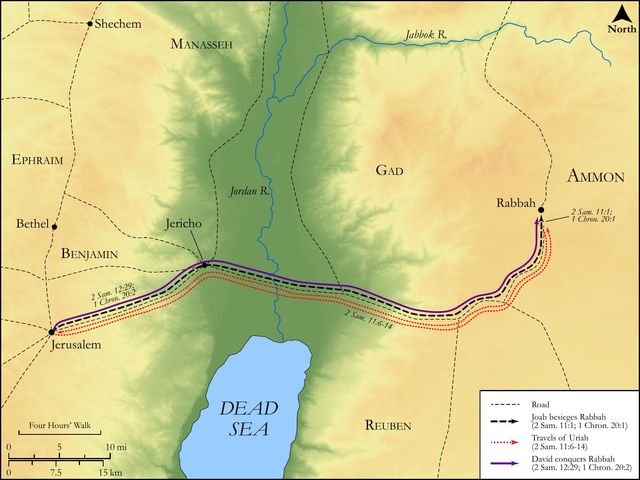
Rabbah (modern Amman, Jordan) was the heavily fortified capital of the Ammonites, a long-standing and often hostile neighbor of Israel. Its strategic location in Transjordan made its capture crucial for securing Israel's eastern frontier and asserting its regional dominance. Ancient sieges were typically protracted and brutal affairs, demanding immense resources, strategic planning, and military skill. The phrase "the royal city" (עִיר הַמְּלוּכָה, 'ir hammelukah') refers specifically to the acropolis or citadel—the innermost, most heavily fortified part of the city, which often housed the king's palace, administrative centers, and key defensive structures. Capturing this section signified a decisive breach of the city's primary defenses, effectively breaking its will to resist and rendering its complete fall inevitable. However, as subsequent verses show, it was distinct from the "city of waters" (mentioned in 2 Samuel 12:27), which housed the vital water supply and was often the last point of resistance in a siege. Joab's action here reflects the common military strategy of securing the command center before the final mop-up operation.
Key Themes
ShowHideThis verse contributes to several overarching themes within 2 Samuel and the broader Deuteronomistic History. Firstly, it highlights Divine Sovereignty Amidst Human Failure: Despite David's egregious sin and the severe consequences prophesied by Nathan (e.g., the sword never departing from his house, as seen in 2 Samuel 12:10), God's larger plan for Israel's kingdom and its expansion continues to unfold. The military success is a testament to God's faithfulness to His covenant promises to Israel, even when His chosen king is deeply flawed. Secondly, it underscores the theme of Military Conquest and Kingdom Building: David's reign is characterized by the consolidation and expansion of Israel's borders, fulfilling the promise of land given to Abraham (see Genesis 15:18). The capture of Rabbah is a significant step in this process. Lastly, it subtly emphasizes Effective Leadership and Loyalty: Joab, despite his own complex moral character and occasional defiance of David, demonstrates unwavering loyalty and exceptional military competence in securing this critical victory for David, even when David himself was morally compromised and absent from the front lines.
Exposition and Analysis
ShowHideKey Word Analysis
ShowHideMeaning "Jehovah-fathered." Joab was David's nephew and the commander of his army. Throughout David's reign, Joab proved to be a fiercely loyal, cunning, and often ruthless military leader. His capture of Rabbah's "royal city" underscores his indispensable role in David's kingdom-building efforts, even as David was embroiled in personal sin.
A primitive root meaning "to feed on; figuratively, to consume; by implication, to battle (as destruction); devour, eat, [idiom] ever, fight(-ing), overcome, prevail, (make) war(-ring)." This word emphasizes the active, destructive, and intense nature of the military engagement. It highlights Joab's direct involvement in the prolonged and difficult siege, signifying a decisive and consuming battle.
A primitive root meaning "to catch (in a net, trap or pit); generally, to capture or occupy; also to choose (by lot); figuratively, to cohere; [idiom] at all, catch (self), be frozen, be holden, stick together, take." This verb signifies a decisive and successful act of seizure or occupation. In this context, it means Joab successfully captured and occupied the fortified heart of Rabbah, indicating a major breakthrough and the effective end of the city's main resistance.
Verse Breakdown
ShowHide"And Joab fought against Rabbah of the children of Ammon"
This clause establishes the central figure of the action, Joab, and the specific target of his military campaign, Rabbah, the capital city of the Ammonites. It highlights Joab's persistent and active role as David's chief general, emphasizing the duration and intensity of the conflict that had served as the backdrop for David's moral failings. Joab's unwavering leadership and military prowess are evident in his continued engagement.
"and took the royal city"
This signifies the decisive breakthrough in the siege of Rabbah. The "royal city" refers to the fortified citadel or acropolis, the administrative and defensive heart of the Ammonite capital. Its capture means that the primary seat of power and resistance within Rabbah had fallen. This was a critical strategic achievement, effectively ending the main resistance and paving the way for the complete subjugation of the city, which Joab then invites David to oversee in the subsequent verses.
Literary Devices
ShowHideThe verse employs Juxtaposition by immediately following Nathan's scathing rebuke of David, placing a significant military victory directly after a profound personal and moral failure. This highlights the complex reality that God's overarching purposes can advance even amidst the deep flaws of His chosen instruments. There is also an element of Irony in that David's greatest military success in this campaign is achieved by his general, Joab, in the very location where David orchestrated Uriah's death. This success, while outwardly glorious, is tainted by the king's sin. Furthermore, Joab's action can be seen as Foreshadowing David's eventual arrival and the complete subjugation of Rabbah, demonstrating Joab's strategic mind in setting the stage for David to claim the ultimate glory of the conquest.
Theological and Thematic Connections
ShowHideThe capture of Rabbah's "royal city" in 2 Samuel 12:26 serves as a powerful reminder of God's unwavering sovereignty and faithfulness to His covenant promises, even in the face of profound human sin. While David's actions brought severe consequences upon his house, God's plan for Israel's dominion and the establishment of His kingdom through David continued to advance. This demonstrates that God can and does use imperfect vessels to accomplish His perfect will, distinguishing between personal accountability for sin and the broader trajectory of His divine purpose. It underscores that ultimate victory and the establishment of kingdoms are not solely dependent on human righteousness but on God's electing grace and providential hand, which orchestrates events for His glory.
Reflection and Application
ShowHideThis passage offers profound lessons for believers today. It challenges us to hold in tension the reality of God's sovereign plan and the undeniable consequences of human sin. We see that God's kingdom work can progress even through flawed individuals and in the shadow of moral failure. This should not be interpreted as an excuse for sin, but rather as a testament to God's immense grace and His ability to work all things for His purposes. For leaders, it's a sobering reminder that outward success or perceived divine favor does not negate the need for personal integrity and repentance. We are called to strive for holiness even as we serve, recognizing that God's work is ultimately His, not ours. It also encourages us to trust in God's overarching plan when we see imperfections or even failures in the church or among its leaders, knowing that His ultimate victory is assured, not dependent on our flawless performance but on His perfect faithfulness.
Questions for Reflection
ShowHideFAQ
ShowHideWhat is the significance of "the royal city" versus the "city of waters" in the context of Rabbah's capture?
ShowHideThe distinction between "the royal city" (mentioned in 2 Samuel 12:26) and the "city of waters" (mentioned in 2 Samuel 12:27) is crucial for understanding the final stages of the siege of Rabbah. "The royal city" refers to the acropolis or citadel—the heavily fortified, inner core of the city where the king's palace and government buildings were located. Its capture signified the breaking of the city's primary defenses and the collapse of its command structure. However, the "city of waters" referred to the section of the city that controlled the vital water supply, often a spring or well. In ancient sieges, a city could hold out for a long time if its water source remained intact, even if its main defenses were breached. Joab's strategic message to David in 2 Samuel 12:27-28 reveals that while he had taken the administrative heart, the city of waters still needed to be secured for a complete and decisive victory, allowing David to come and claim the final glory.
Why is this military victory mentioned immediately after Nathan's rebuke of David?
ShowHideThe immediate juxtaposition of Joab's military success with Nathan's severe rebuke of David for his sin (found in the preceding verses of 2 Samuel 12) serves several theological and narrative purposes. Firstly, it highlights the complex reality of God's sovereignty: His overarching plans for Israel's kingdom and the fulfillment of His promises continue to advance, even when His chosen human instruments are deeply flawed and facing the consequences of their sin. Secondly, it underscores the distinction between personal sin and God's broader redemptive purposes. While David's sin brought severe judgment upon his house, it did not entirely derail God's work through him as king. Thirdly, it sets the stage for David's return to public leadership. Joab's message in 2 Samuel 12:27-28 invites David to personally lead the final assault, allowing him to reassert his authority and demonstrate his leadership after a period of moral disgrace and repentance.
Christ-Centered Fulfillment
ShowHideThe military conquest of Rabbah's "royal city" by Joab, a flawed but effective general serving a compromised king, ultimately points to the perfect and ultimate conquest achieved by Jesus Christ. David's kingdom, though divinely appointed, was built through earthly warfare and human effort, often stained by sin and imperfection. In contrast, Christ is the true King who establishes His eternal kingdom not by conquering earthly cities with physical armies, but by triumphing over the spiritual forces of sin, death, and the devil. His victory was secured on the cross, where He disarmed the spiritual rulers and authorities and made a public spectacle of them, triumphing over them in Christ (as proclaimed in Colossians 2:15) and, through His resurrection, conquered the ultimate "royal city" of death itself, freeing those who were held in slavery by their fear of death (Hebrews 2:14-15). Unlike Joab, who needed David to complete the conquest, Christ's victory is complete and self-sufficient. His kingdom, though "not of this world" (John 18:36), is expanding and will ultimately encompass all things, culminating in the declaration that "The kingdom of the world has become the kingdom of our Lord and of his Christ, and he will reign forever and ever" (Revelation 11:15). Thus, 2 Samuel 12:26, with its earthly conquest and imperfect leaders, serves as a shadow of the perfect, untainted, and eternal triumph of the King of kings, Jesus Christ.