


1 Chronicles 19:19
Bible text: King James Version (1769 Blayney text) · Public domain
Bible text: King James Version with Strong's numbers · Public domain
Bible text: Berean Standard Bible · Public domain
Bible text: American Standard Version (1901) · Public domain
Bible text: World English Bible, Messianic edition · Public domain
Bible text: Geneva Bible (1599) · Public domain
Bible text: Young's Literal Translation · Public domain
- וַיִּרְאוּvai·yir·'Uand they sawH7200Conj-w ¦ V-Qal-ConsecImperf-3mpVerb Qal Consecutive Imperfect 3rd Plural Masculineוַandיִּרְאוּthey saw
- עַבְדֵי'av·Dei[the] servants ofH5650N-mpcNoun Plural Masculine Construct
- הֲדַדְעֶזֶרha·dad·'E·zerHadadezerH1928N-proper-mNoun Proper Masculine
- כִּיkithatH3588PrtParticle Conditional
- נִגְּפוּni·ge·Futhey had been defeatedH5062V-Niphal-Perf-3cpVerb Niphal Perfect 3rd Plural common gender
- לִפְנֵיlif·Nei<to> beforeH6440Prep-l ¦ N-mpcNoun Plural Masculine Constructלִ<to>פְנֵיbefore
- יִשְׂרָאֵלYis·ra·'ElIsraelH3478N-properNoun Proper Location
- וַיַּשְׁלִימוּvai·yash·Li·muand they made peaceH7999Conj-w ¦ V-Hiphil-ConsecImperf-3mpVerb Hiphil Consecutive Imperfect 3rd Plural Masculineוַandיַּשְׁלִימוּthey made peace
- עִם'imwithH5973PrepPreposition
- דָּוִידda·VidDavidH1732N-proper-mNoun Proper Masculine
- וַיַּעַבְדֻהוּvai·ya·'av·Du·huand they served himH5647Conj-w ¦ V-Qal-ConsecImperf-3mp ¦ 3msVerb Qal Consecutive Imperfect 3rd Plural Masculineוַandיַּעַבְדֻthey servedהוּhim
- וְלֹאve·lo'and notH3808Conj-w ¦ NegParticle Negativeוְandלֹאnot
- אָבָה'a·Vahit was willingH14V-Qal-Perf-3msVerb Qal Perfect 3rd Singular Masculine
- אֲרָם'a·RamAramH758N-properNoun Proper Location
- לְהוֹשִׁיעַle·ho·Shi·a'to deliverH3467Prep-l ¦ V-Hiphil-InfVerb Hiphil Infinitive Constructלְtoהוֹשִׁיעַdeliver
- אֶת'et<obj.>H853DirObjMParticle Object Indicator
- בְּנֵיbe·nei[the] people ofH1121N-mpcNoun Plural Masculine Construct
- עַמּוֹןa·MonAmmonH5983N-proper-mNoun Proper Masculine
- עוֹדodagainH5750Adj-msAdjective Numerical Singular Masculine Absolute
English is a literal word-by-word gloss of the Hebrew, not the KJV's wording. Why?
This is the original text the KJV's translators worked from — each Hebrew word with its own literal English meaning in this verse, prepared by scholars at Tyndale House, Cambridge. The KJV translates whole sentences, not word by word, so its wording differs: one Hebrew word can become several English words, and the KJV may choose “the LORD” where the gloss reads “Yahweh”. Both are faithful — they answer different questions. For the KJV's own rendering, switch to the KJV text.
Details
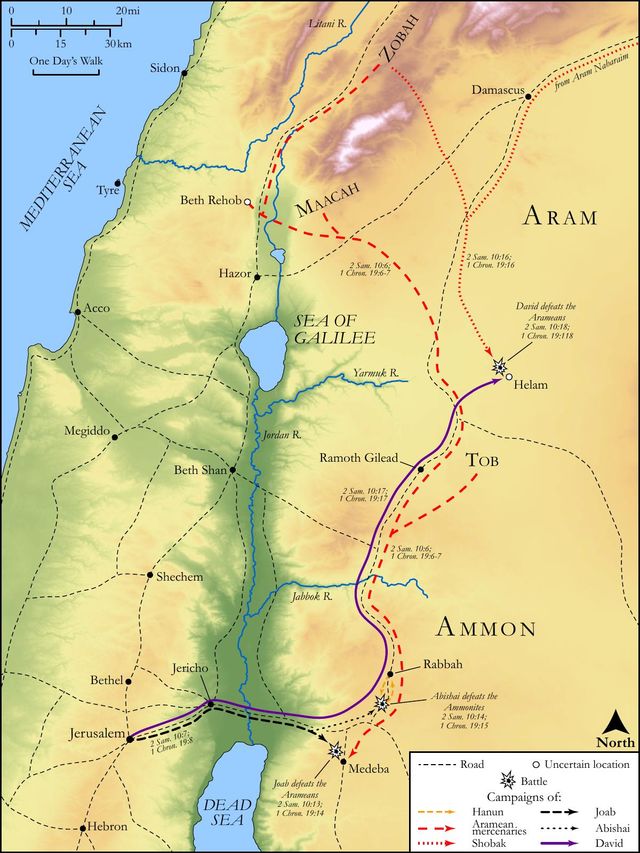
See on the biblical-era map
Study this verse
Public-domain commentary
Matthew Henry
From his Commentary on the Whole Bible. Henry comments on passages, not single verses — this entry covers 1 Chronicles 19:6–19.
We may see here, 1. How the hearts of sinners that are marked for ruin are hardened to their destruction. The children of Ammon saw that they had made themselves odious to David (Ch1 19:6), and then it would have been their wisdom to desire conditions of peace, to humble themselves and offer any satisfaction for the injury they had done him, the rather because they had made themselves not only odious to David, but obnoxious to the justice of God, who is King of nations, and will assert the injured rights and maintain the violated laws of nations. But, instead of this, they prepared for war, and so brought upon themselves, by David's hand, those desolations which he never intended them. 2. How the courage of brave men is heightened and invigorated by difficulties. When Joab saw that the battle was set against him before and behind (Ch1 19:10), instead of meditating a retreat, he doubled his resolution; and, though he could not double, he divided his army, and not only spoke, but acted, like a gallant man, that had great presence of mind when he saw himself surrounded. He engaged with his brother for mutual assistance (Ch1 19:12), excited himself and the rest of the officers to act vigorously in their respective posts, with an eye to God's glory and their country's good, not to any honour and advantage of their own, and then left the issue to God: Let the Lord do that which is right in his sight. 3. How vain the greatest art and strength are against justice and equity. The Ammonites did their utmost to make the best of their position: they brought as good a force into the field, and disposed it with as much policy as possible; yet, having a bad cause, and acting in defence of wrong, it would not do; they were put to the worst. Right will prevail and triumph at last. 4. To how little purpose it is for those to rally again, and reinforce themselves, that have not God on their side. The Syrians, though in no way concerned in the merits of the cause, but serving only as mercenaries to the Ammonites, when they were beaten, thought themselves concerned to retrieve their honour, and therefore called in the assistance of the Syrians on the other side Euphrates; but to no purpose, for still they fled before Israel (Ch1 19:18); they lost 7000 men, who are said to be the men of 700 chariots, Sa2 10:18. For, as now in a man of war for sea-service they allot ten men to a gun, so then, in land-service, ten men to a chariot. 5. those who have meddled with strife that belongs not to them, and have found that they meddled to their own heart, do well to learn wit at length and meddle no further. The Syrians, finding that Israel was the conquering side, not only broke off their alliance with the Ammonites and would help them no more (Ch1 19:19), but made peace with David and became his servants. Let those who have in vain stood it out against God be thus wise for themselves, and agree with him quickly, while they are in the way. Let them become his servants; for they cannot but see themselves undone if they be his enemies.
Continue studying 1 Chronicles 19:19 across the web’s major study libraries — every link below opens this exact verse, chapter, or book on the destination site.
Read & Compare
 BibleGatewayThis verse in more than 200 translations and 70 languages.
 Bible.comThe YouVersion reader — hundreds of translations, reading plans, and highlights.
 ESV.orgCrossway's official English Standard Version reader.
 NET BibleThe NET translation with 60,000+ translators' notes on every rendering decision.
 STEP BibleTyndale House's free study tool — original text, vocabulary, and scholarly resources.
 BibliaLogos Bible Software's free web reader.
 USCCBThe New American Bible (Revised Edition) with the U.S. bishops' study notes.
Commentaries
 BibleHub CommentariesDozens of classic commentaries on this verse, gathered on one page.
 StudyLightMore than 100 commentary sets — the largest collection on the web.
 BibleRefPlain-English commentary on what this verse means, verse by verse.
 Enduring WordDavid Guzik's free commentary on this chapter, widely used by Bible teachers.
 Bible Study ToolsVerse commentary alongside Greek and Hebrew study aids.
Original Language & Research
- BibleHub InterlinearThe verse word by word — original language, transliteration, and English.
- BibleHub LexiconEvery word's original-language definition and Strong's entry.
 Blue Letter BibleDeep-study tools — Strong's numbers, concordance, and word studies.
 SefariaThe Hebrew text with Rashi and centuries of Jewish commentary.
Sermons, Hymns & Audio


TrulyRandomVerse is not affiliated with these sites and doesn’t control their content. They’re linked because they’re genuinely useful.
Summary
This verse encapsulates the decisive turning point and conclusion of a significant military campaign, where the formidable Aramean (Syrian) forces, particularly those under Hadarezer of Zobah, were utterly defeated by King David's Israelite army. Recognizing their overwhelming loss and Israel's divinely-backed might, Hadarezer's subordinates sought a peace treaty with David, submitting themselves as his tributaries. This strategic outcome not only solidified Israel's regional dominance but also effectively severed the military alliance between the Arameans and the Ammonites, ensuring the latter would receive no further aid in their conflict with David's kingdom.
Context
ShowHideLiterary Context
1 Chronicles 19:19 serves as the climactic resolution to the initial phase of the Ammonite-Aramean War, which commences with David's diplomatic overture to Hanun, the new king of Ammon, in 1 Chronicles 19:1-2. Hanun's egregious insult to David's ambassadors (1 Chronicles 19:3-5) ignites the conflict, leading the Ammonites to hire a vast mercenary army from various Aramean kingdoms, including the powerful Zobah under Hadarezer. The preceding verses (1 Chronicles 19:6-18) meticulously detail Joab's strategic brilliance in dividing the Israelite forces to engage both the Ammonites at Rabbah and the Arameans in the open field, securing a decisive victory. This verse, therefore, marks the capitulation of the primary foreign threat, setting the stage for the subsequent, more focused campaign against the Ammonites themselves, which is fully recounted in 1 Chronicles 20.
Historical & Cultural Context
David's reign (circa 1010-970 BC) was a period of significant expansion and consolidation for the nascent Israelite kingdom. The Arameans, or Syrians, were a confederation of powerful Semitic city-states and kingdoms located to Israel's north and northeast, with Zobah, led by Hadarezer, being a particularly dominant regional power. Among the nations of that day, alliances and the use of mercenary forces were common military strategies, as exemplified by the Ammonites' recruitment of Aramean troops. The act of "making peace" and becoming "servants" was the customary outcome for a defeated party, signifying their submission to the victor and typically involving the payment of tribute or military obligations. This victory profoundly reshaped the geopolitical landscape of the Levant, establishing David's hegemony over a wide area and securing Israel's northern borders against formidable and previously independent adversaries.
Key Themes
ShowHide1 Chronicles 19:19 powerfully contributes to several central themes woven throughout the book of 1 Chronicles. Firstly, it emphatically underscores the theme of Divine Sovereignty and God's Granting of Victory. The Chronicler consistently attributes Israel's military successes to God's active intervention and favor upon David, His chosen king, a theme echoed in David's earlier victories, such as at Baal-Perazim (1 Chronicles 14:10-11). Secondly, the verse illustrates the Consequences of Opposing God's Anointed. The decisive defeat and subsequent submission of the powerful Aramean forces serve as a clear demonstration that those who challenge God's chosen king will ultimately be overcome. Thirdly, this victory directly contributes to the Expansion and Consolidation of David's Kingdom, as the Arameans become tributaries, extending Israel's influence and securing its borders, fulfilling aspects of the covenant promises made to David in 1 Chronicles 17. Finally, it subtly introduces the theme of Peace Through Submission, implying that true and lasting stability is achieved not through continued resistance but through acknowledging and yielding to a greater, divinely ordained authority.
Exposition and Analysis
ShowHideKey Word Analysis
ShowHideFrom the primitive root נָגַף (H5062), meaning "to push, gore, defeat, stub (the toe), inflict (a disease)." The Niphal perfect form niggĕpû (implied by the KJV's "were put to the worse") denotes a passive sense, indicating that the Aramean forces were decisively "struck down" or "defeated." This term conveys an overwhelming and incapacitating military rout, leaving no viable option for continued resistance and necessitating surrender. It highlights the completeness of their military failure.
From the primitive root שָׁלַם (H7999), meaning "to be safe (in mind, body or estate); figuratively, to be (causatively, make) completed; by implication, to be friendly; by extension, to reciprocate." The Hiphil form wayyashlîmû means "they caused peace to be" or "they came to terms." This signifies a formal cessation of hostilities and the establishment of a new, often subordinate, relationship. It implies a proactive step taken by the defeated party to reconcile and agree to terms, rather than merely ceasing fire.
The verse uses both H5650 (ʻebed), meaning "a servant" (noun), and H5647 (ʻâbad), meaning "to work (in any sense); by implication, to serve, till, (causatively) enslave, etc." (verb). When they "became his servants," it signifies that they entered into a state of servitude. This typically involved acknowledging David's rule, paying tribute, and potentially providing military support. It represents a fundamental shift in their political status from independent adversaries to subjects of David's expanding kingdom.
Verse Breakdown
ShowHide"And when the servants of Hadarezer saw that they were put to the worse before Israel"
This initial clause sets the scene and provides the impetus for the subsequent actions. "Hadarezer" was the preeminent king of Zobah, a powerful Aramean kingdom, and his "servants" refer to his military forces and, by extension, the allied kingdoms under his command. Their "seeing" that they were "put to the worse" signifies their clear and undeniable defeat in battle against the Israelite army. This defeat was so absolute that it left no room for doubt regarding Israel's military superiority and, implicitly, the divine favor upon David.
"they made peace with David, and became his servants"
Faced with such a crushing defeat, the Aramean forces initiated a peace treaty with David. To "make peace" in this context was to formally end hostilities and enter into a new, often covenantal, relationship of submission. By becoming "his servants," they acknowledged David's rule, agreeing to terms that likely included tribute payments, military assistance when required, or both. This act transformed them from formidable adversaries into servants of David, significantly expanding David's sphere of influence and control over the northern territories.
"neither would the Syrians help the children of Ammon any more"
This concluding phrase highlights the profound strategic consequence of the Aramean defeat. Their submission meant they were no longer able or willing to provide military aid to the Ammonites, who had initially provoked the conflict. This effectively isolated the Ammonites, severely weakening their position and setting the stage for Israel's eventual, unhindered conquest of Rabbah, the Ammonite capital. It underscores the long-term geopolitical impact of David's comprehensive victory.
Literary Devices
ShowHideThe verse effectively employs several literary devices to convey the magnitude and implications of the event. The most prominent is Cause and Effect: the Arameans' overwhelming defeat ("put to the worse") directly causes their decision to "make peace" and become "servants." This clear logical progression underscores the inevitability of their submission given Israel's military dominance. There is also a subtle use of Synecdoche, where "the servants of Hadarezer" represents not just the soldiers, but the entire military and political entity of Hadarezer's kingdom, indicating the comprehensive capitulation of his realm. The final clause, "neither would the Syrians help the children of Ammon any more," functions as a powerful Result Clause, emphasizing the strategic consequence and finality of the Aramean defeat, effectively isolating the Ammonites and demonstrating the comprehensive nature of David's victory. The Chronicler's concise and impactful reporting of such a significant geopolitical shift also demonstrates Conciseness and Understatement, allowing the reader to infer the vast implications without explicit elaboration.
Theological and Thematic Connections
ShowHideThis verse, in its depiction of a decisive military victory and subsequent submission, profoundly illustrates God's active hand in establishing and securing David's kingdom. It is a powerful testament to the divine favor upon David, demonstrating that no human power, however formidable, can ultimately thwart God's sovereign purposes for His chosen king and people. The Arameans' defeat and their subsequent act of "making peace" with David underscore a vital theological principle: true peace and stability often emerge from acknowledging and submitting to God's sovereign will, as manifested through His chosen instruments. This submission brings an end to conflict and ushers in a new order, one where God's people are secure and His kingdom expands, serving as a microcosm of God's ultimate triumph over all opposition.
Reflection and Application
ShowHideThe narrative of 1 Chronicles 19:19 offers profound lessons for contemporary believers, reminding us of God's unwavering sovereignty and His capacity to grant decisive victory in the face of seemingly insurmountable challenges. Just as the powerful Arameans were "put to the worse" before Israel, so too are the spiritual forces that oppose God's kingdom ultimately destined for defeat. This truth should instill deep confidence and steadfastness in our faith, knowing that our ultimate triumph is secured in Christ. Furthermore, the Arameans found peace only through their submission to David. This serves as a powerful metaphor for our spiritual lives: true peace, rest, and freedom from internal and external conflict are found not in resisting God but in humbly submitting to His divine authority and loving lordship. When we align ourselves with His perfect will, we experience the "peace that surpasses all understanding" (Philippians 4:7) and find ourselves on the side of ultimate triumph, participating in His eternal kingdom.
Questions for Reflection
ShowHideFAQ
ShowHideWhat is the significance of Hadarezer in this narrative?
ShowHideHadarezer, the king of Zobah, was one of the most formidable Aramean rulers of his era, commanding a significant regional empire. His involvement in the conflict against David underscores the immense and formidable nature of the opposition Israel faced. His decisive defeat and the subsequent submission of his forces, as described in 1 Chronicles 19:19, were therefore of paramount strategic importance. This victory effectively neutralized a major northern threat to Israel, solidified David's regional dominance, and contributed significantly to the expansion and security of his kingdom. His defeat is also recounted in the parallel account in 2 Samuel 10.
How does 1 Chronicles 19:19 relate to the broader account of David's reign?
ShowHideThis verse marks a pivotal moment in the Chronicler's portrayal of David's reign, emphasizing his role as God's chosen king who brings peace and expands the kingdom. It highlights David's military prowess and, more importantly, God's divine favor upon him. The defeat of Hadarezer's forces and their submission to David is a concrete manifestation of the promises made to David regarding the security and expansion of his kingdom, as articulated in the Davidic Covenant in 1 Chronicles 17. This victory paves the way for further conquests and the consolidation of Israel's power, ultimately allowing David to focus on the monumental preparations for the construction of the Temple, a central theme in the book of Chronicles.
Christ-Centered Fulfillment
ShowHideThe submission of Hadarezer's servants to David in 1 Chronicles 19:19 serves as a powerful foreshadowing of the ultimate and universal submission to King Jesus. Just as the Aramean forces, after being "put to the worse" by David's might, found peace and became his servants, so too will every knee ultimately bow and every tongue confess that Jesus Christ is Lord, to the glory of God the Father (Philippians 2:10-11). David's victory over his enemies, leading to an expanded kingdom and a cessation of hostilities, points to Christ's definitive triumph over sin, death, and all spiritual powers that oppose God's reign (Colossians 2:15). In Christ, the true Son of David, humanity finds ultimate peace not through military subjugation but through redemptive submission to His gracious and sovereign rule (John 14:27). Those who acknowledge His sovereignty and become His willing "servants" enter into the everlasting peace and security of His kingdom, a kingdom that knows no end and offers eternal rest from all conflict (Hebrews 4:9-10). The Arameans' decision to no longer help the Ammonites against Israel prefigures the spiritual reality that once submitted to Christ, believers are no longer allied with the forces of darkness but are fully aligned with the purposes of God's eternal kingdom, walking in newness of life (Romans 6:4).