


2 Samuel 11:2
- וַיְהִיvay·Hiand it wasH1961Conj-w ¦ V-Qal-ConsecImperf-3msVerb Qal Consecutive Imperfect 3rd Singular Masculineוַandיְהִיit was
- לְעֵתle·'Etto [the] time ofH6256Prep-l ¦ N-cscNoun Singular common gender Constructלְtoעֵת[the] time of
- הָעֶרֶבha·'E·revthe eveningH6153Art ¦ N-msNoun Singular Masculine Absoluteהָtheעֶרֶבevening
- וַיָּקָםvai·Ya·komand he aroseH6965Conj-w ¦ V-Qal-ConsecImperf-3msVerb Qal Consecutive Imperfect 3rd Singular Masculineוַandיָּקָםhe arose
- דָּוִדda·VidDavidH1732N-proper-mNoun Proper Masculine
- מֵעַלme·'Alfrom onH5921Prep-m ¦ PrepPrepositionמֵfromעַלon
- מִשְׁכָּבוֹmish·ka·Vohis bedH4904N-msc ¦ 3msNoun Singular Masculine Constructמִשְׁכָּבbedוֹhis
- וַיִּתְהַלֵּךְvai·yit·ha·leKhand he walked aboutH1980Conj-w ¦ V-Hithpael-ConsecImperf-3msVerb Hithpael Consecutive Imperfect 3rd Singular Masculineוַandיִּתְהַלֵּךְhe walked about
- עַל'alonH5921PrepPreposition
- גַּגgag[the] roof ofH1406N-mscNoun Singular Masculine Construct
- בֵּיתbeit[the] house ofH1004N-mscNoun Singular Masculine Construct
- הַמֶּלֶךְha·Me·lekhthe kingH4428Art ¦ N-msNoun Singular Masculine Absoluteהַtheמֶּלֶךְking
- וַיַּרְאvai·Yar'and he sawH7200Conj-w ¦ V-Qal-ConsecImperf-3msVerb Qal Consecutive Imperfect 3rd Singular Masculineוַandיַּרְאhe saw
- אִשָּׁה'i·Shaha womanH802N-fsNoun Singular Feminine Absolute
- רֹחֶצֶתro·Che·tzetbathingH7364V-Qal-Prtcpl-fsVerb Qal Participle Singular Feminine Absolute
- מֵעַלme·'Alfrom onH5921Prep-m ¦ PrepPrepositionמֵfromעַלon
- הַגָּגha·Gagthe roofH1406Art ¦ N-msNoun Singular Masculine Absoluteהַtheגָּגroof
- וְהָאִשָּׁהve·Ha·'i·Shahand the womanH802Conj-w ¦ Art ¦ N-fsNoun Singular Feminine Absoluteוְandהָtheאִשָּׁהwoman
- טוֹבַתto·Vat[was] good ofH2896Adj-fscAdjective Singular Feminine Construct
- מַרְאֶהmar·'EhappearanceH4758N-msNoun Singular Masculine Absolute
- מְאֹדme·'OdveryH3966Adj-msAdjective Numerical Singular Masculine Absolute
English is a literal word-by-word gloss of the Hebrew, not the KJV's wording. Why?
This is the original text the KJV's translators worked from — each Hebrew word with its own literal English meaning in this verse, prepared by scholars at Tyndale House, Cambridge. The KJV translates whole sentences, not word by word, so its wording differs: one Hebrew word can become several English words, and the KJV may choose “the LORD” where the gloss reads “Yahweh”. Both are faithful — they answer different questions. For the KJV's own rendering, switch to the KJV text.
Details
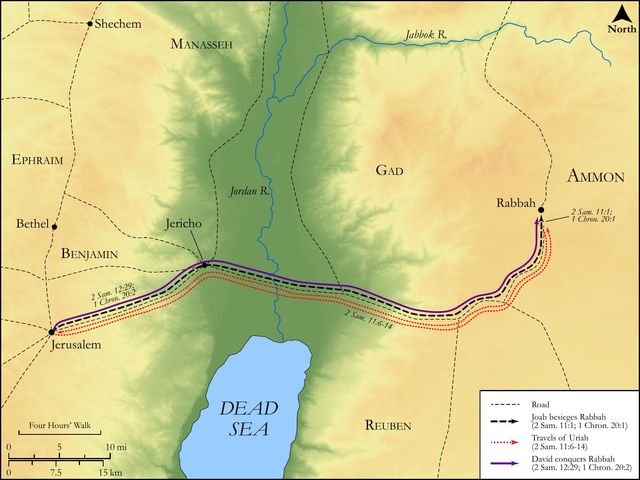
See on the biblical-era map

Study this verse
Public-domain commentary
Matthew Henry
From his Commentary on the Whole Bible. Henry comments on passages, not single verses — this entry covers 2 Samuel 11:1–5. His three-level outline is real structure in the source text, so it is rendered as structure.
Here is, I. David's glory, in pursuing the war against the Ammonites, Sa2 11:1. We cannot take that pleasure in viewing this great action which hitherto we have taken in observing David's achievements, because the beauty of it was stained and sullied by sin; otherwise we might take notice of David's wisdom and bravery in following his blow. Having routed the army of the Ammonites in the field, as soon as ever the season of the year permitted he sent more forces to waste the country and further to avenge the quarrel of his ambassadors. Rabbah, their metropolis, made a stand, and held out a great while. To this city Joab laid close siege, and it was at the time of this siege that David fell into this sin.
II.David's shame, in being himself conquered, and led captive by his own lust.
The sin he was guilty of was adultery, against the letter of the seventh commandment, and (in the judgment of the patriarchal age) a heinous crime, and an iniquity to be punished by the judges (Job 31:11), a sin which takes away the heart, and gets a man a wound and dishonour, more than any other, and the reproach of which is not wiped away.
1.Observe the occasions which led to this sin.
(1.)Neglect of his business. When he should have been abroad with his army in the field, fighting the battles of the Lord, he devolved the care upon others, and he himself tarried still at Jerusalem, Sa2 11:1. To the war with the Syrians David went in person, Sa2 10:17. Had he been now at his post at the head of his forces, he would have been out of the way of this temptation. When we are out of the way of our duty we are in the way of temptation.
(2.)Love of ease, and the indulgence of a slothful temper: He came off his bed at evening-tide, Sa2 11:2. There he had dozed away the afternoon in idleness, which he should have spent in some exercise for his own improvement or the good of others. He used to pray, not only morning and evening, but at noon, in the day of his trouble: it is to be feared he had, this noon, omitted to do so. Idleness gives great advantage to the tempter. Standing waters gather filth. The bed of sloth often proves the bed of lust.
(3.)A wandering eye: He saw a woman washing herself, probably from some ceremonial pollution, according to the law. The sin came in at the eye, as Eve's did. Perhaps he sought to see her, at least he did not practise according to his own prayer, Turn away my eyes from beholding vanity, and his son's caution in a like case, Look not thou on the wine it is red. Either he had not, like Job, made a covenant with his eyes, or, at this time, he had forgotten it.
2.The steps of the sin. When he saw her, lust immediately conceived, and,
(1.)He enquired who she was (Sa2 11:3), perhaps intending only, if she were unmarried, to take her to wife, as he had taken several; but, if she were a wife, having no design upon her.
(2.)The corrupt desire growing more violent, though he was told she was a wife, and whose wife she was, yet he sent messengers for her, and then, it may be, intended only to please himself with her company and conversation. But,
(3.)When she came he lay with her, she too easily consenting, because he was a great man, and famed for his goodness too. Surely (thinks she) that can be no sin which such a man as David is the mover of. See how the way of sin is down-hill; when men begin to do evil they cannot soon stop themselves. The beginning of lust, as of strife, is like the letting forth of water; it is therefore wisdom to leave it off before it be meddled with. The foolish fly fires her wings, and fools away her life at last, by playing about the candle.
3.The aggravations of the sin.
(1.)He was now in years, fifty at least, some think more, when those lusts which are more properly youthful, one would think, should not have been violent in him,
(2.)He had many wives and concubines of his own; this is insisted on, Sa2 12:8.
(3.)Uriah, whom he wronged, was one of his own worthies, a person of honour and virtue, one that was now abroad in his service, hazarding his life in the high places of the field for the honour and safety of him and his kingdom, where he himself should have been.
(4.)Bath-sheba, whom he debauched, was a lady of good reputation, and, till she was drawn by him and his influence into this wickedness, had no doubt preserved her purity. Little did she think that ever she could have done so bad a thing as to forsake the guide of her youth, and forget the covenant of her God; nor perhaps could any one in the world but David have prevailed against her. The adulterer not only wrongs and ruins his own soul, but, as much as he can, another's soul too.
(5.)David was a king, whom God had entrusted with the sword of justice and the execution of the law upon other criminals, particularly upon adulterers, who were, by the law, to be put to death; for him therefore to be guilty of those crimes himself was to make himself a pattern, when he should have been a terror, to evil doers. With what face could he rebuke or punish that in others which he was conscious to himself of being guilty of? See Rom 2:22. Much more might be said to aggravate the sin; and I can think but of one excuse for it, which is that it was done but once; it was far from being his practice; it was by the surprise of a temptation that he was drawn into it. He was not one of those of whom the prophet complains that they were as fed horses, neighing every one after his neighbour's wife (Jer 5:8); but this once God left him to himself, as he did Hezekiah, that he might know what was in his heart, Ch2 32:31. Had he been told of it before, he would have said, as Hazael, What! is thy servant a dog? But by this instance we are taught what need we have to pray every day, Father, in heaven, lead us not into temptation, and to watch, that we enter not into it.
Historical interpretation
Two Centuries of Reception
4 surviving comments on this verse. Each one is dated, so this reads as a timeline rather than a list.
Select a marker to jump to its quote. Markers stagger vertically where authors wrote within a few decades of each other.
We have taken up the task of writing an apology for the present style of the prophet David, not because he needs this gift, who has excelled in such great merits and flourished in virtues, but because many people, reading the sequence of his deeds without considering the power of the Scriptures or the hidden mysteries, wonder how such a great prophet did not avoid the contagion of adultery first and then of murder.
Therefore, it was our desire to review the history itself, which seems to have been exposed to sin. For in the second book of Kings (2 Samuel 11:2-27), we read that while David was walking in his royal palace, he saw a woman bathing (her name was Bathsheba), of remarkable beauty and grace, with a very attractive face, and he was overcome by the desire to possess her. However, the woman was married to a man named Uriah, and the scene of his death was arranged by royal command. For although it had no effect on his desire, yet it was considered to greatly impede his sense of shame for adultery.
Therefore, let us begin with the most obvious, whom God justified, so that you may not judge. 'For it is of little concern to me,' says Paul, 'that I should be judged by you or by any human court; indeed, I do not even judge myself' (1 Corinthians 4:3). Even though he was still in the body and subject to temptation, he did not judge himself because a spiritual person is not judged by anyone but God alone. Finally, he added, 'The one who judges me is the Lord' (1 Corinthians 4:4). Therefore, do not judge anything before the appointed time (ibid., 4 and 5). But David has already fulfilled his time and has earned grace, and he is justified by Christ; since David himself rejoiced in being called the son of the Lord, and those who confessed him in this way were enlightened. Why do you call a man of God from a reward to judgment? The Lord has already judged him, of whom he said to Solomon: If you walk before me as your father David walked in the holiness of heart and righteousness, in order to do everything I commanded him (3 Kings 9:4). Is he worthy of judgment or reward, who has done everything according to heavenly commands, walking in holiness and righteousness of heart? Where the vices and sins of others are hidden, there David receives divine testimony of his virtue and glory. And we discuss his sin in vain, for it is through his merit and grace that the sins of others have been revealed. For when Solomon sinned by not keeping the Lord's commands and God intended to divide his kingdom into many parts, He said to him: However, I will not do this in your days because of your father David. I will take it from the hand of your son. However, I will not take the whole kingdom; I will give him one scepter because of my servant David (3 Kings 11:12-13). Therefore, since the Lord justifies, who is there to condemn? What God has cleansed, you must not call common (Acts 10:15).
Nevertheless, with due regard to heavenly judgment, in which you honor the prophet even more, enter into his actions and behaviors. Do not marvel at the man, and do not judge him to be equal to the angels, because he has spent most of his life, even from childhood, dwelling in riches, honors, and positions of power, and has been subjected to many temptations. He has only once given in to error, and it is through this error that even the angels of heaven, as Scripture recounts (Genesis 6:2), were cast down from their virtue and grace. Indeed, another error of his is mentioned, that he caused the people to be counted.
David was a man after God’s own heart, and his lips had often sung of the Holy One, the future Christ. Yet as he walked upon his housetop he was fascinated by Bathsheba’s nudity, and [he] added murder to adultery. Notice here how, even in his own house, a man cannot use his eyes without danger. Then repenting, he says to the Lord, “Against you, you only, have I sinned and done this evil in your sight.” Being a king he feared no one else.
For blessed Jerome among others points out that Bathsheba manifested a type of the church or of human flesh and says that David bore the mark of Christ; this is clearly apt at many points. Just as Bathsheba when washing herself unclothed in the brook of Kidron delighted David and deserved to attain the royal embraces, and her husband was slain at the prince’s command, so too the church, the assembly of the faithful, once it has cleansed itself of the foulness of sins by the bath of sacred baptism, is known to be joined to Christ the Lord. It was indeed appropriate in those days that the future mysteries of the Lord should be manifested by a deed of this kind, and that what people considered a blameworthy act should be shown to point in a spiritual sense to a great mystery.
But who that hears of it, not only among believers but among unbelievers themselves also, does not utterly loathe this, that David walking upon his roof lusted after Bathsheba, the wife of Uriah? Yet when he [Uriah] returns back from the battle, he bids him go home to wash his feet. Whereupon he answered at once, “The ark of the Lord dwells in tents; shall I then take rest in my house?” David receives him to his own table and delivers to him letters, through which he would die. But who does David walking upon his roof typify if not him concerning whom it is written, “He has set his tent in the sun.” And what else is it to draw Bathsheba to himself, but to join to himself by a spiritual meaning the law of the letter, which was united to a carnal people? For “Bathsheba” means “the seventh well,” surely, in that through the knowledge of the law, with spiritual grace infused, perfect wisdom is ministered to us. And whom does Uriah denote but the Jewish people, whose name is interpreted “My light from God”? Now because the Jewish people are raised high by receiving the knowledge of the law, they glory as though “in the light of God.” But David took from this Uriah his wife and united her to himself, surely in that the strong-handed One, which is the meaning of “David,” our Redeemer, showed himself in the flesh, while he made known that the law spoke in a spiritual sense concerning himself. In this way, because it was held according to the letter, he demonstrated that he took it from the Jewish people and joined it to himself, in that he declared himself to be proclaimed by it. Yet David asks Uriah to “go home to wash his feet,” in that when the Lord came in the flesh, he asked the Jewish people to turn back to the home of the conscience and to wipe off with their tears the defilements of their deeds, that they would understand the precepts of the law in a spiritual sense and, finding the font of baptism after the grievous hardness of the commandments, have recourse to water after toil.
Continue studying 2 Samuel 11:2 across the web’s major study libraries — every link below opens this exact verse, chapter, or book on the destination site.
Read & Compare
 BibleGatewayThis verse in more than 200 translations and 70 languages.
 Bible.comThe YouVersion reader — hundreds of translations, reading plans, and highlights.
 ESV.orgCrossway's official English Standard Version reader.
 NET BibleThe NET translation with 60,000+ translators' notes on every rendering decision.
 STEP BibleTyndale House's free study tool — original text, vocabulary, and scholarly resources.
 BibliaLogos Bible Software's free web reader.
 USCCBThe New American Bible (Revised Edition) with the U.S. bishops' study notes.
Commentaries
 BibleHub CommentariesDozens of classic commentaries on this verse, gathered on one page.
 StudyLightMore than 100 commentary sets — the largest collection on the web.
 BibleRefPlain-English commentary on what this verse means, verse by verse.
 Enduring WordDavid Guzik's free commentary on this chapter, widely used by Bible teachers.
 Bible Study ToolsVerse commentary alongside Greek and Hebrew study aids.
Original Language & Research
- BibleHub InterlinearThe verse word by word — original language, transliteration, and English.
- BibleHub LexiconEvery word's original-language definition and Strong's entry.
 Blue Letter BibleDeep-study tools — Strong's numbers, concordance, and word studies.
 SefariaThe Hebrew text with Rashi and centuries of Jewish commentary.
Sermons, Hymns & Audio


TrulyRandomVerse is not affiliated with these sites and doesn’t control their content. They’re linked because they’re genuinely useful.
Summary
This verse serves as the pivotal moment marking King David's tragic moral decline, initiating a cascade of sin that would bring devastating consequences upon himself, his family, and his kingdom. It vividly portrays a scene of unexpected vulnerability and temptation, as David's uncharacteristic idleness and elevated vantage point converge to create the perfect storm for a profound moral failure that would forever stain his otherwise remarkable legacy.
Context
ShowHideLiterary Context
This verse immediately follows 2 Samuel 11:1, a crucial detail that sets the stage for David's vulnerability. That preceding verse explicitly states, "And it came to pass, after the year was expired, at the time when kings went forth to battle, that David sent Joab, and his servants with him, and all Israel; and they destroyed the children of Ammon, and besieged Rabbah. But David tarried still at Jerusalem." David's uncharacteristic absence from his kingly duty on the battlefield creates the idleness that precipitates his susceptibility to temptation. The narrative then swiftly moves from David's observation in 2 Samuel 11:2 to his inquiry about the woman, his sending for her, and the resulting adultery, as detailed in 2 Samuel 11:3-4. This rapid progression highlights the immediate and devastating consequences of his initial gaze and subsequent actions.
Historical & Cultural Context
The "eveningtide" was a common time for relaxation and quiet after the heat of the day, often signaling a transition from public activity to private life. Ancient Israelite homes, particularly in urban settings, commonly featured flat roofs that served as versatile private spaces for various activities, including sleeping, relaxing, and enjoying cooler air. From the "roof of the king's house," David would have had a commanding view over the surrounding city, offering a degree of privacy for himself while inadvertently granting him a vantage point over others' private spaces. Washing rituals were common in ancient cultures for hygiene and purification, and while public bathing existed, a woman washing herself at home would typically expect privacy within her own courtyard or dwelling. David's elevated position allowed him to intrude upon this private moment, transforming a common architectural feature into a platform for temptation and a violation of privacy.
Key Themes
ShowHideThis pivotal verse introduces several critical themes that resonate throughout the rest of David's narrative and the broader biblical account. Firstly, it underscores the danger of idleness and complacency, as David's dereliction of his kingly duty in 2 Samuel 11:1 creates the void that temptation fills. Secondly, it powerfully illustrates the peril of the eyes and the progression of temptation. David's initial "seeing" is not inherently sinful, but his lingering gaze and subsequent actions demonstrate how a visual encounter can be the gateway to lust and full-blown sin, a concept echoed in Jesus' teaching on the heart's intentions in Matthew 5:28 and James' explanation of temptation's progression in James 1:14-15. Finally, this verse serves as the catalyst for a profound downward spiral, demonstrating how a seemingly minor misstep can lead to a cascade of increasingly grave sins, including adultery, deception, and murder, with far-reaching consequences for David and his kingdom, as detailed in 2 Samuel 12.
Exposition and Analysis
ShowHideKey Word Analysis
ShowHideA primitive root meaning "to see, literally or figuratively (in numerous applications, direct and implied, transitive, intransitive and causative)." While this verb can simply mean "to see" or "to look," in this context, it carries a deeper implication. It suggests more than a casual, fleeting glance; rather, it implies a deliberate, prolonged observation, a gaze that moves beyond mere perception to contemplation and desire. David "saw" in a way that allowed the image to take root in his mind, fueling his subsequent actions. This is not a passive observation but an active engagement with what he beheld.
Meaning "good (as an adjective) in the widest sense; used likewise as a noun... good, a good or good thing... beautiful, best, better, bountiful, cheerful, at ease, fair (word), (be in) favour, fine, glad, good... pleasant, pleaseth, pleasure, precious, prosperity, ready, sweet, wealth, welfare, (be) well(-favoured)." The full phrase "very beautiful to look upon" in the KJV combines H2896 (ṭôwb) with H3966 (mᵉʼôd - "vehemence, i.e. vehemently; by implication, wholly, speedily, etc. (often with other words as an intensive or superlative; especially when repeated)") and H4758 (marʼeh - "a view (the act of seeing); also an appearance (the thing seen), whether (real) a shape (especially if handsome, comeliness; often plural the looks), or (mental) a vision"). This combination emphasizes an exceptional, striking, and overwhelming beauty. The use of mᵉʼôd intensifies ṭôwb, indicating a powerful allure that immediately captivated David's attention and stirred his lust. The text does not use this description to excuse David's sin, but to explain the potent nature of the temptation he faced.
Verse Breakdown
ShowHide"And it came to pass in an eveningtide"
This phrase sets the scene at a specific time of day (H6153 ʻereb, H6256 ʻêth), often associated with winding down, rest, and perhaps a lowering of one's guard. It is a period of transition from the day's activities, making David's subsequent actions all the more striking as they occur when vigilance might be diminished.
"that David arose from off his bed, and walked upon the roof of the king's house"
This clause highlights David's active movement (H6965 qûwm - "to rise"; H1980 hâlak - "to walk"). He is not merely lying in bed but actively rising and moving to a specific vantage point (H1406 gâg - "a roof"; H4428 melek - "king"; H1004 bayith - "house"). The "roof of the king's house" signifies his elevated physical and social position, yet it is from this height that his moral descent begins. This action is conspicuously contrasted with the preceding verse where kings are "going forth to battle," underscoring David's idleness and misplaced activity.
"and from the roof he saw a woman washing herself"
This is the core action of the verse. David, from his elevated position, observes (H7200 râʼâh - "to see") a woman (H802 ʼishshâh) engaged in a private act of washing (H7364 râchats - "to lave (the whole or a part of a thing); bathe (self), wash (self)"). The act of "washing herself" implies vulnerability and a reasonable expectation of privacy, which David inadvertently or deliberately violates by his observation.
"and the woman [was] very beautiful to look upon"
This final clause provides the critical motivation for David's subsequent actions. The woman's exceptional beauty (H3966 mᵉʼôd - "very"; H2896 ṭôwb - "beautiful"; H4758 marʼeh - "to look upon") is explicitly stated as the catalyst for David's desire, explaining the powerful allure that drew his gaze and ignited his lust.
Literary Devices
ShowHideThe verse is rich in Irony, particularly when read in conjunction with 2 Samuel 11:1. David, the great warrior-king renowned for his valor, is found idle at home during a time when "kings went forth to battle." His physical elevation on the roof ironically precedes his moral degradation, as his position of power becomes the very platform for his fall. There is also significant Foreshadowing in this seemingly simple observation. The lingering gaze and the explicit description of the woman's captivating beauty serve as a potent harbinger of the adultery, deception, and murder that will inevitably follow, setting in motion the tragic events detailed throughout 2 Samuel 11 and 2 Samuel 12. Furthermore, Symbolism can be seen in the "eveningtide," which can represent a time of spiritual dimness, a lowering of spiritual guard, or a period of moral vulnerability. The "roof" itself, a place of privacy and elevated perspective, symbolizes David's position of power and authority, which he tragically misuses for illicit observation and the initiation of sin.
Theological and Thematic Connections
ShowHideThis verse serves as a profound theological cautionary tale, illustrating the universal susceptibility to temptation, even for those deeply devoted to God. It highlights that sin often begins subtly, not with a grand act of rebellion, but with a gaze, a thought, or an unchecked desire. David's experience underscores the biblical truth that idleness can be a breeding ground for temptation, and that true spiritual vigilance requires guarding not only our actions but also our eyes and our hearts. The story powerfully demonstrates the progressive nature of sin, where one seemingly small compromise can lead to a cascade of devastating choices and consequences, emphasizing the urgent need for self-control, discipline, and reliance on God's strength to prevent such a downward spiral.
Reflection and Application
ShowHideDavid's fall, beginning with this seemingly innocuous moment of observation, serves as a stark reminder that no one, regardless of their spiritual stature, past faithfulness, or position of authority, is immune to temptation. His story compels us to cultivate a posture of constant vigilance, recognizing that sin often gains its first foothold through our senses, particularly our eyes, and then takes root in our hearts. In an age saturated with visual stimuli and readily accessible content, the call to guard our hearts and minds from unholy desires is more urgent than ever. We are challenged to examine our own lives: Where might we be idle, either physically, mentally, or spiritually, thereby creating an open door for temptation? What "rooftops" or vantage points in our lives (e.g., social media, entertainment, unchecked privacy, or even positions of influence) might expose us to images or situations that can lead to sin? David's experience underscores the critical importance of proactive spiritual discipline, accountability to trusted brothers and sisters in Christ, and a consistent, active pursuit of God's will to safeguard against the insidious progression of temptation and its devastating consequences.
Questions for Reflection
ShowHideFAQ
ShowHideWas David's sin premeditated, or was it an impulsive act?
ShowHideThe text suggests that David's initial "seeing" was opportunistic rather than premeditated. He "walked upon the roof" and "saw" her, implying an accidental encounter. However, his subsequent actions—sending to inquire about her, then sending for her—demonstrate a deliberate choice to pursue the temptation. While the initial sight was not sought out, David chose to dwell on it and act upon the lust it ignited, transforming a moment of temptation into a conscious act of sin. This progression from observation to inquiry to action highlights a conscious choice to indulge rather than resist.
Why was David on the roof at "eveningtide" instead of at war?
ShowHideThis is a critical detail highlighted in the preceding verse, 2 Samuel 11:1. The text explicitly states that "at the time when kings went forth to battle... David tarried still at Jerusalem." His absence from his kingly duty and his uncharacteristic idleness created the context for his vulnerability. Had he been where he was supposed to be, leading his troops in battle, this temptation likely would not have occurred. His being on the roof at "eveningtide" is a direct consequence of his dereliction of duty, illustrating how neglecting one's responsibilities can open the door to temptation.
Does Bathsheba's "very beautiful" appearance excuse David's sin?
ShowHideAbsolutely not. The description of Bathsheba's beauty explains the powerful allure that captivated David and the intensity of the temptation he faced, but it in no way absolves him of his responsibility for his actions. The biblical narrative consistently holds individuals accountable for their choices, regardless of the strength of the temptation. David's sin was his own, as confirmed by the prophet Nathan's direct confrontation in 2 Samuel 12 and the severe, divinely ordained consequences that followed. The text highlights the temptation's power to underscore David's failure of self-control, not to mitigate his guilt.
Christ-Centered Fulfillment
ShowHideThe tragic account of David's fall in 2 Samuel 11:2 powerfully underscores the pervasive reality of human sinfulness and the desperate need for a perfect King. David, a "man after God's own heart" (Acts 13:22), still succumbed to temptation, demonstrating that even the most devout among us are fallen and prone to sin. This narrative points us to Jesus Christ, the true and greater King, who faced every temptation known to humanity (Hebrews 4:15) yet never yielded to sin. Unlike David, who was idle when he should have been at war, Jesus was always actively engaged in His Father's will, even to the point of death on a cross (Philippians 2:8). Where David's gaze led to lust and defilement, Jesus' gaze was always one of compassion, healing, and truth, seeing into the hearts of people to offer redemption (John 1:47-48). His perfect life, sacrificial death, and victorious resurrection provide the only true cleansing for sin, a spiritual washing far superior to the physical washing observed by David. Jesus is the Lamb of God who takes away the sin of the world, offering forgiveness, restoration, and the power to overcome temptation through His indwelling Holy Spirit, fulfilling the righteousness that David and all humanity so desperately lack and providing a path to genuine purity of heart (Matthew 5:8).