


2 Samuel 15:10
Bible text: King James Version (1769 Blayney text) · Public domain
Bible text: King James Version with Strong's numbers · Public domain
Bible text: Berean Standard Bible · Public domain
Bible text: American Standard Version (1901) · Public domain
Bible text: World English Bible, Messianic edition · Public domain
Bible text: Geneva Bible (1599) · Public domain
Bible text: Young's Literal Translation · Public domain
- וַיִּשְׁלַחvai·yish·Lachand he sentH7971Conj-w ¦ V-Qal-ConsecImperf-3msVerb Qal Consecutive Imperfect 3rd Singular Masculineוַandיִּשְׁלַחhe sent
- אַבְשָׁלוֹם'av·sha·lOmAbsalomH53N-proper-mNoun Proper Masculine
- מְרַגְּלִיםme·ra·ge·LimspiesH7270V-Piel-Prtcpl-mpVerb Piel Participle Plural Masculine Absolute
- בְּכָלbe·kholin allH3605Prep-b ¦ N-mscNoun Singular Masculine Constructבְּinכָלall
- שִׁבְטֵיshiv·Tei[the] tribes ofH7626N-mpcNoun Plural Masculine Construct
- יִשְׂרָאֵלYis·ra·'ElIsraelH3478N-properNoun Proper Location
- לֵאמֹרle·Mor<to> sayingH559Prep-l ¦ V-Qal-InfVerb Qal Infinitive Constructלֵ<to>אמֹרsaying
- כְּשָׁמְעֲכֶםke·sha·me·'a·Khemwhen hear youH8085Prep-k ¦ V-Qal-Inf ¦ 2mpVerb Qal Infinitive Constructכְּwhenשָׁמְעֲhearכֶםyou
- אֶת'et<obj.>H853DirObjMParticle Object Indicator
- קוֹלKol[the] sound ofH6963N-mscNoun Singular Masculine Construct
- הַשֹּׁפָרha·sho·Farthe ram's hornH7782Art ¦ N-msNoun Singular Masculine Absoluteהַtheשֹּׁפָרram's horn
- וַאֲמַרְתֶּםva·'a·mar·Temand you will sayH559Conj-w ¦ V-Qal-ConsecPerf-2mpVerb Qal Consecutive Perfect 2nd Plural Masculineוַandאֲמַרְתֶּםyou will say
- מָלַךְma·Lakhhe has become kingH4427V-Qal-Perf-3msVerb Qal Perfect 3rd Singular Masculine
- אַבְשָׁלוֹם'av·sha·LomAbsalomH53N-proper-mNoun Proper Masculine
- בְּחֶבְרוֹןbe·chev·Ronin HebronH2275Prep-b ¦ N-properNoun Proper LocationבְּinחֶבְרוֹןHebron
English is a literal word-by-word gloss of the Hebrew, not the KJV's wording. Why?
This is the original text the KJV's translators worked from — each Hebrew word with its own literal English meaning in this verse, prepared by scholars at Tyndale House, Cambridge. The KJV translates whole sentences, not word by word, so its wording differs: one Hebrew word can become several English words, and the KJV may choose “the LORD” where the gloss reads “Yahweh”. Both are faithful — they answer different questions. For the KJV's own rendering, switch to the KJV text.
Details
See on the biblical-era maps
Study this verse
Public-domain commentary
Matthew Henry
From his Commentary on the Whole Bible. Henry comments on passages, not single verses — this entry covers 2 Samuel 15:7–12. His two-level outline is real structure in the source text, so it is rendered as structure.
We have here the breaking out of Absalom's rebellion, which he had long been contriving. It is said to be after forty years, Sa2 15:7. But whence it is to be dated we are not told; not from David's beginning his reign, for then it would fall in the last year of his life, which is not probable; but either from his first anointing by Samuel seven years before, or rather (I think) from the people's desiring a king, and the first change of the government into a monarchy, which might be about ten years before David began to reign; it is fitly dated thence, to show that the same restless spirit was still working, and still they were given to change: as fond now of a new man as then of a new model. So it fell about the thirtieth year of David's reign. Absalom's plot being now ripe for execution,
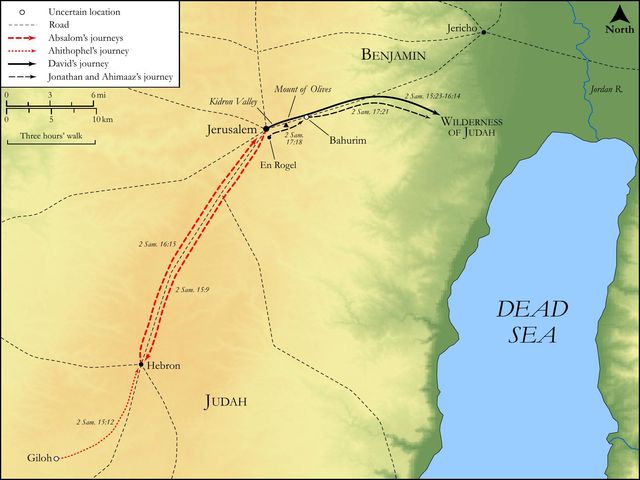
I.The place he chose for the rendezvous of his party was Hebron, the place where he was born and where his father began his reign and continued it several years, which would give some advantage to his pretensions. Every one knew Hebron to be a royal city; and it lay in the heart of Judah's lot, in which tribe, probably, he thought his interest strong.
II.The pretence he had both to go thither and to invite his friends to him there was to offer a sacrifice to God, in performance of a vow he had made during his banishment, Sa2 15:7, Sa2 15:8. We have cause enough to suspect that he had not made any such vow; it does not appear that he was so religiously inclined. But he that stuck not at murder and treason would not make conscience of a lie to serve his purpose. If he said he had made such a vow, nobody could disprove him. Under this pretence,
1.He got leave of his father to go to Hebron. David would be well pleased to hear that his son, in his exile, was so desirous to return to Jerusalem, not only his father's city, but the city of the living God, - that he looked up to God, to bring him back, - that he had vowed, if he were brought back, to serve the Lord, whose service he had hitherto neglected, - and that now, being brought back, he remembered his vow, and resolved to perform it. If he think fit to do it in Hebron, rather than in Sion or Gibeon, the good king is so well pleased with the thing itself that he will not object against his choice of the place. See how willing tender parents are to believe the best concerning their children, and, upon the least indication of good, to hope, even concerning those that have been untoward, that they will repent and reform. But how easy is it for children to take advantage of their good parents' credulity, and to impose upon them with the show of religion, while still they are what they were! David was overjoyed to hear that Absalom inclined to serve the Lord, and therefore readily gave him leave to go to Hebron, and to go thither with solemnity.
2.He got a good number of sober substantial citizens to go along with him, Sa2 15:11. There went 200 men, probably of the principal men of Jerusalem, whom he invited to join with him in his feast upon his sacrifice; and they went in their simplicity, not in the least suspecting that Absalom had any bad design in this journey. He knew that it was to no purpose to tempt them into his plot: they were inviolably firm to David. But he drew them in to accompany him, that the common people might think that they were in his interest, and that David was deserted by some of his best friends. Note, It is no new thing for very good men, and very good things, to be made use of by designing men to put a colour upon bad practices. When religion is made a stalking-horse, and sacrifice a shoeing-horn, to sedition and usurpation it is not to be wondered at if some that were well affected to religion, as these followers of Absalom here, are imposed upon by the fallacy, and drawn in to give countenance to that, with their names, which in their heart they abhor, not having known the depths of Satan.
III.The project he laid was to get himself proclaimed king throughout all the tribes of Israel upon a signal given, Sa2 15:10.
Spies were sent abroad, to be ready in every country to receive the notice with satisfaction and acclamations of joy, and to make the people believe that the news was both very true and very good, and that they were all concerned to take up arms for their new king. Upon the sudden spreading of this proclamation, "Absalom reigns in Hebron," some would conclude that David was dead, others that he had resigned: and thus those that were in the secret would draw in many to appear for Absalom, and to come into his assistance, who, if they had rightly understood the matter, would have abhorred the thought of it, but, being drawn in, would adhere to him. See what artifices ambitious men use for the compassing of their ends; and in matters of state, as well as in matters of religion, let us not be forward to believe every spirit, but try the spirits.
IV.The person he especially courted and relied upon in this affair was Ahithophel, a politic thinking man, and one that had a clear head and a great compass of thought, that had been David's counsellor, his guide and his acquaintance (Psa 55:13), his familiar friend, in whom he trusted, who did eat of his bread, Psa 41:9. But, upon some disgust of David's against him, or his against David, he was banished, or retired from public business, and lived privately in the country. How should a man of such good principles as David, and a man of such corrupt principles as Ahithophel, long agree? A fitter tool Absalom could not find in all the kingdom than one that was so great a statesman, and yet was disaffected to the present ministry. While Absalom was offering his sacrifices, in performance of his pretended vow, he sent for this man. So much was his heart on the projects of his ambition that he could not stay to make an end of his devotion, which showed what his eye was upon in all, and that it was but for a pretence that he made long offerings.
V.The party that joined with him proved at last very considerable.
The people increased continually with Absalom, which made the conspiracy strong and formidable. Every one whom he had complimented and caressed (pronouncing his matters right and good, especially if afterwards the cause went against him) not only came himself, but made all the interest he could for him, so that he wanted not for numbers. The majority is no certain rule to judge of equity by. All the world wondered after the beast. Whether Absalom formed this design merely in the height of his ambition and fondness to rule, or whether there was not in it also malice against his father and revenge for his banishment and confinement, though this punishment was so much less than he deserved, does not appear. But, generally, that which aims at the crown aims at the head that wears it.
Continue studying 2 Samuel 15:10 across the web’s major study libraries — every link below opens this exact verse, chapter, or book on the destination site.
Read & Compare
 BibleGatewayThis verse in more than 200 translations and 70 languages.
 Bible.comThe YouVersion reader — hundreds of translations, reading plans, and highlights.
 ESV.orgCrossway's official English Standard Version reader.
 NET BibleThe NET translation with 60,000+ translators' notes on every rendering decision.
 STEP BibleTyndale House's free study tool — original text, vocabulary, and scholarly resources.
 BibliaLogos Bible Software's free web reader.
 USCCBThe New American Bible (Revised Edition) with the U.S. bishops' study notes.
Commentaries
 BibleHub CommentariesDozens of classic commentaries on this verse, gathered on one page.
 StudyLightMore than 100 commentary sets — the largest collection on the web.
 BibleRefPlain-English commentary on what this verse means, verse by verse.
 Enduring WordDavid Guzik's free commentary on this chapter, widely used by Bible teachers.
 Bible Study ToolsVerse commentary alongside Greek and Hebrew study aids.
Original Language & Research
- BibleHub InterlinearThe verse word by word — original language, transliteration, and English.
- BibleHub LexiconEvery word's original-language definition and Strong's entry.
 Blue Letter BibleDeep-study tools — Strong's numbers, concordance, and word studies.
 SefariaThe Hebrew text with Rashi and centuries of Jewish commentary.
Sermons, Hymns & Audio


TrulyRandomVerse is not affiliated with these sites and doesn’t control their content. They’re linked because they’re genuinely useful.
Summary
2 Samuel 15:10 details the critical moment of Absalom's meticulously orchestrated rebellion against his father, King David. Having subtly cultivated popular support over four years, Absalom, now strategically positioned in Hebron under false pretenses, dispatches secret agents throughout all the tribes of Israel. These agents are tasked with a synchronized declaration: upon hearing the prearranged signal of the trumpet, they are to proclaim, "Absalom reigneth in Hebron," thereby initiating a widespread and coordinated usurpation of David's throne. This verse encapsulates the strategic cunning and deceptive nature of Absalom's bid for power, setting the stage for the ensuing civil war and revealing the depth of his ambition.
Context
ShowHideLiterary Context
This verse is deeply embedded within the unfolding narrative of Absalom's long-simmering rebellion, which reaches its overt manifestation in 2 Samuel 15. Prior to this point, Absalom had spent four years meticulously cultivating public favor by acting as a pseudo-judge, listening to the people's grievances and lamenting the king's inaccessibility, thereby "stealing the hearts of the men of Israel" as described in 2 Samuel 15:6. His journey to Hebron, ostensibly to fulfill a vow, was a calculated deception, as detailed in 2 Samuel 15:7-9. Verse 10 represents the crucial next step in his strategic rollout, moving from covert manipulation to an overt, coordinated declaration of his kingship. The immediate consequence is David's hasty flight from Jerusalem, a desperate measure to avoid direct confrontation and bloodshed, as vividly portrayed in 2 Samuel 15:13-14.
Historical & Cultural Context
Absalom's choice of Hebron held immense historical and symbolic significance for the Israelite monarchy. It was the very city where David was first anointed king over Judah (2 Samuel 2:4) and where he reigned for seven and a half years before establishing Jerusalem as his unified capital. Absalom's declaration in Hebron was a deliberate attempt to legitimize his claim by associating himself with the origins of David's kingship and capitalizing on any lingering regional loyalties or disaffection with Jerusalem. The "sound of the trumpet" (Hebrew: shofar) was a common and powerful means of public communication in ancient Israel, used for assembling the people, signaling alarm, proclaiming festivals, or announcing important events, including the anointing of a king (1 Kings 1:34). Its use here signifies a public, authoritative, and widespread proclamation, designed to create an immediate and overwhelming impression of Absalom's ascendancy and to rally support for his cause across the nation.
Key Themes
ShowHideThis verse powerfully illustrates several key themes prevalent in the book of 2 Samuel and the broader Deuteronomistic History. The primary theme is Rebellion and Usurpation, as Absalom directly challenges the divinely established authority of his father, King David, and seeks to seize the throne by force and cunning. This act is characterized by Strategic Deception and Propaganda, evident in Absalom's long-term manipulation of public sentiment and the coordinated, nationwide announcement designed to maximize impact and minimize David's response time. The use of the trumpet highlights the Power of a Coordinated Signal and mass communication in rallying support for a movement. Furthermore, the declaration "throughout all the tribes of Israel" underscores Absalom's ambition for Divided Loyalty and a complete overthrow of David's unified kingdom, rather than a mere factional dispute. This rebellion also serves as a tragic consequence of David's own past sins, fulfilling the prophecy of perpetual trouble within his house as pronounced by Nathan in 2 Samuel 12:10-11.
Exposition and Analysis
ShowHideKey Word Analysis
ShowHideThis term, from the root râgal, meaning "to walk along" or "to reconnoiter," refers to secret agents or scouts, often employed for covert operations or intelligence gathering. Absalom's use of these raggālîm (the participial form of the verb) emphasizes the clandestine and deceptive nature of his initial move. These were not open heralds but secret operatives, implying a calculated effort to catch David off guard and ensure the simultaneous, widespread dissemination of the message without immediate detection, maximizing the element of surprise.
The shôwphâr was typically a ram's horn, distinct from the silver trumpets used by priests. It produced a loud, penetrating sound, serving as a powerful signal for various purposes: war, assembly, religious festivals, and royal proclamations. Its use here indicates a public, significant, and urgent announcement, intended to be heard across distances and understood as a call to action or a declaration of a new reality. It lent an air of officialdom and gravitas to Absalom's illegitimate claim, mimicking legitimate royal pronouncements.
This verb, mâlak, is the standard term for exercising kingship, becoming king, or ascending the throne. It is a direct and unambiguous declaration of Absalom's claim to the throne. The present tense "reigneth" (or "is king") implies an immediate and established reality, designed to create a fait accompli in the minds of the people, rather than a mere aspiration or future event. It is a bold, audacious declaration of usurpation, asserting an accomplished fact before David could react.
Verse Breakdown
ShowHide"But Absalom sent spies throughout all the tribes of Israel, saying,"
This clause reveals Absalom's strategic genius and deceptive methodology. He did not launch an open assault but initiated a covert operation, dispatching agents across the entire kingdom. This ensured that his declaration would be heard simultaneously and widely, maximizing its impact and minimizing David's time to react. The phrase "all the tribes of Israel" underscores the comprehensive nature of his ambition—he sought to seize the entire unified kingdom, not just a faction or a particular region.
"As soon as ye hear the sound of the trumpet,"
This establishes the prearranged signal for the rebellion's public phase. The trumpet's sound was chosen for its ability to travel far and wide, and its traditional association with significant public announcements or calls to action. It was a clear, unambiguous cue for Absalom's agents to spring into action, ensuring coordination across a geographically dispersed network and creating a sense of unified popular uprising.
"then ye shall say, Absalom reigneth in Hebron."
This is the core message of the rebellion. The command for the spies to "say" (proclaim) indicates a verbal, public declaration, not a mere whisper. The content, "Absalom reigneth," is a direct usurpation of David's authority, presented as an accomplished fact. The specification "in Hebron" ties the new "kingship" to a city with deep historical ties to David's initial anointing, lending a false sense of legitimacy and continuity to Absalom's illegitimate claim and appealing to historical precedent.
Literary Devices
ShowHideThe verse employs several potent literary devices to convey its dramatic intensity and underlying themes. Foreshadowing is powerfully evident, as this coordinated declaration directly precedes and sets in motion the full-scale civil war, hinting at the widespread conflict and bloodshed to come. There is profound Irony in Absalom's choice of Hebron, the very city where David was first anointed king, now being used as the launching pad for his son's rebellion against him. This twists a symbol of legitimate authority and divine appointment into one of illegitimate usurpation and betrayal. The "sound of the trumpet" functions as powerful Symbolism, representing not just a prearranged signal but a call to arms, a declaration of a new, illegitimate era, and a public challenge to the established, divinely ordained order. The entire scheme is an example of Dramatic Irony, as the reader is fully aware of Absalom's deceitful intentions and the tragic consequences that will unfold, while many of the unsuspecting populace are about to be swept into his rebellion based on a lie.
Theological and Thematic Connections
ShowHide2 Samuel 15:10 profoundly illustrates the destructive nature of unchecked ambition and the insidious power of deception. Absalom's rebellion is not merely a political maneuver but a theological crisis, directly challenging the divinely appointed king and disrupting the peace and unity of God's chosen nation. It reveals how human schemes, even when meticulously planned and widely executed, ultimately stand in stark contrast to God's sovereign will and righteous order. While Absalom sought to establish his reign through cunning, manipulation, and force, the narrative subtly underscores that true kingship, especially in God's economy, is not seized but bestowed, and its legitimacy is rooted in divine appointment and righteous rule, not popular acclamation gained through manipulation. This episode serves as a stark reminder that attempts to grasp power outside of God's timing and method often lead to chaos, division, and destruction, reflecting the brokenness of humanity and the devastating consequences of sin within even the most prominent families of faith.
Reflection and Application
ShowHideAbsalom's meticulously planned rebellion, culminating in the synchronized declaration of his kingship, offers profound lessons for contemporary life. It serves as a powerful cautionary tale about the dangers of unchecked ambition and the corrosive nature of deceit. We are reminded that appearances can be deceiving; Absalom's outward charm, charismatic presence, and feigned piety masked a heart consumed by a lust for power and a willingness to betray. This narrative challenges us to cultivate discernment, to look beyond superficial popularity or charismatic leadership, and to critically evaluate the motives and methods of those who seek influence, whether in the church, community, or political sphere. It underscores the importance of loyalty and faithfulness to legitimate authority, not out of blind obedience, but out of a recognition of divine order and the wisdom of established structures. Furthermore, it prompts us to consider how easily public opinion can be swayed by coordinated propaganda and how quickly unity can be shattered by division sown through manipulation. Ultimately, this passage calls us to humility, integrity, and a trust in God's ultimate sovereignty, rather than relying on human schemes and deceptive tactics to achieve our ends.
Questions for Reflection
ShowHideFAQ
ShowHideWhy did Absalom choose Hebron as the place to declare himself king?
ShowHideAbsalom's choice of Hebron was highly strategic and symbolic. Hebron was the city where King David was first anointed king over Judah and reigned for seven and a half years before moving his capital to Jerusalem (2 Samuel 2:4). By declaring himself king in Hebron, Absalom sought to tap into the historical legitimacy of David's initial reign and potentially appeal to any lingering regional loyalties or disaffection with Jerusalem as the capital. It was a calculated move to associate his illegitimate claim with the origins of David's legitimate kingship, lending an air of continuity and tradition to his usurpation, thereby attempting to garner broader support.
What was the significance of the "sound of the trumpet" in Absalom's plan?
ShowHideThe "sound of the trumpet" (specifically, the shofar or ram's horn) was a crucial element of Absalom's plan because it was a widely recognized and powerful means of public communication in ancient Israel. The shofar was used for various significant announcements, including summoning assemblies, signaling alarm, proclaiming festivals, and even anointing kings (1 Kings 1:34). By coordinating the declaration of his kingship with the simultaneous sounding of trumpets across all tribes, Absalom aimed to create an immediate, widespread, and authoritative impression of his ascendancy. It ensured that the message would be heard far and wide, creating a sense of a unified, nationwide movement and catching David and his loyalists by surprise, thus maximizing the impact of his coup.
Christ-Centered Fulfillment
ShowHideAbsalom's rebellion, launched with the deceptive trumpet blast proclaiming his self-appointed reign, stands in stark contrast to the true King, Jesus Christ. Absalom sought an earthly throne through manipulation, secrecy, and usurpation, ultimately leading to bloodshed and his own tragic demise. His ambition was rooted in self-exaltation, a desire for power that defied legitimate authority and brought chaos. In profound contrast, Jesus' kingship was not declared by secret spies or earthly trumpets of rebellion, but by divine decree and humble service. He did not come to seize an earthly kingdom by force, famously stating, "My kingdom is not of this world" (John 18:36). His anointing was not in a political capital but through the Holy Spirit at His baptism, affirmed by the voice of God (Matthew 3:16-17). He reigned not by demanding allegiance through force, but by offering His life as a sacrifice for humanity's redemption (Mark 10:45). Ultimately, He was crowned with thorns before ascending to His rightful throne in heaven, where He reigns eternally (Philippians 2:8-11; Hebrews 1:3). While Absalom's trumpet heralded a temporary, illegitimate reign, the trumpet of God will one day sound, not for rebellion, but for the glorious return of the true King of kings, Jesus Christ, whose reign is eternal, righteous, and brings ultimate peace and justice to all creation (1 Thessalonians 4:16; Revelation 19:16).