


Isaiah 29:4
Bible text: King James Version (1769 Blayney text) · Public domain
Bible text: King James Version with Strong's numbers · Public domain
Bible text: Berean Standard Bible · Public domain
Bible text: American Standard Version (1901) · Public domain
Bible text: World English Bible, Messianic edition · Public domain
Bible text: Geneva Bible (1599) · Public domain
Bible text: Young's Literal Translation · Public domain
- וְשָׁפַלְתְּve·sha·falTand you will become lowH8213Conj-w ¦ V-Qal-ConsecPerf-2fsVerb Qal Consecutive Perfect 2nd Singular Feminineוְandשָׁפַלְתְּyou will become low
- מֵאֶרֶץme·'E·retzfrom [the] groundH776Prep-m ¦ N-fsNoun Singular Feminine Absoluteמֵfromאֶרֶץ[the] ground
- תְּדַבֵּרִיte·da·Be·riyou will speakH1696V-Piel-Imperf-2fsVerb Piel Imperfect 2nd Singular Feminine
- וּמֵעָפָרu·me·'a·Farand from [the] dustH6083Conj-w ¦ Prep-m ¦ N-msNoun Singular Masculine Absoluteוּandמֵfromעָפָר[the] dust
- תִּשַּׁחti·Shachit will be humbledH7817V-Niphal-Imperf-3fsVerb Niphal Imperfect 3rd Singular Feminine
- אִמְרָתֵךְ'im·ra·Tekhyour utteranceH565N-fsc ¦ 2fsNoun Singular Feminine Constructאִמְרָתֵutteranceךְyour
- וְהָיָהVe·ha·yahand it will beH1961Conj-w ¦ V-Qal-ConsecPerf-3msVerb Qal Consecutive Perfect 3rd Singular Masculineוְandהָיָהit will be
- כְּאוֹבke·'ovlike a necromancerH178Prep-k ¦ N-msNoun Singular Masculine Absoluteכְּlikeאוֹבa necromancer
- מֵאֶרֶץme·'E·retzfrom [the] groundH776Prep-m ¦ N-fsNoun Singular Feminine Absoluteמֵfromאֶרֶץ[the] ground
- קוֹלֵךְko·Lekhyour voiceH6963N-msc ¦ 2fsNoun Singular Masculine Constructקוֹלֵvoiceךְyour
- וּמֵעָפָרu·me·'a·Farand from [the] dustH6083Conj-w ¦ Prep-m ¦ N-msNoun Singular Masculine Absoluteוּandמֵfromעָפָר[the] dust
- אִמְרָתֵךְ'im·ra·Tekhyour utteranceH565N-fsc ¦ 2fsNoun Singular Feminine Constructאִמְרָתֵutteranceךְyour
- תְּצַפְצֵףte·tzaf·Tzefit will whisperH6850V-Piel-Imperf-3fsVerb Piel Imperfect 3rd Singular Feminine
English is a literal word-by-word gloss of the Hebrew, not the KJV's wording. Why?
This is the original text the KJV's translators worked from — each Hebrew word with its own literal English meaning in this verse, prepared by scholars at Tyndale House, Cambridge. The KJV translates whole sentences, not word by word, so its wording differs: one Hebrew word can become several English words, and the KJV may choose “the LORD” where the gloss reads “Yahweh”. Both are faithful — they answer different questions. For the KJV's own rendering, switch to the KJV text.
Details
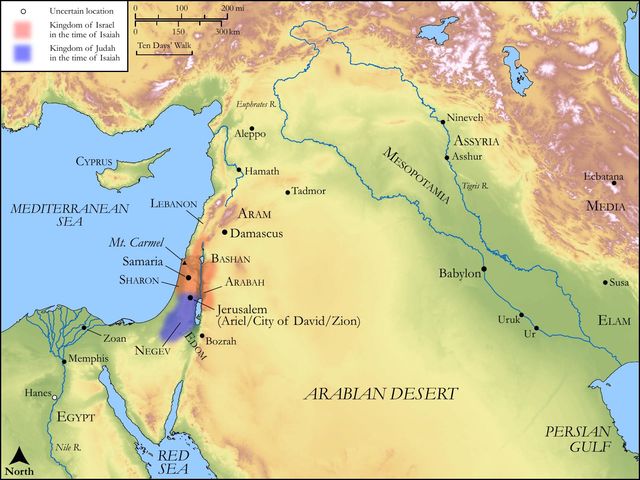
See on the biblical-era map
Study this verse
Public-domain commentary
Matthew Henry
From his Commentary on the Whole Bible. Henry comments on passages, not single verses — this entry covers Isaiah 29:1–8. His four-level outline is real structure in the source text, so it is rendered as structure.
That it is Jerusalem which is here called Ariel is agreed, for that was the city where David dwelt; that part of it which was called Zion was in a particular manner the city of David, in which both the temple and the palace were. But why it is so called is very uncertain: probably the name and the reason were then well known. Cities, as well as persons, get surnames and nicknames. Ariel signifies the lion of God, or the strong lion: as the lion is king among beasts, so was Jerusalem among the cities, giving law to all about her; it was the city of the great King (Psa 48:1, Psa 48:2); it was the head-city of Judah, who is called a lion's whelp (Gen 49:9) and whose ensign was a lion; and he that is the lion of the tribe of Judah was the glory of it. Jerusalem was a terror sometimes to the neighbouring nations, and, while she was a righteous city, was bold as a lion. Some make Ariel to signify the altar of burnt-offerings, which devoured the beasts offered in sacrifice as the lion does his prey. Woe to that altar in the city where David dwelt; that was destroyed with the temple by the Chaldeans. I rather take it as a woe to Jerusalem, Jerusalem; it is repeated here, as it is Mat 23:37, that it might be the more awakening. Here is,
I.The distress of Jerusalem foretold.
Though Jerusalem be a strong city, as a lion, though a holy city, as a lion of God, yet, if iniquity be found there, woe be to it. It was the city where David dwelt; it was he that brought that to it which was its glory, and which made it a type of the gospel church, and his dwelling in it was typical of Christ's residence in his church. This mentioned as an aggravation of Jerusalem's sin, that in it were set both the testimony of Israel and the thrones of the house of David.
1.Let Jerusalem know that her external performance of religious services will not serve as an exemption from the judgments of God (Isa 29:1): "Add year to year; go on in the road of your annual feasts, let all your males appear there three times a year before the Lord, and none empty, according to the law and custom, and let them never miss any of these solemnities: let them kill the sacrifices, as they used to do; but, as long as their lives are unreformed and their hearts unhumbled, let them not think thus to pacify an offended God and to turn away his wrath." Note, Hypocrites may be found in a constant track of devout exercises, and treading around in them, and with these they may flatter themselves, but can never please God nor make their peace with him.
2.Let her know that God is coming forth against her in displeasure, that she shall be visited of the Lord of hosts (Isa 29:6); her sins shall be enquired into and punished: God will reckon for them with terrible judgments, with the frightful alarms and rueful desolations of war, which shall be like thunder and earthquakes, storms and tempests, and devouring fire, especially upon the account of the great noise. When a foreign enemy was not in the borders, but in the bowels of their country, roaring and ravaging, and laying all waste (especially such an army as that of the Assyrians, whose commanders being so very insolent, as appears by the conduct of Rabshakeh, the common soldiers, no doubt, were much more rude), they might see the Lord of those hosts visiting them with thunder and storm. Yet, this being here said to be a great noise, perhaps it is intimated that they shall be worse frightened than hurt. Particularly,
(1.)Jerusalem shall be besieged, straitly besieged. He does not say, I will destroy Ariel, but I will distress Ariel; and she is therefore brought into distress, that, being thereby awakened to repent and reform, she may not be brought to destruction. I will (Isa 29:3) encamp against thee round about. It was the enemy's army that encamped against it; but God says that he will do it, for they are his hand, he does it by them. God had often and long, by a host of angels, encamped for them round about them for their protection and deliverance; but now he was turned to be their enemy and fought against them. The siege laid against them was of his laying, and the forts raised against them were of his raising. Note, When men fight against us we must, in them, see God contending with us.
(2.)She shall be in grief to see the country laid waste and all the fenced cities of Judah in the enemies' hand: There shall be heaviness and sorrow (Isa 29:2), mourning and lamentation - so these two words are sometimes rendered. Those that are most merry and jovial are commonly, when they come to be in distress, most overwhelmed with heaviness and sorrow; their laughter is then turned into mourning. "All Jerusalem shall then be unto me as Ariel, as the altar, with fire upon it and slain victims about it:" so it was when Jerusalem was destroyed by the Chaldeans; and many, no doubt, were slain when it was besieged by the Assyrians. "the whole city shall be an altar, in which sinners, falling by the judgments that are abroad, shall be as victims to divine justice." Or thus: - "There shall be heaviness and sorrow; they shall repent, and reform, and return to God, and then it shall be to me as Ariel. Jerusalem shall be like itself, shall become to me a Jerusalem again, a holy city," Isa 1:26.
(3.)She shall be humbled, and mortified, and made submissive (Isa 29:4): "Thou shalt be brought down from the height of arrogancy and insolence to which thou hast arrived: the proud looks and the proud language shall be brought down by one humbling providence after another." Those that despise God's judgments shall be humbled by them; for the proudest sinners shall either bend or break before him. They had talked big, had lifted up the horn on high, and had spoken with a stiff neck (Psa 75:5); but now thou shalt speak out of the ground, out of the dust, as one that has a familiar spirit, whispering out of the dust. This intimates,
[1.]That they should be faint and feeble, not able to speak up, nor to say all they would say; but as those who are sick, or whose spirits are ready to fail, their speech shall be low and interrupted.
[2.]That they should be fearful, and in consternation, forced to speak low as being afraid lest their enemies should overhear them and take advantage against them.
[3.]That they should be tame, and obliged to submit to the conquerors. When Hezekiah submitted to the king of Assyria, saying, I have offended, that which thou puttest on me I will bear (Kg2 18:14), then his speech was low, out of the dust. God can make those to crouch that have been most daring, and quite dispirit them.
II.The destruction of Jerusalem's enemies is foretold, for the comfort of all that were her friends and well-wishers in this distress (Isa 29:5, Isa 29:7): "Thou shalt be brought down (Isa 29:4), to speak out of the dust; so low thou shalt be reduced. But" (so it may be rendered) "the multitude of thy strangers and thy terrible ones, the numerous armies of the enemy, shall themselves be like small dust, not able to speak at all, or as much as whisper, but as chaff that passes away. Thou shalt be abased, but they shall be quite dispersed, smitten and slain after another manner (Isa 27:7); they shall pass away, yea it shall be in an instant, suddenly: the enemy shall be surprised with the destruction, and you with the salvation." The army of the Assyrians was by an angel laid dead upon the spot, in an instant, suddenly. Such will be the destruction of the enemies of the gospel Jerusalem. In one hour shall their judgment come, Rev 18:10. Again (Isa 29:6), "Thou shalt be visited, or (as it used to be rendered) She shall be visited with thunder and a great noise. Thou shalt be put into a fright which thou shalt soon recover. But (Isa 29:7) the multitude of the nations that fight against her shall be as a dream of a night-vision; they and their prosperity and success shall soon vanish past recall." The multitude of the nations that fight against Zion shall be as a hungry man who dreams that he eats, but still is hungry; that is,
1.Whereas they hoped to make a prey of Jerusalem, and to enrich themselves with the plunder of that opulent city, their hopes shall prove vain dreams, with which their fancies may please and sport themselves for a while, but they shall be disappointed. They fancied themselves masters of Jerusalem, but shall never be so.
2.They themselves, and all their pomp, and power, and prosperity, shall vanish like a dream when one awakes, shall be of as little value and as short continuance. Psa 73:20. He shall fly away as a dream Job 20:8. The army of Sennacherib vanished and was gone quickly, though it had filled the country as a dream fills a man's head, especially as a dream of meat fills the head of him that went to bed hungry. Many understand these verses as part of the threatening of wrath, when God comes to distress Jerusalem, and lay siege to her.
(1.)The multitude of her friends, whom she relies upon for help shall do her no good; for, though they are terrible ones, they shall be like the small dust, and shall pass away.
(2.)The multitude of her enemies shall never think they can do her mischief enough; but, when they have devoured her much, still they shall be but like a man who dreams he eats, hungry, and greedy to devour her more.
Historical interpretation
Historical reception
1 surviving comment on this verse from the historical church.
(Chapter 19, verse 1, and following) Woe to Ariel, Ariel the city that David besieged. Year after year is added, the appointed feasts have come to an end. I will besiege Ariel, and she will be sad and mournful; she will be like an Ariel to me. I will encircle you like a sphere, and I will throw up a mound against you, and I will set up siege works against you. You will be brought low, and your speech will come from the ground, and your voice will be like that of a python from the earth, and your speech will mumble from the dust. And it will be like the fine dust of those who blow against you, and like the passing smoke of those who have prevailed against you. And suddenly, immediately, it will be visited by the Lord of hosts, with thunder and earthquake, and with a great voice of whirlwind and tempest, and with the flame of devouring fire. And it will be like the dream of a night vision, the multitude of all the nations that have fought against Ariel, and all who have warred against her and besieged her and prevailed against her. As a hungry person dreams and eats, and when he has awakened, his soul is empty; and as a thirsty person dreams and drinks, and when he has awakened, he is still thirsty, and his soul is empty: so will be the multitude of all the nations that have fought against Mount Zion. Woe to Ariel, Ariel, the city that David besieged! Gather together year after year, eat, for you will eat with Moab; for I will oppress Ariel, and her strength and wealth will be mine, and I will encamp around you like David, and I will send a rampart around you, and set up towers all around you, and your words will be humbled on the ground, and your words will be brought down to the ground. And your voice will be like that of those who speak from the earth, and your voice will weaken to the ground. And the wealth of the wicked will be like dust from a wheel, and like ashes that are carried away, the multitude of those who oppressed you; it will be sudden from the Lord of hosts. For there will be a visitation with thunder, and a great shaking, a powerful storm, and a devouring flame of fire. And they will be like a dreamer at night, the wealth of all the nations that have fought against Ariel, and all who have fought against Jerusalem and gathered against it, and afflicted it. And they shall be like those who hunger and eat in dreams: when they wake up, their dream is in vain, and like one who thirsts and drinks in a dream, when he wakes up, he will still be thirsty, and his soul will have hoped in vain. So shall be the riches of all the nations that have fought against Mount Zion. Because we have interpreted, Woe, in Hebrew it is written Oi (), which is sometimes used in the vocative case, so that Ariel may not mourn, but call out; although in the current context it should be understood as mourning. Ariel is also interpreted as the lion of God; and for the city which Aquila interpreted, πολίχνην, that is, a small town or village, is read in Hebrew as Cariath, which properly means a village, and in Syriac it is called Cartha, hence it is also called a village of forests Cariath Jarim. Finally, in the earlier passage (Isaiah 1:21) where we read: How has the faithful city Zion become a prostitute? for city, Cariath is written, that is, a village: which we can express as a translation of Aquila literally, as a little city. Therefore, Ariel, which means the lion of God, was once called the strongest Jerusalem: or, as others believe, the temple and altar of God that was in Jerusalem. And what follows: Which David conquered, as Symmachus interpreted it, the stronghold of David, and Theodotion, the encampment of David, is read in Hebrew as Hana, which the most learned Hebrews wanted to signify as dwelling place. So if we read: which David conquered, let us refer to that time when David captured the fortress of Zion, while the blind and lame resisted, and Joab, the first, ascended the heights. But according to Symmachus and Theodotion, it should be understood that David restored and fortified it, and a year was added to the year, or subtracted, as Aquila interpreted; and the festivals have passed. For when the temple was destroyed and the Jewish religion abolished, all their festivities perished. And the Lord says that He will encamp around Ariel with the army of Babylon, and it will be sad and mournful when it is destroyed by them. And again under Jesus, the son of Josedech, the high priest, and Zorobabel, the son of Salathiel, were Ezra and Nehemiah, when Haggai and Zechariah prophesied that it would be like Ariel, having the appearance of the ancient temple, but without its magnificence and adornment. Moreover, the Lord threatens that He will surround Ariel with a sphere, and cast a rampart against it, and set up fortifications for its siege, and fulfill what He Himself laments concerning Jerusalem in the Gospel: 'If thou hadst known, even thou, at least in this thy day, the things which belong unto thy peace! But now they are hid from thine eyes. For the days shall come upon thee, that thine enemies shall cast a trench about thee, and compass thee round, and keep thee in on every side, and shall lay thee even with the ground' (Luke 19:42-44). And Jerusalem will be trampled by the nations until the time of the Gentiles is fulfilled. In other words, the same prophet now says that she who was humiliated will speak from the earth, and her voice will be heard from the dust. Her voice will be like that of a python from the earth, and it will murmur like sparrows, so that through these words he may signify the necromancy of the magi, by which they are said to summon souls and hear the voices of thin shades, or rather, of demons. Finally, regarding the python, Aquila interpreted the great one, which is called in Hebrew Cheb (), which the 70 interpreters translated as speaking of the earth. With these words, it is indicated that the ruin of the temple will last until the end of the world, collapsed into ashes and never to be raised again. And so, O Ariel, the army of Roman power will surround you, and they will be compared to an innumerable dust that flies through the air. Therefore, it is not the weakness of their opponents that the dust and ashes are compared to, but the multitude that is equal to countless grains of sand. And this will happen suddenly and quickly, so that in the midst of peace, wars will rise up under Nero, and the Lord of hosts will visit Jerusalem with thunder and earthquake, and whirlwind and devouring fire, which signifies the burning of the temple. But the Romans, after the Jews were defeated and Jerusalem was destroyed under Titus and Vespasian, offered the plundered vessels of God to the Capitol; and they thought that their own power and the favor of the gods, rather than the anger of God, was the reason for what they had done, as if in a dream and in a nightly vision, they will possess all riches. And just as someone who is hungry thinks in their dreams that they are eating, and someone who is thirsty drinks from dry throats, and when they wake up their thirst becomes even stronger, deceived by the empty drink: so the multitude of all nations, who fought against the power of Rome and subjugated to it, will have wealth like a shadow, and a cloud, and a dream of the night, which they will leave behind with their untimely destruction. In the place where we have been placed, all who have waged war and besieged and prevailed against it have been translated to seventy, and all who have fought against Jerusalem, which is not found in Hebrew. In this beginning of the chapter, where we said, 'A year is added to a year, or subtracted,' they are interpreted as 'gather the fruits or produce, year upon year;' 'eat, for you will eat with Moab.' And the meaning is, before the acceptable year of the Lord's preaching comes, indeed two years, of which we read in the Song of Habakkuk according to the Hebrew: 'In the midst of two times you will be known' (Habakkuk 3), 'sow for yourselves in tears so that you may reap in joy' (Psalm 126). It is written in the Gospel according to John that the Lord came to Jerusalem three times during the Passover, which makes two years (John 2:13). However, what follows, 'For you shall eat with Moab,' is not found in Hebrew. We can say that unless the fruits of repentance are gathered for themselves, they will begin to eat with those who do not enter the Church of the Lord forever. The other things in which they seem to disagree are obvious, and from what we have explained, their interpretation is easy. I know that I have read Ariel's interpretation, my light is God's, which is far different. Here the first syllable is written with Aleph and Res: lux autem quae Hebraice dicitur Or, inter Aleph et Res mediam habet litteram Vau, quae in praesenti nomine non habetur. And everything that is now said against Ariel refers to heretics, who consider their doctrine to be the light of God, and they must be fought by the true David: all their solemnities must be taken away, and present joy must be turned into future sorrow: to whom God commands to repent, lest they begin to eat with the Moabites, and be similar to the Gentiles. For he will attack Ariel himself, and he will surround all their power and wealth with his army. And with the towers, that is, the leaders of the Church, he will humble their words on the earth, so that they may not raise their mouth to heaven, but be written on the earth, speak of the earth, and be like dust scattered by the wind. And all the wealth of the wicked will appear in an instant, when he visits them in his majesty, descending in a whirlwind, storm, and fire of punishment; and they will understand that all their wealth, the pomp of their words, and the arguments of their verses, are compared in vain to a dream of someone eating and drinking: those who fight against Jerusalem, the vision of peace; or against Ariel, the strongest lion, and ultimately against Mount Zion, where the city of the Church cannot be hidden.
Continue studying Isaiah 29:4 across the web’s major study libraries — every link below opens this exact verse, chapter, or book on the destination site.
Read & Compare
 BibleGatewayThis verse in more than 200 translations and 70 languages.
 Bible.comThe YouVersion reader — hundreds of translations, reading plans, and highlights.
 ESV.orgCrossway's official English Standard Version reader.
 NET BibleThe NET translation with 60,000+ translators' notes on every rendering decision.
 STEP BibleTyndale House's free study tool — original text, vocabulary, and scholarly resources.
 BibliaLogos Bible Software's free web reader.
 USCCBThe New American Bible (Revised Edition) with the U.S. bishops' study notes.
Commentaries
 BibleHub CommentariesDozens of classic commentaries on this verse, gathered on one page.
 StudyLightMore than 100 commentary sets — the largest collection on the web.
 BibleRefPlain-English commentary on what this verse means, verse by verse.
 Enduring WordDavid Guzik's free commentary on this chapter, widely used by Bible teachers.
 Bible Study ToolsVerse commentary alongside Greek and Hebrew study aids.
Original Language & Research
- BibleHub InterlinearThe verse word by word — original language, transliteration, and English.
- BibleHub LexiconEvery word's original-language definition and Strong's entry.
 Blue Letter BibleDeep-study tools — Strong's numbers, concordance, and word studies.
 SefariaThe Hebrew text with Rashi and centuries of Jewish commentary.
Sermons, Hymns & Audio


TrulyRandomVerse is not affiliated with these sites and doesn’t control their content. They’re linked because they’re genuinely useful.
Summary
Isaiah 29:4 delivers a stark prophetic declaration concerning Jerusalem's profound and divinely orchestrated humiliation. Poetically referred to as "Ariel," the city is depicted as being utterly abased, reduced to a state where its voice emanates faintly from the ground and dust, akin to the illicit murmuring of a necromancer. This vivid imagery powerfully conveys a complete loss of dignity, authority, and influence, serving as a severe divine judgment upon the city for its spiritual blindness, complacency, and rebellion against God. The verse underscores the grave consequences of unfaithfulness, where even a privileged city faces such a dramatic and demeaning reversal of fortune.
Context
ShowHideLiterary Context
Isaiah 29 initiates a powerful prophetic oracle against "Ariel," a symbolic and poetic designation for Jerusalem, carrying connotations of both "lion of God" (suggesting strength) and "hearth of God" (referring to the altar in the Temple). The preceding verses Isaiah 29:1-3 detail God's impending judgment, describing a siege that will bring immense distress, mourning, and lamentation upon the city. Despite its sacred status and the presence of God's altar, Jerusalem is portrayed as spiritually dull, blind, and complacent Isaiah 29:9-10. Verse 4, therefore, serves as the climactic and most vivid description of the city's abasement, illustrating the depth of its fall from prominence and authority as a direct result of this divine chastisement. The imagery of speaking from the ground sets the stage for the subsequent lament and the eventual promise of spiritual renewal and restoration for a remnant Isaiah 29:17-24.
Historical & Cultural Context
Isaiah prophesied during the tumultuous 8th century BCE, a period dominated by the ascendant Assyrian Empire. Jerusalem faced constant geopolitical threats, and this prophecy likely alludes to the Assyrian siege of Jerusalem under Sennacherib in 701 BCE, though its ultimate fulfillment encompasses broader divine judgments against the city's spiritual state. Culturally, the reference to a "familiar spirit" (ʼôwb) is profoundly significant. In ancient Israel, consulting mediums or necromancers who claimed to communicate with the dead was a strictly forbidden practice under Mosaic Law Leviticus 19:31; Deuteronomy 18:10-12. The voices of such mediums were commonly described as eerie, low, and murmuring, as if emanating from the underworld or the grave. By comparing Jerusalem's future voice to that of a familiar spirit, Isaiah emphasizes the city's degradation to something weak, illicit, and stripped of its once vibrant, authoritative, and divinely-inspired prophetic voice. This comparison would have been particularly shocking and damning to an Israelite audience.
Key Themes
ShowHideThis verse contributes significantly to several overarching themes within the book of Isaiah and the broader prophetic corpus. It powerfully illustrates the theme of divine judgment against a people who have become spiritually deaf and complacent, despite their covenant relationship with God. The imagery of being "brought down" and speaking "out of the dust" highlights profound humiliation and abasement, a stark reversal of Jerusalem's expected status as God's holy city. This abasement directly correlates with the theme of consequences of disobedience and spiritual blindness, where outward religious observance has replaced genuine faith and obedience, leading to a loss of influence and authority. The once-proud city's voice, meant to be a beacon of truth and a source of divine revelation, is reduced to a barely audible whisper, symbolizing its diminished spiritual and political standing. This serves as a potent reminder that God's covenant promises are conditional upon faithfulness, a principle articulated throughout the covenant stipulations, particularly in Deuteronomy 28. The verse also subtly introduces the theme of divine sovereignty, demonstrating God's ultimate control over the destiny of nations and cities, even His chosen ones.
Exposition and Analysis
ShowHideKey Word Analysis
ShowHideThis primitive root (H8213) means "to depress or sink (expectation figuratively, to humiliate, intransitive or transitive); abase, bring (cast, put) down, debase, humble (self), be (bring, lay, make, put) low(-er)." In Isaiah 29:4, its use in "thou shalt be brought down" vividly portrays the complete and utter humiliation of Jerusalem. It signifies a dramatic reversal of fortune, from a position of prominence and pride to one of extreme lowness and degradation, emphasizing divine agency in this abasement. The passive voice implies that this is something done to Jerusalem by a higher power, namely God.
From a root suggesting a "mumble" (H178), this term refers to "a water skin (from its hollow sound); hence a necromancer (ventriloquist, as from a jar); bottle, familiar spirit." The comparison of Jerusalem's voice to that of "one that hath a familiar spirit" is profoundly damning. It links the city's future utterance not with divine prophecy or authoritative speech, but with forbidden, illicit, and eerie communication associated with the dead. This implies a voice devoid of life, power, or divine sanction, a stark contrast to the vibrant, life-giving word of God that should have emanated from Jerusalem.
This primitive root (H6850) means "to coo or chirp (as a bird); chatter, peep, whisper." The final phrase, "thy speech shall whisper out of the dust," uses this word to underscore the extreme faintness and insignificance of Jerusalem's voice. It is not merely low but barely audible, a mere "peep" or "whisper," a stark contrast to the booming pronouncements expected from the city of God. This reinforces the theme of complete loss of power and influence, signifying a state of utter desolation and spiritual impotence.
Verse Breakdown
ShowHide"And thou shalt be brought down"
This opening clause immediately establishes the central theme of humiliation and abasement. The verb "brought down" implies a forceful, divinely orchestrated act of debasement, indicating that Jerusalem's fall is not accidental but a direct and intentional consequence of God's judgment. It suggests a dramatic descent from a high, proud position to one of utter lowness and defeat, a reversal of its perceived status.
"and shalt speak out of the ground"
This imagery is deeply symbolic and evocative. Speaking "out of the ground" conjures the idea of a voice coming from the grave, from a state of death, or from beneath the earth. It signifies a complete loss of vitality, authority, and freedom, as if the city itself is buried or utterly defeated, its voice muffled, constrained, and devoid of living power. It is the voice of the vanquished, not the victor.
"and thy speech shall be low out of the dust"
This phrase intensifies the preceding imagery, adding another layer of degradation. "Dust" is a common biblical metaphor for mortality, humiliation, and extreme lowness (e.g., Genesis 3:19). A voice "low out of the dust" reinforces the idea of a voice that is barely audible, stripped of all power and dignity, emanating from a state of profound degradation and insignificance. It is the voice of one utterly defeated and humbled.
"and thy voice shall be, as of one that hath a familiar spirit, out of the ground"
This is the most potent and damning simile in the verse. By comparing Jerusalem's voice to that of a necromancer, Isaiah condemns the city's future utterances as illicit, eerie, and devoid of divine truth. The voices of familiar spirits were associated with the dead and were strictly forbidden by God's law, emphasizing that Jerusalem's voice will be an abomination, lacking any legitimate or authoritative prophetic power, and still emanating from a state of death-like abasement. It suggests a perversion of its true calling.
"and thy speech shall whisper out of the dust"
This final clause provides a chilling summary and reiteration, underscoring the extreme weakness and insignificance of Jerusalem's future voice. The "whisper" (tsâphaph) emphasizes the barely audible nature, a stark contrast to the authoritative pronouncements expected from God's chosen city. It encapsulates the complete and utter humiliation, where the city's once-proud voice is reduced to a faint, ghostly murmur from the depths of its defeat, signifying a profound spiritual and physical desolation.
Literary Devices
ShowHideIsaiah 29:4 is exceptionally rich in Imagery, painting a vivid and visceral picture of Jerusalem's downfall through sensory details, primarily focusing on sound and spatial position. The repeated phrases "out of the ground" and "out of the dust" create a powerful visual of extreme lowness, burial, and desolation, emphasizing the city's complete abasement and loss of life. Simile is prominently employed in "as of one that hath a familiar spirit," which draws a damning comparison between Jerusalem's once-authoritative voice and the illicit, eerie murmuring of a necromancer. This comparison effectively strips the city of its prophetic authority and associates it with forbidden, unholy practices. The verse also utilizes Hyperbole to emphasize the severity of the judgment; the descriptions of speaking from the ground and whispering from the dust are exaggerated to convey total defeat, profound degradation, and an absolute loss of dignity and influence. Furthermore, Parallelism is a key structural element, evident in the repeated grammatical structures and similar concepts ("shalt speak out of the ground" // "thy speech shall be low out of the dust" // "thy voice shall be, as of one that hath a familiar spirit, out of the ground" // "thy speech shall whisper out of the dust"). This repetition serves to reinforce the central theme of profound humiliation and the diminished, almost non-existent, state of Jerusalem's voice. The entire verse functions as a form of Personification, as the city of Jerusalem is given human attributes of speaking and having a voice, making its degradation more poignant and relatable.
Theological and Thematic Connections
ShowHideIsaiah 29:4 serves as a profound theological statement on divine justice, the consequences of spiritual apathy, and the conditional nature of God's covenant blessings. It reveals that God's covenant people are not exempt from judgment when they turn from Him and become spiritually blind and complacent, as Jerusalem had. The imagery of being brought low and speaking from the dust underscores the biblical principle that pride and spiritual presumption precede a fall, and that true authority and influence stem from faithfulness to God, not from geographical location, religious ritual, or past privilege. This verse highlights God's absolute sovereignty over nations and His willingness to humble even His chosen city to bring about repentance, purification, and ultimately, a remnant's restoration. It reminds us that an authentic voice, whether of an individual or a community, must be rooted in divine truth, humility, and obedience, lest it be reduced to an empty, powerless whisper, devoid of spiritual impact.
Reflection and Application
ShowHideIsaiah 29:4 offers a sobering and urgent call to introspection for individuals and communities of faith today. It serves as a potent warning against the insidious dangers of spiritual complacency, where outward religious observance or historical privilege masks an inner spiritual deafness, indifference to God's word, and a lack of genuine repentance. Just as Jerusalem's privileged status did not shield it from divine judgment, so too must believers guard against presuming upon God's grace without cultivating active faith, humility, and obedience. The powerful imagery of a once-proud voice reduced to a whisper emanating from the dust challenges us to critically examine the authenticity and impact of our own spiritual witness and the collective voice of our faith communities. Is our voice for Christ strong, clear, and authoritative, boldly proclaiming His truth and love, or has it become muffled, compromised, and barely audible due to compromise with the world, spiritual apathy, or fear of man? This verse compels us to cultivate a posture of humility before God, to actively listen for His warnings and promptings, and to ensure that our lives and speech truly reflect His truth and righteousness, lest we too experience a spiritual abasement that diminishes our influence and witness in a world desperately needing to hear the clear voice of the Gospel.
Questions for Reflection
ShowHideFAQ
ShowHideWho is 'Ariel' and why is Jerusalem called that in Isaiah?
ShowHide"Ariel" is a poetic and symbolic name for Jerusalem, used by Isaiah in chapter 29. The name carries a significant double meaning relevant to the prophecy. It can mean "lion of God," suggesting Jerusalem's strength, its formidable nature as a city, and perhaps its association with the tribe of Judah (the lion tribe). However, it can also mean "hearth of God" or "altar hearth," referring to the great altar of burnt offering in the Jerusalem Temple. This latter meaning is particularly poignant in Isaiah 29, as the "hearth" that consumes sacrifices will itself be consumed by divine judgment, becoming a place of distress and lamentation, as vividly described in Isaiah 29:1-2. The dual meaning underscores both Jerusalem's privileged status and its impending doom.
What does it mean for Jerusalem's voice to be "as of one that hath a familiar spirit"?
ShowHideIn ancient Israel, a "familiar spirit" (ʼôwb in Hebrew) referred to a medium or necromancer who claimed to communicate with the dead. Such practices were strictly forbidden by God's law, considered an abomination (e.g., Leviticus 19:31; Deuteronomy 18:10-12). The voices of these mediums were often described as eerie, low, and murmuring, as if coming from the grave or the underworld. By comparing Jerusalem's future voice to that of a familiar spirit, Isaiah is making a powerful and condemnatory statement: the city's once-authoritative and divinely-inspired prophetic voice will be reduced to something weak, illicit, and devoid of divine power or truth. It signifies a complete loss of its legitimate spiritual authority and a descent into a state akin to spiritual death and perversion.
Does this prophecy in Isaiah 29:4 have a historical fulfillment?
ShowHideYes, Isaiah 29:4, along with the broader prophecy against Ariel, found a significant historical fulfillment in the Assyrian siege of Jerusalem in 701 BCE by Sennacherib. While the city was miraculously delivered from total destruction (as recounted in Isaiah 37), the siege brought immense distress and humiliation upon Jerusalem, severely reducing its power and influence. Later, the Babylonian destruction of Jerusalem in 586 BCE (as described in 2 Kings 25) represents an even more complete and devastating fulfillment of the city's abasement, where its voice was truly silenced and its people scattered into exile. Beyond these historical events, the prophecy also carries a broader spiritual meaning, pointing to the consequences of spiritual blindness and rebellion for any people or community that turns away from God.
Christ-Centered Fulfillment
ShowHideWhile Isaiah 29:4 speaks directly of Jerusalem's judgment and profound humiliation, it finds a profound and redemptive Christ-centered fulfillment in the person and work of Jesus Christ. The prophecy of Jerusalem being "brought down" and speaking "out of the ground" powerfully foreshadows the ultimate abasement and suffering of the Messiah Himself. Jesus, though eternally divine, willingly "made himself nothing by taking the very nature of a servant, being made in human likeness" (Philippians 2:7). He was brought low, enduring rejection, suffering, and ultimately, death on the cross, truly speaking "out of the ground" in His death and burial. He was laid in a tomb, silenced by death, a profound humiliation for the Son of God. Yet, it is precisely through this ultimate act of abasement that His voice, initially rejected by many in Jerusalem, becomes the ultimate authoritative and life-giving voice for all humanity. From the "dust" of the grave, He rose triumphantly, conquering sin and death. His resurrection transformed the whisper of death into the thunderous proclamation of victory, fulfilling the promise that all authority in heaven and on earth has been given to Him (Matthew 28:18). Thus, the judgment upon Jerusalem in Isaiah 29:4, while literal for the city, serves as a type for the spiritual judgment that fell upon Christ, allowing for His ultimate exaltation and the establishment of a new, living voice through His Spirit. This Spirit now empowers His Church to speak with divine authority, not from the dust of defeat, but from the power of the resurrected Christ and the Spirit of truth (John 16:13).