


1 Samuel 28:13
Bible text: King James Version (1769 Blayney text) · Public domain
Bible text: Berean Standard Bible · Public domain
Bible text: American Standard Version (1901) · Public domain
Bible text: World English Bible, Messianic edition · Public domain
Bible text: Geneva Bible (1599) · Public domain
Bible text: Young's Literal Translation · Public domain
- וַיֹּאמֶרvai·Yo·merand he saidH559Conj-w ¦ V-Qal-ConsecImperf-3msVerb Qal Consecutive Imperfect 3rd Singular Masculineוַandיֹּאמֶרhe said
- לָהּlahto <the> herPrep-l ¦ 3fsSuffix Personal 3rd Singular Feminineלָto <the>הּher
- הַמֶּלֶךְha·Me·lekhthe kingH4428Art ¦ N-msNoun Singular Masculine Absoluteהַtheמֶּלֶךְking
- אַל'almay notH408NegParticle Negative
- תִּירְאִיtir·'Iyou fearH3372V-Qal-Imperf-2fsVerb Qal Imperfect 2nd Singular Feminine
- כִּיkiforH3588PrtParticle Conditional
- מָהmahwhat?H4100InterrogPronoun Interrogative
- רָאִיתra·'Ithave you seenH7200V-Qal-Perf-2fsVerb Qal Perfect 2nd Singular Feminine
- וַתֹּאמֶרva·To·merand she saidH559Conj-w ¦ V-Qal-ConsecImperf-3fsVerb Qal Consecutive Imperfect 3rd Singular Feminineוַandתֹּאמֶרshe said
- הָאִשָּׁהha·'i·Shahthe womanH802Art ¦ N-fsNoun Singular Feminine Absoluteהָtheאִשָּׁהwoman
- אֶל'eltoH413PrepPreposition
- שָׁאוּלsha·'UlSaulH7586N-proper-mNoun Proper Masculine
- אֱלֹהִים'E·lo·HimgodsH430N-mpNoun Plural Masculine Absolute
- רָאִיתִיra·'I·tiI have seenH7200V-Qal-Perf-1csVerb Qal Perfect 1st Singular common gender
- עֹלִים'o·Limcoming upH5927V-Qal-Prtcpl-mpVerb Qal Participle Plural Masculine Absolute
- מִןminfromH4480PrepPreposition
- הָאָרֶץha·'A·retzthe earthH776Art ¦ N-fsNoun Singular Feminine Absoluteהָtheאָרֶץearth
English is a literal word-by-word gloss of the Hebrew, not the KJV's wording. Why?
This is the original text the KJV's translators worked from — each Hebrew word with its own literal English meaning in this verse, prepared by scholars at Tyndale House, Cambridge. The KJV translates whole sentences, not word by word, so its wording differs: one Hebrew word can become several English words, and the KJV may choose “the LORD” where the gloss reads “Yahweh”. Both are faithful — they answer different questions. For the KJV's own rendering, switch to the KJV text.
Details
See on the biblical-era map
Study this verse
Public-domain commentary
Matthew Henry
From his Commentary on the Whole Bible. Henry comments on passages, not single verses — this entry covers 1 Samuel 28:7–14. His two-level outline is real structure in the source text, so it is rendered as structure.
Here, I. Saul seeks for a witch, Sa1 28:7. When God answered him not, if he had humbled himself by repentance and persevered in seeking God, who knows but that at length he might have been entreated for him? but, since he can discern no comfort either from heaven or earth (Isa 8:21, Isa 8:22), he resolves to knock at the gates of hell, and to see if any there will befriend him and give him advice: Seek me a woman that has a familiar spirit, Sa1 28:7. And his servants were too officious to serve him in this evil affair; they presently recommended one to him at Endor (a city not far off) who had escaped the execution of Saul's edict. To her he resolves to apply. Herein he is chargeable, 1. With contempt of the God of Israel; as if any creature could do him a kindness when God had left him and frowned upon him. 2. With contradiction to himself. He knew the heinousness of the sin of witchcraft, else he would not have cut off those that had familiar spirits; yet now he had recourse to that as an oracle which he had before condemned as an abomination. It is common for men to inveigh severely against those sins which they are in no temptation to, but afterwards to be themselves overcome by them. Had one told Saul, when he was destroying the witches, that he himself would, ere long, consult with one, he would have said, as Hazael did, What? Is thy servant a dog? But who knows what mischiefs those will run into that forsake God and are forsaken of him?
II.Hearing of one he hastens to her, but goes by night, and in disguise, only with two servants, and probably on foot, Sa1 28:8. See how those that are led captive by Satan are forced,
1.To disparage themselves. Never did Saul look so mean as when he went sneaking to a sorry witch to know his fortune.
2.To dissemble. Evil works are works of darkness, and they hate the light, neither care for coming to it. Saul went to the witch, not in his robes, but in the habit of a common soldier, not only lest the witch herself, if she had known him, should decline to serve him, either fearing he came to trepan her or resolving to be avenged on him for his edict against those of her profession, but lest his own people should know it and abhor him for it. Such is the power of natural conscience that even those who do evil blush and are ashamed to do it.
III.He tells her his errand and promises her impunity.
1.All he desires of her is to bring up one from the dead, whom he had a mind to discourse with. It was necromancy or divination by the dead, that he hoped to serve his purpose by. This was expressly forbidden by the law (Deu 18:11), seeking for the living to the dead, Isa 8:19. Bring me up him whom I shall name, Sa1 28:8. This supposes that it was generally taken for granted that souls exist after death, and that when men die there is not an end of them: it supposes too that great knowledge was attributed to separate souls. But to think that any good souls would come up at the beck of an evil spirit, or that God, who had denied a man the benefit of his own institutions, would suffer him to reap any real advantage by a cursed diabolical invention, was very absurd.
2.She signifies her fear of the law, and her suspicion that this stranger came to draw her into a snare (Sa1 28:9): Thou knowest what Saul has done. Providence ordered it so that Saul should be told to his face of his edict against witches, at this very time when he was consulting one, for the greater aggravation of his sin. She insists upon the peril of the law, perhaps to raise her price; for, though no mention is made of her fee, no doubt she demanded and had a large one. Observe how sensible she is of danger from the edict of Saul, and what care she is in to guard against it; but not at all apprehensive of the obligations off God's law and the terrors of his wrath. She considered what Saul had done, not what God had done, against such practices, and feared a snare laid for her life more than a snare laid for her soul. It is common for sinners to be more afraid of punishment from men than of God's righteous judgment. But,
3.Saul promises with an oath not to betray her, Sa1 28:10. It was his duty as a king to punish her and he knew it, yet he swears no to do it; as if he could by his own oath bind himself from doing that which, by the divine command, he was bound to do. But he promised more than he could perform when he said, There shall no punishment happen to thee; for he that could not secure himself could much less secure her from divine vengeance.
IV.Samuel, who was lately dead, is the person whom Saul desired to have some talk with; and the witch, with her enchantments, gratifies his desire, and brings them together.
1.As soon as Saul had given the witch the assurance she desired (that he would not discover her) she applied to her witchcrafts, and asked very confidently, Whom shall I bring up to thee? Sa1 28:11. Note, Hopes of impunity embolden sinners in their evil ways and harden their hearts.
2.Saul desires to speak with Samuel: Bring me up Samuel. Samuel had anointed him to the kingdom and had formerly been his faithful friend and counsellor, and therefore with him he wished to advise. While Samuel was living at Ramah, not far from Gibeah of Saul, and presided there in the school of the prophets, we never read of Saul's going to him to consult him in any of the difficulties he was in (it would have been well for him if he had); then he slighted him, and perhaps hated him, looking upon him to be in David's interest. But now that he is dead, "O for Samuel again! By all means, bring me up Samuel." Note, Many that despise and persecute God's saints and ministers when they are living would be glad to have them again when they are gone. Send Lazarus to me, and send Lazarus to my father's house, Luk 16:24-27. The sepulchres of the righteous are garnished.
3.Here is a seeming defector chasm in the story. Saul said, Bring me up Samuel, and the very next words are, When the woman saw Samuel, (Sa1 28:12), whereas one would have expected to be told how she performed the operation, what spells and charms she used, or that some little intimation would be given of what she said or did; but the profound silence of the scripture concerning it forbids our coveting to know the depths of Satan (Rev 2:24) or to have our curiosity gratified with an account of the mysteries of iniquity. It has been said of the books of some of the popish confessors that, by their descriptions of sin, they have taught men to commit it; but the scripture conceals sinful art, that we may be simple concerning evil, Rom 16:19.
4.The witch, upon sight of the apparition, was aware that her client was Saul, her familiar spirit, it is likely, informing her of it (Sa1 28:12): "Why hast thou deceived me with a disguise; for thou art Saul, the very man that I am afraid of above any man?" Thus she gave Saul to understand the power of her art, in that she could discover him through his disguise; and yet she feared lest, hereafter, at least, he should take advantage against her for what she was now doing. Had she believed that it was really Samuel whom she saw, she would have had more reason to be afraid of him, who was a good prophet, than of Saul, who was a wicked king. But the wrath of earthly princes is feared by most more than the wrath of the King of kings.
5.Saul (who, we may suppose, was kept at a distance in the next room) bade her not to be afraid of him, but go on with the operation, and enquired what she saw? Sa1 28:13. O, says the woman, I saw gods (that is, a spirit) ascending out of the earth; they called angels gods, because spiritual beings. Poor gods that ascend out of the earth! But she speaks the language of the heathen, who had their infernal deities and had them in veneration. If Saul had thought it necessary to his conversation with Samuel that the body of Samuel should be called out of the grave, he would have taken the witch with him to Ramah, where his sepulchre was; but the design was wholly upon his soul, which yet, if it became visible, was expected to appear in the usual resemblance of the body; and God permitted the devil, to answer the design, to put on Samuel's shape, that those who would not receive the love of the truth might be given up to strong delusions and believe a lie. That it could not be the soul of Samuel himself they might easily apprehend when it ascended out of the earth, for the spirit of a man, much more of a good man, goes upward, Ecc 3:21. But, if people will be deceived, it is just with God to say, "Let them be deceived." That the devil, by the divine permission, should be able to personate Samuel is not strange, since he can transform himself into an angel of light! nor is it strange that he should be permitted to do it upon this occasion, that Saul might be driven to despair, by enquiring of the devil, since he would not, in a right manner, enquire of the Lord, by which he might have had comfort. Saul, being told of gods ascending, was eager to know what was the form of this deity, and in what shape he appeared, so far was he from conceiving any horror at it, his heart being wretchedly hardened by the deceitfulness of sin. Saul, it seems, was not permitted to see any manner of similitude himself, but he must take the woman's word for it, that she saw an old man covered with a mantle, or robe, the habit of a judge, which Samuel had sometimes worn, and some think it was for the sake of that, and the majesty of its aspect, that she called this apparition Elohim, a god or gods; for so magistrates are styled, Psa 82:1.
6.Saul, perceiving, by the woman's description, that it was Samuel, stooped with his face to the ground, either, as it is generally taken, in reverence to Samuel, though he saw him not, or perhaps to listen to that soft and muttering voice which he now expected to hear (for those that had familiar spirits peeped and muttered, Isa 8:19); and it should seem Saul bowed himself (probably by the witch's direction) that he might hear what was whispered and listen carefully to it; for the voice of one that has a familiar spirit is said to come out of the ground, and whisper out of the dust, Isa 29:4. He would stoop to that who would not stoop to the word of God.
Historical interpretation
Historical reception
2 surviving comments on this verse. Each one is dated, so this reads as a timeline rather than a list.
They [the Jews] reflected on the death of Abraham and the prophets, understanding that Samuel, too, when he was under the earth because of death, was brought up by a medium who thought the gods were somewhere below the earth and who said, “I saw gods ascending from the earth.” They had not, however, comprehended the life of Abraham and the prophets, nor that the God of Abraham, Isaac and Jacob was not the God of them as men who were dead, but as men who were alive.
Samuel in hades! Samuel, he who was special among the prophets, who was dedicated to God from his birth, who before his birth is said to be in the temple, who at the same time he was weaned was clothed with the ephod and double cloak and became a priest of the Lord, the child to whom the Lord when he speaks uttered his messages, he was brought up by a medium?… Why is Samuel in hades?…Samuel comes up, and note that she does not say that she saw the soul of Samuel. She does not say she saw a man. She has been scared by this thing which she saw. What did she see? “I saw gods,” she says, “coming up from the earth.” And perhaps Samuel has not only come up in order just to prophesy to Saul, but it is likely, just as here “with the holy he will be holy, and with an innocent man he will be innocent,” and with the one of the chosen he will be as one of the chosen, and here the ways of the holy are with the holy but not with the sinners. And if then at some point the way of life of the holy is with the sinners for the purpose of saving the sinners, so perhaps also you may speculate whether either the holy souls of the other prophets in the coming up of Samuel come up together or perhaps whether they were angels of their spirits—the prophet says, “the angel who speaks in me”—or whether they were angels who came up together with the spirits. And every [place] is filled with those who need salvation, and “are they not all ministering spirits sent forth to serve for the sake of those who are to obtain salvation?” Why do you fear to say that every place has need of Jesus Christ? Those who have need of Christ have need of the prophets. But if he has no need of Christ, he has no need of those who prepare for the appearance and dwelling of Christ.
Continue studying 1 Samuel 28:13 across the web’s major study libraries — every link below opens this exact verse, chapter, or book on the destination site.
Read & Compare
 BibleGatewayThis verse in more than 200 translations and 70 languages.
 Bible.comThe YouVersion reader — hundreds of translations, reading plans, and highlights.
 ESV.orgCrossway's official English Standard Version reader.
 NET BibleThe NET translation with 60,000+ translators' notes on every rendering decision.
 STEP BibleTyndale House's free study tool — original text, vocabulary, and scholarly resources.
 BibliaLogos Bible Software's free web reader.
 USCCBThe New American Bible (Revised Edition) with the U.S. bishops' study notes.
Commentaries
 BibleHub CommentariesDozens of classic commentaries on this verse, gathered on one page.
 StudyLightMore than 100 commentary sets — the largest collection on the web.
 BibleRefPlain-English commentary on what this verse means, verse by verse.
 Enduring WordDavid Guzik's free commentary on this chapter, widely used by Bible teachers.
 Bible Study ToolsVerse commentary alongside Greek and Hebrew study aids.
Original Language & Research
- BibleHub InterlinearThe verse word by word — original language, transliteration, and English.
- BibleHub LexiconEvery word's original-language definition and Strong's entry.
 Blue Letter BibleDeep-study tools — Strong's numbers, concordance, and word studies.
 SefariaThe Hebrew text with Rashi and centuries of Jewish commentary.
Sermons, Hymns & Audio


TrulyRandomVerse is not affiliated with these sites and doesn’t control their content. They’re linked because they’re genuinely useful.
Summary
In 1 Samuel 28:13, King Saul, in a desperate and disobedient act, consults a medium at Endor to conjure the prophet Samuel. The verse captures the medium's astonished and fearful declaration to Saul, "I saw gods ascending out of the earth," a pivotal moment revealing the terrifying and unexpected nature of the apparition that manifested, confirming the supernatural, albeit illicit, success of the conjuration. This exclamation sets the stage for the dire prophecy Samuel delivers, underscoring the gravity of Saul's spiritual rebellion and the unwavering sovereignty of God.
Context
ShowHideLiterary Context
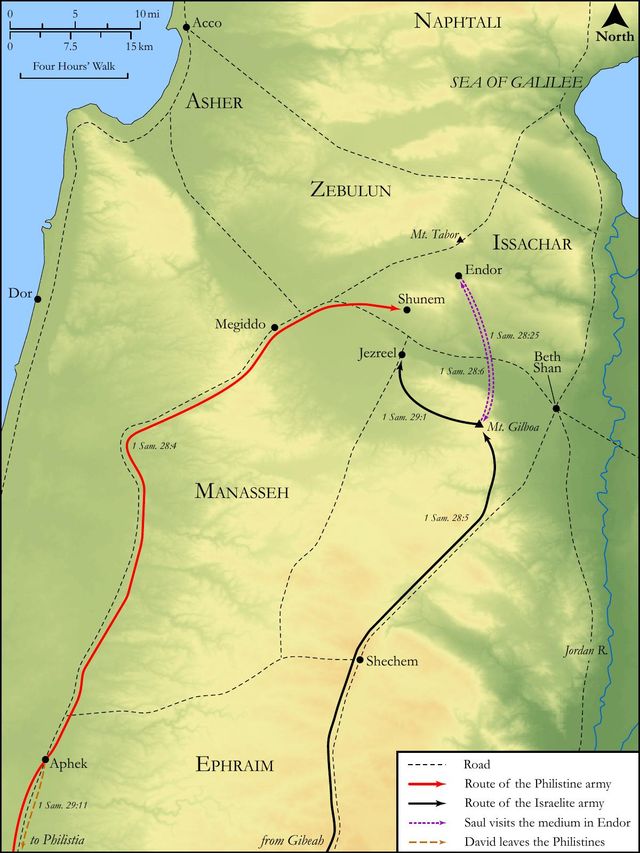
This verse is a critical juncture within the larger narrative of 1 Samuel 28, which details Saul's final, desperate attempt to seek divine guidance outside of God's prescribed means. Immediately preceding this, Saul, abandoned by God and facing a formidable Philistine army, disguises himself and seeks out a medium, despite having previously purged such practices from the land. The medium's initial reluctance, noted in 1 Samuel 28:9, is overcome by Saul's assurance, leading her to attempt to conjure Samuel. Verse 13 marks the moment of the apparition's appearance, specifically the medium's shocked reaction and description, which precedes the subsequent dialogue between Samuel and Saul, detailed in 1 Samuel 28:15-19, confirming Saul's impending doom and the transfer of his kingdom.
Historical & Cultural Context
The nations round about Israel frequently engaged in various forms of divination, necromancy, and communication with the dead, believing that spirits of the deceased or other supernatural entities could provide guidance or reveal hidden knowledge. However, Mosaic Law explicitly and repeatedly forbade such practices for Israel, condemning them as "detestable to the Lord," as seen in Deuteronomy 18:10-12. Saul's act is a profound violation of this covenant, highlighting the depth of his spiritual decline and desperation in the face of God's silence, as noted in 1 Samuel 28:6. His hypocrisy is stark, given his earlier enforcement of the very laws he now violates, recounted in 1 Samuel 28:3.
Key Themes
ShowHideThe narrative of 1 Samuel 28:13 and its surrounding context powerfully illustrates several key themes. Desperation and Disobedience are paramount, as Saul's actions represent the culmination of his rebellion against God's clear commands and his tragic descent into seeking answers outside of divine will. This episode serves as a stark warning against Forbidden Practices, particularly necromancy and spiritualism, which are anathema to God and lead to severe consequences. Even though a genuine manifestation occurs, the means of summoning it are illicit, underscoring the danger. Finally, the passage highlights Divine Sovereignty; despite Saul's sinful method and the dark nature of the conjuration, God remains in control. The subsequent prophecy delivered by Samuel, as found in 1 Samuel 28:19, confirms God's unchanging word and judgment against Saul, demonstrating that even through unconventional and forbidden channels, God's purposes will prevail.
Exposition and Analysis
ShowHideKey Word Analysis
ShowHideThe Hebrew word אֱלֹהִים (ʼĕlôhîym) is a plural noun that most commonly refers to the one true God (e.g., in Genesis 1:1). However, it can also denote "gods" (plural), "divine beings," or "powerful ones." In this context, the medium's use of the plural likely signifies that she saw a powerful, supernatural entity, awe-inspiring and terrifying in its appearance, which she perceived as divine or belonging to the realm of the spiritual. Her shock indicates that this was not merely a trick but a genuine, albeit supernaturally dark, manifestation that transcended her usual experiences. It suggests an encounter with a powerful spirit, likely Samuel himself, but perceived through the lens of a pagan medium's understanding of "divine" or "otherworldly" beings.
The Hebrew root עָלָה (ʻâlâh) means "to ascend," "to come up," or "to go up." This word choice vividly describes the direction from which the apparition emerged – "out of the earth." It implies a chthonic or underworld origin, consistent with the ancient belief that the spirits of the dead resided in a realm beneath the earth (Sheol). The visual of something "ascending" emphasizes the supernatural nature of the event, suggesting a powerful force at work, breaking through the boundary between the living and the dead, and further contributing to the medium's terror and astonishment.
The Hebrew noun אֶרֶץ (ʼerets) refers to "the earth" or "the ground." In this specific context, it signifies the source or origin point of the apparition. Coupled with "ascending," it reinforces the idea that the being emerged from the realm of the dead, commonly understood in Israelite thought as Sheol, located beneath the earth. This detail underscores the illicit nature of the medium's practice, as it involves disturbing the dead, a practice strictly forbidden by God.
Verse Breakdown
ShowHide"And the king said unto her, Be not afraid:"
This opening clause reveals Saul's initial reaction to the medium's terrified scream. His command, "Be not afraid," suggests he is trying to calm her, but it also implies his own anxiety and desperation. He is eager to know what has happened, indicating his deep investment in the outcome of this forbidden ritual. This phrase sets a tense and fearful tone for the subsequent revelation.
"for what sawest thou?"
This direct question from Saul immediately follows his attempt to calm the medium. It highlights his urgent need for information and his desire to understand the nature of the supernatural manifestation. Saul, unable to see the apparition himself, relies on the medium's vision, underscoring his spiritual blindness and dependence on illicit means for divine insight. This question is the prompt for the medium's shocking declaration.
"And the woman said unto Saul, I saw gods ascending out of the earth."
This is the climactic statement of the verse, delivered by the medium in a state of profound shock and fear. Her use of "gods" (ʾĕlōhîym) to describe the single figure of Samuel indicates the overwhelming, awe-inspiring, and terrifying nature of the apparition. The phrase "ascending out of the earth" vividly portrays the supernatural origin of the being, implying it emerged from the realm of the dead (Sheol), confirming that a genuine, albeit supernaturally dark and forbidden, conjuration has occurred. This declaration immediately precedes the identification of the figure as Samuel.
Literary Devices
ShowHideThe passage employs several potent Literary Devices to convey its dramatic and theological weight. Dialogue is central, driving the narrative forward through the urgent exchange between Saul and the medium, revealing their states of mind and the unfolding supernatural event. The medium's terrified exclamation, "I saw gods ascending out of the earth," serves as a moment of Anagnorisis (recognition or discovery), not just for Saul but for the medium herself, who is genuinely surprised by the power of what she has evoked. There is also a strong element of Dramatic Irony, as Saul, who once purged the land of mediums, now desperately seeks one out, highlighting his profound hypocrisy and spiritual decline. The appearance of Samuel, rising from the earth, is a powerful Symbolism of the consequences of Saul's disobedience and God's unwavering judgment, even when delivered through an illicit channel. Furthermore, the medium's description of "gods" introduces a degree of Ambiguity or Mystery regarding the exact nature of the spiritual realm and the beings within it, emphasizing the awe and dread associated with such forbidden encounters.
Theological and Thematic Connections
ShowHideThe narrative of 1 Samuel 28:13 profoundly underscores the severe consequences of spiritual disobedience and the dangers of seeking guidance outside of God's revealed will. Saul's desperate turn to necromancy, a practice explicitly forbidden by the Mosaic Law, highlights his complete abandonment of God's covenant and his descent into spiritual apostasy. While the text confirms a genuine supernatural manifestation (Samuel's appearance), it does not endorse the means by which it occurred. Instead, it serves as a stark warning that even if a true message is conveyed, engaging in forbidden practices is an affront to God's holiness and sovereignty. The passage reinforces the principle that God's word and judgment will ultimately prevail, regardless of human attempts to manipulate or circumvent divine authority through illicit means. It challenges believers to trust in God's timing and methods of revelation, even in times of perceived divine silence, rather than resorting to practices condemned by Scripture.
Reflection and Application
ShowHideThe chilling account in 1 Samuel 28:13 serves as a profound spiritual mirror for believers today. Saul's desperation, leading him to violate God's clear commands, is a cautionary tale about the dangers of seeking answers from sources other than God's revealed Word and the Holy Spirit. In moments of crisis, when God seems silent or answers are elusive, the temptation can be to grasp at illicit or unbiblical solutions. However, this passage calls us to a deeper trust in God's sovereignty and His perfect timing. It reminds us that true spiritual guidance comes through prayer, diligent study of Scripture, and seeking counsel from godly leaders within the community of faith. Saul's tragic end, directly linked to his persistent disobedience and his pursuit of forbidden knowledge, underscores the severe consequences of rejecting God's authority and seeking desperate measures against His will. Our response to perceived divine silence should be repentance, humility, and steadfast reliance on the Lord, knowing that He is faithful even when we do not understand His ways.
Questions for Reflection
ShowHideFAQ
ShowHideWas the apparition truly Samuel, or was it a demonic deception?
ShowHideThe biblical text strongly suggests that the apparition was indeed Samuel. The medium's terrified reaction, describing it as "gods ascending out of the earth," indicates a manifestation beyond her control or expectation. Furthermore, the subsequent message delivered by the apparition is consistent with Samuel's prior prophecies to Saul and accurately foretells Saul's death and the transfer of the kingdom, as seen in 1 Samuel 28:17-19. While God strictly forbids necromancy, His sovereignty is absolute, and He can use even forbidden means to accomplish His purposes, as He did here to deliver a final, damning word to Saul. The text does not explicitly identify it as a demonic deception, but rather as Samuel, albeit summoned through illicit means.
Why did God allow Samuel to appear if He had ceased to answer Saul?
ShowHideGod's allowing Samuel to appear, despite His prior silence to Saul through legitimate means (dreams, Urim, prophets, 1 Samuel 28:6), serves to underscore the finality and severity of His judgment against Saul. God's silence was a consequence of Saul's persistent disobedience and rebellion. When Saul resorted to forbidden practices, God, in His sovereign control, permitted Samuel to appear not to offer new guidance or a chance for repentance, but to confirm the irreversible consequences of Saul's actions and to pronounce his impending doom. It was a word of judgment, not of grace, demonstrating that God's will would be accomplished regardless of Saul's desperate, sinful attempts to circumvent it.
Christ-Centered Fulfillment
ShowHideThe desperate, illicit act of Saul seeking guidance from a medium in 1 Samuel 28:13 stands in stark contrast to the perfect and ultimate revelation found in Jesus Christ. Saul's turning to "gods ascending out of the earth" highlights humanity's inherent longing for divine connection and guidance, a longing that fallen humanity often seeks to fulfill through forbidden and dangerous means. However, the New Testament proclaims that God has spoken definitively and fully through His Son, Jesus, who is the true and living Word, as declared in John 1:1-3 and Hebrews 1:1-2. Unlike the terrifying and illicit appearance from the earth, Jesus "descended from heaven" (John 3:13) and "ascended far above all heavens" (Ephesians 4:10), demonstrating His divine origin and supreme authority over all realms, including death itself. He is not a spirit conjured from the earth, but the Lord of life who conquered death and Sheol, as seen in Revelation 1:18. In Christ, we have direct access to God through the Holy Spirit, and His Word, the Bible, is our authoritative guide, rendering any need for forbidden practices obsolete. He is the ultimate Prophet, Priest, and King, providing all the revelation and mediation we could ever need, inviting us to come boldly to His throne of grace rather than seeking the counsel of the dead, as encouraged in Hebrews 4:16.