


1 Samuel 28:10
Bible text: King James Version (1769 Blayney text) · Public domain
Bible text: Berean Standard Bible · Public domain
Bible text: American Standard Version (1901) · Public domain
Bible text: World English Bible, Messianic edition · Public domain
Bible text: Geneva Bible (1599) · Public domain
Bible text: Young's Literal Translation · Public domain
- וַיִּשָּׁבַעvai·yi·Sha·va'and he sworeH7650Conj-w ¦ V-Niphal-ConsecImperf-3msVerb Niphal Consecutive Imperfect 3rd Singular Masculineוַandיִּשָּׁבַעhe swore
- לָהּlahto <the> herPrep-l ¦ 3fsSuffix Personal 3rd Singular Feminineלָto <the>הּher
- שָׁאוּלsha·'UlSaulH7586N-proper-mNoun Proper Masculine
- בַּיהוָהba·Yah·wehby YahwehH3068Prep-b ¦ N-properNoun Proper TitleבַּbyיהוָהYahweh
- לֵאמֹרle·Mor<to> sayingH559Prep-l ¦ V-Qal-InfVerb Qal Infinitive Constructלֵ<to>אמֹרsaying
- חַיchai[by] [the] lifeH2416Adj-msAdjective Singular Masculine Absolute
- יְהוָהYah·wehof YahwehH3068N-properNoun Proper Title
- אִם'imifH518PrtParticle Conditional
- יִקְּרֵךְyi·ke·Rekhit will happen to youH7136V-Qal-Imperf-3ms ¦ 2fsVerb Qal Imperfect 3rd Singular Masculineיִקְּרֵit will happen toךְyou
- עָוֹן'a·VonpunishmentH5771N-msNoun Singular Masculine Absolute
- בַּדָּבָרba·da·Varin the matterH1697Prep-b ¦ N-msNoun Singular Masculine Absoluteבַּin theדָּבָרmatter
- הַזֶּהha·Zeh<the> thisH2088Art ¦ PrtParticle Demonstrativeהַ<the>זֶּהthis
English is a literal word-by-word gloss of the Hebrew, not the KJV's wording. Why?
This is the original text the KJV's translators worked from — each Hebrew word with its own literal English meaning in this verse, prepared by scholars at Tyndale House, Cambridge. The KJV translates whole sentences, not word by word, so its wording differs: one Hebrew word can become several English words, and the KJV may choose “the LORD” where the gloss reads “Yahweh”. Both are faithful — they answer different questions. For the KJV's own rendering, switch to the KJV text.
Details
See on the biblical-era map
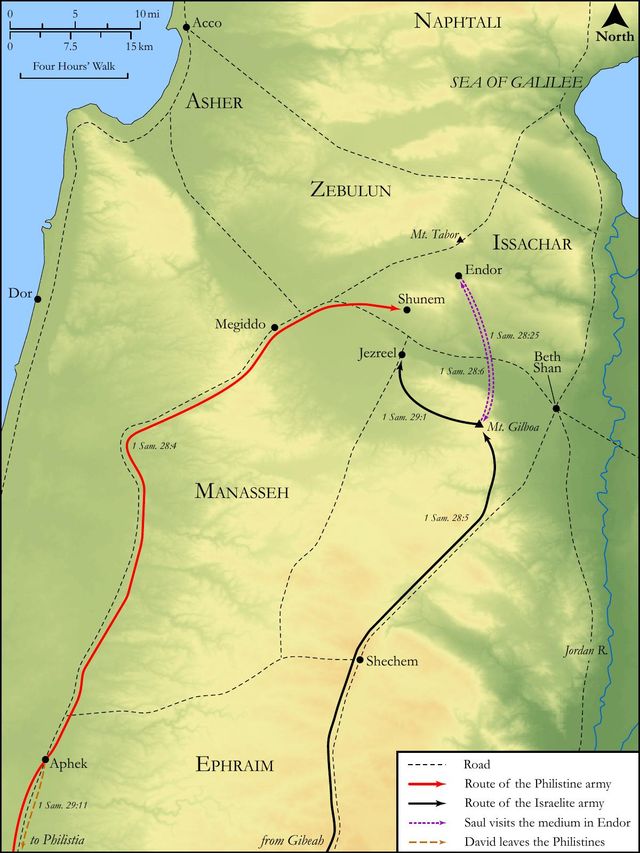
Study this verse
Public-domain commentary
Matthew Henry
From his Commentary on the Whole Bible. Henry comments on passages, not single verses — this entry covers 1 Samuel 28:7–14. His two-level outline is real structure in the source text, so it is rendered as structure.
Here, I. Saul seeks for a witch, Sa1 28:7. When God answered him not, if he had humbled himself by repentance and persevered in seeking God, who knows but that at length he might have been entreated for him? but, since he can discern no comfort either from heaven or earth (Isa 8:21, Isa 8:22), he resolves to knock at the gates of hell, and to see if any there will befriend him and give him advice: Seek me a woman that has a familiar spirit, Sa1 28:7. And his servants were too officious to serve him in this evil affair; they presently recommended one to him at Endor (a city not far off) who had escaped the execution of Saul's edict. To her he resolves to apply. Herein he is chargeable, 1. With contempt of the God of Israel; as if any creature could do him a kindness when God had left him and frowned upon him. 2. With contradiction to himself. He knew the heinousness of the sin of witchcraft, else he would not have cut off those that had familiar spirits; yet now he had recourse to that as an oracle which he had before condemned as an abomination. It is common for men to inveigh severely against those sins which they are in no temptation to, but afterwards to be themselves overcome by them. Had one told Saul, when he was destroying the witches, that he himself would, ere long, consult with one, he would have said, as Hazael did, What? Is thy servant a dog? But who knows what mischiefs those will run into that forsake God and are forsaken of him?
II.Hearing of one he hastens to her, but goes by night, and in disguise, only with two servants, and probably on foot, Sa1 28:8. See how those that are led captive by Satan are forced,
1.To disparage themselves. Never did Saul look so mean as when he went sneaking to a sorry witch to know his fortune.
2.To dissemble. Evil works are works of darkness, and they hate the light, neither care for coming to it. Saul went to the witch, not in his robes, but in the habit of a common soldier, not only lest the witch herself, if she had known him, should decline to serve him, either fearing he came to trepan her or resolving to be avenged on him for his edict against those of her profession, but lest his own people should know it and abhor him for it. Such is the power of natural conscience that even those who do evil blush and are ashamed to do it.
III.He tells her his errand and promises her impunity.
1.All he desires of her is to bring up one from the dead, whom he had a mind to discourse with. It was necromancy or divination by the dead, that he hoped to serve his purpose by. This was expressly forbidden by the law (Deu 18:11), seeking for the living to the dead, Isa 8:19. Bring me up him whom I shall name, Sa1 28:8. This supposes that it was generally taken for granted that souls exist after death, and that when men die there is not an end of them: it supposes too that great knowledge was attributed to separate souls. But to think that any good souls would come up at the beck of an evil spirit, or that God, who had denied a man the benefit of his own institutions, would suffer him to reap any real advantage by a cursed diabolical invention, was very absurd.
2.She signifies her fear of the law, and her suspicion that this stranger came to draw her into a snare (Sa1 28:9): Thou knowest what Saul has done. Providence ordered it so that Saul should be told to his face of his edict against witches, at this very time when he was consulting one, for the greater aggravation of his sin. She insists upon the peril of the law, perhaps to raise her price; for, though no mention is made of her fee, no doubt she demanded and had a large one. Observe how sensible she is of danger from the edict of Saul, and what care she is in to guard against it; but not at all apprehensive of the obligations off God's law and the terrors of his wrath. She considered what Saul had done, not what God had done, against such practices, and feared a snare laid for her life more than a snare laid for her soul. It is common for sinners to be more afraid of punishment from men than of God's righteous judgment. But,
3.Saul promises with an oath not to betray her, Sa1 28:10. It was his duty as a king to punish her and he knew it, yet he swears no to do it; as if he could by his own oath bind himself from doing that which, by the divine command, he was bound to do. But he promised more than he could perform when he said, There shall no punishment happen to thee; for he that could not secure himself could much less secure her from divine vengeance.
IV.Samuel, who was lately dead, is the person whom Saul desired to have some talk with; and the witch, with her enchantments, gratifies his desire, and brings them together.
1.As soon as Saul had given the witch the assurance she desired (that he would not discover her) she applied to her witchcrafts, and asked very confidently, Whom shall I bring up to thee? Sa1 28:11. Note, Hopes of impunity embolden sinners in their evil ways and harden their hearts.
2.Saul desires to speak with Samuel: Bring me up Samuel. Samuel had anointed him to the kingdom and had formerly been his faithful friend and counsellor, and therefore with him he wished to advise. While Samuel was living at Ramah, not far from Gibeah of Saul, and presided there in the school of the prophets, we never read of Saul's going to him to consult him in any of the difficulties he was in (it would have been well for him if he had); then he slighted him, and perhaps hated him, looking upon him to be in David's interest. But now that he is dead, "O for Samuel again! By all means, bring me up Samuel." Note, Many that despise and persecute God's saints and ministers when they are living would be glad to have them again when they are gone. Send Lazarus to me, and send Lazarus to my father's house, Luk 16:24-27. The sepulchres of the righteous are garnished.
3.Here is a seeming defector chasm in the story. Saul said, Bring me up Samuel, and the very next words are, When the woman saw Samuel, (Sa1 28:12), whereas one would have expected to be told how she performed the operation, what spells and charms she used, or that some little intimation would be given of what she said or did; but the profound silence of the scripture concerning it forbids our coveting to know the depths of Satan (Rev 2:24) or to have our curiosity gratified with an account of the mysteries of iniquity. It has been said of the books of some of the popish confessors that, by their descriptions of sin, they have taught men to commit it; but the scripture conceals sinful art, that we may be simple concerning evil, Rom 16:19.
4.The witch, upon sight of the apparition, was aware that her client was Saul, her familiar spirit, it is likely, informing her of it (Sa1 28:12): "Why hast thou deceived me with a disguise; for thou art Saul, the very man that I am afraid of above any man?" Thus she gave Saul to understand the power of her art, in that she could discover him through his disguise; and yet she feared lest, hereafter, at least, he should take advantage against her for what she was now doing. Had she believed that it was really Samuel whom she saw, she would have had more reason to be afraid of him, who was a good prophet, than of Saul, who was a wicked king. But the wrath of earthly princes is feared by most more than the wrath of the King of kings.
5.Saul (who, we may suppose, was kept at a distance in the next room) bade her not to be afraid of him, but go on with the operation, and enquired what she saw? Sa1 28:13. O, says the woman, I saw gods (that is, a spirit) ascending out of the earth; they called angels gods, because spiritual beings. Poor gods that ascend out of the earth! But she speaks the language of the heathen, who had their infernal deities and had them in veneration. If Saul had thought it necessary to his conversation with Samuel that the body of Samuel should be called out of the grave, he would have taken the witch with him to Ramah, where his sepulchre was; but the design was wholly upon his soul, which yet, if it became visible, was expected to appear in the usual resemblance of the body; and God permitted the devil, to answer the design, to put on Samuel's shape, that those who would not receive the love of the truth might be given up to strong delusions and believe a lie. That it could not be the soul of Samuel himself they might easily apprehend when it ascended out of the earth, for the spirit of a man, much more of a good man, goes upward, Ecc 3:21. But, if people will be deceived, it is just with God to say, "Let them be deceived." That the devil, by the divine permission, should be able to personate Samuel is not strange, since he can transform himself into an angel of light! nor is it strange that he should be permitted to do it upon this occasion, that Saul might be driven to despair, by enquiring of the devil, since he would not, in a right manner, enquire of the Lord, by which he might have had comfort. Saul, being told of gods ascending, was eager to know what was the form of this deity, and in what shape he appeared, so far was he from conceiving any horror at it, his heart being wretchedly hardened by the deceitfulness of sin. Saul, it seems, was not permitted to see any manner of similitude himself, but he must take the woman's word for it, that she saw an old man covered with a mantle, or robe, the habit of a judge, which Samuel had sometimes worn, and some think it was for the sake of that, and the majesty of its aspect, that she called this apparition Elohim, a god or gods; for so magistrates are styled, Psa 82:1.
6.Saul, perceiving, by the woman's description, that it was Samuel, stooped with his face to the ground, either, as it is generally taken, in reverence to Samuel, though he saw him not, or perhaps to listen to that soft and muttering voice which he now expected to hear (for those that had familiar spirits peeped and muttered, Isa 8:19); and it should seem Saul bowed himself (probably by the witch's direction) that he might hear what was whispered and listen carefully to it; for the voice of one that has a familiar spirit is said to come out of the ground, and whisper out of the dust, Isa 29:4. He would stoop to that who would not stoop to the word of God.
Continue studying 1 Samuel 28:10 across the web’s major study libraries — every link below opens this exact verse, chapter, or book on the destination site.
Read & Compare
 BibleGatewayThis verse in more than 200 translations and 70 languages.
 Bible.comThe YouVersion reader — hundreds of translations, reading plans, and highlights.
 ESV.orgCrossway's official English Standard Version reader.
 NET BibleThe NET translation with 60,000+ translators' notes on every rendering decision.
 STEP BibleTyndale House's free study tool — original text, vocabulary, and scholarly resources.
 BibliaLogos Bible Software's free web reader.
 USCCBThe New American Bible (Revised Edition) with the U.S. bishops' study notes.
Commentaries
 BibleHub CommentariesDozens of classic commentaries on this verse, gathered on one page.
 StudyLightMore than 100 commentary sets — the largest collection on the web.
 BibleRefPlain-English commentary on what this verse means, verse by verse.
 Enduring WordDavid Guzik's free commentary on this chapter, widely used by Bible teachers.
 Bible Study ToolsVerse commentary alongside Greek and Hebrew study aids.
Original Language & Research
- BibleHub InterlinearThe verse word by word — original language, transliteration, and English.
- BibleHub LexiconEvery word's original-language definition and Strong's entry.
 Blue Letter BibleDeep-study tools — Strong's numbers, concordance, and word studies.
 SefariaThe Hebrew text with Rashi and centuries of Jewish commentary.
Sermons, Hymns & Audio


TrulyRandomVerse is not affiliated with these sites and doesn’t control their content. They’re linked because they’re genuinely useful.
Summary
1 Samuel 28:10 captures a pivotal and tragic moment in King Saul's life, revealing the profound depths of his spiritual desperation and moral compromise. Having been abandoned by God and facing imminent battle, Saul, in a desperate attempt to gain divine counsel, swears a solemn oath by the LORD to protect the medium of Endor. This oath, given to facilitate a forbidden act of necromancy, stands in stark and hypocritical contrast to Saul's earlier enforcement of God's law against such practices, underscoring the tragic consequences of his persistent rebellion against divine authority and his complete spiritual decline.
Context
ShowHideLiterary Context
This verse is strategically placed at a critical juncture, immediately following God's silence to Saul's legitimate inquiries through dreams, Urim, and prophets 1 Samuel 28:6. The narrative emphasizes Saul's utter isolation and fear as he faces the formidable Philistine army. Having previously purged the land of all mediums and spiritists in supposed obedience to the Mosaic Law 1 Samuel 28:3, Saul's secret visit to the medium of Endor, disguised to avoid recognition, highlights the tragic culmination of his spiritual apostasy. The oath in verse 10 is a crucial element in establishing trust with the fearful medium, enabling the subsequent, highly controversial, and divinely permitted appearance of Samuel's spirit. This act serves as the final, desperate attempt by Saul to secure guidance outside of God's prescribed ways, ultimately confirming his doom.
Historical & Cultural Context
Ancient Israelite society was governed by the Mosaic Law, which unequivocally condemned and prohibited all forms of divination, necromancy, and communication with the dead as "detestable abominations" Deuteronomy 18:10-12. The penalty for engaging in such practices was death, as explicitly stated in Leviticus 20:27. Saul's earlier actions to enforce this law underscore its gravity and his initial, albeit inconsistent, commitment to God's commands. His clandestine journey to Endor, a place likely known for such illicit activities, vividly illustrates the desperation of a king who, having forfeited divine favor, resorts to forbidden means, even at the cost of violating his own edicts and God's clear word. The solemnity of an oath sworn "by the LORD" (Yahweh) was paramount in ancient Israel, serving as a binding covenant that invoked divine judgment upon falsehood, making Saul's misuse of it particularly egregious.
Key Themes
ShowHideThe passage powerfully illustrates the themes of desperation and hypocrisy, as Saul, abandoned by God due to his persistent disobedience, resorts to the very practices he once condemned, invoking God's holy name to sanction his sin. This episode further highlights the destructive nature of disobedience and rebellion, showcasing Saul's consistent rejection of God's revealed will, a pattern that began with his failure to fully obey God's command regarding the Amalekites and ultimately led to his rejection as king. The sanctity and profound misuse of oaths are also central, as Saul's vow, though made in a context of profound sin, underscores the gravity with which such promises, especially those invoking the divine name, were regarded in Israel. This entire episode serves as a stark and sobering warning about the perils of seeking counsel outside of God's revealed truth when confronted with overwhelming fear or uncertainty, demonstrating the spiritual consequences of abandoning divine authority.
Exposition and Analysis
ShowHideKey Word Analysis
ShowHideThis verb (H7650) means "to swear an oath," implying the act of binding oneself by a solemn vow, typically invoking a divine witness or guarantor. When used in conjunction with "by the LORD" (בַּיהוָה), it signifies the most serious and binding form of oath, placing the speaker under divine judgment if the oath is broken. The profound irony here is that Saul, who has been rejected by the LORD (H3068) and is actively disobeying His command, presumes to use the very name of the LORD to guarantee a promise that facilitates further disobedience.
The Hebrew word (H2416) for "liveth" signifies "alive" or "living." In the oath formula "As the LORD liveth," it affirms the active, vibrant, and ever-present reality of God. It functions as a powerful self-imprecation, essentially stating, "May the living God strike me dead if I do not keep this promise." For Saul to utter such a phrase in this context highlights his profound spiritual blindness; he invokes the living God to sanction an act that is an abomination to that very God, demonstrating a desperate attempt to legitimize his forbidden actions.
The Hebrew word (H5771) translated as "punishment" is rich in meaning, encompassing "perversity," "iniquity," "guilt," and the "punishment (of iniquity)." Thus, Saul is not merely promising freedom from a legal penalty, but assuring the medium that no "iniquity" or "guilt" will be attributed to her for this act. He effectively promises immunity from both human and divine retribution for engaging in a practice explicitly forbidden by God's law, revealing the extent of his desperate attempt to circumvent the moral and legal consequences of a grave sin.
Verse Breakdown
ShowHide"And Saul sware to her by the LORD"
This opening clause immediately establishes the extreme solemnity and gravity of Saul's oath. By swearing "by the LORD" (Yahweh, H3068), Saul invokes the personal covenant name of God, making God Himself the guarantor of his promise. This is an act of profound hypocrisy, as Saul, who has been abandoned by God for his disobedience, now presumes to use God's holy name to facilitate a forbidden act of necromancy. It underscores the depth of his spiritual depravity and desperation.
"saying, [As] the LORD liveth"
This is a common and powerful oath formula in ancient Israel, affirming the living reality and active presence of God as the ultimate witness and enforcer of the oath. It functions as a self-imprecation, essentially saying, "May the LORD strike me dead if I do not keep this promise." For Saul to utter such a phrase in this context highlights his profound spiritual blindness; he invokes the living God to sanction an act that is an abomination to that very God.
"there shall no punishment happen to thee for this thing"
This is the substance of Saul's promise to the medium. He guarantees her immunity from the legal and societal consequences of her forbidden practice, which, according to Mosaic Law, was punishable by death Leviticus 20:27. This promise is a desperate measure to gain her cooperation, revealing Saul's willingness to violate God's law and his own prior decrees in his frantic search for answers outside of God's revealed will. The word "thing" (H1697, dâbâr) here broadly refers to the entire illicit affair of divination.
Literary Devices
ShowHideThe passage employs several potent literary devices to highlight Saul's tragic state. Irony is paramount, as King Saul, who once purged mediums from the land in obedience to God's law, now desperately seeks one out and swears by the very God he is disobeying to protect her. This highlights the tragic decline of Saul's character and reign, moving from a divinely appointed king to a desperate, hypocritical figure. The use of a solemn oath ("As the LORD liveth") in such a profane context serves as a powerful form of contrast, emphasizing the chasm between God's holiness and Saul's spiritual rebellion. The narrative also builds suspense, as the reader anticipates the consequences of this forbidden consultation, knowing God's previous silence and Saul's history of disobedience, creating a sense of impending doom.
Theological and Thematic Connections
ShowHide1 Samuel 28:10 serves as a stark theological commentary on the dangers of spiritual desperation and the profound consequences of persistent disobedience. It underscores the principle that when individuals or nations abandon God's revealed will and seek counsel through forbidden means, they plunge themselves into deeper spiritual darkness and compromise. Saul's actions demonstrate a complete inversion of righteous leadership, where the king, meant to uphold God's law, actively subverts it for personal gain, highlighting the insidious nature of hypocrisy. This passage stands as a powerful warning against seeking answers or comfort outside the boundaries of God's Word and His prescribed ways, reminding believers that even in the most dire circumstances, faithfulness to God's commands remains paramount. It illustrates that God's silence is not an invitation to disobedience, but often a consequence of prior rebellion, and that true guidance is found only in His revealed truth.
Reflection and Application
ShowHideSaul's tragic story in 1 Samuel 28:10 offers profound lessons for contemporary believers, serving as a powerful reminder that desperation, when untethered from faith and obedience, can lead to catastrophic spiritual compromise. When we face overwhelming challenges, perceive God's silence, or are tempted to find quick solutions outside of His revealed will, Saul's example warns us against resorting to forbidden means, whether literal divination or more subtle forms of seeking counsel from ungodly sources or trusting in our own flawed understanding. Our integrity, especially in our promises and vows, should reflect our unwavering commitment to God, not our willingness to manipulate His name or His principles for our own ends. The passage calls us to cultivate a deep trust in God's sovereignty and His timing, even when answers are not immediately apparent, and to consistently seek His guidance through prayer, diligent study of His Word, and godly counsel, rather than succumbing to the allure of forbidden paths.
Questions for Reflection
ShowHideFAQ
ShowHideWhy did Saul seek a medium when he had previously outlawed them?
ShowHideSaul sought a medium out of extreme desperation and spiritual abandonment. God had ceased to answer him through traditional means like dreams, Urim, or prophets 1 Samuel 28:6. Facing a formidable Philistine army and sensing his impending doom, Saul, in a moment of profound fear and spiritual decline, resorted to the very practices he had previously purged from the land, demonstrating the depths of his hypocrisy and his willingness to violate God's clear commands Deuteronomy 18:10-12 in a desperate attempt to gain guidance. His actions reveal the tragic extent to which a heart hardened by disobedience will go to find answers outside of God's will.
Was the medium truly able to summon Samuel, or was it a deception?
ShowHideThe text of 1 Samuel 28 describes the appearance of Samuel in a way that strongly suggests a genuine, albeit divinely permitted and extraordinary, manifestation, rather than a mere deception by the medium. The medium herself is terrified by what she sees, crying out in alarm 1 Samuel 28:12, indicating that something beyond her control or usual practice occurred. Furthermore, Samuel's message to Saul is accurate and profoundly prophetic, foretelling his death and the transfer of the kingdom to David 1 Samuel 28:19, a truth only God could reveal. While God strictly forbids necromancy, He is sovereign and can choose to intervene even in forbidden contexts to achieve His purposes, as He did in this unique and extraordinary instance to deliver a final, damning word of judgment to Saul.
Christ-Centered Fulfillment
ShowHideThe tragic account of Saul's desperation and his hypocritical oath to the medium of Endor starkly contrasts with the perfect obedience and ultimate fulfillment found in Jesus Christ. Saul, a king chosen by God, ultimately rebels against divine authority, seeking forbidden knowledge and invoking God's name in a context of profound spiritual compromise. His story highlights humanity's propensity to stray from God's revealed will when faced with fear and uncertainty, leading to spiritual darkness and judgment. In contrast, Jesus Christ, the true and eternal King, perfectly submitted to His Father's will, even unto death on the cross Philippians 2:8. He is the ultimate source of divine wisdom and guidance, the one through whom God truly speaks to humanity, having spoken in these last days by His Son Hebrews 1:1-2. Unlike Saul, who sought to manipulate spiritual forces for his own desperate ends, Christ offered Himself as the ultimate sacrifice, breaking the power of sin and death, and providing a way for humanity to commune with God not through forbidden means, but through His atoning work and the New Covenant established in His blood Colossians 2:13-15. His life, death, and resurrection demonstrate that true peace, guidance, and reconciliation are found not in desperate attempts to bypass God's commands, but in faithful reliance upon the Lamb of God, who takes away the sin of the world John 1:29, and through whom we have access to the Father Ephesians 2:18.