


1 Samuel 19:6
Bible text: King James Version (1769 Blayney text) · Public domain
Bible text: Berean Standard Bible · Public domain
Bible text: American Standard Version (1901) · Public domain
Bible text: World English Bible, Messianic edition · Public domain
Bible text: Geneva Bible (1599) · Public domain
Bible text: Young's Literal Translation · Public domain
- וַיִּשְׁמַעvai·yish·Ma'and he listenedH8085Conj-w ¦ V-Qal-ConsecImperf-3msVerb Qal Consecutive Imperfect 3rd Singular Masculineוַandיִּשְׁמַעhe listened
- שָׁאוּלsha·'UlSaulH7586N-proper-mNoun Proper Masculine
- בְּקוֹלbe·Kolto [the] voice ofH6963Prep-b ¦ N-mscNoun Singular Masculine Constructבְּtoקוֹל[the] voice of
- יְהוֹנָתָןye·ho·na·TanJonathanH3083N-proper-mNoun Proper Masculine
- וַיִּשָּׁבַעvai·yi·sha·Va'and he swore an oathH7650Conj-w ¦ V-Niphal-ConsecImperf-3msVerb Niphal Consecutive Imperfect 3rd Singular Masculineוַandיִּשָּׁבַעhe swore an oath
- שָׁאוּלsha·'UlSaulH7586N-proper-mNoun Proper Masculine
- חַיchai[by] [the] lifeH2416Adj-msAdjective Singular Masculine Absolute
- יְהוָהYah·wehof YahwehH3068N-properNoun Proper Title
- אִם'imifH518PrtParticle Conditional
- יוּמָתyu·Mathe will be put to deathH4191V-Hophal-Imperf-3msVerb Hophal Imperfect 3rd Singular Masculine
English is a literal word-by-word gloss of the Hebrew, not the KJV's wording. Why?
This is the original text the KJV's translators worked from — each Hebrew word with its own literal English meaning in this verse, prepared by scholars at Tyndale House, Cambridge. The KJV translates whole sentences, not word by word, so its wording differs: one Hebrew word can become several English words, and the KJV may choose “the LORD” where the gloss reads “Yahweh”. Both are faithful — they answer different questions. For the KJV's own rendering, switch to the KJV text.
Details
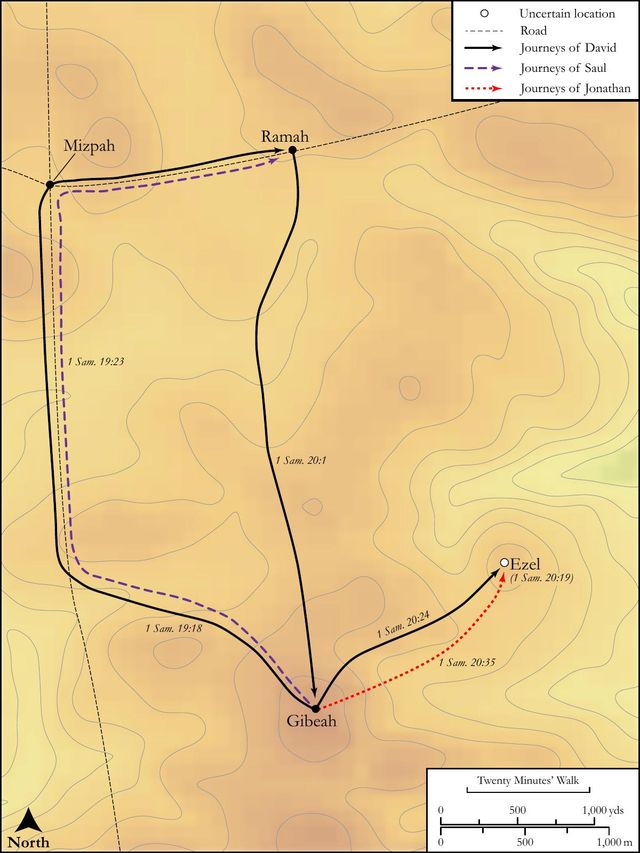
See on the biblical-era map
Study this verse
Public-domain commentary
Matthew Henry
From his Commentary on the Whole Bible. Henry comments on passages, not single verses — this entry covers 1 Samuel 19:1–7. His four-level outline is real structure in the source text, so it is rendered as structure.
Saul and Jonathan appear here in their different characters, with reference to David.
I.Never was enemy so unreasonably cruel as Saul.
He spoke to his son and all his servants that they should kill David, Sa1 19:1. His projects to take him off had failed, and therefore he proclaims him an out-law, and charges all about him, upon their allegiance, to take the first opportunity to kill David. It is strange that he was not ashamed thus to avow his malice when he could give no reason for it, and that knowing all his servants loved David (for so he had said himself, Sa1 18:22), he was not afraid of provoking them to rebel by this bloody order. Either malice was not then so politic, or justice was not so corrupted as it has been since, or else Saul would have had him indicted, and have suborned witnesses to swear treason against him, and so have had him taken off, as Naboth was, by colour of law. But there is least danger from this undisguised malice. It was strange that he who knew how well Jonathan loved him should expect him to kill him; but he thought that because he was heir to the crown he must needs be as envious at David as himself was. And Providence ordered it thus that he might befriend David's safety.
II.Never was friend so surprisingly kind as Jonathan.
A friend in need is a friend indeed. Such a one Jonathan was to David. He not only continued to delight much in him, though David's glory eclipsed his, but bravely appeared for him now that the stream ran so strongly against him.
1.He took care for his present security by letting him know his danger (Sa1 19:2): "Take heed to thyself, and keep out of harm's way." Jonathan knew not but that some of the servants might be either so obsequious to Saul or so envious at David as to put the orders in execution which Saul had given, if they could light on David.
2.He took pains to pacify his father and reconcile him to David. The next morning he ventured to commune with him concerning David (Sa1 19:3), not that night, perhaps because he observed Saul to be drunk and not fit to be spoken to, or because he hoped that, when he had slept upon it, he would himself revoke the order, or because he could not have an opportunity of speaking to him till morning.
(1.)His intercession for David was very prudent. It was managed with a great deal of the meekness of wisdom; and he showed himself faithful to his friends by speaking good of him, though he was in danger of incurring his father's displeasure by it - a rare instance of valuable friendship! He pleads,
[1.]The good services David had done to the public, and particularly to Saul: His work has been to thee-ward very good, Sa1 19:4. Witness the relief he had given him against his distemper with his harp, and his bold encounter with Goliath, that memorable action, which did, in effect, save Saul's life and kingdom. He appeals to himself concerning his: Thou thyself sawest it, and didst rejoice. In that and other instances it appeared that David was a favourite of heaven and a friend to Israel, as well as a good servant to Saul, for by him the Lord wrought a great salvation for all Israel; so that to order him to be slain was not only base ingratitude to so good a servant, but a great affront to God and a great injury to the public.
[2.]He pleads his innocency. Though he had formerly done many good offices, yet, if he had now been chargeable with any crimes, it would have been another matter; but he has not sinned against thee (Sa1 19:1), his blood is innocent (Sa1 19:5), and, if he be slain, it is without cause. And Jonathan had therefore reason to protest against it because he could not entail any thing upon his family more pernicious than the guilt of innocent blood.
(2.)His intercession, being thus prudent, was prevalent. God inclined the heart of Saul to hearken to the voice of Jonathan. Note, We must be willing to hear reason, and to take all reproofs and good advice even from our inferiors, parents from their own children. How forcible are right words! Saul was, for the present, so far convinced of the unreasonableness of his enmity to David that,
[1.]He recalled the bloody warrant for his execution (Sa1 19:6): As the Lord liveth, he shall not be slain. Whether Saul swore here with due solemnity or no does not appear; perhaps he did, and the matter was of such moment as to deserve it and of such uncertainty as to need it. But at other times Saul swore rashly and profanely, which made the sincerity of this oath justly questionable; for it may be feared that those who can so far jest with an oath as to make a by-word of it, and prostitute it to a trifle, have not such a due sense of the obligation of it but that, to serve a turn, they will prostitute it to a lie. Some suspect that Saul said and swore this with a malicious design to bring David within his reach again, intending to take the first opportunity to slay him. But, as bad as Saul was, we can scarcely think so ill of him; and therefore we suppose that he spoke as he thought for the present, but the convictions soon wore off and his corruptions prevailed and triumphed over them.
[2.]He renewed the grant of his place at court. Jonathan brought him to Saul, and he was in his presence as in times past (Sa1 19:7), hoping that now the storm was over, and that his friend Jonathan would be instrumental to keep his father always in this good mind.
Historical interpretation
Historical reception
1 surviving comment on this verse from the historical church.
When Saul heard this, placated by the voice of Jonathan, etc. When the people of the Jews heard the voice of the preaching apostles, they were placated from the wrath of former fury; and by the true assertion of faith, they testified that the Church of Christ can never be exterminated from the midst, never can his memory perish, who is before the ages and remains forever. This same people said these things in those who heard the voice of the doctors of spiritual matters, which Jonathan and his merits signify. For in whomever they did not say these things, they are those of whom it is written: And their ears were hard of hearing (Acts XXVIII). And elsewhere: And who is deaf, except to those whom I have sent my messengers?
Continue studying 1 Samuel 19:6 across the web’s major study libraries — every link below opens this exact verse, chapter, or book on the destination site.
Read & Compare
 BibleGatewayThis verse in more than 200 translations and 70 languages.
 Bible.comThe YouVersion reader — hundreds of translations, reading plans, and highlights.
 ESV.orgCrossway's official English Standard Version reader.
 NET BibleThe NET translation with 60,000+ translators' notes on every rendering decision.
 STEP BibleTyndale House's free study tool — original text, vocabulary, and scholarly resources.
 BibliaLogos Bible Software's free web reader.
 USCCBThe New American Bible (Revised Edition) with the U.S. bishops' study notes.
Commentaries
 BibleHub CommentariesDozens of classic commentaries on this verse, gathered on one page.
 StudyLightMore than 100 commentary sets — the largest collection on the web.
 BibleRefPlain-English commentary on what this verse means, verse by verse.
 Enduring WordDavid Guzik's free commentary on this chapter, widely used by Bible teachers.
 Bible Study ToolsVerse commentary alongside Greek and Hebrew study aids.
Original Language & Research
- BibleHub InterlinearThe verse word by word — original language, transliteration, and English.
- BibleHub LexiconEvery word's original-language definition and Strong's entry.
 Blue Letter BibleDeep-study tools — Strong's numbers, concordance, and word studies.
 SefariaThe Hebrew text with Rashi and centuries of Jewish commentary.
Sermons, Hymns & Audio


TrulyRandomVerse is not affiliated with these sites and doesn’t control their content. They’re linked because they’re genuinely useful.
Summary
1 Samuel 19:6 captures a pivotal moment where King Saul, influenced by the earnest appeal of his son Jonathan, makes a solemn, divinely-invoked oath not to harm David. This verse powerfully illustrates Jonathan's unwavering loyalty and courageous intercession, temporarily overriding Saul's escalating jealousy and murderous intent, and serving as a testament to God's providential protection over David's life amidst royal intrigue.
Context
ShowHideLiterary Context
This verse is situated within a highly volatile period of Saul's reign, characterized by his increasing paranoia and malevolent hostility towards David. David's military successes and burgeoning popularity had fueled Saul's intense envy, leading to repeated attempts on David's life, including a javelin attack in 1 Samuel 18:11. Jonathan, however, had formed an extraordinary and unbreakable covenant of friendship with David, valuing him above his own royal inheritance, a bond profoundly established in 1 Samuel 18:1-4. In the immediate preceding verses of 1 Samuel 19, Jonathan bravely confronts his father, reminding Saul of David's faithful service, his heroic victory over Goliath, and the great salvation he brought to Israel (1 Samuel 19:4-5). Jonathan's impassioned and logical advocacy culminates in Saul's temporary capitulation and the solemn oath recorded here, representing a brief reprieve from Saul's relentless pursuit.
Historical & Cultural Context
The act of swearing an oath "As the LORD liveth" (חַי יְהוָה, chai YHWH) was an extremely serious and binding declaration in ancient Israelite society. Such an oath invoked God, Yahweh, as a living witness to the truth and sincerity of the speaker's words, placing the speaker under divine judgment if the oath was broken. For a king, whose word carried immense weight and whose decrees were considered law, such a public vow was particularly significant, intended to assure those present, and indeed the entire nation, of his commitment. This cultural practice underscores the profound gravity of Saul's promise and, by extension, the egregious nature of his subsequent betrayal. Furthermore, the narrative reflects the inherent instability of the early Israelite monarchy, where a king's personal whims, spiritual state, and emotional volatility could directly impact the lives of his subjects and the future trajectory of the nation, contrasting sharply with the ideal of a king ruling justly under God's covenant law.
Key Themes
ShowHideThis verse powerfully illustrates several overarching themes within 1 Samuel. Firstly, it highlights the power of intercession and loyal friendship, profoundly exemplified by Jonathan's selfless courage in defending David, even at great personal risk to his own life and royal prospects. His advocacy temporarily diverts Saul's murderous intent, demonstrating the significant influence of righteous counsel. Secondly, it underscores Saul's volatile and inconsistent character, marked by impulsiveness, spiritual instability, and a tragic inability to maintain his commitments. His oath, though solemn, proves to be a fleeting moment of clarity or remorse, soon to be broken as his jealousy resurfaces (1 Samuel 19:9-10). This foreshadows the tragic trajectory of his reign and his ultimate rejection by God. Thirdly, the verse subtly reinforces the theme of divine protection over God's chosen one. Despite Saul's relentless attempts, David's life is consistently preserved, often through human instruments like Jonathan, aligning with God's overarching plan for David to succeed Saul as king, as prophesied in 1 Samuel 16:13.
Exposition and Analysis
ShowHideKey Word Analysis
ShowHideThis verb signifies more than merely hearing; it implies listening with attention, understanding, and often, obeying or responding positively. In this context, it suggests that Saul genuinely took Jonathan's words to heart, at least for a moment, and allowed them to influence his decision. It represents a rare instance of Saul yielding to righteous counsel rather than being solely driven by his paranoid impulses.
To "swear" or "take an oath" is to make a solemn declaration, often invoking a divine being as a witness or guarantor of the truth of the statement. This act elevates a promise from a mere intention to a sacred commitment, binding the speaker to its fulfillment under penalty of divine judgment. Saul's act of swearing here indicates a high degree of seriousness and public commitment, at least superficially.
This word means "alive" or "living." In the phrase "As the LORD liveth" (חַי יְהוָה, chai YHWH), it is part of a powerful and frequently used oath formula in the Old Testament. It means "by the life of Yahweh" or "as surely as Yahweh lives." It is the strongest possible affirmation, invoking the very existence and active presence of God as a witness and guarantor of the oath's truth and binding nature. For Saul to use this phrase underscores the extreme gravity of his promise not to harm David, making his subsequent breach of it all the more reprehensible.
Verse Breakdown
ShowHide"And Saul hearkened unto the voice of Jonathan:"
This clause highlights a significant, albeit temporary, shift in Saul's disposition. Despite his deep-seated jealousy and murderous intent towards David, he pauses to listen to his son. Jonathan's appeal, rooted in David's loyal service and God's deliverance through him, resonated with a flicker of reason or conscience within Saul, demonstrating the persuasive power of truth spoken courageously.
"and Saul sware,"
This signifies the formal and public act of taking an oath. It was not a casual statement but a deliberate, binding declaration. The act of swearing itself indicates Saul's intention to commit to his promise, at least at that moment, perhaps influenced by the weight of Jonathan's words and the public nature of the discussion.
"[As] the LORD liveth,"
This is the most potent part of Saul's oath. By invoking the living God, Yahweh, Saul elevates his promise to a sacred covenant. He calls upon God as a witness and guarantor, effectively placing himself under divine judgment if he were to break this vow. This phrase underscores the solemnity and perceived irrevocability of his commitment, making his subsequent actions a direct affront to God.
"he shall not be slain."
This is the explicit promise made by Saul concerning David. It is a direct and unequivocal declaration of David's safety, a complete reversal of Saul's previous murderous intentions. This promise, however fleeting, reveals the temporary success of Jonathan's intercession and God's providential hand in protecting David, ensuring His divine plan would continue to unfold.
Literary Devices
ShowHideThe verse employs several significant literary devices that enrich its meaning and foreshadow future events. Irony is profoundly present, as Saul, the king chosen by God, swears by the living God to protect David, the very man whom God has chosen to replace him, only to break this sacred oath shortly thereafter. This highlights Saul's spiritual decline and his increasing rebellion against God's will. Foreshadowing is also evident; Saul's temporary change of heart, followed by his quick reversion to hostility, foreshadows his continued instability, erratic behavior, and ultimate tragic end. This pattern of fleeting repentance followed by renewed malice characterizes much of his remaining reign. The stark contrast between Jonathan's unwavering loyalty, selflessness, and spiritual discernment and Saul's volatile, self-serving paranoia further emphasizes the moral and spiritual chasm between father and son, and by extension, between a king after God's own heart (David) and one who has turned from Him.
Theological and Thematic Connections
ShowHideThis verse, though brief, is rich in theological implications, underscoring God's sovereign protection over His chosen instruments, even amidst intense human hostility and political intrigue. David's life is preserved not by his own strength or cunning, but by divine providence, often working through unexpected means like Jonathan's courageous intercession. Saul's oath, sworn by the living God, reveals the seriousness with which God views human promises, particularly those made in His name. Saul's subsequent breaking of this oath highlights the danger of spiritual inconsistency and the tragic consequences of allowing jealousy and an evil spirit to override moments of clarity and divine influence. It also speaks to the power of righteous advocacy and the profound impact of a faithful friend who is willing to rebuke the powerful, even at personal cost, aligning their actions with God's purposes.
Reflection and Application
ShowHideThe narrative of 1 Samuel 19:6 offers profound lessons for contemporary believers, challenging us to examine the depth of our own friendships and the integrity of our commitments. It prompts us to consider if we possess the courage and selflessness to intercede for others, even when it is difficult, inconvenient, or carries personal risk, much like Jonathan's bold advocacy for David. Jonathan's example reminds us that true loyalty is not passive but actively seeks the good of the friend, even at personal cost. Furthermore, Saul's fleeting commitment and subsequent breach of a sacred oath serve as a sobering warning against making promises without genuine change of heart or deep-seated integrity. It highlights the spiritual danger of allowing negative emotions like jealousy, paranoia, and resentment to fester, ultimately leading to broken vows, spiritual inconsistency, and a life out of alignment with God's will. Ultimately, the verse encourages us to place our trust in God's unfailing protection. Even when surrounded by treachery, opposition, or the volatile whims of others, we can rest assured that God's purposes for His people will prevail, often working through unexpected means or individuals to ensure His will is done.
Questions for Reflection
ShowHideFAQ
ShowHideWhy did Saul's oath not last?
ShowHideSaul's oath, though solemnly sworn by the living God, was a temporary aberration from his increasingly unstable and malevolent character. His underlying jealousy and paranoia towards David, coupled with the recurring influence of an evil spirit (1 Samuel 16:14), quickly reasserted themselves. The text indicates that "an evil spirit from the LORD came upon Saul" shortly after this oath, leading him to again attempt to kill David with a javelin (1 Samuel 19:9-10). This demonstrates that his oath was not born of genuine repentance or a fundamental change of heart, but perhaps a momentary weakness, a fleeting moment of clarity, or a strategic desire to appease Jonathan. Saul's reign is tragically characterized by such spiritual inconsistency and a persistent inability to submit to God's will.
What does "As the LORD liveth" mean in this context?
ShowHideThe phrase "As the LORD liveth" (חַי יְהוָה, chai YHWH) is a powerful and sacred oath formula frequently used in the Old Testament. When Saul swore this, he was invoking the very existence and active presence of Yahweh, the living God, as a witness to the truth and binding nature of his promise. It means, "As surely as God is alive and actively present, so my word is true and binding." For a king to utter such an oath made his promise exceptionally weighty and solemn, placing him under divine judgment if he were to break it. It was the strongest possible affirmation, underscoring the gravity of his commitment not to harm David, and making his subsequent betrayal a direct affront to God.
How did Jonathan's actions demonstrate true friendship?
ShowHideJonathan's actions in 1 Samuel 19:6, and throughout his relationship with David, profoundly exemplify true, selfless friendship. Firstly, he demonstrated courageous defense of the weak by speaking truth to his volatile father, King Saul, risking his own life and royal favor to defend David (1 Samuel 19:4-5). Secondly, he showed unwavering loyalty, prioritizing his deep covenant friendship with David over his own claim to the throne or his father's irrational demands (1 Samuel 20:4). Thirdly, his actions were profoundly selfless, as he understood that David was God's chosen king and genuinely desired David's well-being and success, even if it meant his own demotion or displacement. Jonathan's intercession was born of a pure heart, reflecting a friendship that sought the good of the other, even at immense personal cost.
Christ-Centered Fulfillment
ShowHideThe narrative of 1 Samuel 19:6, with Jonathan's intercession and David's providential protection, profoundly foreshadows the person and work of Jesus Christ. David, God's anointed king, is preserved from the murderous schemes of Saul, just as Jesus, the ultimate King and Anointed One, was divinely protected until His appointed time. Jonathan's selfless advocacy for David, risking his own standing and life, points to Christ as our supreme Intercessor and Advocate. Unlike Jonathan, whose intercession was temporary and whose father's promise was broken, Jesus offers a perfect, eternal intercession before the Father on our behalf (Hebrews 7:25). Furthermore, Saul's broken oath, sworn by the living God, highlights human sinfulness and the tragic inability to keep even the most sacred vows, contrasting sharply with Christ's perfect obedience and unwavering faithfulness to God's will (Philippians 2:8). Jesus is the true Lamb of God, whose life was not taken by human treachery but willingly laid down as the ultimate sacrifice for the sins of the world (John 1:29). His resurrection then assures us that God's plan for His chosen King cannot be thwarted, guaranteeing our salvation and eternal life through His enduring reign (Romans 8:34).