


John 10:34
- ἈπεκρίθηApekrithēAnsweredG611V-ADI-3SVerb Aorist Middle Deponent Indicative 3rd Singular
- αὐτοῖςautoisto themG846P-DPMPersonal pronoun Dative Plural Masculine
- ὁho<the>G3588T-NSMDefinite article Nominative Singular Masculine
- Ἰησοῦς·IēsousJesusG2424N-NSM-PNoun Nominative Singular Masculine Individual
- οὐκoukSurelyG3756PRT-NNegative Particle Negative
- ἔστινestinit isG1510V-PAI-3SVerb Present Active Indicative 3rd Singular
- γεγραμμένονgegrammenonwrittenG1125V-RPP-NSNVerb Perfect Passive Participle Nominative Singular Neuter
- ἐνeninG1722PREPPreposition
- τῷtōtheG3588T-DSMDefinite article Dative Singular Masculine
- νόμῳnomōlawG3551N-DSMNoun Dative Singular Masculine
- ὑμῶνhumōnof youG4771P-2GPPersonal pronoun Genitive 2nd Plural
- ἐγὼegōI myselfG1473P-1NSPersonal pronoun Nominative 1st Singular
- εἶπα·eipasaidG2036V-2AAI-1SVerb 2nd Aorist Active Indicative 1st Singular
- θεοίtheoigodsG2316N-NPMNoun Nominative Plural Masculine
- ἐστε;esteyou are’?G1510V-PAI-2PVerb Present Active Indicative 2nd Plural
English is a literal word-by-word gloss of the Greek, not the KJV's wording. Why?
This is the original text the KJV's translators worked from — each Greek word with its own literal English meaning in this verse, prepared by scholars at Tyndale House, Cambridge. The KJV translates whole sentences, not word by word, so its wording differs: one Greek word can become several English words, and the KJV may choose “charity” where the gloss reads “love”. Both are faithful — they answer different questions. For the KJV's own rendering, switch to the KJV text.
Details
See on the biblical-era maps
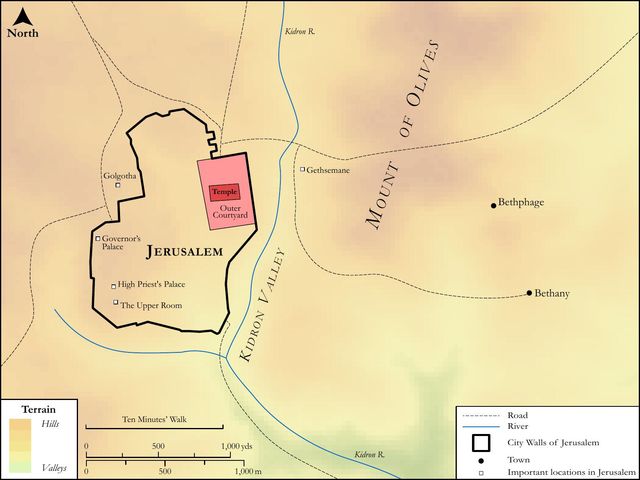
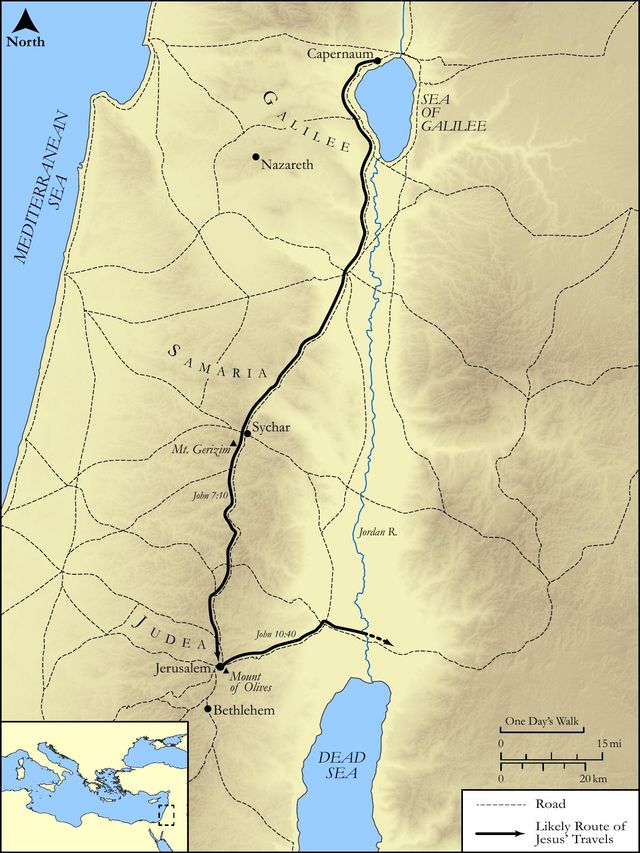
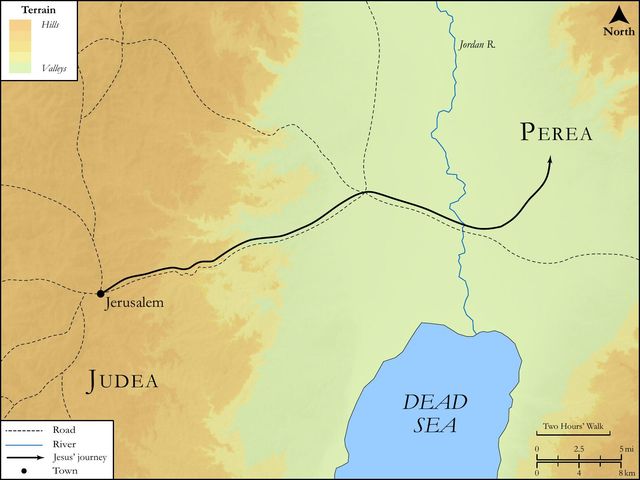
Study this verse
Public-domain commentary
Matthew Henry
From his Commentary on the Whole Bible. Henry comments on passages, not single verses — this entry covers John 10:22–38. His four-level outline is real structure in the source text, so it is rendered as structure.
We have here another rencounter between Christ and the Jews in the temple, in which it is hard to say which is more strange, the gracious words that came out of his mouth or the spiteful ones that came out of theirs.
I.We have here the time when this conference was:
It was at the feast of dedication, and it was winter, a feast that was annually observed by consent, in remembrance of the dedication of a new altar and the purging of the temple, by Judas Maccabaeus, after the temple had been profaned and the altar defiled; we have the story of it at large in the history of the Maccabees (lib. 1, cap. 4); we have the prophecy of it, Dan 8:13, Dan 8:14. See more of the feast, 2 Macc. 1:18. The return of their liberty was to them as life from the dead, and, in remembrance of it, they kept an annual feast on the twenty-fifth day of the month Cisleu, about the beginning of December, and seven days after. The celebrating of it was not confined to Jerusalem, as that of the divine feasts was, but every one observed it in his own place, not as a holy time (it is only a divine institution that can sanctify a day), but as a good time, as the days of Purim, Est 9:19. Christ forecasted to be now at Jerusalem, not in honour of the feast, which did not require his attendance there, but that he might improve those eight days of vacation for good purposes.
II.The place where it was (Joh 10:23):
Jesus walked in the temple in Solomon's porch; so called (Act 3:11), not because built by Solomon, but because built in the same place with that which had borne his name in the first temple, and the name was kept up for the greater reputation of it. Here Christ walked, to observe the proceedings of the great sanhedrim that sat here (Psa 82:1); he walked, ready to give audience to any that should apply to him, and to offer them his services. He walked, as it should seem, for some time alone, as one neglected; walked pensive, in the foresight of the ruin of the temple. Those that have any thing to say to Christ may find him in the temple and walk with him there.
III.The conference itself, in which observe,
1.A weighty question put to him by the Jews, Joh 10:24. They came round about him, to tease him; he was waiting for an opportunity to do them a kindness, and they took the opportunity to do him a mischief. Ill-will for good-will is no rare and uncommon return. He could not enjoy himself, no, not in the temple, his Father's house, without disturbance. They came about him, as it were, to lay siege to him: encompassed him about like bees. They came about him as if they had a joint and unanimous desire to be satisfied; came as one man, pretending an impartial and importunate enquiry after truth, but intending a general assault upon our Lord Jesus; and they seemed to speak the sense of their nation, as if they were the mouth of all the Jews: How long dost thou make us to doubt? If thou be the Christ tell us.
(1.)They quarrel with him, as if he had unfairly held them in suspense hitherto. Tēn psuchēn hēmōn aireis - How long dost thou steal away our hearts? Or, take away our souls? So some read it; basely intimating that what share he had of the people's love and respect he did not obtain fairly, but by indirect methods, as Absalom stole the hearts of the men of Israel; and as seducers deceive the hearts of the simple, and so draw away disciples after them, Rom 16:18; Act 20:30. But most interpreters understand it as we do: "How long dost thou keep us in suspense? How long are we kept debating whether thou be the Christ or no, and not able to determine the question?" Now,
[1.]It was the effect of their infidelity, and powerful prejudices, that after our Lord Jesus had so fully proved himself to be the Christ they were still in doubt concerning it; this they willingly hesitated about, when they might easily have been satisfied. The struggle was between their convictions, which told them he was Christ, and their corruptions, which said, No, because he was not such a Christ as they expected. Those who choose to be sceptics may, if they please, hold the balance so that the most cogent arguments may not weigh down the most trifling objections, but scales may still hang even.
[2.]It was an instance of their impudence and presumption that they laid the blame of their doubting upon Christ himself, as if he made them to doubt by inconsistency with himself, whereas in truth they made themselves doubt by indulging their prejudices. If Wisdom's sayings appear doubtful, the fault is not in the object, but in the eye; they are all plain to him that understands. Christ would make us to believe; we make ourselves to doubt.
(2.)They challenge him to give a direct and categorical answer whether he was the Messiah or no: "If thou be the Christ, as many believe thou art, tell us plainly, not by parables, as, I am the light of the world, and the good Shepherd, and the like, but totidem verbis - in so many words, either that thou art the Christ, or, as John Baptist, that thou art not," Joh 1:20. Now this pressing query of theirs was seemingly good; they pretended to be desirous to know the truth, as if they were ready to embrace it; but it was really bad, and put with an ill design; for, if he should tell them plainly that he was the Christ, there needed no more to make him obnoxious to the jealousy and severity of the Roman government. Every one knew the Messiah was to be a king, and therefore whoever pretended to be the Messiah would be prosecuted as a traitor, which was the thing they would have been at; for, let him tell them ever so plainly that he was the Christ, they would have this to say presently, Thou bearest witness of thyself, as they had said, Joh 8:13.
2.Christ's answer to this question, in which,
(1.)He justifies himself as not at all accessary to their infidelity and skepticism, referring them,
[1.]To what he had said: I have told you. He had told them that he was the Son of God, the Son of man, that he had life in himself, that he had authority to execute judgment, etc. And is not this the Christ then? These things he had told them, and they believed not; why then should they be told them again, merely to gratify their curiosity? You believed not. They pretended that they only doubted, but Christ tells them that they did not believe. Skepticism in religion is no better than downright infidelity. It is now for us to teach God how he should teach us, nor prescribe to him how plainly he should tell us his mind, but to be thankful for divine revelation as we have it. If we do not believe this, neither should we be persuaded if it were ever so much adapted to our humour.
[2.]He refers them to his works, to the example of his life, which was not only perfectly pure, but highly beneficent, and of a piece with his doctrine; and especially to his miracles, which he wrought for the confirmation of his doctrine. It was certain that no man could do those miracles except God were with him, and God would not be with him to attest a forgery.
(2.)He condemns them for their obstinate unbelief, notwithstanding all the most plain and powerful arguments used to convince them: "You believed not; and again, You believed not. You still are what you always were, obstinate in your unbelief." But the reason he gives is very surprising: "You believed not, because you are not of my sheep: you believe not in me, because you belong not to me." [1.] "You are not disposed to be my followers, are not of a tractable teachable temper, have no inclination to receive the doctrine and law of the Messiah; you will not herd yourselves with my sheep, will not come and see, come and hear my voice." Rooted antipathies to the gospel of Christ are the bonds of iniquity and infidelity. [2.] "You are not designed to be my followers; you are not of those that were given me by my Father, to be brought to grace and glory. You are not of the number of the elect; and your unbelief, if you persist in it, will be a certain evidence that you are not." Note, Those to whom God never gives the grace of faith were never designed for heaven and happiness. What Solomon saith of immorality is true of infidelity, It is a deep ditch, and he that is abhorred of the Lord shall fall therein, Pro 22:14. Non esse electum, non est causa incredulitatis propri dicta, sed causa per accidens. Fides autem est donum Dei et effectus praedestinationis - The not being included among the elect is not the proper cause of infidelity, but merely the accidental cause. But faith is the gift of God, and the effect of predestination. So Jansenius distinguishes well here.
(3.)He takes this occasion to describe both the gracious disposition and the happy state of those that are his sheep; for such there are, though they be not.
[1.]To convince them that they were not his sheep, he tells them what were the characters of his sheep. First, They hear his voice (Joh 10:27), for they know it to be his (Joh 10:4), and he has undertaken that they shall hear it, Joh 10:16. They discern it, It is the voice of my beloved, Sol 2:8. They delight in it, are in their element when they are sitting at his feet to hear his word. They do according to it, and make his word their rule. Christ will not account those his sheep that are deaf to his calls, deaf to his charms, Psa 58:5. Secondly, They follow him; they submit to his guidance by a willing obedience to all his commands, and a cheerful conformity to his spirit and pattern. The word of command has always been, Follow me. We must eye him as our leader and captain, and tread in his steps, and walk as he walked - follow the prescriptions of his word, the intimations of his providence, and the directions of his Spirit - follow the Lamb (the dux gregis - the leader of the flock) whithersoever he goes. In vain do we hear his voice if we do not follow him.
[2.]To convince them that it was their great unhappiness and misery not to be of Christ's sheep, he here describes the blessed state and case of those that are, which would likewise serve for the support and comfort of his poor despised followers, and keep them from envying the power and grandeur of those that were not of his sheep.
First, Our Lord Jesus takes cognizance of his sheep: They hear my voice, and I know them. He distinguishes them from others (Ti2 2:19), has a particular regard to every individual (Psa 34:6); he knows their wants and desires, knows their souls in adversity, where to find them, and what to do for them. He knows others afar off, but knows them near at hand.
Secondly, He has provided a happiness for them, suited to them: I give unto them eternal life, Joh 10:28. 1. The estate settled upon them is rich and valuable; it is life, eternal life. Man has a living soul; therefore the happiness provided is life, suited to his nature. Man has an immortal soul: therefore the happiness provided is eternal life, running parallel with his duration. Life eternal is the felicity and chief good of a soul immortal. 2. The manner of conveyance is free: I give it to them; it is not bargained and sold upon a valuable consideration, but given by the free grace of Jesus Christ. The donor has power to give it. He who is the fountain of life, and Father of eternity, has authorized Christ to give eternal life, Joh 17:2. Not I will give it, but I do give it; it is a present gift. He gives the assurance of it, the pledge and earnest of it, the first-fruits and foretastes of it, that spiritual life which is eternal life begun, heaven in the seed, in the bud, in the embryo.
Thirdly, He has undertaken for their security and preservation to this happiness.
a.They shall be saved from everlasting perdition. They shall by no means perish for ever; so the words are. As there is an eternal life, so there is an eternal destruction; the soul not annihilated, but ruined; its being continued, but its comfort and happiness irrecoverably lost. All believers are saved from this; whatever cross they may come under, they shall not come into condemnation. A man is never undone till he is in hell, and they shall not go down to that. Shepherds that have large flocks often lose some of the sheep and suffer them to perish; but Christ has engaged that none of his sheep shall perish, not one.
b.They cannot be kept from their everlasting happiness; it is in reserve, but he that gives it to them will preserve them to it. (a.) His own power is engaged for them: Neither shall any man pluck them out of my hand. A mighty contest is here supposed about these sheep. The Shepherd is so careful of their welfare that he has them not only within his fold, and under his eye, but in his hand, interested in his special love and taken under his special protection (all his saints are in thy hand, Deu 33:3); yet their enemies are so daring that they attempt to pluck them out of his hand - his whose own they are, whose care they are; but they cannot, they shall not, do it. Note, Those are safe who are in the hands of the Lord Jesus. The saints are preserved in Christ Jesus: and their salvation is not in their own keeping, but in the keeping of a Mediator. The Pharisees and rulers did all they could to frighten the disciples of Christ from following him, reproving and threatening them, but Christ saith that they shall not prevail. (b.) His Father's power is likewise engaged for their preservation, Joh 10:29. He now appeared in weakness, and, lest his security should therefore be thought insufficient, he brings in his Father as a further security. Observe, [a.] The power of the Father: My Father is greater than all; greater than all the other friends of the church, all the other shepherds, magistrates or ministers, and able to do that for them which they cannot do. Those shepherds slumber and sleep, and it will be easy to pluck the sheep out of their hands; but he keeps his flock day and night. He is greater than all the enemies of the church, all the opposition given to her interests, and able to secure his own against all their insults; he is greater than all the combined force of hell and earth. He is greater in wisdom than the old serpent, though noted for subtlety; greater in strength than the great red dragon, though his name be legion, and his title principalities and powers. The devil and his angels have had many a push, many a pluck for the mastery, but have never yet prevailed, Rev 12:7, Rev 12:8. The Lord on high is mightier. [b.] The interest of the Father in the sheep, for the sake of which this power is engaged for them: "It is my Father that gave them to me, and he is concerned in honour to uphold his gift." They were given to the Son as a trust to be managed by him, and therefore God will still look after them. All the divine power is engaged for the accomplishment of all the divine counsels. [c.] The safety of the saints inferred from these two. If this be so, then none (neither man nor devil) is able to pluck them out of the Father's hand, not able to deprive them of the grace they have, nor to hinder them from the glory that is designed them; not able to put them out of God's protection, nor get them into their own power. Christ had himself experienced the power of his Father upholding and strengthening him, and therefore puts all his followers into his hand too. He that secured the glory of the Redeemer will secure the glory of the redeemed. Further to corroborate the security, that the sheep of Christ may have strong consolation, he asserts the union of these two undertakers: "I and my Father are one, and have jointly and severally undertaken for the protection of the saints and their perfection." This denotes more than the harmony, and consent, and good understanding, that were between the Father and the Son in the work of man's redemption. Every good man is so far one with God as to concur with him; therefore it must be meant of the oneness of the nature of Father and Son, that they are the same in substance, and equal in power and glory. The fathers urged this both against the Sabellians, to prove the distinction and plurality of the persons, that the Father and the Son are two, and against the Arians, to prove the unity of the nature, that these two are one. If we should altogether hold our peace concerning this sense of the words, even the stones which the Jews took up to cast at him would speak it out, for the Jews understood him as hereby making himself God (Joh 10:33) and he did not deny it. He proves that none could pluck them out of his hand because they could not pluck them out of the Father's hand, which had not been a conclusive argument if the Son had not had the same almighty power with the Father, and consequently been one with him in essence and operation.
IV.The rage, the outrage, of the Jews against him for this discourse:
The Jews took up stones again, Joh 10:31. It is not the word that is used before (Joh 8:59), but ebastasan lithous - they carried stones - great stones, stones that were a load, such as they used in stoning malefactors. They brought them from some place at a distance, as it were preparing things for his execution without any judicial process; as if he were convicted of blasphemy upon the notorious evidence of the fact, which needed no further trial. The absurdity of this insult which the Jews offered to Christ will appear if we consider,
1.That they had imperiously, not to say impudently, challenged him to tell them plainly whether he was the Christ or no; and yet now that he not only said he was the Christ, but proved himself so, they condemned him as a malefactor. If the preachers of the truth propose it modestly, they are branded as cowards; if boldly, as insolent; but Wisdom is justified of her children.
2.That when they had before made a similar attempt it was in vain; he escaped through the midst of them (Joh 8:59); yet they repeat their baffled attempt. Daring sinners will throw stones at heaven, though they return upon their own heads; and will strengthen themselves against the Almighty, though none ever hardened themselves against him and prospered.
V.Christ's tender expostulation with them upon occasion of this outrage (Joh 10:32):
Jesus answered what they did, for we do not find that they said any thing, unless perhaps they stirred up the crown that they had gathered about him to join with them, crying, Stone him, stone him, as afterwards, Crucify him, crucify him. When he could have answered them with fire from heaven, he mildly replied, Many good works have I shown you from my Father: for which of those works do you stone me? Words so very tender that one would think they should have melted a heart of stone. In dealing with his enemies he still argued from his works (men evidence what they are by what they do), his good works - kala erga excellent, eminent works. Opera eximia vel praeclara; the expression signifies both great works and good works.
1.The divine power of his works convicted them of the most obstinate infidelity. They were works from his Father, so far above the reach and course of nature as to prove him who did them sent of God, and acting by commission from him. These works he showed them; he did them openly before the people, and not in a corner. His works would bear the test, and refer themselves to the testimony of the most inquisitive and impartial spectators. He did not show his works by candle-light, as those that are concerned only for show, but he showed them at noon-day before the world, Joh 18:20. See Psa 111:6. His works so undeniably demonstrated that they were an incontestable demonstration of the validity of his commission.
2.The divine grace of his works convicted them of the most base ingratitude. The works he did among them were not only miracles, but mercies; not only works of wonder to amaze them, but works of love and kindness to do them good, and so make them good, and endear himself to them. He healed the sick, cleansed the lepers, cast out devils, which were favours, not only to the persons concerned, but to the public; these he had repeated, and multiplied: "Now for which of these do you stone me? You cannot say that I have done you any harm, or given you any just provocation; if therefore you will pick a quarrel with me, it must be for some good work, some good turn done you; tell me for which." Note,
(1.)The horrid ingratitude that there is in our sins against God and Jesus Christ is a great aggravation of them, and makes them appear exceedingly sinful. See how God argues to this purpose, Deu 32:6, Jer 2:5; Mic 6:3.
(2.)We must not think it strange if we meet with those who not only hate us without cause, but are our adversaries for our love, Psa 35:12; Psa 41:9. When he asks, For which of these do you stone me? as he intimates the abundant satisfaction he had in his own innocency, which gives a man courage in a suffering day, so he puts his persecutors upon considering what was the true reason of their enmity, and asking, as all those should do that create trouble to their neighbour, Why persecute we him? As Job advises his friends to do, Job 19:28.
VI.Their vindication of the attempt they made upon Christ, and the cause upon which they grounded their prosecution, Joh 10:33.
What sin will want fig-leaves with which to cover itself, when even the bloody persecutors of the Son of God could find something to say for themselves?
1.They would not be thought such enemies to their country as to persecute him for a good work: For a good work we stone thee not. For indeed they would scarcely allow any of his works to be so. His curing the impotent man (ch. 5) and the blind man (ch. 9) were so far from being acknowledged good services to the town, and meritorious, that they were put upon the score of his crimes, because done on the sabbath day. But, if he had done any good works, they would not own that they stoned him for them, though these were really the things that did most exasperate them, Joh 11:47. Thus, though most absurd, they could not be brought to own their absurdities.
2.They would be thought such friends to God and his glory as to prosecute him for blasphemy: Because that thou, being a man, makest thyself God. Here is,
(1.)A pretended zeal for the law. They seem mightily concerned for the honour of the divine majesty, and to be seized with a religious horror at that which they imagined to be a reproach to it. A blasphemer was to be stoned, Lev 24:16. This law, they thought, did not only justify, but sanctify, what they attempted, as Act 26:9. Note, The vilest practices are often varnished with plausible pretences. As nothing is more courageous than a well-informed conscience, so nothing is more outrageous than a mistaken one. See Isa 66:5; Joh 16:2.
(2.)A real enmity to the gospel, on which they could not put a greater affront than by representing Christ as a blasphemer. It is no new thing for the worst of characters to be put upon the best of men, by those that resolve to give them the worst of treatment.
[1.]The crime laid to his charge is blasphemy, speaking reproachfully and despitefully of God. God himself is out of the sinner's reach, and not capable of receiving any real injury; and therefore enmity to God spits its venom at his name, and so shows its ill-will.
[2.]The proof of the crime: Thou, being a man, makest thyself God. As it is God's glory that he is God, which we rob him of when we make him altogether such a one as ourselves, so it is his glory that besides him there is no other, which we rob him of when we make ourselves, or any creature, altogether like him. Now, First, Thus far they were in the right, that what Christ said of himself amounted to this - that he was God, for he had said that he was one with the Father and that he would give eternal life; and Christ does not deny it, which he would have done if it had been a mistaken inference from his words. But, secondly, They were much mistaken when they looked upon him as a mere man, and that the Godhead he claimed was a usurpation, and of his own making. They thought it absurd and impious that such a one as he, who appeared in the fashion of a poor, mean, despicable man, should profess himself the Messiah, and entitle himself to the honours confessedly due to the Son of God. Note, 1. Those who say that Jesus is a mere man, and only a made God, as the Socinians say, do in effect charge him with blasphemy, but do effectually prove it upon themselves. 2. He who, being a man, a sinful man, makes himself a god as the Pope does, who claims divine powers and prerogatives, is unquestionably a blasphemer, and that antichrist.
VII.Christ's reply to their accusation of him (for such their vindication of themselves was), and his making good those claims which they imputed to him as blasphemous (Joh 10:34, etc.), where he proves himself to be no blasphemer, by two arguments: -
1.By an argument taken from God's word. He appeals to what was written in their law, that is, in the Old Testament; whoever opposes Christ, he is sure to have the scripture on his side. It is written (Psa 82:6), I have said, You are gods. It is an argument a minore ad majus - from the less to the greater. If they were gods, much more am I. Observe,
(1.)How he explains the text (Joh 10:35): He called them gods to whom the word of God came, and the scripture cannot be broken. The word of God's commission came to them, appointing them to their offices, as judges, and therefore they are called gods, Exo 22:28. To some the word of God came immediately, as to Moses; to others in the way of an instituted ordinance. Magistracy is a divine institution; and magistrates are God's delegates, and therefore the scripture calleth them gods; and we are sure that the scripture cannot be broken, or broken in upon, or found fault with. Every word of God is right; the very style and language of scripture are unexceptionable, and not to be corrected, Mat 5:18.
(2.)How he applies it. Thus much in general is easily inferred, that those were very rash and unreasonable who condemned Christ as a blasphemer, only for calling himself the Son of God, when yet they themselves called their rulers so, and therein the scripture warranted them. But the argument goes further (Joh 10:36): If magistrates were called Gods, because they were commissioned to administer justice in the nation, say you of him whom the Father hath sanctified, Thou blasphemest? We have here two things concerning the Lord Jesus: - [1.] The honour done him by the Father, which he justly glories in: He sanctified him, and sent him into the world. Magistrates were called the sons of God, though the word of God only came to them, and the spirit of government came upon them by measure, as upon Saul; but our Lord Jesus was himself the Word, and had the Spirit without measure. They were constituted for a particular country, city, or nation; but he was sent into the world, vested with a universal authority, as Lord of all. They were sent to, as persons at a distance; he was sent forth, as having been from eternity with God. The Father sanctified him, that is, designed him and set him apart to the office of Mediator, and qualified and fitted him for that office. Sanctifying him is the same with sealing him, Joh 6:27. Note, Whom the Father sends he sanctifies; whom he designs for holy purposes he prepares with holy principles and dispositions. The holy God will reward, and therefore will employ, none but such as he finds or makes holy. The Father's sanctifying and sending him is here vouched as a sufficient warrant for his calling himself the Son of God; for because he was a holy thing he was called the Son of God, Luk 1:35. See Rom 1:4. [2.] The dishonour done him by the Jews, which he justly complains of - that they impiously said of him, whom the Father had thus dignified, that he was a blasphemer, because he called himself the Son of God: "Say you of him so and so? Dare you say so? Dare you thus set your mouths against the heavens? Have you brow and brass enough to tell the God of truth that he lies, or to condemn him that is most just? Look me in the face, and say it if you can. What! say you of the Son of God that he is a blasphemer?" If devils, whom he came to condemn, had said so of him, it had not been so strange; but that men, whom he came to teach and save, should say so of him, be astonished, O heavens! at this. See what is the language of an obstinate unbelief; it does, in effect, call the holy Jesus a blasphemer. It is hard to say which is more to be wondered at, that men who breathe in God's air should yet speak such things, or that men who have spoken such things should still be suffered to breathe in God's air. The wickedness of man, and the patience of God, as it were, contend which shall be most wonderful.
2.By an argument taken from his own works, Joh 10:37, Joh 10:38. In the former he only answered the charge of blasphemy by an argument ad hominem - turning a man's own argument against himself; but he here makes out his own claims, and proves that he and the Father are one (Joh 10:37, Joh 10:38): If I do not the works of my Father, believe me not. Though he might justly have abandoned such blasphemous wretches as incurable, yet he vouchsafes to reason with them. Observe,
(1.)From what he argues - from his works, which he had often vouched as his credentials, and the proofs of his mission. As he proved himself sent of God by the divinity of his works, so we must prove ourselves allied to Christ by the Christianity of ours.
[1.]The argument is very cogent; for the works he did were the works of his Father, which the Father only could do, and which could not be done in the ordinary course of nature, but only by the sovereign over-ruling power of the God of nature. Opera Deo propria - works peculiar to God, and Opera Deo Digna - works worthy of God - the works of a divine power. He that can dispense with the laws of nature, repeal, altar, and overrule them at his pleasure, by his own power, is certainly the sovereign prince who first instituted and enacted those laws. The miracles which the apostles wrought in his name, by his power, and for the confirmation of his doctrine, corroborated this argument, and continued the evidence of it when he was gone.
[2.]It is proposed as fairly as can be desired, and put to a short issue. First, If I do not the works of my Father, believe me not. He does not demand a blind and implicit faith, nor an assent to his divine mission further than he gave proof of it. He did not wind himself into the affections of the people, nor wheedle them by sly insinuations, nor impose upon their credulity by bold assertions, but with the greatest fairness imaginable quitted all demands of their faith, further than he produced warrants for these demands. Christ is no hard master, who expects to reap in assents where he has not sown in arguments. None shall perish for the disbelief of that which was not proposed to them with sufficient motives of credibility, Infinite Wisdom itself being judge. Secondly, "But if I do the works of my Father, if I work undeniable miracles for the confirmation of a holy doctrine, though you believe not me, though you are so scrupulous as not to take my word, yet believe the works: believe your own eyes, your own reason; the thing speaks itself plainly enough." As the invisible things of the Creator are clearly seen by his works of creation and common providence (Rom 1:20), so the invisible things of the Redeemer were seen by his miracles, and by all his works both of power and mercy; so that those who were not convinced by these works were without excuse.
(2.)For what he argues - that you may know and believe, may believe it intelligently, and with an entire satisfaction, that the Father is in me and I in him; which is the same with what he had said (Joh 10:30): I and my Father are one. The Father was so in the Son as that in him dwelt all the fulness of the Godhead, and it was by a divine power that he wrought his miracles; the Son was so in the Father as that he was perfectly acquainted with the whole of his mind, not by communication, but by consciousness, having lain in his bosom. This we must know; not know and explain (for we cannot by searching find it out to perfection), but know and believe it; acknowledging and adoring the depth, when we cannot find the bottom.
Historical interpretation
Two Centuries of Reception
9 surviving comments on this verse. Each one is dated, so this reads as a timeline rather than a list.
Select a marker to jump to its quote. Markers stagger vertically where authors wrote within a few decades of each other.
This Spirit, (according to the apostle's showing, ) meant not that the service of these gifts should be in the body, nor did He place them in the human body); and on the subject of the superiority of love above all these gifts, He even taught the apostle that it was the chief commandment, just as Christ has shown it to be: "Thou shalt love the Lord with all thine heart and soul, with all thy strength, and with all thy mind, and thy neighbour as thine own self." When he mentions the fact that "it is written in the law," how that the Creator would speak with other tongues and other lips, whilst confirming indeed the gift of tongues by such a mention, he yet cannot be thought to have affirmed that the gift was that of another god by his reference to the Creator's prediction.
This, he says, is ocean, "generation of gods and generation of men" ever whirled round by the eddies of water, at one time upwards, at another time downwards. But he says there ensues a generation of men when the ocean flows downwards; but when upwards to the wall and fortress and the cliff of Luecas, a generation of gods takes place. This, he asserts, is that which has been written: "I said, Ye are gods, and all children of the highest; " "If ye hasten to fly out of Egypt, and repair beyond the Red Sea into the wilderness," that is, from earthly intercourse to the Jerusalem above, which is the mother of the living; "If, moreover, again you return into Egypt," that is, into earthly intercourse, "ye shall die as men." For mortal, he says, is every generation below, but immortal that which is begotten above, for it is born of water only, and of spirit, being spiritual, not carnal. But what (is born) below is carnal, that is, he says, what is written. "That which is born of the flesh is flesh, and that which is born of the spirit is spirit." This, according to them, is the spiritual generation. This, he says, is the great Jordan which, flowing on (here) below, and preventing the children of Israel from departing out of Egypt-I mean from terrestrial intercourse, for Egypt is with them the body,-Jesus drove back, and made it flow upwards.
You shall escape the boiling flood of hell's eternal lake of fire and the eye ever fixed in menacing glare of fallen angels chained in Tartarus as punishment for their sins; and you shall escape the worm that ceaselessly coils for food around the body whose scum has bred it. Now such (torments) as these shall thou avoid by being instructed in a knowledge of the true God. And thou shalt possess an immortal body, even one placed beyond the possibility of corruption, just like the soul. And thou shalt receive the kingdom of heaven, thou who, whilst thou didst sojourn in this life, didst know the Celestial King. And thou shalt be a companion of the Deity, and a co-heir with Christ, no longer enslaved by lusts or passions, and never again wasted by disease. For thou hast become God: for whatever sufferings thou didst undergo while being a man, these He gave to thee, because thou wast of mortal mould, but whatever it is consistent with God to impart, these God has promised to bestow upon thee, because thou hast been deified, and begotten unto immortality. This constitutes the import of the proverb, "Know thyself; "i.e., discover God within thyself, for He has formed thee after His own image. For with the knowledge of self is conjoined the being an object of God's knowledge, for thou art called by the Deity Himself. Be not therefore inflamed, O ye men, with enmity one towards another, nor hesitate to retrace with all speed your steps. For Christ is the God above all, and He has arranged to wash away sin from human beings, rendering regenerate the old man. And God called man His likeness from the beginning, and has evinced in a figure His love towards thee. And provided thou obeyest His solemn injunctions, and becomest a faithful follower of Him who is good, thou shall resemble Him, inasmuch as thou shall have honour conferred upon thee by Him. For the Deity, (by condescension,) does not diminish aught of the divinity of His divine perfection; having made thee even God unto His glory!
That Christ is God. In Genesis: "And God said unto Jacob, Arise, and go up to the place of Bethel, and dwell there; and make there an altar to that God who appeared unto thee when thou reddest from the face of thy brother Esau." Also in Isaiah: "Thus saith the Lord, the God of Sabaoth, Egypt is wearied; and the merchandise of the Ethiopians, and the tall men of the Sabeans, shall pass over unto Thee, and shall be Thy servants; and shall walk after Thee bound with chains; and shall worship Thee, and shall pray to Thee, because God is in Thee, and there is no other God beside Thee. For Thou art God, and we knew it not, O God of Israel, our Saviour. They shall all be confounded and fear who oppose Thee, and shall fall into confusion." Likewise in the same: "The voice of one crying in the wilderness, Prepare ye the way of the Lord, make straight the paths of our God. Every channel shall be filled up, and every mountain and bill shall be made low, and all crooked places shall be made straight, and rough places plain; and the glory of the Lord shall be seen, and all flesh shall see the salvation of God, because the Lord hath spoken it." Moreover, in Jeremiah: This is our God, and no other shall be esteemed beside Him, who hath found all the way of knowledge, and hath given it to Jacob His son, and to Israel His beloved. After this He was seen upon earth, and He conversed with men." Also in Zechariah God says: "And they shall cross over through the narrow sea, and they shall smite the waves in the sea, and they shall dry up all the depths of the rivers; and all the haughtiness of the Assyrians shall be confounded, and the sceptre of Egypt shall be taken away. And I will strengthen them in the Lord their God, and in His name shall they glory, saith the Lord." Moreover, in Hosea the Lord saith: "I will not do according to the anger of mine indignation, I will not allow Ephraim to be destroyed: for I am God, and there is not a holy man in thee: and I will not enter into the city; I will go after God." Also in the forty-fourth Psalm: "Thy throne, O God, is for ever and ever: the sceptre of righteousness is the sceptre of Thy kingdom. Thou hast loved righteousness, and hated iniquity: wherefore God, Thy God, hath anointed Thee with the oil of gladness above Thy fellows." So, too, in the forty-fifth Psalm: "Be still, and know that I am God. I will be exalted among the nations, and I will be exalted in the earth." Also in the eighty-first Psalm: "They have not known, neither have they understood: they will walk on in darkness." Also in the sixty-seventh Psalm: "Sing unto God, sing praises unto His name: make a way for Him who goeth up into the west: God is His name." Also in the Gospel according to John: "In the beginning was the Word, and the Word was with God, and God was the Word." Also in the same: "The Lord said to Thomas, Reach hither thy finger, and behold my hands: and be not faithless, but believing. Thomas answered and said unto Him, My Lord and my God. Jesus saith unto him, Because thou hast seen me, thou hast believed: blessed are they who have not seen, and yet have believed." Also Paul to the Romans: "I could wish that I myself were accursed from Christ for my brethren and my kindred according to the flesh: who are Israel-ires: whose are the adoption, and the glory, and the covenant, and the appointment of the law, and the service (of God), and the promises; whose are the fathers, of whom, according to the flesh, Christ came, who is God over all, blessed for evermore." Also in the Apocalypse: "I am Alpha and Omega, the beginning and the end I will give to him that is athirst, of the fountain of living water freely. He that overcometh shall possess these things, and their inheritance; and I will be his God, and he shall be my son." Also in the eighty-first Psalm: "God stood in the congregation of gods, and judging gods in the midst." And again in the same place: "I have said, Ye are gods; and ye are all the children of the Highest: but ye shall die like men." But if they who have been righteous, and have obeyed the divine precepts, may be called gods, how much more is Christ, the Son of God, God! Thus He Himself says in the Gospel according to John: "Is it not written in the law, that I said, Ye are gods? If He called them gods to whom the word of God was given, and the Scripture cannot be relaxed, do ye say to Him whom the Father hath sanctified and sent into the world, that thou blasphemest, because I said, I am the Son of God? But if I do not the works of my Father, believe me not; but if I do, and ye will not believe me, believe the works, and know that the Father is in me, and I in Him." Also in the Gospel according to Matthew: "And ye shall call His name Emmanuel, which is, being interpreted, God with us."
When they said, "For a good work we stone thee not, but for blasphemy; and because that thou being a man makest thyself God"; hear His answer; "If the Scripture called them gods unto whom the word of God came, how say ye that I blaspheme, because I said, I am the Son of God?"
What He saith is of this kind: "If those who have received this honor by grace, are not found fault with for calling themselves gods, how can He who hath this by nature deserve to be rebuked?" Yet He spake not so, but proved it at a later time, having first relaxed and yielded somewhat in His discourse, and said, "Whom the Father hath sanctified and sent." And when He had softened their anger, He bringeth forward the plain assertion. For a while, that His speech might be received, He spoke in a humbler strain, but afterwards He raised it higher, saying, "If I do not the works of My Father, believe Me not; but if I do, though ye believe not Me, believe the works."
Seest thou how He proveth what I said, that He is in nothing inferior to the Father, but in every way equal to Him? For since it was impossible to see His Essence, from the equality and sameness of the works He affordeth a proof of unvaryingness as to Power. And what, tell me, shall we believe?
"That I am in the Father, and the Father in Me."
"For I am nothing other than what the Father is, yet still Son; He nothing other than what I am, yet still Father. And if any man know Me, he knoweth the Father, and if he knoweth the Father, he hath learnt also the Son." Now were the power inferior, then also what relateth to the knowledge would be false, for it is not possible to become acquainted with one substance or power by means of another.
(Hom. lxi. 2) Our Lord did not correct the Jews, as if they misunderstood His speech, but confirmed and defended it, in the very sense in which they had taken it. Jesus answered them, Is it not written in your law,
(Hom. lxi) Or, we must consider this a speech of humility, made to conciliate men. After it he leads them to higher things; If I do not the works of My Father, believe Me not; which is as much as to say, that He is not inferior to the Father. As they could not see His substance, He directs them to His works, as being like and equal to the Father's. For the equality of their works, proved the equality of their power.
But see what answer the Lord gave to their dull apprehension. He saw that they could not bear the brilliance of the truth, and He tempered it with words. "Is it not written in your law," that is, as given to you, "that I said, Ye are gods?" And the Lord called all the Scriptures generally, the law. "If He calleth them gods, to whom the word of God came, and the Scripture cannot be broken: say ye of Him, whom the Father hath sanctified, and sent into the world. Thou blasphemest; because I said, I am the Son of God?" If the word of God came to men, that they might be called gods, how can the very Word of God, who is with God, be otherwise than God? If by the word of God men become gods, if by fellowship they become gods, can He by whom they have fellowship not be God? If lights which are lit are gods, is the light which enlighteneth not God? If through being warmed in a way by saving fire they are constituted gods, is He who gives them the warmth other than God?
(Tract. xlviii) i. e. the Law given to you, I have said, Ye are Gods? (Ps. 82:6) God saith this by the Prophet in the Psalm. Our Lord calls all those Scriptures the Law generally, though elsewhere He spiritually distinguishes the Law from the Prophets. On these two commandments hang all the Law and the Prophets. (Matt. 22:40) In another place He makes a threefold division of the Scriptures; All things must be fulfilled which were written in the Law of Moses, and in the Prophets, and in the Psalms concerning Me. (Luke 24:44) Now He calls the Psalms the Law, and thus argues from them; If he called them gods unto whom the word of God came, and the scripture cannot be broken, say ye of Him whom the Father hath sanctified, and sent into the world, Thou blasphemest, because I said, I am the Son of God?
(Tract. xlviii) Or sanctified, i. e. in begetting, gave Him holiness, begat Him holy. If men to whom the word of God came were called gods, much more the Word of God Himself is God. If men by partaking of the word of God were made gods, much more is the Word of which they partake, God.
I said, Ye are gods, ...
Since therefore the Father called certain men gods, and of necessity the honourable name was something external, super-added to them, for He Who is God by Nature is One only; lest Jesus also should be deemed to be one |104 of that class----clothed in the glory of the Godhead, not as essentially His own, but rather as something external, super-added to Himself, in the same way as was the case with those others----He as a matter of necessity clearly distinguishes Himself from them. For He shows that He differed so far from their poverty, that when He was in them, [then only, and] on that very account they were called gods: because He is the Word of God the Father. And if the Word, being in them, was in any cases sufficient to make those who were really [only] men shine with the honour of the Godhead; how could He be anything else than God by Nature, Who bestowed freely even upon those others His splendour in this way?
Now convicting the Jews, that not because He said: I and the Father are One, they were stoning Him, but without reason; He says: "If, because I said I was God, 1 seem to blaspheme; why, when the Father said by the Law to certain men: Ye are gods, did ye not judge that to be blasphemy?" And this He says, not as instigating them to say anything against the Father, but to convict them of being ignorant of the Law and the inspired Scriptures. And seeing that the difference between those who were called gods and Him Who is in His Nature God is great, through the words which He uses, He teaches us the distinction; for if the men unto whom the Word of God came were called gods, and were illumined with the honour of the Godhead, by admitting and receiving the Word of God into their soul, how could He through Whom they became gods, be other than in His Nature God? For the Word was God, according to the language of John, Who also bestowed this illumination on the others. For if the Word of God through the Holy Spirit leads up to superhuman grace, and adorns with a Divine honour those in whom He may be, Why, saith He, say ye that I blaspheme when I call Myself Son of God and God? Although by the works I have done from Him I am borne witness to as in My Nature God. For having sanctified Me He sent Me into the world to be the Saviour of the world; and it is the attribute only of One in His Nature God, to be able to save men from the devil and from sin and from corruption.
But perhaps when the Divine Scripture saith that the Son was sent from the Father, the heretic straightway deems the expression a support to his own error, and will say in all probability: "Ye who refuse to speak of the Son as inferior to the Father, do ye not see that He was sent from Him, as from a superior and a greater one?" What then shall we say? Surely, that the mention of His being sent is particularly suitable to the measure of His self-humiliation; for thou nearest that Paul, uniting Both, then says that the Son was sent from the Father, when He was also made of a woman and under the Law as a Man amongst us, although being "Lawgiver and Lord. And if the Son be understood as made in the form of a servant, then said to be sent from the Father, He suffers no damage whatever, with regard to His being also Consubstantial with Him and Coequal in glory and in no respect at all falling short. For the expressions used among ourselves, if they are applied to God, do not admit of being accurately tested; and I say that we ought not to understand them just exactly as they are usually understood among ourselves, but as far as may be suitable to the Divine and Supreme Nature itself. For what [else could happen], unless the tongue of man possessed words competent to suffice for setting forth the Divine glory? Accordingly it is absurd that the preeminence of the glory which is highest of all should suffer injury through the weakness of the human tongue and its poverty of expression. Remember that which Solomon says: The glory of the Lord maketh language obscure. For when we waste our labour in trying to express accurately the glory of the Lord, we are like to those who wish to measure the heavens by a span. Therefore when anything is said concerning God in words generally applied to men, it must be understood in a manner befitting God. Else what wilt thou do when thou hearest David singing in his psalm: O Thou that sittest upon the Cherubim, show Thyself; stir up Thy strength and come to save us? For how does the Incorporeal sit? And where does He call upon the God of the universe to come to for us, the God Who saith by the Prophets: Do not I fill heaven and earth, saith the Lord? Where therefore should He come to for us, when He filleth all things? Again, it is written that some were building a tower to reach unto heaven, and the Lord came down to see the city and the tower; and the Lord said, Gome and let Us go down and there confound their tongues. Where did the Lord go down? Or in what manner doth the Holy Trinity urge Itself on to the descent? And how, tell me, did the Saviour Himself also promise to send to us the Paraclete from heaven? For where or whence is That Which filleth all things sent? For the Spirit of the Lord filleth the world, as it is written.
Therefore the expressions ordinarily used of ourselves signify things above us, if they are spoken concerning God. Dost thou wish to understand any of those things so difficult of comprehension? Then thy mind proves too weak to grasp them, and dost thou perceive that it is so? Be not provoked to anger, O man, but confess the weakness of thy nature, and remember him that said: Seek not out the things that are above thy strength. When thou di-rectest thy bodily eye to the orb of the sun, immediately thou turnest it away again, overcome by the sudden influx of the light. Know therefore that the Divine Nature also dwells in unapproachable light; unapproachable, that is, by the understandings of those who over-busily look into it. Therefore also when things concerning God are expressed in language ordinarily used of men, we ought not to think of anything base, but to remember that the wealth of the Divine Glory is being mirrored in the poverty of human expression. For what if the Son is sent from the Father? Shall He then on this account be inferior? But when from the solar body its light is sent forth, is that of a different nature from it and inferior to it? Is it not foolish merely to suppose such a thing for a moment? Therefore the Son, being the Light of the Father, is sent to us, as we may say, from a Sun that darteth forth Its Beam; which indeed David also entreats may take place, saying: O send out Thy Light and Thy Truth. And if it is a glory to the Father to have the Light, how dost thou call that in which He is glorified inferior to Him? And the Son Himself also says concerning Himself: Whom the Father sanctified and sent. Now the word "sanctified" is used in the Scripture in many senses. For it is said that anything dedicated to God is sanctified. For instance He said unto Moses: Sanctify unto Me all the firstborn. And again, that is sanctified which is prepared by God for the execution of any of His designs, for He speaks thus concerning Cyrus and the Medes, when He determined that they should make war against the city of the Babylonians; The mighty ones are come to fulfil Mine anger, being both joyous and proud; they have been sanctified, and I lead them. And again, that is sanctified which is made to participate of the Holy Spirit. Therefore the Son saith that Himself is sanctified by the Father, as having been prepared by Him for the restitution of the life of the world, and for the destruction of those who oppose Him; or still further, in so far as He was sent to be slain for the salvation of the world; for indeed those things are called holy which are set apart as an offering to God. And we say that He was sanctified, even as men like ourselves are, when He became flesh: for His Flesh was sanctified, although it was not in its nature holy, by being received into union with the Word; and because this is come to pass, He is sanctified by the Father; for the Godhead of Father and Son and Holy Spirit is One.
Continue studying John 10:34 across the web’s major study libraries — every link below opens this exact verse, chapter, or book on the destination site.
Read & Compare
 BibleGatewayThis verse in more than 200 translations and 70 languages.
 Bible.comThe YouVersion reader — hundreds of translations, reading plans, and highlights.
 ESV.orgCrossway's official English Standard Version reader.
 NET BibleThe NET translation with 60,000+ translators' notes on every rendering decision.
 STEP BibleTyndale House's free study tool — original text, vocabulary, and scholarly resources.
 BibliaLogos Bible Software's free web reader.
 USCCBThe New American Bible (Revised Edition) with the U.S. bishops' study notes.
Commentaries
 BibleHub CommentariesDozens of classic commentaries on this verse, gathered on one page.
 StudyLightMore than 100 commentary sets — the largest collection on the web.
 BibleRefPlain-English commentary on what this verse means, verse by verse.
 Enduring WordDavid Guzik's free commentary on this chapter, widely used by Bible teachers.
 Bible Study ToolsVerse commentary alongside Greek and Hebrew study aids.
Original Language & Research
- BibleHub InterlinearThe verse word by word — original language, transliteration, and English.
- BibleHub LexiconEvery word's original-language definition and Strong's entry.
 Blue Letter BibleDeep-study tools — Strong's numbers, concordance, and word studies.
 CNTR CollationThe earliest Greek manuscripts of this verse, collated letter by letter.
Sermons, Hymns & Audio


TrulyRandomVerse is not affiliated with these sites and doesn’t control their content. They’re linked because they’re genuinely useful.
Summary
In John 10:34, Jesus masterfully responds to the Jewish leaders' accusation of blasphemy by quoting from their own revered Scripture, Psalm 82:6. He challenges their narrow interpretation of His divine claims by reminding them that their "law" itself refers to certain human authorities as "gods." This strategic appeal to the Old Testament serves as an a fortiori argument, demonstrating that if divinely appointed human judges could bear such a title, how much more legitimate is the claim of the One whom the Father has consecrated and sent into the world, thereby asserting His unique and inherent divine Sonship.
Context
ShowHideLiterary Context
This verse is situated within a highly charged encounter between Jesus and the Jewish leaders during the Feast of Dedication in Jerusalem, as recorded in John 10:22-42. The confrontation escalates after the leaders demand Jesus state plainly if He is the Christ (John 10:24). Jesus responds by pointing to His works and His intimate relationship with the Father, culminating in the profound declaration, "I and my Father are one" (John 10:30). This statement is perceived as blasphemy by the Jews, who then attempt to stone Him for "making thyself God" (John 10:31-33). John 10:34 is Jesus' direct, biblically grounded counter-argument to this accusation, appealing to the very Scriptures His accusers claimed to uphold.
Historical & Cultural Context
The Feast of Dedication (Hanukkah) was a celebration commemorating the rededication of the Second Temple after its desecration by Antiochus IV Epiphanes. This historical backdrop of national identity and religious purity likely heightened the tension surrounding Jesus' claims. The Jewish concept of "law" (nomos in Greek, referring broadly to the Old Testament Scriptures) held ultimate authority. Blasphemy, defined in Leviticus 24:16, was punishable by stoning, reflecting its gravity. The term "gods" (elohim in Hebrew, theos in Greek) could refer to the one true God, but also to angels, or, as in Psalm 82, to human judges or rulers who exercised delegated divine authority. These judges were considered God's representatives on earth, tasked with dispensing divine justice, and thus, in a sense, stood in God's place.
Key Themes
ShowHideJohn 10:34 contributes significantly to several major themes throughout the Gospel of John. Foremost is the theme of Jesus' divine identity and unique Sonship, as He continually asserts His oneness with the Father and His divine origin (John 1:1, John 5:18). Another crucial theme is the authority and interpretation of Scripture. Jesus consistently appeals to the Old Testament to validate His claims and expose the flawed reasoning of His opponents, demonstrating that the Scriptures "cannot be broken" (John 10:35). The escalating conflict between Jesus and the Jewish leadership is also prominent, highlighting their spiritual blindness and inability to recognize God's Son despite the evidence of His words and works.
Exposition and Analysis
ShowHideKey Word Analysis
ShowHideThis primary verb means "to grave" or "to write," and figuratively, "to describe." Its use here emphasizes the permanence, authority, and undeniable truth of what is recorded in Scripture. When Jesus says, "Is it not written," He appeals to an established, unchangeable divine revelation that His audience acknowledges as authoritative.
While nomos often refers specifically to the Pentateuch (the first five books of Moses), in this context, it is used more broadly to encompass the entire Old Testament, specifically including the Psalms, from which Jesus quotes. This demonstrates Jesus' understanding of the unified authority of all Scripture and His expectation that His Jewish audience would likewise recognize the authority of the Psalms as part of "their law."
Of uncertain affinity, this term primarily refers to a deity, especially the supreme Divinity. However, as used here and in Psalm 82:6, it figuratively refers to "magistrates" or human authorities. By Hebraism, it can also mean "very" or "exceeding." In Psalm 82, elohim (the Hebrew equivalent) refers to human judges or rulers who held positions of delegated divine authority, acting as God's representatives on earth. Jesus' use of this term here highlights that even their own Scriptures acknowledged certain human figures as "gods" in a functional, authoritative sense, not in an inherent divine sense.
Verse Breakdown
ShowHide"Jesus answered them"
This phrase signals Jesus' direct response to the Jewish leaders' accusation of blasphemy in John 10:33. His answer is not a denial of His divine nature but a sophisticated defense rooted in their own sacred texts.
"Is it not written in your law"
This is a rhetorical question that serves as a powerful appeal to the undeniable authority of the Jewish Scriptures. By saying "your law," Jesus acknowledges their reverence for the Old Testament while simultaneously using it as the foundation for His counter-argument. He is forcing them to confront their own accepted truths.
"I said, Ye are gods?"
This is a direct quotation from Psalm 82:6. In its original context, Psalm 82 is a divine indictment against corrupt human judges or rulers in Israel who were called "gods" (elohim) because they held positions of authority, acting as God's representatives on earth and dispensing justice. The psalm then condemns them for their unrighteous judgment, stating they would "die like men" (Psalm 82:7). Jesus uses this quote to establish a precedent: if the Scriptures themselves could bestow the title "gods" upon mere human beings who were recipients of God's word and held delegated authority, then His own claim to Sonship, as one whom the Father consecrated and sent, is not blasphemous but perfectly consistent with scriptural precedent, and indeed, far superior.
Literary Devices
ShowHideJesus employs several potent literary devices in this concise verse. The most prominent is the Rhetorical Question, "Is it not written in your law, I said, Ye are gods?" This question is not posed to elicit information but to make a point, forcing His Jewish audience to acknowledge the undeniable authority of their own Scriptures and the precedent contained within them. This sets up an A Fortiori Argument (Latin for "from the stronger"), where Jesus argues from a lesser case to a greater one. If human judges, who are merely recipients of God's word and exercise delegated authority, can be called "gods" by divine decree, how much more legitimate is the claim of Jesus, whom the Father Himself has consecrated and sent into the world? This argument relies on Intertextuality, the direct quotation and recontextualization of Psalm 82:6, demonstrating Jesus' profound knowledge and masterful application of Scripture. Finally, there is a subtle Irony in Jesus using their own revered "law" to expose the inconsistency and spiritual blindness of His accusers, turning their perceived weapon of blasphemy back on their own flawed understanding.
Theological and Thematic Connections
ShowHideJohn 10:34 is a profound theological statement on the nature of divine authority, the integrity of Scripture, and the unique identity of Jesus Christ. It underscores the principle that God's Word is unbreakable and consistent, even when its implications challenge human preconceptions. Jesus' argument highlights the distinction between delegated authority, given to human judges who were meant to represent God's justice, and His own inherent, unmediated divine Sonship. While the judges of Psalm 82 were called "gods" due to their office and reception of God's word, they were still mortal and fallible. Jesus, however, is the very Word made flesh, eternally one with the Father, consecrated and sent by Him. This passage therefore affirms both the absolute truth of Scripture and the unparalleled divinity of Jesus, who stands infinitely above any human authority.
Reflection and Application
ShowHideJesus' response in John 10:34 offers a powerful model for engaging with truth and error, particularly when facing accusations rooted in misunderstanding or spiritual blindness. It challenges us to approach Scripture with humility and a desire for deep understanding, rather than imposing our own preconceived notions. We are reminded that God's Word is cohesive and authoritative, and its truths, when rightly understood, will always point to Christ. For us today, this passage underscores the importance of knowing the Bible thoroughly, not just superficially, so that we can discern truth, defend our faith, and avoid misinterpretations that lead to false conclusions about God and His Son. It also calls us to reflect on the immense privilege and responsibility of being called "children of God" through Christ, recognizing that while we are not divine, we are called to bear His image and reflect His light in the world, just as the judges of old were meant to reflect God's justice.
Questions for Reflection
ShowHideFAQ
ShowHideWhy did Jesus call human judges "gods" in Psalm 82?
ShowHideIn Psalm 82:6, the Hebrew word translated "gods" is elohim. This term can refer to the one true God, but it is also used in the Old Testament to refer to powerful beings like angels, or, as in this context, human authorities such as judges or rulers. These individuals were considered "gods" not because they were inherently divine, but because they held positions of delegated divine authority. They were God's representatives on earth, tasked with administering justice and upholding God's law. By calling them elohim, the psalmist emphasizes the sacredness and gravity of their office, highlighting that they were meant to act as God's agents in judging the people.
Does this verse mean that all humans are divine or "gods" in some sense?
ShowHideAbsolutely not. Jesus' argument in John 10:34 is an a fortiori argument, moving from the lesser to the greater. He is not claiming that all humans are divine. Rather, He is saying that if the Scriptures themselves, which are unbreakable (John 10:35), could refer to mere human judges as "gods" because they received God's word and exercised delegated authority, then His own claim to be the "Son of God" is infinitely more justified. Jesus' claim is not to delegated authority but to inherent, unique divine Sonship, being the One whom the Father "sanctified and sent into the world" (John 10:36). This passage highlights the vast distinction between human authority (even divinely appointed) and Jesus' intrinsic divinity.
What does "your law" refer to in this context?
ShowHideWhen Jesus says "your law" in John 10:34, He is using the term nomos (Greek for "law") in a broad sense to refer to the entire corpus of the Old Testament Scriptures, not just the Pentateuch (the first five books of Moses). The quote itself comes from the book of Psalms (Psalm 82:6), which is part of the "Writings" section of the Hebrew Bible. By referring to it as "your law," Jesus acknowledges the Jewish leaders' reverence for the entirety of their sacred texts and appeals to the undisputed authority of all Scripture as God's revealed Word.
Christ-Centered Fulfillment
ShowHideJohn 10:34, though a defense of Jesus' unique identity using an Old Testament passage, points profoundly to His Christ-centered fulfillment. The corrupt judges of Psalm 82, though called "gods" due to their divinely delegated authority, ultimately failed in their mission to administer justice righteously and were condemned to "die like men" (Psalm 82:7). In stark contrast, Jesus is the perfect and ultimate embodiment of divine authority, not by delegation, but by inherent nature. He is the true Son of God, the very Word who "was God" (John 1:1) and through whom "all things were made" (John 1:3). Unlike the fallen human "gods," Jesus perfectly reflects the Father's character and executes His will, demonstrating His divine power through His works (John 10:37-38). His claim to be the One whom the Father "sanctified and sent into the world" (John 10:36) is the ultimate fulfillment of God's sending His divine representative. His life, death, and resurrection validate His unique status as the Son who perfectly reveals the Father and offers eternal life to all who believe in Him (John 3:16), far surpassing any temporary, delegated authority granted to mere mortals.