


1 Samuel 15:29
Bible text: King James Version (1769 Blayney text) · Public domain
Bible text: Berean Standard Bible · Public domain
Bible text: American Standard Version (1901) · Public domain
Bible text: World English Bible, Messianic edition · Public domain
Bible text: Geneva Bible (1599) · Public domain
Bible text: Young's Literal Translation · Public domain
- וְגַםve·Gamand alsoH1571Conj-w ¦ AdvAdverbוְandגַםalso
- נֵצַחNe·tzach[the] eminence ofH5331N-mscNoun Singular Masculine Construct
- יִשְׂרָאֵלYis·ra·'ElIsraelH3478N-properNoun Proper Location
- לֹאlo'notH3808NegParticle Negative
- יְשַׁקֵּרye·sha·Kerhe will deal falselyH8266V-Piel-Imperf-3msVerb Piel Imperfect 3rd Singular Masculine
- וְלֹאve·Lo'and notH3808Conj-w ¦ NegParticle Negativeוְandלֹאnot
- יִנָּחֵםyi·na·Chemhe will regretH5162V-Niphal-Imperf-3msVerb Niphal Imperfect 3rd Singular Masculine
- כִּיkiforH3588PrtParticle Conditional
- לֹאlo'notH3808NegParticle Negative
- אָדָם'a·Dam[is] a manH120N-msNoun Singular Masculine Absolute
- הוּאhu'heH1931Pro-3msPronoun Personal 3rd Singular Masculine
- לְהִנָּחֵםle·hi·na·Chemto regretH5162Prep-l ¦ V-Niphal-InfVerb Niphal Infinitive Constructלְtoהִנָּחֵםregret
English is a literal word-by-word gloss of the Hebrew, not the KJV's wording. Why?
This is the original text the KJV's translators worked from — each Hebrew word with its own literal English meaning in this verse, prepared by scholars at Tyndale House, Cambridge. The KJV translates whole sentences, not word by word, so its wording differs: one Hebrew word can become several English words, and the KJV may choose “the LORD” where the gloss reads “Yahweh”. Both are faithful — they answer different questions. For the KJV's own rendering, switch to the KJV text.
Details
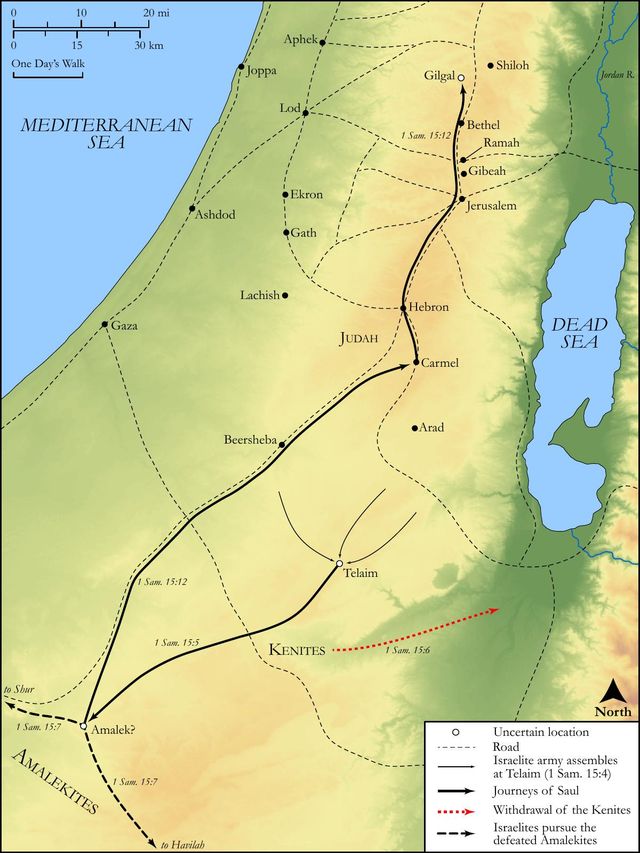
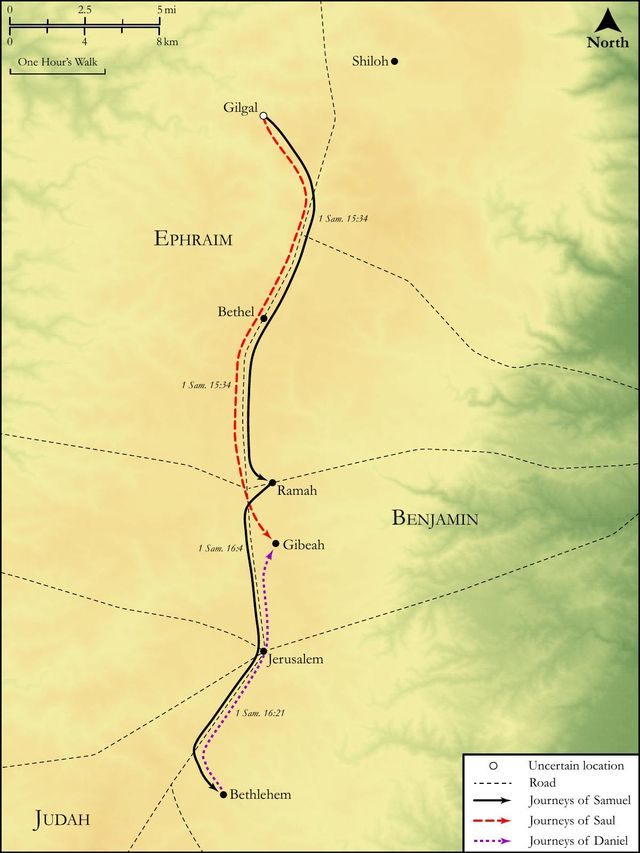
See on the biblical-era maps
Study this verse
Public-domain commentary
Matthew Henry
From his Commentary on the Whole Bible. Henry comments on passages, not single verses — this entry covers 1 Samuel 15:24–31. His two-level outline is real structure in the source text, so it is rendered as structure.
Saul is at length brought to put himself into the dress of the penitent; but it is too evident that he only acts the part of a penitent, and is not one indeed. Observe,
I.How poorly he expressed his repentance.
It was with much ado that he was made sensible of his fault, and not till he was threatened with being deposed. This touched him in a tender part. Then he began to relent, and not till then. When Samuel told him he was rejected from being king, then he said, I have sinned, Sa1 15:24. His confession was not free nor ingenuous, but extorted by the rack, and forced from him. We observe here several bad signs of the hypocrisy of his repentance, and that it came short even of Ahab's.
1.He made his application to Samuel only, and seemed most solicitous to stand right in his opinion and to gain his favour. He makes a little god of him, only to preserve his reputation with the people, because they all knew Samuel to be a prophet, and the man that had been the instrument of his preferment. Thinking it would please Samuel, and be a sort of bribe to him, he puts it into his confession: I have transgressed the commandment of the Lord and thy word; as if he had been in God's stead, Sa1 15:24. David, though convinced by the ministry of Nathan, yet, in his confession, has his eye to God alone, not to Nathan. Psa 51:4 Against thee only have I sinned. But Saul, ignorantly enough, confesses his sin as a transgression of Samuel's word; whereas his word was no other than a declaration of the commandment of the Lord. He also applies to Samuel for forgiveness (Sa1 15:25): I pray thee, pardon my sin; as if any could forgive sin but God only. Those wretchedly deceive themselves who, when they have fallen into scandalous sin, think it enough to make their peace with the church and their ministers, by the show and plausible profession of repentance, without taking care to make their peace with God by the sincerity of it. The most charitable construction we can put upon this of Saul is to suppose that he looked upon Samuel as a sort of mediator between him and God, and intended an address to God in his application to him. However, it was very weak.
2.He excused his fault even in the confession of it, and that is never the fashion of a true penitent (Sa1 15:24): I did it because I feared the people, and obeyed their voice. We have reason enough to think that it was purely his own doing and not the people's; however, if they were forward to do it, it is plain, by what we have read before, that he knew how to keep up his authority among them and did not stand in any awe of them. So that the excuse was false and frivolous; whatever he pretended, he did not really fear the people. But it is common for sinners, in excusing their faults, to plead the thoughts and workings of their own minds, because those are things which, how groundless soever, no man can disprove; but they forget that God searchest the heart.
3.All his care was to save his credit, and preserve his interest in the people, lest they should revolt from him, or at least despise him. Therefore he courts Samuel with so much earnestness (Sa1 15:25) to turn again with him, and assist in a public thanksgiving for the victory. Very importunate he was in this matter when he laid hold on the skirt of his mantle to detain him (Sa1 15:27), not that he cared for Samuel, but he feared that if Samuel forsook him the people would do so too. Many seem zealously affected to good ministers and good people only for the sake of their own interest and reputation, while in heart they hate them. But his expression was very gross when he said (Sa1 15:30), I have sinned, yet honour me, I pray thee, before my people. Is this the language of a penitent? No, but the contrary: "I have sinned, shame me now, for to me belongs shame, and no man can loathe me so much as I loathe myself." Yet how often do we meet with the copies of this hypocrisy of Saul! It is very common for those who are convicted of sin to show themselves very solicitous to be honoured before the people. Whereas he that has lost the honour of an innocent can pretend to no other than that of a penitent, and it is the honour of a penitent to take shame to himself.
II.How little he got by these thin shows of repentance. What point did he gain by them?
1.Samuel repeated the sentence passed upon him, so far was he from giving any hopes of the repeal of it, Sa1 15:26, the same with Sa1 15:23. He that covers his sins shall never prosper, Pro 28:13. Samuel refused to turn back with him, but turned about to go away, Sa1 15:27. As the thing appeared to him upon the first view, he thought it altogether unfit for him so far to countenance one whom God had rejected as to join with him in giving thanks to God for a victory which was made to serve rather Saul's covetousness than God's glory. Yet afterwards he did turn again with him (Sa1 15:31), upon further thoughts, and probably by divine direction, either to prevent a mutiny among the people or perhaps not to do honour to Saul (for, though Saul worshipped the Lord, Sa1 15:31, it is not said Samuel presided in that worship), but to do justice on Agag, Sa1 15:32.
2.He illustrated the sentence by a sign, which Saul himself, by his rudeness, gave occasion for. When Samuel was turning from him he tore his clothes to detain him (Sa1 15:27), so loth was he to part with the prophet; but Samuel put a construction upon this accident which none but a prophet could do. He made it to signify the rending of the kingdom from him (Sa1 15:28), and that, like this, was his own doing. "He hath rent it from thee, and given it to a neighbour better than thou," namely, to David, who afterwards, upon occasion, cut off the skirt of Saul's robe (Sa1 24:4), upon which Saul said (Sa1 24:20), I know that thou shalt surely be king, perhaps remembering this sign, the tearing of the skirt of Samuel's mantle.
3.He ratified it by a solemn declaration of its being irreversible (Sa1 15:29): The Strength of Israel will not lie. The Eternity or Victory of Israel, so some read it; the holy One, so the Arabic; the most noble One, so the Syriac; the triumphant King of Israel, so bishop Patrick. "He is determined to depose thee, and he will not change his purpose. He is not a man that should repent." Men are fickle and alter their minds, feeble and cannot effect their purposes; something happens which they could not foresee, by which their measures are broken. But with God it is not so. God has sometimes repented of the evil which he thought to have done, repentance was hidden from Saul, and therefore hidden from God's eyes.
Historical interpretation
Historical reception
1 surviving comment on this verse from the historical church.
Furthermore, the triumpher in Israel will not relent, etc. He who, he says, alone—indeed, all of Israel—by his grace made you triumph while fighting against Amalek, he will not spare you either, who are transgressing his word; for the more you received the power to conquer not by your own strength but from heaven, the less excusable you will be shown in preserving the anathema. Because as Moses says: The war against Amalek is the Lord's alone (Exod. XVII); and: I shall erase the memory of Amalek from under heaven (Ibid.). This same sentiment is to be understood in spiritual warfare, where we endanger ourselves the more by sparing our enemies, that is, by indulging in vices, owing to the greater grace of our Author which we daily receive for the remission and forgiveness of sins. We should fear that we ourselves, too complacent in our pursuit of heavenly vision, might deserve to hear along with Saul, Because the triumpher in Israel will not relent; that is, the one who has granted the gift of victory in many cases to incite you to thanksgiving and diligence in living, will also condemn you to severe examination by his court's decree in the end. Some believe that the saying, Furthermore, the triumpher in Israel will not relent, does not refer to the Lord, but to him of whom it was previously said, And he will give it to your neighbor, better than you; which namely means that since David took power of the kingdom, he would not spare either the house of Saul or foreign enemies ordered by the Lord to be slaughtered. This they interpret morally, that our neighbors who are better than us strive to extinguish the vices they notice in us with utmost effort, lest they themselves fall into the same pit of transgression into which they miserably observe others slipping. But what follows, And he will not be swayed by repentance, signifies the eternal and immutable judgment of the Lord that he has threatened. Furthermore, what is added, For he is not a man, that he should repent, clearly indicates that where it is said that God repented, it does not mean a changeable nature in the divine substance, where there is no change or shadow of turning, but a form of speech adapted to humans, tempered by human manner. Therefore, God does not repent of any of his covenants like a man, for his judgment on all things is as fixed as his presence is sure.
Continue studying 1 Samuel 15:29 across the web’s major study libraries — every link below opens this exact verse, chapter, or book on the destination site.
Read & Compare
 BibleGatewayThis verse in more than 200 translations and 70 languages.
 Bible.comThe YouVersion reader — hundreds of translations, reading plans, and highlights.
 ESV.orgCrossway's official English Standard Version reader.
 NET BibleThe NET translation with 60,000+ translators' notes on every rendering decision.
 STEP BibleTyndale House's free study tool — original text, vocabulary, and scholarly resources.
 BibliaLogos Bible Software's free web reader.
 USCCBThe New American Bible (Revised Edition) with the U.S. bishops' study notes.
Commentaries
 BibleHub CommentariesDozens of classic commentaries on this verse, gathered on one page.
 StudyLightMore than 100 commentary sets — the largest collection on the web.
 BibleRefPlain-English commentary on what this verse means, verse by verse.
 Enduring WordDavid Guzik's free commentary on this chapter, widely used by Bible teachers.
 Bible Study ToolsVerse commentary alongside Greek and Hebrew study aids.
Original Language & Research
- BibleHub InterlinearThe verse word by word — original language, transliteration, and English.
- BibleHub LexiconEvery word's original-language definition and Strong's entry.
 Blue Letter BibleDeep-study tools — Strong's numbers, concordance, and word studies.
 SefariaThe Hebrew text with Rashi and centuries of Jewish commentary.
Sermons, Hymns & Audio


TrulyRandomVerse is not affiliated with these sites and doesn’t control their content. They’re linked because they’re genuinely useful.
Summary
1 Samuel 15:29 delivers a profound declaration from the prophet Samuel to King Saul, spoken at the critical juncture when God had decisively rejected Saul's kingship due to his profound disobedience. This verse powerfully articulates the immutable nature of God, asserting that "the Strength of Israel" is utterly reliable, incapable of falsehood, and does not change His mind or regret His decrees in the way fallible humans do. It underscores the finality of divine judgment against rebellion and highlights the stark contrast between God's perfect steadfastness and humanity's fickle nature.
Context
ShowHideLiterary Context
This verse serves as the climactic pronouncement within a deeply tragic narrative detailing King Saul's irreversible downfall. The preceding verses of 1 Samuel 15 recount God's explicit command to Saul to utterly destroy the Amalekites, including all their livestock, as an act of divinely ordained judgment. Saul, however, disobeys by sparing King Agag and the choicest of the sheep and oxen, rationalizing his actions as an intention to offer sacrifices to the Lord. Samuel confronts Saul, denouncing his partial obedience as outright rebellion, equating it to the sin of witchcraft and idolatry, which incurs divine wrath, as stated in 1 Samuel 15:23. Saul's desperate attempts to justify himself and cling to his kingship are met with Samuel's unwavering declaration of God's irrevocable judgment: the kingdom would be torn from him. Amidst Saul's pleas and a final, symbolic tearing of Samuel's robe, the prophet delivers this powerful theological statement, emphasizing the unchangeable nature of the divine decree.
Historical & Cultural Context
The command to utterly destroy the Amalekites (known as cherem or "devotion to destruction") was a specific, divinely ordained act of judgment against a people who had historically opposed Israel from their exodus, as recorded in Exodus 17:8-16. Saul's failure to execute this command fully was not merely a tactical error but a direct act of rebellion against God's sovereign authority, demonstrating a greater concern for popular approval and personal gain than for divine obedience. Among the kings of the nations, a king's authority was often seen as derived from the gods, but in Israel, the king was explicitly God's vice-regent, bound by covenant and divine law. Samuel, as God's prophet, held the authority to declare God's will and judgment, even over the king. The concept of God "repenting" (Hebrew: nacham) when applied to the divine character, particularly in this context, does not imply regret or a change of mind due to error, as it would for a human. Instead, it refers to a change in God's dealing with humanity based on their actions, or a cessation of a specific judgment or intention, always consistent with His eternal character and purpose. Here, it emphasizes the finality of God's judgment against Saul, contrasting it with human fickleness.
Key Themes
ShowHideThe verse encapsulates several crucial theological and narrative themes. Foremost is the theme of God's Immutability, asserting that God's character, promises, and decrees are steadfast and unchangeable, providing a bedrock of certainty in a world of flux. This directly relates to Divine Reliability and Truthfulness, highlighting that "the Strength of Israel will not lie," meaning God's word is absolutely dependable and His pronouncements are true and final. There is a sharp Contrast Between God and Man, explicitly stating, "for he is not a man, that he should repent." This differentiates the perfect, sovereign, and unchanging God from fallible, inconsistent, and regretful humanity. While God may "relent" from a threatened judgment in response to human repentance (as seen in Jonah 3:10), this is a change in His action consistent with His justice and mercy, not a change in His inherent nature or eternal purpose. In Saul's case, the judgment was irrevocable. Finally, the verse powerfully underscores the Consequences of Disobedience, demonstrating that rebellion against God's explicit commands carries severe and unalterable repercussions, even for a divinely appointed king, affirming God's justice and sovereignty over His chosen leaders.
Exposition and Analysis
ShowHideKey Word Analysis
ShowHide(נֵצַח), this word properly refers to a goal, i.e., the bright object at a distance traveled towards; hence (figuratively), splendor, or (subjectively) truthfulness, or (objectively) confidence; but usually (adverbially), continually (i.e., to the most distant point of view); alway(-s), constantly, end, ([phrase] n-) ever(more), perpetual, strength, victory. When applied to God as "the Strength of Israel," it signifies not merely physical might but His enduring, eternal, and unassailable character. It speaks to God's steadfastness, His unwavering faithfulness to His covenant, and His ultimate triumph. It implies that God's nature is one of absolute permanence and reliability, the very foundation of Israel's existence and hope.
(שָׁקַר), a primitive root meaning to cheat, i.e., to be untrue (usually in words); fail, deal falsely, lie. In this context, it emphatically states that God is utterly incapable of falsehood. Unlike humans who might lie, break promises, or prove unreliable, God's word is always true, and His decrees are always fulfilled. This reinforces His absolute integrity and trustworthiness, contrasting sharply with Saul's deceptive partial obedience.
(נָחַם), a primitive root meaning properly, to sigh, i.e., breathe strongly; by implication, to be sorry, i.e., (in a favorable sense) to pity, console or (reflexively) rue; or (unfavorably) to avenge (oneself); comfort (self), ease (one's self), repent(-er,-ing, self). When used of God, particularly in contexts like this, it is an anthropomorphism—attributing a human characteristic to God to help human understanding. However, the verse immediately negates the human implication: "for he is not a man, that he should repent." This clarifies that God does not "repent" in the sense of regretting a mistake, changing His inherent character, or altering His eternal purpose due to new information or weakness. Instead, in this specific instance, it signifies the unalterable nature of His decree against Saul. God's judgments and promises are fixed and final, not subject to the wavering emotions or fallibility of humanity.
Verse Breakdown
ShowHide"And also the Strength of Israel"
This majestic title refers to God Himself, emphasizing His enduring power, faithfulness, and the unyielding nature of His character. It highlights that the divine being who has established and sustained Israel is the one whose word is now being declared, underscoring the authority and reliability of the pronouncement.
"will not lie nor repent"
This double negative affirmation powerfully asserts God's absolute truthfulness and immutability. He is incapable of speaking falsely or breaking His word. Furthermore, He does not change His mind in a way that implies regret, error, or inconsistency, especially concerning His declared judgments or purposes. This phrase sets God apart from all human fallibility and unreliability.
"for he [is] not a man, that he should repent"
This concluding clause serves as the theological explanation and justification for the preceding statement. It draws a sharp, definitive distinction between the divine and the human. Human beings are fallible, prone to error, regret, and changing their minds based on new circumstances or weaknesses. God, however, is transcendent, perfect, and sovereign; His knowledge is complete, His will is perfect, and His decrees are eternal. Therefore, His "repentance" (or lack thereof, in this case) is fundamentally different from human repentance, signifying the unchanging nature of His righteous judgment, which is not subject to reconsideration.
Literary Devices
ShowHideThe verse employs several potent Literary Devices to convey its profound theological truth. Anthropomorphism is evident in the use of human actions like "lie" and "repent" being applied to God, which helps human understanding of divine attributes. However, this is immediately followed by a strong Negation ("will not lie nor repent") and a clarifying Contrast ("for he is not a man, that he should repent"). This contrast is the most prominent device, sharply differentiating God's perfect, unchanging nature from the inherent fallibility and changeability of humanity. The repetition of the concept of "repent" further emphasizes the finality and irrevocability of God's decision regarding Saul. Furthermore, the title "the Strength of Israel" functions as a Metonymy or Epithet for God, powerfully encapsulating His enduring power, faithfulness, and reliability, which stands in stark opposition to Saul's demonstrated unreliability and lack of spiritual strength. The entire statement acts as a Divine Oracle, a direct, authoritative pronouncement from God through His prophet, carrying absolute weight and finality.
Theological and Thematic Connections
ShowHideThe declaration in 1 Samuel 15:29 is a cornerstone text for understanding God's immutability and absolute reliability. It assures us that God's character is consistent, His promises are unbreakable, and His purposes are unswerving. While the Bible sometimes speaks of God "relenting" or "repenting" (e.g., in response to human repentance, as in the case of Nineveh), these instances must be understood in light of His unchanging nature. They reflect a change in His dealings with humanity based on their actions, not a change in His inherent character or eternal will. In Saul's case, the judgment was a fixed consequence of persistent rebellion, illustrating that God's justice is as unwavering as His mercy. This verse provides immense comfort for those who trust in God's promises, knowing He cannot lie, and a solemn warning for those who disregard His commands.
Reflection and Application
ShowHideThe profound truth that "the Strength of Israel will not lie nor repent" offers both immense comfort and a serious challenge for believers today. In a world characterized by uncertainty, broken promises, and shifting values, the unchanging nature of God provides an unshakeable anchor for our faith. We can fully trust His word, His promises of salvation, forgiveness, and eternal life, knowing that He is utterly dependable. This should cultivate a deep sense of security and peace in our relationship with Him, freeing us from anxiety about God's faithfulness. Simultaneously, the verse serves as a powerful reminder of the seriousness of obedience and the consequences of rebellion. Just as Saul faced irreversible judgment for his partial obedience and self-serving actions, we are called to wholehearted submission to God's will. Our faith is not merely intellectual assent but is demonstrated through a life of active, sincere obedience, recognizing that God's standards are not arbitrary but flow from His perfect, righteous character. This understanding should lead us to greater reverence, humility, and a fervent desire to align our lives fully with His unchanging purposes, knowing that His decrees, whether of blessing or judgment, are final and true.
Questions for Reflection
ShowHideFAQ
ShowHideDoes God ever "repent" or "change His mind" in other parts of the Bible, and how does that reconcile with this verse?
ShowHideThis is a common and important question. The Hebrew word for "repent" (nacham) can indeed be used in other biblical contexts to describe God "relenting" or "changing His mind" (e.g., Jonah 3:10, Jeremiah 18:8). However, it's crucial to understand this through the lens of God's unchanging character, as affirmed in Malachi 3:6 and James 1:17. When God "relents," it does not imply regret over a mistake, a change in His inherent nature, or an alteration of His eternal purpose. Rather, it signifies a change in His dealings with humanity based on their response. For instance, if a people turn from their wickedness, God, in His consistent mercy and justice, may "relent" from a threatened judgment. In 1 Samuel 15:29, the context is God's irrevocable judgment on Saul for persistent rebellion, emphasizing that God's decree against Saul's kingship was final and not subject to reconsideration based on human pleading or manipulation. Here, "repent" signifies a change of purpose or decree that God, unlike fallible humans, does not experience, especially when His righteous judgment has been fully pronounced due to unrepentant sin.
Christ-Centered Fulfillment
ShowHideThe unchangeable nature of God, so powerfully declared in 1 Samuel 15:29, finds its ultimate and most glorious fulfillment in the person and work of Jesus Christ. He is the tangible manifestation of the "Strength of Israel" who "will not lie nor repent." God's eternal plan of salvation, conceived before the foundation of the world, is perfectly executed in Christ, demonstrating that God's promises are not subject to human failure or divine reconsideration. As 2 Corinthians 1:20 proclaims, "For all the promises of God find their Yes in him." Jesus Himself is described as "the same yesterday and today and forever" (Hebrews 13:8), embodying the immutability of God's character in human form. Unlike Saul, who failed in obedience and faced rejection, Christ perfectly obeyed the Father, even to the point of death on a cross (Philippians 2:8), thus establishing an unshakeable foundation for our redemption. His sacrifice is the unchangeable basis of our salvation, a covenant established not with human frailty but with divine faithfulness, securing eternal redemption for all who believe (Hebrews 9:12). Thus, 1 Samuel 15:29, while a solemn warning to Saul, ultimately points to the steadfast love and unwavering faithfulness of God, perfectly revealed and secured in His Son, Jesus Christ, who is the faithful and true witness of God's unchanging nature (Revelation 3:14).