


1 Samuel 28:20
Bible text: King James Version (1769 Blayney text) · Public domain
Bible text: King James Version with Strong's numbers · Public domain
Bible text: Berean Standard Bible · Public domain
Bible text: American Standard Version (1901) · Public domain
Bible text: World English Bible, Messianic edition · Public domain
Bible text: Geneva Bible (1599) · Public domain
Bible text: Young's Literal Translation · Public domain
- וַיְמַהֵרvay·ma·Herand he made hasteH4116Conj-w ¦ V-Piel-ConsecImperf-3msVerb Piel Consecutive Imperfect 3rd Singular Masculineוַandיְמַהֵרhe made haste
- שָׁאוּלsha·'UlSaulH7586N-proper-mNoun Proper Masculine
- וַיִּפֹּלvai·yi·Poland he fellH5307Conj-w ¦ V-Qal-ConsecImperf-3msVerb Qal Consecutive Imperfect 3rd Singular Masculineוַandיִּפֹּלhe fell
- מְלֹאme·lo'[the] fullness ofH4393N-mscNoun Singular Masculine Construct
- קוֹמָתוֹko·ma·Tohis statureH6967N-fsc ¦ 3msNoun Singular Feminine Constructקוֹמָתstatureוֹhis
- אַרְצָה'Ar·tzah[the] ground towardsH776N-fs ¦ SfxNoun Singular Feminine Absoluteאַרְצָ[the] groundהtowards
- וַיִּרָאvai·yi·Ra'and he was afraidH3372Conj-w ¦ V-Qal-ConsecImperf-3msVerb Qal Consecutive Imperfect 3rd Singular Masculineוַandיִּרָאhe was afraid
- מְאֹדme·'OdexceedinglyH3966Adj-msAdjective Numerical Singular Masculine Absolute
- מִדִּבְרֵיmi·div·Reifrom [the] words ofH1697Prep-m ¦ N-mpcNoun Plural Masculine Constructמִfromדִּבְרֵי[the] words of
- שְׁמוּאֵלshe·mu·'ElSamuelH8050N-proper-mNoun Proper Masculine
- גַּםgamalsoH1571AdvAdverb
- כֹּחַko·achstrengthH3581N-msNoun Singular Masculine Absolute
- לֹאlo'notH3808NegParticle Negative
- הָיָהHa·yahit wasH1961V-Qal-Perf-3msVerb Qal Perfect 3rd Singular Masculine
- בוֹvoin <the> himPrep-b ¦ 3msSuffix Personal 3rd Singular Masculineבin <the>וֹhim
- כִּיkiforH3588PrtParticle Conditional
- לֹאlo'notH3808NegParticle Negative
- אָכַל'a·Khalhe had eatenH398V-Qal-Perf-3msVerb Qal Perfect 3rd Singular Masculine
- לֶחֶםLe·chemfoodH3899N-msNoun Singular Masculine Absolute
- כָּלkolallH3605N-mscNoun Singular Masculine Construct
- הַיּוֹםhai·Yomthe dayH3117Art ¦ N-msNoun Singular Masculine Absoluteהַtheיּוֹםday
- וְכָלve·kholand allH3605Conj-w ¦ N-mscNoun Singular Masculine Constructוְandכָלall
- הַלָּיְלָהha·La·ye·lahthe nightH3915Art ¦ N-msNoun Singular Masculine Absoluteהַtheלָּיְלָהnight
English is a literal word-by-word gloss of the Hebrew, not the KJV's wording. Why?
This is the original text the KJV's translators worked from — each Hebrew word with its own literal English meaning in this verse, prepared by scholars at Tyndale House, Cambridge. The KJV translates whole sentences, not word by word, so its wording differs: one Hebrew word can become several English words, and the KJV may choose “the LORD” where the gloss reads “Yahweh”. Both are faithful — they answer different questions. For the KJV's own rendering, switch to the KJV text.
Details
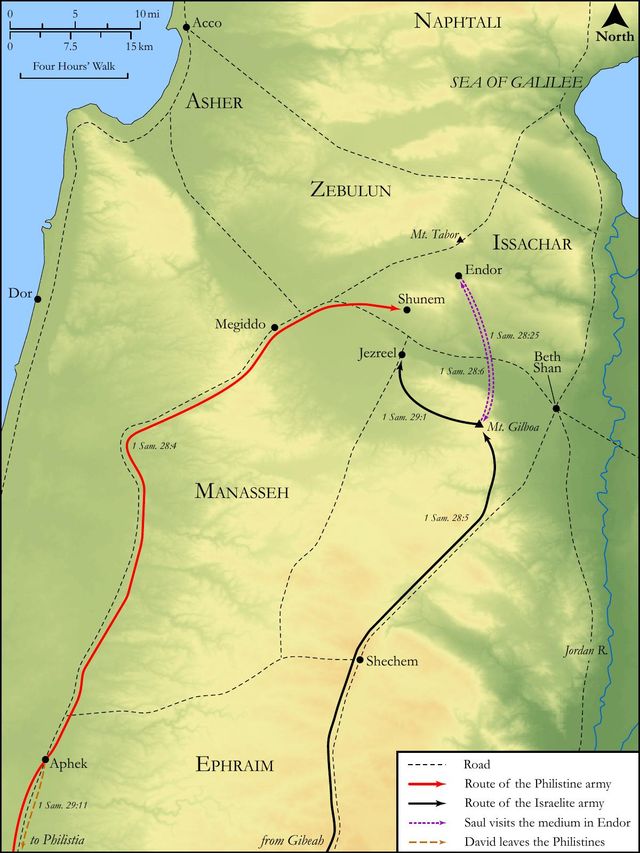
See on the biblical-era map
Study this verse
Public-domain commentary
Matthew Henry
From his Commentary on the Whole Bible. Henry comments on passages, not single verses — this entry covers 1 Samuel 28:20–25. His two-level outline is real structure in the source text, so it is rendered as structure.
We are here told how Saul received this terrible message from the ghost he consulted. He desired to be told what he should do (Sa1 28:15), but was only told what he had not done and what should be done to him. Those that expect any good counsel or comfort otherwise than from God, and in the way of his institutions, will be as wretchedly disappointed as Saul here was. Observe,
I.How he sunk under the load, Sa1 28:20.
He was indeed unfit to bear it, having eaten nothing all the day before, nor that night. He came fasting from the camp, and continued fasting; not for want of food, but for want of an appetite. The fear he was in of the power of the Philistines (Sa1 28:5) took away his appetite, or perhaps the struggle he had with his own conscience, after he had entertained the thought of consulting the witch, made him to nauseate even his necessary food, though ever so dainty. This made him an easy prey to this fresh terror that now came upon him like an armed man. He fell all along on the earth, as if the archers of the Philistines had already hit him, and there was no strength in him to bear up against these heavy tidings. Now he had enough of consulting witches, and found them miserable comforters. When God in his word speaks terror to sinners he opens to them, at the same time, a door of hope if they repent: but those that apply to the gates of hell for succour must there expect darkness without any glimpse of light.
II.With what difficulty he was persuaded to take so much relief as was necessary to carry him back to his post in the camp.
The witch, it should seem, had left Saul alone with the spectre, to have his talk with him by himself; but perhaps hearing him fall and groan, and perceiving him to be in great agony, she came to him (Sa1 28:21), and was very importunate with him to take some refreshment, that he might be able to get clear from her house, fearing that if he should be ill, especially if he should die there, she should be punished for it as a traitor, though she had escaped punishment as a witch. This, it is probable, rather than any sentiment of kindness, made her solicitous to help him. But what a deplorable condition had he brought himself to when he needed so wretched a comforter!
1.She showed herself very importunate with him to take some refreshment. She pleaded (Sa1 28:21) that she had obeyed his voice to the endangering of her life, and why therefore should not he hearken to her voice for the relieving of his life? Sa1 28:22. She had a fat calf at hand (and the word signifies one that was made use of in treading out the corn, and therefore could the worse be spared); this she prepared for his entertainment, Sa1 28:24. Josephus is large in applauding the extraordinary courtesy and liberality of this woman, and recommending what she did as an example of compassion to the distressed, and readiness to communicate for their relief, though we have no prospect of being recompensed.
2.He showed himself very averse to it: He refused, and said, I will not eat (Sa1 28:23), choosing rather to die obscurely by famine than honourably by the sword. Had he laboured only under a defect of animal spirits, food might have helped him; but, alas! his case was out of the reach of such succours. What are dainty meats to a wounded conscience? As vinegar upon nitre, so is he that sings songs to a heavy heart, so disagreeable and unwelcome.
3.The woman at length, with the help of his servants, overpersuaded him, against his inclination and resolution, to take some refreshment. Not by force, but by friendly advice, they compelled him (Sa1 28:23), and of no other than such a rational and courteous compulsion are we to understand that in the parable, Compel them to come in, Luk 14:23. How forcible are right words, when men are pressed by them to that which is for their own interest! Job 6:25. Saul was somewhat revived with this entertainment; so that he and his servants, when they had eaten, rose up and went away before it was light (Sa1 28:25), that they might hasten to their business and that they might not be seen to come out of such a scandalous house. Josephus here much admires the bravery and magnanimity of Saul, that, though he was assured he should lose both his life and honour, yet he would not desert his army, but resolutely returned to the camp, and stood ready for an engagement. I wonder more at the hardness of his heart, that he did not again apply to God by repentance and prayer, in hopes yet to obtain at least a reprieve; but he desperately ran headlong upon his own ruin. Perhaps, indeed, now that rage and envy possessed him to the uttermost, he was the better reconciled to his hard fate, being told that his sons, and Jonathan among the rest, whom he hated for his affection to David, should die with him. If he must fall, he cared not what desolations of his family and kingdom accompanied his fall, hoping it would be the worse for his successor. Emou thanontos gaia michthetō puri - I care not if, when I am dead, the world should be set on fire. He begged not, as David, "Let thy hand be against me, but not against thy people."
Historical interpretation
Historical reception
1 surviving comment on this verse from the historical church.
And immediately Saul fell full length on the ground, etc. Reading the words of the prophets, the people of the Jews celebrating vain sacrifices, indeed the wretched suffer terror, but they do not have the strength of faith by which they may be blessed, because the grace of evangelical preaching has been shining around the world for such a long time, and they did not know how to eat the living bread that came down from heaven.
Continue studying 1 Samuel 28:20 across the web’s major study libraries — every link below opens this exact verse, chapter, or book on the destination site.
Read & Compare
 BibleGatewayThis verse in more than 200 translations and 70 languages.
 Bible.comThe YouVersion reader — hundreds of translations, reading plans, and highlights.
 ESV.orgCrossway's official English Standard Version reader.
 NET BibleThe NET translation with 60,000+ translators' notes on every rendering decision.
 STEP BibleTyndale House's free study tool — original text, vocabulary, and scholarly resources.
 BibliaLogos Bible Software's free web reader.
 USCCBThe New American Bible (Revised Edition) with the U.S. bishops' study notes.
Commentaries
 BibleHub CommentariesDozens of classic commentaries on this verse, gathered on one page.
 StudyLightMore than 100 commentary sets — the largest collection on the web.
 BibleRefPlain-English commentary on what this verse means, verse by verse.
 Enduring WordDavid Guzik's free commentary on this chapter, widely used by Bible teachers.
 Bible Study ToolsVerse commentary alongside Greek and Hebrew study aids.
Original Language & Research
- BibleHub InterlinearThe verse word by word — original language, transliteration, and English.
- BibleHub LexiconEvery word's original-language definition and Strong's entry.
 Blue Letter BibleDeep-study tools — Strong's numbers, concordance, and word studies.
 SefariaThe Hebrew text with Rashi and centuries of Jewish commentary.
Sermons, Hymns & Audio


TrulyRandomVerse is not affiliated with these sites and doesn’t control their content. They’re linked because they’re genuinely useful.
Summary
1 Samuel 28:20 powerfully captures King Saul's immediate and devastating physical and emotional collapse upon receiving the dire prophecy from the spirit of Samuel. Having desperately sought forbidden counsel from a medium after God had ceased to answer him, Saul is confronted with the terrifying reality of God's final judgment: the loss of his kingdom, Israel's defeat, and his own impending death alongside his sons in battle. This verse vividly portrays the profound despair, existential fear, and utter physical and spiritual weakness that gripped the king, exacerbated by his prolonged fasting, as the crushing weight of divine abandonment and certain doom settled upon him.
Context
ShowHideLiterary Context
This verse serves as the dramatic climax of a deeply tragic narrative arc within 1 Samuel 28. Immediately preceding it, Saul, in his ultimate desperation, sought counsel from a medium at Endor, a practice explicitly forbidden by God's law, as detailed in Deuteronomy 18:10-12. Despite his earlier efforts to purge such practices from the land, Saul's spiritual abandonment by God—who no longer answered him through dreams, Urim, or prophets (1 Samuel 28:6)—drove him to this illicit act. The spirit of Samuel, unexpectedly appearing by divine allowance, delivered a crushing prophecy detailing Saul's imminent defeat and death, along with that of his sons and the Israelite army (1 Samuel 28:19). Verse 20 describes Saul's visceral, immediate reaction to this pronouncement, marking the final, irreversible descent of the first king of Israel and setting the stage for the tragic events of 1 Samuel 31.
Historical & Cultural Context
The setting is the eve of a decisive battle against the Philistines, Israel's formidable and long-standing enemies. The Philistines possessed superior military technology and organization, posing an existential threat to Israel's nascent kingdom. Saul's reign had been characterized by ongoing conflict with them, but his persistent disobedience had led to God's withdrawal of support, leaving him vulnerable and spiritually isolated. Culturally, the consultation of mediums and necromancy, though strictly condemned by the Mosaic Law, was a common practice among the nations round about, reflecting attempts to gain secret knowledge or manipulate spiritual forces. For an Israelite king to resort to such a practice underscored the depth of his despair and his complete departure from reliance on Yahweh. Furthermore, the physical act of falling prostrate on the ground was a common expression of profound submission, fear, or overwhelming grief throughout Scripture, as when Daniel, afraid, fell upon his face, often indicating a complete loss of control or resignation to fate. Saul's extended fasting, mentioned in the latter part of the verse, was a common practice in times of great distress or mourning, further contributing to his physical debilitation.
Key Themes
ShowHideThis verse powerfully underscores several major themes present throughout the books of Samuel. Firstly, it highlights the consequences of persistent disobedience and rebellion against God's explicit commands. Saul's initial rejection of God's word (1 Samuel 13 and 1 Samuel 15) led to God's withdrawal of His Spirit and ultimately, the tearing away of the kingdom from him (1 Samuel 15:23). Secondly, it emphasizes the terrifying reality of divine judgment. The prophecy delivered by Samuel's spirit is not merely a prediction but a pronouncement of God's just wrath, leading to profound fear and despair. Thirdly, the verse illustrates the interconnectedness of physical and spiritual well-being, as Saul's physical weakness amplifies his spiritual and emotional collapse. Finally, it serves as a stark reminder of God's sovereignty over kings and kingdoms, demonstrating that even a king chosen by God can be utterly cast down when he rejects the divine will and seeks counsel outside of His divine parameters.
Exposition and Analysis
ShowHideKey Word Analysis
ShowHideA primitive root meaning "to fall" in a great variety of applications. Here, it signifies a sudden, uncontrolled, and complete physical collapse. It implies not just a loss of balance but a profound surrender to an overwhelming force, indicative of utter defeat and the shattering of one's spirit. This "fall" is both literal and symbolic, representing the complete downfall of Saul's reign and his personal integrity.
The verb yârêʼ (H3372) means "to fear," "to revere," or "to be afraid." The intensifying adverb mᵉʼôd (H3966) means "very much," "exceedingly," or "greatly." Together, "sore afraid" describes an extreme, profound, and overwhelming terror. This was not mere apprehension but an existential dread that paralyzed Saul, born of the realization that God's judgment was sealed and imminent, leaving no room for hope or escape. It speaks to a fear of consequences, not a reverential fear of God.
The noun kôach (H3581) refers to vigor, force, capacity, or strength. The phrase "no strength in him" signifies a complete physical, mental, and spiritual debilitation. While directly linked to his lack of food, it also serves as a powerful metaphor for his spiritual powerlessness and the complete withdrawal of God's sustaining hand from his life and reign, leaving him utterly vulnerable and without recourse.
Verse Breakdown
ShowHide"Then Saul fell straightway all along on the earth"
This clause describes the immediate and dramatic physical reaction of King Saul. The Hebrew conveys a sense of a sudden, uncontrolled, and complete prostration, falling flat on his face or back, literally "the fullness of his height" upon the ground. This physical collapse is a powerful visual representation of his utter defeat and the shattering of his spirit. It signifies not just a loss of physical balance but a complete surrender to the overwhelming weight of the prophecy he had just heard, marking the end of his self-reliance and kingly dignity.
"and was sore afraid, because of the words of Samuel"
This part identifies the primary cause of Saul's collapse: the terrifying message delivered by Samuel's spirit. The fear described is not ordinary anxiety but an intense, profound terror, a visceral reaction to the pronouncement of divine judgment and impending doom. It highlights the direct, devastating impact of God's unalterable word, even when delivered through unconventional means. Saul's fear is rooted in the realization that his fate is sealed, and there is no escape from the consequences of his persistent rebellion.
"and there was no strength in him; for he had eaten no bread all the day, nor all the night."
This final clause provides both a physical explanation and a profound symbolic layer to Saul's weakness. His prolonged fasting, likely due to the intense stress and anxiety leading up to the battle and his desperate consultation, had left him physically depleted. This physical exhaustion exacerbated his mental and emotional breakdown. Symbolically, his lack of physical strength mirrors his spiritual weakness and the complete withdrawal of God's sustaining power from his life, leaving him utterly vulnerable and without recourse. His physical state is a mirror of his spiritual destitution.
Literary Devices
ShowHideThe verse employs several potent literary devices to convey the depth of Saul's despair and the finality of his downfall. Hyperbole is evident in the phrase "fell straightway all along on the earth" and the declaration "there was no strength in him," emphasizing the absolute and total nature of his collapse, extending beyond mere physical weakness. This extreme description underscores the overwhelming impact of Samuel's words. Symbolism is profoundly at play, as Saul's physical prostration and lack of strength symbolize his spiritual defeat, the crumbling of his kingdom, and his complete abandonment by God. His physical state mirrors his internal, spiritual reality. The verse also utilizes pathos, evoking a sense of pity or sadness for Saul, despite his disobedience, as he faces the horrifying and inescapable consequences of his choices. Furthermore, the entire scene acts as powerful foreshadowing, directly predicting and setting the stage for the tragic events of the next day, when Saul and his sons would indeed die in battle, fulfilling Samuel's grim prophecy.
Theological and Thematic Connections
ShowHide1 Samuel 28:20 stands as a stark theological declaration concerning the dire consequences of persistent rebellion against divine authority and the terrifying reality of God's unyielding judgment. It illustrates that spiritual separation from God leads to profound despair and a complete loss of inner strength, regardless of one's earthly position or power. Saul's fear is not merely of physical death, but of a death that signifies God's final and irrevocable abandonment and the complete unraveling of his life and legacy. This verse serves as a powerful reminder that God's word, whether of blessing or judgment, is utterly reliable and will inevitably come to pass. It underscores the sanctity of God's commands regarding forbidden practices like necromancy, showing that seeking counsel outside of God's revealed will only leads to deeper darkness, intensified despair, and ultimately, destruction.
Reflection and Application
ShowHideSaul's dramatic collapse in 1 Samuel 28:20 offers a sobering reflection on the human condition when persistently separated from God. It reminds us that ongoing disobedience and a refusal to genuinely repent can lead to a state of profound spiritual and emotional desolation, where even physical strength gives way. Saul's desperate turn to forbidden practices, rather than humble repentance and seeking God through legitimate means, only hastened his downfall and intensified his despair. This narrative challenges us to examine our own lives: when faced with crises, God's apparent silence, or overwhelming challenges, do we turn to illicit or ungodly solutions, or do we humbly seek Him through prayer, His revealed Word, and the wise counsel of His people? The verse also highlights the interconnectedness of our physical and spiritual well-being; neglecting one can profoundly impact the other. Ultimately, it serves as a powerful cautionary tale about the devastating consequences of rejecting God's authority and the profound peace that is lost when one lives in defiance of His will, choosing self-reliance or forbidden paths over divine trust.
Questions for Reflection
ShowHideFAQ
ShowHideWhy did Samuel appear if consulting mediums was forbidden by God?
ShowHideThe appearance of Samuel in 1 Samuel 28 is a complex and debated theological point. While the medium was engaged in a practice strictly forbidden by God's law, the biblical text strongly implies that Samuel's appearance was not a result of her power or manipulation, but rather a direct, sovereign, and unexpected act of God. It was a divine intervention to deliver a final, authoritative word of judgment to Saul, confirming his rejection and impending doom. God, in His absolute sovereignty, can use even illicit contexts to accomplish His purposes, though He never condones the sin itself. This was not an endorsement of necromancy, but a dramatic demonstration of God's control over life and death, and His unwavering commitment to His word, even when it is a word of severe judgment.
What does Saul's physical collapse and lack of strength reveal about his state?
ShowHideSaul's physical collapse and profound lack of strength reveal the deepest depths of his despair, terror, and spiritual desolation. While his prolonged fasting, likely due to intense anxiety and distress, certainly contributed to his physical debilitation, his physical state is also a powerful metaphor for his spiritual condition. He was utterly broken, not just physically exhausted, but spiritually bankrupt and devoid of divine favor. The absence of strength signifies the complete withdrawal of God's sustaining presence and empowering Spirit, leaving Saul exposed and helpless before the terrifying reality of divine judgment. It underscores the interconnectedness of body, soul, and spirit, showing how extreme spiritual and emotional distress can manifest in severe physical weakness and a complete loss of vitality.
Is this passage a warning against seeking forbidden counsel today?
ShowHideAbsolutely. This passage serves as a powerful and enduring warning against seeking counsel or guidance through means explicitly forbidden by God. Just as necromancy was an abomination in ancient Israel (Deuteronomy 18:10-12), contemporary practices such as astrology, divination, spiritism, certain forms of New Age mysticism, or any attempt to gain knowledge or power outside of God's revealed will are equally condemned. Saul's experience demonstrates that such pursuits, often born of desperation and a lack of trust in God, lead not to peace or a solution, but to deeper despair, spiritual danger, and ultimately, judgment. Believers are called to seek God's wisdom and guidance through His Word (Psalm 119:105), prayer (Philippians 4:6-7), and the guidance of the Holy Spirit and the Christian community.
Christ-Centered Fulfillment
ShowHide1 Samuel 28:20, with its depiction of Saul's utter collapse under the crushing weight of divine judgment and the devastating consequences of sin, powerfully foreshadows the ultimate human condition apart from Christ, while simultaneously highlighting the profound contrast with the redemption offered in Him. Saul's "sore afraid" state and "no strength" perfectly illustrate the terror and helplessness of humanity facing God's righteous wrath for sin, a wrath that Jesus willingly bore on the cross. Unlike Saul, who was abandoned by God due to his persistent rebellion and self-will, Jesus, though perfectly obedient, experienced ultimate abandonment on the cross, crying out, "My God, my God, why hast thou forsaken me?" Yet, in His abandonment, He secured our eternal acceptance and reconciliation with God. Saul's earthly kingdom was torn from him, leading to his demise; Christ's spiritual kingdom is eternal, established through His decisive victory over sin and death, offering true strength, peace, and an unshakable hope to all who believe. Where Saul's desperation led him to forbidden practices and deeper despair, Christ's perfect obedience and sacrificial death provide the only legitimate and righteous access to God, becoming our Great High Priest and the Lamb of God who takes away the sin of the world. His physical suffering and death were not a sign of His weakness or God's judgment upon Him for His own sin, but the means by which He conquered sin and death, offering us the strength to stand in the face of our own spiritual battles and the promise of eternal life, rather than despair and judgment.